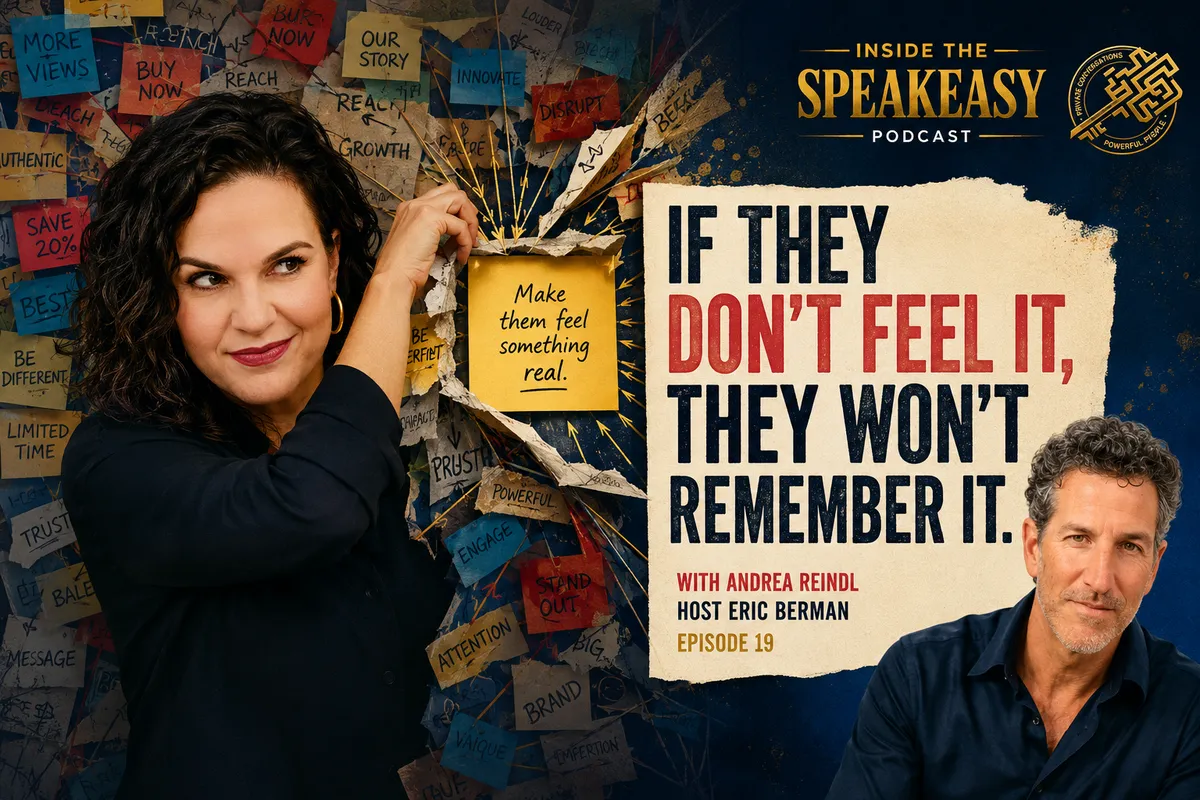
Andrea Reindl, a Calgary-based branding and marketing entrepreneur who spent years helping authors reach the New York Times bestseller list, believes branding is far simpler than most people make it. In this conversation with host Eric Berman, Andrea traces her street-smart MBA from a family-run motel and campground to selling custom-fit bras at 16 and investing in real estate in her twenties. She shares what she learned behind the scenes with publisher Ray Bard on The ONE Thing, why a book may be the hardest product you will ever sell, and how the neuroscience of memory shapes a brand people actually remember. She also walks through a sticky-note exercise for finding your top organizing idea, explains why clear brand guides matter even more in the age of AI, and makes the case that trust is becoming the currency of the future.
In this episode, you'll discover:
- The two questions Andrea says all of branding comes down to: how you make people feel and what you want them to remember
- Why laughing, crying, and getting angry are the three easiest ways to trigger the adrenaline that turns a message into a memory
- Andrea's step-by-step sticky-note brain dump for finding the one idea people must know before anything else about your brand makes sense
- What Ray Bard and The ONE Thing taught Andrea about building a business model around a book and selling it in bulk
- Why Andrea believes clear brand guides, original content, and good teaching let real subject matter experts extend their reach with AI
Episode Summary
Andrea Reindl says she has a street-smart MBA. She grew up in a small Alberta town, where her parents owned a motel, a restaurant, and a campground, and she was expected to contribute to the family business from a young age. At 16, at her mom's suggestion, she started selling custom-fit bras, a business she ran for about three years through home parties, info sessions at gyms, and even an appearance on the local TV station. She later sold jewelry, read Rich Dad Poor Dad and began investing in real estate at 24, and still owns rental properties today.
In 2009, at 29, Andrea started working with authors in the publishing space, helping promote their books to the New York Times bestseller list. Seeing that work from behind the scenes, she realized she loved branding, marketing, and communications. When a copywriter who had fallen behind asked her to take a stab at a sales page, he called back a couple of hours later to ask whether she had copywriting training. That led her into copywriting, marketing, and branding for authors, helping them get clear on their big idea, which is still the work she loves most.
Andrea explains that a book is not really a $25 or $35 product. Readers are giving it eight to 10 hours of their life and weighing it against the unread books already on their shelf, so authors are selling trust, authenticity, connection, and time. The bestselling authors who were easiest to work with did two things well: they had an audience they could mobilize, and they took the time to clarify and brand their idea. From publisher Ray Bard, who published The ONE Thing, she learned to think about how a book could be sold in bulk and what business model sits behind it, which for The ONE Thing grew to include facilitators, journals, and relationship seminars.
Andrea then connects branding to neuroscience. Because neurons that fire together wire together, it is easier to attach a new idea to something an audience already knows than to explain it from scratch. For her, branding comes down to two things: how you want people to feel every time they interact with your company, and what you want them to remember. Getting people to laugh, cry, or get angry releases a little adrenaline, and adrenaline creates memory. She adds that the logo is almost an afterthought; when the branding is right, the logo becomes obvious, much like a baby who seems to name itself.
For anyone working on their own messaging, Andrea shares a simple exercise. Brain dump everything you want people to understand, feel, or know onto individual sticky notes, cluster them into three to five piles, then place the one idea people must know first at the top of the wall and nest two to five ideas beneath it. Using Eric as an example, she says he is known for connection and community, and that his high follow-through only makes sense once people understand he is connected. Eric notes how often websites, teams, and platforms say different things, and Andrea traces that inconsistency to a lack of clear organizing principles.
On AI, Andrea admits she did not jump on generative tools right away, but now sees them as a huge opportunity for experienced subject matter experts. Long, clear brand guides can train these tools, but only if people are crystal clear about who they are, because the tools do not think. An expert who creates one original piece of content a week can use workflows to extend their reach without a large team. She believes teaching has been decentralized, pointing to her son, who learned physics on YouTube after a poor teacher. She closes by saying trust is the currency of the future, and that brands consistent online and in person will win it.
Big Ideas Discussed
Branding Comes Down to Feel and Remember
Andrea says people in branding like to make it complicated, partly because complexity lets them charge more. In her view, it really comes down to two questions: how do you want people to feel every single time they interact with your company, and what do you want them to remember about it? Everything else, including the logo, follows from those answers.
The mechanism is emotional. Andrea explains that laughing, crying, and getting angry are the three easiest ways to get people to release a little adrenaline, and adrenaline creates memory. She points to how people who were old enough remember exactly where they were on September 11, 2001, and to headlines that make readers laugh or so angry they open the email just to argue with it. For entrepreneurs, the practical takeaway is to decide deliberately which feeling each touch point should create and which one or two words customers should walk away with.
Attach Your Idea to Something People Already Know
Drawing on what she has learned about neuroscience, Andrea notes that neurons that fire together wire together. It is easier to take something your audience already understands and attach your idea to it than to create a brand-new idea and try to explain it. She describes it like duct tape wrapped around wires: confirm what people already know, place your idea beside it, and they are more likely to remember you.
She uses The ONE Thing as an example. At its core it is a productivity book, but it is framed around something everyone already accepts, that you can only do one thing at a time. That simple big idea gave the brand room to nest corporate training, facilitators, journals, and relationship seminars underneath it. Eric adds that this approach makes a message feel easy to the recipient. For experts, the lesson is that a familiar frame can make an original methodology far easier to grasp and to share.
Find the One Idea That Goes at the Top of the Wall
Andrea's brand clarity exercise starts with sticky notes, a pen, and a blank wall. Write every individual thing you want people to understand, feel, or know about you on its own note and stick them up in random order. Then cluster the notes that belong together, which usually produces three to five piles. Finally, choose the one idea someone must know to understand everything else, put it at the top, and nest two to five supporting ideas underneath; her secret sauce is getting people down to two.
The hard part is that the top idea is not always what you expect. Andrea says people often place something at the top and realize it is not what they are known for, or not what they want to be known for. Most subject matter experts skip this step and plaster random ideas across their messaging, which confuses people, because no one cares until you make it relevant to them. Eric pairs the exercise with a simple audit: interview someone about their business, then ask whether their website actually says the same thing.
Clarity Is What Makes AI Useful
Andrea does not fear AI, noting that spreadsheets and calculators have long done similar work, but she was slow to adopt generative tools. Over the last year and a half she has come to see them as a huge opportunity for people with 10 to 15 years in the trenches of their craft. Her team creates long, clear brand guides that act as a manual for how a company communicates, and those guides can train AI tools. The catch, she says, is that the tool does not think, so people must be clear about who they are, the impact they want, and their position.
Eric connects this to what Brian Tracy calls the law of expediency: the temptation to lean on AI for speed while skipping the fundamentals. Andrea's model keeps the human at the center. An expert who records one original, thought-provoking piece of content each week can use workflows to republish it widely without eight editors and 10 graphic designers. She believes AI, used well, can transfer knowledge from older generations to younger ones, and that the people who learn to teach well on camera stand to become some of the best-paid people in the world.
Questions We Answer in This Episode
What does Andrea Reindl say branding really comes down to?
Andrea Reindl says branding comes down to two things: how you want people to feel every time they interact with your company, and what you want them to remember about it. She believes people in branding often make it complicated so they can charge more, and that the logo is almost an afterthought once the branding is right.
Why do laughing, crying, and getting angry make a brand memorable?
Andrea Reindl explains that laughing, crying, and getting angry are the three easiest ways to get people to release a little adrenaline, and adrenaline creates memory. She compares it to how people remember where they were on September 11, 2001, and to headlines that make readers so angry they open the email to argue.
What is Andrea Reindl's sticky-note exercise for brand clarity?
Andrea Reindl has people brain dump everything they want others to understand, feel, or know onto individual sticky notes on a blank wall. They then cluster the notes into three to five piles, place the one idea people must know first at the top, and nest two to five supporting ideas underneath, ideally narrowing it down to two.
Why does Andrea Reindl call books the hardest thing to sell?
Andrea Reindl says a book is not really a $25 or $35 product, because readers are committing eight to 10 hours of their life and comparing it against unread books on their shelf. Authors are really selling trust, authenticity, connection, and time, which is why she believes books are harder to sell than higher-priced offers.
What did Andrea Reindl learn from publisher Ray Bard?
Working behind the scenes with Ray Bard, who published The ONE Thing, Andrea Reindl learned to think about how a book could be sold in bulk and what business model sits behind it. She says The ONE Thing took time to clarify its big idea, which let it grow into facilitators, journals, corporate training, and relationship seminars.
How does Andrea Reindl think experts should use AI for their brand?
Andrea Reindl sees AI as a tool for organizing ideas, not a thinker, so experts must first be crystal clear about who they are and what they stand for. Her team creates long, clear brand guides that can train AI tools, and she encourages experts to create original content weekly and use workflows to extend its reach.
Why does Andrea Reindl say trust is the currency of the future?
Andrea Reindl believes people will increasingly trust what they know and who they have met in person, and that we are in a trust recession right now. If who you are online matches who you are in person, people feel relaxed around you. She says being clear on your brand is what makes authenticity obvious.
Full Episode Transcript
Read the Full Episode Transcript
Cold Open: What You Are Really Selling When You Sell a Book
Andrea Reindl: Because when you're selling a book, it isn't really the $25 or the $35 for the book that you're selling. What you're selling is that people care enough to read the book and that's like eight to 10 hours of their life. Or they're comparing against all the books they haven't read sitting on their shelf and do they really need another one? And so you're not really selling. It's not a $25 product. In fact, in books are probably the hardest thing ever, ever that you'll sell.
Eric Berman: Welcome to the Speakeasy Podcast where the real conversations happen. Behind closed doors with the boldest entrepreneurs, creators and growth minds in the game. No fluff, no filters. Just the raw strategies, personal stories and mental models that move the needle. I'm Eric Berman. Now let's get into it.
Welcome Andrea Reindl and a Reunion Years in the Making
Eric Berman: In today's episode of Inside the Speakeasy, I'm so excited to bring with us Andrea Rende from Calgary. And you're going to learn some of the latest and greatest tips on really branding. And Andrea's got such a killer way of breaking it down to two very simple small steps. And you're going to walk away from watching this and saying I got it. And it's going to totally change the way you're thinking about your own brand and messaging. Plus, she's going to share some of her experiences with anybody who's out there trying to launch a best selling New York Times bestselling book. She's going to drop some nuggets and what's worked in the past as well as tell you all about the beautiful world Calgary. Welcome, Andrea.
Andrea Reindl: Hey, I'm so glad to be here. Thank you. Thanks for having me.
Eric Berman: Yeah, thanks. And you know, our journey's been cool. Where you and I met each other, gosh, probably I think about maybe 10 years or so ago at various big masterminds, marketing masterminds and other groups and then kind of went on on a little journeys. Then we got rekindled again through a friend in common in the community. And I'm so glad we got to touch base again and it's been so much fun working with you and Gemma and just loved and I got a chance. I'm excited for anybody who hasn't been to Calgary and Banff, had such a fun experience out there. What a fun town.
Andrea Reindl: Yeah, it's good, Good. Thank you I like it here. We like the mountains, the fresh air, not very many people. It's all very good.
Eric Berman: So now you grew up there your whole life?
Andrea Reindl: I have, I've been in Alberta my whole life. Yeah. Not Calgary. I grew up in a much, much smaller town, but I have been in Alberta my whole life.
Eric Berman: I love it, I love it. It's beautiful.
A Street-Smart MBA and Selling Custom-Fit Bras at 16
Eric Berman: Well, cool. Let's get into because I, you know, I know a little bit of your backstory and you were just like, you know, we had some talks in the, quote, green room about, you know, the education we all spent a lot of money on and then where so many of us entrepreneurs ultimately are just like, well, that was sort of interesting. I learned some cool social skills, but it's my street smart MBA that really made a difference. Is that kind of, you know, tell me a little bit of your journey and what you've been through.
Andrea Reindl: Yeah, totally. I always say I have a street smart MBA. I grew up in an entrepreneurial family. My mom and dad owned a motel, a restaurant and a campground. So when I was really little from like from the time I was born, I was around business and I was required to contribute in whatever way I could or I was like the little kid that sat in the restaurant while my parents did the things they did to run their business. So I grew up in an entrepreneurial family and when I was 16, I started selling custom fit bras, which cracks me up now because I can't even imagine doing it now. I would like walk into people's houses that were clearly way older than me and size them and fit them for a bra. And then I would order up their bra size and go back and deliver it. And I learned a lot of like basic door to door sales skills. I guess it would be. I didn't sell door to door, but it was kind of the same set of skills when I was 16.
Eric Berman: So how does that work? I was just like, take a step back. Like, how do you start that at 16? Like, where are you at? Like, are you just like, I just need to do something. Then how did it work?
Andrea Reindl: It was actually my mom's idea. My mom got all like, she heard about it. She was like, oh, this would be a great thing for an. It would give her great skills. I was still 16, I was going to school at the time. And so it was really my mom's idea that this is what I should start as a business. And I guess I was persuadable and coachable. And so that's what I did. I actually Ended up doing it for about three years. And sometimes it was like Tupperware parties where people would get their friends together. And sometimes it was me. Like I once went on the local TV station to talk about bras. I went to gyms and you know, like advertised to gyms and ran info sessions at gyms when I was 16 or 17 and just did whatever I could to hustle clients. Of course that was in the days before there was like automated marketing or even text messaging. So I did everything by phone and I don't even remember how I set appointments, but I must have done it by phone. And Day-Timer, Franklin Covey actually is how I [unclear] appointment setting.
Eric Berman: So you're out there knocking on gyms. Wherever you find people, you're out there and you're trying to get. And then like, were they looking at you like, you know, who's a 16 year old kid talking about bras?
Andrea Reindl: I don't know that anybody ever questioned much my age. And in fact it wasn't until I was like, well, they always used to say how great I was because I was so young and successful. And I remember the first time that didn't happen in a room. I was about 24, 25. I had start, I read Rich Dad Poor Dad when like the, I don't know, probably the year it came out. And started investing in real estate when I was 24. And I remember the first time I was in a room talking about investing in real estate and nobody said like, oh, you're so young and smart. And that was almost like a little sad for me because I wasn't the young smart one anymore. Yeah, nobody ever really questioned my age on anything. I just got a lot of, I actually got a lot of accolades for it when I was young. I don't get that anymore, but I used to. I'm like, oh, you can tell me I'm young and successful. But it hasn't happened in decades at this point.
Eric Berman: Wow. Okay, so, well, what happened to the, what happened to the bra business and what was next?
Andrea Reindl: Oh, it was ultimately I just didn't sell very many of like, I just, it wasn't, it wasn't a lifelong business. I did sell jewelry after that for a long time. I did a lot of sales things. And then I started investing in real estate when I had kids as a side hustle while I stayed home with my kids for a couple of years. And I did well in that. Like I still have rental properties that I own. And then When I was 29 in 2009, I started working with authors in the publishing space and helping them promote their books to New York Times bestseller.
Eric Berman: And.
Andrea Reindl: And because of that and getting to know them behind the scenes and seeing like, I realized that I loved branding, I loved marketing, I love communications. I remember the first time someone sent me some copy because he was, you know how copywriters fall behind sometimes, but they never want to admit it. And somebody sent me, I don't know what I had to write a sales page or something. He was like, can you just take a stab at writing this? And I sent it back to him a couple of hours later and he picked up the phone and called me and said, do you have copywriting training? And I said, well, not really, I've done a little bit. And he's like, you were fast and this is good. And so I started doing like copywriting, marketing, branding for authors to help them communicate their big idea and get really clear about what their message was. And the thing about when you're writing a book is that you have to clarify your ideas because it's going on paper or you know, essentially on paper. And so that's really where I love to work today still. And it's what I do with people is help them get really clear about their big idea and their brand so that it's remembered by other people.
Bestselling Authors and Why Books Are So Hard to Sell
Eric Berman: Love it. I want to dig into that and. Cause I know you have a lot to teach in that before you get there. You mentioned something I want to hit on because I know you do have a lot of thought leaders that might be listening authors and you know, you talked about getting to, you know, best selling books and all that. Tell us a little bit about that experience. I know there was a way to do it. You could buy your way to success. Is that still the games or what's different and what'd you love about that and what'd you learn?
Andrea Reindl: So yes, I think there is still a game that does that. It's not something I personally do anymore. But I'll tell you what I learned and I think that principles are still the same. Is that the beauty of having a really well branded, easy to remember good book, like a well written book is not necessarily a well selling book, right? Like the best selling book is not the best written book always. But if you can get the two together, if you can get a really well written book, one that takes all of your ideas as a subject matter expert and it organizes them in a simplified way so that the average reader can read them. And I'm talking about nonfiction, I've never touched, I've never touched a fiction book. So these are all like nonfiction, business health, how to that kind of thing, personal growth, those kinds of books. What I learned with working with best selling authors is that it was all about making sure you could mobilize an audience to buy the book. Because when you're selling a book, it isn't really the $25 or the $35 for the book that you're selling. What you're selling is that people care enough to read the book and that's like eight to 10 hours of their life. Or they're comparing it against all the books they haven't read sitting on their shelf and do they really need another one? And so you're not really selling. It's not a $25 product. In fact, in books are probably the hardest thing ever that you'll sell. It's much easier to sell something for more money that has a different deliverable or a different outcome. Because when you're selling a book you're really selling, are the people going to trust you? You're selling authenticity, you're selling connection and you're selling time. Yeah. You have to convince people that it's worth trusting you and that it's worth the time to read the book. So what I learned working with the best selling authors is that the ones that were the easiest to work with, that had the best ideas, they were doing two things really well. They had an audience that they could mobilize and they were really good at clarifying and branding their idea. And they took the time up front to get clear about their idea and figure out how to put it in the book. And like spend the time making sure it was in the right sequence. Like what do you introduce first, what do you introduce next? And how is the table of contents laid out so that people read the table of contents and understand it and the cover and the subtitle. And like all that is where we would spend a lot of time and just being patient in how do we take this idea and make it so somebody that doesn't know anything about your subject matter can understand it. And for a lot of subject matter experts, this means dumbing it down or it means simplifying it. And frankly, I think what my gift is or what where I've done really well is that I'm smart enough to listen really well. And when I don't know the subject matter knowledge, I can be also dumb enough to have them explain it to me again. Right. And then say like oh no, no, no, hang On a second, like, because.
Eric Berman: You're almost trying to be the avatar to say, look, if I can't understand what you're trying to tell me, then we got a problem here. You got to be able to dummy it down for me, Only the people that get it are going to get it versus everybody else.
Lessons From Ray Bard and The ONE Thing
Eric Berman: I might put you on the spot here a little bit, but is there again, for those authors of us or people that are wanting to read books, is there any examples of, like, either way, like, somebody like, wow, like this person, or maybe some of the authors you worked with that you refine that, you look back and say, this is a good example of somebody who just nailed their brand and their messaging. Like a good model for us to follow. Maybe. And if you can remember again, this might be harder. Somebody who, like, didn't, like, maybe, like, oh, wow, I read this book and they just totally, like, you know, missed it. And I don't necessarily want to call people out, but I don't know. Do you have any thoughts on that?
Andrea Reindl: Yeah, I do. I have one that I like the most. So when I work with Ray Bard, who is the publisher that I spent the most time learning from, he published The ONE Thing. And when we were working on The ONE Thing behind the scenes with him, what he would. He was always thinking, how could that book be sold in bulk? That was one of the things Ray would always think about with books is how do we sell this book in bulk? And I think a lot of authors don't think about that. Like, they are so excited to write their book and get their idea out there. Maybe they're thinking about how it's going to grow their business, but they're not necessarily thinking about the reader experience or how are they going to sell the book. And, you know, what's the rest of the business model behind the book? Like, I spend. I do three things with clients. I help them get clear on their business model behind their idea and then their message, which is the marketing stuff of, like, how you actually sell that idea and then also their methodology. So that's their intellectual property and what is their unique way of saying something? Yeah, because there's not really a lot of new ideas. I hate to say this, like, it. I'm kind of. There's not. Right. Like, we're all repurposing some idea from someone else, but there's maybe a new idea for a different target market or a new idea just the way you understand it or whatever that is. So how do you create intellectual property that's branded so that's what Ray really spent a lot of time going over. And then he'd also think about, how can we sell this book in bulk? And so The ONE Thing did that really well. Like, they. They spent the time to slow down and get clear about what the purpose of the book. Because really, it's a productivity book. But how do you get clear about how you're going to talk about your version of productivity? And then it turned into, like, corporate training, relationship seminars. You know, like, it's. If you go look at The ONE Thing right now in terms of their business model, they have facilitators, they have journals, they have relationship seminars. They're like, how do you take The ONE Thing and build it into any part of your life? And that's all because they slowed down enough at the beginning of the process to start with a [unclear].
Eric Berman: Part of the vision early on, or that just sort of like part of the vision and then expanded or. I mean, sounds like you did magic to help them figure that out. She talked about. It's like figuring out the whole model.
Andrea Reindl: Yeah. I was more of, like an observer than I was in terms of in it. That was really Ray. But the. Yes. They had the vision for, like. And that's what a lot of visionaries. I giggle because a lot of visionaries, they all come. Have you ever seen that? I could find it and send it to you, but have you ever seen that graphic of Walt Disney's business plan? It's kind of common in the entrepreneur world. And it's basically like he's got movies and merch and Disneyland and I mean, he looked like a crazy dude. It's like this weird mind map with arrows going where you don't understand it. Every visionary I've ever worked with, some time in the first, like, hour when I listen to them, they're going to draw some crazy face map like that. Like, they're like this. And then I want to do this. Whoa, hang on. You know this. You work with similar people. Right.
Eric Berman: And if I could just get 1% of this market going to be a billionaire.
Andrea Reindl: Totally. Right. And if I could just get 1%.
Eric Berman: Of the people to buy my stuff. Right?
Andrea Reindl: Yeah. So you want to do all that just like Disney did. You've got to have a big enough idea that you can figure out how to nest everything else under that umbrella so people understand it. And I think spending a lot of time learning about neuroscience in the last 20 years, a lot of that is making it so that the consumer's brain has a place to Find, file it in something that they're already familiar with.
Eric Berman: Got.
Andrea Reindl: Right. Because it's easier to take something that somebody knows and then attach your idea to it than it is to create a new idea and then try to explain your new idea. It's just easier to say you already know this. Okay, it's like this, but it's also like that. And just grab an analogy and attach something to it. So The ONE Thing is framed that way, we all know you can do one thing at a time. And so by taking that and making it the big idea, they were then able to nest all that other.
Eric Berman: It's almost like, as you're saying, it's almost like as a recipient, it feels like it's going to be easy.
Andrea Reindl: Yeah, right.
Eric Berman: It feels like I already know this can't be that. Oh, okay. To tweak off what I know, I'll just do something I know better is what you're saying. And that's an interesting angle. And again, if those of us listening, you know, it's almost like, yeah, you're just simplifying. We don't think it's too complicated. Just tweak something that people know. Yeah, we want expediency. We want easy. We don't want. Yeah, so interesting.
Neurons That Fire Together: Branding as Memory
Andrea Reindl: There was a big plan there. Well, and the neuroscience of that is for people to be able to take the neurons that fire together, wire together. And so if you know who your target market is, and you know what they already understand when it comes to identifying your big idea, you take something they understand, you put your idea beside it and then just kind of like duct tape goes around wires. If you can confirm what they already know, but put your idea into what they already know, they're more likely to remember you. Because the neurons that fire together wire together. And that's how memory is created, and so love it. That's really how I see branding is. Branding's about creating memory for people. And the way you create memory is you start with something they already know. You're not starting from scratch.
Eric Berman: That's interesting.
Why Your Logo Is an Afterthought
Eric Berman: Okay, so let's get into the branding, because I know that's really. I mean, you know, queen of branding, you know, other things I could call you because you've been doing it so long and you're so good at it. You know, when you think branding, there's so many different ways that could go. Talk to me a little bit about, you know, I think you really hone in on. On that idea, on branding, that idea. And what are you seeing out there? What's working today. What do you love to do? Let's just get in a little bit.
Andrea Reindl: Yeah, totally. So I think what's working today is branding. And when I say branding, I don't really mean your logo. Like we do logo development at our company. But logo to me is like an afterthought almost, right? If your branding is really good, your logo just as obvious. It's kind of like when you have a baby and then the baby's born and it sort of named itself and you're like, oh, well, this baby doesn't look like a Susan, but it definitely looks like a Mary. Like, you know, like, that's kind of what logos are like. So to me, when I think about branding and ideas, it's how can you take specifically if you are a subject matter expert, somebody who's been, you have some great field of knowledge, whatever it might be in health, in fitness, in business, whatever that is, you take that and you want to make it so that you're known for that topic. It's really important that you put your ideas into some sort of a methodology or a model. Some people call it model, I call it method, whatever it is some sort of a framework that other people can understand, so that the framework becomes what you lead with and the framework becomes how you talk about it. And some of that is just getting really clear about what it is that you know. And that's part of what I spend time doing with people is like listening to the subject matter experts and asking questions that a lot of times they usually a really smart person will leave out several steps of what they know because it's so in their unconscious competency. Right. They're so good at it, they forget that those of us that don't know their skill set, we don't know what they know. And so they forget to explain.
Eric Berman: Everybody know these obvious things.
Andrea Reindl: Everybody know this. And usually what they forget to explain are the basics. Like, if we knew step one, two and three, we could figure the rest out. But they skip one, two and three and they're talking about other things. And you know, what you said earlier,.
Eric Berman: And I imagine even on the simple stuff or the step one, two and three, it's also probably doing in a way that is. Can resonate and is simple for me to understand and absorb.
Feel and Remember: Laugh, Cry, or Get Angry
Eric Berman: Right?
Andrea Reindl: So branding to me comes down to really only two things. How do you make people feel and what do you want them to remember? Because the way you get people to remember something is they either have to laugh, cry or get angry. They have to Feel. If they feel, there'll be a little hit of adrenaline. Adrenaline creates memory. Short term memory creates long term memory. And so really, branding is only two things. How do you want people to feel every single time they interact with your company? And then what do you want them to remember about your company?
Eric Berman: Laugh, cry, and get angry. You just said those. But are those really three emotions you're going for on the feel?
Andrea Reindl: Yeah, they're the three easiest ways to get people to release a little adrenaline into their system. And when we have adrenaline released into our system, we will create memories. So the more adrenaline that's released into our system, the more the memory will be created. Which is why for those of us that are old enough to remember September 11, 2001, we all remember where we were that day and the first time we saw those planes fly into that building. And like, we remember that incident. If you were old enough for it to impact you, because so much adrenaline was released into your system at such a odd time, that's why it created a memory of like, for a lot of people, we remember where we were, what we were wearing, you know, who was there, how we felt, like the first call we made to check on somebody we cared about or whatever it was.
Eric Berman: Right, right.
Andrea Reindl: So laugh, cry, or get angry are the three easy ways to get people to release some adrenaline into their system. System. And adrenaline creates memory.
Eric Berman: Got it. You know, laugh, meet a good comedian or whatever. You're gonna, you know, laugh a lot.
Andrea Reindl: Comedian, yeah. That's why, like, a clever headline will make you laugh. That's why even like, if you think about good headlines, it'll get open rate. Sometimes they'll make you angry. You'll be like, that's not true. And then you open up the email to like, argue with the headline. Right.
Eric Berman: So I guess, as I say too, and there's sometimes that, you know, bad press and be good press. Right. Some people could do stuff. They get so angry, everybody's picking up talking about it and you're like, oh, that was actually maybe intentional. There's a good branding. Actually they did that at times.
The Sticky-Note Brain Dump Exercise
Eric Berman: Okay, so back to. Because I really want to go a little bit deeper here because there's so many. I think a lot of our listeners will be in the world of their brand and messaging and what other tips you have for like. All right, so I'm just going to sit down with you. Somebody sits down for the first time and is it just that simple where you get them to kind of, you know, if I don't have you in front of me right now, and I'm just sort of thinking about my own branded messaging. What should I be doing? Is it maybe like talking to others and asking them to, you know, simplify or what they see when they read my brand or what kind of tips do you have for me there?
Andrea Reindl: Oh, that's a good question. If you're by yourself or you're with someone who's willing to listen to you. One of the exercises I do with clients or people right away is I get them to do what I call brain dump. So grab sticky notes and a pen and a blank wall and take your topic or your business or whatever it is that you're trying to brand, and then write down on an individual sticky note all the things that you want other people to understand or you want other people to feel or you want other people to know about you. So, like, write all those things down, like, and stick them on individual sticky notes and just put them in whatever random order they appear, because that's just dumping everything out of your brain to make it visible. And sometimes, like, once they're there and they're visible, you realize, oh, I forgot to say this, or I didn't say that, or these two things. So step one is just dump it all. Step two is take those dumped ideas and start clumping them together in what sort of, like, saying goes together? You know, like, oh, well, these two things are kind of the same. So take those two sticky notes and put them together. Oh, these three things are the same. Oh, but this is different. And then like, and you end up usually with like, three to five piles of ideas. And from all those ideas, take the one that somebody must know in order to understand everything else and stick it at the top of your wall. So now you have, like, one sticky note at the top of your wall that says, this is what they must know. And after they know that, what, three to five ideas underneath nest easily or two to five ideas? I really try to get people down to two. That's my, like, secret sauce.
Eric Berman: But people must know about my brand. If nothing else, this is the one takeaway.
Andrea Reindl: Yeah.
Eric Berman: Is that sort of the same thing as saying, if you're going to go tell somebody else about my brand, what is it that one thing you would say?
Andrea Reindl: Like, if I was going to say anything about your brand, like, for me, it's that. And I think you're pretty well known for this. It's like you create connection and community. Right. You know, and I think you've been known for that for as long as I've ever known you. Like, you're connected. You create connections and you remember people. Those are all come down to connections and community. And then everything else you do fits underneath that. And so I would think we could probably ask a hundred people and we get some version of those two words back. Right, Right. Eric's well connected. And then even like you're known for your high follow through, but no one cares about your follow through if they don't first understand that you're connected.
Eric Berman: Got it, Got it.
Andrea Reindl: But after we understand that you're connected, then your follow through makes sense and your follow through is what makes you connected. So sometimes what people do is they'll put something up at the top of this sticky note board and then realize like, oh, that's not really what I. It's either not really what I am known for, not what I want to be known for. And so just play around with what goes at the top. And then how do you nest everything underneath that?
Eric Berman: That's very interesting. You're right. It said a different way. What you think maybe, or maybe what you think you want to be known for isn't necessarily the top thing that should be. That could be a secondary thing. You know what's going to be more appealing to others? I guess what's going to evoke back to what you said. What's going to evoke more motion feelings and getting into that side, I imagine, big part of that.
Andrea Reindl: And once you have that top organizing principle of what your brand really is, then two to five sub pillars can go underneath that and they make sense because they're anchored back to the top line.
Eric Berman: Right.
Andrea Reindl: But what most subject matter experts do is they dump everything out and then they randomly grab the equivalent of the sticky notes and they start just plastering that all over their messaging. And it just confuses people because people don't care until you make it relevant to them. No one cares about you or I. We have to make it relevant to them. So if you're someone with a big idea, you've got to take that big idea and make it relevant to your audience so that they want to continue to engage with you and they want to hire you and they want to work with you and they want you on their stages or whatever that was looks like.
Why Messaging Drifts Across Teams and Platforms
Eric Berman: Yeah, I mean, I think what you're saying it's so interesting because obviously we were somewhat done a lot of some similar work on the branding side. And it just astonishes me when I just look at people's messaging and websites. How far off, like, I mean, just the exercise of asking somebody and interviewing them and then saying, now go look at your website and tell me, does it say what you just told me?
Andrea Reindl: Yeah.
Eric Berman: And then interviewing, like, their team and the people around you and having them all, like, you want to talk about that a little bit about, like, just the inconsistency that you see from people.
Andrea Reindl: Oh, totally. Like, the. Whether it's like. And I think it's usually because, like, there's so much inconsistency with how people show up, whether it's on platforms. So, like the different platforms and what they're saying or on their website, like you say, or like, the visionary will have the business owner. A visionary will have one idea and their team will have another idea. And that's because there's lack of those organizing principles of who are we trying to impact? How do we want them to feel and what do we want them saying about us? What do we want them to remember? What's the word? I try to bring it down when I work with clients, [unclear], to just bring it down to like, one or two words that people will remember about them. You know, if we think about, like, The 7 Habits of Highly Effective People, we know that that organization organizes people and they're very structured and they create calm. Like, I feel calm around anything Stephen Covey. Right. Because they're all about creating that calmness and then organizing. And I think that's what everything Stephen Covey does, even now when they move into, like, anything that they do, it still comes under those two basic big ideas.
Eric Berman: Yep, yep. And I think you said something earlier I'm going to bring up because to me, it was kind of profound. I want to reiterate it. I think some of the visionaries make faulty assumptions that people just should understand what they're saying because they're already five steps ahead always of what they're thinking. And like, well, everybody should. And like, you got to dummy it down and what you think it is not clear to people. How do you clarify that and going through that? And I'm a big believer, like, I've come a long way on the whole branding stuff, too. And I, and I, like we said earlier, because I've said that before, too, it's not just a logo. I mean, the messaging to me is everything and the feelings that you're evoking and, you know, certainly encourage, you know, everybody to make sure they're going through, whether they reach out to you or anybody else or just, you know, talk to loved ones around them. But I think you got to go through that exercise and to say, is my message that I'm out there in the world and what I'm saying, is it consistent and does it actually make sense and is it authentic to me? So I love all that stuff you said.
AI, Brand Guides, and Extending the Reach of Experts
Eric Berman: I want to talk about another future. You know, we're now in this scary, exciting, confusing, but no world of AI and how it integrates into, you know, the world you're playing into, branding into. And, you know, before we were in the, quote, green room, we talked a lot about the word I'm hearing a lot of is authenticity and trust. So tell me your sort of thoughts, vision on that world of where we're going.
Andrea Reindl: Yeah, so I kind of resisted some of that. Like, so when we say AI one is. I think we've all been using AI. I've been using it my whole career because really, like a spreadsheet is AI. I remember my dad being so excited about Microsoft Excel. He was like, you wouldn't believe what this will do. Right?
Eric Berman: Yeah.
Andrea Reindl: Because he had to do everything on paper prior to that with his business. And so, first of all, I'm not super scared of AI because we've all been using it like a calculator as AI, you know, the original ones from the 70s and 60s and 50s or whatever. So that's one thing. But when ChatGPT and those like generative AI started to emerge, I didn't jump on the bandwagon right away. I really thought, you know, like, I just didn't. I just didn't.
Eric Berman: I don't know.
Andrea Reindl: I had a bunch of reasons why more recently, like the last year and a half, I have. Because I really believe that it's a huge opportunity for real subject matter experts, people who have been in their craft, whatever it is. If you're like a doctor, a dentist, a marketer, like Anyone who's had 10 to 15 years working in the trenches of their bit. Like, they're educated and they have a trench work and they're like, good at what they do. There's this beautiful world now where you can get really clear about what you want to create. You can get clear about a brand guide. I don't know what you guys do, but we create these brand guides that are long and com. Like, not complicated. They're just long and clear. Right. This is how we do stuff around here. And they become a manual for how you want to communicate and what you want to be known for. And then those can train these tools that we have. I just see them, like tools they're tools to help us organize our ideas better. That's really all they are.
Eric Berman: Yeah.
Andrea Reindl: However, you have to be crystal clear about what you give it because it doesn't think. This is why. That's what I find fascinating. Like it's not thinking. You need to tell it what you want it to do. And therefore, we, the people on the other side, need to be so clear and so aligned about who we are, what impact we want to make and what our position on something is. That tool can do what we ask it to do.
Eric Berman: Yeah. I can almost see as you're saying that like the natural tendency for us is the law of expediency, as my beloved Brian Tracy would say, is, you know, we all have a tendency to want to go as fast, quick, cheap as possible and be lazy, you know, by nature. So I think there would be a tendency to say, I'm going to leverage AI so much, but they forget to do some of the fundamental things. Like you said that if you don't think and feed it the right inputs in the beginning, you're going to be going down a rabbit hole of data which may not be necessarily the best output. Would you agree to that some degree?
Andrea Reindl: Totally agree to it. And there's that on a broad global level, like from a brand perspective, Right. It was like as a company, if you're not clear about that high level brand stuff, but then bring it down into like a day to day, like a week, a podcast even. What you and I are doing right now, right, we're having a real human, authentic conversation. There's no voiceovers going on. We're not putting weird. I don't know if you've seen those weird videos where people have their AI twin. I can't stand them.
Eric Berman: [unclear] in case somebody wants.
Andrea Reindl: This is really me and these are my real wiggles and all that kind of stuff. But that I think if you've got that this is what I'm excited about is if you've got that weekly great piece of material that you're producing as a visionary right now, somebody who's writing a book and has an idea, because that's all my world that I live in. If you're creating original, good content once a week and then you use tools and workflows to be able to reproduce and republish that content, you have this opportunity to like lengthen the reach of your arms, like to create impact longer than you ever could have, like so much easier than you could have before. You don't need eight editors and 10 graphic designers and all the things we used to have to bring to something you really can, as long as you're creating original, thought provoking your original content. So that's why I love working with people that are those actual subject matter experts. And frankly, the thing that I also find is that the real subject matter experts aren't really good at navigating their phone and TikTok.
Eric Berman: Yeah.
Andrea Reindl: So in some ways the people who have a lot of noise right now, like the people who are good at navigating TikTok and their telephone, don't have subject matter knowledge. And so the subject matter experts just need to be more authentically themselves and aligned and clear and have the support to also put that on TikTok so that they can get some traction. So I think it's a great, I think AI, if we play it right as humans, is a great way to transfer knowledge and wisdom from older generations to younger generations.
Eric Berman: Yeah.
Andrea Reindl: And I hope we smarten up and use it that way.
Eric Berman: Yep. And you, you know, you said the authentic word and I like. And I was gonna make sure I caught that tip. It was pretty interesting. So you're saying you're finding the thought leaders and gurus who are able to know how to technically navigate the world of TikTok and are authentic and say, I'm going to lean into it and get good at it and be. And just talk from the heart, say things I want to say. They're going to have a lot more success than, than those that aren't engaging.
Andrea Reindl: Absolutely. And I think that I don't know that they're actually navigating the platform. Right. I mean, you can hire young people to do that, but the ones that are showing up and getting on camera and getting and becoming good at storytelling, becoming good at being on camera, making sure that they can communicate clearly. Like that's a skill set that they're going to need to have. But if they have that skill set and they're willing to record their ideas, we now can replicate those ideas with the AI tools. And I think that's what I really like, like a great brand guide, great workflows, and a great subject matter expert who is willing to slow down and teach really well.
Teaching Has Been Decentralized
Andrea Reindl: I actually have this belief that teaching has been decentralized and no one's really talking about it. But in North America, you know, like you have to go to school and then the teachers teach you the things. However, I actually think we have more high paid teachers on YouTube than we've ever had in the past. And if you right now can mass. If you have a subject matter knowledge, you can master the skill of teaching, you can be one of the most influential, highly paid people in the world. We can now broadcast great teachers. You know, like, my son had a terrible grade 11 physics teacher, and yet he loved physics. So he went and learned physics on YouTube. And then I heard him teaching his friends physics and his class had a higher physics average than the rest because he learned it on YouTube, not because he learned it from school.
Eric Berman: Oh, wow. What you're saying to me with, you know, as, you know, I have two little ones and I constantly think about the future of school. Like, my wife and I'll drive by the high school and be like, well, there's a high school they might be going to, if they're still a high school by the time they go to school. Because my belief is exactly that, like, why wouldn't, why wouldn't we all just be going online or popping in our VR headsets and, you know, with AI supporting us to go learn and saying like, in my mind it's like, okay, what does your child like to do? What's a personality type? Well, let's just give them a dose of this skill that they're going to enjoy learning from. In the way, from the best teacher out there that teaches the subject and be happy. And it's funny, I read something in today and I think it was an Axios or something. They talked about how, like they were talking about the future of school nursing. Yeah, in the future. And when kids go to school and the teachers are more likely just going to be. Not babysitters, but just basically watching the kids to make sure, you know, like, they're. You're there. They're just overseeing stuff like daycare for the kid. Because are they really going to be learning at these schools or are they going to be going there from those teachers? Or does the role of the local teacher change to be more facilitator? I mean, I don't know where this is going to head, but it's got to be different.
Andrea Reindl: It's got to be different. And I think the skill of a subject, like the people that are writing books, if you can look at yourself as a teacher, like, how do I teach this content in the best way possible? We now have these massive platforms we can put great teachers on.
Eric Berman: Yeah.
Andrea Reindl: And whatever topic you're teaching, if you're teaching to adults or kids, you can become one of the best paid people in the world.
Eric Berman: Amazing. And then all the way back to full cycle. But make sure you get your brand right. Yeah, you got all Andrea's rules [unclear] brand correctly. Because when you do launch, and again, a lot of us especially I love a big part of our community, we have a lot of brains, some decent amount of thought leaders. And what you're getting me slash them excited about is, look, your world might be growing really quickly if you do this right, because you know, on YouTube and others, you might get be getting sought after a lot more people that if you are the expert and you are authentic. And again, I think people, you and I are just brainstorming where this is going, but I just feel like there's going to be this world where people might be getting quickly turned off by the AI bots and saying, no, I really want, want to do talk to somebody that's live because maybe I have a question that I want to really answer. Not an answer that might be right or 80% right or you know, I just don't know, you know, kind of thing.
Trust Is the Currency of the Future
Andrea Reindl: I also think people will have. I think we're going to go back. This is why I think Speakeasy is amazing, is that we are going to trust more of what we know and who we've met in person. And so if who you are online and who you are in person is very consistent, then people will have this like natural, relaxed nervous system around you. They're going to feel normal. They're going to feel like, oh, this is someone I can trust. Like, our instincts are not going away as people. So our instinct is to trust people that we know. And so if you're consistent with your brand both in person and online, trust is going to be the currency of the future. And we're in a trust recession right now. And so the currency is how do you build authenticity? And I really do think it comes back to brand. I feel like if you're clear on your brand, then authentic is obvious.
Eric Berman: I love it. I love it.
Keep Your Brand Simple and True to You
Eric Berman: And on that note, is there any, anything I didn't ask that I should have or anything else you wanted to share?
Andrea Reindl: I don't think so. I think the thing I maybe just one little piece.
Eric Berman: Yeah.
Andrea Reindl: People in branding like to make it complicated and I think they do that because then they can like charge a bunch more money for it. And it really isn't that complicated. It's how do you make people feel and what do you want them to remember? That's really that simple. And just keep your brand simple, but also keep it like who you really are.
Eric Berman: Right. I love it. That's a good way to end it. So I've always said those are the biggest takeaways, feel and remember. And I think if we all do a little bit more of that, that we're all going to surge ahead. So thank you so much for your time. And if you're listening and you want to really get some extra help with the branding, definitely reach out to Andrea. All our info is there, but, you know, plus if you just want to meet an incredible person and especially if you're traveling to Calgary and you want the local tour, the local guide to what to do and where to do, she's so great at helping out an all around amazing human being. Thank you so much for being with us today, Andrea.
Andrea Reindl: Thank you so much.
Eric Berman: And that's a wrap from the Speakeasy Podcast. If something sparked for you, don't keep it to yourself. Share it, review it, and pass it to the one person who needs to hear this right now. Want in on the real mastermind? Tap the link in the show notes to apply until next time. Keep scaling, stay sharp and don't be the smartest one in the room.

About The Guest
Andrea Reindl
Andrea Reindl is a Calgary-based entrepreneur and the branding and marketing strategist behind Legacy Creative, an agency that offers brand design, messaging and offer clarity, brand guides, and digital infrastructure for leaders and subject matter experts. Raised in a small Alberta town by parents who owned a motel, a restaurant, and a campground, she started her first business at 16 selling custom-fit bras and later sold jewelry and began investing in real estate at 24. In 2009 she began working with authors in the publishing space, helping promote books to New York Times bestseller status and learning from publisher Ray Bard, whose titles include The ONE Thing. That work led her into copywriting, marketing, and branding, where she helps clients clarify their business model, message, and methodology so their big idea is remembered. She describes herself as an entrepreneur of nearly three decades.



