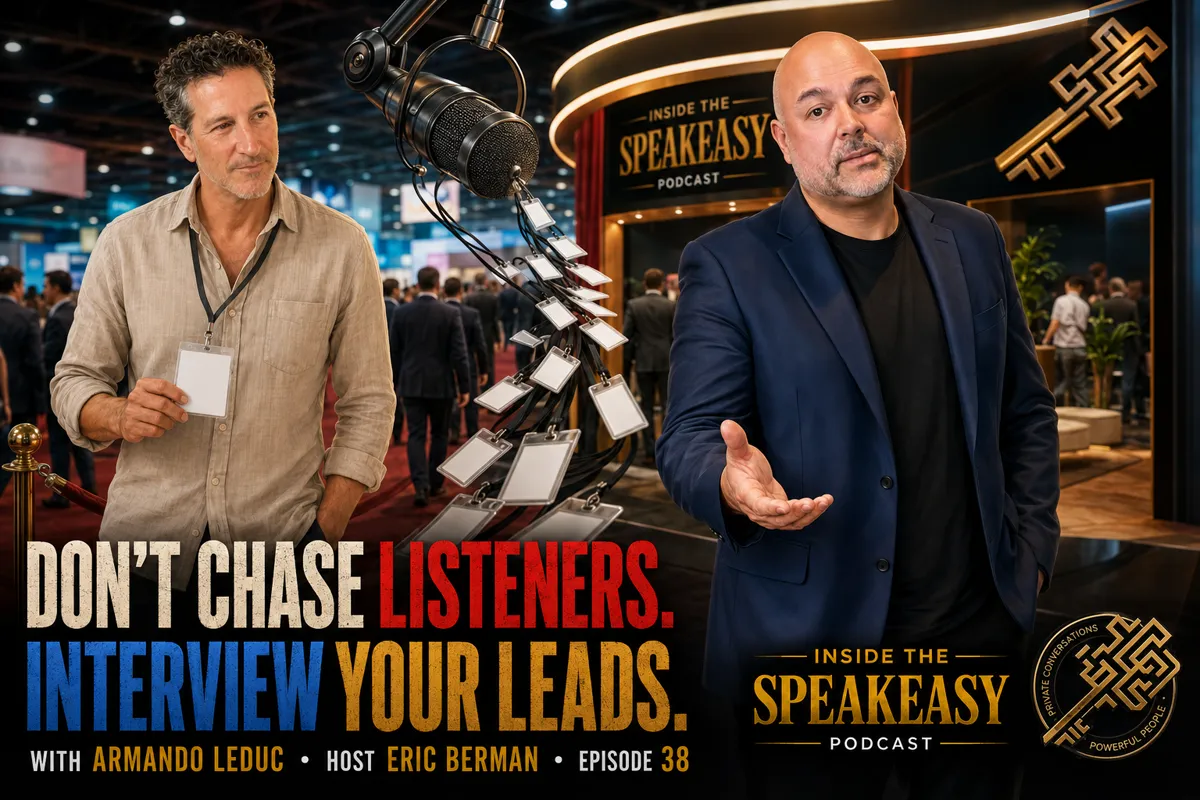
Armando Leduc, the New Orleans actor, producer, and founder of Leduc Entertainment, says he does not really care if anybody listens to his podcasts. In this conversation with host Eric Berman, Armando explains why he treats every interview as a recorded one-on-one with a potential partner, and how a single Zoom call with a high school friend in 2020 grew into what he describes as seven figures in revenue. He shares how he beats imposter syndrome with stage time and the three rules of improv, how he recorded 50 podcasts in two and a half days at a legal conference, and how a workers comp firm used a podcast to build referral relationships with personal injury attorneys. Armando also walks through the PASTOR framework his hosts use for interviews, and Eric changes his own guest strategy for the Speakeasy Podcast in real time.
In this episode, you'll discover:
- Why Armando says stage time, on a real stage, on social media, or on a podcast, is the fastest way through imposter syndrome
- A simple starting exercise: ask AI for 20 questions your avatar would ask, answer them on your phone, and post them
- Why Armando focuses on the guest in the chair rather than the size of the audience, and how that changed Eric's strategy
- How a podcast booth at a legal conference brought in organizers, speakers, and exhibitors, and why candy in a bowl does not
- The PASTOR framework from Ray Edwards that Armando uses to train his podcast hosts to run engaging interviews
Episode Summary
Armando Leduc works with a lot of high-level attorneys who have been experts in their field for years, sometimes decades, but who clam up the moment they get in front of a camera. When he was asked to speak about imposter syndrome at an Eight Figure Firm conference, he looked for the common thread among the clients who had made the jump. His answer was stage time. A stage can be a real stage, but Armando says social media is a stage now, and so is a podcast. The more stage time you get, he says, the more confident you get, because everything you need is already inside you.
He connects this to the three rules of improv: say yes and, make your partner look like a rock star, and say the first thing that comes to your head instead of bringing in the inner critic to edit something before it exists. Armando says that whenever you start something new, you are going to suck at it, and the only way to get better is to do it. He learned that singing lead in a band on Bourbon Street for eight years, starting out reading lyrics off a sheet of paper. For people who want to begin, he suggests asking AI for 20 questions their avatar would ask, answering them on their phone, and actually posting the videos.
Armando's own path started with a trumpet in middle school and an audition for Grease during his last semester of high school in Harlem, Georgia. He got the lead role, joined a barbershop quartet, signed with an agent, and did a lot of theater. A 2012 exhibit called LifeLike at the New Orleans Museum of Art, featuring a marble trash bag and an artist's painstakingly recreated childhood home, taught him that the journey is the point. He went on to study acting techniques and improv, including at Upright Citizens Brigade in Los Angeles.
Podcasting changed Armando's life in 2020. During COVID he had a Zoom conversation with Luis, a high school friend whose Atlanta personal injury firm, Bader Scott, Armando thinks was pulling in 40 million a year. Three months later Luis started Eight Figure Firm, a consulting company that helps attorneys scale, and hired Armando to shoot content. That led to work with other attorneys and an embedded partnership Armando says has produced seven figures in revenue. A chain of podcast introductions, from Whitney Lee to Jasmine Jonte to Glen Ledwell, then brought him to Flight Club, where he met Eric.
Armando's core advice is that the point of a podcast is to connect with the people you want to connect with. He tells clients to niche down and invite the people who already have access to their avatar, including conference organizers, speakers, exhibitors, and referral partners. He describes buying a booth at Law Di Gras in San Diego and recording 50 podcasts in two and a half days, which kept his team so busy he had to hire three new people. He also explains how a Fort Lauderdale workers comp firm used its podcast to build relationships with personal injury attorneys, passing dozens of cases back and forth.
When Eric asks whether he should keep interviewing only Speakeasy members, Armando says to do both, and explains how he uses his Partnership for Profit podcast to invite top New Orleans marketing agencies and then introduce them to the Speakeasy New Orleans chapter. He walks through the PASTOR framework his hosts use, describes how he delegates production to his team so he can stay present at events, shares his self-produced comedy Life on Bourbon, and explains why the people are what keep him coming back to Speakeasy.
Big Ideas Discussed
Stage Time Beats Imposter Syndrome
Armando says actors constantly chase validation, and that head trash from childhood, fear of being made fun of, and everything else that stops people from putting themselves out there is what he calls imposter syndrome. He points to Theodore Roosevelt's Man in the Arena speech: the credit belongs to the person actually in the arena, not the critic.
His remedy is stage time, and he uses the three rules of improv to explain it. Say yes and, as two people do when they build an unscripted conversation together. Make your partner look like a rock star, because the more a host edifies a guest, the more the guest opens up. And say the first thing that comes to your head, rather than editing something before it exists. Armando's consultants, some with acting and directing backgrounds, put clients through role-playing exercises so they do the thing before they do the thing, and then ask them whether they died. They did not, so they move on.
The Guest Is the Real Audience
Armando says the most common objection he hears, about five times a day, is that podcasting is a saturated market and nobody will listen. His answer is that the listeners are not the point. He describes a client, an accent coach for A-list actors, who struggled to get viewership, and told her to bring on the producers, production companies, and agents she wanted to hire her, with celebrity guests adding credibility.
Eric reframes it: the business may not come from the five or ten people listening, but from the person being interviewed, who now knows, likes, and trusts you more. Armando agrees a thousand percent. He says a podcast is a recorded one-on-one in a heightened state, where both people show up with their A game and are fully engaged. He adds that giving someone a platform to talk about their expertise for 30 or 45 minutes creates a bond, and that the return can come from the very first guest, as it did for him.
Niche Down and Go Where Your Avatar Gathers
Armando says it is hard to get introductions if you are looking for entrepreneurs doing three to five million in revenue, because nobody knows what other people earn. If you say you want personal injury attorneys or dentists, people know where to find them: at conferences and in Facebook, Skool, and LinkedIn groups. So he goes straight to the source, the conference organizers, speakers, and exhibitors, because they are all serious.
At Law Di Gras he paid for a booth and recorded podcasts right on the loud conference floor, after first bringing the organizer onto his own podcast. Organizers, speakers, top exhibitors, and curious attorneys came by, and conversations about what his company does followed without a hard sell. He says businesses spend thousands on booths expecting them to attract people, but candy in a bowl will not get anyone to sign up. Inviting vendors, speakers, organizers, and ideal clients in for a conversation every 20 minutes will, and he says you do not need to be a podcast company to do it.
The PASTOR Interview Framework
Armando trains his podcast hosts using PASTOR, the framework from Ray Edwards' How to Write Copy That Sells. P covers the people you serve, along with their problems and pain points. A amplifies the pain by asking what happens if it is not solved. S is a story of someone you helped, T is that person's transformation, O is the offer, and R is the resolve, the call to action.
He demonstrates it live using Speakeasy as the example, with Eric's answers about lonely entrepreneurs, burnout, Armando's own story as a member, and the free first event. He says many podcasts fall flat because hosts do not follow a framework and do not really care about the conversation, and that listeners can tell when someone is engaged or thinking about something else. Eric adds that hosts are often all over the place, which makes the content harder to watch and listen to.
Questions We Answer in This Episode
How does Armando Leduc use podcasting for lead generation?
Armando Leduc treats each podcast as a recorded one-on-one with someone he wants a relationship with, such as a referral partner, conference organizer, or person connected to his ideal client. He says he does not really care whether anyone listens, because the business comes from the relationship with the guest. He says his own connections have led to an embedded partnership worth seven figures.
How can podcasting help you overcome imposter syndrome?
Armando Leduc says the fastest way through imposter syndrome is stage time, and that a podcast, like social media, counts as a stage. He says everyone is bad at something new and only gets better by doing it. He suggests asking AI for 20 questions your avatar would ask, answering them on your phone, and posting them.
What are the three rules of improv Armando Leduc teaches?
Armando Leduc teaches say yes and, make your partner look like a rock star, and say the first thing that comes to your head. He says these rules help people stop editing themselves before they create anything. He compares a good podcast interview to an unscripted improv scene that the host and guest build together.
Who should you invite as guests on a business podcast?
Armando Leduc recommends inviting people who already have connections to your ideal client, such as referral partners, conference organizers, speakers, and exhibitors. He describes a workers comp firm that invited personal injury attorneys onto its podcast and built referral relationships that passed dozens of cases. He says celebrity guests can add credibility, but relationships drive the business.
How did Armando Leduc record 50 podcasts at one conference?
Armando Leduc says he bought a booth at Law Di Gras, a legal conference in San Diego, and recorded podcasts right on the conference floor over two and a half days. He had already brought the conference organizer onto his own podcast. Organizers, speakers, top exhibitors, and attorneys stopped by, and he says the follow-up work forced him to hire three new people.
What is the PASTOR framework for podcast interviews?
PASTOR is a copywriting framework from Ray Edwards' book How to Write Copy That Sells, which Armando Leduc uses to train his podcast hosts. It covers the people served and their pain, amplifying that pain, a story, the transformation, the offer, and the resolve or call to action. Armando says following it keeps interviews focused and engaging.
Should a community podcast interview people outside the community?
Armando Leduc told Eric Berman to do both. He says interviews with Speakeasy members highlight what they do and capture video testimonials, while interviews with outside guests can bring new people in. He says his Partnership for Profit podcast invites top New Orleans marketing agencies and then introduces them to the Speakeasy New Orleans chapter.
Full Episode Transcript
Read the Full Episode Transcript
Welcome: Podcasting, Production, and Imposter Syndrome
Eric Berman: This show is brought to you by HighLevel, the AI driven business operating system trusted by over 2 million businesses to help automate, scale and create real leverage. High Level isn't just a tool, it's the engine behind some of the most agile and high performing teams on the planet. If you're ready to streamline everything, amplify your reach, and actually build a business that works for you, you're in the right place. Visit www.gohighlevel.com/Speakeasy-mastermind-promo to get an exclusive 30 day trial for being a listener of the Inside the Speakeasy Podcast. Enjoy the show. Have you ever thought about doing a podcast and been scared? Well, today's episode, you're going to learn from Armando out of New Orleans and how he absolutely crushes it with podcasts and how you can use POD as a huge strategy for generating leads. No matter where you are in business, what you're doing, and it's guaranteed success. You've got to listen to these amazing tips. Plus, if you're already running podcasts, how to do it better, how to level up. And we're going to get into so much more about production and acting and how to combat imposter syndrome. And we're going to hit all sorts of topics today, ranging around podcasting, getting lead gen through podcasting, what you need to learn about podcasting as far as should I do it, should I not do it? And if you are doing it now, you could do it better. And it goes beyond podcasting. We're talking entertainment, baby. We're talking getting some cool things because Armando is the man. He's actually produced our Speakeasy annual events too. And everywhere I'm going to events, I want Armando behind me as the producer director and just get in his brain. Welcome to the show, buddy.
Armando Leduc: Hey, thank you, man. Thank you for having me. You guys got an amazing brand. We could talk about the Speakeasy too, a little bit. I definitely want to drop some testimonials as far as Speakeasy and what it's been like for me so.
Eric Berman: Well, I appreciate that. Well, I mean, the other thing we're going to cover, we didn't talk about that. And in the intro here is imposter syndrome. We all have it and you actually talk a lot about that. In fact, you were just saying you came off a huge event talking about that. I Love. Before we get into the world of podcasting and all the stuff you learned, that and entertainment, everything else. And you're acting too. You're an actor. How did this all start? You know, was there imposter syndrome buried into that? Walk me through that a little bit.
Why Experts Clam Up on Camera and the Power of Stage Time
Armando Leduc: I think we all, as actors, I'm going to say actors have this constant just drive to get validation from people. That's why we love getting on stage, because we get the applause and we're just constantly chasing the validation. And because of childhood trauma, I guess, you know, people, they have a lot of head trash and a lot of trauma regarding putting themselves out there, right. Whether it's getting made fun of, whether it's all of the things that are stopping them from taking action, all that is wrapped up into what I call imposter syndrome, stage fright, whatever it is that you want to call it. And I was asked to speak at an Eight Figure Firm conference about imposter syndrome specifically. And as I was putting it all together and trying to figure out, okay, what is, what's a common thread with all of my clients and how have they been able to make the jump?
Eric Berman: Right.
Armando Leduc: I know you work with a lot of celebrities that already are, you know, a hundred stages past that. We work with a lot of people that have high reputations, they're high level attorneys that have been in their field for years, right? Sometimes decades. But you get them in front of a camera and then they clam up. And so we're going, okay, how are we taking somebody that is an expert at what they do and. And put them in front of a camera and make them feel natural and are you familiar with Theodore Roosevelt's man in the arena?
Eric Berman: No, I've heard of it, yeah.
Armando Leduc: Great. Right. So basically the speech was. It is not the critic who counts. It is not the man who points at the strong man stumbling. The credit belongs to the man that's actually in the arena, the one that's. Whose face is marred by dust, sweat, run blood. Because that's the guy, right? Or that's the girl, the ones that are in there doing it. And so what I learned is if you can give yourself stage time. And what does stage time mean? Either actual stage where you're speaking in front of people. Social media is a stage now. Right. So not just creating content and leaving it into Google Drive, but creating content and putting it out and podcasting. Right. Like this is a stage. And so as we're going through, what I've noticed is that the more stage time you get the more confident you get, because all of it's inside you.
The Three Rules of Improv and Eight Years on Bourbon Street
Armando Leduc: And I bring it to the three rules of improv. The three rules. Have you ever done improv?
Eric Berman: Nope.
Armando Leduc: It's amazing. Such a releasing experience, right? You're scared. You should absolutely do it.
Eric Berman: Yeah, I heard a lot. I heard that's actually good to, you know, people get through their improv to help with speaking and everything else out there.
Armando Leduc: It is. Because what it does is it helps you realize that all of the authenticity that you have is within you. Right?
Eric Berman: Yeah.
Armando Leduc: You just have to be comfortable letting it out and showing it off to everybody. And so the three rules of improv are say yes and. Which we're doing right now. We're yes and Right. You're giving me a platform. You're saying yes, and you're building. I'm saying yes, and I'm building. And we're building a story together. Because this is not scripted. Right. Like, you didn't send me a script before this podcast. Correct. So congratulations. You're already improvising. We improvise on a daily basis. Right. How we talk to people. Right? Yes. And second rule is make your partner look like a rock star. So you've given me an opportunity to speak on your platform. You're making me feel good about it. You have edified me at the very beginning. So I'm already in a state where I feel like I can share my truth with you. Not only that because we're live or not live, but because we're recording this. You're not going to let me fall on my face, right? You're going to treat me like a rock star. Because the more you treat me like a rock star, the more I'm going to talk, the more I'm going to feel comfortable sharing my story with you. And so you make your partner look like a rock star. That's two. And then the third thing is, say the first thing that comes to your head. But we're so quick to bring in the editor. Right? Everybody's so quick to bring in the inner critic, to edit something before it exists. And I'm saying, why don't you just create right at the very beginning? Like, if you've never done social media content, you're going to suck. If you've never done a podcast, you're going to suck. If you've never spoken on stage, you're going to suck. If you've never been on stage singing or whatever, whenever you're starting something new, you're going to suck at it. But the more you do it, the better you get. I sang on Bourbon Street for eight years of the lead singer band. And when I first got approached, I was an emcee and I would sing along to the music and I would just keep the party going, right? That was my job, Bourbon Street. And then I got approached to say, hey, you got a good voice. Would you like to be a lead singer in this band? And I was like, no, absolutely not. But I did it anyway, right? And they're like, look, we'll give you, you know, the lyrics on paper, you know, and you can just read the lyrics while the song's going on and we'll, you know, we'll practice a few times. You already know Don't Stop Believing. You already know Billie Jean. You already know these songs, right? You just got to get more stage time. And so I got up there and, you know, the first week I was just reading off the paper and looking and super awkward, you know. But you did it, right? And the more I did it, the more creative I got, the less I cared and the more I got into the creative end of things.
Eric Berman: And you had fun with it. Yeah.
Armando Leduc: Yeah.
Eric Berman: Well, what you said earlier just kind of go back. I think a lot of it is. And I think we all, I mean, not just this, but in a lot of things we do. You're so afraid of what if we don't get started? And I think in your. What you're saying is, I mean, just mindset. Look, know you're not going to be great at it, but you also know that you're never going to get to there if you don't start. So you gotta throw yourself in there. I mean, isn't it, Aren't you playing a lot of the, you know, what's the worst case that can happen kind of thing too? Like, how do you get through that, that fear people have? Oh my God, I'm gonna be judged. I'm gonna suck.
Armando Leduc: Yeah. You know, part of what we do, and I've got consultants that have acting backgrounds that had directing backgrounds. So a lot of our consultations are bringing them through acting exercises and doing role playing stuff and giving them opportunities to do the thing before they go and do the thing, right? And as a result, they be like, did you die? No, you didn't die. Great. So let's move on, right? Like, you're gonna survive this and we're gonna hold your hand through the process, but more importantly, we're gonna coach you through it and sort of be the bird that kicks you out of the Nest that, you know, will show you that you will fly no matter what.
Eric Berman: So wrapping through just the imposter syndrome in general. So what's the biggest thing, then, the biggest technique is it just goes. Just do it.
Armando Leduc: The thing is, if you want to get over it, I would start, go to AI, Ask whatever it is that your. Your avatar. Ask it. Give you, like, 20 Q&A questions that you can answer, grab your phone, and then just look at it and ask. Answer those questions, you know, 20 of them. And then here's the most important thing. Put it out, like, actually post it, right?
Eric Berman: And just get it going, get the momentum. Love that.
Armando Leduc: This role.
Eric Berman: Yes, I love that.
From a High School Musical to the Craft of Acting
Eric Berman: So let's go back to earlier days. So, Armando, what Take us through. Just, you're obviously successful entrepreneur, done acting, all that. Where did little Armando start? How did this all happen? How'd you get to where you are today, man?
Armando Leduc: So I was. I played trumpet when I was in middle school, and then throughout high school, I was just kind of trying to figure it out, trying to figure out what I wanted to do. And a friend of mine told me that there were auditions for Grease, the show, the High School Musical. When I was in high school, it was my last year. It was my last semester, and I auditioned, and it changed my life. I got the lead role, and I joined a barbershop quartet.
Eric Berman: Been going back right there. I mean, you just said, I'll do it. That was imposter syndrome went there. I was probably one of your big. The confidence, I'm sure. One way the hell up is this at New Orleans, by the way, too.
Armando Leduc: This was in Harlem, Georgia. So ended up doing that and got an agent and started doing, you know, a ton of theater. You know, learned a lot. Learned from some amazing people that took me, you know, took me under their wing and mentored me through that process. And, you know, and they were like, you just got. You got to work on it. You got to do the craft. You got to have a craft for acting, and you got to pay attention to the work and instead of the destination. But I didn't really understand that in my twenties too much, right? I was just always wanting to get there, always wanting to get there. And I did a. There was a awesome transformational art exhibit at the New Orleans Museum of Art that I still remember in 2012 called LifeLike. And all of the artists in there had the mindset that it was just about the art form, not necessarily the result, Right? So they were recreating these everyday objects out of, for instance, There was a trash bag, a hefty trash bag overflowing. And it was just right there on the ground. And it was made of marble. Like, you looked at it, and it looked like a hefty. It looked like a plastic bag. But the guy painstakingly recreated a hefty trash bag out of marble for just the art's sake, right? Like, he wasn't selling it. It wasn't. This guy recreated his childhood home and painstakingly took two years to find the exact refrigerator, to find the exact wallpaper, to find the dining room table and the chairs and the linoleum floor. And you walk through it like you walk through his house in the exhibit.
Eric Berman: Oh, my gosh.
Armando Leduc: And it was mind blowing to me because I was like, I was so end result driven. I was like. And there was like, no, man. Are you missing the whole point of it? Like, the journey is the point. Like, aren't we here for the journey? Like, you're trying to get to the end, right? And so that sort of changed it for me. And so I started getting really into the study of acting. And that's when I, like, I took all kinds of acting techniques, and that's when I got involved in improv. And, you know, improv changed my life, too. I did, you know, Upright Citizens Brigade in L.A., you know, National Comedy Company, ComedySportz, and things like that. Just transformational for me. So anyway, like, it just stage time for me, like, changed my life, you know. And so that's what I'm preaching these days is just like, you know, get out of your comfort zone. Fastest way to do that is get yourself some stage time. Especially coaches, consultants, and, you know, these professionals, they want to, you know, they want to step out and step into their power. And when I'm like, I'll help them out.
Eric Berman: Yep, love it. So I know you do. You help in all those areas, and you're great at it. But, you know, ultimately, the biggest thing that you do a lot of, and I know you do in the niche of the attorney niche, because that's just a niche that you're having a lot of success with. And we can go down that a little bit, because I want to talk about what you do there and is obviously podcasting. I mean, get your stage time. And I could see, you know, talk to me first about the bridge between all you learned in acting and just getting out there into why you got so passionate about the world of podcasting.
How One Zoom Call Became a Seven-Figure Partnership
Armando Leduc: Podcasting changed my life in 2020 during COVID Okay. I was kind of sitting around just like everybody else, trying to figure out what it is that I'm going to do with my life. A friend of mine who I went to high school with, Luis, was super successful with a PI firm, a personal injury firm in Atlanta, Georgia, called Bader Scott. I think they were pulling in 40 mil a year. And I was just like, hey, man, like, let's sit and have a conversation about how you got successful. I didn't. It was not a podcast. It was just a zoom call. Me and him. And I was just asking him questions. And then three months later, he calls me up and he's like, hey, I just started this company called Eight Figure Firm. It's a consulting firm for attorneys on how to scale. Will you come and shoot content for me? And I was like, sure, yeah, I would love to. Right? Because he knew I had a production company, but at the time, I wasn't shooting, like, volume of content for people. So I learned about, like, you know, creating a batch of content for everybody. And then he started hiring me for other attorneys. That's how I got into the legal space. And what I noticed is that, man, one person can change the whole game. I mean, he just him alone, him and his company. And our embedded partnership has been 7 multi. 7 Figures in revenue off of one person.
Eric Berman: Right.
Armando Leduc: And so that's why I'm like, man, at now, what I'm preaching to people on podcasting is like, okay, sure, use your podcasting for viewership. Sure, use your podcasting to get your personal brand out there. But for me, more importantly is who are the people I want to connect with? Who are the people that, if I had a connection with them, that we could maybe create some sort of embedded partnership or they introduced me to somebody else, which is how I'm talking to you right now. Right. Whitney Lee, who was on my podcast, introduced me to Jasmine Jonte, who introduced me to Glen Ledwell, who got me into Flight Club. I met you at Flight Club. This whole Speakeasy world opened up to me that I didn't even know about. Right now I'm going to Antarctica on Saturday as a result. Join Flow as a result. And so I'm meeting all of these people through my podcast, not because I'm trying to build a viewership. I'm just, like, trying to create connections. And so the more connections I'm making, the more opportunities I'm getting.
Eric Berman: Love it.
Why Audience Size Is Not the Point of a Podcast
Eric Berman: Okay, so you're actually sort of teased a little bit of the strategy, because I know we talk a lot about how to leverage podcasts for lead gen, there's so many questions I have in the world. Podcast. I mean, you know, first, I mean, I guess we could start with the basics, you know, what to do to start. How do we get going about it? And you're talking about using podcasting as strategy to generate new leads. So maybe we cover like all of those. As somebody that's sitting down listening to this, let's start with a person who doesn't have a podcast yet, and then we'll kind of lead into, you know, strategies for those that have a podcast may not be thinking about right now. So starting with those that don't, what would you sit down with them and say why they should be getting one and how it's gonna help and generate leads.
Armando Leduc: I love it. Cause I think I have this conversation at least five times a day.
Eric Berman: Yeah.
Armando Leduc: Because everybody's. Everybody's mindset when it comes to podcasts is that it's saturated market. Who's gonna listen to my podcast? What's the point?
Eric Berman: Right?
Armando Leduc: Like all of the. Just the head trash of why I shouldn't be doing it. And then I come in and go, look, number one, I have a client. Her name is Audrey. She's a accent coach for A-list celebrities, right? And she, Daniel Kaluuya, who. Who was in Get Out, the lead actor in that he won the Academy Award for his role in the Malcolm X movie. She coached him on that accent.
Eric Berman: Okay?
Armando Leduc: All this to say that I helped her launch her podcast, and she can't even get viewership. Imagine this person that's working with A-list actors can't get viewership, right? Because she just has to get it going. She has. Get it off the ground. I keep telling her, I was like, don't you. You can't expect it to start hitting after just 10 episodes, right? It's just. It's a long game. I told her, I was like, guys, you're. The point of the podcast is to connect with the people that you want to connect with, right? So for her, she wants producers to hire her. She wants production companies to hire her agents, people like that. So I'm like, bring those people on. Don't worry about the celebrities. Yeah, bring in the celebrities to create the credibility for your show. But for me, if I'm trying to build the book of business, then the people that I want to connect with are the people that already have connections to my avatar. And we learn about this through Flight Club too, right? Like with the joint ventures and things like that. It's like the. These people already have hundreds if not thousands, if not hundreds of thousands of people in their organization already that. And they have the clout. And so with one email, they can go, hey, I think you should work with. So and so all of a sudden can change your life.
Eric Berman: Yeah, Right.
Armando Leduc: With one email. So those are the people that I'm sitting going, okay, who do I need to meet? Which is why I niche down to attorneys, because this works really well. If you niche down. If you're telling me that, hey, I want to work with entrepreneurs that are like 3 to 5 million in revenue, how many people do you know what their revenue is in their business? Like. Like you don't, right? If you tell me, hey, I'm looking for PI attorneys. Great. I know PI attorneys. If you're telling me I'm looking for dentists, or I'm looking for coaches and consultants, or I'm looking for so and so, then I can tell you, hey, I know where those people are hanging out. They're hanging out at conferences. They're hanging out in Facebook groups, They're hanging out in Skool groups, LinkedIn groups. And so what I'm doing is I'm going straight to the source. I'm going to the conference organizer. I'm talking to the speakers, I'm talking to the exhibitors, because all of those people are serious, right? Conference organizers, serious. People that are speaking on stage are serious. And the people that are spending money to be at that conference, they're also serious.
Eric Berman: That's right. That's right.
Fifty Podcasts in Two and a Half Days at Law Di Gras
Armando Leduc: Well, those are the people that I go after. Legal vendors, conference organizers. We did. We just came back from Law Di Gras in San Diego, right? Huge legal conference, and we did 50 podcasts in two and a half days.
Eric Berman: God, you must [unclear]. Holy smokes.
Armando Leduc: It was insane. But we cleaned up. Like, we were so busy after that conference, I had to hire three new people, right? And, like, I still have a backlog.
Eric Berman: Of people that want, let's go more granular. Because if you're listening to this, they want to make sure that everybody really follows what you're doing here. So. So you're obviously in the legal niche. You're going to a legal conference. You were able to set yourself up as the podcast guy within there. Clearly, you know, you obviously did some work to get there, because I know you're podcasting different lawyers, so I imagine you already had a relationship with the organizer of Law Di Gras to get that role, right?
Armando Leduc: I did, because guess where I brought him.
Eric Berman: You brought him into a podcast.
Armando Leduc: Brought him to my podcast, and then.
Eric Berman: He's doing like, hey, why don't you come to my conference? And you probably suggested, hey, why don't I be there? I could do podcasts. Everybody get everybody on the show. So he sets a podcast room for you.
Armando Leduc: You're now, I did it right there on the floor and I paid to be there, right? Like, I wasn't yet. I wasn't asking for a handout. I was just like, hey, I'm going to buy a booth and I'm going to set up at the booth. And it was loud and noisy and people were walking by. But because of that, I had the conference organizer, I had speakers that were on stage, I had the top exhibitors come to my booth. And then obviously other attorneys are coming by going, what are you guys doing? Oh, yeah, come on in. We're talking about this. This is what we do. You don't have to have a podcast company to have a podcast, right? Like, whatever. If you had an AI company that services lawyers, you should have a podcast at that conference, talking to them about AI, right? And bringing them into that conversation super easily.
Eric Berman: Now, you're generally, I mean, look, as an interviewer, again, you know, we both playing that game. You know, you're generally interested in the topic. You have to, you know, you have to be listening, engaging the, you know, conversation. We all know, one on one. This goes back way to the days of winning friends and influencing others and all that. I mean, you're generally interested what you are. Obviously, you know, people then like you. They're like, okay, this Armando guy is pretty cool. Thanks for having me on the show. Yep. Then what? And then are they asking you, like, how do I, you know, you're like, yeah, you should create a podcast for your offer. What are you selling to your lawyers? I want to understand the end game and how it works.
Armando Leduc: Is it a podcast immediately? Yeah, that. I see you're doing a podcast, but what is it? Why? What do you do? You know, and then we roll into a conversation super easily about what we do, how we help, and it's not a hard sell. Right. Have you thought about building a personal brand? Have you thought about, you know, doing social media content and podcast? I always thought about that, but I never knew where to start. We can help you with that. We do that all the time.
Eric Berman: So the lawyers, the sell to them is, look, you're just regular, you know, why don't you get yourself out there more, as you said earlier, throw yourself out there, get on stage. That's going to build credibility to you and the Law firm, people doing research, Google, whatever else are out there, they see that, wow, this guy's legit. Or gal's legit because of the podcast.
Armando Leduc: Yeah.
Turning Podcast Guests Into Referral Partners
Armando Leduc: But here's the thing with podcast Legal specifically is I'm inviting other attorneys in their space or other referral partners that can refer them business. For instance, I have a workers comp lawyer in Fort Lauderdale. They just do workers comp. They don't do personal injury, they don't do anything else. So a lot of their referral partners are personal injury attorneys. And so I'm like, well, let's start a podcast and invite those personal injury attorneys to your podcast. You'll create a relationship now. You can open up those referral partnerships. You get PI cases, they get work injury cases. So we've been doing that for the last year and they've, I mean, they passed dozens of cases that are six, you know, high six figures in value, right? Yeah. All because of the relationship that they built on a podcast, which is what I'm saying. You know, if you're an estate planning attorney, bring in financial advisors, family law attorneys, other, you know, other people that you can do that with. Immigration, same deal, nonprofits, other personal injury attorneys that don't do immigration, you know, all these other, you can get cases galore.
Eric Berman: Love it.
Armando Leduc: All while just building relationships and building your personal brand at the same time and building content.
Eric Berman: Got it. So again, I know we're going the rabbit hole of legal, but for anybody watching slash listening, think about your niche. I mean, I mean, how can you, I mean, certainly you could take what you're doing in your industry, your niche, same concept. That's great. So just do it, get out there, start it.
Managing Expectations and the Real Return on a Podcast
Eric Berman: So let's talk about that. Managing expectations. You know, I'm somebody myself, you know, five, six months in, you know, going down that. What do you tell people are just like, well, it's not like snap your fingers and you're going to have all this business. What do you advise on what it's going to take to build something when they can start expecting a little bit of ROI for their time?
Armando Leduc: I mean, if you really understand the power of follow up. I know Glen had posted something on Facebook a few days ago which I thought was super powerful because he was like, it's not about the first call, it's about the second call. It's that second follow up call that lets that person know, oh, this person. It wasn't just a, it wasn't just a one night stand. They actually want to have a relationship with me. Right. We forget because we're just so focused on ads and bringing in new business and bringing new business that we forget about actually creating relationships with people on a human level. You know, and I know AI is pervasive to everything, so people are looking for connection more and more often. So you're asking me, how quickly can somebody see return? It could happen just like it happened for me off of the first one. Right? Like, you invite somebody on, they connect with you, they're a good referral partner for you. All of a sudden they're all like, hey, yeah, let's create an embedded partnership here. I love what you're doing.
Eric Berman: So let me carefully explain the win you're saying in there. We oftentimes think, and I'm not saying, I'm just saying in general, we think, oh, podcast, I'm only going to get business because of the thousands of, you know, the listeners that I hope listen to it one day. And maybe there's only five, 10 listeners. And what you're getting me to rethink the obvious is in front of me. It's not so much the listeners. They will come over time. It's the person you're interviewing who is you've deepened a relationship with. They know like and trust you more. They might be bringing you business.
Armando Leduc: That's it.
Eric Berman: That's it. Okay. So that's a really good reframe for those of us that are hesitant and worried about how much time and energy to get going there. Now, the other side, I assume that's just a matter of everything's different, I imagine. Right. So if you're interviewing some people and some people have huge lists and they promote it, you're going to get more traffic, you may get momentum, you may not. Either way, I think what you're arguing is that sort of. Or maybe maybe you're saying maybe not. I'm sort of reading into it that if you're doing it right, interviewing the right people, the followers from your podcast is sometimes the gravy, but the real actions in the person you're interviewing, is that a big part of what you're saying?
Armando Leduc: A thousand percent. I don't really care if anybody listens to the podcast, to tell you the truth. Right. Because it's just a recorded one on one. You know, it's just in a heightened state. I know. You know, I know that because it's a podcast. Eric is going to show up, you know, to bring his A game. Armando is also going to show up to bring his A game. Right. Because we're Being recorded. So this one on one is a heightened connection.
Eric Berman: So genius. At the same time, I freaking love that. You're so dead on. You're right. Just the fact that there might be one person besides you and I listening to this conversation. We have to be on our A game and we have to put on a good show or at least, you know, be focused and paying attention and not multitasking and doing the shit that we do sometimes 100% love it.
Armando Leduc: Yeah. I mean, what people remember, I think in The Ultimate Sales Machine, they say people remember about 17% of a conversation and that's if they're paying attention.
Eric Berman: Wow.
Armando Leduc: We're not getting on the phone and an email and distractions and yada, yada, yada. But yeah, for sure. I'm like totally engaged. You're totally engaged, right? And that's what I'm saying. Like I've built massive relationships with people just because we're on a podcast together and I'm like actually learning about them and there's connection. Like, holy shit, I actually do like this guy or actually do like this girl. We should totally do some stuff together.
Should Speakeasy Interview People Outside the Community?
Eric Berman: So a real time strategy pivot live on the podcast here I've been, and I know you're going to tell me, but when we launched Speakeasy, I think this is interview, like number 30 something. I believe my focus has been, let me just go talk to everybody in the community. And for so, I mean, for a couple reasons. One is I selfishly get to know people more, which allows me to help serve them in other ways and vice versa. I also know subconsciously it does some things you talk about, you know, they're going to maybe, you know, continue to say good things about our relationship, Speakeasy, et cetera, et cetera. And I'm hoping other people in the community get to know more about them. What I've sort of put a line over at least a fuzzy line and I haven't let it go yet, is people outside of Speakeasy. And you're going to say, Eric, you're missing the boat here. You should be interviewing a lot of people outside the Speakeasy to get them, you know, to obviously share members, all that. And I think I've been blindly thinking, well, I think the members are more interested in meeting other members versus they just want good content from people, I'm guessing, I don't know, what's your take on that? Would you suggest that I should stop, lift up the curtain and say, hey, I can. I should just interview anybody who's obviously has got good content, could share stuff of value to the community.
Armando Leduc: So you would argue I would have both for sure. Right. Like one, have the Speakeasy members talk about what they do, obviously. Two, they should obviously talk about Speakeasy in a good way. That way you can also get testimonial in video form from it. Right. Where they can just know. Talk to me about what Speakeasy means to you and what kind of experience you've had and why do you keep showing up. And you know, I told you, in November, I'm going to use this strategy to bring more people into the Speakeasy for New Orleans. I think I already have five new people coming to the event in December.
Eric Berman: Amazing.
Armando Leduc: Yeah. And it's just all from the podcast. And here's the deal, it's not even me. I'm not even the one doing the podcast. I have, well, another podcast called Partnership for Profit where I have three podcast hosts. And so we're doing 10, 15 podcasts a week. So I have my VA going. All right, who are the top marketing agencies in New Orleans or Baton Rouge, surrounding areas, whether social media, web design, you know, whatever. And then if they're ranking at the top, they're obviously spending money and doing something right. So we'll go to their Contact Us page. Hey, we'd love to have you on the podcast. We bring them to the podcast, we interview them. It's another weeding out process too. And then from there I'm like, hey, I think you really love this group called Speakeasy. Take a look know, you know, we're meeting on on December 4th. You should come by, check it out. Some really cool people in there.
Eric Berman: Yeah.
Armando Leduc: You know, and it's a super. Yeah, tell me more about that. Would love to. I would love to come in.
Eric Berman: Wow, genius. Well, geez. Here's how we solve this problem and we do what we teach on the podcast. I love it. Brilliant. Okay. I mean, I mean, this is obviously hope everybody's learning. Like, I'm sitting here in real time saying, okay, I'm going to change my strategy here. So thank you for that.
The PASTOR Framework for Better Interviews
Eric Berman: Those that you are seeing podcasts and you're obviously observing and watching, what are maybe two or three things that you're seeing? I mean, for one, I already got one big takeaway which is just, you know, the guest and thinking about the guests and how to like reposition your mind. These guests could be relationship builders and people that can connect you to leads, et cetera, et cetera. Maybe other tips for people that already have podcasts, things that you say commonly they're not doing a good job over. They should be doing this or that.
Armando Leduc: I don't know if they're super engaged in the conversation. Did you ever read Ray Edwards' How to Write Copy That Sells?
Eric Berman: God, that was so long ago.
Armando Leduc: It's a long ago. Such a good book. Anyway, the framework on how he creates the video sales letters is PASTOR.
Eric Berman: Right.
Armando Leduc: Who are the people you serve? What are the problems and pain points that they have? How do you amplify that pain? Stories of people you've helped Transformations, offer and resolve. Right. So that's the framework. When I'm teaching my podcast hosts how to do podcast interviews, I do it through that framework. Hey, Eric, tell me about the people you help. Well, we help entrepreneurs meet other entrepreneurs in this environment, yada, yada. What's some of the pain points? Pain points is, you know, entrepreneurship is hard. We're oftentimes alone, and we really have many people to talk to. And then A stands for amplify. Amplify the pain. So what happens if they don't have other people to talk to? Right. Burnout. You know what I mean? They're going to continue maybe not learning the things that they need to learn. Right. Tell me about a story of somebody that, that you've helped. Well, you know, Armando over here, he joined the Speakeasy, met amazing people all of a sudden, you know, made some connections, added another six figures to his bank account, you know, but more importantly, he's learning and he's taking the tips that he's learned through Speakeasy and applying it to his life and business.
Eric Berman: Right, Right. Awesome.
Armando Leduc: That's what's transformation. Transformation is, you know, now he's living a more fulfilled life and knows that he has a community that he can count on. That's awesome. All right, and then offer. What's your offer, Eric? Oh, offer is, you know, people can come to the first event for free. We also have an annual event. We have a Circle group, yada, yada, yada. R is the resolve. What's the call to action? Speakeasy.com yada yada. Right. And so that's the framework that I. We use to ask questions. Not that we can't ask other questions here and there. We just. That's the framework that we use to question things.
Eric Berman: Yep. What you say? So I was just say you feel like the biggest thing you've seen that people are missing out on. They're just a little bit all over the place. They don't follow a good Framework, and therefore the content isn't. Is harder to digest and watch slash, listen to.
Armando Leduc: Yeah, I think because they also don't really care. You know what I mean? Like, you could tell if somebody cares and they're engaged or they're off thinking about something else. And, like, okay, you know, like, it's not a. You're saying it's not easy to sit and listen to somebody attentively these days because we're so ADD, right? And it's like, all right, what's the next thing, especially for us, that. That we're in the legal industry and we're having to interview over and over and over again. Or immigration. Like, how many times do I need to hear and be super engaged about, you know, a dog bite, you know, or an Uber accident?
Eric Berman: Mon, you probably have your legal degree already. You probably go to pass that exam pretty quickly at this point. All these lawyers you talk to. No, I mean, I still go back to how the hell you did 50 interviews in three. Like, I just boggles my mind. I'm. I'm, like, dying. If I got a day in my calendar, I have two on the day. I'm just like, oh, my God, this is gonna be tough. But, yeah, good on you for that. Wow.
Armando Leduc: Yeah. But here's the thing, too, right? Like, I know your time is valuable. I know your time is valuable. So the fact that you're allowing me a platform to talk about myself also creates this connection and bond, right? Because I'm like, dude, this dude could be doing so many other things, but he decided that I am important enough to spend, you know, 30, 45 minutes to talk about me and my expertise. Of course I'm going to be bonded to you. Of course that's going to make me feel good, right?
Eric Berman: It's true. No, you nailed it.
Delegating to Elevate and Producing Mastermind Events
Eric Berman: All right, so that was very helpful on the podcasting. And then the other love. I mean, I mean, obviously, hopefully you're enjoying hearing from Armando here, but you know, other things that you're doing right now. I mean, you're. In fact, we were just talking in the, quote, green room through all the connections that you are going to Antarctica this next weekend, and you get opportunities to film. You've done our events, our big Speakeasy events. I've seen you at a Flight Club events. You love producing the big event. Yeah. You're wearing many hats, so that's. So tell me a little bit more about that, and what are any takeaways you have from the production side, the filming and the video of these big events? What do you love to do there? That's kind of a lot of questions built into one.
Armando Leduc: I love the producing end of things. Right. Like, I'm all about the delegate to elevate and the Who Not How. Right. Like Gary, who's my head videographer, has been a godsend because he just, he cares, he loves it, he's into it. And that just goes into a good hiring process. Right. And just making sure that you understand what it is that you need. What is, you know, clearly defined the KPIs of the role. And so for me these days, it's more about finding the right whos and not the hows. That way I can be present at Flight Club and Flow and all these other conferences where I can just, you know, be on the producing end, meet people, people, you know, be engaged and then, you know, my team is doing their thing.
Eric Berman: Love it. Similar, I mean, you and I follow similar philosophy. It's like, how can you, as fast as possible find a who to allow yourself to do all these things that you're doing? What kind of events for those that don't know, what kind of events do you like to produce? And tell me a little bit more about what the, what your key things you're doing are.
Why a Podcast Beats Candy at a Conference Booth
Armando Leduc: I mean, we've been doing so a lot of masterminds as of late. Flow, Flight Club, Eight Figure Firm, Seven Figure Agency, Speakeasy, and 2026. I'm going really hard into like legal conferences, but then also talking to some of the members that are in Speakeasy and Flight Club about them going to the conferences and starting a podcast at the conference because it was so such a successful endeavor for us that like they're, you know, people are spending thousands to go to these conferences to sit in a booth and they think that the booth is going to attract people and it's not. Right. Like it might, but like candy and a bowl is not going to get people to sign up. Right. Or want to listen to your thing. But if you had a podcast right there and there, you know, and you're inviting people like every 20 minutes to come and have a conversation with you that are other vendors in the space and speakers and conference organizers and actual avatars that you want to talk to.
Eric Berman: Right. Oh, so genius. So simple. Yeah. So like, I imagine again, you know, you got the confidence, you don't have the problem. You like to talk to the people. You also understand the AV side of it. And I have a feeling people will put a lot of excuses in front of them why they couldn't do something less simple as that. And I imagine you're coaching people and teaching people how to do that. I imagine it's ain't that complicated to make it put it together and oh my, it's like you're literally sitting. I mean, this is one of the biggest gifts you're giving today. So I appreciate that. If anybody's listening and saying, wow, next time they go get a booth or I mean, this should motivate a lot of people to get a booth just to do what you're talking about and test it out and say, I'm going to get a ton of leads by doing this. Powerful, powerful. So please reach out to Armando if you have questions on that. I'm like, damn, Come to Speakeasy, our annual event, and get a booth and we'll have everybody doing podcasting. Funny, the competing corners.
Life on Bourbon and What Armando Values About Speakeasy
Eric Berman: So Armando, what else? What did we miss that we didn't hit that you usually like to talk about in these?
Armando Leduc: I got a lot of things, but I think, I think I've overwhelmed and fire hosed people enough. I do have a show that I produce called Life on Bourbon is a comedy about New Orleans. And so I'm self producing that. And it's a grassroots project that, that I put together and it's a labor of love for sure. And I'm just trying to have a good time these days.
Eric Berman: Love it. And if you are, I hope, I mean, everybody likes to get to New Orleans every once in a while you now have a new friend reach out to Armando. If you get out there, he knows everybody out there might be able to sing a song for you and bring you to something fun. And the last year you already teased it throughout. I mean, but I'll have to ask it again in a more proper way because you kind of threaded it, but maybe top wins. What have you loved about Speakeasy so far?
Armando Leduc: I just look the people for sure and we talk about that. That's the whole reason, right? That's the whole reason why we go to a mastermind like sure is going to Austin, Fun and San Diego. Sure, yes. Love it. Love that. Love that I can travel, but I travel so that I can go see my friend Eric and Glen and Stephanie and all of these people, you know, to connect with them on, you know, one to one basis. Flesh to flesh, looking them in the eye and I'm like, wow, this is a powerful thing when you get a bunch of high vibrational beings together that are all driven and focused and motivated and want to grow and have that same mindset when you're with, in that space with these people, you can't help but elevate. Like, it just happens naturally. You don't even have to think about it. You don't even have to like, I would imagine if somebody was just like, I'm going to show up to this event with like the most negative attitude ever to not want to like, be involved in anything, and that person would like, just have, like, it would be so dissonant that they would either have to leave or match that energy.
Eric Berman: That's right. Yeah.
Armando Leduc: And that's, that's what I noticed when I first went to Flight Club, was my first mastermind thing that like, was outside of like the legal space because I had done Eight Figure Firm when I did that. And I met you and you were telling me about, oh, you could do this, but at a local level. And I was like, oh, that's cool. I like that. Right? It was like, cool, let me do that. Right. And so we started the Speakeasy New Orleans chapter and I knew some guys that, you know, were heavy hitters in the marketing space. We never had a, an excuse, I guess, to get together to talk.
Eric Berman: Yep.
Armando Leduc: And so this was like such a perfect excuse to do that. And because people were invested in it, it was a way for us to sit and talk about what are the wins and what are you learning. And not just in business personally and biohacking and, you know, I. In business, I mean, it would like the whole, the whole thing. And it's just like, wow, okay, so you got some people in here that you can count on that, like, have your back. That's been my experience with the New Orleans chapter. But then being able to plug into the Speakeasy Global chapter, I've had several people on my podcast. We've connected, super smart people that, you know, and if you just go through the scroll through the Circle, you know, Circle app, it's just like, it's just ton. A ton of value. Yeah. You know, so it's been. Been transformational for me for sure.
Eric Berman: Oh, well, thank you so much. Appreciate that. And we're better for, much better for. Having people like you in the community, especially leaders like you that are leading charge in great cities who appreciate everything you're doing. And I appreciate your time today, coming in Inside the Speakeasy Podcast and dropping some amazing nuggets. So thank you so much, Armando. Look forward to hanging out with you soon. Appreciate it, man. And that's a wrap from the Speakeasy Podcast. If something sparked for you. Don't keep it to yourself. Share it, review it, and pass it to the one person who needs to. Hear this right now. Want in on the real Mastermind? Tap the link in the show notes to apply until next time. Keep scaling, stay sharp, and don't be. The smartest one in the room.
About The Guest
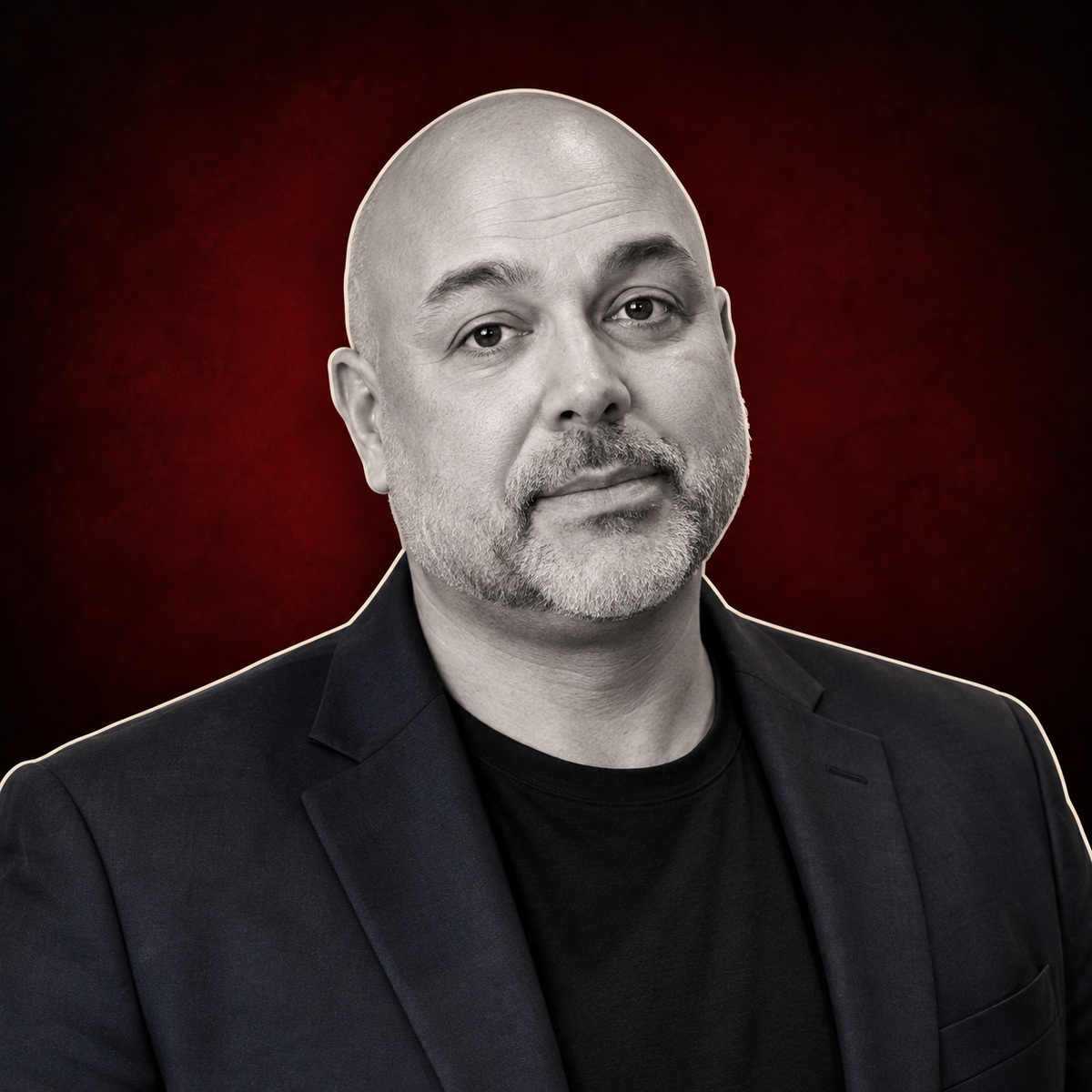
Armando Leduc
Armando Leduc is a New Orleans-based actor, producer, and entrepreneur and the founder of Leduc Entertainment, a video production, podcast production, and personal branding firm that works extensively with attorneys and law firms. He began performing after landing the lead in a high school production of Grease in Harlem, Georgia, went on to theater and improv training, including at Upright Citizens Brigade in Los Angeles, and spent eight years singing lead in a band on Bourbon Street. Armando started producing content for attorneys in 2020 through Eight Figure Firm, a consulting company for law firms, and now helps professionals build personal brands and referral partnerships through podcasting. He hosts the Spaghetti on the Wall podcast, runs the Partnership for Profit podcast with a team of hosts, has produced Speakeasy annual events, and is self-producing a comedy about New Orleans called Life on Bourbon. He leads the Speakeasy Mastermind New Orleans chapter.