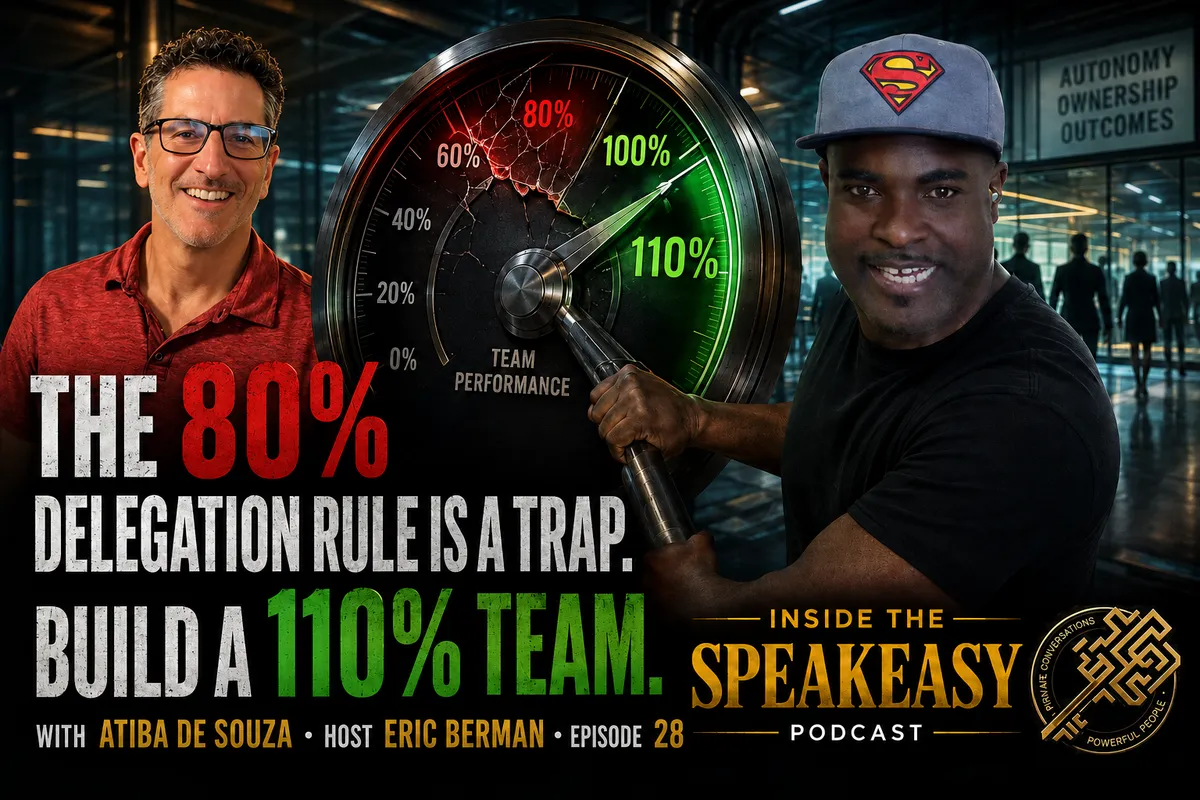
Atiba de Souza was born into a family of entrepreneurs in Trinidad, became his mother's business partner at 15, and was building websites in 1996 while professors were asking him to write the college courses he was supposed to take. In this conversation with host Eric Berman, Atiba traces three decades of building search systems, from a search engine sold for $2,500 and a reporting system for the EPA to an agency that guaranteed page one Google rankings and later reinvented itself around video SEO. He then turns to the subject of his book, The Delegation Trap. Atiba explains why leadership starts with core values rather than hiring, why the popular advice to delegate to anyone who can do a task 80% as well as you is a lie, and how a struggling new hire named Christine led him to create the four-question CASE Method. He also shares why poor delegators will struggle with AI, and why he and his wife chose the Philippines for their next chapter.
In this episode, you'll discover:
- Why Atiba says leadership, delegation, and managing people all start with core values that describe who you actually are, not who you wish you were
- How his team puts its five core values into every job post, interview, two-week onboarding, and team meeting, and why a candidate who asks no questions does not get hired
- Why the advice to delegate to someone who can do a task 80% as well as you keeps business owners trapped
- The four questions of the CASE Method, Challenges, Articulate, Study, and Easier, and how they help an employee learn to think the way you do
- Why Atiba believes anyone who is bad at delegating to people will be bad at delegating to AI, and how his 23-person team trains an AI employee for every role
Episode Summary
Atiba de Souza says he was born into generational entrepreneurship. Growing up in Trinidad, he caught a taxi from school to his mother's restaurant and did his homework there every day, and his parents ran restaurants, pubs, and other businesses. After the family moved to the Maryland and Washington D.C. area, his mother took a job briefly before building what Atiba describes as one of the largest catering businesses in the area. By 15 he was her business partner, sitting in every planning session, and he still joins her quarterly planning sessions more than 30 years later.
At the University of Maryland, Atiba studied Decision and Information Systems and found the work easy. As a sophomore he took the department's 400-level course and scored 100%, and the dean told him there was nothing left to teach him and suggested he transfer. At Capitol College, a professor asked him to help write a course that did not yet exist, and then the bursar told him he would still have to pay to take it for credit. By then the computer consulting company he had formed with two friends after high school was building websites, and Atiba left college for good.
The years that followed were messy. Atiba and his partners built an early search engine and sold it in 1997 for $2,500 to a company that did nothing with it. From 1998 to 2000 the business made money but was rudderless, and in 1999 Atiba got married and had his first child. His partners walked away and he kept the company. He decided to lean into search and moved into the public sector, building search systems for the government, including a reporting system for the EPA that was used from 2005 to 2017. Along the way he realized that getting people and computers to understand each other was the same problem as human communication. Frustrated by government waste, he returned to the private sector in 2005.
Betting that Google would move from links to semantic search, Atiba built his agency around answering the questions people were asking, and from 2005 to 2018 it was so effective that he guaranteed page one rankings. By 2019 competition made that guarantee impossible, and in December 2019 he let everyone go and quit. While helping with his wife's business, he met Kasim Aslam, who refused to let him quit, and while reading Sean Cannell's book on YouTube he realized video could rank the way blogs once did. After a year and a half of research and development, his agency began ranking video on page one, and today it works with doctors moving from insurance to cash-based practices.
Turning to teams, Atiba says building a high-performing team does not start with hiring. A line from John Maxwell's The 21 Irrefutable Laws of Leadership taught him that authority is not leadership, and by about 2015 he understood that everything starts with core values that you actually live. His company's five core values appear in every job post, and candidates must show all five. Curiosity is king, so a candidate who asks no questions does not get hired. Atiba describes a recent miscommunication that his team handled with curiosity, and explains why, following Jack Welch, he treats most failures as system failures rather than people failures.
On delegation, Atiba argues that most of the advice in popular books is wrong, especially the idea that you should hand off work to anyone who can do it 80% as well as you. He tells the story of Christine, a new hire who cried in their weekly meetings until he started asking her questions, which became the CASE Method in his book, The Delegation Trap. He also discusses the fear and superhero complex that keep leaders from letting go, the difference between judger and learner questions, and why poor delegators will struggle with AI. The conversation closes with Atiba's move to the Philippines and his role as co-captain of Speakeasy's virtual Global Nomads chapter.
Big Ideas Discussed
Core Values Come Before Hiring
Atiba says everyone assumes building a team starts with hiring and recruiting, and that is absolutely wrong. It starts with personal and company core values that you live every day. Too many companies, he says, write aspirational values, hang them on a wall or a Zoom background, and then cuss out an employee or a client. His advice is to create core values about who you actually are, live them, recognize them when your people live them, and expect your people to live them too.
In Atiba's company, every job post includes the five core values, and a candidate must show all five, not three out of five, to be hired. Skill set comes second. Because curiosity is king, a candidate who reaches the interview and asks no questions, or only surface-level ones, is not hired. Interviewers also ask which core value the candidate expects to struggle with most and why. New hires get two weeks of onboarding built around the values, and team meetings keep weaving them in, such as asking for personal and professional wins because relationships are everything.
The 80% Delegation Rule Is a Lie
Atiba says he read tons of books on delegation and found the advice did not work. One big example from a popular book is to delegate to anyone on your staff who can do a task 80% as well as you. Nobody, he says, starts a business to produce 80%, any more than they would hand over a $100 bill and be happy to get $80 back. Worse, owners lie awake wondering whether that person is only doing 80% of their 80%, then decide it is faster to do it themselves.
Eric agrees that with his own reputation on the line, 80% or 90% is not good enough, and Atiba says that is exactly right. His goal is not 80% or 90% but 110%, an employee who understands the direction the leader is going well enough to add their own genius on top. He points to Sophia on his staff, who now writes the company's landing pages better than he could and fully owns that work.
The CASE Method
To grow the company, Atiba needed to hand off SEO after more than 20 years of doing it himself. He hired Christine, who he believed could become a second version of his brain, but for six to eight weeks she cried in their Tuesday meetings because her work kept missing the mark. One morning, out of ideas, he asked her what challenges she had faced that week, then asked her to walk him through every step she took. He picked four of those steps, two she did right and two she did wrong, and asked what she assumed before each step and what actually happened.
Those questions revealed the gap between how he thinks and how she thinks, and they became the CASE Method in The Delegation Trap. C is the challenges. A is articulating the steps. S is choosing and studying four of those steps. E, which he added about six weeks later, asks what was easier than expected, a question that uncovers hidden talents an employee may not recognize. Atiba runs it as a structured, repeated CASE Method meeting on real projects until the employee no longer needs him and does the work better than he does.
Better Questions Make Better Delegators, Even With AI
Atiba says the real reasons leaders avoid delegating are not finding the right person or paying them, but the horror stories they have heard and a superhero complex that gives them a dopamine hit from saving the day. He describes a business owner who would not delegate because it only solved a $200,000 problem, and says it will never become a million-dollar problem if he will not delegate it. His first tip is to ask better questions, and his book separates judger questions from learner questions. When a fractional marketing officer planned to ask a new client why its past campaigns were expected to work, he helped her reframe it as asking what the desired outcome of those campaigns was, and she got the work.
The same skill applies to AI. Because AI was built to mimic the human brain, Atiba says anyone who is bad at delegating to people will be pretty poor at delegating to AI. Eric adds that people tend to check a human's work but assume AI got it right the first time. Atiba expects the divide between companies that can delegate well and those that cannot to grow. In his 23-person company, every person has an AI employee working alongside them, and the team uses the CASE Method to train each one.
Questions We Answer in This Episode
Who is Atiba de Souza?
Atiba de Souza is the founder and CEO of Client Attraction Pros, a video marketing and video SEO agency, and the author of The Delegation Trap. Born in Trinidad and raised in the Maryland and Washington D.C. area, he has built websites and search systems since the mid-1990s, including a reporting system for the EPA. He is co-captain of Speakeasy's virtual Global Nomads chapter.
Why does Atiba de Souza say building a team starts with core values?
Atiba de Souza says leadership, delegation, and managing people all start with core values, and leaders who do not live theirs daily will fail spectacularly. He advises writing values that describe who you actually are rather than who you hope to be. His company puts its five core values in every job post and expects candidates to show all five.
How does Atiba de Souza hire for core values?
Atiba de Souza's team looks for markers in the interview that show a candidate shares all five company core values. Because curiosity is king, a candidate who asks no questions, or only surface-level ones, is not hired. Interviewers also ask which core value the candidate expects to struggle with most, and new hires go through two weeks of onboarding built around the values.
What is wrong with the 80% delegation rule, according to Atiba de Souza?
Atiba de Souza calls the advice to delegate to anyone who can do a task 80% as well as you one of the biggest lies in delegation books. No one starts a business to produce only 80%, and owners end up worrying that the work is really getting done, then taking it back. He aims instead for employees who reach 110% by understanding how the leader thinks and adding their own genius.
What is the CASE Method from The Delegation Trap?
The CASE Method is Atiba de Souza's four-question process for teaching an employee to think the way a leader does. C asks about the challenges they faced, A has them articulate the steps they took, S chooses and studies four of those steps, and E asks what was easier than expected. Atiba runs it as a repeated, structured meeting until the employee can do the work better than he can.
What is the difference between judger and learner questions?
Atiba de Souza says judger questions put people on the defensive, while learner questions let you get to the answer you actually need. He gives the example of a fractional marketing officer who planned to ask a new client why its past campaigns were expected to work. Reframed as asking what the desired outcome of those campaigns was, the question avoided making the client feel judged, and she got the work.
How does delegation apply to AI, according to Atiba de Souza?
Atiba de Souza says AI was built to mimic the human brain, so anyone who is bad at delegating to people will be poor at delegating to AI too. He warns against expecting AI to turn garbage into gold. In his 23-person company, every team member has an AI employee working alongside them, and those AI employees are trained with the same CASE Method used for people.
Full Episode Transcript
Read the Full Episode Transcript
Meet Atiba de Souza, Author of The Delegation Trap
Eric Berman: No fluff, no filters. Just the raw strategies, personal stories, and mental models that move the needle. I'm Eric Berman. Now let's get into it. In today's episode of Inside the Speakeasy, I am so excited to bring in Atiba de Souza who is the absolute guru when it comes to team leadership operating with high performance employees. And we're going to talk about his new book, The Delegation Trap. We all suck at delegating, and we are going to get some incredible skills. He's going to teach us his CASE Method, and we're going to come out with new learnings and growth, and our employees are going to love us for it. Welcome to the stage, Atiba.
Atiba de Souza: Thank you. Thank you, Eric. So glad to be here. Glad we finally got to do this and to do this for one of my favorite communities, the Speakeasy community.
Eric Berman: Thank you, my man. Appreciate that. All right, we are going to get into some good stuff today. We're going to get into how to build the teams, the mistakes, the things you've learned along the way, what's working now, the future. We're going to talk about recruiting overseas. In fact, you're moving overseas. We're getting into that and why. And ultimately, you just dropped a book. I know you're excited. Called The Delegation Trap, and I have a feeling we're going to talk a lot about that, plus give some big wins to the community on what's working and what some of the big pitfalls. And I love that name Delegation Trap because damn. Oh, that's so good. I know how we all get into that, so I can't wait to hear more about that before we roll into that. It just doesn't magically happen out of nowhere. T. But talk to me a little bit through your background, like, where'd you grow up? How'd you get in this world of entrepreneurship?
Born Into Entrepreneurship and Outgrowing College
Atiba de Souza: Yeah. So I was born into entrepreneurship. I don't think I had a choice. You know, I think when people are growing up, you can say, what do you want to be when you grow up? And kids have all the fantasies and that type of thing. My reality was I was born into parents who were entrepreneurs. I was born into a family of entrepreneurs. I was born into generational entrepreneurship. And it was one of those things where it was kind of weird if you had a job, like you were the black sheep of the family if you had a job. Right.
Eric Berman: That's Cool.
Atiba de Souza: And so I didn't really have much of a choice because it's all I knew was all I saw. I mean, my earliest memories of school were leaving school. Right. And I grew up in Trinidad in the Caribbean and literally catching a taxi from school to my mother's restaurant where I spent every day sitting, doing my homework in the restaurant. I was there. I was in it. Right. My parents ran restaurants, pubs, all different sorts of businesses. My mother is still to this day one of the largest caterers in the Washington D.C. area. So it was all I knew then when we came to this country, it was a brief hiatus where my mother had to get a job because she's brand new in the country. You didn't just show up and start a business and you're successful. But that didn't last long.
Eric Berman: Right.
Atiba de Souza: Okay. By the age of really 15, I was her business partner. I was in every planning session, every business meeting, everything for her companies and sitting there and learning and going back and forth and adding value and helping her plan stuff from 15 on to the point. I just got a message today about our next quarterly planning session for three weeks from now. So. Yes. What is that? 30 Odd years of planning sessions.
Eric Berman: Wow. And I guess, you know, you're so you're there as a kid just watching, observing, and all of a sudden, you know, certainly, you know, mom trusts you, so she knows you're the confidant and she just. We're just going as if we're just running things. What do you think, Atiba?
Atiba de Souza: And that's all I had. And it was all I knew.
Eric Berman: Where did you guys move to from when you came out from Caribbean?
Atiba de Souza: So we moved to Maryland and we were in Maryland, the Maryland D.C. area, right outside of D.C. for the last 40 years. And yeah, so we were there for a long time and, you know, it's been great to help her build her business over that time. It taught me a ton, obviously. Right. But yeah, she's still there, still doing very, very well. And so it's great.
Eric Berman: Amazing.
Atiba de Souza: Yeah. Yeah. And so then I get to college, and college was an interesting experience. Number one, I never finished.
Eric Berman: What college? What college you at now? So you think so, so why are you going to college? Do you think that this is the path? Right, I just should go to school?
Atiba de Souza: Well, yes, so that was the path, number one. And so I went to University of Maryland because it was the path. It was a thing to do. And college, the high school I went to, was very difficult in terms of education. And they like, they put a lot of rigor on us. And so I got to Maryland, and Maryland was like a breeze, dude. I stopped going to class. I would stay in the student hall and play games and cards all day long because I only needed to go to class for a little bit to still get good grades. And so that's what I did. And at that time, I decided I was going to Decision and Information Systems. So my first company with the one that has morphed into what I have today, the agency that I have today, started when I graduated high school. Me and two friends who had already done work together formed what was called a computer consulting company back then, building websites for people and laying network cable. Remember, remember when you used to have to crawl in the ceiling to lay cable? So that was late 95 into 96. And so now we're building websites in 1996. Wow. I love today when everyone talks about GIFs. If you can go back to the Wayback Machine and look up a company called Cook Ross, we published one of the first GIFs online ever in 1996. Wow.
Eric Berman: I was right there with you. We'll talk separately off out of the next time we hang out about what life was like back then. I remember it well.
Atiba de Souza: We're doing that and we're making money. And I'm also in school and I'm taking what back then was called Decision and Information Systems. That was the whole computer and marketing thing back then. How they try to figure it out, Right. And my sophomore year, I went to meet with the dean of the department, and the dean of the department said, young man, you just took our 400 level course as a sophomore. I don't have anything else to teach you. Oh, Jesus. Wow. And not only did you take it, but you took it and you got 100% in the class.
Eric Berman: Oh, my.
Atiba de Souza: I don't have anywhere else for you to go. I suggest you transfer.
Eric Berman: Come on. They really said you should leave our school or transfer departments.
Atiba de Souza: You're talking about, well, no, transfer to a different school. Because he's like, there's nothing else for us to do for you. Oh, my God, you're just going to be bored for the next two years. Now at this point, I'm making money and business is going well. And he's saying transfer. Now I'm still of the mind as so many of us are. Well, I'm in school. I got to get a degree. So I transferred to another college called Capitol College, which was also in Maryland. And I transferred there because they had what they said was a fully mapped out program. So Maryland's program wasn't finished building, Right? That's what the dean was trying to tell me, but they said they had this program mapped out. Dude, I got there, I spent one semester, took a bunch of classes, had a great time. I thought I was in heaven because I was learning so much. And I was like, yes. Finally, I got to the end of my first semester, and yet another professor says to me, so we have these classes on the syllabus, but nobody's written them yet.
Eric Berman: Wow.
Atiba de Souza: Would you be willing to help us write the class? We don't have anyone else to fill the class other than you. I'm thinking, write the class. And this is great. So I spent the next semester actually writing the class with the professor. I get to the end, and now business is starting to take off. At this point, the. Okay, this is 1998 business is taking off. 98 Into early 99 businesses.
Eric Berman: Listening, we're talking, we're talking. These are the days of Netscape kind of really getting started. And, you know, everybody's like, looking at, trying to get their first sites up and all that stuff.
Atiba de Souza: Yes, that's exactly where we were. And we were all in that. And business is taking off because we had built something called a search engine, which we can talk about, that people weren't familiar with. We had built this thing called a search engine, right? And we had people who wanted to buy the search engine. And I'm here, I'm going to school. I'm like, okay, fine, I'm writing the course. I get to the end of that semester, Eric and I go and turning everything in. And the professor's like, this is perfect and wonderful. And then the bursar comes into our meeting and says, in order for you to get credit, you still have to pay to take the course. I'm sitting there as a 20 year old kid, like, are you kidding me? I just wrote the course. I wrote all the tests for the course. And now you're telling me I got to pay to take the course so you can give me credit? Does that make. And, oh, by the way, this is the first one, and we need you to do more.
Eric Berman: Oh, God, yeah.
Atiba de Souza: Yeah. So Capitol College lasted all about a semester and a half, almost two semesters before I was like, by y'. All.
Eric Berman: Yeah. And now obviously you have the clients and you're off and running with the agency.
Atiba de Souza: Right? Business was doing well, and it was just like, hey, let's call this quits. Right? Like, this college thing clearly is not for me.
Eric Berman: Good for you. Like many of us other entrepreneurs. You said, I like life over here a lot better, makes more sense. And you're not making. Well, you're making money at the end of the day versus having to write a check. And you're saying, why would I do that? Didn't make sense. I'm getting clients. And so let's walk down the agency path.
Selling a Search Engine for $2,500 and Going Solo
Eric Berman: So now you're out there, you're off and running, and I have to imagine there's a bunch of windy roads there. Like maybe you said you've been doing this for the same group or you started 30 years ago. It's the same agency. Was there a time that it sort of died out? And how did you get into the world of just being okay, working with the people? Now you got to deal with employees. Here's 20 year old. I go, oh my gosh, I got to get a team going.
Atiba de Souza: Yeah, yeah. So that period after leaving Capitol College got really messy, okay? Really, really, really messy. Because number one, we didn't understand what we were a bunch of really smart guys who got together and started doing something that no one else was doing. Building websites. Okay. And even tiny little web apps at the time, Right? And Perl, if you can imagine. Right. And then we built this thing called a search engine. Now, we didn't call it a search engine, but we had all of these websites and you can come and you could search and it would tell you which website to go to find information that you were looking for.
Eric Berman: There you go.
Atiba de Souza: And somebody found out about it and they bought it from us. Now, oh, let's talk about a 20 year old selling something in 1997. Okay? This is before Google showed up and we sold our search engine. Get this. And I thought we were hot stuff, okay? Leaving Capitol College. We're in it now. We sold our search engine for 2,500 bucks.
Eric Berman: Tell me it wasn't one of the big dogs.
Atiba de Souza: It wasn't. And what to make it worse, was the company that bought it did absolutely nothing with it.
Eric Berman: Got it.
Atiba de Souza: Okay. Because they didn't understand what they bought either. And so we looked back and was like, oh my gosh. But now. So that happened and then it became, okay, so what are we? What are we? And so we had built this search thing and we started figuring out search algorithms, and then now these search engines are starting to come online and what are we? And so we had two years, 98 to 2000 that were just brutal. Now we were making money, but they were brutal because we were rudderless. And my business partners were still in College. And they were trying to be cool college students. And I'm out here saying, yo, let's build a company now for real. And my first child is born in 99, and I get married the first time in 99. So my world just went foosh.
Eric Berman: Wow.
Atiba de Souza: Okay. Long story short, they ended up. We all ended up parting ways and I kept the company and they walked.
Eric Berman: Away first big corporate breakup. All right, and did you have to pay them out or you just said,.
Atiba de Souza: Hey, they just agreed at that point. I didn't have to pay them out because they'd already been paid out on all the work that we had already done that, which was our agreement, and the work that was in at that point, none of them had any capability of doing. Got it.
Eric Berman: Okay, so that's great. So you had your first buyout of a partner that you were not your typical 20, 21 year old kid. I could see that between what you've achieved and everything else. So, okay.
Atiba de Souza: And so in there, There was also 99 into 2000 and the Y2K bug, dude, we figured out stuff to detect Y2K bug. We were in the cable companies. So that's why I said we were lost in what we were because we were doing all this marketing, but because we were technical, people were calling us for all this other stuff. So we were doing all this other weird, random stuff too. Okay.
Building Search Systems for the Government and the EPA
Atiba de Souza: And so now 2000 is proper here and they leave and it's just me, and it's like, okay, where do we go now? Right, right. And that's when I decided to lean into search.
Eric Berman: Okay.
Atiba de Souza: Okay. That was the start of really, really saying, okay, we're going to leave everything else and we're just going to build search systems. And at that point, I actually left the private sector and went to the public sector and started building search systems for the government. Now people say, well, that's not marketing, but it is because we were helping. It was a search system that helped funnel information, which is marketing. Right. So external marketing, which is all internal marketing stuff that we were doing in terms of how I looked at it. Okay?
Eric Berman: Right.
Atiba de Souza: And also in that time was when I realized what we were doing was marketing.
Eric Berman: Right.
Atiba de Souza: And in that time was also when I realized that man made computer to think like him. Y' all remember this when we talk about AI later. Man made computer to think like him. Now we're building systems and we're having issues with the system not working because we're thinking this way and the computer's thinking this way. Right. And how do we make our thinking line up with what the computer expects so we can get what we wanted. Right. And that's when I started realizing that's all human communication is. That's it. When two people are communicating, that's what's going on. And so I started making these correlations between and at the time, leading groups of developers who are building systems and understanding what we're building there and how we're communicating with the computer to how humans communicate with each other and then how that affects the world and business.
Eric Berman: Right.
Atiba de Souza: So 2000 to 2005, we built some major systems. There was a point where we built the system that, you know, the EPA, obviously, everybody knows the Environmental Protection Agency.
Eric Berman: Yep.
Atiba de Souza: Yeah. We built a system that did all of their reporting. All of their reporting. Anything that you ever heard from 2005 to 2017 that came out of the EPA came out of the system we built. Oh, wow. Geez.
Eric Berman: That's amazing. These are all the part of the teams as you're building them out.
Atiba de Souza: Yes. So 2005, I left government, and I left government for a ton of different reasons, the biggest of which was government waste. Killed me.
Eric Berman: No. Shocking.
Atiba de Souza: Yeah. Yeah. We used to sit around and calculate, because we would have a meeting with 20 people in it, and we would sit around and calculate how much the government was paying for this meeting and how little was getting done. And most people in that room were billing at $125 an hour or up. And you got 20 of them.
Eric Berman: Jesus.
Atiba de Souza: And nothing came out of the meeting. Two hours later. Right.
Eric Berman: When you wonder what happens when there's little accountability. Turnover every few years. And just like, wow.
Atiba de Souza: And so, yeah, the straw that broke the camel's back, in all honesty, was we built that big system for the EPA. We launched it. And when we launched it, it was supposed to be the bedrock of a bigger system that was going to get built. Okay. And we all knew that. And they spent $10 million to build this system. And it was supposed to be part of $100 million system. We deployed it, it worked. It was wonderful. Then they decided to go with a different primary contractor because we were a sub. And the new primary contractor came in and decided they were going to scrap everything that we did and start over. And the government was like, cool, no problem, let's do it. That was the moment. And what really sealed it all was six months later when the primary contractor failed and they went back to the system we built, and that's what they used till 2017.
Eric Berman: Wow.
Atiba de Souza: And I was just like, I'm Done with this. I can't.
Eric Berman: Right?
Atiba de Souza: I can't.
Eric Berman: It's gotta be so frustrating.
Atiba de Souza: It was, yeah.
Betting on Semantic Search and Guaranteeing Page One
Atiba de Souza: So I left there and that team that we had built over there and we went back into, but the private sector back into regular business of marketing small business owners. And at that time, if you remember, 2005 was a fun year for Google because that was the moment in time where, and God bless him, and he will admit this, people like Ryan Deiss and Perry Belcher had figured out how to game the system. Right? Marketers had figured out how to game Google. And so they'd figured out how to game the system and Google wasn't happy about it. And we knew Google wasn't. It was clear that Google wasn't happy about it. And I looked at it and I said, okay. I mean, we've been building at this point search systems for almost a decade. And I'm like, okay, so how do they solve this problem? Right? Because they built it on links. How do they solve this problem? And my answer, which ended up being their answer was it has to go semantic, which is exactly what they did. And then LSI came out and all that other stuff. And so understanding that that should be the answer, I then said, okay, so if again, going back to the whole humans communicate to humans the way humans communicate to computers and because computers were made in their image, so because we had learned so much stuff here, I said, okay, so how do we crosswalk everything we know about getting a human to program a computer to get it to do what it wants into communication between two humans now? Right, right. And so understanding the technical side of the spec that, okay, so they're going to go with something semantic. I mean, I didn't know it was going to be LSI, but I figured it was going to be something semantic. Then if they're going to go with something semantic, then what's the communication between these two humans? Well, the communication then if you're going semantic, is I'm going to ask a question and I want a good answer. Which then also fulfilled. When you went back and looked at Google's primary mission for search, it fulfilled their primary mission. So I'm sitting there in 2005 and I'm saying, okay, so if I were Google, I would base things on getting people the answers to the questions that they want. And so therefore, we've got to figure out what questions they want to ask and allow business owners to answer those questions. Well, we did that. And from 2005 to really 2018, we got so good at it. That we would guarantee page one ranking.
Eric Berman: Wow. Wow. So now, okay, so. So you're going through this time. You figure that out. Your agency's booming.
Atiba de Souza: Right.
Eric Berman: You're adding employees, you're going through the ups and downs of that.
Atiba de Souza: Yeah. And so we're growing, and things are great. Things are great.
Quitting in 2019 and Reinventing With Video SEO
Atiba de Souza: 2018, Though, things started to change. Oh, and 2018, things started to change. And at that point, I went to one of my clients and I said, I believe video is going to be the future of all of this. And all of this written stuff we're doing isn't going to last much longer in the form because there's too much competition coming and too many people are figuring out and they're figuring how to gain the system. Again, video is the future.
Eric Berman: Right.
Atiba de Souza: The client said, I agree. And then I said, so would you fund us doing R and D to figure out how to do video? Yeah. Well, the client said, no.
Eric Berman: Okay.
Atiba de Souza: Go figure.
Eric Berman: Yeah.
Atiba de Souza: And so that got shelved, and we continued. And 2019, I was ready to quit. Actually, I wasn't ready to quit. I said I was quitting. 2019, I let everybody go. And I said, I'm done.
Eric Berman: Okay. So hold on. Timeout. So you're there, you guys profitable, making good business, and you're having. I mean, how many employees do you have at that time? How many clients?
Atiba de Souza: So, yeah, so by 2019, I was in a place where I could no longer guarantee first place or page one rankings because there was so much competition, and the competition was so bad in terms of what they were producing. Right. And it was just. It was clear that people had figured out how to game the system, and I wasn't happy with the results we were delivering. I was getting tired of running the agency, and I was at a place where I was just like, you know what? It will be easier not to.
Eric Berman: Yeah. So despite making money and all that, you just said, I'm going to walk away. I'm going to go to the next thing.
Atiba de Souza: Now, one of my flaws, I'm going to say, and maybe it's because I sold something for $2,500 that was worth a lot more. One of my flaws is when I get tired, I just walk away. I'm not really good at selling businesses anymore. I've sold a few, but I'm not really good at it.
Eric Berman: Right.
Atiba de Souza: I usually look at it. I'm like, it's too much hassle. I'm gone. I'm out. Let me go do something else. And so, yeah, we've got clients in 2019. That I'm just like, I'm just not feeling this anymore. I'm not enjoying this. I'm not loving what we're producing. I'm not loving our results. And that was December of 2019.
Eric Berman: I know it's coming around. Covid's coming up.
Atiba de Souza: Wife and I take a vacation in January, come back in February, and, well, we know what happens. And I'm like,.
Eric Berman: Yeah.
Atiba de Souza: And so I quit. I did. I quit. And I walked away. And I said, okay, this was great timing. Thank you. Thank you, God. Thank you, world. This is great. I'm out. And it wasn't even hard at that moment.
Eric Berman: Yeah.
Atiba de Souza: To walk away because I was tired. It was a massive reset. And my wife's business was starting to take off at that time, and we had just put her in a program, and so I was like, okay, she needed help with marketing. I was like, you know what? I'm just going to come do your marketing, and I'll just be in the background and do your marketing. And so we joined this program. And in this program, I met Kasim Aslam. And Kasim said to me, what the hell you mean you're quitting? You can't quit. Like, do you understand how much you know and what you have to give? You can't. And he literally kicked my tail. Literally kicked my tail until I said no. Now, in that period of time, I also picked up a book, and the name is slipping my mind right now by one of the famous YouTubers. It's the best, number one best selling book on YouTube because I read a lot. And so I'm reading this book. And part of the reason why I'm reading this book is because, you know, my wife wanted to do YouTube as well. I was like, all right, so I'm going to read and learn. And I'm not thinking about the video thing at all. Right. I'm just thinking about YouTube. And I'm reading and I'm, oh, Sean Cannell. That's who wrote the book, Sean Cannell. And as I'm reading this book and listen to Sean talk about how he does video, I'm like, hold on. What you're doing to create a video is almost identical to what we did to create blogs that ranked. And I had this moment of epiphany in 2020 of. And so, yes, my quit didn't last long. Go figure.
Eric Berman: You just take the same smarts and move it to a different lane.
Atiba de Souza: Yes. And I started saying to myself, well, what if we could create video that ranked on page one? Just like we used to do with written content. And so we spent a year and a half doing research and development on that and figuring out how to do it. And we did it.
Eric Berman: Nice. Nice. And here you are. You've been doing that. You started there. Right. And you've been doing that for a while and now you're focusing that on the medical sector. Right. With the, with various. And the doctors and helping them rank.
Atiba de Souza: Yeah. I mean, and you know, we love working with the doctors. We love working with doctors who were insurance and want to leave insurance to come over to the cash based world. Because I truly believe that's the future of medicine. Because they can actually care for us.
Eric Berman: Yep.
Atiba de Souza: Right. They're not under someone's thumb who's telling them what they can and can't do. And we get such, you know, like, I've seen the care that my wife, my son have gotten when we paid cash for it and versus when we didn't. And it's just such better care.
Eric Berman: Wow.
Atiba de Souza: Yeah.
Eric Berman: I love it. And so now along the way of doing that and you've had the successful agency on the video side working with medical.
Why Leadership Starts With Core Values
Eric Berman: I'm going to turn a little bit towards the teams because ultimately now one of the greatest things that's come out of all this is your ability to really build a high performance team. And you know, does it start. Do we start with the hiring and the recruiting? Like give us, walk us through some steps and what we can all learn from that. From those. Are watching or listening to the podcast today?
Atiba de Souza: Yeah, yeah, no, absolutely. So no, it does not start with the hiring or the recruiting. That's where everybody thinks it starts. And that is absolutely wrong. In 2001, I was listening to John Maxwell's The 21 Irrefutable Laws of Leadership. And I remember exactly where I was. The traffic light I was sitting at as I'm listening. And back then it was on tape. Right. I was in the car listening to it on tape. And I remember John Maxwell at that moment saying, real leaders lead in nonprofit organizations. Anyone can lead in a for profit organization when they have to follow you because you're paying them. And it hit me like a ton of bricks because it meant that authority wasn't leadership. And we so often conflate those two things.
Eric Berman: Very good.
Atiba de Souza: Okay.
Eric Berman: Like that. Yep.
Atiba de Souza: And they can't be conflated. And so what I've learned over the years based on that statement, and it took me, no joke, y', all, it took me 12, 13 years to maybe more. 14 Years. Yeah, about 14 years. About 2015, before I really understood. This is leadership delegation, managing people running your company, the people in your company starts with your core values. If you don't understand your personal core values, the core values of your company and you're not living them daily, you're going to fail. And not even just a little bit. You're going to fail spectacularly.
Eric Berman: Interesting. Yep. Makes sense.
Atiba de Souza: Okay, so that's the thing here.
Eric Berman: We hear those buzzwords, but you're gonna. I assume it's more about really digging in, going through the proper exercise, doing the work that everybody wants to skip ahead because they want to go get that first customer, start building, building, building. They never stop to take a breath. But you have to sort of understand what your core values are based on your personal values. And that needs to be. What needs to be shouted. Needs to be. What do you do with those?
Atiba de Souza: Yeah, so it's a great question. So now let me bring that. Land that plane a little bit here, because this isn't core values. You stick up on a wall and you walk by every day, even if you're in a virtual setting or, you know, you have up on the wall behind you on your Zoom background. So you think, oh, everybody sees my core values. Right. And then you're cussing out your employee, or you're cussing out a client, or you're deliberately lying about something. You see, there's the thing. So many of us, we create core values that are aspirational of what we would like to be. No, no, no. Create core values about who you actually are, because you have to live it. You have to live it. And not only do you have to live it, but you have to then show it to your people when they're living it and expect that they're going to live it, too. In our company, it's very clear. If you don't align with our core values, you don't be living long here, period. Right now, landing that plane for everyone. It does start in the hiring process. So it starts with after you've done the work to figure out your core values, which is a whole process all by itself to truly figure out what your core values are. Once you have that, now you're going to put out a job post. Guess what? All of our job posts have our core values in it.
Eric Berman: Yep. Now you're interviewing for the core values, not just their skill set.
Atiba de Souza: I don't care what their skill set is. Don't. Because if they can't meet my core values, it doesn't matter how great they are, period.
Eric Berman: Right.
Atiba de Souza: And I've proven that time and time again. And I guarantee, if you're listening to us right now, you've had that person that you thought was going to be great because they were so talented at whatever it is that you hired them to do, and, oh, my gosh, they were the biggest pain in your tail.
Eric Berman: Biggest disaster. Yep.
Atiba de Souza: Right. And it happens to all of us. And when it does, it's not their fault. It's our fault. Because we weren't clear on what our core values are there, then through our interview process, we actually look for markers that prove that our core values are your core values. And here's what I'm saying. We got five. And I'm not saying that you have three out of five. No, man, you got to have all five. Okay. Okay. And if you don't, we won't hire you.
Eric Berman: Got it? So give me an example of without going through all five. Give me example one or two. And then how are you actually able to hire for that core value?
Atiba de Souza: Yeah, sure. So one of them is curiosity is king. We believe that curiosity is king, which means that you have to continually ask and ask better questions every single day. You have to be curious about what you're doing. You have to continually want to get better. And the way we get better is through the questions that we ask. So here's a real talk. If you've made it all the way to an interview with one of us, and in that interview, you don't ask us questions, or the questions you ask are just barely surface, we won't hire you, period.
Eric Berman: Right. So at the end of the day, it's an easy one. So, hey, do you have any questions before we get move the next step? If it's like, nope, I got it. You're like, fantastic, well, thanks for your time.
Atiba de Souza: Easy. Because I know right there, you're not. You're putting your best foot forward right now. Right. And our interviews are not intimidating. We actually. Our interviews are the weirdest things ever. We create an environment where you're really comfortable before we even really start the interview.
Eric Berman: Yeah, okay.
Atiba de Souza: Right.
Eric Berman: Okay.
Atiba de Souza: So. So, yeah, we're checking for those core values. Then in the interview, we go through the core values again, and then we talk about why they align to the person. And we want. We want to hear you say it, why you align with the core values. Hell, we even ask you, what. Which one of these core values do you believe you're going to struggle with the most? And why?
Eric Berman: Why?
Atiba de Souza: I want to hear how you think you're going to Struggle. Because maybe how you think you're going to struggle is a struggle and be like, yeah, yeah, we don't want that, or maybe something here. We can help you work on that, because I can see that. Right, okay. And so we're very deliberate there. Then in our onboarding, you get two weeks, and we're going through core values every step of the way. Then in every team meeting that happens. Right. So not every meeting, but every team meeting that happens, we go through core values in different ways.
Eric Berman: And then, meaning they're sort of probably threaded as examples. How are you using core values within the structure? Is that just a guess is how you do it?
Atiba de Souza: Yes. And like, relationships are. Everything is one of our core values. And so one of the things that we go through are what are your wins and what are your personal wins and your professional wins? Because we want to see that you're winning in your personal life with other people. Because we're big on the relationships in your life, not just your relationships here. All the relationships have to work well. Right, right. And so it's a very deliberate weaving in, in interesting ways of our core values where most people in the company wouldn't even realize that it's a core value thing that we're doing right now. We know what we've set it up to be. You see, we're all playing on that same page now. Leadership can happen.
Eric Berman: Got it.
Atiba de Souza: Okay. Right. Give you a real example of that.
A Miscommunication That Proved Systems Fail, Not People
Atiba de Souza: So last night, I got a message from someone on the staff. Hey, you sent this thing. And we went out and did the thing, and we want you to check it. My response number one was, why are you checking? Why are you sending it to me to check it? I don't need to check it.
Eric Berman: Right.
Atiba de Souza: Because what I needed them to do, actually, was to just do a screen recording. Like, in this process, we just need to do a screen recording of this. Like, I don't need to check that. You did a screen recording. Like, duh. Right, right, right. And they're like, screen recording. What are you talking about? We went and used HeyGen. Like, what do you mean you used HeyGen? Well, we took the document that you. You gave us, and we created a training on it, and then we used HeyGen to create the training. We thought that's what you wanted. What? And through it all, what happened was I miscommunicated.
Eric Berman: Right?
Atiba de Souza: I did. And I left them in a situation where they had to figure it out. And this was what they figured out based on my miscommunication. Right, right.
Eric Berman: You didn't communicate clearly what you had in your head or left for misinterpretation.
Atiba de Souza: But because of our core values, number one, they were curious enough to actually figure out how to make it work. And what they created actually was pretty darn good, to be honest with you. Right. I was like, man, this is actually great. Even the screen recording I want you to do. So that was one. But then two, when it was all done, I literally just said, and I wish I could show you the Slack message. This is completely my fault and I miscommunicated. But because of our core values, they understand where I'm coming from and there's no breach of trust there. Got it.
Eric Berman: Okay, that's great.
Atiba de Souza: But you see, if we didn't have that, those types of things are the things that pile up and then you have an employee quit and you're like, why are you quitting? Oh, I can't stand it here. Where did that come from?
Eric Berman: Right. Well, I think a big thing you're doing there as a leader is you're looking inward first before you sit in there, poke blame, which often a lot of us do. You know, everybody wants to blame everybody else versus saying, well, wait a second, you're just asking the question, could it have been something I did? Could it have been my miscommunication? Look at the effort these guys went through to do all this stuff. They needed to do a two minute task. They spent 30 minutes on it.
Atiba de Souza: Right.
Eric Berman: Great way of handling it versus what a lot of people would have done.
Atiba de Souza: Absolutely. And you know, Jack Welch, former CEO of GE, Jack: Straight from the Gut, man, I learned this decades ago. So this had to been like 2003, reading Jack's book, Jack: Straight from the Gut. And one of the things that stuck with me from that book was just the ideology behind Six Sigma, which is also the ideology behind franchising, that 95% of workplace failure is due to poor systems, not poor people. And so yes, there was failure in that yesterday. And I'm. Which is another one of our core values of perfecting the system. And so yes, there was failure in that moment. And I had to stop and say, this isn't failure by them. This was probably a system failure. Let me go back and look. And then that's when I realized, yeah, I communicated poorly. I was a system failure.
Eric Berman: Got it. Now this is going to lead into. I'm imagining this maybe is a good segue into. You just said I communicated poorly. The magic delegation word, which is, you just wrote a book on this. I know it's getting A lot of great buzz I've encountered. Many of us entrepreneur folk suck at delegating. If I can just be blunt. Control thing, afraid to let go, you know, kind of stuff.
The 80% Delegation Lie
Eric Berman: So talk to us about delegation. You know, tell us some key things you learned in the book and what are some takeaways we could take here. Maybe some of the most common mistakes we make.
Atiba de Souza: So, number one, if you're listening to us right now. Thank you. And you hear the word delegation, and you probably had that feeling that Eric just espoused of control. I don't want to. So on and so forth, right? And for most of us, that's not actually what's going on. That's what's going on at the surface, but that's not actually what's going on inside. What's going on inside is we've either tried, seen, or heard of too many delegation horrors where it just went completely wrong. Too many people who have suffered, and we're just like, I can't go through that.
Eric Berman: Yep.
Atiba de Souza: But you've heard those horrors because you and I, me and you, Eric, me and you, listener, we've all been lied to. We have. I have read tons of books on delegation in my career to figure this out.
Eric Berman: Okay?
Atiba de Souza: They're all lies. And honestly, I wonder if half of them were even written by people who have ever delegated. Here's one big one. If you've got somebody on your staff who can do it 80% as well as you delegate, that's a big one. From a really popular book on delegation. That is one of the biggest lies. Because none of us started a business to be able to produce only 80%. None of us walk into a place and say, hey, here's $100 bill. Please give me back 80, and I'll be happy with it.
Eric Berman: Right?
Atiba de Souza: Like, we don't live in that world. And so when we take all of this advice that we've been given in the world, and I go through this in book, I go through and I dispel all of the advice that we've been given, because I've tried it all, too. And I'll tell you why it doesn't work. Okay? It all designed to keep you trapped.
Eric Berman: Interesting. Okay.
Atiba de Souza: Okay. When you give away and say, okay, you could do it 80% as well as me, you then go to bed at night wondering, is it really getting done? Because if they could do it 80% as well as me, are they going to do 80% of that only so then they're only 64% of me and now, oh my gosh. What is my company, if it's only 64%, as good as. I'm just going to keep control.
Eric Berman: Right.
Atiba de Souza: It would be faster if I do it myself.
Eric Berman: Right?
Atiba de Souza: Okay. Right. We say those things, don't we?
Eric Berman: Oh, yeah.
Atiba de Souza: And it's all because of the lies that we've been told. So that's number one or 80%.
Eric Berman: You know, I got ownership mentality here. My ass is on the line. 80%, 90%. I'm going to lose a client. That's not good enough. I can't. I can't take that risk.
Atiba de Souza: And here's the truth. It's not good enough. 80%, 90% Is not good enough.
Eric Berman: How do we get out of this trap?
Christine's Story and the Birth of the CASE Method
Atiba de Souza: So that's what I learned and what I talk about in the book. I was in a place a few years ago where obviously, as you've heard, I've been in the search SEO game for a very long time. I probably have forgotten more SEO at this point than most people know. Unfortunately, I don't say that proudly, but it's probably just true. And I was in a place where I realized in order for the company to keep growing, I needed to get out of SEO. I needed to give it up, meant I needed to teach someone else how to do it. I needed to delegate. I got 20 odd years at that point, plus of experience. Who the hell can I delegate this to?
Eric Berman: Yeah, how are you going to do that?
Atiba de Souza: It's impossible. And so we went out and we searched and researched. We searched all around the globe. And I found this young lady and her name was Christine. I talk about her in the book. And when I interviewed Christine, I was like, oh my gosh, she has the brain. In order to do this, she can become the second version of my brain with my thinking in the interview with her. And I loved her and I hired her and I said, this is going to be great. And I hope none of you have been where I'm. What I'm about to just say. In the first six to eight weeks of Christine working for me, we had a meeting every single. It was a Tuesday. Every single Tuesday. We had a meeting Tuesday mornings. And for six, eight weeks, she showed up. And in that meeting, she cried. Now what? That's not good.
Eric Berman: No.
Atiba de Souza: And she cried because she was an emotional human who felt like she was doing a poor job that she thought she was really capable of. And she felt like she was failing because every single week she showed up and what she did, it wasn't right. She missed the mark And I am there, literally pulling my hair out, trying to figure out how to get her to understand. I'm going through every delegation method, Eric, everything you can imagine, okay? To teach her how I do SEO and what she needs to do, and it's just not working. I'm not proud of this. And I talk about it in the book. I'm not proud of it. I'm not proud to make someone cry. That's awful. Like, you shouldn't do that at work.
Eric Berman: Right?
Atiba de Souza: Right. And so this morning, this one morning, she's coming to the meeting, and I'm there early. I'm like, okay, Atiba, you can't make Christine cry today. Like, that's not good, because she's going to quit. Yeah, right? Like, it's not good, dude. Right? And I'm racking my brain. I'm like, what do I do? How do I make this work? What do I say? Because I've tried everything. I'm going through all the different delegation methods that I've tried, and nothing's working. And Christine shows up to the meeting, and I have no idea what led me down this path, but the first thing I said to her was, Christine, I'd like you to tell me what challenges you had this week with the project. And Christine started sharing stuff with me, and I was hearing things, and I'm just, like, hearing her perspective on things and the challenges she had, and some of them didn't make sense, and some of them made sense, and some of them made me scratch my head, but I'm just listening to her. And then when she was done, I asked her, I said, okay, so let's go back to the beginning. And I just want you to walk me through all of the steps that you took to get. Because, you know, we were working on getting stuff to rank, doing SEO to get this to rank, what you did. So now I've heard all her challenges, and now I'm asking her to give me all these steps. And she's laying out all these steps, Eric. And as she's laying out all these steps, I'm saying, yep, that's right. Yep, that's right. Whoa. Why'd you go that way? Left? You should have gone right. You should have gone down. Hold on. That's a U turn. That's not a proceed. Right? And this is what I'm thinking as I'm writing down all these steps that she's taking. And so then after I've written down all the steps that she had done, I looked at the list, and I Said, okay, Christine, I'm going to look at about four of these, and I want to study these and kind of dig in to these with you. Right. Four of the steps, because there was a bunch of them. And I knew we didn't have enough time, and so I chose two she did right and two she did wrong. And I said, okay, just tell me, what were you assuming before you start this step? What did you assume the. And what the outcome to be and what happened, what actually happened through it? And now she's telling me all of this stuff. And what I am seeing was becoming crystal clear to me. Remember going back to that whole thing of human computer, the communication. Right. All the way back to there. What I'm seeing now is the complete disconnect in the way I think and the way she thinks.
Eric Berman: Right.
Atiba de Souza: And the chasm that existed in between.
Eric Berman: Oh, what you're doing is you're walking over to her brain, though, through this process.
Atiba de Souza: Yes. Right. And remember, when we're talking about the computer, it was, okay, we need a computer to do something human. How do we get the human to think like the computer? To get the computer to do what the human wants? Right, Right. And so that's where I am now. And I'm like, oh, crap. It's all. It's like just popping in my head like, oh, I see it, I see it, I see it, I see it, I see it. And so then it becomes, how do I help her learn to think? And that was what was born in what I talk about in the book called the CASE Method. C, A, S, E. I just gave you C, A, S, E. So there are four questions, four questions that make up the CASE Method that helps you learn how your employee thinks and how to help them think the way you do and see the way you do things. It doesn't mean that they're going to do what you do, but when they can understand the direction that you're going because they can think like you are now, you can get not 90%, not 80%, but actually get to 110%, because they can now take what you thought and where you were going and now add their genius on top of it. That's how you now accelerate your company.
Eric Berman: That's embrace.
Atiba de Souza: Get a team that actually performs, forms, and outperforms you.
Eric Berman: You left me with an open loop, and it was a good one. You said, so what's the C-A-S and what's the E stand for?
Atiba de Souza: So the C is what were your challenges? The A is articulate your. The steps. The S is we're going to choose for the steps, and we're going to study for the steps. And then the E, which I didn't discover until about six weeks after coming up with C-A-S, is. So Christine. And this was when we had a little bit more time in a meeting because she was starting to get things right. Christine, what in this process has been easier for you than expected? So the E is easier. Easier than expected because in that question right there, you start to uncover hidden talents that you don't know that your employee has. They may not even recognize.
Eric Berman: Right. Plus, I imagine it also helps when you're going through and getting in their head what areas you need to do more teaching of which is more naturally she's going to pick up.
Atiba de Souza: Yes. And so it's an iterative process, and we talk about it in the book. We call it the CASE Method meeting. And so it's an actual structured meeting that we have where we go through this and with a project and we learn and then we do it again. And we iterate and we iterate and reiterate to the point that they get so good they no longer need you, and they do it by better than you. You know, TheDelegationTrap.com is the book, y'. All. I've yet to read all the content on that page. And so many people have reached out to me, like, man, that's a great landing page. Yeah. I run a marketing agency. I know how to write a landing page. I've written tons of landing pages in my life. I don't anymore because Sophia on my staff is. She's more than 110% better than me. Wow. And so I don't anymore. We went through this process. She now owns it. She's great. I don't even get to see him.
Fear, Horror Stories, and the Superhero Complex
Eric Berman: So let's take a step back because this is brilliant and thank you for all this. To me, I feel like half the problem, if not more, in talking to people is the when. Like. Like, when do they even start? Like, is it just that they're afraid because they don't have a body to delegate to? Is it like, is it a fear because they don't know how to delegate properly, so therefore they're holding it in.
Atiba de Souza: Yeah. And so at the surface, it's all of those. It's the fear of delegating. Where do I find this body? People often also lean on the. Especially if you're brand new in hiring. How am I going to pay someone? Is a big one that people often say, right. And those are all fruit. They Are. They're the things that we say at the surface. Ain't none of them true. Now, they may be true in how you look at the world, but they're not actually true because you know your plate is full. You know you need help. You just don't want.
Eric Berman: Right.
Atiba de Souza: Because you heard all the horror stories and you think you can't delegate. Well, because you heard all the horror stories. Right, Right.
Eric Berman: There's one more thing, too. I feel like people are doing. And I've seen it. Ego. Like, something about, like, it makes me feel good knowing I could be the only one or I gotta do it. And it gives me purpose to how do these things and feel important.
Atiba de Souza: Okay, so let's get into that one. It's a big one and it's hero complex. So this one, a lot comes up once you have an established team and. And you're still inserting yourself all the time.
Eric Berman: That's right.
Atiba de Souza: Right. Because at that point, you've gone through the days where you were the only one in the company. You started this company because whatever the company does, typically you were good at.
Eric Berman: Yeah.
Atiba de Souza: Right. And so you were the genius and you did the thing and you felt good about it and you got the dopamine hit of doing it.
Eric Berman: That's right. That's right.
Atiba de Souza: It fed you, right. All the ups and downs. It fed you because you were an entrepreneur and you were going to stand tall. Then you started building a team because business took off, because you were good. And so now business, it took off. Now you got this team of people, and they're doing pieces, but they're still all like, hey, Susie, can you look at this for me? Hey, can you help me with this? Hey. And now you're sick and tired of all the questions, but secretly, not only sick and tired of all the questions, but you secretly love all the questions because you love saving the day.
Eric Berman: You feel important, gives you purpose.
Atiba de Souza: Yes. You're still getting that dopamine hit, Right?
Eric Berman: Well, I think there's another. And I think the next layer of that is that it goes back to our own areas of genius. You know, we might be good at doing the thing, but we might suck at delegating and leading. And therefore, we go back to our comfort zone and say, I'm just going to go back over there and be miserable because I can't. I'm overworked.
Atiba de Souza: Yes. Right. But that's also hero complex.
Eric Berman: All superhero complex.
Atiba de Souza: Yeah. Okay. And it's one of those things where, as I work with entrepreneurs and I say that almost to A t some of the guys will admit it. Most people, though, male and female, will not admit that you have superhero complex. And so you're probably listening to me right now saying, that's not me. I don't have superhero complex. Yeah, you do, [unclear].
Eric Berman: We need to build a superhero complex test. And when you fail at that test, most likely it's time to follow The Delegation Trap techniques and go to the CASE Method and everything else.
Atiba de Souza: We should, we absolutely should do that. Because I'm bar none, there's not been a single entrepreneur I have spent time with who is not living in the superhero complex. Who is saying, I'm having a problem with delegation.
Eric Berman: Yeah, it probably just varies degrees of the superhero complex. Imagine. But yeah. How big's your score?
Atiba de Souza: I talked to one guy the other day who told me at the event you and I were at, he told me that he didn't want to delegate because it was only going to solve a $200,000 problem for him. And I can just keep the $200,000 problem and I could just do it myself. Now, if it was a million dollar problem, then maybe then I'll delegate it. And I'm thinking it never becomes a million dollar problem because you won't delegate it.
Eric Berman: Yeah.
Atiba de Souza: And you say you can't grow. Right. And he was talking about his sales like, I can't grow. Of course you can't grow.
Eric Berman: It's crazy.
Judger Versus Learner Questions
Eric Berman: What would you say? And I'm going to kind of. I'm going to talk about one more question. I'm going to go to AI and then we'll kind of wrap the. All the companies, all the entrepreneurs, you talk to all of us listening. Can you give me one? What's the first tip, one big tip that based on what you see, we could all be doing right now to take to other than. I'd say probably read your book, number one, to get some great ideas. But within the book, is there a simple technique just to get us in the habit of improving our crappy delegation skills?
Atiba de Souza: Yes. And so it's called asking better questions. The number one reason that we fail is because we don't ask great questions. We get into situations and let's face it, an emotional situation with an employee or your spouse, how oftentimes do you ask a great question that it actually gets to a resolution? Most of us don't. In a situation where something's going on and you need to communicate something, you've got so much stuff in your head, you don't communicate well and you're not Asking great questions back. And so we spend a lot of time in the book talking about understanding the difference between the judger and the learner question and how to take those two different paths. And then when you're on the learner path, there are actually. And we don't have time to go through all of this today, but five different types of questions that you should ask situationally. Okay.
Eric Berman: That feels more like learning versus the judging questions, which we tend to do.
Atiba de Souza: We ask a ton of judging questions.
Eric Berman: Can you give me one example of a learning versus judging question that we might. Yeah.
Atiba de Souza: I had a lady call me a few weeks ago and she wanted my advice. She's a fractional marketing officer and she was going into a situation where she's brand new and she was going to a first client situation. This client has had other marketing agencies in the past who have done really odd stuff like. Huh? Stuff. Yeah, yeah. In the marketing. Right. And it's not worked. Right. And so taking this outside of business in your company, just to give you the example here. And so we're talking and she says, and so I'm going to go in and I'm going to ask them, why did you think that was going to work? Right, right. And I said, okay, what do you think the outcome of asking that question is going to be? Because the moment in time I've spent a bunch of money. Now I got somebody new coming in and you're asking me, so why did you think the stuff you were doing in the past would work? I'm going to feel judged.
Eric Berman: That's right.
Atiba de Souza: However, and we reframed and she did get the work. As a matter of fact, we reframed that question for her and it was. So I see that you've done X, Y and Z campaigns in the past. What was the desired outcome of those campaigns when you were running them?
Eric Berman: Slight tweak. Yeah. More learning versus judging.
Atiba de Souza: Slight tweak doesn't put the person on the offensive. And you get to learn outside of the defensive. And you get to learn.
Eric Berman: Right.
Atiba de Souza: They'll actually answer that question. They don't feel judged. They don't feel like, oh, I did it wrong. Right. And have to defend. Yeah. You actually get to the answer that you want. So one of the things too that you get when you buy the book on TheDelegationTrap.com is We Built a situational coach that you can actually go in and tell it your situation and it will give you the questions that you should ask back.
Eric Berman: Oh, that's cool.
Atiba de Souza: As business owners as leaders, we don't ask enough questions. We're used to telling, telling, telling, telling, telling, talking, talking, talking, talking.
Delegating to AI and Training AI Employees
Eric Berman: So good segue. That thing you mentioned in your book is that using AI, Atiba, or others, and what is the future of workers and labor in. You know, you're talking about delegation now. And now I need to probably. How do I prepare myself for delegation with, you know, back to talking to computers. Right. Full circle.
Atiba de Souza: Exactly. It is completely full circle. And so understand that AI was built to mimic the human brain. Ergo, if you are bad at delegating to another human, your ability to delegate to AI is going to be pretty darn poor, too. Oh, but hey, so smart and so blah, blah, blah. Yeah, it is, it is. And right now we are in the gold rush of it all. And it's all well and good, and it's all, you know, it's like the Internet back in 2000, right? It's like, oh, my gosh, there's so much information. It's wonderful. Yeah, it's all going to peter out in a few years when stuff starts to normalize and you start to realize, yeah, this isn't great. I talked to a client today and she was like, I think I need your help. I need your help with AI, because I built these agents in ChatGPT that, yeah, I want them to do marketing for me and they're writing like emails and all this other stuff, and I think they're good.
Eric Berman: You know, it's funny you say something that just hit me like a ton of bricks based on what you're teaching today. I think it's so profound about us getting better at delegation and listening to some of the stuff you're saying, and here's why. And I'm just reiterating what you're saying, but it really just hit me. And it's one more variable that AI is going to add, which is going to make it more disastrous for people. And it's the lazy expediency factor that we all want to go towards. You know exactly where I'm going with this comment. Like, in the world of delegation, people and humans, you will take the time to review their work, go through it, figure out what's going on, do it. In the world of AI, we're making assumptions. I don't need that. Employee AI is going to get it right the first time. But if we're effing up in the beginning, we're not prompting, we're not asking the right questions. It's going to give us an output Based on what it thinks is right. And we're going to assume it's good and go on to the next thing and realize it's crap, as you just said. And I think we're going to love expediency, as my beloved Brian Tracy teaches, you know, and others, is we're going to want it to be fast, easy, quick, wash our hands, and go on to the next day. So this is a skill set I think we definitely need. You got me thinking that we definitely need to get good at. More so now than ever.
Atiba de Souza: I would say more so now than ever. And the thing is, the divide is going to get greater, okay? Because those who can will and their companies will go here, and everyone else will stay in [unclear] down here. And you're so right about that. Right. You know, you can say the old adage, garbage in, garbage out. And we want AI to be smart enough that we can give it garbage and it produces gold. But that's. Yeah, that's not reality.
Eric Berman: Yeah.
Atiba de Souza: Right. I love AI and I love what we can do with AI. And I can tell you, we build. So in my company at this point, we have 23 people, and every single person has an AI employee that works alongside them, that helps them with their job. Right. Now, how do we build all of those? Guess what? We use the CASE Method to train the AI employees to do whatever job it is that they're doing. Yeah, I love it all work.
Eric Berman: I already have ideas for your next sequel to this book. You probably talk a lot about it, so.
Why Atiba Is Moving to the Philippines and Leading Global Nomads
Eric Berman: So before I lied, I do have one more thing to ask you. It's. You and I talked about this a little bit, and with my lack of good memory, all this amazingness, you got family and everything out here. You have lots going on, yet you're moving in a few months to Philippines.
Atiba de Souza: Yeah.
Eric Berman: What's going on out there? And obviously, if anybody wants a good connection on Philippines, you have one.
Atiba de Souza: I got it. At this point, it's less than 30 days. So it's in October of 2025 when.
Eric Berman: This episode comes out, you will likely be in the Philippines.
Atiba de Souza: Okay, I'd likely be in the Philippines. So this goes way, way, way, way, way back to a conversation I had with my wife before she was my wife. And that conversation centered around, I want to live a life where I can just travel and do whatever I want and not have to stay in many places for long and see the world and just, you know, have a job that will let me do that or a business or something that would let me do that and people who took care of things. We had that conversation probably in 2000. 2000. No, by 2002. About 2002. Okay. And in seven years ago, so 2017, 2018, we revisited that conversation and we looked at what is life going to be like once the kids are gone, Right? Once the kids are out of the house, what is life going to be like? Because the thing that I refused to do was I refused to be one of those couples that once the kids left, we looked at each other and said, who are you? I refuse to do that. I've seen it too many times, right? And said, so what is it going to look like? And let's figure that out. And what we came up with was that we wanted to live a digital nomad life. We wanted to go see the world. And so seven years ago, we made that choice. And we spent the last seven years working to this point. Now, we didn't know where we were going to go. We knew we would end up in Southeast Asia at some point. We knew we wanted to go to have a place in Portugal. We knew probably South America somewhere or Central America. We knew these types of things, but we didn't know specifically. So in the last couple of years, we started looking more specifically as the time was drawing nearer. Up until, honestly, March of this year, we were moving to Panama. Panama City was the answer. That's where we were going. We had made the choice. We had made the decision. I mean, dude, we went down, we got bank accounts, we were looking at property, like it was all in on Panama. Wow. And then March of this year, I went to the Philippines. Now, we talked earlier. I'm from the Caribbean. You know, I travel a ton. I see a lot of different places. And because I travel so much and because I'm always on the road and because I was originally from the Caribbean, I've never actually felt at home anywhere. And it was something that I hear people talk about. And I was like, I don't know what y' all talking about, but whatever. To me, I can go anywhere and survive. I grew up in a third world country in the 70s and 80s. I can survive anywhere in the 2000s is always my thought, Right? And so Panama was it. Then we land in the Philippines in March, and within 15 minutes of being in the Philippines, I had a feeling I had never had before in my life.
Eric Berman: Wow.
Atiba de Souza: And my soul just said, we are home. And in that moment, I said, come on, dude. Like, this is just, you know, you're just excited to be in Asia. Come on. You know, this is just excitement.
Eric Berman: Yeah.
Atiba de Souza: We were there for two weeks, and that feeling just kept growing and growing, getting stronger and stronger to the point I am one of those people who. I never have a problem leaving. Like, when it's time to go, I'm gone. I get on a plane, I'm gone. That day, leaving the Philippines was so hard for me and so emotional for me.
Eric Berman: Wow.
Atiba de Souza: To get on that plane. And so that's how we ended up choosing the Philippines. Now it's that I got a lot of staff there. It helps the other things, too, but those are the secondary things to that primary of I, for the first time in my life, felt at home.
Eric Berman: Wow. Very cool. Very cool. Well, thank you for that. And I guess last thing is I've enjoyed having met you over the last, you know, two, three years, and you've been such a. For those that don't know, Atiba is now our new co captain of our virtual chapter. So being the amazing digital nomad, he gets to kind of lead and facilitate. And if you've listened to this podcast, you know what an incredible opportunity is to be able to be in a virtual or live room with Atiba, kind of facilitating and leading a group. So he is leading our Global Nomads within Speakeasy. But tell me, what's been your favorite part of Speakeasy so far?
Atiba de Souza: The people, 100%, you know, and I know I'm getting to see some of y' all tomorrow and in person in San Diego, and I'm excited about that, you know, so, one, I joined Speakeasy as a global member and had no local chapter, didn't really know anyone else around, came to some of the virtual, you know, stuff that we do monthly for a few times. But then that first in person meeting in. What was that? Vegas. When we did in Vegas. Yeah, right. It was just like, yeah, I belong with these people. I did. I did. It was a different home in the Philippines, but it was. It was a. These are great people to be around. Right?
Eric Berman: Yeah.
Atiba de Souza: I mean, and he's a great guy. Like, Michael Bernoff got up on stage and spoke. It was my first time I ever seen Michael Bernoff then going up and talking to him, having a conversation with Michael Bernoff, like, he didn't know me from Adam, but willing to spend time with me.

About The Guest
Atiba de Souza
Atiba de Souza is the founder and CEO of Client Attraction Pros, a video marketing and video SEO agency based in Rockville, Maryland, and the author of The Delegation Trap, which introduces his four-question CASE Method for delegation. Born in Trinidad into a family of entrepreneurs, he grew up in the Maryland and Washington D.C. area and became his mother's business partner at 15. He began building websites in 1996, sold an early search engine in 1997, and spent years building search systems for the government, including a reporting system for the EPA. He then built an agency that guaranteed page one Google rankings before reinventing it around video SEO, and it now works with doctors moving to cash-based practices. Atiba is co-captain of the Speakeasy Mastermind's virtual Global Nomads chapter.



