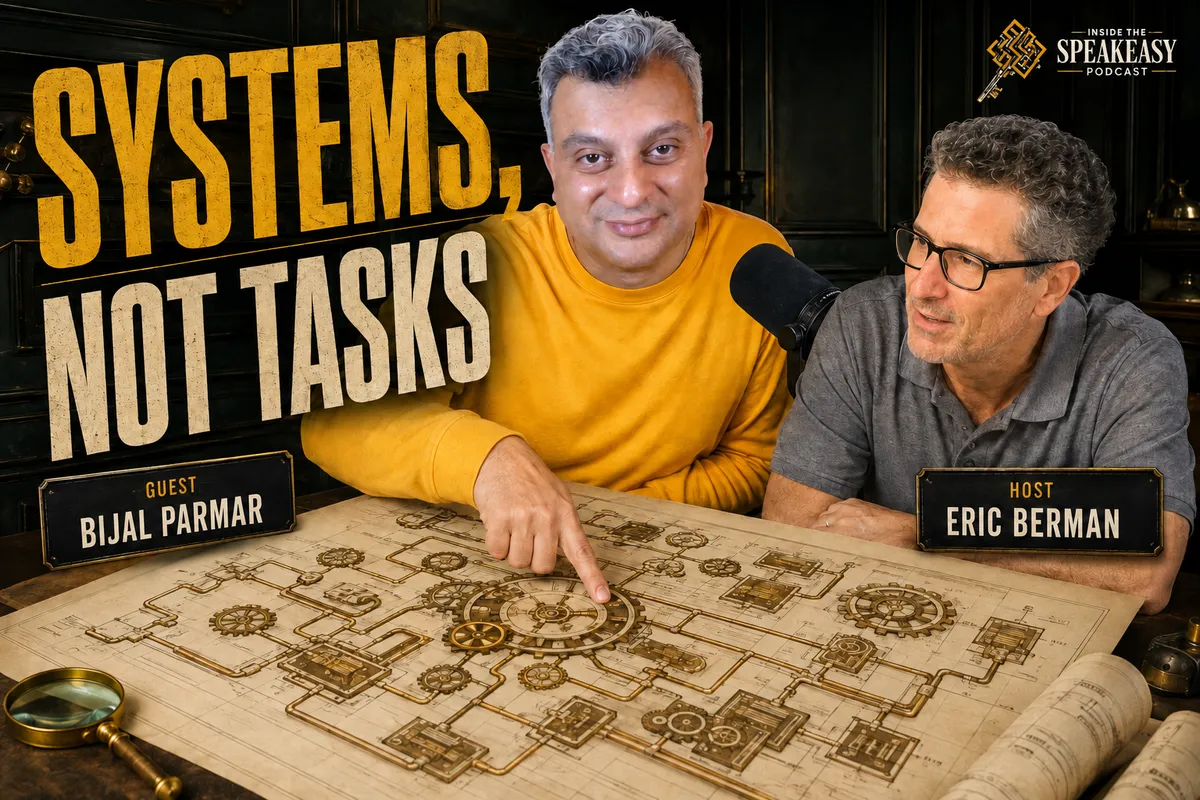
Beejel Parmar, founder of BeeEPiC Outsourcing and the Las Vegas Speakeasy chapter's MVP, has rebuilt his life and career more times than most entrepreneurs would care to count. In this conversation with host Eric Berman, Beejel traces the path from a UK aerospace engineering background to a San Diego business partnership that collapsed, repeated visa denials, and a February 2009 breaking point, and explains how learning to ask for help led him into the outsourcing industry. He then breaks down the model he designed when he started over in 2019: no markup fees, VAs coached in clusters he calls hives, and a system-first approach to delegation. Beejel also shares his FLAG rule for handling VA performance problems, his ROI framework for defining a role before hiring, and how he expects AI to reshape overseas hiring.
In this episode, you'll discover:
- Why Beejel believes eight or nine times out of 10 a struggling VA is a system problem, not a people problem, and what system-first delegation looks like in practice
- The FLAG rule Beejel teaches both clients and VAs, and why a first offense earns a yellow flag rather than an instant firing
- The ROI framework for defining a VA role: reclaim time, overcome task resistance, and increase leads, sales, and profit
- How BeeEPiC Outsourcing replaces the typical two-to-five-times agency markup with a coaching model and VA communities called hives
- The expensive lesson Beejel learned from ignoring warning signs and not asking for help, and how doing the opposite helped him start over in 2019
Episode Summary
Beejel Parmar grew up in the UK fascinated by flying and NASA, earned a background in aerospace engineering, and moved to the US in 1997, spending three years in Chicago. A friend then invited him to San Diego to start a company together in automotive recruiting. About a year in, Beejel discovered his partner had been misleading him, and the family lost nearly everything, including their home. He admits the warning signs were there, including checks that bounced for no reason, but he wanted to believe in a positive outcome. His biggest regret is that he did not ask for help. Instead of renting out the home and downsizing, the family panic-sold a house worth about $450,000 that he says is worth about $1.4 million today.
The setbacks kept coming. Around 2003 the family returned to the UK for a new visa and came back to start a brain state training center in La Jolla. At the end of 2006 the visa tied to that business was denied, with an immigration officer telling him he would have been better off opening a Dunkin' Donuts. After returning in 2007 and losing an engineering job in the crash, Beejel hit what he calls his dark night of the soul in February 2009. He describes contemplating suicide and picking up a knife out of anger at himself, until he saw the look in his wife's eyes and came to his senses. That moment became his turning point, and the first event he attended afterward was Turning Point with Marshall Sylver.
Inspired by The 4-Hour Workweek, Beejel decided to enter the outsourcing space with three VAs and new business cards. At his very first networking event, the first speaker on stage already ran an outsourcing business with about 100 VAs. Rather than walk away, Beejel asked him for advice, which led to a coffee meeting, an affiliate role, a master affiliate role, and finally a job. Over the next 10 years he helped grow that agency from about 100 to roughly 500 VAs. When an immigration lawyer's error forced the family to leave the US again in 2010, they sold about 99 percent of their belongings on what they call Freedom From Stuff Day and traveled for about five years while Beejel kept building the agency remotely, something he says was only possible because he had learned to work with VAs.
After returning to the US to help scale the company, Beejel and the CEO began pulling in different directions, and around Thanksgiving 2019 they parted ways. This time, Beejel did what he had not done before: he paused, took stock of his reputation and network, and asked people how he could help. He started BeeEPiC Outsourcing with no VAs and no clients and placed his first VA in January 2020. Drawing on a book about how beehives function, he redesigned the model. BeeEPiC does not charge clients the two-to-five-times markup he says is typical at agencies. Clients pay a nominal fee for ongoing coaching and course correction of their VAs, who are paid directly by the client and hired in clusters called hives that train and gather together every few months.
Much of the conversation focuses on what makes VA hires succeed. Beejel's core idea is system-first delegation: start with a business goal, identify the system that achieves it, document the SOPs, software, AI tools, and assets behind it, and then give a VA ownership of that system rather than a laundry list of tasks. He shares how his team uses Friday Think Time, an idea he credits to Keith Cunningham, to have every VA suggest system improvements, and how giving each weekly meeting a single purpose kept meetings shorter and more focused. He also explains his FLAG rule, which covers falsifying information, attendance and attitude, and gross negligence, along with client surveys that feed an AI tool to generate course-correction playbooks.
Asked for his top hiring tip, Beejel points to clarity of the role through his ROI framework, and notes that most BeeEPiC clients are solopreneurs and small teams growing from about $100,000 toward a quarter million. Eric adds his own lessons as a client: be patient, treat daily check-ins as your most important meeting while you delegate, and put people in roles that match their strengths. The episode closes on AI. Beejel expects many VAs to lose work as AI replaces routine tasks, but says those who keep learning are becoming far more valuable, effectively turning into system and AI operators so business owners can stay in the visionary role.
Big Ideas Discussed
Delegate Systems, Not Task Lists
Beejel argues that most business owners approach their first VA with a laundry list of tasks and hope for miracles. His alternative, which he calls system-first delegation, starts with a specific goal or problem and asks which system will achieve or solve it. Underneath that system sit the SOPs, processes, software, AI integrations, and assets such as websites, media kits, and books. Only then does the VA come in, as the system operator responsible for running it, tracking its KPIs, and reporting back.
The payoff is that owners no longer wake up wondering what to delegate, and problems become easier to diagnose. Beejel says that eight, if not nine, times out of 10 a breakdown is a system problem rather than an operator problem, and that a decently skilled VA can deliver strong ROI as long as the system works, much as McDonald's does not need a Michelin-star chef to assemble a burger. For owners whose systems live only in their heads, he suggests starting with an SOP library or asking an AI chat tool to draft a workable first version, then making ongoing improvement part of the VA's job.
Clear Lines in the Sand Make VA Relationships Work
Beejel's FLAG rule gives both clients and VAs clarity about what it takes to keep the job. The F stands for falsifying information or lying to a client, the A for attendance and attitude, and the G for gross negligence. A first violation earns a yellow flag, a second a red flag, and a third leads to dismissal. When clients ask why a lie does not mean immediate firing, Beejel explains that many VAs have worked in environments where they were told to lie to clients about their names, hours, or who was working on what, so he gives them a chance to adjust.
The rule works alongside regular feedback. Clients rate their VAs from one to five stars on factors such as ownership of the role and understanding instructions, and BeeEPiC runs the responses through an AI tool built on the company's experience to produce a course-correction playbook, which human performance managers then review with the VA. Beejel's point is that catching a VA who is a couple of degrees off course is far easier than rescuing one who has drifted far. He also invites VAs to give feedback on how business owners show up, because the relationship works both ways.
Define the Role Before You Hire: The ROI Framework
When Eric asks for one tip for anyone hiring a VA, Beejel says it is clarity of the role, which he frames with ROI. R is reclaiming time from busy work so the owner can focus on higher-value work. O is overcoming task resistance and procrastination by handing off the things the owner keeps avoiding. I is increasing leads, sales, and ultimately profit. For about 90 percent of BeeEPiC clients, he says, the reason to hire falls into one or more of those categories, while more mature businesses, roughly 10 to 20 percent, are usually hiring for scale in areas such as customer support and onboarding.
Eric adds the client's perspective. Delegation does not happen magically, he says, and owners who throw everything at a new VA without systems or patience tend to fail. He treats one or two daily check-ins as perhaps the most important meetings of his day while he is delegating, and he has seen a team member who struggled in one role thrive once she was moved to work that matched her skills. Beejel reinforces the point: many owners who say it is not working simply do not meet with their VAs or give them feedback.
Asking for Help Changes the Outcome
Beejel's story is shaped by a lesson he learned the hard way. When his San Diego partnership fell apart, he saw the warning signs and had friends around him, but he turned inward instead of reaching out. He believes that cost him millions of dollars, years of stress, and a home he panic-sold. The turning point came when he did the opposite, walking up to a competitor on stage and asking for advice, which led to a decade-long career in outsourcing.
When he was let go in 2019, he applied the same lesson immediately. He paused, listed his assets, including his reputation and network, and asked people how he could help, which brought in some operations work while he launched BeeEPiC Outsourcing from nothing. He tells Eric he now posts challenges on the Speakeasy forum even when they might sound silly, because someone always has a tip or an offer to meet. Eric says creating a place where entrepreneurs can be vulnerable without fear of judgment was a big part of the vision for Speakeasy.
Questions We Answer in This Episode
What is system-first delegation?
System-first delegation is Beejel Parmar's approach to working with VAs. Instead of handing a VA a list of tasks, the owner identifies a business goal, the system that achieves it, and the SOPs, software, AI tools, and assets behind it. The VA then owns and operates that system, tracks its KPIs, and suggests improvements.
Why does Beejel Parmar say most VA problems are system problems?
Beejel Parmar says that eight, if not nine, times out of 10 a breakdown is a system problem rather than an operator problem. If the system works, a decently skilled VA can deliver strong results without being a rock star. He compares it to McDonald's, which does not need a Michelin-star chef to make a burger.
What is the FLAG rule for managing VAs?
FLAG is Beejel Parmar's performance rule for VAs: F for falsifying information or lying to a client, A for attendance and attitude, and G for gross negligence. A first violation earns a yellow flag, a second a red flag, and a third leads to dismissal. He teaches the rule to both clients and VAs so expectations are clear from the start.
What is the ROI framework for hiring a VA?
Beejel Parmar uses ROI to clarify a VA role before hiring. R is reclaiming time from busy work, O is overcoming task resistance and procrastination, and I is increasing leads, sales, and profit. He says about 90 percent of his clients hire for one or more of those reasons.
How is BeeEPiC Outsourcing different from a typical VA agency?
Beejel Parmar says agencies typically charge clients a two-to-five-times markup on VA wages. BeeEPiC Outsourcing does not charge a markup; clients pay VAs directly and pay BeeEPiC a nominal fee for ongoing coaching and course correction. VAs are hired in clusters called hives that train together and meet every few months.
Will AI replace virtual assistants?
Beejel Parmar expects many VAs to struggle to find work as AI replaces tasks they have typically done. However, VAs who keep learning AI are becoming far more valuable and can do work that once cost around $100 per hour. He sees them evolving into system and AI operators so business owners can stay in the visionary role.
How did Beejel Parmar get into the outsourcing industry?
After a breaking point in February 2009, Beejel Parmar read The 4-Hour Workweek and decided to start an outsourcing business with three VAs. At his first event, the first speaker already ran an outsourcing company with about 100 VAs, so Beejel asked him for advice. That led to an affiliate role and then a job, and over 10 years he helped grow that agency to about 500 VAs.
Full Episode Transcript
Read the Full Episode Transcript
A Cold Open From Beejel Parmar's Lowest Moment
Beejel Parmar: I said, I'm highly educated, I shouldn't be in this position. Why I've been struggling. I've tried all these different entrepreneurial things and I actually contemplated suicide. It went to that dark place of like, would my million dollar life insurance policy be the thing that would safeguard my family's future, even though it may not be mine? I picked up a knife and I was so angry with myself, Eric. I was just so angry at failing my family, my wife, my kids, my parents, you know, and ultimately myself.
Eric Berman: Welcome to the Speakeasy Podcast where the real conversations happen behind closed doors with the boldest entrepreneurs, creators and growth minds in the game. No fluff, no filters, just the raw strategies, personal stories and mental models that move the needle. I'm Eric Berman. Now let's get into it. Today's episode. You're going to meet Beejel Parmar, one of our leading experts when it comes to hiring and VAs. And man, he's got some incredible systems and he's dropped some incredible nuggets today about what to look for when hiring VAs. What mistakes we entrepreneurs constantly make and really share some of his amazing stories and entrepreneurial journeys. Talk about a guy who's won from rags to riches and been burnt out and blown up so many times, four or five times moving from overseas to us, getting kicked out, making money, losing, going down to a dollar on almost committing suicide because he was down in the dumps. But he's made it out and he's thriving now more than ever. So excited. Welcome, Beejel Parmar. Welcome to Inside the Speakeasy Podcast, where today I'm so pumped and excited to have my newish friend. I'd say newish because I was fortunate to meet Beejel Parmar through Las Vegas at the launch of the Las Vegas Speakeasy chapter. And since then, I'd like to think we've become friends and colleagues and we've talked to each other quite a bit and formed a really good bond in the relationship. And really he's been a lot of my go to guy when it comes to all things hiring and outsourcing. VAs and he's been there for me all along the way over the last few years. Beejel, welcome to the show.
Beejel Parmar: Eric, thank you so much. And honestly, it's been a pleasure getting to know you for the last, I was going to say a year, but it's actually been about two or maybe even coming up to two and a half years now. You brought Speakeasy to Vegas, and it's probably one of the best things that could have happened.
Eric Berman: Thank you. Appreciate that. And likewise, you've been such an amazing member of our community, and I think the first time we did awards, you won one of our awards, so thank you for that. What was the award for again? Which one did you get?
Beejel Parmar: I think it's contribution to the Vegas chapter or MVP. The Vegas chapter.
Eric Berman: Nice. The Vegas MVP. I love it. I love it.
Why Beejel Always Wears Yellow
Eric Berman: And before we get started, you know, we're going to talk about history, but for anybody who has not seen Beejel or is wondering who the guy is, just look for the color yellow. You know, you talk about branding and other things now. You always have yellow. I know your company's called BeeEPiC, and I imagine the yellow has something to do with the B and the yellow B. But tell me through that and actually how that's. You know, I know we're going to get in some outsourcing, and I want to hear your amazing story because it's some great stuff to share, but I.
Beejel Parmar: Know you can see that, Eric. But this is the book I read right around my 50th birthday. I was actually working for another outsourcing company. I read the book on how to grow an organization based on the observation of a beehive and how bees function. And I thought, oh, that's kind of a cool idea. And slowly the yellow kind of emerged. When I started my own company, I felt like I want to do homage to the bee, the mighty bee, you know, because bees are actually a symbol of productivity. As business owners, we should be delegating ourselves out of doing the busy work. So the whole thing, the whole theme just came about. And now I'm just kind of known as a guy with the yellow jacket, the guy in yellow, so that the branding works. But I'm not a branding expert, just the color yellow.
Eric Berman: Well, I want to dig into that because there's a learn there. Like, I've seen people that do that. I mean, you know, you see, I think of Rudy Mawer, who I know, you know, I talked to recently. He's all in red, always in red. And that's like his thing. And that you're the guy in yellow. Like, has that actually helped? Has that got conversations?
Beejel Parmar: You know, when you have a foreign name, it's not easy to remember. But when I connect the dots to them, because I say, oh, what's your name? Beejel. So remember B. You know, my friends call me B, but remember B, yellow and black. So I kind of anchor the color. And then people will be out somewhere, they'll see the color yellow and they'll send me, hey, Beejel, I just saw this yellow car or I saw this yellow, you know, this honeycomb thing. And they'll send me messages so people remember the brand. So that's been very helpful.
Eric Berman: That's great. That's great. I'm sure you're a family and wife, loves looking at your wardrobe. It's quite a bit of yellow. And then when you go shopping, is it like you see, look for the yellow.
Beejel Parmar: It makes it very easy for them to shop for me.
Eric Berman: That's right. Any holiday present, it's, let's look for something yellow. It's great. Easy to gift at that point. How many pairs of yellow shoes you got? You got a couple?
Beejel Parmar: I got two.
Eric Berman: All right, all right. Well, cool.
From Aerospace Engineering to a San Diego Betrayal
Eric Berman: I know we're not here to talk about yellow all day, but you had an interesting story. Now remind me, I think you said you're from the UK, Is that right? Yeah.
Beejel Parmar: So I'm from the UK. I got a background in aerospace engineering. I came over to the US in 97, I lived three years in Chicago. And then a friend of mine said, hey, come join me in San Diego and we'll start a company together in automotive recruiting industry. And so I left my job of several years, we moved to San Diego, got into automotive recruiting and about a year into that relationship, I found out he was kind of lying to me, misleading us. And subsequently we pretty much lost everything. So we got to our dream. You know, San Diego was a dream of mine. Backpacked right after graduation across America. I remember coming to San Diego and I said, I want to move here, it's beautiful. And he finally made it happen, but as a kind of a short lived fairy tale again. About a year into our San Diego move, found out he was lying to me. We basically ended up losing our home. And the next several years was really challenging. But that's also the entry into entrepreneurship too.
Eric Berman: Wow. So I mean, how did you get through that? Okay, so you come out here. Well, first of all, let's back up a second. You came out from UK, what prompted you to come out here?
Beejel Parmar: You know, I grew up having a fascination for flying NASA. I was going to be a NASA engineer. And so that led me to come to the U.S. I was very young to actually 7 or 8 years old. We went to visit NASA, Disney World. I grew up American TV. So it's always been a childhood dream to get to come to the U.S. wow, that's great.
Eric Berman: So you made it out. You get to San Diego, you're thinking you're on a great path, went from NASA to auto, but to the. Onto the recruiting side and you get screwed over. I'd love to do lessons of sharing too.
Ignoring the Warning Signs and Not Asking for Help
Eric Berman: What about that experience? Can you share? Like, I mean, without maybe. Obviously we don't need to name names today. But you know, as far as like, what was the thing that you got screwed on? How could you have identified it sooner? What lesson would you share on that.
Beejel Parmar: At that time period? Quite a lot. I kind of made peace with it. Like, you know, what's happened has happened. Ultimately, I kind of had a feeling that very early on that something wasn't right. But you as entrepreneurs, you kind of look for the positive. You don't want to often believe the signs, right? If I looked at the data, and I'm using the word data because, you know, there's times where checks that would be written would just bounce for no reason at least, you know, I was like, why is this bouncing? So the data was there telling me something was wrong. But I wanted to believe, you know, that couldn't be true. I wanted to believe in the positive outcome. You know, he was the one who introduced me to Landmark Forum. For those of you who don't know, Landmark Forums kind of in the personal development realm. So, you know, I overlooked the signs and ultimately that it cost me a fortune. I mean, it literally cost me millions of dollars, peace of mind. I mean, it took me to a very depressive state. We had to leave the country multiple times, you know, because we don't ever become illegal. But we had to kind of go back to the UK, apply for a new visa, come back. Ultimately it cost us, you know, literally almost $65,000 to finally get our green card. And took 20 years from that point to get our green card. 70,000-odd dollars in legal fees and stuff. Not to mention the lost opportunity. But the signs were there, Eric. And here's the thing, I didn't ask for help. I was caught in the headlights. If I just asked people, hey, what do I do? All we have to do. We had a home back then, we bought a home. It was about 450,000 or whatever. If we just had the peace of mind, I'll just move out, rent the home out and just downscale your lifestyle and get yourself back on your feet, right? But in that moment, like panic sale, got to get out, you want to go into debt. And ultimately at home today is about $1.4 million right. So a very expensive lesson to learn on multiple fronts.
Eric Berman: Wow. And so part of when you say you didn't ask, I mean, is. It seems like a lot of questions didn't ask. Even along the way, when you saw those signs, you didn't know where to go to. And then afterwards, when you're going through that whirlwind, a lot of energy, a lot of panic probably set in, and you didn't have a community or anybody to reach out to, to ask for guidance.
Beejel Parmar: Is that so here's the funny thing. One thing. We've been very privileged. We've always had friends, we've always community. But, you know, when your back's up against the wall, you, instead of reaching out, we tend to kind of go in. We almost did the exact opposite of what we should do when we're in trouble. And bringing this kind of full circle a bit to. To Speakeasy. It's one of the things I really appreciate is whenever I've had a challenge, I've posted it on the Speakeasy forum, and somebody's always reached out with a little tip or even a offer, hey, let's meet and let's see what we can do. And I do that. I ask, even if it sounds silly, because someone out there is going to have an answer that you haven't thought about. And that's the importance of not just having a committee, but being able to share in the community and not feel that fear of being judged. I think one of the reasons that we don't ask is what will people say? You know, as business owners, I think every single person, every single one of us has gone through some kind of challenge. Right. In different flavors. And being part of this community, all I find is support from other members, not even people I've met. It's people who are part of other chapters as well. So that's why I'm such a big. A big, you know, fan of the community, of what you're building here.
Eric Berman: Oh, I really, really appreciate that. Yeah. No, that was a big part of the vision is to create a place where we could be vulnerable and scared sometimes. Being an entrepreneur and going through these big lessons and who can you turn to and who can you. Like you said, you know, the fear of how are people going to feel about it. And we've all been through these tough times and. And I'm glad the community's been there, so that. That's been big part of the vision. And so. And I appreciate you being vulnerable and sharing and reaching out as you have so let's go down the journey here.
Visa Denials, a Failed Wellness Center, and a 2009 Breaking Point
Eric Berman: So now you had to go back.
Beejel Parmar: Right around 2003 was when we first had to leave. So basically we sold a home, we went back to the UK, got a brand new visa, we came back, started a new business. This time it's kind of in the health and wellness space. I was one of the first people to kind of start doing what was known as brain state training. We hooked up to electrodes and basically through the brain patterns, we could basically do personal development work and actually see the brain change real time. So we had a center in La Jolla. I got approval from the U.S. immigration in the U.S. but in 2000, I think it was end of 2006, went back to the UK to get our actual visa and they denied it because there's no prior concept that they could model this off. And literally, I kid you not, this was the words from the immigration officer in the window. He goes, you've been better off opening up a Dunkin Donuts. And so our investment into this wellness center, which will be out to all high tech therapy beds and Tesla coils, I mean, it was state of the art stuff back then, went down the drain. So again, we had to come back, fire-sell everything, like 10 cents on the dollar. We left, got a brand new visa, we came back at the end of the year, about September of 2007. Now I worked for an engineering company for about a year. Then we hit the crash, lost that position. We had to leave anyway. So 2009 was basically dark night of the soul moment. It was February 2009. I said, I'm highly educated, I shouldn't be in this position. Why? I've been struggling, I've tried all these different entrepreneurial things and I actually contemplated suicide. It went to that dark place of like, would my million dollar life insurance policy be the thing that would safeguard my family's future even though it, you know, may not be mine? Anyway, thank God. Well, it never went further than, well, here's what really happened, if you want to know the truth. I picked up a knife and I was so angry with myself, Eric. I was just so angry at failing my family, my wife, my kids, my parents, you know, and ultimately myself. And. But thankfully, literally, I saw the look on my wife's eyes and I came to my senses. That was the start of the turning point, you know, and ironically, the very first event I went back to, to kind of build something out of this was called Turning Point with Marshall Sylver and went through a series of courses with him.
Asking a Competitor for Help and Entering Outsourcing
Beejel Parmar: And eventually I was in one of the workshops and I was thinking about, what do I do next? Like, I was in a lost place. And I just read The 4-Hour Workweek and I thought, you know, maybe I should kind of play around with this idea. And the very next event, I went to the very first speaker. Oh, this is funny. So I basically decided to get into the outsourcing space. I didn't know anybody. I knew a friend who had hired a Filipino. So I offer that connection. And I started with three VAs. So I got my new business cards and I was all pumped up. I was going to go to my first event, going to, you know, make all these connections and start my business. But the very first speaker on stage happened to be in the outsourcing business. I was like, are you effing kidding me? Right? This is my big moment, my big relaunch in life. And the very first speaker. [unclear]. He has been a successful entrepreneur. He's built a team of about 100 VAs at the time. And I was like, he just stole my thunder. But one of the things I'd learned, it was all, you know, ask for help. So he went up to him and said, look, I'm in the same business. I'm trying to get started. Would you give me some advice? Long story short, we had a coffee the following week, and he offered me, hey. To become an affiliate. That became an affiliate Master Affiliate. Eventually said, look, why don't you just join me? And for the next 10 years, I helped grow that. That agency from 100 to about 500 VAs. So that kind of brings us up to kind of about 2019. But that's how I got into the industry. So I picked up The 4-Hour Workweek by Tim Ferriss, fell in love with the idea, and here we are.
Five Years Abroad Building a Remote Agency
Eric Berman: And one thing that I would, you know, commend you on is, you know, you've learned along the way too, you're not. I mean, I could see you've been out, what, five times now. You came in and out. You try to get out there to stay four times.
Beejel Parmar: Three of the three or four times. Yeah. And that moved the whole family because my kids, my wife, you know.
Eric Berman: Yeah.
Beejel Parmar: I mean, last time, 2009 is when I joined the agency. 2010, My immigration lawyer screws up our immigration paperwork. So I've got this newly found relationship, you know, working with somebody I just met several months earlier. My lawyer says, you've got two choices. Either you leave the country or become illegal. Well, we don't become illegal. So I then I had to break the news to him and say, hey, I'm really sorry, but we have to leave the country. And he goes, look, well, we talk about the laptop lifestyle. So, you know, just as long as you can do your work, we're all good. So we left the US and it was basically, we started to sell all of our stuff. July 4th of 2010, we call Freedom From Stuff Day. We sold pretty much 99% of all of our things. And we packed our, you know, we always say packed four red bags, three laptops, two kids, one wife. And in September, we left the US and we thought we'd be away for around six months, maybe a year, get a new visa and come back. We ended up traveling for about five years while building the outsourcing agency. If it wasn't for the VAs supporting that journey, you know, just, we wouldn't have been able to travel, enjoy the travel, you know, build a company, had I not cut my teeth on learning how to work with VAs.
Eric Berman: That's amazing. And clearly, I mean, the message too is, I mean, when you're pushing that hard and you're going through the kind of scar wounds and the battle wounds, you've been, I mean, you're hungry, you weren't afraid to go approach that guy on stage and ask and just be curious and say, I'm going to figure out a way to make this work. And, you know, if there's a will, there's a way, right? You just keep going and grinding. And that's such an incredible story of how hard you've gone and how you persevered and congrats on that. And, you know, here we are today, now, you know, running your own. You learned a lot from that, obviously, that experience.
Parting Ways and Reinventing the VA Agency Model
Eric Berman: And so now you must have broken off, obviously at some point and tell us through that moment what happened.
Beejel Parmar: So, you know, eventually the CEO said, hey, Beejel, can you come back to the U.S. we want to scale the company or grow the company. You know, from where we had been around 500, well, I think at the time it was around 400ish or whatever. I said, okay, yeah. So we basically got a brand new visa. We came back on a H1 visa, and I started to, you know, help grow the business. But around 2017, 18, right when crypto was really kind of starting to make a buzz, the CEO was kind of going in one direction, I wanted to take the company in a different direction. We were not seeing eye to eye and turned around right the day after Thanksgiving 2019, I said, Beejel, we got to part ways and you know, initially it was like another shock is like, oh my God, like what am I going to do? But honestly, he gave me a favor. And I always remember because when we first started to work together, he said, Beejel, look, I'm gonna teach you everything about this business. And he did, you know, he taught me a lot. I got to go to the Philippines with him. But also learned a lot about what not to do or not how I would do things different in 2019. As I mentioned, I just picked up this book and I was kind of inspired by some of the stuff I learned about, you know, bees and the bee behavior. So how do I do? If I had to reinvent this industry, how would I do it differently? So some of the things that I did differently is I didn't want to charge our clients markup fees. A lot of the clients that we were servicing were really kind of early stage entrepreneurs or entrepreneurs who kind of just didn't have big budgets. They were not your big, you know, seven figure businesses. There are people who are kind of trying to scale from the kind of sometimes the low six figures upwards. So they were very cash tight. And they said, well, how about we don't focus on profit per hour, which is how most agencies work through a markup fee right around. Most clients don't realize if they hired somebody through an agency, it's typically a two to five times markup. Instead, we focus on performance, kind of like a coaching program for VAs. So rather than clients pay us this markup fee, they pay us to help support and course correct their VA so VAs can actually perform better. So I took the membership type model, I'm sorry, the coaching membership type model, applied it to this industry. We don't charge the VAs anything, but the clients pay us a very nominal fee. We use that to basically do online trainings, in person gatherings. And I use this concept of a hive, which is where another B analogy comes from, where we hire in clusters. So that means that every 3, 4, 5 months VAs can actually get together just as we get together as a community. Eric. You know, for Speakeasy, they get to train each other. They do some fun events. I go over once a year. We do a big party. We do the Harry Potter themed training event using AI. Last year we did Rockstar where everyone got dressed up as rock stars. We had to use AI to write songs and do promotional campaigns and stuff. So we tried to make being part of this community fun. Even though they're Actually getting paid directly by the client. So apart from my internal team, all the VAs get paid by the clients, but we look at them as part of our community. So it's kind of. We try and incorporate that aspect for our VAs and our clients.
Eric Berman: Yep. No, I love it. And it's an interesting model. Because I'm a customer of your model. I always found it interesting because you. I tend to remember the hourly rate I'm paying the people I hire through you. I'm like, damn, this is a good rate. Getting great quality people at this rate. And I know there's an ongoing service fee as well, but I attributed that to exactly what you said. I look at that and say, well, I know Beejel is doing great with that. That money that's going to make them better. It gives them the culture and all the other things that I don't have to worry about. You're taking care of all those other things, which, like you said, that's some of the stuff that if I was paying you, let's say five bucks an hour for an employee, you know, oftentimes that might be 8, 9, 10 an hour through other agencies. And they're using that money, in theory to do some of that stuff, you hope, but you don't know what they're doing, you know, kind of thing. And I know you're doing good by them.
Starting BeeEPiC Outsourcing From Scratch
Eric Berman: Well, I'm gonna go back one second on that flip over. You were working. You know, you had that job forever. You, you know, with him, and you learned a lot. Tell me through your fears, what's the emotional state? And then I want to dive back into your business today because it's a great model, but what's your emotional state when, like, was it like, no brainer, you're going to go do your own business? Because all these other times you were working with somebody else, yet now you're an entrepreneur, running it yourself. And so walk us through that journey of, okay, I'm on my own now.
Beejel Parmar: We met for coffee. It was the day of Thanksgiving, 2019. We met for coffee, and we had been going through a bit of a challenging time. The agency had been going through a bit of a challenging time. Part of it, I felt, was because of lack of focus. Right. Instead of trying to focus on one thing and do it well, we've kind of been doing a little bit of this and a little bit of that and kind of dabbling with AI and stuff. So this was like, hey, this is my vision for the next kind of six months to get us Back on track. We had this conversation. I was feeling really good about having delivered this kind of strategic plan. And I remember I said, hey, Beejel, I'm sorry, I gotta cut you loose, right? We gotta just part ways, cut you loose. So I was like, first, it was a shock. I didn't see that coming, right? And I say that, but I think in my heart, I kind of felt it was. Sooner or later it was gonna happen, right? We had kind of. We had a decade together. We did some great stuff. We did live events together. By the time it had run its course. But in the moment, the first 24 hours was like, panic, right? What am I going to do? You know, we didn't have, you know, a lot saved up because the move back from India back to the US Cost quite a bit. The first few months, the first year or so of being back, we were really tight. So a lot of money was going out, not in. And so I was like, oh, my God, what do we do here? But everything I'd learned from the previous experience of, you know, kind of hitting that deer in the headlights, it was like, okay, pause. Okay. What are the assets that I have, right? I've got my reputation. I built a good network of people. And I just started to ask Eric. I just. I did exactly what I didn't do the first time around, right? I said, hey, how can I help you? What can I do? Here's some of my skill, my talents. A few people who I knew needed some help from an operational perspective, I started to help them out. Got a little bit of money coming in at the time, and I started the new company, BeeEPiC Outsourcing. There was no VA, there was no clients. It was literally the idea. And again, you build it back up again. And so I think, you know, you have. You could have that faith, hope, whatever is the right word, that there is light somewhere. But you just got to keep working towards it and not stay stagnant. But, yeah, that's kind of how we started. So we started really, I would say January of. I always say December of 2019, but that was Christmas month. I don't think I did anything in outsourcing back then, apart from conversations, but the really, the first VA was placed, I think January of 2020.
System-First Delegation Explained
Eric Berman: Wow, that's great. And now you're own entrepreneur making it happen. And as we said, you have a unique model. How's it been? Tell us about the ups and downs of what you've learned the most now, being an entrepreneur. And really, I would say, let's Talk a little bit more. And within that, within the space that is now, I think clearly gotten more competitive as more and more people go out there to try or hire overseas. What do you see in the industry? For those that are listening, what kind of tips do you have for people looking to hire?
Beejel Parmar: So it's a very competitive space. I mean, it was back then, you know, we do things a little bit differently, right? So we're not an agency and we're not exactly, you know, hiring direct. So we're kind of this hybrid model where, you know, in a way we're assisting people to hire directly, which have a very nominal fee for that, the hiring part. But where we make our money is this ongoing course correction. So I know that people who hire through agencies are paying about two to five times markup. So a lot of their money is going into that markup. And the other people I know I've hired directly are not getting what I call a five star performance out of the VA. We're looking to bridge that gap. So even though it's a very competitive space, you know, we've carved out a brand, we've carved out a niche for ourselves there. But ultimately, when I look at, you know, how do we help our clients become more successful with their VAs, there's a few things that we've done a little bit differently. So first of all, we talk about system first delegation. Most people, when they finally come around to the idea of hiring a VA, they're often thinking about their laundry list of tasks that they want to delegate. And they often take their add list and pass it onto their VA and hope for miracles that the VA is going to take care of this list, which is great. Ultimately, that's why we want to get stuff off our plate to the VAs. But what I coined is what I call system first delegation or system first outsourcing. What I mean by that is every business has some specific goals or issues they are looking to achieve or resolve. The next question is what is the system that that's going to help you achieve that goal or overcome that issue? Right. And this is not my original idea. I got the idea from several books. One of them being How to Fail at Almost Everything and Still Win Big. And the other one was Black Box Thinking. I think that was the very first book that really tuned me into how to think about this as a system problem, not a VA problem. And then once we can identify the system. Now underneath the system are your SOPs, your processes, your. The software that might be part of the System. And today, of course, AI integration is part of the system. The assets, such as your websites, your media kit, your brand, your book, et cetera. And then the final part of that is the system operator, the VA. So why is this relevant to this conversation? Because if you are assigning the system responsibility to your VA, you don't have to wake up every morning think, oh my God, what task am I going to delegate? That can be overwhelming in itself. Now, the VAs are trained in a system. They own the system. I often say, delegate your thinking. Delegate the responsibility of the system being run by to the team member, not just the tasks, right? Their job is to look at, track the KPIs, report the KPIs to you. You can make a decision whether the system is functioning. The system is not doing its job. Is it a system problem or an operator problem? Eight, if not, nine times out of 10, it's usually a system problem. You can take a mediocre VA. What I mean by the mediocre, I mean that they're low quality. I'm saying, you know, a fairly, you know, a decently skilled VA, but not like a rock star or exceptional, whatever. But as long as they're running the system, system is working. You can get the ROI you want out of that system, right? You don't have to go hire rock stars every single time. You just need to hire somebody who's got the qualifications and ability to run a system. The same way McDonald's has a system for building burgers. They don't need a five star chef, they don't need a Michelin star chef to build a burger. They need somebody how can basically put the burger on the grill and put it in a bun and close the thing, put in a box and hand it over, right?
Eric Berman: So it's a good analogy. So I mean, if they don't have that, that SOP or that system in place and you're hiring people to work, you know, flip burgers, they may not do it right? They may not do it exactly. You want, you never taught them the system and you don't have your system together. And obviously there's a lot of people that fail when they come to you in the first place because they're like, well, I don't have systems, I don't have time to put systems together.
Think Time and Single-Purpose Team Meetings
Eric Berman: So what do you recommend in those situations?
Beejel Parmar: We basically, we have a library of SOPs. But in this day and age, it's just as easy to go chat and say, hey, build me a system to accomplish this task. It doesn't have to be a perfect system. Start with a something that works. Sometimes most of the systems are actually locked up in a client's head, in which case we can do a little bit of a deep dive. And then we basically extract the systems or create the systems. And they say part of the VA or the system operator. VA's job is ongoing system improvement. Once the VA has been onboarded, they've been given the system, they know how the system runs. Part of what I call every Friday, we have in our company called Think Time. I got the idea of Keith Cunningham. So we meet with the whole team and I'll go back to the weekly meetings in a second because it's important, but every Friday is Think Time. I asked the VAs, hey, so how's your system running? What are the issues that are coming up? How do you think you can improve it? And then I said, great, next week I want you to explore what tools or softwares or methodologies can we do to improve that system. Right. So we're always a system first company we're looking. Every single VA now owns systems in the company and it's their job to kind of suggest ideas of how to improve that system. So another thing, talking about meetings now. So that's our Friday meeting. Before, we'd have three, like team meetings a week. And you know, these meetings would kind of ramble on and go in different directions and everything else. Two months ago now, we switched that model to every meeting has a very specific purpose. So Mondays is like our HR meeting, right? It's all about hiring the VAs. Tuesday is Finance and admin, Wednesdays is lead gen, Thursdays is matching, and Fridays is Think Time. That means that everybody who's going, who needs to be on that meeting knows what the meeting's about. We can keep the meeting shorter, stay on topic. We save time. But more than anything else, it saves mental energy because we're not going all over the map, you know, during these meetings. And one of the biggest things, when people say it's not working out, they don't meet with their VAs. They don't take time to meet with the VAs, have conversations. They hire VAs and just basically hope that the VAs are magically gonna figure out their business and do the right thing. It doesn't work like that. We got to be as kind of the partner in the five star performance. We have to do our role of, you know, showing up, giving that feedback, looking at what the VA is doing, apply some course correction, and that's what we help. That's where basically a lot of people say, look, I just don't know how to do this.
The FLAG System and Course-Correction Feedback
Eric Berman: That's a question I have because I imagine you're getting clients who just keep turning over VAs. And the end of the day it's not the VA problems, they're the problem. So at what point can you identify that and what do you do those customers? Maybe again, what kind of suggestions you have for us or maybe many of us are the problem.
Beejel Parmar: [unclear], look, when you're hiring VAs, they're from a different country, different culture, they may even speak the same language. But if they're from the Philippines, they may process and think differently. So there's going to be breakdowns. So first of all, if the knowledge, if you're going to work on a budget, there's going to be things you're going to have to work through, right? For that matter, you can hire people here locally for a hundred dollars per hour. There's still going to be issues. So you're never going to get like a no issue hire. So then the onus is on us like we use kind of systems and KPIs. We know when things are not kind of working out the way they should. We're going to see behavior. So I have something called, I call it flag. So FLAG stands for falsifying information, lying to a client. The A stands for attendance and attitude. And the G is like gross negligence. It's kind of a little bit of a catch all. But I teach both the clients and the VA's this. I said, look, you're going to be okay working with your client. But if you've violate any of these kind of four criteria, then you're going to be issued a yellow flag. We think, hey Beejel, why wouldn't you just, if someone lies to me, why wouldn't you just kind of fire them on the spot? The reason being is that most VAs have worked in environments where they've been basically told to lie to their clients, right? For various reasons, right? Lying about their name, lying about the hours, lying about who's working on what projects. So I have to acknowledge that sometimes it's not that they want to be liars, is that that's how they protected their ass. So I give them, right? And so the first offense is a yellow flag, the second fence is a red flag, and the third time is dismissal. So that that way you set up the parameters of hey, this is when you're going to get let go right from the beginning, right as long as you know these things don't happen. As long as you can do your job and you don't violate this, we're golden. So clarity of what it's going to take to keep the job and what it's going to, what's going to happen if you violate these things. Most people never put these, you know, these lines in the sand. It's just basically they hire them and then one day the client might say, you know what, it's not working out. We've just gone too far on this tangent. And they just say, hey, we know we need a new VA. And what I like to do is like if we check in regularly and what we do is we send out kind of a survey and that allows for what I call instant feedback. And what happens is if we allow a VA to go this far off course, it's almost, it makes it more challenging to bring them back online. However, if they go off by a couple of degrees now, we can basically say, look, here's the recipe or here's the prescription and bring them back in line. So we built something called actually the outsourcing model model and like the [unclear] model is built on ownership of the role, understanding the job, understanding instructions, et cetera. And what the clients do. They basically answer. They basically rate the VAs from 1 to 5 star in these parameters with a little of kind of input of what the issue is. It runs it through an AI brain built on our kind of decades of experience and it spits out basically a course correction playbook for the VAs.
Eric Berman: Nice.
Beejel Parmar: And our human performance managers check in. Do you understand what the course corrections are? Can we help you? What resources do you need? And that's how we kind of bring them back online. When we were building this, I said, well, hang on a second, who knows better than your VA how you actually show up, how we actually show up as business owners. Now not every business owner is open to this, but they should be because the insights you get from this, feedback from somebody who's kind of really seeing this into a human to human interaction can be invaluable, especially if we aspire to improve our performance too. Because it is a two way thing. You can't just have a lifestyle VA and expect the best outcome.
Eric Berman: Totally.
The ROI Framework for Defining a VA Role
Eric Berman: What would you say is the number one tip you have for any of us who are looking to hire VA? And then I'm going to get sort of two part question. I think most of your VA is in the Philippines, if I'm not mistaken. Right.
Beejel Parmar: Well, today, well, the most of them are in the Philippines, but we have a growing hive community in Nairobi, Kenya. Great EAs coming out of there, highly educated, they're raising English schools. South Africa and Colombia. We had a kind of a growing request for Latin VAs too. So we now expand these four countries.
Eric Berman: I was asking where else you're seeing them pop up and so you just hit that question. So, okay, so you're getting some good pockets, good hives out in those areas. And so then first part of my question is what's the probably the one tip takeaway you would give to us that are looking to hire VAs to make sure we have the most success?
Beejel Parmar: Yeah. So the tip is clarity of what the role is. I have something called ROI R is reclaim time. So where do you need somebody to come and help you reclaim time from? Busy work?
Eric Berman: Right.
Beejel Parmar: So you can do spend more of your time on the higher value work. The O is overcoming task resistance and procrastination. So what are the things that you're avoiding doing? And the I is basically how do you increase leads and sales and ultimately profit?
Eric Berman: Right.
Beejel Parmar: So for 90% of our clients, so the reason to hire a VA is going to be in one or multiple of those categories. Now for say more mature businesses, it might be scale. There's scale going on. They want to onboard customer support, customer onboarding type things. But that's probably about maybe 10, 20% of our business. The rest are what I call solopreneurs, micropreneurs. Small mom and pop teams that are kind of, you know, growing out of their 100,000 range up into maybe a quarter million range. But they still have cash flow challenges and we'll keep the budgets super tight and they're the ones who, that we kind of specialize in serving.
Eric Berman: Yep, yep. No, I love it. I mean for me, my tips on that having been the other side is everything you said, plus I just, you know, be patient. I think you said it earlier. If you don't have the systems and yourself in place, you're going to fail. Like, you got to be patient. As much as we want to just delegate everything and say, okay, they're here, let me just throw everything in their way. It's going to fail. You got to do all those daily check ins and figure out a way to put them in that. I always say, like that daily check in or check ins, you know, one or two a day is almost becomes, in my opinion, your most important meeting of the day. Despite everything else, especially when you're that mode of delegating off and teaching them. Otherwise, you're just missing such great opportunity. And once you can get everything off your plate, then you get that time back. But you can't. This doesn't happen magically. You got to mentally prepare for it. And I've seen too many times, I've watched too many times people failing to do that exercise. And I think the other thing that I could tell you that I've learned as well is it's like anything else. It's like right butts, right seats. You know, we've had somebody in our team who was passed over, and I worked with this person on some projects and she's been amazing. And it's just like somebody else. And I'm like, well, I don't think you guys spend enough time with her. Or perhaps you were pushing her to do a skill set that she wasn't great at. So find the skills they're great at and they'll thrive in there because they all have the right attitude. I've seen they're hungry and it's been amazing to work with. And I certainly encourage anybody listening, if you haven't done it, do it. Like, just go learn it, figure it out. It's not a high cost, especially five bucks an hour for some of these people. And I'm just like so shocked at what I've gotten. Even today, I could share my Speakeasy right arm who's been with me for beginning. I'd be so in trouble without her. She's doing such an amazing job and she's been incredible. And somebody out here in the States for that kind of salary is significantly more than what we're paying. And I'm paying her well for Philippines wages. But absolutely.
How AI Will Change Overseas Hiring
Eric Berman: One last question I was going to ask you is, what do you see? I like that you're a tech background guy, so you're obviously nerding out like the rest of us in the world of AI. What are you seeing with respect to how AI is going to affect the overseas hiring? You know, Philippines, Colombia, anywhere else, I.
Beejel Parmar: Would be like, I say it's not going to have an effect. I think a lot of VAs are going to probably lose a lot of their jobs. But what it's really doing, at least for those who are willing to stay up to date on, I wouldn't call them AI experts. Right. But just AI technology is. It's allowing VAs to be far more valuable to businesses. I mean, the VAs can do things today that you may have had to pay somebody you know, a hundred dollars per hour for not more than two, couple of years back. Right. So right now is. I don't know if saying it's the honeymoon period is the right word even. But right now AI is giving VAs an ability to, to do things or perform at a higher level. All right, now, as AI changes, I think, you know, a lot more VA is going to struggle to find work as some of the things that VAs have typically done get replaced. I think there's going to be a lot of VA sitting on the sidelines, you know, hoping to get work. So, you know, any VAs having to listen to this, basically, you know, learn AI, learn how to be a result. That's another reason, Eric, that we say system first delegation and system operators. Because when I say system, a system in this day and age typically would include AI as part of that system. So turning our VAs from VAs to becoming system operators means. And technically they're AI operators. So they're the ones who are still operating the AI and managing the AI, driving a lot of businesses. Because again, our role should not be in that. Our role should be the visionary role, staying on top of steering the business and not having to be the ones learning all the AI. Right? Yeah. What's the goal? What's the system? Who can operate the system?
Eric Berman: Yeah, I mean, I kind of see it the same way because I'm watching that again live, real time. It's like I'm watching those that are same way just being more efficient. You're using AI, you know, they're taking the task off my hand plate instead of me asking the prompts, digging in there. They're doing the same things that I would do and that they know the system of what needs to happen. So I like the way you say that. I didn't think of it that way in the system first delegation, which is brilliant. Well, thank you for dropping all those amazing words of wisdom and for being there for myself, for my needs, for hiring and for people in the community. You've been so great at engaging others. And I think anybody who should definitely reach out to you if they have questions on the things we talked about and other. I know it's BeeEPiC Outsourcing. It's Bee, of course, EPiC Outsourcing. And get a chance to meet Beejel. And I look forward to seeing you when I hit Vegas next or I'm sure at the next conference. And thank you so much for joining us today.
Beejel Parmar: We'll see you soon. Thanks so much.
Eric Berman: And that's a wrap from the Speakeasy podcast if something sparked for you, but don't keep it to yourself. Share it, review it, and pass it to the one person who needs to hear this right now. Want in on the real Mastermind? Tap the link in the show notes to apply until next time. Keep scaling, stay sharp, and don't be the smartest one in the room.

About The Guest
Beejel Parmar
Beejel Parmar is the founder and CEO of BeeEPiC Outsourcing, a Las Vegas-based company that helps entrepreneurs hire, train, and manage virtual assistants. Originally from the UK with a background in aerospace engineering, Beejel moved to the US in 1997 and worked through a series of entrepreneurial setbacks and visa challenges before entering the outsourcing industry in 2009. Over the next decade he helped grow an outsourcing agency from about 100 to roughly 500 VAs, much of that time while traveling abroad with his family. He launched BeeEPiC Outsourcing at the end of 2019 with a coaching-based model that avoids agency markups and organizes VAs into communities called hives, with VAs in the Philippines, Kenya, South Africa, and Colombia. Beejel teaches system-first delegation and is a member of the Las Vegas chapter of Speakeasy Mastermind, where he was recognized as the chapter's MVP.



