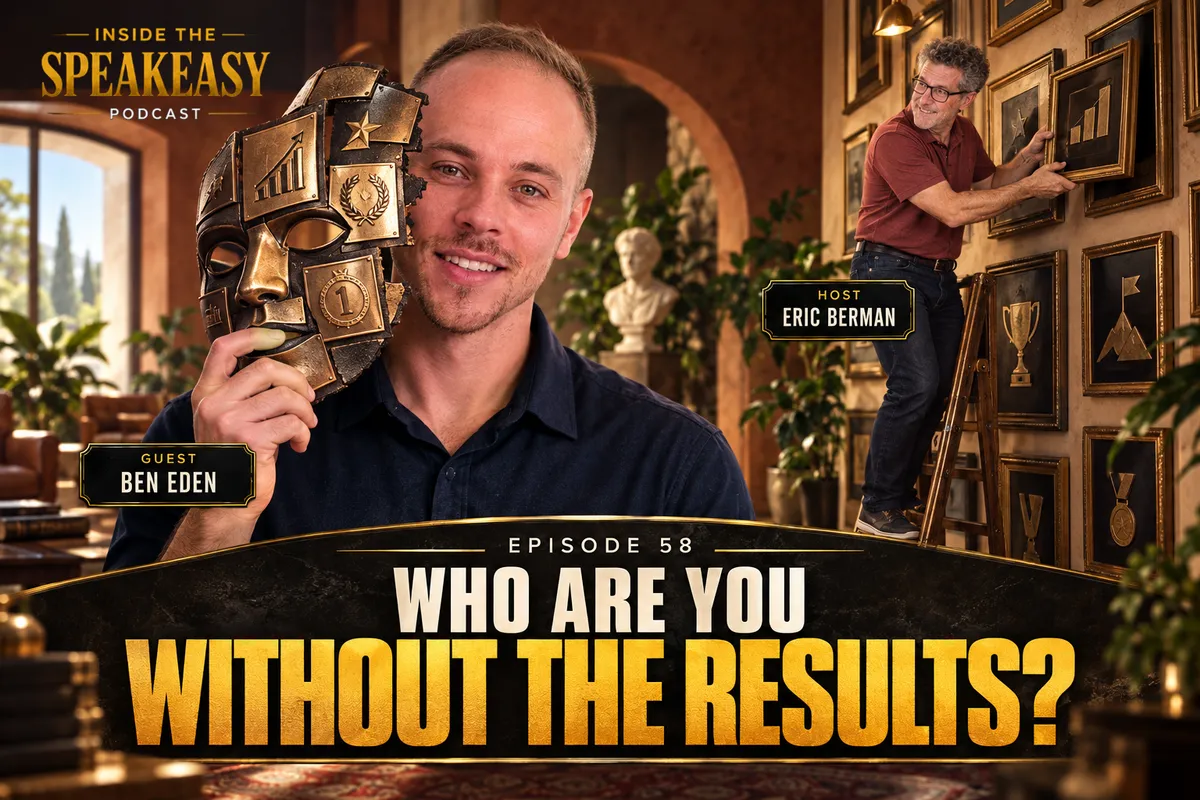
Ben Eden, author of How We See Ourselves and the leadership coach behind the Eden Model, argues that most entrepreneurs who feel stuck do not need another skill, strategy, or tactic. They need to change how they see themselves. Ben learned this the hard way. He became an HR executive in his 20s, checked every box the world calls success, and still felt like a failure after his CEO told him, "We have nothing against you. We just hate HR." In this conversation with host Eric Berman, Ben walks through the six layers of the Eden Model, from results at the top to identity at the base, and explains why swapping "What else should I be doing?" for "Who am I becoming?" changes everything above it. He also shares the childhood dodgeball moment that shaped 20 years of his life, a client who rewrote how he talked about drinking, and three signals that reveal where your real strengths lie.
In this episode, you'll discover:
- Why chasing results and tying your self-worth to them leaves even high-achieving entrepreneurs feeling empty, stuck, and asking whether this is all there is
- How the Eden Model stacks results, behaviors, emotions, thoughts, beliefs, and identity, and why a stalled goal sends your mind straight to identity
- The one question shift Ben Eden recommends: stop asking what else you should be doing and start asking who you want to become
- Three signals that point to a hidden strength, including work you watch others do and know you could do better, and praise you shrug off as easy
- How Eric Berman recognized that the dinner group he quietly organized for 15 years was the lane he belonged in all along
Episode Summary
Ben Eden's central argument is that the standard path to success is built backward. Most people are taught to chase results, feel good when they get them, and then call themselves successful. Ben demonstrates the problem live with host Eric Berman. When Ben asks what an F in school means, Eric lands on "You're a failure." Ben points out that almost everyone does this: they turn a result into an identity statement. Instead of "I got a failing grade," the mind says "I failed," and that habit follows people into their careers and their companies.
Ben lived that pattern for years. He studied human resources, earned a master's degree, became an executive in his 20s, traveled the world, and helped a company go international. By every outside measure he was successful. Then his CEO told him, "Ben, we have nothing against you. We just hate HR." Because Ben had built his entire identity around being an HR professional, he heard that he was hated. His brain began collecting proof, from missed meetings to lunches he was not invited to, and he felt like a complete failure while wearing what he calls a mask of success. Ben shares candidly that he turned to an addiction during this period, which deepened the gap between his values and his behavior.
The turning point came through a support group and then therapy. In the group, Ben saw successful, intelligent people who looked just like him, which made him wonder whether he could still be a good person who had turned to a bad behavior. In therapy, he learned that every behavior is driven by an emotional need and traced his own emotional pain back to a dodgeball game at age nine. After a moment of feeling that he belonged and was good at something, his friends laughed at his sweaty armpits and called it gross and disgusting. Ben says he carried that message for 20 years and hid behind a "shield of success," keeping people at arm's length. Revisiting that memory with his therapist began to change how he saw himself, and it eventually gave him the confidence to leave his executive role to become a speaker and coach, even though he made the leap in February 2020.
From there, Ben lays out the Eden Model, a pyramid with results at the top followed by behaviors, emotions, thoughts, beliefs, and identity at the base. Using a million-dollar revenue goal as the example, he shows how everything flows smoothly while results come in. When the strategies stop working, people skip every middle layer and go straight to identity: Am I meant to do this? Maybe this is not for me. Ben's fix is to change the question. Asking "What else should I be doing?" or "Why isn't this working for me?" leads to endless tactics or a list of reasons it won't work. Asking "Who am I, and is that who I want to become?" works from the foundation up. He illustrates this with a client, a director at a medical facility, who could not be promoted until he saw himself as a VP and who later stopped calling himself an alcoholic and started saying "I used to drink."
The conversation becomes personal when Eric applies the model to himself. He describes years as a number two, then as an agency owner partnered with Brian Tracy, doing work that looked successful but never felt like his identity. What did feel right was the dinner group he had organized for 15 years, the seed of Speakeasy. Ben points out how Eric's energy shifted as he told that part of the story and offers three signals for finding your own lane: work you watch others do and feel you could do better, what the people around you consistently say you are good at, and strengths you dismiss because they come easily.
Ben closes by connecting identity to fulfillment. Success on a resume, he says, is fragile when it rests on one pillar while family, health, finances, and contribution are neglected. He describes his 90-day coaching packages and why outside challenge speeds the work, and he shares that Speakeasy is the first group where he has felt he belongs, which he credits with changing how he sees himself and, in turn, his results.
Big Ideas Discussed
Stuck Entrepreneurs Need an Identity Shift, Not a New Tactic
Ben Eden's core claim is that when entrepreneurs hit a plateau, the missing piece is rarely another skill, strategy, or fad. It is how they see themselves. Ben speaks from experience. As an HR executive, he read the books, attended the seminars, and listened to the gurus, and none of it changed how he felt. What finally worked was the deeper internal work of understanding the emotional pain he had carried since childhood and replacing the story he told about himself.
That shift is what made his career change possible. Ben says a speaker at a conference triggered a strong tug in his chest and the question, "Why are you not on that stage?" Before his inner work, he would have answered with his nine-year-old self's shame. Afterward, he could see himself as a speaker and coach, and he committed to doing whatever it took. He left his executive role in February 2020 and says he did not waver, because his confidence rested on identity rather than on hitting a number of stages in a set timeframe. For a founder, the lesson is that results can lag, but a settled identity carries you through the failures in between.
How the Eden Model Explains Why Missed Goals Feel Personal
The Eden Model is a pyramid Ben uses to diagnose where someone is stuck. From top to bottom, the layers are results, behaviors, emotions, thoughts, beliefs, and identity. Ben walks Eric Berman through a million-dollar revenue goal. When the behaviors produce results, you feel great, you think the plan is working, you believe you can make it, and you start to see yourself as someone who could become a millionaire. Everything depends on the results.
When the strategies stop working, the sequence collapses. Ben notes that people do not calmly examine their behaviors or emotions; they jump straight to identity, asking whether they are meant to do this or whether they are a failure. Eric supplies those exact questions in real time, which Ben uses to show how universal the pattern is. His point is that seeing the layers laid out lets you notice the spiral instead of getting lost in it. Ben describes being stuck as not knowing how to change because you do not know where you are, who you are, or who you want to be. The model gives a business owner a way to locate the real problem before reaching for another tactic.
Ask Who You Are Becoming Instead of What Else to Do
Ben's most practical tool is a change in the questions entrepreneurs ask themselves. The usual questions are "What else should I be doing?" and "How come this isn't working for me when it works for someone else?" Ben says the first sends you through tactic after tactic until you go nuts, and the second prompts your brain to list every reason it won't work. Neither touches the foundation of the Eden Model.
The better question is "Who am I, and is that who I want to become?" Ben admits it is unusual and uncomfortable, which is why people avoid it, but he argues it reveals whether the result you are chasing is even right for you. He applies the same thinking to midlife regret, describing successful people around 50 and older who built an empire and then wonder whether they became the person they wanted to be. His client story makes the idea concrete. A director at a medical facility wanted a promotion but doubted he could ever be like his VP boss, and Ben says that doubt was the real barrier. Later, the same client shifted from "I'm an alcoholic" to "I used to drink," and Ben describes that change in self-description as a huge difference.
Three Signals That Reveal the Lane You Belong In
When Eric Berman shares his own path, from number two at a startup to agency owner partnered with Brian Tracy to community builder, Ben turns it into a teaching moment. He notices that Eric's language stayed in identity and comparison when he described his imposter syndrome around the dinner group, and that his energy visibly lifted when he talked about the group itself. Ben says everybody knows what the tug is; the question is whether you align yourself with it.
Ben offers three signals to help people find that alignment. First, if you watch someone do something and feel frustrated because you know it could be done better, that is likely a strength. Second, listen to what family, partners, and friends say you are good at and who they see you as, while being careful not to absorb the negatives. Third, notice when you dismiss something by saying, "Doesn't everybody do that?" Eric confirms the third signal from experience: wrangling entrepreneurs and following through felt so easy that he took it for granted, until he realized how rare it was. For entrepreneurs, these signals point to where an existing strength is already waiting.
Questions We Answer in This Episode
What is Ben Eden's Eden Model and what are its layers?
The Eden Model is a pyramid Ben Eden uses to show how people get stuck. From top to bottom, its layers are results, behaviors, emotions, thoughts, beliefs, and identity, with identity as the foundation. Ben explains that when results come easily, everything above identity feels positive. When results stall, people skip the middle layers and go straight to identity, asking whether they are a failure. Ben says the model helps entrepreneurs see what is happening in their minds so they can change it instead of spiraling.
Why do successful entrepreneurs still feel empty after reaching their goals?
Ben Eden says successful people can feel empty because they do not know who they are outside of their success and results. Many people chase the milestones the world defines, such as a degree, an executive title, a nice house, and a nice car, and then ask, "Was that it?" Ben explains that when how someone sees themselves does not align with what they have and how they feel about it, outward success cannot produce fulfillment, which is why he urges doing the internal work first and along the way.
What question does Ben Eden recommend asking when your business feels stuck?
Ben Eden recommends replacing "What else should I be doing?" and "Why isn't this working for me?" with "Who am I, and is that who I want to become?" He says the first two questions either send you chasing tactics until you go nuts or lead your brain to list reasons something won't work. The identity question is uncomfortable and unusual, Ben admits, but it addresses the base of the Eden Model and helps you tell whether the result you are chasing is actually right for you.
How can you tell what your real strengths are, according to Ben Eden?
Ben Eden suggests watching for three signals. First, if you see someone do something and feel frustrated because you know it could be done better, that may be your strength. Second, listen to what family, partners, and friends say you are good at and who they see you as, without dwelling on negatives. Third, pay attention when you dismiss a skill by thinking everybody can do it. Eric Berman shares that organizing entrepreneurs felt so easy to him that he took it for granted.
How did a childhood dodgeball game shape Ben Eden's sense of identity?
Ben Eden traces much of his adult struggle to a dodgeball game when he was nine. After helping his team win and feeling that he belonged, his friends laughed at his sweaty armpits and called it gross and disgusting. Ben says the message that stuck was that he was gross and disgusting, and he carried that for 20 years without telling anyone. To protect himself, he hid behind what he calls a shield of success, staying good at everything while keeping people at arm's length.
How does changing self-talk help someone break a habit like drinking?
Ben Eden describes a coaching client who confided that he was an alcoholic, as his father had been. Rather than focusing only on behaviors and methods, Ben helped him change the way he talked about himself. The client stopped calling himself an addict and began saying "I used to drink" and "I no longer turn to alcohol." Ben calls that a huge difference and says the deep identity shift is what allowed everything else to change. This is Ben's coaching experience, not medical advice.
How does Ben Eden's 90-day coaching program work?
Ben Eden offers 90-day coaching packages, which he says are long enough to go deep and to see success quickly, and they can be extended to a year. Sessions focus on a client's story and language, as Ben demonstrated with Eric Berman by picking up on his word choices. Ben acknowledges people can apply his tools on their own and see results if they are intentional, but he says working with someone who challenges your thoughts and beliefs is what changes how you see yourself faster.
Full Episode Transcript
Read the Full Episode Transcript
Why Breakthroughs Start With How You See Yourself
Announcer: Welcome to Inside the Speakeasy podcast, the private room where today's sharpest founders, innovators, and renegade thinkers come to trade the ideas that move industries. This show is brought to you by HighLevel, the AI-driven business operating system trusted by over 2 million businesses to help automate, scale, and create real leverage. HighLevel isn't just a tool, it's the engine behind some of the most agile and high-performing teams on the planet. If you're ready to streamline everything, amplify your reach, and actually build a business that works for you, you're in the right place. Visit www.GoHighLevel.com/Speakeasy-Mastermind-Promo to get an exclusive 30-day trial for being a listener of the Inside the Speakeasy podcast. Enjoy the show.
Ben Eden: If you follow the model, you don't ask about your behaviors, not even your emotions, your thoughts, your beliefs. Now, should we address those? Sure. But if you want to change everything, you change from the base. So you change your question about your identity.
Eric Berman: God, this is key. So many of us entrepreneurs are stuck and we can't get to the next level, and we're just looking for that big breakthrough. And guess what? It's not necessarily a new skill, strategy, tactic, or fad. Often it's how you actually see yourselves. And we're going to learn all about that as he, the author and leadership coach behind the Eden Model, is about to share some really, really incredible strategies, game-changing strategies, simple techniques to help us get to that breakthrough, stuff that is just right there in front of us. And we all are stuck and we need this. I'm so excited to head on out to Utah to meet one of our amazing members in our Utah chapter. Welcome to the show, Ben Eden.
Ben Eden: Thank you so much, Eric. I've been looking forward to this.
Eric Berman: Yeah, me as well. I'm so excited. I mean, I love talking to some of our top leadership coaches and consultants out there and people that work with us, because we need that. We're in our game. We're in the business running around. Sometimes it's one little twist, one little thing, that we just have to reframe the way we're looking at stuff. And I imagine you cover a lot of that, and I want to get to some of the things you say, because I'm so excited personally, and I'm stuck. I need some breakthroughs here too. So let's go back in time a little bit. Tell me about the nine-year-old story and how that flows into everything.
Turning a Failing Grade Into an Identity Statement
Ben Eden: Okay. Well, I'm going to do what a lot of TV shows do and show you a snippet and then go back in time. So I did what most of the world teaches is the path to success. In fact, what the world teaches is you chase results. And if you get the results, you feel good, and therefore you feel successful. And we know this because it starts in elementary school, right? I mean, help play along with me here. In elementary school, what results are you supposed to get?
Eric Berman: Just to get A's and O's, or whatever the number is, five A's.
Ben Eden: Yes, yes, so those types of results. And if you get an A, what does that mean about you?
Eric Berman: It means that I'm doing a great job and I've achieved the highest level of success there.
Ben Eden: Okay, good. So it was interesting how you worded that, because when I do this on stages, most people say it means I'm smart.
Eric Berman: Oh, okay.
Ben Eden: Now watch this. If you get an F in school, what does that mean about you?
Eric Berman: I mean, you are bad, you failed, you didn't do the work, you didn't do the [unclear] work, you're a failure.
Ben Eden: Okay, good. Now, everybody listening, just pay attention to the words Eric just used. This is what we all do. So I'm just making this a good example for everybody. Eric, you're unique, and I can tell a lot about you because of the words you used first, but what you ended on was failure, right? What most people do is they take a result and make it an identity statement. It's not "I got an F." It's not "I got a failing grade." It's "No, I failed." So we learn that from very little, and it translates into work. It translates into our entrepreneur life. If we succeed, we're successful. See how we connect that? So this was my mindset as I went through, when I said, great, I want to be successful. How do I achieve success? You go to school, get a degree, become an executive, travel the world, have the nice things. There you go. So I said, great, I can do that. I did all the education. I became an executive in my 20s, traveled the world, helped make a company become international, and technically you'd say, great, then successful.
Eric Berman: You checked all the boxes they teach you in life to tell you the path.
Ben Eden: Yeah. But what every single entrepreneur listening can relate with is, as soon as you check that box, then you think, was that it? Or what's next?
Eric Berman: Right.
Ben Eden: Right? And we immediately move on to the next thing.
"We Just Hate HR": An Executive's Identity Crisis
Ben Eden: So here's what happened to me. I had done everything that I was supposed to to be successful, and I checked the boxes. But my boss... So I was in HR. I studied human resources, loved it, got the master's degree, became a certified professional in the national space, and was really doing well in the HR space. But at work, my boss, the CEO, the person who should most value what I bring to the table, came to me one day and said, "Ben, we have nothing against you. We just hate HR." So think, the last seven-plus years, creating my identity completely around this HR, because I thought success, I want to be the best HR professional there is, because I know what they can do for a company. So with that as my identity, when my boss says, "We have nothing against you, Ben, we just hate HR," my brain takes it to mean, well, I'm HR, so therefore you must hate me.
Eric Berman: Right.
Ben Eden: And here's what happens. Our brain proves everything that we believe, right? So it's like, okay, well, he hates me. So now when he doesn't invite me to meetings, when he's short with me, when he takes my coworkers out to lunch and not me, everything proves to me, well, he says he has nothing against me, but he really hates me.
Eric Berman: Got it. You're starting to focus on that.
Ben Eden: Yes. And so even though I was successful, top of the game, I felt like a complete failure. I felt like, who am I? What am I even doing here?
Eric Berman: And total mind mess-up thinking, like you said, you checked the boxes, you did the things, you're like, what do you mean? How can somebody not like... I just did everything, everything I'm supposed to do.
Ben Eden: Yes. And that is a complete struggle for the brain, because for years this, quote unquote, worked. This is what works. This is how I'm successful. And now exactly what I was doing isn't working. So now the brain is saying, I have no clue what to do. And on the deepest level it says, I have no clue who I am or who I'm supposed to be.
Eric Berman: Right.
Ben Eden: Entrepreneurs at every level of breakthrough, they go through this, whether consciously or subconsciously. Who am I? Who am I supposed to be? And what do I want to accomplish? But we'll get there.
Eric Berman: Right. Yeah, right.
Ben Eden: But let me just wrap up this story, because this is important and everybody can relate. As I was feeling this, trying to be successful, trying to check other boxes to fill my cup, I couldn't find that. And so I did what the brain does. I want to feel a certain way, and if I can't, I'll find another way to feel that. And that's where you enter even the world of addictions. I started to enter that world and things that I was not proud of. And that impacted my sense of identity even more, because now I'm doing things that are against who I think I am, against my values, and I don't know how to get out of it. So now I hate how people feel about me. I don't like what I'm doing. And now I start to hate myself.
Eric Berman: Yourself? Yeah.
Ben Eden: So when people say, Ben...
Eric Berman: And not knowing how to get out of this, this downward spiral.
Ben Eden: That's exactly right. So I'm stuck in this world where people looking at me say, "Ben, you have the picture-perfect life. Executive in your 20s, your resume looks amazing. You should be super happy, right? Traveling the world, the nice house, the nice car." But no, I felt like I had to have this mask of success on, saying this is the identity that people like. But who am I really? Actually, who I thought I was at that time was a broken, disgusting, you know, something-wrong-with-me type of person. So there's the depth.
The Nine-Year-Old Dodgeball Story and the Shield of Success
Ben Eden: But now let's get to the nine-year-old story, right? So I'm facing this addiction and really trying to get out of it. And I finally come to this point to say, I have to change. I cannot keep living this way. It goes against my values. I don't like it. I can't pretend it doesn't exist. I have to ask for help. So I did. I joined a group. And maybe we'll get into that story, but I know how much time we have. But as I went to this group, I thought, do I really have to admit to other people that this is what I was doing? Because I have this facade, or this mask, that has been, you're amazing. And I can't tell people that, no, I'm not. So I go to this group. But as I go to this group, I look around and I think, wait a minute, they look exactly like me. Good people, often very successful, smart, intelligent, and so forth. I'd say, wait a minute. So if they're good people who happened to turn to a bad behavior, maybe I'm still a good person. Maybe there is still something of worth inside of me, even though people hate me, right?
Eric Berman: You realize you're not alone at this point, which is really... at that level.
Ben Eden: Yes, absolutely. So getting deeper, I really, really had to change. I said, I want nothing to do with this behavior anymore, this addiction. I want to get rid of it. So I will go a level deeper beyond paying for this group, which was hard to pay for. I said, I will use therapy. So I went through the stigma. I paid even more to use the therapist. And as I was talking to him, I discovered that, wait a minute, if I was a successful person with high values, religious, going to church, all those things, why would I turn to this addiction? And I learned that every behavior we do is based on an emotional need. And I started to learn about emotional pain. So I said, I wonder if I have emotional pain. And as I reflected, I remembered a story of when I was nine years old. I was in elementary school, and we were playing a game of dodgeball. And here I was, a nine-year-old, finally starting to come up with an identity of myself, who I want to be. I want people to like me. I want people to feel proud of me. And I want to know that I'm good at something. So as I was throwing the ball against the other team and getting the other person out, I heard my teammates cheering for me, saying, "Ben, wow, you're good at this. We're going to win. Our team's going to win. This is great." I'm excited, feeling good, throw that ball, get the other person out, and we win. Our team wins. So I'm thinking, this is good. My identity feels awesome. I'm feeling happy. I feel like I belong and that I'm good at something. So we end the game, and we're going to leave the gym, and I find my friends, and I say, I want to go celebrate with them. So I find the group and I say, "Hey guys, wasn't that a great game? Wasn't that awesome?" But I find my friends laughing about something. Naturally, I want to be involved. So, "Hey guys, what's so funny?" And they say, "Well, raise your arms." Confused, weird request, but I guess I'll play along. So I raise my arms, and they laugh even harder. So now at this point I'm thinking, we were celebrating, I was feeling good, I was feeling like I belonged, but now they're laughing, and potentially laughing at me. What's happening? As I have my arms raised, I look down and I realize that I have extremely sweaty armpits. Now, we might think, okay, you're playing a game of dodgeball, of course, right?
Eric Berman: Yeah, yeah.
Ben Eden: What's the big deal? But here I was, the nine-year-old boy, not fully understanding how the body works, and I must have been sweating a whole lot more than other people, because otherwise why would my friends laugh at me?
Eric Berman: So this is before people are sweating, you know, at that age?
Ben Eden: Exactly, yeah. So when they laugh at me and they point at me and they say, "Ew, that's gross. Ew, that's disgusting," what does my brain hear?
Eric Berman: You are gross and disgusting.
Ben Eden: That's exactly right. So that comment, mixed with those emotions of shame, fear, and embarrassment, things that they don't necessarily teach in elementary school, nor do you want to feel, they get stuck with me. And I tell myself, I never want to feel that way ever again. So I lived with that for 20 years. Nobody knew. Not even my mom. I didn't tell her about the experience. And I carried that with me for 20 years, because what definition did I carry with me? I said, wait a minute, the moment I feel good and I belong is actually when people might laugh, and they might discover something about me that I don't control and that I'm not proud of. So what I did to compensate is I hid behind what I call the shield of success. So I was good at everything, or everything that I did, I was good at. Let's put it that way, right? And so I kept up the facade. Ben's a leader, Ben's successful, Ben can do anything, Ben's amazing. I'd say, yes, I much prefer that than letting you get any closer than arm's length and realizing I'm not the person you think I am.
Eric Berman: Right. So as you grew up, you wanted to continue having success without letting them see your armpits, in theory, in that analogy. Like, don't get too close to me. They might laugh at me. They might find something, and I lose this image I have of myself.
Therapy, Self-Worth, and the Leap Into Speaking
Ben Eden: Yeah. So this carries through to the world of entrepreneurs. Every time we want to change, we have to change the way we see ourselves. For example, as I was in my HR executive position, and I was going through this journey of therapy and self-discovery and seeing, wow, I had no idea I was carrying this around. And I saw myself as this executive, but a hated executive, even to the point where I stopped telling my friends. I just said, "I just do HR." I have to change. But reading books didn't change it. Going to seminars didn't change it. The strategies, the skills, like you mentioned at the beginning of this podcast, those didn't do it for me, even though I listened to all the gurus. What finally changed it for me was when I was in therapy, and we were talking about this emotional pain, and I finally got the courage up to tell my therapist that story. And as I shared the story, he did not laugh at me, which was important. And he said, "I want you to imagine going back to this nine-year-old boy and taking him to a safe place and tell him, 'I want you to know that you just went through something very difficult, and you have every right to feel the way that you do. But I want you to know that it is over, that you are loved, and that you're going to do amazing things in life.'" Now, I almost called him a liar when he told me that, because I didn't feel that to be true at all. But as I told my little self that many times, it finally started to have a tiny hope of, maybe it is true. And let me tell you, I went from seeing myself as the hated HR executive who was a failure, because I had spent all these years building an identity that nobody likes, to finally, through this process, thinking, wait a minute, maybe I am a good person, maybe I do have something to offer, and maybe I am valued even if some particular people don't see that. So because of that... Now, I had a dream since being very little to be an inspirational speaker. I loved coaching, I loved leadership, but there was zero hope of me becoming that because of this nine-year-old experience. But as I broke through this and I started to change the way I saw myself, it allowed me to, yes, leave my executive position, which is hard for many people. How do I change what I've been doing for years? How I set up my identity. How do I do that? How do I leave that?
Eric Berman: Yeah.
Ben Eden: Well, you first change the way you see yourself, because then I could believe that, yes, I can be a speaker. I can speak on stages. People can ask me for help and my expertise, and I can show them.
Eric Berman: What did you see yourself as to enable you to think that you can now speak on stages?
Ben Eden: Yeah. So I'll start with a feeling. As I was about to leave this position, I went to a conference. And as I listened to the speaker on stage, I had this massive tug inside my chest, and it said, why are you not on that stage? Now, if I had felt that tug before, I'd have said, I'll tell you why, because of my nine-year-old self. But because I had done this work, and I say there's nothing wrong with me, I could do that, I can provide value, yes, I have a message to share, I do see myself on that stage. And because it was so clear and so powerful, I said, I'm going to do whatever's necessary to make that happen, even leaving my executive position.
Eric Berman: Nice, nice. So off you went, and then what happened?
Ben Eden: Yeah, I mean, so this was February of 2020.
Eric Berman: Good timing.
Ben Eden: I know.
Eric Berman: Wait a second, universe is telling me... Oh my God, what another mind screw with you at that point.
Ben Eden: Yeah. But it was still fine, because I was so confident in my new self that I didn't care.
Eric Berman: I love it.
Ben Eden: Yeah. So sometimes as entrepreneurs, if we have to reinvent ourselves or redefine ourselves as we're striving for the next level, you just have to be so sure of that identity first. Then the results will follow. If I said I have to get on 30 stages in the next two months and I didn't, then I may have given up. But because I've known at a core identity that I am a speaker, that I am a coach, that I am worthy, then I can proceed through the ups and downs, the failures, and so forth. But it has been the best transition I've done.
Feeling the Tug: What You're Doing Versus Who You're Becoming
Eric Berman: How did you see yourself as a coach, a speaker? Was it just more of a feeling you got when you saw others and you thought about yourself in that role?
Ben Eden: Again, this relates to a lot of what people can feel. We always want to feel a certain way, and as we look at others, as we surround ourselves with others, we're always internally asking the question, could I be like that? Would I want to be like that? Would I want to be like that person?
Eric Berman: Okay.
Ben Eden: And so yes, as I studied them and as I listened to them and I learned from them, I said, absolutely, I want to be like that. So it goes into the world of what people call imposter syndrome. Well, you're not that way, so how can you pretend? But really, that's how we have to start and say, I want to be that way. So I'm going to do what's necessary to become like that.
Eric Berman: That's an interesting analogy, because I have to believe, and I went through this, a lot of others do too, that often we're doing things. And maybe I'm just kind of going down this path. I mean, a certain self-discovery, if you will, is you go in there, you do the boxes, you get the job, you get the first job, you're in a career, you're an entrepreneur, you have an idea, you go build something, or you're just running a company and doing things. And you realize, well, I'm good at it because I'm successful, and I have the skills to go build something, and I have an entrepreneur skill. But am I actually doing what I'm meant to be doing? Is this really my identity? Like, do I need to be doing this kind of stuff? And you said something that's interesting, which is when you watch other people doing stuff, and maybe you're in a role where something feels off, you see somebody else in that role on stage being something similar. Does that really pull you in? Or is it somebody else who's doing something else that speaks or does something that you're modeling, and you're like, I'm being drawn to that person, that you almost want to model them? You're almost, I wouldn't say envious, but you have this feeling of, like, I could be doing that too. I could teach that. I know these things. That should be me out there. Interesting signal. And I don't know how many of us actually think about that or really look for that signal and say, wait a second, maybe you're doing the wrong thing right now. Should you be going over there? That's kind of a lot from what you're saying. And I don't know if you meant that, but that's something that struck me as you were talking through that.
Ben Eden: No, that's interesting. Now let me confirm before I go into it. Having been struck like that, do you find it as a thought that we should consider or that we shouldn't consider?
Eric Berman: No, I think should. I think if you're finding yourself observing somebody else doing something, intuitively, you're like, am I really happy doing what I'm doing right now? You look over here and you're like, maybe the grass is greener over here, because I keep getting drawn. I don't know, is it just the complex of an entrepreneur who can't stay focused and thinks the grass is always greener? Or is it like, I'm actually really being drawn over here, and I resonate with that, and that could be me, and they see themselves being that person? I don't know.
Ben Eden: I love this. This is where we get to the heart of what I've learned and experienced. So we're going to start from this end, the top end. Usually, this isn't the perfect age, but I've often watched people, you know, 58, 50 years plus, where they finally come to this realization. I've built an empire. I've made my millions. I've influenced so many people all over the world. But where's my fulfillment? Did I become the person that I wanted to? And then they turn to other things.
Eric Berman: Right.
Ben Eden: So here's what we all face. And I'm going to point out your language, because we all speak this way. What I'm doing...
Eric Berman: Okay.
Ben Eden: ...versus who am I becoming? Now, it's unusual to talk that way. And because it's unusual, it's uncomfortable. And therefore, we don't like to talk that way sometimes, because it's like, who am I becoming? I don't know. I don't want to talk about it.
Eric Berman: Right. Right.
Inside the Eden Model: From Results Down to Identity
Ben Eden: And so that's where the Eden Model comes in.
Eric Berman: And I'll make sure this episode has a link to the image of the Eden Model so they can follow along. And let's dig into the Eden Model. What is the Eden Model?
Ben Eden: Yeah. Because this is how you can, for yourself, diagnose where you are and then be able to flip it. So it's an image. It's a pyramid where results are at the top. Identity is the base, the foundation. But let me walk everybody through it real quick. So there's results up top, behaviors, and I'm just going down: results, behaviors, emotions, thoughts, beliefs, and identity. So let's use the example that we're talking about. Somebody's in a room listening to somebody else, feels kind of the tug to, hey, you should learn from that person. You should become a little bit more like, you know, who that person is. But then we're stuck on, but I'm doing this. That's why we're so focused on results and behavior. And I'm just going to say a million dollars, okay? That's a nice round number. In our business, if the result we're looking for is a million dollars, what are we going to do? Well, the list goes on. All the behaviors you can try to earn a million dollars. Now, if all the behaviors are leading us towards a million dollars, how do we feel? We feel great. We feel like this is working. This is cool. Okay. And as you feel that way, what are you thinking? I'm just going down the model. What are you thinking? This is so cool. People said this would work, and it is working. That's amazing. I'm going to keep doing this. And then right below that is a belief. You know what? I think I can make this work. I think I can make a million dollars. This business is going to be successful. Therefore, your identity is, hey, I could become a millionaire. You know, I could, whatever. But notice how I did that. Everything is dependent upon the results. Now watch what happens if it's the opposite, and what truly happens. Everybody listening knows this. You want to make a million dollars. You know the behaviors you should try, the strategies, the skills, the books, the webinars, whatever the gurus say. And you're trying them. You're doing all the right things, putting in the hours, attending the groups, reading the books, but it's not working. Now how do you feel?
Eric Berman: You feel like you're questioning yourself, you question your ability to be successful. Am I doing the right thing? Am I meant to do this? Am I a failure?
Ben Eden: Yes.
Eric Berman: Can I ever get there? Maybe this is not for me.
Ben Eden: There you go. So what you just illustrated, Eric, thank you, is as we're feeling those things, you immediately go down to identity. You skip everything else. Your thoughts and your beliefs are all about your identity. I don't know if I'm cut out for this. I don't know if this is for me. So we can resonate that this is true, correct? So all I did was put it into a model that we can see, because when we can see what's happening in the brain, then we can do something about it instead of getting lost in the spiral. That's what we define as stuck. I don't know how to change because I don't know where I am. I don't know who I am or who I want to be. Does this make any sense?
Eric Berman: Yeah. So let's go back to what you're teaching. So in that example, if you're failing, you're not hitting it, how do you get out of being the identity, of having that identity? Well, I'm saying, what are you teaching me, or for the person that's not succeeding? In that same example, I'm trying to hit the million. That's the result I want. I'm not doing it. My natural default is to put it on my identity.
Ben Eden: Yes. [unclear] to a better solution.
Eric Berman: Everything you hear on this show comes back to one idea: proximity. I wrote the book on it. Literally. Proximity Pays, my best-selling book, available now at proximitypays.com.
Changing the Questions You Ask About Your Identity
Ben Eden: Good. So here's one very easy thing that everybody listening can do now. It's change your question. So the question we most often ask ourselves is, what else should I be doing? Or, how come this isn't working? Okay? Those are two very common ones. It's working for somebody else, somebody else said it would work, how come it's not working for me? But as long as you have those two questions, what's your brain going to do? It's going to give you all the reasons why it doesn't work for you. Or you're going to stress out, because what else should I do? Try this, try this, try this, try this, until you go nuts. But instead, if you follow the model, you don't ask about your behaviors, not even your emotions, your thoughts, your beliefs. Now, should we address those? But if you want to change everything, you change from the base. So you change your question about your identity. This is the key area. I'm going to go back to the question you posed. If you're in a group and you're doing, doing, doing, whether it's working or not, that's a different story, but you feel a tug. That's where you use the question of, who am I becoming? And is that who I want to become? Because it's such a core question, and it's uncomfortable. It's unusual.
Eric Berman: Okay.
Ben Eden: But if you ask that question, then you'll know if the result is the right one for you. This is a key thing that you had asked me previously. What's the biggest mistake that people make when it comes to identity or the feeling of success? It's assuming it looks like that, or it looks like that, or it looks like that, right? Everybody looks outside of themselves and says, oh, that's success. That's what I want.
Eric Berman: Right.
Ben Eden: Success is different for everybody.
Eric Berman: That's right.
Ben Eden: It has to be defined from inside, and it starts with who do you want to become.
Eric Berman: Right. And so, okay, so that's a good segue into, you know, the concept of so many successful people who wake up one day. They think they hit the milestones, they have the cars, everything you talked about, and all of a sudden you hear this: they're not happy. Midlife crisis could be one word you hear. People look at them and say, how can this person not be happy? Why are they being so destructive? They've got the things. They've got the family, the car, the this, the that. This, I imagine, has a lot to do with what you're talking about.
Ben Eden: Yep. Because they don't know who they are outside of all that success or those results.
Eric Berman: Okay. So dig in a little bit more for me. So somebody's being really successful from what somebody would view, because the result, the perceived result, is high, but they're not happy. So dig in, help me understand a little more. Is their identity off? Because why? Because they're doing something despite what they feel like they really want to be doing, yet it's almost like success despite their true core. They still made it. They're not happy.
A Client's Shift From Director to VP and Beyond Alcohol
Ben Eden: Yeah. Let me give you an example to make it easier.
Eric Berman: Okay.
Ben Eden: One of the clients that I worked with, he came to me first as a director in a medical facility. So on all accounts, pretty darn successful, making good money, managing people, and just doing his thing. But he first came to me saying, I want to be promoted. I have this opportunity. I want to be promoted. Now, we could have talked about, well, here's how you fill out your resume, here's the interview questions you can practice, and talk about all the behaviors. We could even say, well, here's how you can be confident, here's the questions you can ask. That's thoughts and beliefs and emotions and so forth. But that does not change things until we talk about identity. Does he even see himself as a VP? And I checked his language. He said, well, my boss, who was the VP, left. I just don't know if I can ever be her. Well, as long as you have that thought, you're never going to get promoted, because you don't want it. Your identity doesn't match with that.
Eric Berman: Right.
Ben Eden: And as we did get him a promotion, he came back to me and he said, you know what? I've been having this tug to start a real estate business. I'm interested. I want to start. How do I do that? So again, we could have just talked strategies. I could have given books and blah, blah, blah. But first, we had to align his identity with being in real estate. Could he do both? Or did he need to jump into one or the other? Now, getting one step deeper, because again, this happens to everybody. As we went through his more superficial identities of director, VP, and maybe real estate entrepreneur, he came to the emotional pain side of things, or his deeper identity that he doesn't want people to know about. Now, this isn't to say everybody has an addiction, but we can relate on how we feel and maybe something that we have carried with us. So then he came to me and he said, hey, I haven't told anybody this, but I'm an alcoholic. My dad was. I've been at this for years. I don't know what to do. So again, I could have said, hey, you know, drinking is bad for you. And we could have talked about behaviors, we could have talked about recovery methods. But until, through coaching, I helped him change the way he talked about himself... He didn't call himself an addict anymore. He said, "I used to drink." Huge difference. Huge difference. Then he was able to say, "I no longer drink," or "I no longer turn to alcohol," versus "I'm an alcoholic." Complete difference.
Eric Berman: Okay.
Ben Eden: So when we're going through our journey, we have to make that deep shift, and then everything else changes, and he gets the results. So back to your question. When somebody is super successful by all accounts, and at the end of the day they might commit suicide, or they might be super unhappy, and the world's like, how is that even possible? It's because how they saw themselves did not align with what they had and how they felt about it. So it's so important that we do the internal work first and along the way. Does that answer your question?
Eric Berman: Yeah, it's almost like what they've become to the outer world is now their self-fulfilling prophecy, and they're struggling with it, because that's not who they want to be, and they're just...
Ben Eden: Exactly, yeah. And I think it's too late.
Eric Berman's Own Identity Shift to Community Builder
Eric Berman: Yep. It's interesting. So I have two more things. One is I want to share... I think this is going to resonate, and I'm going to share a personal story, because I think you'll like this, because I think I'm going through... you're helping me crystallize my own version of what you talked about, being in the fifties. And really, it's funny, because you're actually living it. You're living through my own identity shift by being a member of Speakeasy, in an interesting way. And that is me having... and I'll share the story because others might find similar paths. Having gone from starting a company, or being a right arm of somebody that started a company, discovering I was an entrepreneur and loved doing it, but didn't really quite know that because I was always a number two, going through a crazy seven years of my first work life, then not wanting to be a number two and saying, well, I feel like I have to be able to do something myself, not really knowing you're an entrepreneur until, like... but I think something was pulling me towards that. And then building things because I could do it. I could do anything. I just felt confident that I could do stuff, but not really understanding what lane I should be playing in as an entrepreneur building stuff, because you could go and say, hey, let me go buy a fast food franchise, and I feel like I could be successful with it. But hopefully, that's my... then the one I want to be doing is buying a bunch of franchises? I don't know. Like, I struggle. Sure, I can go do anything. I don't know, anything I've done, I could build. I'll work hard and I'll hit the boxes, and I'll probably be successful. You know, most of my career after the first big startup was being an agency guy. And it's kind of a running joke with people running agencies: you don't wake up one morning and say, hey, I want to go run an agency. You kind of find your way into that because you're good at a skill and you do it. For me, I was never good at a specific marketing skill. I was more of a building-a-business skill, and I happened to be a good generalist, and I was really good at creating relationships, doing biz dev, and I partnered with the legendary Brian Tracy. I'm like, oh, this feels good. I'm with a guru. It feels successful, feels great to build it and running a company with him and being in that world. But part of me was just like... so you said something interesting. I didn't want to be the guy on stage teaching marketing and going up there. That was not my identity, I didn't feel good about it. I was always struggling with that and feeling something off and not really in love and passionate about the inner workings. Although, arguably, people would say, yeah, Eric is building a nice career, he's somewhat successful doing that. But really what shifted was me looking and saying, oh, this dinner group that I've been managing for 15 years, that was right underneath my feet, that gave me a ton of joy, when everybody came to me and said, "Eric, what you've been doing here, there's something special, and you should do this in other cities." And they kept talking about that. I felt good about it, like, wow, it feels good and all that. But until I actually went for it and said, wait a second, this is what I actually really love to do. And I saw other community builders, like your example, me seeing others doing it. Every time I'd go to an event and see a community builder, I'd be frustrated, saying, there's no reason why I shouldn't be doing that. And then I finally made a leap and said, all right, I'm going after this. And now I feel like I'm truly in my lane. Yes, I'm struggling like tons and doing a lot of stuff and trying to do multiple things in my life right now. But it's like, I know in my core that this is where I've got to be, and this is where the end of my path will be, in this lane here. So you've had me thinking a lot as you're talking about the identities, that I went through this entire journey to get to the point of being... probably, ultimately, when I do get there and achieve the success by measurements of success, I think ultimately I'm going to be way happier, because my identity is going to be attached to something on the success side that I truly feel I belong in. So I thought that made sense. You probably clearly understand what I'm talking about.
Ben Eden: That was powerful. You took us through the whole thing.
Eric Berman: Yep. So that's a lot of what you teach, right? And I kind of stumbled on it the hard way. Like, I look back and I always say, you know, I wish I had met you earlier, because it's like, you know, when you hear the question, what's one of your life's regrets? What do you wish you did more of? What would you teach your kids? I'm like... and I say it differently. I say, you know, figure out the sandbox you enjoy and try to figure out a way to play in that sandbox. Otherwise, you're in the wrong sandbox, spending a lot of energy in the wrong area of life. So how do you find the lane you should be driving in?
Ben Eden: Yes.
Eric Berman: [unclear] But that's kind of a little bit of what I discovered, finally.
Ben Eden: Very powerful. Can I ask you a few follow-up questions?
Eric Berman: Absolutely. Yeah.
Ben Eden: First, when you had this feeling about the dinner group, and you're like, you know, I don't want to be on stage, but I love this dinner group thing, at the time, did you know how to take it to multiple cities across the US?
Eric Berman: No. When we did this for years, I had my own imposter syndrome of organizing this group, and would I be valuable to others, and how do I make people keep showing up? These people are all bigger names, and more powerful, more successful. Me, what the hell, you know, me? I'm lucky to be in this room, I kind of thought.
Ben Eden: There you go. So I'm pointing this out because you made it clear to me, and we want to make sure this podcast gives people something they can take away. So your language was all about identity.
Eric Berman: Okay.
Ben Eden: You got stuck in that. I don't want to do it because I'm stuck in how I feel, and I'm stuck in how I feel compared to other people. The moment you said, yes, this is me, you made it happen. Then it did. Here's what else to point out, which is super cool. Everybody listening can tell the energy that you had when you were telling me about, I was with Brian Tracy, I was doing this. See the emotions. And then you're like, you know what? But about this dinner idea, that's cool. And see, you're smiling now. And this is what I sense about people. I know where they want to be, and I know if they're there because of how they talk. Everybody knows what the tug is. It's just a question of, are you aligning yourself to it or not?
Eric Berman: Right. Yep. No, I love it. And I think you're right. I think my identity was... it took a while, and then it was only until people kept coming to me and saying, hey, what you're doing here... And the ironic thing, it wasn't even my group, necessarily. I was just the organizer. You know, I was just one of five, when we were all equals. But ultimately, I became the de facto leader of it, because I took the reins and said, let's get it going. And it was like, okay, I'm going to build this thing out. And so because it was the passion, I think my identity grew as people started attaching... this became Eric's group, and Eric was leading it. And then all of a sudden, they loved me for it, and they loved how I was leveling up their lives and the feelings that I was bringing to them. I'm like, wait a second, I'm providing immense value to these amazing high-level individuals, and they appreciate what it's doing. And I was getting joy from doing that. And it was something that felt natural and easy for me, and joyous. So...
Three Signals That Point to Who You Want to Become
Ben Eden: So what's cool is this. So my book is called How We See Ourselves, and like in your example, people already saw you this way. But at the time you didn't, because you were stuck in some emotions and some self-identity, right? And then another tool I want to give people that you just illustrated is, how do I know who I want to be?
Eric Berman: Okay.
Ben Eden: Because we will always act in alignment with the way we see ourselves.
Eric Berman: Right.
Ben Eden: We'll come back to it, or we'll change. So here are some things that we can do now. We can go talk to our five closest friends, family members, business partners, whatever. And you can just ask them a few questions or think through these things. Number one is, to your point, if you watch somebody do something and you're frustrated because you think it can be done better, that is a strength of yours. Then you can talk to your friends.
Eric Berman: Hmm.
Ben Eden: What about this? The other is, to your point, what people see that you're good at and who they see you as. When you hear that, you should listen. Now, be careful. You don't want to listen to the negatives, but be careful to pay attention to what people are saying. The final is, if you consider something common sense, well, doesn't everybody do that? I mean, it's not a big deal that I lead these groups across the US, whatever. That's another strength of yours. Those three are signs that say, wait a minute, maybe I should pay more attention to this, because there's already something there. And the next step is aligning how you see yourself with that. Does that make any sense?
Eric Berman: Totally. And I'm going to double down on one thing you said, because I reflect on that a lot too, and I'll share again, I'll share my story if it helps, because we're doing stories. So you said something you're good at. I can share this all the time: the things that I am naturally good at feel easy to me. I didn't think it was a big deal. Like, wait a second, why are people giving me credit for just organizing this dinner and doing this stuff? And I realized in hindsight, I'm like, Eric, this is easy for you because you're good at it. You're good at actually wrangling entrepreneurs and following up with them. I later discovered how crappy most entrepreneurs are at follow-through and organizing and doing all these things. And I'm like, wait a second, this is something that puts me in a different area, and I love it and I'm good at it. And people were commending me for that and appreciating that. And I just took it for granted because it was so obvious and easy for me. And now I'm just discovering personality types and all that, and seeing that I'm in a rare personality type for a certain type of person. I'm like, okay, well, I should look at that, as you just said. That's a signal that we probably often overlook. And so I'm glad you said that. I just wanted to double down because I felt that too. So yeah, interesting.
Ben Eden: Yeah.
Eric Berman: Well, really cool. And those are some good tips. And what I like about what you said is that none of this is rocket science. I think it's almost like taking a step back and just observing and asking certain questions and looking from a different reference. Like you said, looking within, going to your surroundings. I remember doing some fun exercises like this in my EO, my Entrepreneurs' Organization forum, similar things too, where it was a fun exercise where everybody talked about your strengths, what they admire about you. And then there was some blind spot stuff too, and it was more constructive feedback on the other side. But it was interesting, because you're right: when you have that exercise and you ask those that you care about what you're good at, it does give you a little bit of a clue, and I think you should listen to that, is what you're teaching and you're reminding us of today.
Fulfillment, 90-Day Coaching, and Finding Belonging at Speakeasy
Ben Eden: Absolutely. And I'll add this, because what may be going through people's minds right now is, okay, but how do I change? I feel like I should do something different because I'm recognizing the tug, but the world is hard to conquer sometimes, because most conversations are, what do you do and how are you doing at it? How do I change from, oh, I have this going on, to, I really want to build this, but my network might think this is who I am? I mean, there's a lot to deal with.
Eric Berman: Right.
Ben Eden: And instead of conquering the world... I mean, this is back to the Stephen Covey principles, right? What's inside your circle? Well, go inside your circle and look at who you are and who you want to be and see, you know what, I can do this. On to your next step, this is breakthrough to the next level, or it's breakthrough to a different level, okay?
Eric Berman: Right.
Ben Eden: But it all starts with those quiet moments and saying, no matter what the result is, no matter what I'm doing, who is it that I want to become? Let me put myself out 12 months from now, 10 years from now. And if I look back, do I want to say, I struggled for 10 years to make a million dollars, maybe I even made $10 million, but who am I? What am I having with that? That's more successful than some dollar amount or some other success metric.
Eric Berman: Right. And that's the ultimate, because if you can achieve all the... how do you measure it? The financial and all the other successes you want, which obviously financials are a piece of it, but it's having the happy life, the family, the all-right, and do it in the area that you're identified to be in doing it, I would imagine that's probably the utopia of success. And I want to hear a couple of case studies or stories of that. What are good examples of people you know of, or you worked with, that have achieved the right successes in the identity that they should be playing in?
Ben Eden: Yeah. Well, I know people have different opinions about all successful people, but I'll just give this example with Tony Robbins. He teaches the science of success and the art of fulfillment. Now, you can follow a lot of people's stories, and some very, very successful people, if you know their backstory, you know, they're bankrupt, they turn to addictions, they're divorced, I mean, their families are in shambles, and everything else. But the people who are able to have success from a resume standpoint and fulfillment are those who can have a strong family and strong health and strong finances and give back to the world.
Eric Berman: Okay.
Ben Eden: The problem exists when we're successful in one of these areas, but everything else is in shambles, and you don't have fulfillment. And when that one pillar falls, you crumble.
Eric Berman: Right.
Ben Eden: And that is...
Eric Berman: So really, I mean, that's what the Brené Browns teach. That's what a lot of the big people on stage teach, when they get to a point: I was super successful, and I sold this business, and then I realized what's most...
Ben Eden: Yes, right.
Eric Berman: You hear that all the time.
Ben Eden: That's right.
Eric Berman: Well, cool, Ben. So how do you work? I mean, this is fascinating, and I hope those that are listening get inspired and think through this. But if they need some extra coaching to help them get there, tell me a little bit about how people could work with you.
Ben Eden: Yeah, absolutely. So these are 90-day coaching packages, because it's enough time to go deep and to have you see success quickly.
Eric Berman: All right.
Ben Eden: Then, of course, we can translate it into a year. But we have those coaching sessions where we can go deep on your story. As you saw what I did with you, Eric, I quickly pick up on your language, and we can make immediate shifts. You had shifts in how you saw yourself and how you thought today, true?
Eric Berman: Yep.
Ben Eden: Yeah, so that is what happens when people work with me in that coaching environment.
Eric Berman: Love it. All right. We'll have all the info for Ben in the show notes, and the links and all those things. Plus, Ben's got some great stuff he's always giving away, so you can check his things out in the links below. Are there any questions that I didn't ask that I should have?
Ben Eden: Oh, that is a great question. I'll answer this because this is my personality. Well, can't I just do this on my own? As with anything, sure. It just depends on your speed and the type of results that you want. Some of the tools that we gave today, I encourage you to do right now. You can do a lot of them today. You can even say, you know, I'm just going to do this for the next 12 months, and you will see results if you are intentional about it. But really, the big difference comes when you work with somebody who can help challenge those thoughts, or who can help point out, wait a minute, maybe that belief isn't serving you anymore, and then reach and change how you see yourself.
Eric Berman: Love it. I totally agree with that. So appreciate that. Definitely reach out to Ben. Great guy. I've heard amazing things. Last question I have for you, Ben, is, it's been almost a year. You've been an amazing Speakeasy Mastermind member. Tell us about your experience, and what are you loving about Speakeasy so far?
Ben Eden: You know, I love this question. It's not that I'm not honest, but I'm very, very passionate about this answer. Okay, here's why. I've tried to find the right circle for me. I've tried a lot of masterminds, networking groups, trying to build my business and so forth. I have just never felt like I belonged until this one.
Eric Berman: Wow.
Ben Eden: Okay. From the very beginning, as I told you before, I manifested this year, and I said, I want to surround myself with successful givers. And a friend I knew from a podcast a few years ago, he posted on Facebook, and he says, hey, I'm part of this mastermind of successful givers. And I was like, ding, ding, ding, ding, there's the pull, right? And I went to the meeting, felt great about it, and I said, I just need to do this. And from the very beginning, I have felt like I belong, that I'm valued, that I have value to give, and all the important things about belonging. So I'm not focused on results or comparison or what's going to happen from this group, like exists in many other groups. At the same time, my results have increased like crazy already, because it helps me change the way I see myself. So I'm very, very grateful for this group, Eric.
Eric Berman: Wow. Thank you so much for those kind words, and appreciate you. And really, it's all... I see myself as the grand facilitator, and hopefully being a magnet for amazing people like you, because that just lifts everybody up together. So we appreciate the time today. I know how busy you are. And thank you so much for the time and sharing some amazing words of wisdom. I'll be having some good thoughts all through the night tonight and probably the next couple of weeks. So appreciate you, and I'm looking forward to heading back out there. I've got to get back out to the area and visit you guys soon.
Ben Eden: That'd be great. Thank you, Eric.
Announcer: And that's a wrap from the Speakeasy Podcast. If something sparked for you, don't keep it to yourself. Share it, review it, and pass it to the one person who needs to hear this right now. Want in on the real mastermind? Tap the link in the show notes to apply. Until next time, keep scaling, stay sharp, and don't be the smartest one in the room.
Eric Berman: Hello, I've been noticing you've been following along to Inside the Speakeasy podcast. And if the conversations I'm having out there resonate with you, then I'd like to invite you to apply to learn more about becoming a member of Speakeasy.

About The Guest
Ben Eden
Ben Eden is a best-selling author, executive, and speaker whose book How We See Ourselves: The Model for Lasting Results and Fulfillment argues that real change in results begins by shifting how we see ourselves. He currently leads strategic growth at LifeGuides, where he delivers cohort-based leadership programs, and he is the founder of Reach Your Ultimate Potential, through which he offers coaching and team workshops built on the Eden Model, his framework connecting results, behaviors, emotions, thoughts, beliefs, and identity. Ben studied human resources, earned a master's degree, and became an HR executive in his 20s, helping a company expand internationally. After working through his own identity crisis, he left his executive role in February 2020 to pursue speaking and coaching. Ben is a member of Speakeasy Mastermind's Utah chapter, where he says he has found a circle of successful givers.