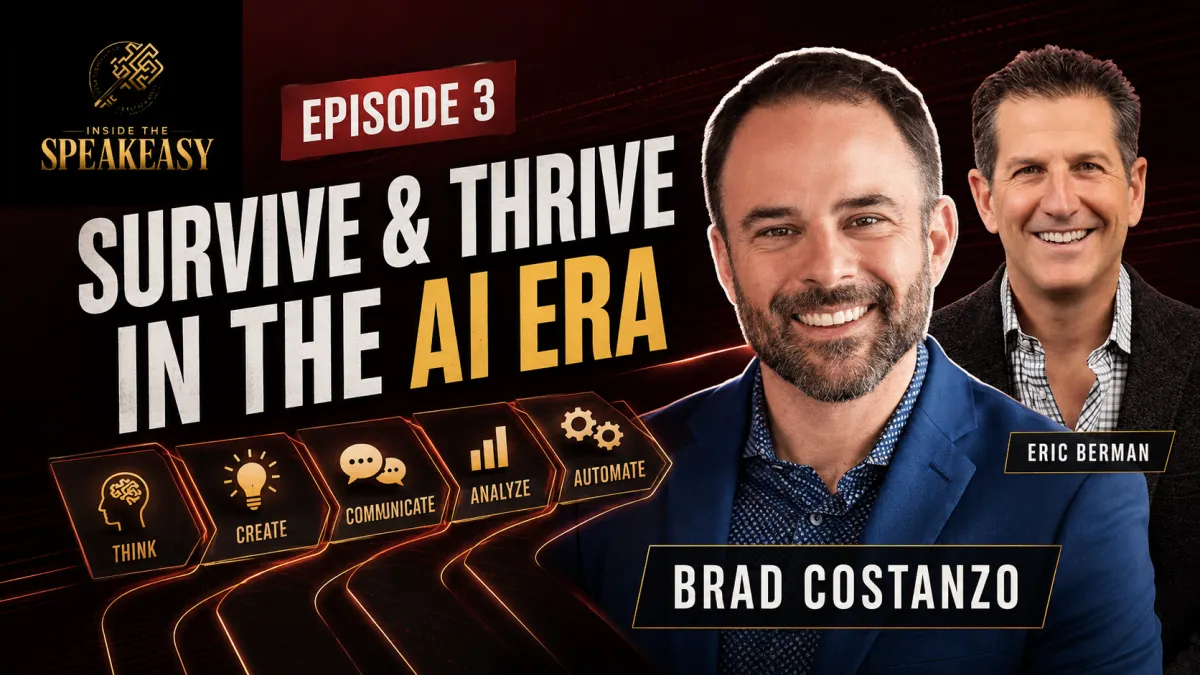
The AI Priority Framework with Brad Costanzo | Speakeasy Podcast
Episode 3 - Featuring Brad Costanzo - Hosted by Eric Berman - 31 minutes
Brad Costanzo, founder of Accelerated Intelligence and an AI implementation consultant embedded with the Brandetize agency and its clients, joins the show to cut through what he calls "tool FOMO" — the anxiety of chasing every new AI release instead of using AI where it actually moves the needle. Brad walks through his Five Buckets framework, which sorts every AI use case into thinking, creating, communicating, analyzing, or automating, and explains why most entrepreneurs get stuck experimenting in the first two buckets while the real return sits in the last three. He also unpacks the "productivity paradox" that can quietly wreck team morale the moment AI makes employees faster, shares the ICE framework he uses to prioritize AI projects with clients, and previews why he thinks the SaaS subscription model is already on its way out. For any entrepreneur overwhelmed by the pace of AI, this conversation offers a practical way to filter signal from noise.
In this episode, you'll discover:
The Five Buckets framework Brad uses to sort every AI use case into thinking, creating, communicating, analyzing, or automating
Why the communication and analyzing buckets deliver the fastest return while most entrepreneurs get stuck experimenting in the first two
How the ICE framework (Impact, Confidence, Effort) helps prioritize which AI projects are actually worth building first
The productivity paradox that causes employees to secretly slow down after AI makes their work faster, and how to reward speed correctly
Why Brad believes the SaaS subscription model is dying and one-time-fee, AI-built software is coming back
Episode Summary
Brad Costanzo opens by naming the problem nearly every entrepreneur is quietly wrestling with: AI feels mandatory, but there are so many tools and use cases that it's easy to chase novelty instead of solving real problems. Brad calls himself an "accidental" AI expert, built over two decades as a serial entrepreneur in digital marketing and publishing, self-described as a "quick start" visionary whose weakness has always been follow-through. When AI exploded, he was already embedded with the Brandetize agency and its clients, which gave him an unusually fast feedback loop for testing tools against real business problems rather than theorizing about them. That practical, outcomes-first approach — "I don't care what tool we use, does it move the needle and does it do it quickly" — is what eventually put him on stages consulting for other companies.
To simplify the overwhelm, Brad developed what he calls the Five Buckets framework: AI only ever does five things — think, create, communicate, analyze, or automate. Thinking covers research, ideation, and strategy; creating covers text, image, audio, video, and combinations of them. Brad notes that thinking and creating are where roughly 90% of people spend their AI time, but the communicating, analyzing, and automating buckets are where the real business outcomes live. Communicating includes phone AI agents, chatbots, and SMS reactivation campaigns — Brad calls this "the closest to the cash register." Analyzing covers both quantitative work, like having AI find patterns in spreadsheets or contracts, and qualitative work, like reviewing sales copy for confusing language or mining top salespeople's call transcripts for training material. Automating, the widest bucket, is what most people now call "agentic" AI — chaining a trigger to multiple actions, such as scoring and routing a new lead automatically based on how they answer an intake form.
Once the buckets are clear, Brad's advice for prioritizing shifts to two rules. First, audit which bucket is consuming the most time, money, and bandwidth right now — that's where to start, not wherever the newest tool happens to point. Second, don't chase the novelty of new capabilities before solving the existing, obvious headache on your plate; the fun stuff can wait until the backlog is cleared. With clients, Brad formalizes this using the ICE framework — scoring potential AI projects by Impact, Confidence, and Effort — to quantitatively rank which projects are worth doing first instead of reacting to whatever tool went viral that week. He also described what he calls the "MAG method": using AI first as a mentor to identify blind spots, then as an assistant to execute the resulting plan, then as a critic to review and improve the output — a loop Brad runs on himself using a custom AI trained on roughly three million of his own words.
Brad then raised what he considers an underdiscussed risk for any entrepreneur with employees: the "productivity paradox." If a business owner gives an employee AI tools that let them produce ten times more work, and then simply hands them ten times more volume as a reward, that employee will quietly sandbag their output rather than reveal how much faster they've become — because nobody wants to be, in Brad's words, "Lucille Ball on the chocolate line." His fix is to reward speed with more interesting, higher-leverage work chosen by the employee, not simply more of the same task, and to ask teams directly what they'd build if their current busywork disappeared.
Asked what he sees most often in client work, Brad pointed to prioritization itself as the number one need, followed closely by the communicating and creating buckets — clients want more and better content, plus faster, more efficient ways to talk to leads and customers. Looking ahead, Brad argued that skill sets are being commoditized and the market is entering "the age of the generalist," where agentic AI can run an entire one-person marketing agency, and he predicted the traditional SaaS subscription model will largely disappear in favor of one-time-fee software that buyers extend themselves with AI. His counterintuitive closing point: as everyone else automates themselves away, the entrepreneurs who preserve real human connection — especially in sales — will have the advantage, because "the agents aren't writing the checks."
Big Ideas Discussed
The Five Buckets Framework: A Map for Where AI Actually Helps
Brad's central framework holds that AI only ever does five things for a business: think, create, communicate, analyze, or automate. Thinking is research, ideation, brainstorming, and strategy; creating covers text, images, audio, video, and combinations of them, such as turning a podcast recording into show notes and clips automatically. Brad points out that these first two buckets are where roughly 90% of people spend their time playing with AI, largely because they're the most visible and accessible entry points.
The framework's real value, in Brad's view, is redirecting attention to the three buckets most entrepreneurs underuse. Communicating covers phone agents, website chatbots, and SMS campaigns for lead qualification and reactivation — what Brad calls "the closest to the cash register." Analyzing spans quantitative work like finding patterns in spreadsheets and contracts, and qualitative work like reviewing sales copy or salesperson call transcripts. Automating, the widest bucket, is agentic AI — chaining a trigger to a sequence of actions, such as an OpenAI prompt that scores and routes a new lead into a CRM the moment they submit an intake form.
The ICE Framework: How Brad Filters Signal From AI Noise
Beyond naming the five buckets, Brad's practical advice for prioritization starts with an audit: identify which bucket is consuming the most time, money, and bandwidth right now, and start there instead of wherever the newest tool points. He pairs this with a firm rule — don't chase the novelty of new capabilities before solving the existing, obvious headache already on the business's plate.
With clients specifically, Brad formalizes this decision-making using the ICE framework: scoring candidate AI projects by Impact, Confidence, and Effort, then quantitatively ranking which ones are worth building first. He described this as the single most common thing he's asked to help with, because most business owners already sense there are dozens of things AI could do for them — the hard part is deciding which one to do first, and ICE gives that decision a repeatable, numeric structure rather than a gut call.
The MAG Method: Turning AI Into Your Mentor, Assistant, and Critic
Brad built a personal AI clone using Delphi, trained on roughly three million of his own words, and uses it in three sequential roles he calls the "MAG method": first as a mentor that identifies his blind spots and limiting beliefs (things like "the illusion of control" or "lone wolf syndrome"), then as an assistant that executes a plan to address them, and finally as a critic that reviews the resulting output and points out what's missing.
Brad walked through a concrete example: asking his AI clone to teach him the elements of a viral blog post, then asking it to write one as his assistant, then asking it to critique that draft and identify what was missed. He argues this "ask AI first" instinct — treating it as a thinking partner before doing the work manually — is itself a skill worth building deliberately, since most entrepreneurs default to grinding through a problem alone before remembering AI could help.
The Productivity Paradox: Why Faster Work Can Backfire on Culture
Brad flagged what he considers an underdiscussed risk for any entrepreneur with employees: give a team member AI tools that let them produce significantly more work, then simply hand them proportionally more volume as the reward, and that employee will quietly slow down and hide their new capacity rather than reveal it — because nobody wants to be treated like Lucille Ball on an accelerating chocolate conveyor belt. Brad has personally done this himself as a contractor, deliberately stretching out work he finished early so clients wouldn't simply pile on more.
His recommended fix is to reward newfound speed with more interesting, higher-leverage work that the employee helps choose, rather than more of the same repetitive task, and to sit down with teams and ask directly what they'd build or improve if their current busywork disappeared. Done well, Brad argues, this turns AI adoption into a culture-building opportunity rather than a source of resentment.
The Coming Death of SaaS and the Rise of the AI Generalist
Looking at where things are headed, Brad argued that skill sets are being commoditized fast and the market is entering "the age of the generalist" — the problem solver who can connect disparate dots across writing, design, and strategy, all of which used to be separate, insulated specialties. He described already-working multi-agent chains where one lead agent hands a software idea to another agent that writes requirements documentation, which passes to an architect and engineer agent, effectively allowing someone to run a one-person marketing agency today.
Brad's boldest prediction is that the traditional SaaS subscription model is largely going to disappear within a few years, replaced by software sold for a one-time fee that buyers then extend themselves using AI and an open-source code base. At the same time, he believes the entrepreneurs who preserve genuine human connection — particularly anywhere sales happens — will hold the advantage as competitors automate themselves away, because, as he put it, "the agents aren't writing the checks."
Questions We Answer in This Episode
What is Brad Costanzo's Five Buckets framework for AI adoption?
Brad Costanzo's Five Buckets framework holds that AI only ever does five things for a business: think, create, communicate, analyze, or automate. Thinking and creating cover research, ideation, and content production; communicating, analyzing, and automating cover lead engagement, data insight, and workflow automation. Brad uses the framework to help entrepreneurs quickly identify which bucket their biggest bottleneck sits in.
How does the ICE framework help decide which AI projects to build first?
The ICE framework scores each candidate AI project on Impact, Confidence, and Effort, then ranks them numerically so a business owner can see which projects offer the best return for the least risk and work. Brad Costanzo uses it with consulting clients to remove guesswork from prioritization when there are more possible AI projects than time to build them.
What is the "productivity paradox," and why can rewarding faster work backfire?
The productivity paradox is Brad Costanzo's term for what happens when a business owner gives employees AI tools that let them work much faster, then simply assigns them a proportionally larger workload as the reward. Employees respond by quietly hiding their new speed rather than revealing it, because faster output just means more work, not more benefit to them.
What is the MAG method Brad Costanzo uses to get better results from AI?
The MAG method is Brad Costanzo's sequence for using AI: first as a mentor to surface blind spots and limiting beliefs, then as an assistant to execute a plan addressing them, and finally as a critic to review the resulting output and point out what's missing. Brad runs this loop using a personal AI clone trained on roughly three million of his own words.
Why does Brad Costanzo think the SaaS subscription model is dying?
Brad Costanzo predicts that within a few years, traditional monthly SaaS subscriptions will largely be replaced by software sold for a one-time fee, with buyers then using AI and an open-source code base to add their own features. He argues the moats that justified recurring pricing are melting away as AI makes it cheap for individuals to build or extend their own tools.
What are Brad Costanzo's favorite AI tools right now?
Brad Costanzo says he still uses ChatGPT more than any other tool, while also praising Google Gemini's AI Studio. For building a personal AI clone, he recommends Delphi (clone.com), which he uses to chat with clients and coach himself. He also highlighted FounderPal, a newer tool he uses to generate marketing strategy and content ideas quickly.
Where should an entrepreneur start when they don't know which AI project to tackle first?
Brad Costanzo recommends auditing which of the Five Buckets — thinking, creating, communicating, analyzing, or automating — is consuming the most time, money, or bandwidth right now, and starting there. He also advises against chasing newly released AI capabilities before solving the existing, obvious problem already sitting on the business's plate.
What should business owners do differently once AI makes their employees more productive?
Brad Costanzo advises rewarding newfound speed with more interesting, higher-leverage work chosen by the employee, rather than simply assigning a proportionally larger volume of the same task. He also recommends sitting down with the team and asking what they would build or improve if their current busywork disappeared, turning AI adoption into a culture-building moment instead of a source of resentment.
Read the Full Episode Transcript
Read the Full Episode Transcript
Cold Open: Brad's AI Mentor in the Mirror
Brad Costanzo: So I built one that has got like 3 million of my words, so it knows me really well. So I can go to it and I can say, list all my blind spots as an entrepreneur and all my toxic traits that are keeping me from succeeding. And I've programmed it to talk to me as the idealized version of me, let's say five years in the future, who's overcome everything — I achieved all this stuff. And when it talks to me, it says, oh, Brad, well, here's the things that are keeping you from becoming me right now. And then I say, now, great, now can you give me some strategies to overcome those? And it's like, yep, here, do this. And it actually becomes my own personal coach. So I'm thinking first — I don't have to figure this out, let it be my mentor, then let it be my assistant. Then the other part is let it be the critic.
Welcome to the Speakeasy Podcast
Eric Berman: Welcome to the Speakeasy Podcast, where the real conversations happen behind closed doors with the boldest entrepreneurs, creators and growth minds in the game. No fluff, no filters, just the raw strategies, personal stories and mental models that move the needle. I'm Eric Berman. Now let's get into it. Hello. In today's episode, I am so pumped to bring on a good friend of over 10-plus years. He also is in the San Diego mastermind group with me. His name is Brad Costanzo — definitely a big AI guru and consultant. And we're going to talk a little bit today about, for those that are struggling with how to prioritize this madness of AI, what's going on out there? Brad's going to share today his fun Five Buckets framework to really help you figure out what to do in any situation within the AI world. It's really exciting. He's going to talk about his productivity paradox. I asked him to get a little bit into some of the trends that he's seeing — he's studying AI all the time and he's also on stages quite a bit, doing a lot of high-end consulting. And I dug in a little bit into what are the top things that his clients are asking him — where do they need the help right now these days, what should we all be looking for. And then we ended with Brad dropping some of his favorite tools. So I'm so excited today to bring you — welcome, Brad Costanzo.
Brad Costanzo: All right.
Eric Berman: I'm so excited to bring on as one of our first early guests to the Speakeasy Mastermind Podcast, Mr. Brad Costanzo. First of all, I'm glad to bring on somebody who I've known for so long, because this is one of our early podcasts, and as I make fools of myself and try to figure this podcast world out as a host, you'll hopefully be a little bit kind to me. For those that aren't watching, we already had our first technical hiccup, in that we forgot to record on the first call — so I should probably not admit that, but I'm admitting it. Sammy, our producer backstage, is probably laughing at me for saying that; he may or may not cut this out. We'll see. But anyway, back onto the podcast — while we're here, I think it's appropriate as we lean into the podcast world, and I was thinking about bringing on somebody who will be somewhat kind to me, but also somebody I feel will have some great stuff to talk about. We're all right now dealing in the world of AI, cutting edge, and you've always been that guy I've gone to when it comes to rolling up your sleeves — down-and-dirty entrepreneur, which is really what we're trying to attract in the community. Right — an entrepreneur that's still excited, still hungry to learn the latest and greatest. They're in the tools, they're in the trenches still, and that reminds me so much of you. For those that don't know Brad, I've known him for, God, fifteen-plus years — he's a hired gun that I bring in to help me and some of my clients when we just need to get to the latest and greatest and high-level thinking and strategy, and do things effectively and efficiently. Brad's kind of that cutting edge, and he'll share a little bit of that as well. But as we get into today — you and I were even talking at our San Diego mastermind last week about some of this — I look at you and I'm like, oh my God, the FOMO and the things going on so fast, and how do you stay focused? And you kind of looked at me like, Eric, I'm still struggling like every day. That's one of the biggest challenges, and I think we're all probably going through that. And I think certainly today, even half the stuff you talk about, if we get too tactical, is going to be obsolete, obviously. So I'd love for you to share a little bit today as we get into it — even some takeaways that are more general, high level, frameworks that people can go through — the things you're doing right now today to help you stay focused knowing that this trend you just looked at today might be gone. Yeah, there's some of those techniques, but don't mind — take a minute just to introduce yourself, get a little of your background, and let's jump into it.
From Entrepreneurial ADD to Accidental AI Expert
Brad Costanzo: Yeah, you bet, and thanks for having me on here — this is great. Like you said, a lot of times host and co-host are asking questions because they're trying to get to know the person, but you and I have been friends and colleagues for a long time. For those who don't know me — I'm an AI guy now, but I became an accidental expert, I think, because I love to tinker and I'm ADD and I love the shiny objects. I'll get into not only what I'm doing in the world of AI and what I'm seeing, but I'll also share a really great framework that I think will help simplify some of the overwhelm — what I call "tool FOMO" — for a lot of folks. Just stay with me. But I think it's important to know where I come from — for the past, I'd say, twenty years I've been really a serial entrepreneur, and started businesses very much in the digital marketing and publishing space. Built a couple, had a couple of small exits — not anything where I created "FU money," and I'm not doing this on a yacht, not yet. In my background I'm very much a quick start, and I'm one of those, I guess, visionary entrepreneurs. My weakness is probably follow-through and organization, and that entrepreneurial ADD has oftentimes been a weakness of mine and kept me unfocused. But interestingly, when AI exploded — I'd been using AI tools in marketing for a while, but then when it exploded, I was actually embedded at Brandetize; we were really working with the Brandetize agency and clients. And when it created all of these opportunities to start using it, it was this shiny object you couldn't afford to ignore. Luckily we had so many clients I could start to apply it to and get real tactical, immediate benefits right away. By doing that, I just started to solve problems — I did it as someone who's not a tech guy, I'm looking at outcomes, like, how do we just create something? I don't care what tool we use — does it move the needle, and does it do it quickly? We started to have a lot of success. One thing led to the next — clients saw work I was doing, they referred me to other people. Pretty soon I'm on stages talking about AI, and that entrepreneurial ADD, or shiny object syndrome, was now chasing objects you can't afford to ignore and learning them quickly. The beautiful part about AI, as everybody who's started to play with it understands, is you understand it quickly. If you start to play with it and figure it out, it starts to come quickly. It's not like learning a new language.
Eric Berman: And I agree with you, because even myself — I observe and see what's going on, but I'm not — I mean, we were even joking about me forgetting to hit the record button on his podcast the first time around. But just getting in there and tinkering and getting a habit — I always come back to a habit — just forcing yourself to start playing, and then you get to the level you're playing at, and that's a whole different world. But yeah, I totally agree.
Brad Costanzo: Play is the key here. I mean, I am an AI expert, and it's only because I play more with it than other people do, and I've focused on that. But I've also found, in working now with dozens of clients and hundreds of students in my coaching program — my background is I run a coaching program for AI, but I also do one-on-one implementation consulting and get my hands dirty — one of the biggest problems I've seen that every single entrepreneur has, especially if you're running the business and don't have time to be the tinkerer and the doer, is they know they have to do it. They know it's not optional — they have to reinvent the way they're working and the things they're doing. But it's overwhelming how many areas it feels like AI can help, and there are so many tools, ten new tools a day. I call it "tool FOMO" — you get really excited about what can be done, and then you go chasing this rabbit, but you realize you're hunting a rabbit that's not going to put food on your table. There's a lot of noise and a little bit of signal. In working with people, it took me about a year to create this, but I realized AI only does five things — five areas. I call them buckets. These are buckets of your business that, once you realize what they do, allow you to slow down and ask: which of these areas do I need the most help with?
The Five Buckets Framework: Thinking, Creating, and Communicating
Eric Berman: And before you go into your buckets, I relate to what you said, because, being not as sophisticated an early adopter of AI, I was in a conversation with my team today, and we were saying we've got to have periodic meetings — we're all there, whether it's sharing AI or digging into each other's areas and figuring out how to coach them, because we tend to assume everybody's just going to figure it out on their own, but they don't know how. So the reality is, if you just let it go on its own, it's not going to happen. So I'm like, no, we've got to set a time — a couple hours, once a month, versus once a quarter — no, that's too late, once a month, let's just get together, put all our brains on one department just to help them focus, and it's going to help improve everything. But as you said, it comes from the fear of running — knowing I'm watching the world doing all these things, yet I don't have confidence my own team is going out there doing the most optimal thing. It's almost like, should I hire an AI consultant to come into my company and do these things? Well, let's try it first. But that's kind of the thoughts going through our head.
Brad Costanzo: Absolutely. I'll actually bring up something — remind me if I don't get to these five buckets, but also remind me if I don't bring up the productivity paradox, because that's really important, especially for somebody like you or anybody who has a lot of employees.
Eric Berman: Let's get in the buckets. I want to hear that, because as we said, that's something everybody can use no matter what the trend is — we can still get into that.
Brad Costanzo: Yeah, and great — the way you use this is how you find the needle-moving projects and filter out the signal from the noise. AI only does five things: it helps you think, create, communicate, analyze, or automate. The first bucket and the second bucket are where 90% of people are playing right now — thinking. Well, what is thinking? It's researching, ideating, brainstorming, coming up with new ideas, like "let me think about this" instead of going to somebody else. You can also learn almost any skill right now using AI, and you can create entire strategies — that's the thinking bucket. The next bucket is creating. It can create a heck of a lot of things, but those things are all either text, images, audio, video, or combinations of them — you can create an entire video from images with text and subcaptions and combinations or derivatives of those things. For instance, after this show goes live, your producer will most likely drop this audio into a tool that will analyze it, create all the show notes, maybe some clips, in a fraction of the money and a matter of minutes, where it used to take hundreds or thousands of dollars per episode. So thinking and creating are where most people play. But the next three buckets are really important, and I think that's where a lot of the outcome comes from — communicating. Well, who do we want to communicate with? Leads, customers, customer service, stakeholders, shareholders, employees. How do you use AI to communicate? There are phone agents, phone AI — it's like a 24/7 virtual assistant. I build these for some of my clients, where it's always on, can make inbound and outbound calls, take information, qualify leads, send it to your CRM, and even live-transfer to a person. Or it can be a chatbot on your website giving information, taking leads, or SMS — I love using text messages for reactivating past clients or creating what we call speed to lead: the minute a lead comes in, start texting with them and get them into action right away. The communication bucket, to me, is the closest to the cash register, so I love working with people who want to start talking to their people right away. The next bucket is analyzing.
The Five Buckets Framework: Analyzing and Automating
Eric Berman: I can relate to what you said, I think, in theory, but I feel like I get stalled at the communicate part. It's almost the scary thing of, okay, now AI is going to be actually communicating in my voice with my customers, and I lose control of that. As you're consulting, do you sense a lot of that, or is it just me feeling that pain right there?
Brad Costanzo: No, no, no — and there's a lot of apprehension, because it has to be, if you're going to be talking to your leads, prospects, and clients. AI can have a brain of its own and it hallucinates, so you have to be really careful, because it needs to be brand-representative — you don't want it to do any damage. So I always start simple: giving basic information, trying to get them to book an appointment with a human. Answer questions, qualify leads, book appointments — those are some of the best ways to start. And the nice part is that people are used to dealing with some version of AI — we've had it with the phone, calling to make an airline reservation, "press one for this, press two for that," a dumb bot. We're used to dealing with those; this is just a smarter version of it, and the more we use it, the more forgiveness we give. I love working with AI agents because it gives me what I want and I don't have to deal with an idiot — and we all deal with idiots all the time, right? The analyzing bucket is important because you can do quantitative analysis — spreadsheets and data, being a data scientist, uploading a whole bunch of stuff and finding stories in the data without spending thousands of dollars on actual data scientists. I'll put up contracts with clients and say, find the holes in this, or find what I need to understand. Then there's qualitative analysis — I'll have it analyze sales copy and find areas that are confusing, unbelievable, or boring, and find ways to correct it. Or we'll take transcripts from salespeople, upload those, find the patterns the best salespeople are naturally doing, and create almost like training materials from that. Then the last bucket is maybe the widest, which is automating, or sometimes we call this "agentic" — that's the big word in AI right now, an agent. How do we string together a trigger and then multiple actions? Most entrepreneurs are used to using Zapier or Make to create automation, but now you can make these really smart. For instance, I have a client where, when people opt in or apply to work with them, they answer a handful of questions; once they answer, it gets sent to an OpenAI prompt that analyzes what they said based on the criteria of their ideal client, then updates the CRM with a lead score on a scale of one to a hundred and gives you the rationale why — it even does background research. It's really, really cool.
How to Prioritize: Find the Bottleneck, Skip the Shiny Object
Brad Costanzo: So the way you use this is, number one, look at where you're spending the most time — which bucket takes your most time, money, and bandwidth? Are you spending a lot of time ideating and strategizing or creating content? Most people are. Are your salespeople spending a lot of time talking to dead leads or unqualified leads? You just kind of audit — what's the biggest bottleneck? That brings me to the next big overarching piece of advice: don't chase the novelty, the new fun stuff first. Solve the existing problems. Everybody wants to do the fun stuff, but get things off your plate so that you can do the fun stuff. I have to tell my clients this all the time, because they're like, "oh, I saw I can do this and this," and I'm like, "yeah, but what's the biggest headache right now?" And they tell me something else, and I say, let's solve that first.
Eric Berman: So you got me thinking here — I talk about the genius matrix a lot with various entrepreneurs: stay in the first quadrant, the things you absolutely love to do and are good at, and get the stuff in the fourth quadrant — that you're not good at, that you hate to do — delegated. So there's two lines of thinking: the shit that I hate to do, that I notice is on my to-do list every day for like three weeks, and then as soon as I remember, let me try AI for this — it's like magic, and I get all this energy because this task I would never want to do, I keep putting off, and all of a sudden it's done. Do you recommend going to your quadrant one, the stuff you love to do, and trying to go faster because you're already good at prompting? Or would you say start with the stuff you hate to do?
Brad Costanzo: I say start with the stuff you hate to do, because that stuff — if you have to do it and hate to do it, get it off your plate, because hating it brings down your creative juices. For everything else, this brings up a general concept: we say double down on your strengths, don't outsource your weaknesses — but there's also the saying that you're only as strong as your weakest link. So if you can fix that weak link or strengthen it, it frees up bandwidth for other things, especially now when it becomes easier and easier. If you don't know how to get that off your plate with AI, you can hire somebody like myself to come in and try to do it, or you can go to AI and have it be your mentor and say, look, these are the things I'm dealing with — can you give me some strategies to get this off my plate, how can I use AI? Use AI as your mentor first, and then use it as your assistant.
Using AI as Mentor, Assistant, and Critic
Eric Berman: You make it — damn you — you make it sound so simple, I wish I did that. Some of the simplest questions and prompts, and that's what I love about your content, Brad — some of the prompts you have are brilliant. You hear them and just want to bang your head against the wall, like, why didn't I think about that? Yeah, just ask the basic question. But it's going back to just playing, getting in there and playing around.
Brad Costanzo: And go AI-first — the first question is, "could AI help me with this?" I do it all the time. I'm sitting there racking my brain going, how the hell do I do this, and I go, wait a minute, why don't I just ask AI? So I've built myself — my best coach right now is me in the future. I built an AI using Delphi, which you're familiar with — I built one with about 3 million of my words and some other stuff, so it knows me really well. I can go to it and say, list all my blind spots as an entrepreneur and all my toxic traits that are keeping me from succeeding, and I've programmed it to talk to me as the idealized version of me five years in the future, who's overcome everything. When it talks to me, it says, oh, Brad, here's the things keeping you from becoming me right now. And then I say, great, now can you give me some strategies to overcome those? And it says, yep, here, do this — it actually becomes my own personal coach. So I'm thinking first — I don't have to figure this out, let it be my mentor, then let it be my assistant, and then the other part is let it be the critic. So, for instance: teach me how to write a viral blog post, what are all the elements? And it says, you have to add the hook, the intro, and this — great, now write it for me as my assistant. And then once it's done, I say, now critique that and tell me what you missed and how to make it better. I call this the MAG method.
Eric Berman: It seems a little scary — a little vulnerable to stare at the mirror and ask your future self, what's wrong with you, do all these things. How did that feel when you did that?
Brad Costanzo: It actually nailed it, so it felt kind of good. I asked, what are my biggest blind spots and limiting beliefs holding me back from realizing my true potential — I'll rattle off a couple. It's, you know, the illusion of control — you have a deep belief that if you just push harder, think smarter, and control every variable, you can bend reality to your will, but it's a trap. It blinds you to the power of surrender, letting go, avoidance of discomfort. The lone wolf syndrome, the fear of being truly seen, perfectionism in disguise, underestimating the power of structure, the need for validation, the belief that you're not ready yet — and it gave me ten more. Then I said, can you give me some ways to get over that, and it said sure. So here's an example — the lone wolf syndrome: the strategy is build a "who, not how" mindset. I started asking myself, who can help me achieve this faster, better than I can alone. And then it gave me another tip. That's pretty self-explanatory, but it's a good reminder, and when it's you talking to yourself, you're kind of like, oh, this is maybe good advice.
The Productivity Paradox: Why Speed Shouldn't Mean More Work
Eric Berman: Let me turn — first, I have two more things I want to talk about, and one, you said don't remind you about the productivity paradox.
Brad Costanzo: Productivity paradox, yeah, cool. This is specifically for people who have employees and are trying to create a culture of innovation. If you enable your employees to get a lot more done with AI — which, as an entrepreneur, is what we want, I want my copywriter to write ten times more copy, ten times quicker — cool. And if I give him those tools and he does that, and I reward him with ten times more projects, they're going to revolt. They're going to sandbag it — even though they got it done quicker, they're going to act like they didn't, because they don't want to be like Lucille Ball on the chocolate line. I may be dating myself, but you remember that scene from "I Love Lucy" where she's shoving chocolate in her mouth because it's coming faster — this sucks, right? So you have to reward employees with better, deeper, or more creative work that they enjoy, as opposed to saying, "I know you're able to get this done ten times quicker, here's ten times more work." No — get it done quicker, and then that free time, work on something that will really benefit the company. Because they will, and I've seen it happen — I've actually done this myself with other clients in the past, where I was like, man, I was able to get this done way too quick, I'm not going to tell them, I'm just going to stretch this out a little bit because I don't want them to just give me more. So we don't think about it this way: identify, sit down with your team, and say, if you didn't have this stuff on your plate that you have to do, but you could work on something at the company that would be really impactful, what would you do? What would you bring to the table? They may have some great ideas.
Eric Berman: Well, I love that. Not only that — I think what you're reminding me is, it's easy for us entrepreneurs running companies to say "efficiency, we got 10x production, go baby, let's keep going." And I think you're right, there's resentment you might feel, but I think in that message you're also getting at is that it's more important now — you might have a mid-level or low-level employee who happens to be an AI superstar, and you give them the opportunity to shine and rise up in the ranks by teaching and coaching other people, especially younger people living in this world. What a cool opportunity to get somebody to become a hero, and just help the whole company out.
Brad Costanzo: Well, and you've always been great — I watch you, you're a great culture builder at the company, and you pay a lot of attention to people, making sure everybody feels appreciated and empowered. I think that could really help you — but also remember, just because they can get it done faster and cheaper doesn't mean don't incentivize them with more work, because it's exhausting. Just because I can doesn't mean I want to — cool, I've got this off my plate now, let me eat some dessert, that ends up working. When I'm working with larger companies, I make sure I bring that up: don't just give your people more stuff.
What Brad's Clients Need Most Right Now
Eric Berman: So speaking of working with other companies, I'm curious — what's a commonality you're seeing? You're doing a lot of consulting, talking to a lot of companies, you might be on a stage and people come talk to you and say, hey, can you help me with this. What would you say are the top one or two things you're finding out there, even with companies that aren't as cutting edge, and how are you helping them the most?
Brad Costanzo: Number one is prioritizing projects, because they realize there's a lot of things they can do, so we go, all right, let's find the needle-movers and ignore everything else. Something you're familiar with is the ICE framework, which is taking all the ideas and scoring them.
Eric Berman: Impact, confidence, and effort, as I see it.
Brad Costanzo: Exactly — and you're quantitatively scoring them, and then going through and saying, all right, these are the ones I should do first. That removes a little bit of pressure, and they go, okay, cool — that's the number one thing, because they realize there's a lot they can do. The communication bucket and the creating bucket are probably the two biggest — everybody wants to create more content, better content, sales copy, but also communicate with their clients more efficiently. They realize they need speed to lead and need to talk to people in a more efficient way — I think those are the two biggest needs. But more than anything, it's still so new, so they just want to know what's possible, what can I do, what should I do, what will move the needle. They also want to future-proof themselves — they don't want to get so far behind, so they need a good understanding of what's possible, and that's really half the battle. You have to know what's possible first to go, okay, maybe I can do this now — I didn't even know ChatGPT could do XYZ now. Every week there's a new capability.
On Stage, FOMO, and Feeling Like an Imposter
Eric Berman: So let's talk about two more questions and then we'll wrap — we have a lot of listeners and other entrepreneurs in our community who are experts and maybe don't get a lot of stage time, so I want to pivot a little bit. How was your emotion — were you scared to get on stages? How do you feel when you're up there? I've seen you in a couple of big crowds, huge events — how do you get through that?
Brad Costanzo: I'm weird — I like the attention and validation. I actually get nervous about public speaking because I get anxious, like, excited — I like to get up and talk, I'm good at it, and I don't get performance anxiety, I get excitement.
Eric Berman: Does your future self say you're good at it?
Brad Costanzo: Yeah, he does. I also studied — you remember Sean Stevenson, one of the best public speakers on the planet — he was a close friend and my speaking mentor. Funny enough, he passed away in 2019, and every time I get on stage, I look down and picture Sean in his wheelchair, giving me a thumbs up, and it inspires me to get up. But it's also one of the things — I've gotten more nervous in the past when I spoke about things other than AI, but I like AI so much it feels like I'm getting up and giving a giant show-and-tell. I get to razzle-dazzle and show people what's possible, and I bring an entertaining vibe to it — so if anybody out there needs a public speaker, I'm available. But I really enjoy that, and I love watching people's eyes go, "wow, I didn't know it could do that." It still surprises me, because I'm in it every day and looking up at people doing things I haven't had a chance to do, and I'm feeling FOMO, so I feel like an imposter — everybody knows the stuff I do — and then I realize, no, they don't.
Eric Berman: It's got to be the hardest thing — every time I talk to somebody, there are so many levels of people wondering, do I share this, is this too simple, this weirdness that's going on even in our masterminds and others. I'm like, just share it no matter what, because even if you're here for the third time, sometimes it's just a different flavor of it that makes it land, and you just never know.
Future Trends: Agents, Obsolescence, and the End of SaaS
Eric Berman: So to wrap, give me a two-part question — what do you see, as you're such a — I've seen some of your posts and all that — what are you seeing as future trends? I know we can't even go back seventy years, but what are you seeing, and what should we be looking out for? What scares you right now?
Brad Costanzo: If you're not a little scared, you're not paying attention at all. We are all outrunning obsolescence very, very quickly, and my motivation to get into this space is definitely being scared of becoming obsolete. But like they say, if you and a friend are outrunning a bear in the forest, you just have to outrun your friend — so I figure if I can just be a little faster than him. Skill sets are being commoditized; we're entering the age of the generalist, the problem solver who can connect disparate dots, because writing, copy, design — all these things we thought were insulated are not insulated anymore. The best people are going to get dangerously good; the people who are just starting out, or who aren't willing to learn and go deep, there's going to be casualties, and it's very real. Agents are going to be taking over — we're already seeing this. There's one I've been playing with where you give a software idea to the lead agent, and that agent passes it off to the person who writes the program requirement documentation, and that sends it to an architect and an engineer, and you see it all happening. You're seeing entire companies being able to run on an agent that just does everything for you — you can create a one-man marketing agency right now, quite literally, and that's dangerous for a lot of people who don't have the skill sets. As I said, you cannot afford to ignore this. Agents are the big thing right now, that's where everything is going. But I also think it's very tempting to AI-ify and automate everything, such as videos, conversations, and the communication bucket. I believe you should start by automating everything that doesn't touch the client, so you can focus on human interaction where it matters — in sales and everything else — because as everybody else tries to automate themselves away, the people who don't are still going to be the ones who build relationships with the people who write the checks, because the agents aren't writing the checks, at least not yet. People want to connect, they want to be human, and I think even in marketing, unpolished, real human content with errors and mistakes is going to be rewarded, because people are going to say, oh, that's human, that's not perfectly polished — I think that's going to get better. So I'm trying to focus on how I can use AI to do all this stuff on the back end so I can be more front-facing and real when it counts, because we're going to get really sick of dealing with robots. Ain't nobody got it figured out — I sure don't, but I'm having a lot of fun trying it. I also think that for the first time, we're really democratizing access to opportunity — the moats around big companies are melting away, even software companies. I think SaaS, the software-as-a-service model, is going to be dead within a few years.
Eric Berman: Everybody keeps talking about that.
Brad Costanzo: Yeah, yeah, and we're going to go back to the way it was, in my opinion, where somebody spins up a piece of software — maybe they use AI to do it — and sells it for a one-time fee, let's say $200 or $1,000, doesn't matter, and then you'll be able to use AI to add new features to it. They'll give you the open-source code base, and you'll add new features yourself. The days of spending a hundred dollars or more every single month, when you could just code this yourself — you can do that now. So the big moats are disappearing, but the opportunities for small people to get out there and add value to the world — the reins are off.
Two Favorite AI Tools to Watch
Eric Berman: My bonus question, two parts — what's your favorite AI tool that you're talking to every day out of the whole lot of them, and then, what's a tool that people haven't heard of so much it'll probably be obsolete by the time this comes out, but you never know. Give me two people might want to take away — which one are you playing in the most, between the Groks and the ChatGPTs and the Clauds and the Perplexities?
Brad Costanzo: Yeah, so I probably still use ChatGPT more than anything else — I love what it does, but I play with all of them. Google Gemini is getting really, really good, and their AI Studio is really amazing. And it's Delphi — clone.com is the site where you can build a second version of yourself. I use this to chat with my clients, to create some marketing material and copy and ideas for myself, but I also use it as my own personal coach. Love Delphi. There's another tool I absolutely love — I discovered it, it's called FounderPal, F-O-U-N-D-E-R-P-A-L, I'll send you a link when we're done — but it's a really amazing tool to get a lot of your marketing strategy and a lot of content and ideas done. That one scared me, because I realized I was charging a lot of money to do the stuff that this thing does for cheap. Those are some of my favorites right now, but there's a new one every day.
Eric Berman: Well, and on that note, we made it through — appreciate you not beating me up too much, it was great. Thanks for chatting, I always learn so much when I talk to you. I know you've got to put the jogging pants on so you can run ahead of the competition in the AI world, because I know you're scared of what's coming after you — go hit that beautiful beach spot you have down in San Diego, run the boardwalk, catch the sunset today. Thank you so much for your time, and appreciate you.
Brad Costanzo: My pleasure. And by the way, if anybody wants to read what I'm doing, I named my company Accelerated Intelligence, because I think artificial intelligence is just a tool — accelerate intelligence is the outcome. I'm trying to talk a lot more about the outcomes, not just the tools, on my newsletter, because I think the tools are going to be a dime a dozen pretty soon — saying "I work in AI" is going to be like saying "I work with the internet." So come join me.
Eric Berman: Love it. And that's a wrap from the Speakeasy Podcast. If something sparked for you, don't keep it to yourself — share it, review it, and pass it to the one person who needs to hear this right now. Want in on the real mastermind? Tap the link in the show notes to apply. Until next time, keep scaling, stay sharp, and don't be the smartest one in the room.

About The Guest
Brad Costanzo
Brad Costanzo is the founder of Accelerated Intelligence, an AI strategy and implementation consultancy that works with agencies, entrepreneurs, and their clients — including a long-running engagement embedded inside the Brandetize agency. After two decades as a serial entrepreneur in digital marketing and publishing, Brad became what he calls an "accidental" AI expert by applying new tools directly to client problems as they emerged, then teaching what worked. He now runs a coaching program for AI adoption, consults one-on-one with entrepreneurs and larger companies on implementation, and speaks on AI strategy at industry stages and events. Brad developed the Five Buckets framework and the ICE prioritization method referenced throughout this episode to help business owners cut through tool overwhelm and focus on the AI projects that actually move the needle.
Want to Be Part of
Conversations Like These?
Inside the Speakeasy gives you a glimpse into the candid, practical conversations happening throughout our community. Every month, Speakeasy brings carefully selected founders, CEOs, and business leaders together to solve real challenges, share what is actually working, and help one another make better decisions faster. If you’re an established entrepreneur looking for the right people, perspectives, and opportunities to accelerate your growth, we’d like to learn more about you.
Complete a short application to tell us about your business and the chapter you’re interested in.