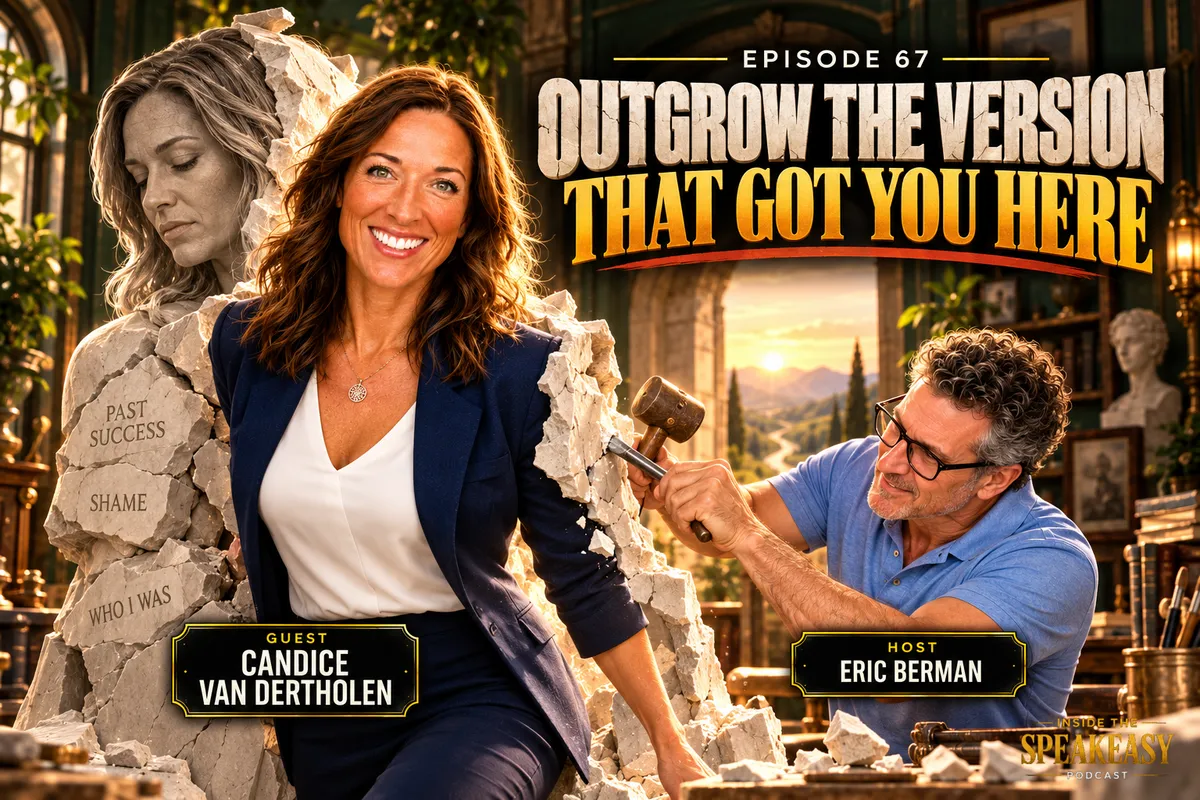
Candice Van Dertholen, founder of The Warrior Within Healing and an energy practitioner who coaches business owners, argues that success itself can become the block that keeps entrepreneurs stuck. Shame and guilt whisper, I hope nobody finds me out. Sitting at the height of your game can whisper something just as limiting: I hope nobody forgets. Candice learned the cost of getting stuck firsthand. She launched her practice with 20 clients, hit a year of near silence after a military move to Southern California, and rebuilt to 92 clients and two fully booked retreats once she started doing the business basics she had taught others for years. She explains why she now gets hired through conversations rather than pitches, how she used LinkedIn to spotlight other people and earn referrals, and what actually happens in an energy session. She also leads host Eric Berman through a short guided breathing practice. For founders who feel successful but stalled, her message is direct: your next level requires you to receive.
In this episode, you'll discover:
- Why success can block growth just as shame does, and how fearing that people will forget your past wins keeps founders from starting something new
- How Candice Van Dertholen went from a year of inconsistent clients to 92 clients by finally doing the business basics she taught others
- What changed when she stopped leading with her title and started listening first, the same shift she used to redesign a standardized gym tour
- How spotlighting other people's work and making introductions on LinkedIn turned the platform into her main source of clients and referrals
- The short sun-and-breath visualization Candice uses to release stagnant energy, and why she believes stillness never felt safe for many adults
Episode Summary
Candice Van Dertholen's central argument is that entrepreneurs often stall not because of what they lack but because of an identity they are holding onto. In her identity work, she sees shame and guilt from earlier experiences, sometimes trauma, sending one message: I hope nobody finds me out. Success sends a mirror-image message. At the height of their game, people think, I hope nobody forgets, and they hesitate to step into something new because they fear failing and being remembered for it. Either way, Candice says, the underlying belief is the same: I want this, but I don't feel worthy to receive it. Host Eric Berman frames the cost plainly, saying founders who get too attached to what they have built lose the ability to see the business evolve and miss opportunities.
Candice's perspective comes from an unusual mix of experience. Her background includes helping franchise owners build their businesses, including work with Anytime Fitness in Washington State and a YogaSix franchise owner in Virginia, plus college studies in early childhood development that leaned heavily on psychology. As a military spouse of 10 years who has lived in five locations, she spent part of the COVID period in emergency veterinary care, where she noticed people ordering delivery several times a day, skipping exercise, and struggling with their mental health. She says those observations shaped the launch of a yoga studio that grew from four walls and a concept to a community of 450 members. A session with an energy practitioner then gave her a level of clarity that led her to launch her own practice.
Her own story is a case study in getting stuck. Candice signed 20 clients right away in Virginia, then moved to Southern California expecting the work to be an easy sell. Instead, she describes a year of silence with nothing consistent. After doing her own inner work, she concluded that she was the problem: she had stopped doing the needle-moving business activities she had taught others throughout her career. Once she took her business seriously, one client became four, and by the end of the following year she had 92 clients, two fully booked retreats, and speaking engagements arriving. The changes she credits are practical. She got comfortable talking about her work, replaced pitching with conversations that invite curiosity, and treated LinkedIn as a serious business channel.
Those changes center on putting the other person first. Rather than opening with her title, Candice lets people talk, listens for what they need, and then shares the breakthroughs she is most excited about. She applied the same logic to a fitness facility's standardized tour, arguing that new members should be asked what brought them in before being walked past equipment that intimidates them. On LinkedIn, she noticed the platform leaning toward community, so she began highlighting other people's work and making genuine introductions. She says most of her clients now come from LinkedIn and referrals. Her positioning has shifted with her goals, from client acquisition when she was rebuilding her practice to corporate speaking today.
Candice describes coaching as the deep work and energy healing as the cleansing part. In sessions, she listens to the language people use to locate where a pattern began, reframes it, and then works to clear it energetically. Her examples include a chiropractor who, as a child, stood at the back of the line to watch other kids move because of a language barrier and internalized that as a limitation, until Candice pointed out that watching movement is now his career. Another client, a physician who had worked in a trauma center, could not focus because her new office recreated the chaos she was used to, and clearing the clutter helped. Candice also leads Eric through a brief breathing visualization, and she says many people never learned that stillness could feel safe.
The conversation closes on purpose and community. Eric shares how he ignored his talent for leading a dinner group of entrepreneurs until enough people told him it was special, and Candice describes a low-key brunch she started in Charlotte that has grown to almost 180 women. Taken together, the episode offers founders a candid reminder that blind spots, hyper-independence, and attachment to past success can cap growth, and that an outside perspective, clear positioning, and a willingness to receive help are often what unlock the next level.
Big Ideas Discussed
Past Success Can Block Your Next Move as Much as Shame
Candice Van Dertholen describes two forces that keep people stuck. Shame and guilt from past experiences tell people, I hope nobody finds me out. Success, she says, can create the opposite fear: I hope nobody forgets. A founder at the top of their game may hesitate to try something new because they worry about failing and having that become the story people remember. Candice voices that inner monologue in founder language: my journey was a success, so who am I to step into something new, and what if I fail and that is what people remember?
Candice's point is that both fears lead to the same place. People want the next opportunity but do not feel worthy to receive it, so they block what is trying to come in. For entrepreneurs, this is a useful lens for diagnosing a plateau. Eric opens the episode by warning that founders who become too attached to what they have built can lose the ability to see the business evolve and end up missing opportunities. Recognizing which fear is in play, being found out or being forgotten, is often the first step toward moving again.
Win Clients by Listening Before You Explain What You Do
Candice says she now gets hired more from having a conversation than she ever would from pitching herself. Her earlier introductions led with her title, energy practitioner, and dove into her method, often while feeling shy about saying it at all. Now she lets the other person go first, listens to who they are and what they are looking for, and then shares the breakthroughs she is most excited about in her work. Eric observes that this lets her educate someone on a topic they already care about, so they conclude she is an expert without her claiming it.
She applied the same principle in her franchise work. One fitness facility she worked with used a standardized gym tour, and Candice pointed out that walking an intimidated prospect straight to the section that scares them guarantees they will not sign up. Her fix was to ask what brought the person in and what they most wanted from a membership, then highlight those features first. For any business owner, the lesson is that sequence matters: understanding the customer before presenting the offer changes how the offer lands.
Treat LinkedIn as a Community Platform, Not a Resume
When Candice rebuilt her practice, she stopped treating LinkedIn as a professional resume and started using it with intention. She says she studied the platform, noticed it leaning toward community a couple of years ago, and committed to building community between calls through follow-up, connection, and conversation. She also began publicly highlighting other people's work, introducing contacts to one another, and recommending people she trusted, including Eric's mastermind.
That reciprocity became her pipeline. Candice says most of her clients now come from LinkedIn and referrals, often from people telling others they need to meet her. She pairs that generosity with clear positioning, deciding where she wants to take people in each season. When she was rebuilding, her content pointed toward client acquisition. Now that she is pursuing corporate speaking, her posts aim to demonstrate that she builds community and earns trust. For entrepreneurs, the takeaway is that generosity and clarity work together: giving builds goodwill, and positioning tells that goodwill where to go.
Hyper-Independent Founders Have to Learn to Receive
Candice argues that the next level requires you to receive at a level you have never understood, and that this is especially hard for entrepreneurs. She describes founders as hyper-independent people who get things done, figure it out, and believe they do not need anybody. Her view is not that founders cannot do it alone, but that going alone can take them a lot longer. She is careful to say this is not about sitting in meditation and waiting for results. Effort is still required, but she believes things start to line up when people believe they are worthy of receiving.
Eric connects this to blind spots: founders cannot fix what they cannot see, which is why an outside perspective that asks hard questions can produce a breakthrough. Candice's client stories illustrate the idea. One client's office recreated the chaotic energy of her former trauma-center job, and decluttering it helped her focus. Candice also points to her own season of building a men's event, which she says is coming together through the support of others. For founders, receiving help may be the skill that matters most at the next stage.
Questions We Answer in This Episode
What does Candice Van Dertholen mean when she says success can block entrepreneurs?
Candice Van Dertholen means that past success can create a fear that holds people back, just as shame does. Shame tells people, I hope nobody finds me out, while success can tell them, I hope nobody forgets. Founders at the height of their game may avoid starting something new because they fear failing and being remembered for it. Candice says both fears come down to the same belief: I want this, but I don't feel worthy to receive it.
How did Candice Van Dertholen rebuild her practice to 92 clients?
Candice Van Dertholen rebuilt her practice by doing the business basics she had taught others for years. After a military move to Southern California, she went through about a year with no consistent clients and realized she was not taking her own business seriously. She got comfortable talking about her work, replaced pitching with curiosity-driven conversations, and used LinkedIn intentionally. One client became four, and by the end of the following year she says she had 92 clients and two fully booked retreats.
How should entrepreneurs introduce themselves instead of leading with a title?
Candice Van Dertholen recommends letting the other person go first. Instead of opening with her title and method, she listens to who people are and what they are looking for, then shares the breakthroughs she is most excited about in her work. Eric Berman notes that this approach lets you educate someone on a topic they already care about, so they see you as an expert without you having to say it.
How did Candice Van Dertholen use LinkedIn to generate clients and referrals?
Candice Van Dertholen used LinkedIn as a community platform rather than a resume. She noticed the platform leaning toward community, so she followed up after calls, had deeper conversations, highlighted other people's work, and made introductions between contacts. She says that reciprocal giving built her business, and most of her clients now come from LinkedIn and referrals. She also adjusts her positioning by season, shifting from client acquisition to corporate speaking.
What happens during an energy healing session with Candice Van Dertholen?
Candice Van Dertholen says her sessions combine coaching with energy work, and she describes coaching as where the deep work happens and energy as the cleansing part. She listens to the language clients use to identify where in their lived experience a pattern began, talks it through, reframes it, and then works to energetically clear it. She says Oura rings and Apple Watches often register a nap or ask whether the wearer is meditating during sessions, which she attributes to a lowered heart rate. These are Candice's own descriptions, not medical advice.
How can your workspace reflect a pattern that keeps you stuck?
Candice Van Dertholen says your environment can mirror an old pattern. She describes a client who left a fast-paced trauma center to coach physicians and could not understand why she struggled to focus. When Candice asked her to describe her office, the client said it felt chaotic, which Candice saw as recreating the energy she knew best. Clearing the clutter and looking at the space differently helped. Candice says sometimes the block is your environment, and sometimes it is your thoughts.
What simple practice does Candice Van Dertholen recommend for resetting your energy?
Candice Van Dertholen leads a short breathing visualization. Listeners breathe in to feel revitalized and breathe out to release stagnant energy, then picture the energy of the sun entering the heart and moving from the top of the head down through the body and into the earth, ending with gratitude. Candice says many people were never taught that stillness is safe, so slowing down for even two minutes can make a meaningful difference.
Full Episode Transcript
Read the Full Episode Transcript
Why Success Can Keep Entrepreneurs Stuck
Announcer: Welcome to Inside the Speakeasy podcast, the private room where today's sharpest founders, innovators, and renegade thinkers come to trade the ideas that move industries. This show is brought to you by HighLevel, the AI-driven business operating system trusted by over 2 million businesses to help automate, scale, and create real leverage. HighLevel isn't just a tool, it's the engine behind some of the most agile and high-performing teams on the planet. If you're ready to streamline everything, amplify your reach, and actually build a business that works for you, you're in the right place. Visit www.GoHighLevel.com/Speakeasy-Mastermind-Promo to get an exclusive 30-day trial for being a listener of the Inside the Speakeasy podcast. Enjoy the show.
Candice Van Dertholen: I work with a lot of people in that identity framework where a lot of times we have and hold shame and guilt and lower energy of previous experience, maybe even trauma. And what shame and guilt tell us is, I hope nobody finds me out. Well, on the other side of it, success can also create a block in that we're sitting here, we're at the height of our game, and we're like, I hope nobody forgets.
Eric Berman: Now, one of the biggest mistakes that entrepreneurs make is becoming so attached to their business that they lose the ability to actually see the business evolution itself. And we get stuck, and we're missing all sorts of opportunities. And I'm so excited because we're going to get some incredible breakthroughs on why we're getting stuck, getting us to the next level, helping us evolve our business and ourselves. I'm so excited to bring to you, inside the Speakeasy podcast, Candice Elizabeth, out from our amazing Charlotte chapter. She's an international speaker, retreat facilitator, private advisor, and founder of The Warrior Within Healing. She works with a ton of high-performing professionals, entrepreneurs, and business leaders who are navigating seasons of growth and transition, and she helps them create alignment between who they have been and who they are becoming. She is the person that every time you walk in a room and see new faces, everybody grabs somebody they know, their fellow entrepreneurs, and says, you've got to get with Candice. And we're going to find out why today. And we're excited because we're bringing her to Inside the Speakeasy podcast today. Welcome, Candice.
Candice Van Dertholen: Thank you, Eric. I'm really excited to dive into this today.
Franchise Roots, Psychology, and Five Military Moves
Eric Berman: All right. Well, I mean, before we get into the really good stuff, because I know you have lots of nuggets, we were talking in the green room and I was like, oh, hold that thought, because I want to learn more. But let's save it. You're out in Charlotte. Tell us a little bit of how you got to where you are today.
Candice Van Dertholen: Yeah. So part of my background has been helping franchise owners build their business. So I had no idea that I would be taking all of those skills and applying it in my everyday life now, in that when you're working with a franchise owner, they're usually like, I got this brand and it's just going to build itself. But in reality, you have to build the foundational elements to make that brand successful. It doesn't matter if it's a fitness facility or a green juice place. You have to build the community around that. And going back, even when I was in college for early childhood development, a lot of it was psychology and connecting the dots and understanding human behavior. And then I'm just a book nerd, and I love to read everything there is about science and spirituality. And so combining all of these skills that I've learned over time really developed what I'm able to do now, where it's like seeing the limitations, hearing the language that people use that is really the pattern that they're holding, is a part of my secret sauce.
Eric Berman: Love it. Okay. So I'm going to slow us back a little bit. Did you grow up in Charlotte? Are you from there?
Candice Van Dertholen: No, so I grew up in Texas. I am now a military spouse of 10 years, so I've quite literally lived in five different locations in the last 10 years. Everywhere from Washington State, we went from Washington to Washington, that was kind of fun, and then out to Southern California, Kansas, I've lived in Tennessee. So I've lived in multiple places, and we're finalizing our stay, AKA my husband's retiring the 31st of August.
Eric Berman: Oh, [unclear].
Candice Van Dertholen: Yeah. So this has been a really expansive year of being able to build what I'm ready to build. You know, having your business live in different states, there's a lot of complications that can go with that, but you know, you learn and you adapt and you grow. And so that's what brought me here to Charlotte and kind of getting into what I'm building in this season.
Eric Berman: And just the difficulties for people traveling around so much for every reason, and how you're adapting to that, because I know that can't be easy. That builds a tough core inside of you to do that. How did you get into this world? You mentioned that you started working with people that are franchise owners. I didn't realize that you buy a franchise, like, okay, I spent all this money buying a franchise, let me set it up and let's go, we're going to start making money based on the brand itself. And you're like, ah, it didn't work that way. How did you get into that side of the business?
From Gym Manager and Emergency Vet Care to a 450-Member Yoga Studio
Candice Van Dertholen: It really is. So my first, quote unquote, big girl job was working for a gym, and I was 22 when I became a manager at a gym and had to learn everything. That's back when you had to still actually data enter things, but, you know, I learned early on how to be a leader, how to connect and do B2B, B2C relationship building. So that set the foundation. And then, you know, getting into working for, I worked under a franchise owner for a YogaSix in Virginia after the height of COVID. So not only were permits a thing, like, everything stalled that building from opening that was possible. But it was my first major project to take on after being out of the industry for so long. So I had worked with Anytime Fitness in Washington State. COVID happens, then we get our orders to move anyway. So you can just imagine, and I'm kind of fast-forwarding a little bit here, but essentially, I came out to Virginia and had to go into a whole different field because there were no jobs open in the fitness industry. That was closed down. We were actually reversed a stage in Virginia. So I went into emergency veterinary care. I had zero background, okay? I really say they probably needed a living, breathing body there. And so they brought me in. But I learned, and this is something that I took later, is that I was observing the patterns that people were going through, and that they were DoorDashing three and four times a day. They were depressed. They were not exercising. Their mental health was really negative. And so I needed to kind of be in it again to see and help build what I would build next, which was launching a yoga studio from four walls and a concept to a community of 450 members. So we hit the ground running hard with the knowledge in the background of, like, okay, this is abnormal for people already. How do we reach them in the place that they're at? They're coming out of COVID. They want to take care of their body, but they might not know how to do it. So again, every single piece of my journey helped really inform why I'm so good at what I do, because I pay attention, and I see how people interact in their everyday life. And how I got into consulting and coaching was that I met my practitioner. I'm an energy practitioner on top of coaching, so I do a combination, more conscious work. I do work with business owners who are more consciously inclined. And again, I met my practitioner and I was like, wait, you're talking about this in public and nobody's saying anything, in, like, Virginia? So I need to know what you're doing, because you have a really great energy and I just want to know more. And then I had a session, and I was just blown away with how I felt and the clarity that I had. And I was like, okay, this is what I'm meant to do. I know that I'm meant to teach this, and I know I'm meant to incorporate it somehow. I didn't know I was going to build a business solely on all of that work until much later.
Instant Success, a Year of Silence, and 92 Clients
Candice Van Dertholen: And so I launched my business. I had, like, instant success. I had 20 clients right away. It was like, I mean, it was unheard of how fast my business grew. And then we had to move. And so when we moved from Virginia to Southern California, I thought, okay, everybody in Southern California has to be into this. Like, it's going to be a cakewalk. Wrong. Wrong. Nobody knew what I was talking about in the area I was in. And so I had this whole year of silence where I kind of got in my feelings. I worked with clients, but nothing really consistent. And then it was like a year later, I did all this inner work and did some other contracting work, and I sat with it and I was like, I know I'm meant to do this, so what is not moving it forward? And if I could play Taylor Swift's song, it's me, I'm the problem, that is what was playing. Because it was me not doing the business needle-moving things I knew to do, that I had been teaching people how to do throughout my career. I wasn't doing it for my own business. I wasn't taking my business seriously. And the moment that I started changing things, it was like my first client came in, then I had four clients, and then it was just like boom, boom, boom. And by the end of that following year, I had 92 clients, two fully booked retreats, speaking engagements were starting to come in. It was like everything changed. And so, yeah, that's what got me into even being in the season I'm in this year, where it's like I'm doing global speaking, I'm facilitating an event, like I'm doing even bigger things. But again, I built that foundation and understanding and belief, A, that I could do it, but then I just went for it and started doing it.
Leading With Curiosity Instead of Pitching Yourself
Eric Berman: Okay, so I know we have a lot of entrepreneurs that are doing high-level coaching, training. There's a lot of leaders within our community and others that are listeners out there. And before we get into the gold that you're teaching, what are those, you said, okay, it snapped. A cobbler's shoe issue. It's me, I'm focusing on others, not on myself. And you went from zero slash one to all these clients. Looking back and reflecting and saying, oh my God, I should have done, you know, what were the top two, three, four things you started doing, and you're like, seems obvious, but, you know, it's a good reminder of the fundamentals that you should be doing?
Candice Van Dertholen: Yeah, so I got really comfortable about talking about the work that I do, first of all, and I got really good at positioning myself within conversations. The big thing that I was missing is I was going into conversations looking for a client instead of going into it looking for a connection. And what has really shifted is I now get hired more from having a conversation with me than I ever would if I were pitching myself to somebody. And I mean, it quite literally changed how I present myself, knowing all that I know about sales and how to really guide the conversation forward in a way that invites curiosity. I also got on LinkedIn and took myself seriously as a business owner.
Eric Berman: I want to unpack what you just said, because I think there's a good thing in there. So you went from meeting people to say, hey, I'm Candice, this is what I do. Give me an example of what you do instead.
Candice Van Dertholen: Yeah. So previous me would have been like, hi, I'm Candice, I'm an energy practitioner, and very shy about even saying it, first of all, but then kind of leaning too much into what I do and even the method, instead of first letting them go first so I can hear who they are, where they're coming from. It was less about me, it was more about them. But then guiding it and saying, yeah, in my work, I'm most excited about, and then I would list, this breakthrough happened over here, instead of leaning so heavily on the title and what I do and who I am and all the things. It's, what am I excited about in this season to share with this person? Because they're like, wait a second.
Eric Berman: Not only that, you're basically going back to, now that I've done active listening and understand what they're looking for, I could share and educate the other person on something you're passionate about, that you're confident in. You can educate them on something without even saying what you do, and they're just like, wow, this person's an expert. And you'd never even say that. But you basically knew they'd be interested in that topic because you learned more about them. So fundamentals, you know, of active listening and, you know, getting that first. So brilliant. Okay. And I think the trigger probably happened inside you, and now you're making a conscious effort to do that a lot more versus what you were doing, and that changed everything.
Candice Van Dertholen: Yeah. One of the things, when I first came on with one of the fitness facilities I was working for, they had a very standardized gym tour, and I broke it down for the owner and I said, okay, but if I'm coming in and I'm so intimidated by this section or this section, and that's the first section you're taking me to, I'm never going to sign up. Instead, we need to ask people, well, what brings you in? Like, what are you most looking to even get out of a membership here? What's going to be motivating? And then highlight those things. Because if somebody's super into group fitness, they may never touch the weights. But if you can at least accentuate and highlight different things in a different order and way, then they're like, oh my gosh, they actually get me.
Eric Berman: It sounds so obvious when you say it, and you're so right. And I even talk about it in my book, but it's so easy for us wanting to spew out stuff about how great we are. And we think we know what the client and the customer wants. Hey, come look at the amazing brand new weights that we just got. Like, I'm never ever going to pick up a weight. I'm not here for that.
Using LinkedIn to Build Community and Referrals
Candice Van Dertholen: Yeah.
Eric Berman: Okay. So thank you. I wanted to go down that lane for a minute. You started talking about LinkedIn. So what did you do there?
Candice Van Dertholen: I got on LinkedIn with intention. Instead of feeling like it was just this professional resume, I was like, okay, I've been studying the platform. That's another thing, is I'm just really great at studying patterns. But I got on there and I recognized, okay, this platform in particular is leaning more towards community in the next year, and this was a couple years back. So I need to get really good at creating community. So how do we do that? We get on calls. How do we create community between the calls? We follow up, we connect, we have conversation. But then I started highlighting other people's work so that I could share with my network, hey, I'm somebody that builds community. I genuinely shared from a place of honesty and care, and I tend to attract really amazing people anyway. So it was natural for me to say, hey, you need to go meet Eric. He's got this amazing mastermind that has high-level people, and here's what you can benefit and get out of it. And people were gravitating towards that. They're like, oh, this person is actually using this platform for connection and to highlight others. And so it takes the conversation a little further of saying, okay, yes, I'm a professional who has great conversation, but with intention. And so those were the things that I did differently on LinkedIn, is that I started having deeper and better conversations, still condensed. You don't have to have a three-hour conversation for it to be impactful. But how can I then say, okay, I'm remembering Eric as this person who needs X, Y, and Z, who can I introduce him to? And I would do it. And so building that reciprocal energy of giving built and built my business. Because most of my clients come from LinkedIn, most of them come from referrals and/or people that are like, hey, you need to meet Candice. And so I got really good at understanding not only what the LinkedIn platform was desiring, but then our human behavior. We're coming out of COVID, we want community, we don't want the surface level, hey, I'm trying to sell you something. And who can I trust?
Eric Berman: Okay. Yeah. Yeah. Love that. So, LinkedIn, the conversations, anything else?
Candice Van Dertholen: And getting back in real life. That is the game changer for me, is that I got really good at knowing what my positioning was. Where am I trying to take people?
Eric Berman: Another important thing I want to emphasize: your own personal brand and messaging, which so many of us have a hard time with, getting our own message out and getting it in a condensed way that other people could talk about it when they're making introductions. You need somebody to be able to say, hey, you got to [unclear] Candice. She is the go-to person for, you know, X, Y, and Z.
Candice Van Dertholen: Yeah. And I will say, even as somebody who's in a rebranding process right now, it's fascinating how much we think we talk about ourselves or our business, and then you're like, people don't know what you do. So we're like, oh, got to fix that. But I'm really excellent at guiding people to know where to go. Meaning, where am I taking them in my content? Who am I, and being authentic with it. But also, an example: the first year on LinkedIn, it was all about client acquisition. I was trying to build my coaching practice back up and get things moving, and so my positioning faced that way. Now that I'm in the season of getting hired in by companies to do speaking, that's my positioning. And what does that look like? Showing that I can build community, that people trust me, and demonstrating that in everything that I post. So again, getting really clear on where I was trying to take people. What was the most important thing for me in that season? Right then it was clients, now it's speaking. You know, and so when we get clear, which I got really clear, we can then help others have that easier line of sight for us.
What Energy Healing Is and How a Session Works
Eric Berman: Got it. So thank you for taking me down that path, because I think it's important to see how you rebuilt. Now let's go to the present and what you're doing. You talked a lot about...
Candice Van Dertholen: Yes, energy healing.
Eric Berman: Energy healing. Okay. So for those of us that aren't as familiar with energy healing, and I know you do more than energy healing, that's part of it, right? Or is that the main? Everything you hear on this show comes back to one idea: proximity. I wrote the book on it, literally. Proximity Pays, my bestselling book, available now at proximitypays.com.
Candice Van Dertholen: That's part of it. It's actually, I would even say it's not the primary. It's almost the secondary, because the coaching is really where we dive deep. The energy is the cleansing part of all of it. So for those that are unfamiliar, we are all energy, and we're all tapped into whatever that looks like to us. Everybody practices a little differently, but for me, what I see is we are very conscious beings in a very physical form. So how do we bridge those two worlds, so that we're living in this body and not way up here, right? But how do we combine that to live more, I don't, the word authentic is so overused right now, but how do we live that in combination? I'm a conscious being, I still have to take action, but how can I do that with greater ease? My job as a practitioner is to come in and listen to the language that people are using to help them identify, okay, where in your lived experience did this pattern begin? And from there, we dive in and talk about it a little bit more, and then we reframe it, and then we energetically clear it out of the body. Energy, to me, is a connection to source, whatever that looks like for you. And me as a practitioner, I am a conduit of that energy flow. So helping the body let go of, now a lot of science is finally coming out about this. There are practitioners that are actually in cancer treatment facilities. I was talking with an oncologist in Texas, and he's like, how do I know when somebody's ready for energy work? And I was like, you just have to ask them, because that's something that's very, it's up to the person. Everybody practices and believes differently, but they know in science that it helps heal the body. I can tell you in sessions, Oura rings and Apple Watches always either pick up a nap, or I think Oura will say, are you meditating or are you sleeping? Because it lowers the heart rate and actually puts you into rest and digest. So there's a lot of science that's proving all of the spiritual side of things. But again, I would say on top of everything, I'm really good at helping you see yourself in a different way so that you will start to honor and value the person you are, which then builds the business that you're here to create.
Client Stories: Worthiness, Self-Sabotage, and a Chaotic Office
Eric Berman: Okay. A lot to unpack there. Thank you for that. Can we dive into some examples? Because I think that might be easier for us to relate. I mean, obviously cancer is a whole different conversation on the health side. But as a typical entrepreneur, how do I even know I'm stuck? What am I feeling? How am I all of a sudden attracted to you? And then what kind of conversations happen? And then I'm going to kind of end it by saying, I had some sessions with you, and then you were able to use energy healing to release that. What's an example of all this?
Candice Van Dertholen: So a lot of clients come to me when they're in this pivotal moment within their life or their business. It could be a transition. So I've worked with so many entrepreneurs who come out of corporate, and they're pretty successful, but they're still not hitting the mark that they want to be at just yet, or they are really looking into that next... And so most of my clients are ranging from 50 to above. Most of my clients are in that second part of life where they're really questioning purpose and intention and, like, where am I going? Something's off. They're not happy. They're maybe super successful, but they don't feel it. I'm enjoying life? I feel stressed. Yeah, right. It's kind of like the meh emoji, you know, like, meh, like, I'm kind of happy, but I'm not really. And most of them are trying to think about what the next evolution of their life looks like. An example: I had a chiropractor who was an immigrant from Japan, and he lived in Canada, and he would go back and forth as a kid. One of his limitations in his current business was expansion and feeling worthy, and wanting to see his business grow past and beyond being the practice partner. And so some of that looks like building technology to help people move differently, et cetera. We were working through some limiting beliefs and some patterns that we were starting to recognize, such as self-sabotage. He gets to a certain layer of success and then he pulls back, or, you know, and we all do it when we don't have the beliefs that we're worthy. And so we started diving in, and I said, okay, but I'm hearing you and I'm listening. So you're telling me that you don't feel quite worthy or good enough to receive this. Let's dive into that. Back up to when he was a kid and traveling back and forth, he did swim lessons, and language was a big barrier for him. So he would stand at the back of the line to watch kids move in order to know what movement to take. Now, he would internalize that as a limitation. But what we unlocked is, I said, and what you do for a career is watching the movement of others so you can help them feel better. And not only that, but now you're building technology to make it easier for them to do that. That energetic release for him was just mind-blowing. He's like, I've never thought of it that way. I always looked at myself as less than. And then on the energetic side of things, we just go in and we help that clear throughout the entire timeline so that you're no longer holding it, because we hold on to every single experience in our physical body. It's what manifests into disease until we acknowledge and move through it. And that's just one example. I worked with a client who is a physician working in a trauma center, and it was very chaotic energy all the time, quick movement, you have to be on your toes. It's very go, go, go energy. Well, when she came out of it and started doing private coaching for physicians, she was like, man, I don't know why I can't focus, but I feel like I'm just sabotaging in these different ways. And I asked her, I said, can you describe for me what your office feels like? And she goes, it just, it feels so chaotic. And I'm like, exactly. You recreated the energy of what you best know in your own environment, and that's why it's hard for you to maintain focus. So from there, what she did to clear some of that energy was moving the clutter out of the office, having a schedule, looking at things differently. So sometimes it's quite literally your environment that is reflecting it. Sometimes it's your thoughts. And it's about feeling into it and acknowledging, okay, what am I recreating that's creating this block?
Eric Berman: I love it. Okay. So it seems like a lot of us have something that we're stuck in, and just getting somebody on the outside to be able to read us, go through the conversations, ask the tough questions about what are our habits, what are we doing. Aha, the light bulb, you get to see the light bulb, because, you know, we're so in it, we can't necessarily find it. And then you're saying energy release, energy release could be a lot of things. It's not just, energy release could be physically, what are you doing in your world to enable yourself to get past whatever level you're at, as you say, evolve to the next level.
Shame, Success, and Learning to Receive Support
Candice Van Dertholen: Yes, exactly. And like you just said, it looks different for each person. And it's usually hard to even describe it sometimes, because people are just so blown away. They're like, I have never felt this good, and they don't understand why. And I'm like, well, because you finally, you finally value who you are. And I say value because we're real big on self-love. But what do we do when we value something? Right. We take care of it. We put it first. We prioritize it. And so being in that energy and frequency of valuing who you are is so different. And I work with a lot of people in that identity framework where a lot of times we have and hold shame and guilt and lower energy of previous experience, maybe even trauma. And what shame and guilt tell us is, I hope nobody finds me out. Well, on the other side of it, success can also create a block in that we're sitting here, we're at the height of our game, and we're like, I hope nobody forgets. Let's walk through that, meaning, nobody forgets that I'm successful. If I want to step into something new, who am I to do it? What if they forget me? What if I fail? That's what they remember me for. My journey was a success. I can't, I can't do this now, because I can't answer it. So you're stuck there. And both tell energetically, like, I want this, but I don't feel I can do it, I don't feel worthy to receive it. And so you're blocking what's trying to come in as a whole. This life can be really easy, and things can flow effortlessly. And I'm not saying that we just sit in meditation and things pop into thin air. We still have to effort. We still have to put the energy forward. But it literally starts to line up because you're believing in yourself to receive it. Your next level requires you to receive at a level you've never understood. And that's hard for so many people, especially entrepreneurs, because what are we as entrepreneurs? Hyper-independent. We get things done, we figure it out, and we don't need anybody, right? We go, we got this. But your next level requires you to receive, because you can't do it on your own. It's not that you can't, it can take you a lot longer.
Eric Berman: It reminds me of, quote, blind spots that we have as entrepreneurs. Like, we don't even know what we don't know. So therefore we can't go solve it and attack it, because we don't even know it's in our own way.
Candice Van Dertholen: Right, exactly.
A Guided Breathing Practice to Reset and Release
Eric Berman: Okay, so for those of us listening right now, is there any kind of exercises or takeaways that we could be doing right now, listening or watching you, that we can do on our own to say, okay, this is something I can improve because of what Candice taught me today, or at least see as a signal that I should lean into this more?
Candice Van Dertholen: Yes, I'm so glad you asked this. One of the practices that you can do to not only reset yourself but to connect in. I often call it connecting back in with the language of our souls. So how we're here on a purpose and a mission to do life, I mean, we kind of disconnect from that intuitive knowledge. And so how can we tune into our own energy, not being a practitioner, just yourself, and really connect into what your business needs? So I quite literally did a training this morning about the energy of your business. What does it feel like? Does it feel chaotic? Does it feel connected? Do you feel purpose? Do you feel desire? What is it that your energy frequency is? A practice that you can do to tune into yourself, and even into a project or your business, is quite literally, I want you to do this with me. Just close your eyes for just a minute. I want you to close your eyes and even slow down the breath as slow as you can make it. As it enters the body, feel it moving and bringing revitalization, and as it comes in, envision as it grabs and holds anything that needs to leave the body. So any stagnant energy, anything that just needs to exit. So on the breath in, feel it revitalizing; on the breath out, feel yourself release. And on the next breath, I want you to visualize the energy of the sun. The sun is this radiant, vibrant frequency that creates new life, new energy flow. And I want you to visualize as it enters through the heart space, almost right along in step with your breath, holding your energy, supporting you, and feel that connection, and visualize as this energy begins to move through your entire body, really just holding you, grounding you into this moment, helping you remember the support that is available, and just connect in with that flow. You might even visualize as the energy of the sun moves from the top of the head, moving through to the heart center, through the upper abdomen, the lower abdomen, moving all the way into the earth through the feet, again grounding your energy, helping you bridge everything that you need to support you. And as you breathe in, again, feeling that energy and that flow, exhaling out anything else that needs to leave the body for this moment. Begin to hold that energy of gratitude for the work that you are here to be a part of, for the divine wisdom that lives within you, and for honoring yourself today. And as you breathe in one more time, exhale out, and allow yourself to come back into this moment, back into this space, and simply be here once more. All right. How was your experience? I'm very curious.
Eric Berman: Oh, it was good. I think my ADHD brain was firing off, and it slowed down for a minute to, you know, get rid of some negative things, emails or, you know, conversations in my head. And I just got rid of them all, and I'm feeling positive about the focus I'm on.
Candice Van Dertholen: Yeah, there you go. Well, and that's the thing. We were kind of taught that stillness was not a safe place for such a long time. If you think about it, meaning as kids, every single time we were by ourselves, we were in trouble. So, you know, we weren't really taught, unless you were taught stillness, you were not taught about it in a safe way. And so kind of helping our brain slow down, even for, you know, two minutes, it does so much for us. And that connection, that's the biggest thing, is as a practitioner, it literally feels like the sun is flowing through my body when I'm in sessions. And it's such an energy of support that I hope that more and more people start to tune into, because every single thing that we're here to build was given to us to see it through. And sometimes it makes zero sense. This men's event that I'm building, zero sense for me to build it whatsoever. I'm a female, like, all the other reasons, right, in the world. But I just knew I was meant to do it. And it's being built very intentionally and purpose-filled. And it's coming together through that divine connection of others. Again, receiving support in a season, and then I'm up-leveling. So.
Finding Purpose: How Eric Discovered Community Building
Eric Berman: Yeah. Well, thank you. You said something else that I can resonate with. I feel like we could both relate, in the sense that you're feeling, and I'm going to imagine you're feeling like you've finally kind of met your purpose and you're leaning into that, and that energy is kind of getting out there. And I think it makes it easier when you feel like you're jumping around different careers and paths and you've finally met that, and now you're thriving because of doing what you're meant to do. And you're obviously really good at it. So, you know, I can relate to that. Obviously on the mastermind side of things, you know, not being all in on community building even though I was meant to be doing this, I think it finally took me 50-some-odd years to figure that out. But here I am. So I get that.
Candice Van Dertholen: Yeah. Well, and I do want to ask you that question. What was it that clicked for you that made you know you needed to build the community?
Eric Berman: I think maybe I should have been a client of yours a while ago, but, you know, at that point of running my marketing agency and, you know, the ebbs and flows of that, I feel like I was never really in the right spot. I was never that passionate about it. I was just always a successful entrepreneur making a decent living, doing things and building whatever I was building, my entire life being an entrepreneur, doing different random stuff. But it was never like, yeah, you could build a profitable business and do stuff. But somebody gave this to me fairly recently. I use the on-stage analogy, meaning, did I feel like I could go on stage and write a book and talk about the things I was doing in that work? And it was kind of like, yeah, man, as you said earlier, like, really? Like, I don't have a big talk about that. I was never like, hey, I'm an agency where I'm the paid media guru and I just want to talk about paid media all day long, right? And then meanwhile, this entire time, I was running this dinner group of entrepreneurs. And to me it was just easy, it was natural. Like, it was a bunch of entrepreneurs for dinner, and I became the de facto leader, because in all the learnings I've had, understanding my personality types and my human designs and all the things that are out there, and realizing that I'm actually really good at facilitating and leading entrepreneurs, and I've got the high follow-through and the emotional intelligence to watch the room and navigate all the different personalities. I thought it was easy, but enough people came to me and said, Eric, what you've done is actually really special. We don't get that anywhere. And then we'd have outside guests who would show up and say, that was the best three-hour dinner mastermind. Why is this not happening like this in my city? Have you thought about doing it? And I'm just ignoring it, until at some point you're like, wait a second, what are you doing here? This is what you should be doing. And then when I kind of went in and started leaning in all in on that, I was just like, woof, like, the energy started flowing through, you know, to use a lot of what you teach. And it was like, okay, this feels right. I could go write a book on it, read a book on it. I could go on stage and talk about it. And then you actually do some deep searching. I'm like, wow, actually everything I've done in my life is a form of community building and leading people. And I never really understood that, but if I watched all my habits, it was there. So that's kind of the quick answer to your question. And it's probably a lot of what, I'm sure, you're seeing talking to clients. I imagine you're probably talking to people too that are misaligned in the work they're doing.
A 180-Woman Brunch and the Courage to Start Something New
Candice Van Dertholen: A lot of it, it's like we're really caught up in the business itself that we have a hard time seeing it for what it is. You know, whether that's a transition out of something or into something new or evolving it. And sometimes it's big changes that people undergo, and sometimes it's small things, like taking one day off of your calendar to fill your cup. That can be one change that brings back so much vibrancy that you didn't realize you were missing. Things like that. And yeah, most of them are actually in a season where they're not in a rush to get to where they think they need to be. That's been the really interesting shift in this season of who I've been working with. They're not in a rush to build it without a solid foundation, which is really helpful for me as far as the work that I'm here to do, because things take time. It takes time to see the return on investment of waiting, but everything that's built with intention builds and expands. I'll tell you this much. So, you know, I've been here in Charlotte for a year as of July, and I started meeting all these great women, and they were all like, hey, let's go do lunch and coffee. And I was like, great, my schedule won't allow me to do that every single time, but you're an amazing person, you're an amazing person, let's get you in the same room. So I built a brunch, and it was super low-key. It's like, hey, come. I put a calendar invite in. The first one, we had like 33 women show up out of 55. And they were like, how do you do this? And I was like, I just put it on the calendar. That's all I did. And now we're up to almost 180 women, and people are constantly asking, can I come? And I'm like, absolutely. And we have about 50 women that come, and it rotates. We do it every other month. But the thing is, I knew I could build it, and it's really easy for me to do. And I, too, minimized that impact at times, until this last one, where people were like, I don't know what it is about coming to these, but I always feel re-energized. They're like, it's 90 minutes on a Monday. Out of all the days that I could have planned it, I picked a Monday. And they're like, I didn't even know if I was going to want to come, but I came and I feel so good. And it's things like that. Like, when you're meant and designed to do something, it becomes more effortless, and people gravitate towards that. I mean, that's one of the reasons why the mastermind is so successful, because when you're in the energy of aligned people, that's where growth happens. You know, like, the intention for the brunch might be, yeah, we're just coming together to get to know one another. That was the other thing. And so it's like, we don't need another networking day. I was like, let's just get to know the woman behind the business. And there's still business going on. Like, things are happening.
Eric Berman: Exactly. Yeah.
Candice Van Dertholen: Yeah.
Eric Berman: That's the byproduct. So kudos to you for figuring out that you're really good at doing that, because not everybody is. Some people don't like to do that, but it's people like you and I that enjoy that. They just create and curate the space, right?
Candice Van Dertholen: Yep.
Eric Berman: Well, we're going to have to do a round two, as we wind up, to talk about all things community. So I look forward to having a different conversation. Or anything I didn't get a chance to ask you today, as we wind up, that I...
Candice Van Dertholen: I don't think so. I feel like the biggest thing that I want to leave the listeners with is, don't be too afraid to start something new or re-envision what you're doing, because, my favorite quote, it's never too late to be who you might have been. And the reason is because if it's there, it's meant to be there for a purpose, and it's just up to you to figure it out.
Eric Berman: I love that. And obviously, there's a lot of takeaways from the great things you went into today, so thank you for that. And I think just even the reminder, I'm going to go back to the blind spots. You know, I think we have all this crazy energy, a lot of us entrepreneurs doing things. I think just even getting somebody who can really relate to us and see us in a different way, and maybe point out some things to help us, just one little thing that can get us a breakthrough, is worth so much value to us. And so certainly take a look at Candice's info, as we drop it in the links from this episode. Well, thank you so much for coming in today, Candice. Really appreciate it.
Candice Van Dertholen: I'm so honored to know you, and I can't wait for our continued journey together. Thank you.
Announcer: And that's a wrap from the Speakeasy Podcast. If something sparked for you, don't keep it to yourself. Share it, review it, and pass it to the one person who needs to hear this right now. Want in on the real mastermind? Tap the link in the show notes to apply. Until next time, keep scaling, stay sharp, and don't be the smartest one in the room.
Eric Berman: Hello, I've been noticing you've been following along to Inside the Speakeasy podcast. And if the conversations I'm having out there resonate with you, then I'd like to invite you to apply to learn more about becoming a member of Speakeasy.

About The Guest
Candice Van Dertholen
Candice Van Dertholen is the founder of The Warrior Within Healing, an international speaker, retreat facilitator, and private advisor based in Charlotte, North Carolina, where she is part of the Speakeasy Mastermind community. An energy practitioner and coach, she works with high-performing professionals, entrepreneurs, and business leaders navigating seasons of growth and transition, helping them create alignment between who they have been and who they are becoming. Before launching her practice, Candice helped franchise owners build their businesses, including Anytime Fitness and YogaSix, and launched a yoga studio that grew to 450 members. Her coaching practice grew to 92 clients and two fully booked retreats, and she is now focused on speaking for companies. A military spouse who has lived in five locations in 10 years, she also hosts a recurring brunch in Charlotte that has grown to nearly 180 women.