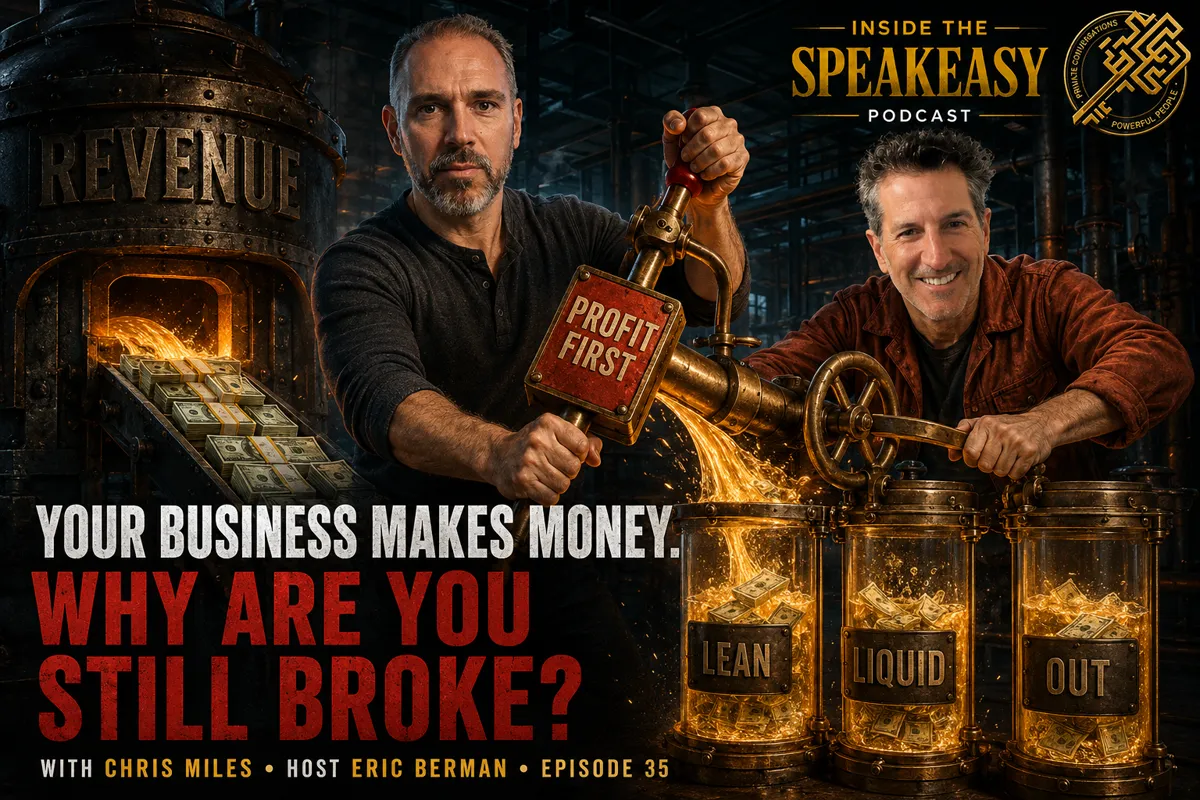
Chris Miles, the cash flow expert who calls himself the anti-financial advisor and hosts the Money Ripples podcast, has become work optional twice, and lost everything in between. In this conversation with host Eric Berman, Chris explains how a sobering retirement review with his own father pushed him away from the save-and-wait approach he was selling as a commission-only financial advisor, and how lending, a rental, and a few referral relationships had him living on passive income by 28. He describes going from asset millionaire to food stamps in the 2008 recession, rebuilding with Garrett Gunderson, and reaching work optional again in 2016. Chris then breaks down the three phases of his new book: get lean, get liquid, and get out. He shares his views on renting versus buying, the reinvestment trap, vetting investment partners, and why he says he is holding more cash right now.
In this episode, you'll discover:
- Why Chris says about 75% of business owners lean toward a spender mindset, and what he means by becoming a wise steward instead
- The eating-out habit that Chris says cost one high-earning couple $5,600 a month, and the other leaks they found
- Why Chris argues a home equity line of credit is not an emergency fund, based on what banks did in 2007 and 2008
- The entrepreneur trap of always reinvesting in the business, and why Chris recommends every owner read Profit First
- The questions Chris asks before trusting anyone with his money, including asking them to describe their worst deal
Episode Summary
Chris Miles did not start out with money. He wanted the freedom of business ownership, so before becoming a business consultant he decided to get real business experience first, and the first opportunity he found was as a 100% commission-only financial advisor. About four years in, his father, a frugal saver who was debt free, had paid off his house in 18 years, and had faithfully funded his 401(k), asked Chris to review his finances. Chris told him that if he retired at 61, he would run out of money in about five or six years. His dad kept working into his 70s.
That conversation bothered Chris, because he was following the same path. Around the same time, a friend who had left financial advising for real estate asked him how many of his clients, and how many of the advisors in his office, were financially free from the investments they recommended. Chris realized the answer was none. He left the business, worked as a mortgage broker, and started learning from investors in their 20s and 30s. By 2006, between a rental, lending money to fix-and-flip investors at the 2% a month borrowers were paying at the time, and referral fees from a mortgage partner and a wholesale jeweler, he had four or five thousand dollars a month coming in against the $3,500 a month he needed. He was 28 and work optional.
In 2007 Chris came out of retirement to partner with Garrett Gunderson on Freedom Fast Track, which later became Wealth Factory. The recession hit their real estate investor clients and Chris's own properties at the same time, and his lifestyle had grown. He says he went from asset millionaire to food stamps, foreclosed on his dream home in April 2009, and survived by teaching people practical ways to find money in their cash flow. That system, combined with Garrett's relationships, helped the business grow to over $5 million in 2010. After parting ways in 2012 and a divorce in 2015, Chris says he reached $10,000 a month in passive income by December 2016.
Chris organizes his approach, and his new book, The Work Optional Blueprint, around three phases. Get lean is not about living on rice and beans, he says, but about being a wise steward: tracking money weekly, cutting forgotten subscriptions, and spending only on what is worthwhile. He describes a client couple spending $5,600 a month eating out in 2010, who he says freed up 70 to 80 thousand dollars a year once they addressed dining, groceries, health insurance, and tax strategies such as the Augusta Rule. Get liquid means keeping cash in your control. Chris says credit lines were cut without warning in 2007 and 2008, and that he keeps most of his own money in a whole life insurance policy he designed for low cost.
On housing, Chris separates principles from strategies. He says liquidity is the principle, while buying a home is a strategy that depends on conditions, and he predicts home values will not appreciate much over the next five years. Get out means putting money to work. Chris says business owners should pay themselves profit rather than reinvesting everything, then build outside income streams. He describes lending, oil and gas, turnkey rentals in the Southeast, and a raw land partnership in which he is the financing partner. He also tells the story of a San Diego chiropractor who traded a low-yielding rental for six Louisiana rentals.
Before investing with anyone, Chris looks for at least 15 years of experience and a full market cycle, asks about their worst deal, and checks for third-party audits, because he bets on the jockey more than the horse. He closes with a warning that he believes getting liquid matters more than ever, says he holds roughly 25 to 30% of his portfolio in cash, and shares how a misplaced college class turned him into a competitive ballroom dancer before he discovered marathons.
Big Ideas Discussed
Spender, Saver, or Steward
Chris describes three money mindsets. Spenders, which he says describes about 75% of business owners, focus on unlimited income and forget about spending. Savers, like his father, live in scarcity and feel they can never save enough or pay off debt fast enough. Chris says scarcity never leads to financial freedom.
The alternative he teaches is stewardship: asking what the best use of each dollar is and how to get money working as hard as possible. He says business owners often understand this better than W-2 employees, because money is meant to be used, just used wisely, in a way that increases your means and your impact. Eric connects it to the idea, which he heard at a Grant Cardone event, that currency needs to keep moving rather than sit idle. Chris adds that the Money Ripples name reflects the ripple effect a steward can create in other people's lives.
Credit Is Not Liquidity
The get liquid phase grew out of Chris's own experience. He says that when money got tight in 2008, he tried to pull money out of his house and the bank said no, and that many of his clients had lines of credit cut overnight, with a letter arriving a week later. His conclusion is that credit cards and home equity lines can be useful tools, but they are not emergency funds.
Chris says much traditional advice locks money away in home equity or in retirement accounts that charge penalties for early access. He prefers to keep money in his own control, and says he holds most of his in a whole life insurance policy designed to keep costs low. He also says business owners should keep at least a couple of months of operating expenses in reserve, and that more cash can put them in a position to buy market share or competitors when others are strapped.
The Reinvestment Trap
Chris agrees that a business is often an owner's best investment, especially early on. The trap, he says, is the owner who always claims to be reinvesting. Citing Mike Michalowicz's Profit First, which he calls a must-read alongside Rich Dad Poor Dad and The E-Myth, Chris says that if you are always reinvesting in your business, you are not profitable.
He warns that this creates tension at home and leaves the business without the liquidity that comes from storing profit. Chris also explains why he does not always favor paying debt down as fast as possible: when he poured everything into debt and then hit a dry month, he ended up scrambling from scarcity, which he says drives business away. Eric summarizes the alternative as paying yourself first, moving that money into a separate account the business cannot touch, and using it to build outside income.
Bet on the Jockey, Not Just the Horse
When people approach Chris with deals for his clients, his first questions are about the operator. How long have they been doing this? Have they been through a full market cycle, ideally 15 years or more? What was their worst deal, and what did they learn? He says he does not want his money to be anyone's guinea pig, and he told one friend who had just moved into oil and gas to check back with him in 2035.
Chris also looks for third-party audits and is skeptical of deals that rely on future improvements, saying that among investors he knows, a deal that is not cash flowing from day one is a red flag. Eric compares this to the venture capital rule that the top three things to evaluate are management, management, and management. Chris adds that living with integrity tends to attract people with the same values, which he says weeds out many of the marketers who are all hat and no cattle.
Questions We Answer in This Episode
What does Get Lean, Get Liquid, Get Out mean?
Get Lean, Get Liquid, Get Out is the three-phase framework Chris Miles teaches in his book The Work Optional Blueprint. Get lean means being a wise steward of spending in your business and at home. Get liquid means keeping cash in your control, and get out means putting that money to work in outside income streams.
Why is Chris Miles called the anti-financial advisor?
Chris Miles began as a commission-only financial advisor but left after realizing that neither his clients nor the advisors in his office had become financially free from the investments they recommended. He now teaches a cash flow approach focused on becoming work optional, rather than saving for decades and hoping it is enough.
How did Chris Miles become work optional at 28?
Chris Miles says he combined three income sources: a rental property, lending money to fix-and-flip investors at the 2% a month borrowers were paying in 2006, and referral fees. Together they brought in four or five thousand dollars a month, while he needed only $3,500 a month to live.
What happened to Chris Miles during the 2008 recession?
Chris Miles says he had raised his lifestyle while his business, clients, and real estate were all hit at once. He describes going from asset millionaire to food stamps and foreclosing on his dream home in April 2009. He says he rebuilt by teaching practical cash flow strategies and reached work optional again in December 2016.
Is a home equity line of credit a good emergency fund?
Chris Miles says no. He says that in 2007 and 2008, banks cut many people's lines of credit overnight without warning, including his own. In his view, credit cards and credit lines can be useful, but an emergency fund needs to be liquid cash that you control.
What is the entrepreneur reinvestment trap?
Chris Miles says many business owners claim they are always reinvesting, which in practice means the business is never profitable. Citing Mike Michalowicz's Profit First, he says owners should pay themselves profit and store that cash. He says this provides liquidity and money to build income outside the business.
What does Chris Miles look for before investing with someone?
Chris Miles says he bets on the jockey more than the horse. He looks for at least 15 years of experience and a full market cycle, asks operators to describe their worst deal, and checks for third-party audits. He says he is wary of deals that are not cash flowing from day one.
Full Episode Transcript
Read the Full Episode Transcript
Welcome and the Anti-Financial Advisor
Eric Berman: This show is brought to you by HighLevel, the AI driven business operating system trusted by over 2 million businesses to help automate, scale and create real leverage. High Level isn't just a tool, it's the engine behind some of the most agile and high performing teams on the planet. If you're ready to streamline everything, amplify your reach, and actually build a business that works for you, you're in the right place. Visit www.gohighlevel.com/Speakeasy-mastermind-promo to get an exclusive 30 day trial for being a listener of the Inside the Speakeasy Podcast. Enjoy the show. Get lean, get liquid, get out. Three incredible strategies that you're going to learn in today's episode of Inside the Speakeasy Podcast where Chris Miles breaks it down and shows us how to make some incredible passive money. Talk to us about some common mistakes that damn I'm making, we're all probably making and let's get out there and make some more money and do the right things. Welcome, Chris Miles.
Chris Miles: Hey Eric, it's good to be here, man.
Eric Berman: I said Salt Lake City, but I know you're in the Salt Lake chapter. Are you near the city there?
Chris Miles: I'm in an hour south of there. So you know, it's close enough.
Eric Berman: Nice, nice. Well, welcome. We're going to get into all things money, Chris. Chris is known as the cash flow expert. Also the anti financial advisor. I love that. The anti financial advisor. I can't wait to drill deep into what the hell that means and you're going to teach him strategies where you're going to get our money. Pay us twice. So I like that. So, dude, I am all about it. I am working my ass off. I am working too hard. I need to get my money hustling way more than I'm hustling. I am so excited to talk to and figure out what the hell I'm doing wrong. Not to mention probably a lot of us listening on the show. And this is great. This is such a good topic because we talk about scaling business and this is the other side because what the hell are we doing this for? Obviously it's for family. It's for wealth, for building the ability for us to not have to worry about that money coming in. And we need people like you in our lives. So thank you for coming on the show.
Chris Miles: Hey, it's been an honor man.
Eric Berman: Well, let's dig into this a little bit. I mean, you know, quick background. I mean, I know you have an incredible podcast. You get about a thousand episodes right now on the Money Ripples podcast. You're out there in the world of talking money, finance. You know, give me a quick background how you got there.
Financial Advisor Years and a Wake-Up Call From Dad
Chris Miles: Yeah, so not the way that most people would think. It wasn't like I started out just, you know, having lots of money, making lots of money, and voila, it's magic wand and I'm there. Right. It was actually from doing the opposite, from screwing up a lot of times and not necessarily having like, you know, the best example, for example, I mean, I started out when I became a business owner. I actually wanted to become a business owner because I wanted to have that freedom, right? My control, my own destiny, my time and everything else. And I was trying to look for something to do. I was actually going to become a business consultant, but I changed direction because I thought, let's have a business experience first before I become a business consultant. Because I don't want to be some 20 something year old kid with an MBA, saying here you should listen to what I do, even though I have no clue what I'm doing. Right.
Eric Berman: I mean, one of those business coaches. Who says they're a business coach? Yeah. They never run a business.
Chris Miles: That's right. It's like the best life coaches in the world. Right. It's like the ones that never experienced life. So I didn't want to be that guy. So I actually looked for a business and the first one I came up is being a financial advisor, the traditional salesman in a suit, you know, that kind of thing. And so I started doing that was 100% commission only. Eventually quit my 9 to 5 job and started doing that, you know, living the dream, so to speak. Although it was kind of a nightmare because I didn't know how to run a business, I wasn't doing great at it. I was barely making ends meet. But I started to slowly get that business going. And then about four years in, I sat down with my dad. Now understand, my dad is like the model poster child of the cheapest son of a gun you've ever met. Right. I mean, depression era mentality. The guy, you know, would buy everything on sale. He has Mrs. Butterworth's still on his shelf that's 25 years old because it was on sale and he refuses to throw it away. Like a level three hoarder, you know. And so this guy like, I mean, he taught me to just scrimp and save, be cheap and everything. Well, he said, Chris, when are you going to advise me? So I sit down with him, I go fly back home to Oregon where I grew up. And I'm sitting down with him and as we're talking, I look at his numbers and everything. I was like, okay, dad, you're 100% debt free. You paid off your house in 18 years, good job. You've been stuffing money in your 401k like every good boy should. Here's the deal, dad, you're 61 year olds. If you want to retire today, you're going to need to die in about five or six years because that's when you'll run out of money. It's like, well, okay, Mr. Sunshine, that's not what I wanted to hear. What do I do? I said, I don't know, we're work longer, save more, just keep going, maybe you'll retire in your 70s. And that's exactly what he did. Now the next month, I'm totally just bugged by this, right? Because remember, I was following in his footsteps too. I was living cheap. I was the guy turned off the AC in the summer, turn off the heat in the winter, save a few bucks so I could throw it all in mutual funds. And hopefully I have, you know, a couple million dollars, you know, a few decades or so. And I realized, like, wait, what if this doesn't work? And at that same time, it's like, when the student's ready, the teacher appears.
The Question That Led Chris to Real Estate
Chris Miles: One of my friends I trained to be a financial advisor had quit to go do real estate investing. And we're talking and he said, well, Chris, how many of your clients are financially free where they don't worry about money? I said, oh, you had to throw that last part in. They all worry about money. Even the retired ones watch CNN and then it's freak out. They're going to lose all their money, right? And it doesn't matter if they're even in the stock market or not. They just freak out because the world's going to end. It's like, okay, good, so nobody, nobody's financially free. Good job, Chris. Well, how about this? How many of you guys as financial advisors are financially free, not off the commissions you're earning, but actually doing these same investments you're recommending. And this is in end of 2005. And I'm thinking, I'm like, you know, there's guys working here since the mid-1970s, they can't retire either. So I don't know, none. There's your problem. So of course I started going on that journey, right? I started trying to find out what my friend knew, learning in the real estate game. I actually eventually quit. I just realized I couldn't teach something that I didn't believe in because I'm the worst poker player. Just heads up Speakeasy community. I'm not going to do gambling with you or ever do Vegas again. I won't do it because I will lose all my money to you. So that's the thing. Like I just can't BS it. And so I just quit. I said I'll never teach about money again. I'll just be a mortgage broker. I will do a little bit of stock trading on the side and I'll teach ballroom dancing. Because you know, one thing that some people know, some people don't, is that I used to be one of the nation's top amateur ballroom dancers. What? So I actually was teaching at Utah Valley University, which of course is where Charlie Kirk was assassinated unfortunately. But. But yeah, I was like the world championship ballroom team there at one point. Just five years prior to this.
Eric Berman: Oh my. We're gonna have to get into that a little bit later if we get some time. I love that. Okay, keep going. You got me.
Chris Miles: [unclear] So. So that's kind of the path I was on. I didn't want to teach about money, but of course I wanted to know how to be free. And I saw these guys in their 20s and 30s in real estate doing it. And so I started to realize it wasn't just about, you know, flipping properties. Although I was flipped my own starter home and pulled out the equity out. But then I rented it back from the owner that I sold it to the investor, then subleased it and tried to make cash flow off that. And I was doing all kinds of things. Cause I realized I could lend my money out to investors and make money off of that. And so I didn't have to be the hands on investor like Kiyosaki talks about in Rich Dad Poor Dad. I could literally turn my money over to those guys and get paid money. And so between that some other income streams. Later that next year in 2006, I had enough passive income coming in. I was able to be work optional as we call it, right? Where you have enough passive income that you could quit. You can work because you want to, not because you have to. And is at that point I really started to ask myself, well, what am I going to do when I grow up? You know, I'm 28, almost 29 years old, not too many people, my friends of mine are able to just to hang out in the middle of the day because you know they have jobs. Right?
Eric Berman: Well, time out though, you kind of spent through something important there. I mean, you just sort of like, oh, you did this, that, the other thing and all of a sudden you now have enough money to live off of passive income in 28. So can you, can we dig into that a little bit or are we going to get back to like what are you doing to be able to make that kind of money that young?
Chris Miles: Yeah, so like I said, like I realized that it was about not about really just saving up a ton of money, but getting it to work by producing income. Because most people teach in the financial advisor world, you got to accumulate it, right? Start it all up like a squirrel saving for that winter of retirement and hopefully the winter doesn't last too long where the squirrel dies of starvation.
Eric Berman: I remember, I mean just, you know, for those, either love them or don't love them. But I remember going to a Grant Cardone event, he talked a lot about that, about just, you know, you got to currency's current, you got to keep it moving. You know, he'd say, you know, you can't having it saved is not. It's exactly what you're saying. He just echoed that. Get it working.
Spender, Saver, or Steward
Chris Miles: I work for it as a steward mentality, right? Because there's spender mentality, which we all know many business owners by the way. About 75% of business owners fall under spender mindset, which is why they become business owners because they have higher control or income, because that's what they hyper focus on. They forget about the spending, but they get unlimited income. And that's why they become an entrepreneur. But on the flip side, also in scarcity are savers like my dad, right? You can never save enough. You can't pay off debt fast enough. It's just never enough. And scarcity never leads to financial freedom. It's about how to be a wise steward, which is what you're referring to, which is what's the best use of my money? How can I get this money to work as hard as possible for me so that I can not just create comfort, right? Not just become work optional, but essentially bless more lives, right? And that's kind of what the Money Ripples, you know, brand is about, right? That ripple effect you can create in others lives. You know, that's what a steward does. Steward's always trying to make it better. Which also by the way A lot of business owners understand better than the 9 to 5 W2 employees, because even if they're spenders, it doesn't take much to switch over, because money is meant to be used. It's just meant to be used wisely in a way that actually increases your means so that you can increase your impact in the world versus just blowing it. Having great lifestyle, looks great on social media, but you always feel trapped. You're always in the hustle. You never escape the hustle.
Eric Berman: Right, Right. I mean, yeah. So, I mean, [unclear]. So what I'm learning so far, and obviously we're going to dig deeper, is have money being fluid and rippling, you know, working. But wisely, you spending money and buying things isn't necessarily the smartest thing. So how do you get your money to work for you to create more income, which we'll get into. Okay, so now we'll go back to your story. Thank you for taking me on that. To clarify. So.
Becoming Work Optional on $3,500 a Month
Chris Miles: So at that time, by the way, I only need 3,500 a month to live on. So I did a few different things, and it really almost became accidental the first time. And I say the first time because, as you mentioned, I had retired twice by the time I was 39. There's a reason, because I screwed up the first time. But I'll tell you what I did the first time, and I'll mention what happened the second time, too. So the first time, you know, like I said, I turned my starter home. I turned it into a rental. And then, of course, from there, I also realized I could lend my money to real estate investors. And there's at that time in 2006, because of appreciation, everything, people were really, really kind of frothy. So people were paying me like 2% a month to borrow your money. So if I had lent somebody a hundred thousand bucks, they'd pay me 2,000 a month.
Eric Berman: So the money you were making on the house, you had, the rental income, there was enough overage to be able to have you take some of that money and lend it out.
Chris Miles: Yeah. Between three different things. So that was one, two was I was lending my money. All right, So I did strip the equity out of my property and stuff because I had, you know, built up a lot of equity in that property, and then I was able to lend that money out. I could lend it out at like 2% a month.
Eric Berman: Yeah.
Chris Miles: So, you know, like I said, if you have $100,000, that's paying you $2,000 a month without touching your principal and that's just lending it to guys are like doing fix and flips and things like that with properties. So you're letting them do the work. You just are the bank.
Eric Berman: Right?
Chris Miles: But also on top of that, it was kind of accidental where I had a friend of mine that asked me. He says, well, Chris, I know you're doing mortgages. Do you like doing mortgages? I said, honestly, I love getting people the results and I love teaching them about the strategies with a mortgage and what you can do with it, especially where you can strip out equity and invest it. But I absolutely hate paperwork. And I was used to being like the rugged do it yourselfer, right? Like, if as a financial advisor, I was like the one stop shop. I had like life insurance, health insurance, you know, I would do your mutual funds, annuities. You know, I did your mortgages. I did everything. And he's like, why do that? This is an abundant world, not a scarcity world with a zero sum game. He's like, why don't you find somebody who actually likes doing paperwork? I said, does that person even exist? You're like, who would be nerdy and dumb enough to do that? He's like, trust me, there are nerds out there that love paperwork.
Eric Berman: Oh, yeah.
Chris Miles: So I went. I went to the broker and asked. I said, hey, who would do that? And he said, oh, talk to Clark, because anybody named Clark would be nerdy enough to do paperwork.
Eric Berman: Clark does sound like that. Yeah, exactly.
Chris Miles: Yeah. So I found, you know, I went to Clark and I said, hey, Clark, if I send you people that I've been teaching about how to take equity from their homes, you know, cash, cash out refinances, and then invest that money, could you help set them up with a mortgage? Do you basically do all the work? He said, yeah. I'm like, would you do it for 50%? You bet. And so the great thing is I'd spend half hour to an hour, teach people, like, here's what you can actually do with your home equity to even pay off your mortgage faster or invest or whatever. And so he's like. So I would say, great. You know, they're like, how do we get that mortgage? Talk to Clark. And I referred to Clark. A month or two later, I get a check in the mail, you know, from Clark for like a thousand or two thousand bucks a month, you know, and. And it was just friends and family. I wasn't like, doing this big affiliate type thing, even though I didn't even know what an affiliate was back then. It was literally just I was sending referrals. I even sent referrals to a jeweler, a wholesale jeweler in Salt Lake City because they would pay a 5% kickback. And I knew that anybody who went to them would pay a third of the price for their engagement rings. And being in my 20s, everybody was getting married and engaged, so occasionally I'd send referrals there. And so I'm getting paid like an affiliate. I'm getting paid from rent, my rental, and I'm getting paid from lending my money out. And the next thing I know, I have like four or five thousand dollars a month coming in. I only needed 3,500 a month to live on. And. And it was crazy because I was hustling so hard to try to make that much money or more as a financial advisor and whatnot. Working easily full time to overtime hours. And now I'm literally working like a three or four hour work week. Even before Tim wrote the book, Tim Ferriss did, right. You know, I was living like that three or four hour work week doing those things. And that's what blew my mind. I didn't think it was even possible.
Eric Berman: Love it. Okay, so now we fast forward. So thanks for clarifying. So now you fast forward your 20s, late 20s, there you said you lost it and then you did it again. And then we'll get into the lessons here.
From Asset Millionaire to Food Stamps and Back
Chris Miles: So, yeah, so 2007, I came out of retirement. I was going to save the world. I was going to teach with a guy named Garrett Gunderson, some of you guys might have heard of him before. We partnered up create a company called Freedom Fast Track, which eventually became Wealth Factory. And we started that in 2007. We're all gung ho, we're going to do it. And of course the recession hits at the same time. That recession is affecting our business because all of our clients were actually real estate investors. So they're all getting wiped out. They didn't have money to pay us. At the same time, my own real estate's having issues. And of course I raised my quality of life up too at that time because I was making so much money. It's like air. You never count the number of breaths you take until it's gone. And that's what was happening. So next thing I know, I'm in the hole 15,000, 16,000 a month. I literally went from like asset millionaire to welfare, like literally on food stamps and trying to figure out how to make ends meet. I found out later because, you know, the guys at this company were overcharging Us for rent. But that's another story. But, you know, things like that were just going on. Like, I was just, like, trying to figure out how to make it work. And during that time, I stopped teaching people how to get outta the rat race and I pivoted. Cause remember, I can't teach something I'm not doing. People always talk about imposter syndrome, and I don't really ever feel that too much because if I don't do it, I don't teach it. And I guess that's how I avoid imposter syndrome, is that I only teach what I know, what I'm doing.
Eric Berman: Comfortable, natural. Yeah, you can. Yeah, exactly.
Chris Miles: So I started teaching people instead of how to find money is in the recession, people are like, Chris, I would love to know the things you've learned, but I just don't have the money to pay you. Now, in the back of my mind, I wouldn't say it verbally, but in the back of my mind I'd be like, man, I wish I was in their financial situation. That's way better than mine is right now. Now, I wouldn't say that out loud because that's business suicide, right? But it was really at a point where I was like, man, like, I wish I was in their situation. So I would tell them, I said, listen, if I could help you find the money to pay me, will you pay me? I said, of course. I was like, great, let's do it. And so I would show them creative ways to improve their cash flow, whether it's ways to track their money, better creative ways to pay off debt, the whole cash flow index, which is now thrown out there with like, the income snowball and income or the debt snowball and debt avalanche and all that kind of stuff. That's now one of the strategies out there that I literally actually created while I was playing Cashflow 202 on my computer. Because I was so desperate, I was up late every night trying to figure out how to take care of my family because I had a bunch of young kids. My wife's talking about moving in her sister's basement. I have collector calls coming every day. You know, like, I was literally, like, being crushed under the pressure. Wow. And so I started teaching them creative strategies of what I was doing in my own situation to stretch those dollars out and make it work, save money on taxes. Right. Things like that. And finally, after going through all that, we can go back to all that, you know, emotional turmoil, how to control your mind during those times. But finally it was like the fourth quarter of 2009, I had that system I had started develop over the course of about a year, year and a half. And then Garrett finally got these great relationships through like Joe Polish in like the dental and chiropractic space. And then all of a sudden like they married the two together, like the new system we were creating. Because the old system that he had created was just trash. So. But mine was actually like implementation versus just philosophy. Meld those two together and the next thing you know, like one of the chiropractic coaches finds out he's freeing up 50,000 a year in tax savings from one of our CPAs. And just left and right, I mean people on average were freeing up about 34, 35,000 a year no new money invested, not even investing money, just finding ways.
Eric Berman: To, smarter ways to do it.
Chris Miles: Yeah, yeah. Better ways to be a better steward of your money to stop those money leaks and things like that. And it just. Our business went from almost bankrupt 2009 to making over 5 million the next year in 2010, you know, and had like over 250 clients come in that next year. So it was, that's what started helping me climb out, right. Start to pay back some of the debts I was digging under. I got myself down to almost nothing, by the way. I foreclosed on my dream home that I had for three years in April 2009, just months before things turned around. It was almost like I had to lose everything to figure out that I had everything in the first place.
Eric Berman: Wow.
Chris Miles: I just had to lose it, you know. So that's where things started really turnaround now 2012, we parted ways. I was like, hit the reset button, had to start over. 2015, I had a divorce, you know, which didn't help either. So I mean this wasn't like it was a straight up shot from there, but still that putting that focus again on how do I get myself back to that work optional place was the focus to where eventually by the December of 2016, I finally said, hey, I've got 10,000 a month coming in of passive income. I'm there now I'm there.
Eric Berman: Wow. Okay, so that's incredible story. As we have time, I'd love to hear how you got through some of these difficult times because we've all been there.
Get Lean: Tracking Money and Plugging Leaks
Eric Berman: Let's jump into some of these strategies too, because you hit a lot of these topics. I think all of us listening are like, okay, what are some of these a. Whether it's money saving strategies or how to get money to work from You. I mean, the big. So far, the big takeaway, which I've heard a little bit, but I like that you talked about is, you know, getting money to flow. So let's talk about some key strategies. You know, what do you often find with this entrepreneur? Some tips you can give. You know, you can start dropping here.
Chris Miles: Yeah, for sure. Yeah. So a lot of these strategies, I mean, come from in my book, the concepts. I call it get lean, get liquid, and get out. So I have the new book that just got released on Amazon called the Work Optional Blueprint. Super excited for that coming out because that's my first book ever just to you guys and Speakeasy, because between the publisher I was working with and Andrea Reindl, you know, having her help with the book, I mean, I would never have gotten it out, you know,.
Eric Berman: [unclear] Andrea, our Calgary leader. So let's make sure I drop that link in the notes. Okay. Keep going. For sure.
Chris Miles: So, yeah, so get lean, get liquid, get out. That's like the three phases you want to get with your money. That's different than what every financial person talks about. So get lean is. I mean, this one might not sound much different, but it is. I mentioned this. It's like, how do we make sure we're wise, steward over money? Like, it's not about living on rice and beans, cutting out that latte like Ramsey or David Bach talks about. Right. Which is like minimizing your way to wealth, which is bs, Right? Like, that's not how we live, you know, especially in. In a world where we want to be bigger stewards of what we have. And so, no, it's all about we be wise. Right. If we're going to spend money on something, make sure it's something that's worthwhile spending on. This applies both in your business and it applies at home. And so really start tracking your money. Track your money. Like, if you're in business, and I know we got plenty of people that are saying, yes, you need to do this, especially if they're in the finance space, is make sure you're tracking your money. I would do it weekly. That's what I do. Like, I track my money weekly, make sure I know what's going on with that. Are there any leaks in the business? Are there any subscriptions I'm paying for that I shouldn't be paying for? Right, right. Like, you know, all those things that you get when you get all these little, you know, different programs and stuff for helping you, you know, do marketing and whatnot. It's like, wait, I don't remember what that thing does anymore. Is it even useful? Right. Or is it extra? We change our CRM up. You know, we freed up money in that in our business recently because we were using a CRM platform, we were using Kajabi, and we're using this and that. Right? Like, totally.
Eric Berman: I'll echo that too, because we did a reason flush out in our own systems. And every time you have that subscription exercise, it's amazing because you got. And I'll just, you know, again, I'll double down on this one. I mean, what typically happens in businesses is you get an employee who's like, hey, I just need to add this tool for so and so, sure, it gets approved. And then that's two years ago. That employee is no longer here. Nobody else is even paying attention to that. And that just happens. And there's literally thousands of dollars of monthly subscriptions that are typically in pieces. Business love that tip. And I think it would double on that one. You said also get lean. That's business. What about on the personal side? What do you often find with your clients that were. It's easy to say, yeah, of course, I'm kind of watching what I spend money on. And, yeah, I'm going to buy my latte. What's a common thing that we're probably not spending, that we're spending on, that we maybe need to think about not spending on?
Chris Miles: Lately I've seen a lot of eating out is a big one. And it's not bad to eat out, but sometimes it gets ridiculous. I had one lady who, she was in it, and her and her husband were making, you know, quarter million a year, but they're like, we're broke and we don't know why. And I looked it up and by the way, this is 2010. This is pre. All the extra inflation we've seen last years. Right. And I look it up, and she's spending $5,600 a month. That would be like now eating out of about 10,000 a month. Right, Right. I mean, just ridiculous amounts. I'm like, what are you doing eating lobster for breakfast? She's like, that's not too far off the truth.
Eric Berman: Wow.
Chris Miles: So I told her, I was like, what if we just reeled it back? That's what, you know, at that time, it's like a thousand dollars a month. So even imagine your case, like, what if you reeled back, you know, spending, you know, eating out 2,000 a month? Right. For her, it was drastic. It made a massive change because going from 5,600 to a thousand frees up 4,600 a month. That's over 50 grand a year. She also found out that they were wasting money, like even food shopping because she was having her daughter's boyfriend live in boyfriend who wanted to be a master chef, you know, buying all kinds of crap. And he sucked at it, apparently. So she's like, okay, we're really in that in. Then we freed up some money, like with health insurance. They're overpaying on health insurance premiums, which I see a lot of entrepreneurs do too. Taxes. A accountant found out there's ways to do little strategies with taxes. Whether it's like, you know, for example, if you're an entrepreneur, many people don't realize that you can actually pay for the use of your house. They call it the Augusta Rule, right? Y Now it's become more knowledgeable now. But man, like, when I was even applying it back in 2011, nobody knew about it, you know, Y. I mean, so using that where you can literally pay for the use of your house for one day at a time not to exceed 14 days a year. And that's tax free income to you, right? Paying your kids, which now you can pay your kids like 14 grand a year tax free, you know, and that's up until they're, you know, till they're 18, things like that. So just little strategies of that nature. And when all was said and done, she freed up like something like over 70, 80 grand a year just doing that stuff. And that's all for her was pretty much personal, you know, in that sense.
Eric Berman: Wow, that's great. Okay, so thanks for sharing this. Okay, so get. Those are some get lean.
Get Liquid: Why a Credit Line Is Not an Emergency Fund
Eric Berman: What about get liquid?
Chris Miles: Get liquid means get your money in your control, right? What's so bad is that most financial advice tells you to lock your money up in prison. They say to pay off that house, trap it in the home equity. But what I learned in 2008, one of the things that made it so stressful on me is that when I wanted to get my money out of the house, when I realized money was getting tight, the bank said no, right? Because starting about mid-2007, they're like, we don't really like business owners anymore, so we're not going to give it to you. And that's what helped cause a lot of the property values to tank during that time. So you can't ever rely on even if you have a home equity line of credit. I had somebody tell me, like, oh, I've got emergency fund. It's a home equity line of credit. I'm good. I said, do you know that back in 2007, 2008, I had many, many clients, even myself, who had lines of credit that they took away and then sent you a letter a week later saying they took your line of credit away. No warning, they just cut it back overnight. They can do that to you at any time. That is not an emergency fund, you know, so if you have credit cards or lines of credit in your banks and things like that, I have them too. But those are not emergency funds. You got to have liquid cash on hand. So don't lock it up in home equity in places like that where you can't get to it. Don't lock up in 401ks and IRAs where they slap you with penalties to touch your own dang money. Right. That's stupid. It's like, no, get that money in your possession and you don't have to keep it in the bank, you know, like, for example, I keep most of my money inside of a life insurance policy, like a whole life insurance policy that pays me 6% a year tax free. But I designed it in a way where it's low cost, so it actually grows versus just cost me a lot of money. Like most people set up crappy insurance agents, you know, not to say anybody in this group has, you know, if they're an insurance agent, not you, of course, but.
Renting Versus Buying a Home Right Now
Eric Berman: Right. I've had multiple debates about. You said that the home equity or just you don't have your money. So rent versus buy. Like most people think the dream is to own a home. I've heard the counter of that's great, but as soon as you buy a home, your money's trapped in the home and you think even though your money might be growing, you typically never take that money out because you just go buy a bigger home with it. And so it's sort of like that money is never working for you as much as you think it is, other than maybe at some point in retirement and you're slowly paying it down. So.
Chris Miles: Right.
Eric Berman: Is that what you mean or what's your take on that? That kind. I know you can always, hey, if your house grows 20, 30%, you can do equity line and take it out. But now you're back to what you talked about. What's your take on that?
Chris Miles: Yeah, you know, like, that's the thing about. There's a difference between principles and strategies. Right. So the principle is have money liquid, which is also a strategy too, in a sense. But really, having liquidity, having access to cash is a principle. Right. It's that safety that you need. Whether or not you buy a house is a strategy and it can change depending on the conditions. I'll make a prediction here, and I'm a huge fan of real estate and I still invest in lots of aspects of real estate, but I predict that you're not going to see your house appreciate much for the next five years.
Eric Berman: Right.
Chris Miles: Maybe in the next 10 years, but not so much in the next five.
Eric Berman: Right.
Chris Miles: And so if someone's saying, like, I'm literally banking on the value of my house going up, that appreciation, don't count on it. Because if that's the only thing that's going to save you, don't buy a house. Right, right. So you're right. I mean, right now we're in a market where rents are actually a better deal than mortgages because rents have actually come down in the last year or two. So there's a good argument that way. Not to mention, I mean, I bought a house here, you know, four years ago, you know, right at the height of 2021, where you're like, you know, trying to outbid everybody. And this house, like after we moved in, a year or so later, the house, the basement floods not from plumbing, but from outside water, which is not covered by home insurance. I knew it had to come out of pocket 100 grand. If I were renting this place, I would not have to pay a dime. So that's the kind of stuff they have to understand that when you buy a house, when it's for your own personal use, it's not an asset, it's a liability. It's really an expense, just like renting is. Now, granted, I agree, you can put a small down payment, make a lot of money on it, and I think overall home ownership will make you wealthier over time. In the short term, don't count on it. And that's where I think renting can be just fine, even if you're a multi millionaire. I've debated the same thing myself.
Eric Berman: You know, would you argue then that it's. That the time to buy a house, potentially strategically, is when you have other cash that you can use that could be liquid versus putting all your money into a house that you're not probably going to gain for a long time? Because you said it's not. Wait until you have enough liquid, not to say, all right, have enough money finally to go buy that house. But I have nothing left after that. You probably would argue against that.
Get Out: Profit First and Building Passive Income Streams
Chris Miles: And that's where the get out comes in. Right? Because you get, get lean, then you get liquid, and then you get that money out working for you. So, yeah, you could buy a house, but it might not be the time to do it. You might say, you know what, I'm going to rent for a few years. Maybe I'm just going to try to stay as stable as I can. But how can I use that money? Could I use it, my business, to grow it? Now, I will give a warning on this. Like, when you're starting up a business, it makes perfect sense that your business is your number one investment and should be your number one investment even after you've started it. However, this is where I see the trap, the entrepreneur trap is this. So many business owners will constantly keep saying they reinvest in their business. And I'm using air quotes on purpose because they say reinvest. But if you use the words of Mike Michalowicz, he's the author of Profit First, which is a must read for every business owner. Just like, you know, just like, you know, you got books like Rich Dad Poor Dad, you got books like The E-Myth. Right? Right. Every entrepreneur needs to read Profit First because what Mike Michalowicz would say is, no, if you're always reinvesting your business, you are not profitable. You're literally spending all your money back in your business.
Eric Berman: Right.
Chris Miles: And long term, that's a chronic problem. Right. Because one, your spouse is going to hate you for it because they're going to say, why your business apparently making a lot of money, but we don't see all that money come home. Right. But the other problem is this, is that you need profit. I mean, profit is a lifeblood of that business. You don't have that liquidity that obviously comes from you having profit and storing that cash. That's why I'm not always a big fan of just paying down your debt super duper fast. Even though I did, I still had to do it in healthy levels because every time I would just use all my money to pay off debt, if I didn't have liquidity, something came up or there was a dry month or something like that, I'm hustling and scrambling major scarcity, which drives away business and makes it, you have to work five times harder to get the same business you would have had, had you relaxed, stayed in abundance. And so getting it out could be in your business. But that's not the permanent solution. That's why I create multiple streams of passive income. And I call it passive because it's literally passive. Not active in my business. Right. But actually creating outside streams of income. Like when I do things with real estate now, right now, I may not be buying rentals.
Eric Berman: Point back to profit first, which I know you talked about, building it as your strategy. If I recollect, it's profit first is most important thing. You got to pull money out to you as part of your strategy. If you're trying to, like, you know, whatever it is, you're not making money. Like, if that's not happening, then you're not doing well as a business right now. You need to be paying yourself first as profit. That money goes into some other account, some other place outside of reinvesting your business so that you could do what you're talking about, which is take that money into other things, get liquidity with that money, build up whatever you need to be building up to start gaining from the work you're doing in the business. Is that accurate?
Chris Miles: That's exactly it. Yeah.
Eric Berman: The savings account, the other account that doesn't. Your business doesn't see or sniff at because it's easy to put that money back in your business, but pay yourself, put it over there. So now you're building up the liquidity in your. Call it, other account, savings account. So strategies with that now to get passive income would be what?
Chris Miles: Yeah. For example, I mentioned lending. You know, I can lend my money right now in a good environment, you know, 10, 12% a year. That means if I have, you know, a hundred thousand bucks, I could be paid roughly about 800 to 1,000 bucks a month on that, you know, so I'm now taking that money and helping to create other streams that then replace what I'm spending at home. Remember, I'm being a wise steward. I'm getting lean again, not being cheap, but just being lean right at home and also in your business and then start to build those streams of income. So lending is another one. I'll even invest in things like oil and gas. You know, oil and gas is great, has some tax advantages, which as business owners, we always love. We get most from our business. It's nice to have some additional ones. It could be right. Rentals. Although I do turnkey rentals where I'm not the one managing the property. Somebody else manages it for me. And the great thing is that, like, I live in the western half of the United States. Rentals here, horrible idea, bad idea. Even people are trying to do Airbnb are having a hard time out here sometimes.
Eric Berman: Right, okay.
Chris Miles: But out east, you know, Southeast, for example, you know, you can go to place like Tennessee or North Carolina and you can get decent rentals. It could be Oklahoma or something like that. You know, there could be rentals there. They have a property manager there on site. So you're not being distracted from your business, trying to deal with all the headaches that might occur.
Eric Berman: Right.
Chris Miles: So those are things you say.
Eric Berman: When you say rentals, that means just buying a property that you rent out. You know, buying a property that's not that expensive or. Yeah, you know, we don't need to spend, you know, us West Coasters are spending, you know, one and a half, two, three million to get anything. You know, you're saying you could put that into way less. Couple hundred grand down into something on the East Coast.
Chris Miles: Yeah. Like for example, I had a, had one guy who actually was in California, San Diego, out in your neighborhood, he's a chiropractor out there. And he had, he had about $800,000 of equity in a rental property that he was only cash flowing, 200 bucks a month. But he was just so laser focused on that scarcity saver mentality. He said, no, no, I'm going to pay this off in six years and then it'll be 2,400 a month. I said, even then you realize that's a crappy return on your money. That's a 3% return. You put it in a CD, make more money. So I told him, I was like, what if we did a tax free exchange of that money out in the Southeast? And so he ended up picking out in a near, you know, out in Louisiana, he bought six rental properties with that one that he sold off in California. Six of those rentals that then were cash flowing, $6,000 a month. He then was taking that money and he did what I call as an income avalanche where you reinvest that income to build it and create more. Right. You compound the income instead of compounding interest. Right. Sustain that income or reinvesting it. Reached out to me last year. He says, Chris, I've now got to like eight or nine properties and I'm making $8,000 a month, over $100,000 a year versus 200 a month that he's making on that property before. Yeah. So, but like I said, like, not, I mean, right now in the current market, we may not push doing that kind of thing as much because that train is kind of not left the station, but it's kind of left the station. It hasn't returned back yet. Make that work. So we always look for different strategies that do work. Like, I have a business partnership right now where these guys buy and sell raw land. I'm the financer, I use my cash. They do all the work. I'm a 70% partner in that business. They're 30. But right now, that half million is kicking off over 12,500 a month. And it's got over now that half million's turned into well over a million dollars of just land alone. That's kicking off cash flow from them taking that property, flipping it, selling it to somebody, but they're sell it to them on a mortgage. So we're like the bank getting paid monthly interest payments every month. Right, right. Things like that. I mean, just, I mean, we can go on and on about it, but ultimately it's. I find that I like to buy real assets that provide real income. And that's what I focus on. So that I know that this is my secret in business too is my business has grown the best when I don't need the money. Right. There is something to be said when somebody's like hungry and they're trying to get after it and they're hustling and that's awesome. But it's a whole nother level of abundance when you know that you're there because you're there to serve. You're not there just to make money off somebody. You're there to show up and serve. And people respond to that. People say yes to you more often. Your conversion ratios go up because you're not desperate. You don't have what I call business breath. Right. Where you reek of that desperation. Like when people are throwing business cards at you, a chamber of commerce events. Right. It's not like that. It's literally like you're there. You're like, I'm here to serve. If I can serve you here, my business, great. If not, I can point you another direction.
Eric Berman: Right.
Chris Miles: It's just non attachment because you know that your family's taken care of regardless of what happens in your business.
Eric Berman: Right. Love it. So that's. So those are all three. So I love it. So lean liquid and get out. You have the liquid, so when you have the liquid money, you want it to start moving and working to floor. You said the assets are a great way to something that's tangible, that's producing money. And then you cycle continues. Right. Because then you get more liquidity and you reinvest that other stuff to get more passive.
Chris Miles: Bingo.
Eric Berman: Love it. So you mentioned today, I mean, gosh, you know, I'm listening to this and thinking of in my world and others. Okay, so you said in today's world. You know, here we are in if this gets dated Q4 of 2025, you like land. What else are you seeing out there that you think is good? If somebody's saying, well I need to, I have some liquidity here, what do I do with it?
Chris Miles: Yeah, lending has been big. Lending my money.
Vetting Partners and Betting on the Jockey
Eric Berman: So where do you go to lend and how do you find people to trust? Like what are the things you've learned and maybe you could share like, because I'm sure not every time you lent money out or something, you never got screwed one. So like yeah. What are the things you're looking for when you do lending or investing in other projects?
Chris Miles: Yeah, I mean one, you can find it yourself or two, you borrow somebody else's network. Right. For me personally, I mean I did through the life hard knocks. I did it the long way, which was build my own network. I've realized that birds of a feather flock together. So first and foremost, like if I'm living a life of integrity, which is a big, you know, I know everybody says that's their value and stuff but literally like honesty and integrity is like an absolute non negotiable. And I noticed when I live that best in my life, I tend to attract people just like that. That's how we got connected. Right? Because like minded people that I know and trust are also know and trust you. And then we got connected together. Right. And so it's that way that's first and foremost that helps weed out a lot of the charlatan, the great marketers that are all talk but no, you know, as they say in Texas, all hat, no cattle. Right. But I would also say this too is like when I look at people, when they come to me because they want my clients, because I have clients that we work with one on one to help them become more optional. They're saying, hey, if they've got money, I've got deals. The first thing I start wondering is, okay, well how long you been doing this? How long you been in this game? You know, like. And tell me your worst deal. I want to know all the scars you've gotten over time. Not from a bad way that I won't trust them, but I want to know what they've learned. I want to know if they've been through a full market cycle. Have they been around for at least 15 years or are they like with one of my friends, bless his heart, he's a great guy he was in the real estate game. But then when things weren't so great in the real estate game for him anymore after 2022, he pivoted into oil and gas. Well, I love oil and gas. But when he's like saying, hey, maybe we should do something together. Well, cool. Why don't you talk to me in about the year 2035 and let's just see if this is something you've stuck with. Right?
Eric Berman: Yeah, yeah.
Chris Miles: Because I don't trust anybody who's just been there for a few years. They've been dabbling in it. I don't want my money to be their guinea pig.
Eric Berman: Right.
Chris Miles: And so that's what I look for. I look for that experience because I bet not just on the horse, the deal itself. I bet on the jockey, who is that person that I'm investing with. That's more important to me than even the deal they're doing.
Eric Berman: I mean, you're ultimately saying Fundamentals 101 from any venture capitalist you talk to is going to put money into a business. What's the top three things you look for? And they say management, management and management.
Chris Miles: Yeah.
Eric Berman: So that's really what matters. And within that is exactly the first three things you mentioned management. What's their experience? Are they honest? Have they been honest with you about the deal that they fucked up on, Pardon my French, and how they got through it and what they did to take care of their people, like, you know, going down that rabbit hole? Because that'll help you with the integrity question.
Chris Miles: Yeah, that's a great point. I mean there are third party verification companies that do audits. Third party audits, that's another great one to see. Like, hey, have you had an auditing report? Done any recently? Because I mean that most people don't do that. But I think now especially there is more stress in the real estate game. It has been for the last three years. You got to be careful, you know, and it could be strategy wise. Like I say, like for example, self storage, that's another thing that we look at. But lately self storage hasn't really been been awesome. So finding opportunity is really hard. So when somebody says, oh, I got a great deal, do you really? It's like 2022, 2023, and there's like, oh, we got this apartment building, it's going to do value add. You know, we're going to do stuff to it. So it increases in value. I'm like, yeah, I've heard that. Like now like amongst us investors, the term value add is a joke because we're like, no, no. If it's not cash flowing from day one, your little value add isn't probably going to work. You know, this means we're going to lose our money, you know, so those kind of things happen. Right. So a lot of that is from experience of losing money, you know, in the past and. Or watching others lose money, too. But it's also, it's literally just from, you know, understanding the deal and the person that's doing the deal.
Eric Berman: Yeah, yeah. I tend to agree with you. I mean, I have done some angel investing and some other types of investing, and I think where I've. I've won and lost through my own hard knocks is exactly what you said. I think when all the end of the day it goes back to I know my lane and what I'm good at, and there's other people in other areas. I'm 10, 15 years behind that. I just didn't go down that path. So who do I know that I trust that's been in this business for 10, 15 years that I could give them my. And I don't care. Like, I'll peel off a percentage to them for handling stuff and saying, look, yeah, you absolutely should earn. You've done all the work for 15 years. Let's make some money together. And certainly you found it great. You know, you're taking care of it. I'm happy to pay you for that. So that's kind of where I've had some successes on when I do some liquidity playing around. But yeah, I love what you're saying there. As we wind up here. What on the finance side? What. Is there anything I didn't ask that I should have asked.
Why Chris Is Holding Cash Heading Into 2026
Chris Miles: You know, I'll say this to go along with when you're asking, what should people be looking at right now? I think right now, getting liquid. You know, that second stage I talked about is more essential than ever. I think we're gearing up for something big and ugly too. I know even AI, I think is awesome. Right. I don't doubt that one bit, but I know that also we've had a massive. As they say, it's a party, right? The bigger the party, the bigger the hangover. And we've had the everything bubble take off. Especially after 2020. Nothing's gone wrong, nothing's gone down. It seems like other than some real estate stuff that did like an apartment space and whatnot. But for the most part, everybody's made money by doing nothing that should concern you. Right. Because that easy Money, the easier it is, the bigger the pop of that bubble. And I think there's a big bubble popping here and you may not see it in 2025 yet. Although we're already seeing cracks, we're already seeing people stop hiring, we're seeing layoffs happen. Although the government likes to report numbers. All is well in Camelot, we all know that's a bunch of BS because they're trying to spin it so that they don't look bad from a political and an economic perspective. You know, so there's a lot of this crap going on that we, we know, we feel it, we sense it, a lot of us do, but we don't know when it's going to happen. And I think, you know, starting in 2026, if you don't have cash, you're going to be sorry. But those that do have cash, those that have cash on hand, you know, even if it means not just a couple months reserves for your business, which you should have, by the way, like at least good couple months of operating expenses in your business, you should have even more because you might have the best opportunity for gobbling up a lot of opportunity. It could be gobbling up market share, could be gobbling up your competitors. You'd be gobbling up like other value add, you know, is the good at value add, if I use that right, Value adds out to your business. I mean, I really think this is the time to have cash. Because there will be a point very soon in the near future, people won't have cash. Stocks are going to crash. We'll see bitcoin fluctuate as well. Good or bad. I mean, we'll see a lot of people be cash strapped and try to pull out of those markets, even bitcoin. Which is why you won't see bitcoin go down. Because it's not like it's valuable. Because people need to get cash, they need to use it. And that's the opportunity. Because when you start seeing everybody raiding their piggy banks and, and breaking it and just trying to survive, if you've got the cash ready to go now, you're going to make the rules, right? The person has the gold makes the rule.
Eric Berman: I love it. I agree with you too. I mean, I, I think outside the COVID dip, which came right back not too long later, I mean, correct me if I'm wrong, but we've had the longest consecutive runs of real estate, stock market and everything all at once. And that is a bad sign. I mean, it's good, but that Is, I agree with you. I think it's going to hit. What percentage of your, and I don't know if you have money or what your data set or your pie or what percentage of money that you might have in these sort of stock markets do you have in cash versus mutual funds and equities and all that?
Chris Miles: Right now I have zero in the stock market, zero in equities, anything like that. Now, liquid cash, like I said, I have a lot of it stored up in my life insurance because it's guaranteed, I'm not going to lose it there. And it makes money in the bank as tax free. So I'm keeping the lion's share of my money there some in banks or online savings accounts. But I mean, I've got, I'd probably say of my entire portfolio, roughly about the same as Buffett, actually, roughly about 25 to 30% in cash. Buffett had 30% of his money in cash right now. 347 Billion, the most he's ever had in cash. He's in cash right now. So I'm modeling the same thing. Even though people think that's stupid, I don't care. Because when the majority, Mark Twain says, is when you find yourself on the side of the majority, it's time to pause and reflect.
Eric Berman: Yeah.
Chris Miles: And right now, like, the majority is like, no, get all your cash out. You're going to lose inflation. Get all the money out. Those are the people that will be sorry.
Eric Berman: Yep, yep. No, I love that. Appreciate that.
From Ballroom Dancing to Marathons
Eric Berman: And then ballroom dancing. Ballroom dancer at 25, like, just close the loop on that or whatever. You are a champion ballroom dancer, right?
Chris Miles: Yeah, that was a very unintentional thing. Just like a lot of things in my life, I guess, you know, it's like you get directed into it. Freshman year of college, I had registered for a math class, but I took two semesters of calculus in high school. I thought it was enough because it was concurrent enrollment with that. But then the college said, you're 0.6 credits short of getting your math requirements done. So I took like a crappy algebra class. Well, I show up there that week when school's gonna start. They said, oh, you don't need it after all. Now, without that class, I wasn't full time. So I was trying to find a one credit class, like some kind of gym class or something like that. And I heard this girl talking to this guy saying, you know, hey, there's lots of girls in this class. I didn't know what class we're talking about, but I Knew that was a class for me. I went and I registered for it and. And I sucked. I was horrible. Girls would even bypass me sometimes to not dance with me in that class. But I had fun, kept doing it, took a second semester, Even took a ballroom class as well. And the next thing I know, my confidence started increased and I actually won like third place in the competition. And after that, my confidence level started going up. I started, kept doing it, practicing, got better, got on the team there that was in Idaho. And then I transferred to one of the two best schools with ballroom dancing. There's. And they're both within five miles of each other. One's BYU and the other is Utah Valley University. Both had world championship teams that alternate going to the world championships and they would always win. So I went to the one I thought was least stuck up. So I went to Utah Valley, did that and, you know, got on their ballroom dance team there. Did that few years, competed at amateur level and tried to avoid the professional level because I didn't want to get paid. So I get paid under the table from the instructors at the university. So I'd get paid in cash and stuff. And, you know, did that for a while. And until my. Who was my dance partner, my now ex wife gave me an ultimatum. Says, you either pick me or ballroom dancing because I'm not doing anymore. We keep having kids. Picked her and then started doing marathon running instead. And now I'm running the world majors and stuff.
Eric Berman: I love it. I love the competition in all areas of your life. And I was going to ask if you ended up getting the girl, if somebody finally would dance with you. And it sounds like, you know, you did at some point. So congrats on that. As we wrap.
What Chris Values About Speakeasy
Eric Berman: What are you enjoying about Speakeasy so far? What's your favorite thing?
Chris Miles: You know, definitely that. It's like the who's who. I've been a part of a lot of different networking groups, mastermind groups, and the one thing that impressed me the most, I mean, first was our chapter president, Kat Merritt. I mean, if you don't know her, you got to get to know Kat. Genius. Freaking brilliant. I actually met her when I worked with Garrett Gunderson. She ran our sales floor, and I've had a relationship with her ever since. And she's amazing. But then I saw the highest, the high caliber that was in the room. I'm like, these are people that make me feel a little self conscious, right? Like, you know, I've been in networking groups. I'm like, okay, I might have the cheapest car, but I have the most money, you know, now I'm like, I'm in these groups thinking, dang, there's a lot of people I can learn from. Just brilliant people and people with a servant heart like, like Kurt Molly. I'll give him a shout out, too. I mean, never met the guy. My CMO knew who he was, you know, and she, like, you know, like, glorified him and stuff. But then you meet him like you're just a normal guy and guys like David Gonzalez, you know, met him. I haven't joined his think tank and stuff too. And I mean, there's just so many brilliant minds in that room that it's really the kind of networking group that is a true mastermind, not just a conference that they, you know, masquerade as being a mastermind.
Eric Berman: Right, right. Well said. I appreciate the words and thank you so much. And thanks for coming in today and dropping some, you know, talking about masterminding and brilliance. I mean, obviously brilliance in your world. And thanks for sharing. Anybody listening? Obviously, I'm sure you have some amazing takeaways as well. And please get a chance to meet Chris and talk to him, and I'm sure he'd be happy to guide you through and give you some pointers as well. And thanks for coming in today, Chris.
Chris Miles: It's been an honor. Thank you so much, Eric.
Eric Berman: And that's a wrap from the Speakeasy Podcast. If something sparked for you, don't keep it to yourself. Share it, review it, and pass it to the one person who needs to hear this right now. Want in on the real mastermind? Tap the link in the show notes to apply until next time. Keep scaling, stay sharp, and don't be the smartest one in the room.

About The Guest
Chris Miles
Chris Miles is a cash flow expert known as the anti-financial advisor and the founder of Money Ripples, which helps clients build passive income and become work optional. He began his career as a commission-only financial advisor, then shifted his focus to cash flow after seeing that traditional saving was not making his clients financially free. Chris first became work optional at 28 through lending, rental income, and referral relationships. After co-founding Freedom Fast Track, which later became Wealth Factory, with Garrett Gunderson, he lost nearly everything in the 2008 recession and rebuilt, becoming work optional again in 2016. He hosts the Money Ripples podcast, which has passed roughly a thousand episodes, and is the author of The Work Optional Blueprint. A former competitive ballroom dancer at Utah Valley University and now a marathon runner, Chris lives in Utah and is a member of the Speakeasy Mastermind Salt Lake chapter.



