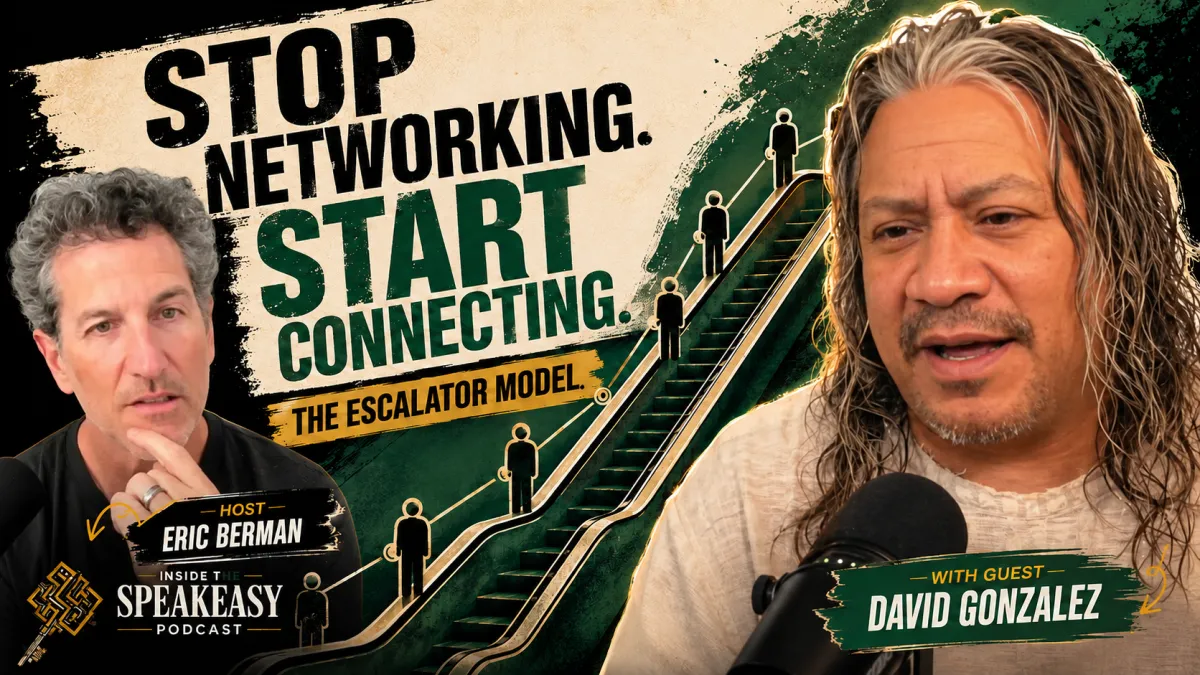
David Gonzalez has hosted the Internet Marketing Party in Austin every single month for sixteen years without missing one, and he joins the show to explain why the model that keeps that streak alive has nothing to do with traditional networking. David walks through how he reverse-engineered a way to fly in high-caliber speakers with no budget for speaker fees by building curated think tanks: small rooms of seven to ten experts assembled to solve one guest's single biggest business bottleneck, run under a strict house rule that the first hour allows only clarifying questions, never advice. He also unpacks the relationship philosophy behind sixteen years of "no VIPs, no pitching" community building, the mindset shift that let him stop comparing his revenue to bigger-name friends, and the escalator model of roughly fifty-four leverage points that now funds a life of leisure instead of a bigger headcount. For anyone building a community or a mastermind from scratch, David's story is a blueprint for turning curiosity into capital.
In this episode, you'll discover:
- How David Gonzalez built curated think tanks that assemble seven to ten experts around one person's single biggest business problem
- Why the first hour of every think tank hot seat bans advice and allows only clarifying questions, a rule borrowed from his EO forum days
- The philosophy of "interested is interesting" and the specific, deeper questions David asks to build relationships that last decades
- What shifted three years ago when David's passive recurring revenue overtook his living expenses and changed how he measures success
- The origin story of his Three-Day Think Tank and Experts Council Mastermind, born from a coach's blunt "you're enough" lesson
Episode Summary
David Gonzalez opens by tracing the Internet Marketing Party back to its accidental beginning: a group of Austin-area marketers driving to Dallas once a month for an informal mastermind, until someone finally asked why they bothered making the drive. David hosted the first Austin meetup in September 2008 after a friend posted about it in the Warrior Forum, expecting a handful of people and getting thirty or forty. The format picked up a second idea from his friend Michael Lovich, who suggested building an email list the way bigger names like Frank Kern and Jeff Walker were doing it: bring in cool speakers, keep them relaxed and social, and never let them pitch or sell from the stage. The branding that stuck was "a drunk TED Talk meets a business happy hour," with one hard rule — no VIPs, no hierarchy, everybody drinking at the same watering hole.
That casual format hit a practical wall once David wanted speakers from outside Texas, because they expected to be paid and the meetup was still just a hobby. Drawing on his experience in EO's Forum structure, where members bring their biggest challenge for the group to work through, David realized he could offer something more valuable than a fee: a curated think tank of seven to ten hand-picked experts, assembled specifically to solve that one speaker's single biggest bottleneck. Someone scaling affiliate traffic would get a room full of people running over a million dollars a month in affiliate revenue; someone considering a sale would get M&A specialists. The rule that makes it work, borrowed directly from EO, is that the first hour allows no advice or solutions, only clarifying questions — David calls himself "really militant" about enforcing it, because it forces the room to understand the problem before anyone tries to solve it.
The model scaled past geography almost by accident. David realized that if he called a respected peer and said he was curating a think tank with two or three other well-known names, that peer would fly in from anywhere just to be in the room, with no other reason to be in town. He now bluntly tells people who decline over scheduling that they're missing the point: the person in the "hot seat" often gets less value than the experts surrounding them, because it's rare to sit in a room full of peers all competing to ask the single best question rather than hand out advice.
David then turns to what he considers the real skill underneath it all: genuine curiosity. His core principle is that "interested is interesting" — asking someone real, layered questions about their family, hobbies, and childhood dreams builds more goodwill than being the most fascinating person in the room. He points to speaker and author Sam Horn as the model for this, describing an exercise he now runs at his three-day think tanks: attendees share their favorite photo of themselves and are guided through questions designed to surface something genuinely vulnerable. He credits a line often attributed to Maya Angelou — that people forget what you said or did, but never how you made them feel — as the truth the exercise is built to prove, adding one caveat: the technique only works when the curiosity is real, not a scripted pattern-interrupt.
David closes with the mindset shift that reshaped how he measures his own success. For roughly his first thirteen years, he felt he didn't belong in rooms with bigger names — not imposter syndrome, he clarifies, but a genuine sense that he hadn't earned a seat next to entrepreneurs with nine-figure exits when his own businesses topped out around a million dollars a year. That changed about three years ago, when he structured deals that pushed his passive, recurring revenue past his living expenses, letting him stop treading water and start "resting on the pool deck." Watching peers run bigger companies while privately miserable or friendless reframed what he optimizes for: a twenty-six-year marriage, a thriving twenty-three-year-old daughter, and a small circle of genuinely close friends. That same reframing is what let his coach, Joe Stolte, talk him into launching the Three-Day Think Tank, which grew into his Experts Council Mastermind — a room, David says, where every single person could be the speaker.
Big Ideas Discussed
Curated Think Tanks: Solving One Problem With a Room of Peers
David's signature format inverts the usual conference structure. Instead of one expert speaking to a crowd, he assembles seven to ten hand-picked experts around a single guest's single biggest bottleneck — built specifically for that person's problem, not a general topic. If the challenge is affiliate revenue, every expert in the room is already running over a million dollars a month in affiliate traffic; if it's an acquisition, the room fills with M&A specialists instead. The format was born out of necessity: once David wanted speakers from outside Austin, they expected to be paid, and his monthly meetup had no budget. He realized the room itself, not a fee, was the currency serious operators would fly in for.
The mechanic that makes the format work is a rule David borrowed from his years in EO's Forum structure: the first hour of every session allows no advice, no solutions, and no resources — only clarifying questions. David describes himself as "really militant" about enforcing this, because it forces the group to fully understand a problem before anyone is allowed to solve it, and it's often the surrounding experts, not the person in the hot seat, who walk away having learned the most.
Interested Is Interesting: David's Real Relationship-Building Secret
Asked repeatedly over the years to write a book on networking, David's answer is always the same: read How to Win Friends and Influence People and skip the rest, because the core insight hasn't changed. His own shorthand for it is "interested is interesting" — the idea that asking someone layered, specific questions about their family, hobbies, or childhood dreams builds a stronger connection in one conversation than trying to be the most fascinating person in the room. He illustrates it with a thought experiment: spend three hours on a flight only asking questions, and the other person goes home telling their spouse what a great conversationalist you were, while you quietly walk away knowing far more about them than almost anyone else does.
David credits speaker and author Sam Horn as the person who models this best, describing an exercise he now runs at his three-day think tanks: attendees bring their favorite photo of themselves, then are guided through questions designed to surface something genuinely vulnerable about why that photo matters. He flags the technique's one real requirement — it only works if the curiosity is genuine. Asking deeper questions as a mechanical pattern-interrupt, without actually caring about the answer, is transparent to the other person and, in David's view, a waste of everyone's time.
The Mindset Shift: From "I Don't Belong" to Financial Independence
For roughly the first thirteen years of building his community, David carried a specific discomfort in rooms full of bigger names — not imposter syndrome, he's careful to distinguish, but an honest sense that he hadn't earned his seat next to entrepreneurs with nine-figure exits when his own businesses topped out around a million dollars a year and twelve employees. Watching peers who ran much larger companies while being privately miserable, divorced, or short on real friendships gave him a different yardstick to measure himself against.
The turning point arrived about three years ago, when David structured deals that pushed his passive, recurring revenue past his monthly living expenses, letting him "rest on the pool deck instead of treading water." That financial independence reframed what he optimizes for: a twenty-six-year marriage, a thriving twenty-three-year-old daughter, and a small circle of genuinely close friends, rather than the revenue and headcount metrics his peers were chasing. He's since stopped measuring his standing by other people's scoreboards, on the theory that not everyone in the room needs to be Michael Jordan to belong in the league.
The Escalator Model and the Birth of the Three-Day Think Tank
David's actual revenue driver isn't the Internet Marketing Party, the think tanks, or his Experts Council — it's what he calls the escalator model, roughly fifty-four different leverage points designed to create win-win scenarios that make working with him a no-brainer, generating passive, annuity-like income that funds a life of leisure most people would associate with a much bigger company. The Three-Day Think Tank, one of his newer offers, exists because of a blunt coaching moment: his coach Joe Stolte did the math on charging ten to twenty people ten thousand dollars each for a weekend, then told David to pitch his top twenty-five prospects at the Internet Marketing Party's five-hundred-person anniversary event.
When David reported back that six people had said yes, Joe corrected him on the spot: nobody is a yes until they've paid. Once David went back and actually collected payment, Joe delivered the real lesson — David didn't need a partner or a co-host, he had everything he needed already. That distinction became the Experts Council Mastermind, which David describes as the only mastermind he knows of with no speakers and no content, because every single person in the room could be the speaker, and hot seats are curated purely by who has already solved the specific problem on the table.
Questions We Answer in This Episode
What is David Gonzalez's curated think tank model?
David Gonzalez's curated think tank model assembles seven to ten hand-picked experts around one person's single biggest business bottleneck, rather than gathering a general audience around a topic. If someone needs help with affiliate revenue, every expert in the room already runs over a million dollars a month in affiliate traffic. The first hour of every session allows only clarifying questions, never advice.
Why does David Gonzalez ban advice during the first hour of his think tanks?
David borrowed the rule from his years in EO's Forum structure, where members share their biggest challenge and the group works through it together. He enforces a first hour of clarifying questions only, with no advice, solutions, or resources allowed, because it forces the room to fully understand a problem before anyone is permitted to try to solve it.
What does David Gonzalez mean by "interested is interesting"?
"Interested is interesting" is David Gonzalez's shorthand for his relationship-building philosophy: asking someone layered, specific questions about their family, hobbies, or childhood dreams builds a stronger connection than trying to be the most fascinating person in a conversation. He illustrates it by pointing out that someone who only asks questions on a long flight is remembered as a great conversationalist, while quietly learning far more about the other person than almost anyone else does.
What is David Gonzalez's escalator revenue model?
The escalator model is David Gonzalez's term for roughly fifty-four different leverage points he's built to create win-win scenarios that make working with him an easy yes. It generates passive, annuity-like recurring revenue that funds a life of leisure he compares to what someone running a much larger company with many more employees might expect, without the need for that larger headcount.
How did David Gonzalez's Three-Day Think Tank get started?
David's coach, Joe Stolte, calculated that ten to twenty people paying ten thousand dollars each for a weekend was a viable event, and pushed David to pitch his top twenty-five prospects at the Internet Marketing Party's five-hundred-person anniversary event. When David reported six verbal yeses, Joe corrected him that nobody is a yes until they've paid, and once payment came in, told David he didn't need a partner to run it himself.
What shifted David Gonzalez's mindset after years of feeling like he didn't belong?
For roughly his first thirteen years in the industry, David felt he hadn't earned his seat in rooms with entrepreneurs who had far bigger exits, despite building his own business to a million dollars a year. About three years ago, his passive recurring revenue exceeded his living expenses, and that financial independence let him refocus on his marriage, his daughter, and a small circle of close friends instead of comparing revenue and headcount to his peers.
How long has the Internet Marketing Party been running, and what is it?
The Internet Marketing Party has run every single month in Austin for sixteen years, with its seventeenth anniversary coming in September. It grew out of informal monthly drives to a Dallas mastermind and became known for bringing in speakers under one condition: no pitching or selling from the stage, and no VIP hierarchy in the room.
How can someone get involved in David Gonzalez's community?
David hosts the Internet Marketing Party on the second Thursday of every month in Austin, and his curated think tanks and Three-Day Think Tank events are open to people who apply through his network. Listeners can learn more through the links in this episode or by reaching out directly to David Gonzalez.
Full Episode Transcript
Read the Full Episode Transcript
Cold Open: The Room With Seven Other Experts
David Gonzalez: If I was to call you and say, hey, I'm doing a think tank for Eddie Maloof, and I've got Eric Berman coming in, I've got Tom Shipley coming in — would you fly in from San Diego for that? Just for that? A lot of times I'll invite people to these think tanks and they'll say, oh, I'm not in Austin anymore, or I'm not going to be in Austin at that time. And I always say the same thing back: you don't get it, because it's very rare to be in a room where you're an expert at something and you're with seven other experts, all competing to give one person the best — not advice, but the best question.
Welcome to the Speakeasy Podcast
Eric Berman: Welcome to the Speakeasy Podcast, where the real conversations happen behind closed doors with the boldest entrepreneurs, creators, and growth minds in the game. No fluff, no filters — just the raw strategies, personal stories, and mental models that move the needle. I'm Eric Berman. Now let's get into it. Hello, everybody. I am so pumped and excited to bring on a longtime friend, one of the OGs in the world of internet marketing, and somebody I've looked up to for many, many years. It's funny, because we have a lot of commonalities in the world of building community, so I was so pumped for you and I to do this call together — especially for those who may not know that when we took Speakeasy from just San Diego and said, let's test firing it off in other cities, the first call I made was to this guy right here. I'm so excited to bring on today's guest, Mr. David Gonzalez. DG, welcome.
David Gonzalez: Hey, thank you so much, Eric, for having me, and hello to everyone watching. Appreciate you taking the time. I'm going to do my best to entertain you, engage you, and make you wiser, smarter, and richer. Let's go.
Sixteen Years of the Internet Marketing Party
Eric Berman: I want to go way back — for those who haven't heard of the Internet Marketing Party, first of all, how many years has that been going on for?
David Gonzalez: As of today, sixteen years. This September will be our seventeenth-year anniversary, and that's every single month without missing one. During COVID we went virtual and still got a ton of people there, but it's just so much fun. People ask how I've stayed so consistent, and honestly, I don't know — do you forget to eat, or brush your teeth, or pick up your kid from school? Certain things are just fun, rewarding, or important enough that you simply do them.
Eric Berman: Let's talk about this — I don't want to spend all my time on the Internet Marketing Party, but it's fascinating. I want to go present, then past, then future a little. What exactly, for those who haven't been to one, is it about? What's the idea?
Growing Up on the Border and Discovering NLP
David Gonzalez: I think, just in case somebody's doom-scrolling and deciding whether they want to listen to this — my intention for this interview is that by the end of it, you have a better sense of how to build community and how to build true, long-lasting relationships with high-quality, high-caliber people. Eric and I talked for a second before we hit record about the structure, and we decided to start with a little of my past. I grew up along the South Texas border, down where Elon Musk is launching rockets now, and there was a lot of poverty there — the main industries were agriculture and the drug trade. My next-door neighbor was a drug lord doing deals with Pablo Escobar. Straight up — I mean literally next door, as in I was at 816 South Indiana and he was at 818 South Indiana. A lot of times when people say "next door" they mean two blocks down; I mean I could throw a rock and hit his house. He eventually got caught and went to prison for ten years, but he was an interesting guy — he used to brag that he could take all his money, lose everything, and within a week have it all back, because of what he had between his ears. He was super charismatic, super engaging, super captivating, and I actually learned a lot from him by way of principles. My mom was a kindergarten teacher and my dad was an educator too, and I always grew up knowing I was built and destined for more. Whenever we came to Texas for vacations — it was a five-hour drive — I always felt like this was home, so this is where I decided to move after I left the house. At the time I was deciding whether to get a master's or a PhD after college, and I'd gotten really interested in Neuro-Linguistic Programming after going through a bad breakup. A friend turned me on to Tony Robbins and Unlimited Power, and he was the academic type who'd studied where Tony Robbins actually got his material — he turned me onto two guys named Bandler and Grinder who started NLP. He had these books on his shelf that looked like magic books, and he wouldn't let me read them until I'd finished Unlimited Power. I was so drawn to it that instead of going to graduate school, I went and studied NLP directly with the people who started it, including the amazing Richard Bandler. I did that for a few years and started my own NLP training center, which was really tough — getting clients was so hard, because they taught you how to work with clients but not how to actually go get them.
From a Hypnosis Franchise to Accidental Internet Marketer
Eric Berman: Sell and knock on doors — yeah, that's not the easy part.
David Gonzalez: Right, and that's when I started hearing about guys like Jay Abraham, Gary Halbert, Gary Eugene Schwartz, and Gary Vincent — it was all kind of adjacent, like once you were into NLP you were into alternative knowledge. I came across a program called Positive Changes Hypnosis, a franchise that promised a hundred clients a month, guaranteed. I signed up immediately, went and took the training, and that's where I met Rich Sheffrin, Harlan Kilstein, Telmik Knudson, and a ton of other people. I ended up running that business and turned it into a million-dollar-a-year business, got into EO through it, and built it up — but once the internet started coming online and other people got licensed as hypnotherapists and started running their own smaller ads, the competition dwindled the business model, and I couldn't figure out how to keep it afloat, so I sold it by the skin of my teeth. That's why I said I had money and I had time coming into the industry of internet marketing, which I didn't even know existed — this was around 2007, before Facebook and before YouTube. My buddy Michael Lovich had started something called the Hypnosis Network and asked me for pointers, and I brushed it off. Then I picked up a copy of Tim Ferriss's The 4-Hour Workweek, read it front to back in one sitting without putting it down, and told Michael, "dude, you're doing this thing." He said, oh yeah, I've met Tim — he came to one of the masterminds we were part of. I couldn't believe it; Tim Ferriss was already a legend in my mind, and I didn't even know what a mastermind was. Michael was hanging around Russell Brunson, Kevin Wilkie, Matt Gill, Steven Pierce, Yannick Silver — going to things like Affiliate Summit that just sounded incredible to me. He introduced me to Kevin Wilkie and Matt Gill, who ran a company called Nitro Marketing and were about to launch their first info product. They asked me to be their affiliate manager even though I had zero experience — they just said my personality would do a good job for them. Michael told me, don't get a job, just go learn all the relationships. So they handed me a spreadsheet with everybody's name on it — Frank Kern, Joe Polish, Yannick Silver, Dan Kennedy — I had their cell phone numbers and emails, but I had no idea who any of them were, so to me they were just regular people. Because of that, I got this reputation early on of "who is this guy?" — everyone else in the space was really insular, and here I come driving a 7 Series with great credit, having a great time. That's how I got to know everyone, including Ryan Deiss right after he'd partnered with Perry Belcher. I took them to lunch, and when they asked what I did, I said "not much" — and I think they assumed I was being secretive, holding out on some strategy they could swipe. But I was seriously doing nothing. So they kept inviting me to more and more parties, figuring if they got me drunk enough I'd finally open up about whatever I was really up to.
The Birth of the Internet Marketing Party
Eric Berman: Seems like you were well connected, and everyone wanted to know your secrets.
David Gonzalez: Exactly, but I was well connected simply because I was building relationships with all the right people in the industry, the biggest names. Then I found out Kevin and Matt were doing a monthly meetup in Dallas for internet marketers — Dallas, McKinney, Plano, that whole area. So me, George Rivera, Jordan Hall, and Steve Gray would pile into a car — sometimes Eric Louvier would join too — and drive up to Dallas for the afternoon mastermind, get worn out having fun, and drive back home. After four or five months of that, somebody finally said, why are we driving all the way to Dallas? We should just do this in Austin. Everyone turned to me and said, Dave, you should do it, you're not doing anything else. I said, okay, cool. Somebody told Eric Louvier, who hadn't made that particular trip and was really popular on the Warrior Forum — for anyone who remembers, that was the biggest user group in internet marketing at the time — and he posted that David Gonzalez was hosting the first internet marketing meetup in Austin, if anybody wanted to come. I remember thinking, well, I guess I'm doing it now. That was September of 2008, and it was amazing — super fun, and I met some of the coolest people there, with people coming in from all over.
Eric Berman: So how many people show up now? That first post went out and you didn't know what you were birthing.
David Gonzalez: Not quite — the first one was probably thirty or forty people, and it was great. I had so much fun and met so many great people that I decided to do it again the next month. Then Michael said he'd heard these things were fun and wanted to come down for one — he'd moved to Fort Worth after living in Austin — and he started coming down every single month. He had the idea that we should build an email list the way Frank Kern and Jeff Walker and guys like that were doing it, because back then, if you had a list of a hundred thousand subscribers, that meant you were making a hundred thousand dollars a month — pretty much a dollar per subscriber per month. So Michael's idea was to build the list by bringing in cool speakers, getting them relaxed and social, and not letting them pitch or sell anything on stage — just share something valuable. It would be like a drunk TED Talk meets a business happy hour networking thing. That was his branding idea, and the rule was no VIPs, no hierarchy — nobody's the king and nobody's the newbie, everybody's drinking at the same watering hole. I thought that was fun, so we started doing it, and our first speaker was Perry Belcher, then Mike Dillard, then Ryan Deiss — the speakers just kept being awesome. Eventually I started running out of names in the local Austin, Dallas, or San Antonio area, so I started inviting people from LA, Miami, or New York. But they'd ask if I was going to pay them to come, and it was just a hobby — I couldn't. So I had to figure out what else I could offer.
How Curated Think Tanks Were Born
David Gonzalez: Remember, earlier I mentioned I was in EO — Entrepreneurs' Organization. In EO there's a structure called Forum, where every month you meet with your twelve forum members, and everybody comes with their biggest challenge or problem, shares it, and the group takes turns helping them work through it. That was really cool, but I started realizing you're stuck with whoever happens to be in your forum. One guy was in the balloon manufacturing industry, another was in sweet tea, another was in life insurance — totally random industries, all trying to help each other on things they had no real experience with. So when I had the idea of how to lure in quality speakers who weren't from Austin and who were used to being paid or at least having their flight and hotel covered, I said: why don't you let me curate a group of seven to ten experts specifically around solving your biggest problem? Not just smart people in general — if you want a YouTube channel with a million subscribers, I'll bring in only people who already have three to five million subscribers, and they'll give you pointers on exactly how to get there. And that idea landed really well.
Eric Berman: So you're able to curate — what's interesting is you and I think very similarly. We both come from the world of curating people, building communities and masterminds, and thinking creatively about how to create value. You're sitting there thinking, how do I create enough value for people who are used to getting paid to come speak, when you're the one bringing them out and saying, hey, come out, I'll curate a room and get you in front of the right audience. Is that basically what ended up happening?
David Gonzalez: Not quite — what I actually said was, tell me your biggest problem, your biggest bottleneck, the challenge that, if we solved it, would generate a six- or seven-figure win for you. They'd say something like, I'm very affiliate-driven and want to get into paid traffic, or I'm all paid traffic and never figured out the affiliate game. If it was the first, I'd bring in only people in their niche spending over a million dollars a month in paid traffic. If it was the second, I'd bring in seven or eight super affiliates bringing in over a million dollars a month in affiliate revenue. Those are just two examples — if someone said they were thinking about selling their company, I'd bring in M&A experts instead.
Eric Berman: So you're bringing in the talent you'd already curated in your city to help solve that specific problem.
David Gonzalez: Right, but it got to a point after the first few where I wasn't limited to the city at all. Think about it, Eric — if I called you and said, hey, I'm doing a think tank for Eddie Maloof, and I've got Eric Berman coming in and Tom Shipley coming in, would you fly in from San Diego for that? Just for that, even if it had nothing to do with Speakeasy and you had no other meetings in town — wouldn't that be worth a three hundred dollar airfare? So that's what I started doing, and a lot of times when I'd invite people and they'd say, oh, I'm not in Austin anymore, or I won't be in Austin then, I'd tell them straight up: you don't get it. This isn't about being in town. A lot of the people I invite end up getting as much value as the person actually in the hot seat, because it's very rare to be in a room where you're an expert at something and you're surrounded by seven other experts, all competing to give one person the best — not advice, but the best question. Because the first hour of every think tank has no solutions, ideas, or resources allowed — all you can do is ask clarifying questions. It's the same thing we did in EO. I'm really militant about it. I keep it real.
Eric Berman: Just to make sure our listeners are tracking — you were describing the past, but this is literally what's happening today. This is where a lot of your current excitement is, bringing these think tanks together. I want to weave in a bit about how you use this — you clearly have a skill set that became natural to you over the years through your NLP and training background, but you're also naturally gifted at being a people person and building relationships. Tell me more about how you're leveraging that now to bring value to everybody and build something that's a genuine win-win.
Interested Is Interesting: The Real Secret to Relationships
David Gonzalez: It's funny you ask, because when we talked earlier about what would make this valuable for listeners beyond just entertainment and cool historical stories, I said — I always hate when connectors and networkers talk about stuff you could just read in How to Win Friends and Influence People. That would honestly be my main tip if you want to get better at building relationships: just read that book. People have asked me for years why I don't write a book on connecting and networking, and my answer is always, because all you have to do is read that one. It feels like a waste of time to rewrite the same book, even though I know other people have tried. I won't say their names, but there's only one connector I know who has genuinely unique, interesting material, and you should talk to him if you ever start a Speakeasy chapter in New York. But back to the main point — what I usually tell people is the simplest thing you can do to build a relationship is realize that interested is interesting. I told Eric before this: if we spent three hours together on an airplane or a long bus ride, and all I did was ask him questions about himself, his family, his hobbies, his interests, his business, by the end of that trip he'd go home and his wife would ask how it went, and he'd say it was amazing, we had the best conversation, David's such a great conversationalist, he's so interesting. Meanwhile I'd go home and say, yeah, it was great, I learned all about Eric — which isn't a bad outcome at all, because now I've built a relationship where I probably know things about him that very few other people in the world know. One of the best people I know at this is a woman named Sam Horn, who comes to a lot of my three-day think tanks. If you know Sam, you know she's world-class — she recently spoke at the actual TED conference, not TEDx, and works with Fortune 50 companies. One of the things we talked about, and something we're going to do at my next three-day think tank, involves my phone background. When you call someone, you can set a photo they see, and mine is this one particular picture of me. Sam once told me, David, that picture of you when you call is so awesome — where are you? I said, honestly, I think that's my favorite picture of myself, and she asked why. I told her — orange is my favorite color, I'm literally on top of the world, and I remember this was when I went to the Arctic Circle, and I love my smile in it. Then I felt naturally inclined to share something more vulnerable, because that's what happens when you talk to Sam Horn — there's no such thing as chit-chat or surface-level conversation with her. I told her I have friends who are so photogenic they can't take a bad picture, but with me, eight out of ten times, how I feel on the inside never matches how I actually look in a photo — except in this one, where I feel like it finally matched. She said, wow, that's great. So at the next three-day think tank, we're going to have people bring their favorite photo of themselves, and Sam is going to guide them through an exercise — pairing up partners and teaching them how to ask questions that draw out what makes that picture their favorite, and get people to feel genuinely vulnerable. What did that experience do for me? It wasn't what Sam said, or what she was wearing, or how she spoke — it was the questions she asked that made me feel a certain way, and that's what I'll remember forever. I think it was Maya Angelou who has that quote: it's not what people say, it's not what people do, it's how they make you feel that you'll remember forever. So I don't think enough people, at events, conferences, masterminds, or even on a Zoom call, spend enough time finding out who the actual human is behind the person in front of them. I'll ask things like, what do you do for fun, what do you do when you're not working, do you have brothers or sisters, what did you most dream of doing when you were a kid? People are sometimes taken aback by questions like that, but you don't need to spend a lot of time on it — just enough to get somebody to give you the real answer instead of the automatic one. If you ask someone what they do when they're not working and they just say "oh, I hang out, do fun stuff," that's not enough — you have to go one layer deeper and say, I'm asking because I actually want to get to know you.
Eric Berman: People know you as being right in the middle of a mega-community, as a relationship guy, and I love this tip because it's so simple. What you're really saying is cut the nonsense that ninety-nine percent of people default to — the typical "what do you do, where are you from" — and instead spin it a little deeper, break the pattern, and actually show that you genuinely care. Is that basically what you're describing?
David Gonzalez: Exactly, and it's funny you say genuinely care, because that's one of the big pieces. If you ask those deeper questions just because you're doing a pattern interrupt, just because it's a technique I described on this podcast, it's not going to work — you actually have to genuinely care. If you're not naturally the kind of person who cares, there are hacks you can use, because I genuinely do care, but I'll admit there are some people I don't care that much about, and in that case you shouldn't try to force a relationship with them. There's enough of everything to go around — I think there are too many people out there who desperately want, say, Tony Robbins or Grant Cardone to notice them, and they'll act like they genuinely care just to get close. If you don't actually like that person, find some other way to make money, or have your affiliate manager go be friends with them, because it's lame and people can feel it. The second piece is being as much in alignment with who you really are as possible — ask yourself, what would I do if nobody was watching? If you had all the money in the world and didn't have to talk to this person, would you still talk to them? If not, then don't. There's a feeling inside you that just knows. When Eric asked me to come on this podcast, I got genuinely excited about it — I don't mean to sound like a jerk, but I get invited on a lot of podcasts, and a lot of times I have to come up with some awkward way of saying no thanks, because it's for them, not for me. With Eric, I could tell he had a genuine interest in people, and I knew it would come through in his questions. He was genuinely excited about inviting me on here. A lot of times people are just working down a checklist, and if you're ever doing that, stop it, because people can feel it, and it's a waste of your life.
Eric Berman: A waste of energy — you're right, and I appreciate those words. It's almost like that energy inside you: if it feels forced, or you just don't want to be there, don't do it. You and I were talking earlier, too, in the green room, if you will, and something else came up I want to go back to. You and I share a lot in common in how we've built communities, and it's funny — we could probably spend days trading stories, and we've had some fun nights hanging out in Austin. But you have good instincts, and I want to go back to the beginning, because some people also carry fear. When you first walked into rooms with the big names you started surrounding yourself with, talk a little about the feelings you went through, because others may feel the same as they try to build community.
Overcoming the Feeling of Not Belonging
David Gonzalez: Well, what happened is Eric said at the beginning that these conversations always go best when there's some vulnerability, some underbelly-type stuff, and I said, I have a few things — I'll keep them business-oriented. Within the last sixteen years in this industry, there's been a feeling that, until about the last three years, followed me for the first twelve or thirteen. Eric asked if it was like imposter syndrome, and I said no, it was worse — to me, imposter syndrome is when somebody's written three New York Times bestsellers and still doesn't feel like a good author. Come on, you're fine, you're okay, save the imposter syndrome for dinner, breakfast, and lunch some other day. But if somebody hasn't written a bestseller and they're in a room full of people who have, that's not imposter syndrome — that's genuinely, I don't belong here. I'm here, and everybody thinks I'm cool enough to be here, but I'm not here for the same reason everyone else is — I'm here because I put the room together. I wanted it to feel otherwise, because there were other people who'd done bigger things — Dan Fleischman, for example, runs his own big mastermind, and he's had a hundred-million-dollar exit and continues to run successful eight-figure businesses. I'd never done that, and I still haven't. Most of what I've built tops out around a million dollars, and many of the people in my community have a hundred and fifty or two hundred employees — I've never had more than twelve. It wasn't until the last few years that I stopped feeling like I didn't belong in that room, because I came to realize that not everybody's Michael Jordan — if you make it into the NBA, you're still in the top percentile, and everybody has a different level of greatness. I've been married for twenty-six years, together with my wife for twenty-nine, and we have an amazing twenty-three-year-old daughter who's the light of our lives — she's healthy, happy, thriving, and loves spending time with us. I have a network of friends that's second to none — people other folks would probably love to hang out with, who invite me to birthday parties with only eight or nine people, who invite me on vacation with them. I'm not talking about people who give you a long hug at a mastermind — these are people who are genuinely sought after.
Eric Berman: I know what you're saying, but what actually switched three years ago — what shifted mentally in your mindset?
David Gonzalez: What shifted it was that I'd structured some deals before COVID that made my passive, recurring revenue start exceeding my monthly living expenses, on autopilot — I'd do the work once and keep getting paid. That put me in a position where I realized, from being an affiliate manager and sitting in enough think tank rooms, that there were people running thirty-million-dollar companies bringing home three hundred thousand dollars, with razor-thin margins, huge risk, and totally under-leveraged businesses — it was all vanity metrics. I also knew people who'd built genuinely big companies but were miserable, divorced, or surrounded by friends who were only interesting when the topic was business. It's a bit like playing a game where you pick a character who can throw lightning bolts but has an Achilles' heel — everything has its highs and lows. Over the last few years, I became financially independent in that way, which let me stop treading water all the time and instead rest on the pool deck and just watch everything happening.
Eric Berman: I relate to that so much, David — that financial hurdle you overcame. You're sitting there watching your bank account, talking to so many people stressing about work, thinking their vanity metrics make them powerful, yet they're not happy and not actually making money. And you're saying, I'm happy in all areas of my life now — amazing friends, family, I'm paying the bills, I love what I'm doing — wait a second, I'm successful here, what makes these other people any different from me? I want to go back to something you said earlier, because I felt the exact same way curating the first Speakeasy group in San Diego — pulling in names like John Assaraf, Mike "King" Higgs, and Darren Hardy, and thinking, these people are making way more money than me, I'm just Brian Tracy's right-hand guy, not Brian Tracy, sitting in the room with all these other peers. I had to convince myself the value I brought — and what you said reminds me — is that the skill you're so good at, curating people, staying on top of them, organizing them, is genuinely an art form. That's what I realized too: organizing and curating big names was an actual skill that almost nobody else was great at or wanted to do, and you happened to be naturally good at it, and that's ultimately where you became successful.
The Escalator Model and the Three-Day Think Tank Origin Story
Eric Berman: I know we've got to wrap in a couple minutes, but for the community listening, you're doing some exciting things — I saw an incredible post today about your next upcoming event, and the level of people involved is impressive. Tell me a little more, for those who want to dig in and get into your circle these days — I know you have the Internet Marketing Party on the second Thursday of every month in Austin, and you used to run a roadshow around Traffic & Conversion that maybe you'll bring back at some point. But right now, what's exciting you most, and how can others play in your circle?
David Gonzalez: Interestingly, what actually drives my revenue isn't the Internet Marketing Party, the three-day think tank, or Experts Council — it's something I've started calling the escalator model, roughly fifty-four different points I use to create win-win scenarios that make it a no-brainer for people to want to work with me. It creates passive, recurring, almost annuity-based revenue, and it lets me live a life of leisure that would normally be reserved for someone running a much bigger company with a lot more employees. The thing most people do know about, and that I'm most excited about right now, is the three-day think tank. Remember earlier I mentioned curating think tank sessions for a guest speaker — for the first fourteen years, the only way to get one was to speak on our stage, and there are only twelve slots a year, which right now are booked all the way through January, usually six or seven months out. A couple months before September 2023, I was coaching with Joe Stolte, and he pulled me aside and said, hey, you really love hanging around really smart, talented people, right? I said, yeah. He said he'd done the math — if I got ten people to pay ten thousand dollars for a weekend, or twenty people, that's a hundred to two hundred thousand dollars, and all I'd have to do is put the invite out. He said the Internet Marketing Party anniversary was coming up with five hundred people there, so why not make a list of the top twenty-five people most likely to say yes to a weekend like that. I made the list, and he told me to ask each of them at the party — tell them I'll never bring it up again if the answer's no, but here's the thing, and sweeten it by mentioning that Joe Stolte, a five-time founder with a six-hundred-million-dollar IPO and a fifty-million-dollar exit, would also be involved. People said yes, so I called Joe and told him everybody was saying yes, I'd already talked to six people and they were all in — I just needed to set up a payment link. He asked if they'd actually paid, and I said no. He said, well, if they haven't paid, they're not yeses, they're just maybes. So I called them all back and told them my coach said you're not a yes unless you've paid, and they said, no problem, here's my credit card. I called Joe back and said, they paid — what do we do with them now? He said, what do you mean "we" — I'm going to be in Hawaii. I said, I don't know what to do. He told me his real coaching for me wasn't that I should put on this mastermind — it was that I thought I needed a partner, that I thought I needed him or somebody else, but I already had everything I needed. I said, okay, I see it, I'm doing this. That's when I decided I'd host think tanks for these people myself, since they'd already agreed to come hang out with a bunch of great, talented people in a mansion. I started doing think tanks for them, and the reviews were out of this world. It's the only mastermind I know of with no speakers and no content, where every single person in the room could be the speaker. It's the kind of room where usually, when there's somebody on stage, people pretend to take a phone call just to step into the lobby — because they trained that person, or someone on their team did — and the second they walk into the lobby, three or four people rush them for a selfie or to pick their brain, and they realize, oh, no wonder I got a discount, I'm actually the product of this mastermind. Those are the people in my Experts Council Mastermind — seven- and eight-figure founders — and all we do is think tanks and hot seats, curated by me bringing in people who are actual experts on that specific problem. That's the real difference between my hot seats and anyone else's: I don't let everyone in the room talk. I only let the people who are actual experts on the thing being discussed.
Closing: Where to Find David
Eric Berman: I know you've got to go, David — I hate to cut you off, because you and I could go for hours talking about all sorts of things, and I love what you're doing. I've heard nothing but amazing things, and anybody listening who wants to learn more about David should check him out in the community — hit him up, go to one of his think tanks. Thank you so much for your time today, David. Again, I appreciate you, thanks for all you've done, and thanks for our friendship. I feel honored to be somewhere in your top circle, and I know you and I will be friends forever, watching each other grow in our careers. Love you, brother.
David Gonzalez: Love you too, man. Talk to you soon.
Eric Berman: And that's a wrap from the Speakeasy Podcast. If something sparked for you, don't keep it to yourself — share it, review it, and pass it to the one person who needs to hear this right now. Want in on the real mastermind? Tap the link in the show notes to apply. Until next time, keep scaling, stay sharp, and don't be the smartest one in the room.
About The Guest
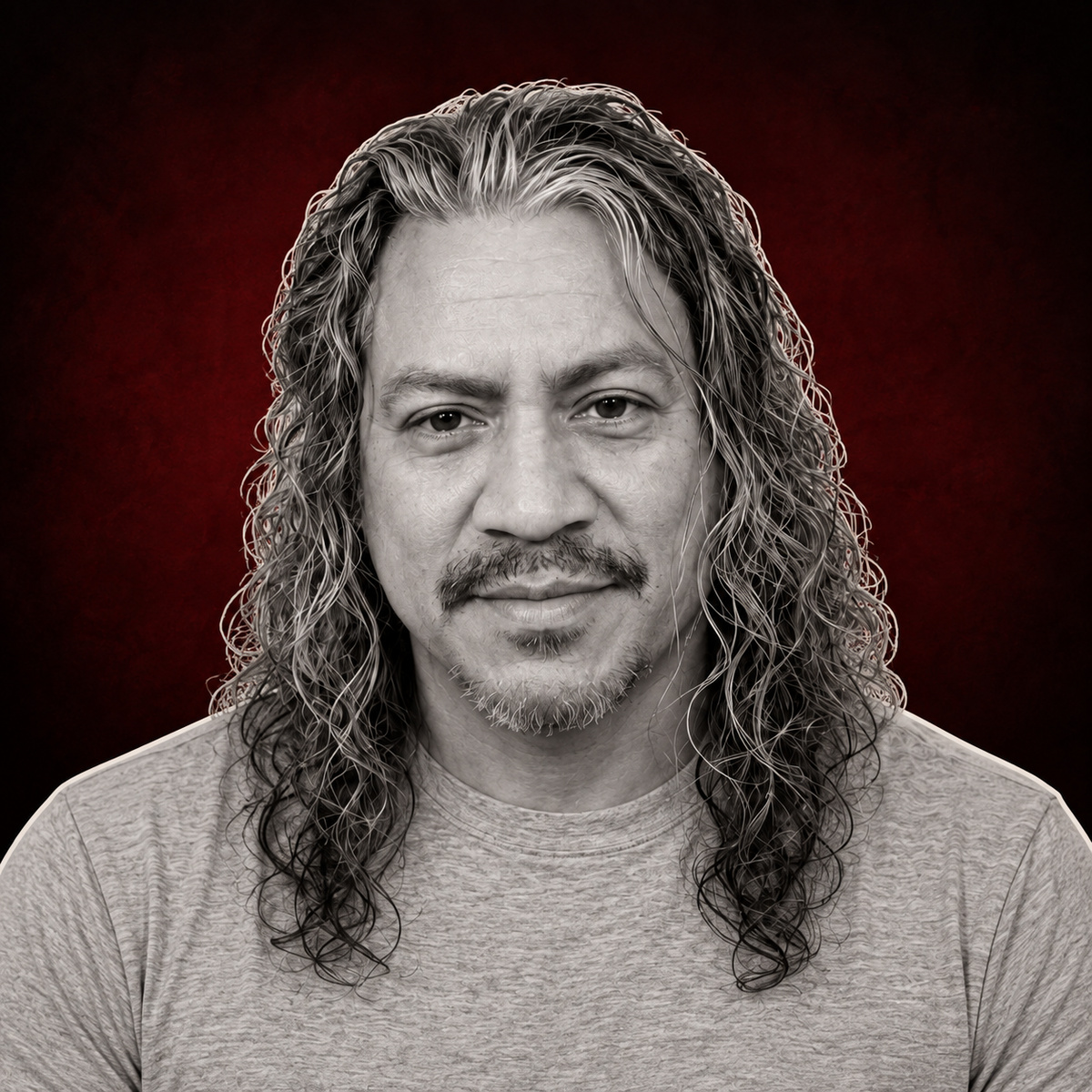
David Gonzalez
David Gonzalez is the founder of the Internet Marketing Party, a monthly Austin event he has hosted without missing a single month for sixteen years, and the creator of the curated think tank format that has since grown into his Experts Council Mastermind. After building and selling a hypnotherapy franchise business, David discovered internet marketing in 2007 and worked his way into the industry as an affiliate manager, building relationships with many of its best-known names along the way. He now curates three-day think tanks and hot-seat sessions that bring seven to ten hand-picked experts together to solve one entrepreneur's single biggest bottleneck, and runs an escalator revenue model built on dozens of leverage points that funds his own life of leisure. David lives in Austin, Texas, where he continues hosting the Internet Marketing Party on the second Thursday of every month.