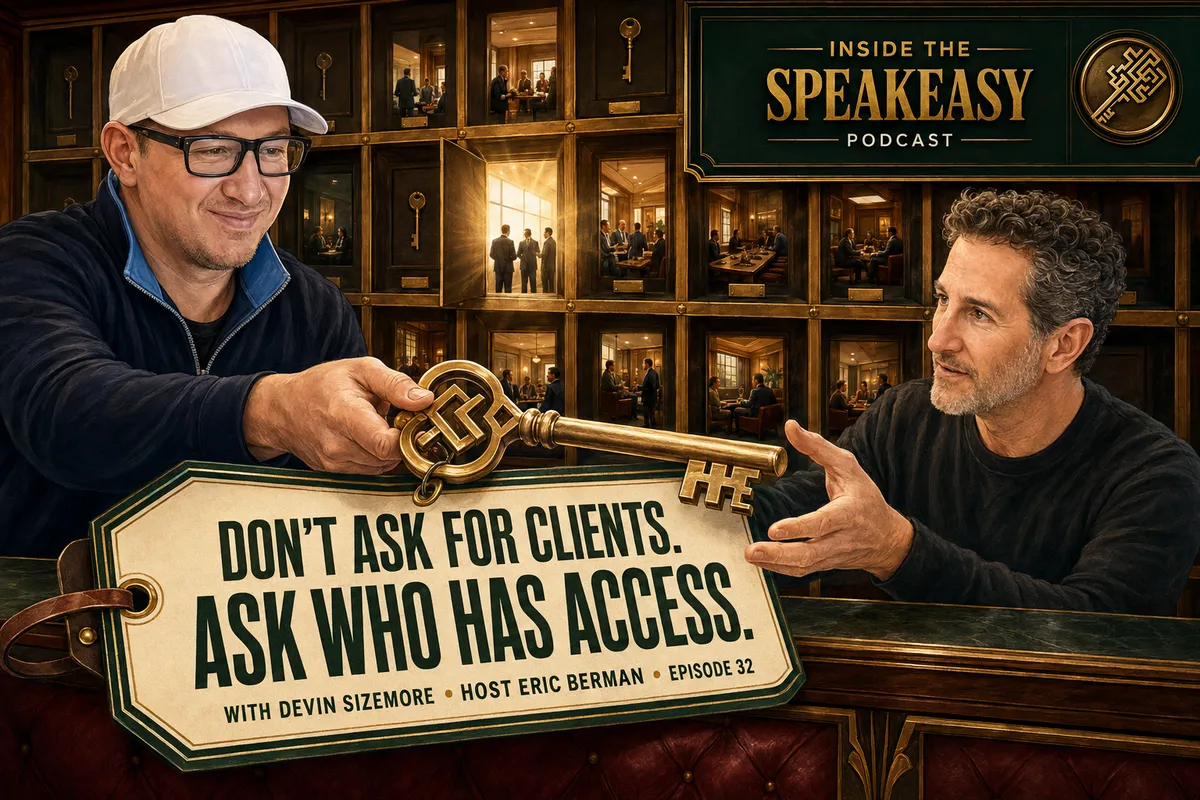
Devin Sizemore, a Reno-based business strategist and creator of the Connection Expansion System, believes most entrepreneurs are chasing the next funnel or paid ad while ignoring the opportunity sitting in every meeting on their calendar. In this conversation with host Eric Berman, Devin explains why the first thing he teaches is to shift your ask away from your ideal client and toward the people who already have access to them, from referral partners and advisors to community hosts and general connectors. He shares how that approach helped him build 200 referral relationships while running a PEO branch, made his cat cafe profitable in its first month, and now fills his free networking community. Devin also breaks down his standard of making three connections for everyone he meets, his definition of winning a meeting, and why he uses the exact same follow-up emails with everyone.
In this episode, you'll discover:
- Why asking to meet your ideal client stalls conversations, and the six groups of people with access to your clients that you can ask for instead
- How Devin built 200 referral relationships in two and a half years and grew a branch that closed five to six inbound leads a month with no paid ads
- The minimum standard Devin sets for every meeting: learn enough to make three strategic introductions for the person in front of you
- What it means to edify, endorse, and explain, and how asking questions first lets you take control of a meeting without pitching
- The word-for-word check-in email Devin uses to restart conversations, and why he says personalizing follow-up has never improved his response rate
Episode Summary
Eric Berman opens by welcoming Devin Sizemore from Reno, Nevada, describing him as a fellow community leader who has been teaching Eric new ways to approach networking. Devin says he recently ran a webinar with a slide titled "let's eliminate the noise," because he sees too many people chasing funnels and paid ads when they could be meeting people, building relationships, and generating opportunity.
The first thing Devin teaches is to shift your ask. When people are asked who they want to meet, they default to their ideal client profile, which educates the listener but often ends the conversation. Devin instead asks who has access to your clients: your best referral partners, the places your clients spend money, gather, and seek education, the advisors, CPAs, attorneys, and coaches they trust, and general connectors who know everyone. Asking for those introductions carries no friction, because nobody is being pushed into a sales conversation. Devin says some of the super connectors he partners with have added his meetings to their group calendars, and some have referred a hundred or more people to his community.
Devin describes that community as built on three pillars: Connection Blitz meetings, which are one hour of power networking; his content, including the Connection Expansion System, his book, email templates, and every webinar, all free; and more than 40 expert interviews. The business makes money through a subscription for unlimited meetings and through strategy sessions and partnerships. He says the community had 70 inbound connections in the first four days of the week.
The same formula worked offline. While running a PEO branch offering workers' comp and payroll, Devin met everyone he could and built 200 referral relationships in two and a half years, producing 12 to 15 inbound leads a month and five to six closed deals without paid ads or lead generation. When he and his partners opened a cat cafe, they courted BNI groups, women's groups, party planners, and two nearby hotels rather than individual customers, and Devin says the cafe was profitable in its first month.
At the core of his system is a simple standard: make three connections for everyone you meet. Devin shares how he opened doors for a contact named Justin in the ultra high net worth space, delivered his introductions within 24 hours, and sent a three-week check-in. Justin replied that the conversations had been great and followed up with two introductions to mastermind and community hosts who were a strong strategic fit, even though the two never transacted or referred clients directly. Eric admits that Devin is currently ahead of him in referrals, and both discuss how giving first invokes the law of reciprocity and why people take strategic introductions seriously. Devin says that when a referral is not anchored on a sale, people take the meeting almost every time, because no one wants to make the person who edified them look bad.
Devin defines winning a meeting as being able to edify, endorse, and explain: knowing enough to praise the person, vouch for what they do, and justify the connections he makes. He takes control by asking questions first, then looks for extra wins such as podcasts, events, and partnerships. Eric adds that poor follow-through holds back many entrepreneurs and recommends hiring help. Devin agrees and explains that he uses the exact same templates for booking, follow-up, introductions, three-week check-ins, and long-term nurture, so the work can be automated or delegated. He closes by reading his check-in email aloud and says the people in Speakeasy are what he has enjoyed most since joining as a global member.
Big Ideas Discussed
Shift Your Ask From Clients to Access
Devin argues that the default networking ask, describing your ideal client and hoping someone knows one, limits both sides of the conversation. It puts the other person on the spot to produce a qualified buyer with the right budget and timing, and when they can't, the meeting effectively ends. He hears the results from people who say they meet many people without results or make connections without receiving any back.
His alternative is to ask for the people who have access to your clients. He groups them into six buckets: your best referral partners, where your clients spend money, where they gather, where they seek education, the advisors who influence them, such as CPAs, attorneys, and coaches, and general connectors. Because these requests are mutually beneficial, people introduce you without friction. Eric frames it as one extra step that produces far more volume, and Devin points to super connectors who have each referred a hundred or more people to his community as proof that one strong relationship can outperform finding the next single member.
Make Three Connections for Everyone You Meet
The minimum standard in Devin's system is to leave every meeting able to make three strategic introductions for the other person. Many people find this intimidating, he says, but the introductions do not have to be clients. They can be people who serve the same market in different ways, which gives the other person new strategic conversations even when Devin has no immediate need for their service.
His story about Justin shows how this plays out. Devin could not refer him a client right away, so he introduced him to others in the ultra high net worth space, followed through within 24 hours, and sent a three-week check-in. Justin responded with two introductions to mastermind and community hosts who were a strong strategic fit. Devin says Justin only knew to play that way because Devin led, and he calls the standard his guarantee: everyone who refers someone to him can do so with confidence, which is why referrals keep coming.
Win Every Meeting by Asking First
Devin encourages listeners to review their last 20 meetings and count how many produced results they were happy with. If it is not most of them, he says, something is missing from the script. His definition of a win is being able to edify, endorse, and explain: edify the person, endorse their product or service with enough knowledge of testimonials and case studies, and explain why he is making each connection.
To get there, he takes control of the meeting, which he stresses does not mean pitching or dropping stats. It means asking where someone lives, who they serve, how they got here, what their dream is, and what challenges they face before sharing anything about himself. He also listens for wins beyond the obvious: content, events to attend or sponsor, podcasts to swap, and groups worth joining. A speaking opportunity he has in November came from exactly that kind of listening in a meeting with another mastermind host.
Templates Make Follow-Up Sustainable
Eric calls weak follow-through one of his biggest pet peeves and suggests that entrepreneurs who know they are bad at it should make a virtual assistant their first hire. Devin agrees that his whole system is built on following up, because relationships take repeated touches and most people never make them.
His key point is that follow-up does not need to be custom. Devin uses the exact same emails to book a meeting, follow up after it, introduce two people, check in after three weeks, and nurture over the long term. He says he has never seen a higher response rate from personalized messages, so templates let a VA or an automation do the work. His check-in email, with the subject line "Checking in, how are you doing?", simply asks what is new and exciting and what challenges have come up. When people reply and ask how he is doing, he shares genuine updates with links, inviting them into his world without pitching.
Questions We Answer in This Episode
What does Devin Sizemore mean by "shift your ask"?
Devin Sizemore says most people ask to meet their ideal client, which often ends a networking conversation. Shifting your ask means requesting introductions to people who have access to your clients, such as referral partners, advisors, CPAs, attorneys, coaches, community hosts, and general connectors. Those requests carry no friction because both sides benefit.
What is the Connection Blitz?
The Connection Blitz is the one-hour power networking meeting at the center of Devin Sizemore's community. Devin says one recent blitz had 21 or 22 people, including 15 first-timers from five countries. It is designed to fix common frustrations with virtual networking, such as not getting contact information or not being able to book meetings.
How does Devin Sizemore's free community make money?
Devin Sizemore keeps his Connection Blitz meetings, Connection Expansion System content, book, email templates, webinars, and expert interviews free. The business earns revenue through a subscription that gives members unlimited meetings, and through strategy sessions and partnerships when there is a right fit. Devin says the free structure removes the barrier to entry, which makes it easy for partners to send their own networks to him.
How did Devin Sizemore grow a PEO branch without paid ads?
While running a PEO branch offering workers' comp and payroll, Devin Sizemore met everyone he could and built 200 referral relationships in two and a half years. He says the branch received 12 to 15 inbound leads a month and closed five to six of them, with some events and speaking but no paid ads or lead generation.
What is the "three connections" rule?
Devin Sizemore's minimum standard is to make three connections for everyone he meets. The introductions are usually strategic, such as people who serve the same clients, rather than direct referrals. Devin says this adds value even when there is no immediate business between the two people and teaches others to open doors in return.
What does it mean to win a meeting?
For Devin Sizemore, winning a meeting means being able to edify, endorse, and explain: praise the person, vouch for their product or service, and explain why he is making each connection. He asks questions first, so he understands the person before talking about himself. He then looks for additional wins such as content, events, podcasts, or partnerships that a narrow focus on prospecting would miss.
Should follow-up emails be personalized?
Devin Sizemore says no. He uses the exact same templates to book meetings, follow up, make introductions, check in after three weeks, and nurture contacts, and says personalizing them has never improved his response rate. Templates let a virtual assistant or an automation sequence handle follow-up consistently, while the messages still go out one to one.
Full Episode Transcript
Read the Full Episode Transcript
Welcome to Reno and Meet Devin Sizemore
Eric Berman: Welcome to Inside the Speakeasy Podcast. The private room where today's sharpest founders, innovators and renegade thinkers come to trade the ideas that move industries. This show is brought to you by HighLevel, the AI driven business operating system trusted by over 2 million businesses to help automate, scale and create real leverage. HighLevel isn't just a tool, it's the engine behind some of the most agile and high performing teams on the planet. If you're ready to streamline everything, amplify your reach and actually build a business that works for you, you're in the right place. Visit www.gohighlevel.com/speakeasy-mastermind-promo to get an exclusive 30 day trial for being a listener of the Inside the Speakeasy Podcast. Enjoy the show. Welcome to Inside the Speakeasy Podcast. And we're heading up to Reno, Nevada, one of my favorite places. Love it up there. And I'm bringing, I'm really excited to bring today somebody being a community leader and manager like myself. I absolutely love talking to other people that know how to build community, that love the art of networking. And this guy has been teaching me some stuff like you wouldn't believe. And I'm stoked to talk about how to level up our whole connection networking game. Welcome, Devin Sizemore.
Devin Sizemore: Eric, thanks for having me, man. I've been looking forward to this conversation.
Eric Berman: Yeah, no, thank you. I mean, I mean, so we're going to get into some cool stuff today. And I know one of the things you talk about is how you could build your business without targeting clients. And you're going to drop some magic, you know, suggestions and ideas. You have, you have a full Connection Expansion System. And I love this because, you know, this is true to my heart. So many of us want to just go into the world of, hey, how do we go do paid media? How do we go do the, all the other things? And you're probably sitting there saying, oh my God, these people are missing opportunities that's right in front of their faces. Is that a feeling you get all the time?
Eliminate the Noise and Shift Your Ask
Devin Sizemore: 100%, man. I did a webinar yesterday and I have a whole slide that says let's eliminate the noise. Like, let's stop chasing the next funnel paid ad, this, that and all those things work in the right environment. And like, let's just get back to meeting people, building relationships and generating opportunity.
Eric Berman: So let's, I mean, let's dig in. I mean, you talk about, I mean, tell me your formula, tell me like, like what's the main things you teach. And you know, I love everybody to walk away with, you know, a couple ideas, man, I got to start doing this.
Devin Sizemore: Yeah, 100%, man. So, you know, the first thing I teach people is to shift their ask. And so what I mean by shift your ask is if I ask you, Eric, who do you want to connect with? Typically your default is some version of your ideal client profile. Right? I want to meet this kind of person. And yours, you would give us qualifiers, right? They own this kind of business, they're B2B. They have this income because that's a good member for Speakeasy. Great. What happens is you're educating me on who to refer you. Great. But when you're like, hey, Devin, I really want you to open doors for me, sometimes that's where the conversation ends. And usually it equals people that tell me one of these things. I'm meeting a lot of people and getting no results, or I'm making a lot of connections but not receiving connections back. In both of those situations, if we shift the ask, it's much easier for people to connect you. So what do I mean by shift the ask? What I mean is we have to shift to who has access to your clients. So we go from one to one to one to many. So the easy, low hanging fruit is who's your best referral partner. But beyond that, we can look at where does your client spend money, where does your client gather, where do they seek education, who has influence over your client, who do they trust? So that's deep, long term, established relationships. Typically advisors, CPAs, attorneys, other coaches, and then who's a general connector that has access to everyone? All six of those buckets that have access to your clients have no friction if you ask for it, Hey, I want to meet mastermind hosts because we can collaborate and create content together. It's beneficial for me, it's beneficial for them. That's easy. Everyone's like, oh, cool, Devin, I'll connect you for that. Again, there's no friction because I'm not trying to tease someone up to you right this second to sell them something and hope that they have the budget, the right mentality, the right time. This is how we start to unlock and so that we can win every meeting instead of our only win in a meeting is did I get a qualified prospect or a direct referral? And that's it. Like, that's such a limited conversation.
Eric Berman: Interesting. So to reiterate, I love what you're saying and it's so obvious. You say it in my mind and is not the direct. Don't necessarily go to the direct. Go to the person who has influenced, like you said, the community leader in the case versus the actual person. Because the community leader then will be able to make that introduction. It's actually a better introduction when it comes to the community leader, as I found, or these other people that are connecting. So it's one extra step to get way more volume. It would be, I guess, way to say that, right?
From One-to-One to One-to-Many With Super Connectors
Devin Sizemore: 100%. Yeah. You go from one to one, which is I get one chance to close this one person to I get this chance to build this relationship that opens doors. A really good example of that is, you know, we partner with other super connectors that refer people to our community because we how we host networking events. Some of those super connectors have integrated my meetings in their group calendars. Some of those super connectors have referred a hundred plus people to our group. That's so much more valuable to me than finding the one next member. Right. I want to find the people where we can collaborate and add value both directions. Or they invite me to their stage, or they invite me to their podcast, or we create content together. All of those are other benefits from meeting people that are often left on the table.
Eric Berman: Well, let's go deeper in that example because for twofold a. I think it's really cool what you're doing and I love for people listening to this podcast to understand it. But I think if we can get that. Understand what you're doing. And you said, all right, here's my approach to building that using the method you're talking about. You kind of just mentioned it, but let's just, let's use your example here. So talk more about that.
Devin Sizemore: Yeah, for sure. So, right. I do exactly what we're doing now and we could break down our exact scenario. Right. I was introduced to you because you're a community host and mastermind host by someone who's a super connector. And then we were able to go, oh wait, I actually fit and I enjoy and love what you guys are doing. And now we're creating content. So that formula worked. But with the group, the way I do it, the free community is a great offer because for us there's no barrier to entry. And so the reason we built our business this way is when I'm collaborating with people, it's really easy to find paths to of success. Hey, you can send your people to me and we'll network with them. And again, there's no barrier. They can come, participate and get value. We could create content. Because I host a community with 560+ that need content. All of these are the ways that when I'm in a meeting, I'm thinking about how could I bring you in and add value to what you're doing and then vice versa. I'm listening for. Oh, you bring guest speakers in, oh, you host events. Oh, you have a huge database or email list. Great. Would you be game for doing a promo to your list and in exchange I'll do this thing. Or maybe my service is just a good value add so that we don't even need to balance it more than me just adding value to your clients. That's how I'm digging into conversations with people to figure out how do we both win while still having the impact we want in the world.
Eric Berman: It's really like turning up the biz dev dial, the partnership dial to get the bigger groups in one to many versus the one to one as you said earlier.
The Three Pillars of Devin's Free Community
Eric Berman: Share with us more. What? Tell me about your community and your network so we can learn.
Devin Sizemore: Yeah, so our community is built on three pillars. So the first is our Connection Blitz meeting, which is kind of what we're known for. So one hour power networking. Today we just came off a blitz. We had 21 people or 22 people, 15 first timers, five countries represented all, every industry you could imagine. And if you've been burned on a virtual networking event, like you're just like tired of going and not getting results, not getting contact information, not meeting the host, not having an ease to book calendar meetings. We solve all of that in one hour. The second pillar is all of my content is in there. So the whole Connection Expansion System, access to my book, our email templates, every webinar I create, it's all available for free. So you can access everything we teach and more. And then the third pillar is expert interviews. We've done more than 40 expert interviews from billionaires to styling consultants to family offices to really dig in deep. These are typically 40 minutes to an hour on what are they doing and how can you implement whatever their expertise is. And so that's the foundation of our community. And then the kind of follow up question is cool, great, that's all free. How do you make money? We do have access to unlimited meetings that as a subscription model. And then I do strategy sessions and partnerships with people if it's a right fit.
Eric Berman: Got it. So you build a community around [unclear]. So one of the meetings, it's not all doing the same meeting. You have one meeting where everybody's just connecting and then you have a meeting where you can get content and education, some other meetings. So clearly I'm going to go back and reverse engineer what you talked about for the example piece for us to get is you're saying, hey, this is my business model, I'm going to win it, take you forever. And this is the key part, what you're saying is for me to add one at a time people to go in there and join a blitz, you know, get exposure that's going to take you forever. You could start, you know, doing cold email outreach. You can go one at a time. Great. If you could find other community leaders who might be interested in doing a co op or, you know, introducing your blitzes to their networks, et cetera, et cetera, you're going to get way more people in there as long as it's collaborative kind of thing. Is that back to your example?
Devin Sizemore: 100%. Yeah. So this week alone we're up 70 new connections. This week. So we're four day, four days into the week, 70 inbound connections. And the formula works no matter what your offer is. And so I want people to really understand that by approaching the network different and looking for these bigger opportunities as you do it more and more over time. It doesn't matter what your offer is. I've used the same formula when launching my cat cafe.
Building 200 Referral Partners in a PEO Branch
Eric Berman: Let's go through examples of that. Sorry to cut you off because you got me interest. Because I mean we did. One example was easy. So just something that might be relatable to the people watching it. So what was something else you did?
Devin Sizemore: Yeah, so let's use. I did a stint in corporate America, right. And so I ran a PEO, so workers comp payroll business. And the formula there is all referrals. So here's how most branch managers do it. They go in the market as a biz dev person. They meet people, qualify them. Great. Occasionally they go get strategic partners. In that industry, it's usually commercial insurance agents. So they build a few commercial insurance agents that refer because the workers commission payback's great, it's easier to close, blah, blah, blah. What I did when I took the market over is I just went out and met everybody because one of our core principles is there's value in every relationship. So I went out and met every single person I had contact with and I just had these meetings recalibrating. Here's what I'm doing, here's what we're looking for. Here's a good strategic opportunity and I Started to find my way into these really interesting referral partner relationships. So B2B sponsorship salespeople, account managers in different sectors, accounting firms, CPA firms, other payroll companies that wanted to generate revenue but were at capacity constraints. I found in over two and a half years, built 200 referral relationships where our branch literally grew on autopilot. Every month we would get 12 to 15 inbound leads. We would close five to six of them with no additional marketing. Sure, we'd host some events, we do some speaking, but no paid ads, no lead gen, just building a network that generates results.
Launching a Cat Cafe Through Strategic Connections
Devin Sizemore: If you fast forward to the cat cafe, which is a physical business, we built it the same way.
Eric Berman: What's a cat cafe?
Devin Sizemore: Yeah, so cat cafe. The front's a coffee shop, the back, you pay by hour to hang out with cats. You could adopt them if you want, but really you pay by hour to hang out with them. So it's great for senior citizens, people whose spouses have allergies or your living situation doesn't allow animals.
Eric Berman: Okay, got it. So that helps me in that context. Okay, so you got this cat cafe. Now how are you building members to that? Not going traditional.
Devin Sizemore: Yeah. So again, yeah, we did social content, we did news media, we did that. All of that was actually formed from meeting everybody. So we just met everyone said, this is what we're doing. Here's a good strategic relationship. And so we started looking for the BNI groups that wanted to host meetings. We started looking for the women's groups and group events that wanted to host people in a unique environment. We started going after party planners where they had clients that were looking for unique birthday or party hosting opportunities or intimate settings. And so again, instead of the one client that's going to come and spend whatever the $12 per hour, we started looking for these people who had access to these group environments. And because we did that when we launched, we were profitable in month one. And we ended up doing more than most coffee shops make in our very first month of business because we had so many raving fans and advocates. But the only reason we figured out who could be a raving fan was we just turned volume and we got creative. One of our best was we had two properties down the street, hotel properties, where they're like, oh my God, this is amazing for our guests. They can go there, they could do their work, they have a different environment, something totally unique to talk to them about. Hey, could we promote your business and have flyers? You're sitting here like, yes, at what point am I going to say no. But again, yeah, in that business, we did do a little more direct to consumer stuff because you have to. But the big money hits that came out of that business is because we looked for these strategic connections. We were open to meeting everyone and then we got creative on how do we go one to many or many to many, where they're referring a lot of referral partners.
Eric Berman: Yep, yep. No, I, I love it. At the end of the day, to me, the seems like, I mean a lot of what your Connection Expansion System is, spend that time. I'm just reiterating what you're saying here because I love it and I tend to do this, you know, know as well because I think I'm naturally a biz dev guy, community biz dev guy. So you and I are probably, you know, molded very similarly is find those partners and I'll add to that who, you know, you're not competing and you're almost providing them an additional call it service or add on, which makes them better in the eyes of their customers because they're able to add their customers, answer the needs of their own customers, like, hey, they're doing this thing, but they don't have this item. But they're going to bring in their friend here, Devin's company, to fulfill that need that their customers have. You're fulfilling, you're filling a void, you're making them look good as you're able to provide a good service ultimately. So they go back to their partner and say, hey, thank you for referring me to Devin. He's got great stuff.
Make Three Connections for Everyone You Meet
Devin Sizemore: And the thing I would tell you too, at the core, what we teach is make three connections for everyone you meet. And so that scares a lot of people because they're like, well, how do I make three connections for this person I just met? Well, you make strategic connections, right? So you help them play the game because they're probably coming into the meeting with you either trying to qualify you as a prospect or get a referral. Referral from you and a referral to a prospect. So I take both those off the table pretty quick unless I need your thing. Great, nice to meet you. Yes. Let me buy your product or get engaged. But otherwise I tell people like, let me introduce you to these three or four people that have access to the same clients you're chasing. And you guys can form strategic conversations. And so what happens is, even the person I'm meeting, if we can't go deep, I can still open doors for them, which teaches them how to do the same thing. So they may go. Look, your offer is not perfect for my audience. I don't need what you have. I see you made three introductions. You know what? I know these one or two people you should meet that are those strategic connections. So even if the person you're talking with isn't that strategic connection, it is highly likely they can open a door in one direction that is hyper impactful. But again, most people lose the whole conversation because it's either. Is there a transaction one direction? Can we refer each other one direction? Maybe if we have a podcast, we default to creating some content, which is a win. But otherwise the conversation's kind of over. You don't really know where to nurture. You're kind of lost on the client journey. Right.
Eric Berman: I want to dig in a little bit more. Cause I want to make sure because I'm still trying to get my head around. So you're saying either way. I get what you're saying. Most people just walk into a conversation, you know, it's black or white. Can we do business? Not, you know, transactional. So you're saying in the case that we don't find an immediate way, we could play together. Or maybe it's just a timing thing or a money thing or whatever. You'll take that conversation and do what? Walk me through that again. You'll say, hey, look, not me now, but I can introduce you to two, three others that could work with you.
A Real Example of Opening Strategic Doors
Devin Sizemore: Yeah, I'll give you a real, real live route today. Example, right? I met this guy Justin a few weeks ago. We had a phenomenal first meeting. I can refer Justin at some point, but his service offering is so specific. And so how do I add value to Justin? Because I don't need what he offers. I'm very set with the service provider, but I love his offering. I can't tee him up to anyone right now. What I can do is I open doors. He [unclear] in the ultra high net worth space. I open doors to a few other people that play in that space. And Justin's like, dang, those are amazing connections because they are serving my client in different ways. Now he from our meeting. Right.
Eric Berman: So in that example, you're introducing them through your game. You're teaching was you introduced them to strategic partners because you don't know actual people that could use the services. But the partners you're introducing a might, is that right?
Devin Sizemore: A hundred percent, yeah. And I do have people, but it's such a right time introduction that I'm like, look, I'll listen. And when my family, office, clients go hey, Devin, I need this. Great, I got someone. But you know, I can't just tee him up to a family office and he takes a meeting.
Eric Berman: And those are more valuable introductions anyway, at the end of the day, if he's based on what you're teaching. Okay, so you introduce him to those partners and then you said in return that and then keep going.
Devin Sizemore: Yeah. So what happened is he's like, look, I'm traveling for a few weeks, I'll make some intros for you. Because he had some people in mind, but you could tell he was trying to figure out the relationship. Well, 24 hours later, I delivered, I made my connections, I sent him a three week check in. He replied and said, oh my God, those conversations have been great. Literally following the check in email, which was today, I now have two introductions in my inbox, both to very high level mastermind and community hosts that we have perfect alignment from a strategy standpoint. And again, him and I, we didn't transact and we didn't direct refer clients to each other. What we did is we both strategically opened doors for each other, but the only reason he knew how to play that way is I led. Right? I showed up at the meeting going, Justin, let me open some doors for you strategically. And then when he goes, well, wait, what doors can I open for you now? I can answer strategically because my ask is not just stuck on the client and now we're both winning.
Leading First and the Law of Reciprocity
Eric Berman: I get it completely. And I'm going to expand on what you're saying. And I think selfish, I should say secretly behind the scenes. What people don't know listening is Devin and I are in that game. We're playing it indirectly where he's ahead of me right now and I don't like it. Meaning he's given me some referrals and I haven't really done poo poo yet for him. But this is actually playing out in real time. It's bothering me because that's just the way I roll, that I haven't. And in my mind I'm already like, okay, I gotta dig in and spend some more time with Devin to understand what he's doing. Like, I kind of heard it the first time, probably went into 10 million other things, like we all do. I'm like, okay, this is a good referral. Partner for me. I better take this guy seriously. Because at some point, you know, Devin's only going to do so much. At some point. He's got a million other people he can refer to and do other things. And I know you don't do that with that intention. But that's just the law of at some point, you know, that well [unclear] run dry if somebody else is just taking. That's his human nature at some point. But that being said, you also understand the way the law of reciprocity and others works. Or you're saying, I've learned enough to say, I'm going to go out there and do it first you said, take the initiative, show them, make killer intros, which your name is attached to those intros. And when you've proven yourself, you are invoking the law of reciprocity. And I have a feeling there's a lot of people out there that owe you favor cards than you owe them.
Devin Sizemore: So, yeah, I love the pull the curtain back moment, right? And so if we pull the curtain back on why we teach what we teach and why we do what we do, it's this exact conversation, right? I want to add so much value as quick in a relationship as I can so that at some point when I need to cash in, people will respond. And cash it in could be like right now, hey, I've got a strategy session deal going till tomorrow night. If you know anyone, refer them or, hey, I'm looking for this specific intro. And now you're like, yeah, I got you. Let me go grab that out of my index and, you know, give it to you. If you do that, more and more, you create this huge network that is responsive, not reactive. Because typically your network's only reacting right when the ask is perfect or the time is perfect. Whereas in my network, most of the time, I could reach out right now, drop an email blast, and action will happen on an introduction standpoint instantly. Because so many people are like, oh, yeah, you know what? I do owe you, Devin, thanks for clarifying who you need to know. I got you. Great. Yep, great. We both win.
Eric Berman: I love it. And it's funny because we're on opposite sides. I'm usually sitting on your side. And you got ahead of me on this one. So it does bother me. I literally had this conversation last week with somebody. I'm like, you know, my, you know, it was like, God, Eric, you're always referring and helping, introducing. You know, what can I do? I'm like, I like to be the guy that does the intros first. I want to have somebody owing me. If I ever need that favor, I can ask of it. Exactly what you said. You know, try to make the introductions, try to connect people where I can. And I hope people are following along as you're listening to this again. It's. We tend to be transactional and I'm just adding what you said. And I think if we go beyond that and think about these strategic intros, and I know there's a few really good players in our community and others that I know that understand this game, don't ignore it. I mean, I think it's fantastic for people to really, really understand what you're talking about. And I mean, you go from cold lead to warm, hot lead. You know, people taking phone calls in this example because of what you're saying, which is brilliant. And I love that you're teaching this.
Devin Sizemore: Yeah. I mean, you also mentioned something there. I want people to understand is when you're referred to someone, they take the meeting like 99% of the time if it's not a transactional referral. And so that's the other part of this is we've gotten rid of the pro. Like, if you're struggling to book meetings, even if you're getting referrals, it's probably because it's always anchored on a sale. When I make introductions, the majority of people take the meetings. When I get introduced to people, I'm on calendars with the majority of people because it's so strategic in nature. Everyone's like, oh, there is something in it for me. Why would I not show up to this? Why would I not participate in this introduction? And the other person teed it up like they're edified. I make them look bad if I don't follow through.
Eric Berman: That's right. That was the last point. You just said I was going to nail it. Exactly. When you do this correctly, it's almost always the case because nobody wants to be the person that makes the other person look bad or screw it up or, you know, oh, community leader. Devin's making an intro. And it's funny, before in the quote green room, I was even talking to Devin earlier and saying, you know, it's interesting because you're making referrals and they're from you. I want to take them. I want to. Last thing I want to do is ignore a poo poo referral from a guy who's giving me lots of referrals. And that get back to you because then you're done giving me referrals. So I got to take that. You know, I got to take those seriously. And Devin's giving me a lot of referrals. I'm like, ah, I don't know if I can handle all these. You know, he's he's such a great guy, so you definitely want to know him and his community and all that. But yeah, so I get it. I love what you're saying. These are the main bits.
How to Win Every Meeting
Eric Berman: Any other little kind of like tips or secrets or things that you've taught a lot of or you notice from the average person that could be doing more of?
Devin Sizemore: Yeah. So I think winning every meeting is the theme I like to really pound home to people is you probably can get in meetings, right? You're probably getting something on your calendar. If you're not, there's a bunch of strategies we could talk about, but I'm going to assume that the people listening to this probably have people on their calendar. You've got to win every meeting and your team needs to win every meeting. So if you have a sales team, if you have biz dev people out there, you've got to equip them to hunt for the podcast, hunt for the event opportunities, the sponsorship opportunities, the partnership opportunities, the integrated offers the part, like direct integrated partnership, the JVs, the whatever. You've got to equip them to think about. Look, how do I talk to this person in front of me differently so that one, I can add value to them even if it's not our product or service, and, and two, how can I find value for our company Again, even if it's not their product or service or mine? We've got to win every meeting. And so it really changes the way you approach these 15-, 30-minute meetings you guys are doing. You've got to show up, you got to take control of the meeting. You have to be the one asking all the questions and getting all the information so that when it's time, you can add value and make connections, you can open doors and you can put ideas on the table. And so I really want people to think through. You know, if you go back and look at your last 20 meetings, how many of them generated results that you're happy with? And if it's not the majority or all of them, then you've got to really think through what's the script and what am I missing?
Edify, Endorse, and Explain
Eric Berman: Well, can we dig in deeper? You said win a meeting. How do you define winning a meeting?
Devin Sizemore: Yeah, so for me, so winning a meeting, I want to be able to edify, endorse and explain. So I want to be able to edify the person I'm meeting, meaning I know enough about them to go, yeah, Eric's a rock star. I want to be able to endorse what they do so their product or service offering. So I need to know enough about what they do some testimonials in case studies. Be like, yeah, Rockstar, love it. And I need to be able to explain why I'm going to make the connections I make. Because when I approach every meeting, I use one of our core principles, control what you can control. So I want to go into the meeting and I want to ask all the questions so I can do the three E's. Following the meeting, I'm going to make the three connections and send a follow up email and then I'm going to nurture over time because I know that the law of reciprocity kicks in and it will generate what's needed. I'm also looking for the other wins. Can we create content? Can you add value to my network? Can I add value to your network? Are you hosting events? Are you attending and sponsoring events? Which ones? Maybe I want to go like, can I get a piece of information that I didn't have before we got on the meeting? So beyond just controlling and the ability to follow up and add connections, I'm looking for all of these other places and pieces that allow me to win. Great example. I'm speaking at an event in November. It came from another mastermind host. He's like, oh, I'm speaking at this event. Matter of fact, I don't know why it didn't click. You should be at that event. Great. Because you introduced me to the host, met the host on the stage. Great. Is your biz dev team missing that? Are you missing that in meetings? Because again, you're so focused on qualifying and prospecting that you're missing. Oh, you, you forgot to hear that they're part of this other group. Well, how do you participate with that group? Or you forget to hear that they're attending these events. Great. Could they introduce you to the person who hosts the event? Could you be there? Could you sponsor? Could you speak? Oh, I was just on a podcast. I do a lot of podcasting. Great, me too. Which podcast were you on? Could we swap podcasts with each other and help open door? Like, what else could you be listening for?
Eric Berman: Yeah, there's a bunch of things going on peel there. Number one, you said, and I think this is part of your system. Yes. You want, of course, walk away and see if you can get a partnership or a content or something else. But you said something before that, which is like, if nothing else, can you reiterate and understand them and their product well enough that you could refer three people and that's your Sort of your job and mission after, oh, it's almost walking into the meeting knowing if nothing else, you're going to refer three people to this. You know, unless they're a total idiot and person you just don't want anything to do with. But assuming you want them kind of in your sphere at some point, then what three people can you introduce to them afterwards? You're already winning as you define it. If you could just do that alone, because ultimately that'll come back. In many cases, you can't go into things assuming that it's always going to happen, but in many cases it will. Is that correct? That was one of your big definitions of winning there.
Devin Sizemore: Yeah, a hundred percent. That is the minimum standard and that's my guarantee. So if you show up to a blitz and it's your first one, I'm gonna open doors for you. If we meet one to one, I'm gonna open doors for you. Every person who then refers me can do it with confidence because every person you refer me to is gonna get a few connections and I'm gonna add value to them in the very first meeting. And now all of a sudden, everyone refers everyone to Devin. Yes, it's my example. Right. Cause it's me. But you could be Devin too. Like, you could build a network over time where we were flipping the script and teaching people like, oh, you got to know Eric. Because not only is Eric a badass, he has an amazing product. They're crushing it. Eric's going to take care of the person I'm sending them to by adding value, providing resources, and helping them move their network forward. Man, I would send everyone to Eric.
Eric Berman: That's amazing. I think of nothing else. That's such a good tip that we talked about a lot is you're winning. If you could learn enough about them to refer three people and all the other things you just said, I mean, that's amazing to think like that. I love that. I'm going to start thinking through that. That one, I think, also embedded in what you said. And I'm going to pull this out because again, you and I are so similar and you said it kind of quickly is I do this. You probably talk about it too. I mean, try to get the other person talking first as much as you can, because you're going to be able to understand how to then ask the questions, make sure you understand and ultimately be able to tell your conversations around more listening versus talking. And we tend everybody, a lot of people want to just talk about themselves and what they do is that kind of your strategy?
Devin Sizemore: Yeah, in every meeting, whether it's networking, whether it's a one to one, whether it's group meeting. Like, I want to always take control, but people had to hear me when I say take control. That doesn't mean I'm getting ready to pitch and position and present ego and drop stats. Take control means, Eric, where do you live? Great. You answer. And as soon as you answer, I'm starting the conversation. You're probably going to go, where do you live too? I live in Reno. That's great. Hey, Eric, tell me what you're up to, man. Who do you serve? Right? And then the flow is, we go backwards. How'd you get here? We go forwards. Cast a vision. What's your dream? Dream? We talk about challenges, we look for ways to connect you. And after all that's done, then you can ask me questions. But I really will push people to go look, I'll definitely tell you about myself. Let me ask a few more questions just to make sure I can really add value to you and make the right connections. People are like, okay, last thing that.
Follow-Up Systems and the Case for Templates
Eric Berman: You didn't talk about but is one of my biggest pet peeves. And I know you're gonna, you're all about this is I feel so many entrepreneurs fail because they absolutely suck ass. Excuse my French on follow through and follow up. And they're horrible at it. And most are. And it just absolutely astonishes me the lack of systems people have. That's my personal tip. Like, I tell everybody, I'm like, if you could just figure out how to fix your follow through on stuff, you're way light years ahead. Step one is if you suck at it, and you know you suck at it, then the first hire you're going to have is a VA or somebody that's going to be on every call and everything you need to do to make sure what you said in the call and what you promised you can actually do. Because if you're not good at follow through, you probably are not going to put yourself in this situation to do your system knowing you're not even gonna be able to follow through on the thing you talked about. So you wanna dig in that a little bit. Can you resonate with me on that? Yeah.
Devin Sizemore: The short of the short is yes. Like, the whole system is built on following up. Because if we know the stats, right, to get deals done, it's enough touches to build relationships, it takes touches. And so if the whole world sucks at following up and the whole world is trying to pitch close and sell. Then let's do it different, right? Let's be the ones that follow up. Let's be the ones that add value without counting to see who's keeping score. And then let's build a system where we're architecting in a way where we win, right? Over time, the numbers and volume all pan out. But yes, in order to do that, you have to follow up. One secret I'll tell you about follow up is people try to make follow up way too custom. So in my group, all my emails are in there. So you can go in and literally copy and paste them. We use the exact same email to book a meeting. The exact same email to follow up from meeting. The exact same email template when introducing two parties. The exact same email to check in in three weeks. The exact same nurture template with everyone long term. Why is that critical? It's critical because then you can automate it or you can outsource it, right? So you can either bring in your virtual assistant or you can build an automation sequence because you're not having to go, Eric, I really saw that you went to XYZ school and you know, blah, blah, blah. You know what? I've actually never seen an increased response rate. If I customize it, personalize it, or just give you the email that I know works, the response rate's identical. So I might as well just use the template that my VA or my system can just produce and then we're done. It's the same with intros. When I do intros, it's an intro template and an intro template in a sentence that explains why my VA can do that. So it still feels like Devin's crushing it and opening doors. But guess what? We can automate that too. So, yes, make it easy. Stop trying to customize everything. You don't need to. You need to follow up because that's where you're going to win. That's right.
Eric Berman: And it's funny because we'll say it. I know it crushes. It's not that hard, but so many people won't do it. I understand people. A lot of our zones of genius of most entrepreneurs do not lie in the world of follow up. I get that. Please get help for yourself. And I'm just saying this is just what I've seen, I've witnessed. I don't mean to offend anybody out there, but mostly it's just the entrepreneur mindset. It just doesn't have that skill set as well as others might have. Well, that's fantastic. I know as we wrap.
The Check-In Email That Starts Conversations
Eric Berman: Any other final thoughts at all that you think of that maybe we didn't cover today that you wish you might have?
Devin Sizemore: The thing I'll tell everyone is the nurture process. This is something we do that pisses a lot of people off and a lot of people disagree. I use the same nurture email and I'm actually going to give a template right now because I want people to hear the languages. Checking in, how are you doing? That's a subject line. Hey Eric, I hope you're doing well and having a great day. It's been a while since we last connected. Anything new and exciting in your world, any new challenges? I look forward to hearing back from you. That's it. That's the check in. We have such a high response rate to our check in because it's sent one to one even though it is automated. It's a one to one email and it's all about the other person. Because what we're trying to do is create a conversation. I want people to respond and go, this is what I'm stoked on. This is my challenge. This is what's great. And then you're like, fantastic. How can I either support what you're so stoked about or hey, I can make a connection to solve that problem. And then typically in the response email they're going to say, hey Devin, what are you excited about? How are you? And then I can reply and go, I'm super excited because ACES is over 560 members. Here's a link. We just launched a bunch of Connection Blitz meetings. There's more of them. Here's a link. And I'm fired up cause I'm looking more strategy sessions. None of those are selling or pitching. They're all true statements. But I actually invited you to engage in my world three times in a follow up email where I'm adding value to you.
Eric Berman: I love it. I love it. Genius. Well, cool. Well, all of Devin's stuff is going to be listed on the show. Notes and all that fun stuff. So I know you're probably eager to learn more about these doing. Maybe get some of these notes and templates. Check out all the great stuff he's doing.
Devin's Speakeasy Experience and Wrap-Up
Eric Berman: Devin, I know you've been in Speakeasy for a few months as a global member. We talked. Maybe we'll get Reno off out there one of these days. We'll get a local chapter out there. But what have you enjoyed so far.
Devin Sizemore: About the community, man, the people, without a doubt. And I do a lot of networking. I'm in other masterminds, I go to a lot of high end events. The people you've attracted are all amazing. Every meeting I have, that's a one to one meeting with someone that's in Speakeasy, they take a meeting. We have such a value driven conversation that's not sales and we're collaborating. Like the list of people I'm collaborating with in Speakeasy is getting longer and longer every day because the members are all crushing it and they're all creative thinkers about how do we play big. So if you're looking for a home in the B2B space, particularly with top level absolute rock stars that are good humans, it's a no brainer.
Eric Berman: Wow. Well, I appreciate that, especially coming from another somebody as smart as you building networks and communities. That's an honor to hear that. And I'm actually stoked that you're having all these amazing conversations and collisions as I like to call them already. And that's really what gets me excited, is hearing success stories of people and I don't even know what's going on and I just hear people connecting and doing business and good things. That's my win. So thank you so much for coming in today and that was so great to chat and mostly learn more from you. You know, even you and I are playing at a similar game and you already taught me a bunch of things, so I appreciate that. Thank you so much.
Devin Sizemore: Thanks Eric. Appreciate it.
Eric Berman: And that's a wrap from the Speakeasy Podcast. If something sparked for you, don't keep it to yourself. Share it, review it and pass it to the one person who needs to hear this right now. Want in on the real mastermind? Tap the link in the show notes to apply until next time. Keep scaling, stay sharp and don't be the smartest one in the room.

About The Guest
Devin Sizemore
Devin Sizemore is a business strategist, author, and the creator of the Connection Expansion System, a framework of scripts and language for building referral relationships. Through Devin Sizemore Consulting, he hosts the ACES community, a free networking group built around one-hour Connection Blitz meetings, member content, and expert interviews, which he says has grown past 560 members. Before building his community, Devin ran a PEO branch in workers' comp and payroll, where he says he built 200 referral relationships in two and a half years. A Reno native and serial entrepreneur, he co-founded Enchanted Cat Café, Reno's first cat café, which opened in 2022. He is also the author of the Connection Expansion book and a global member of Speakeasy Mastermind, where he collaborates with fellow members on strategic partnerships.