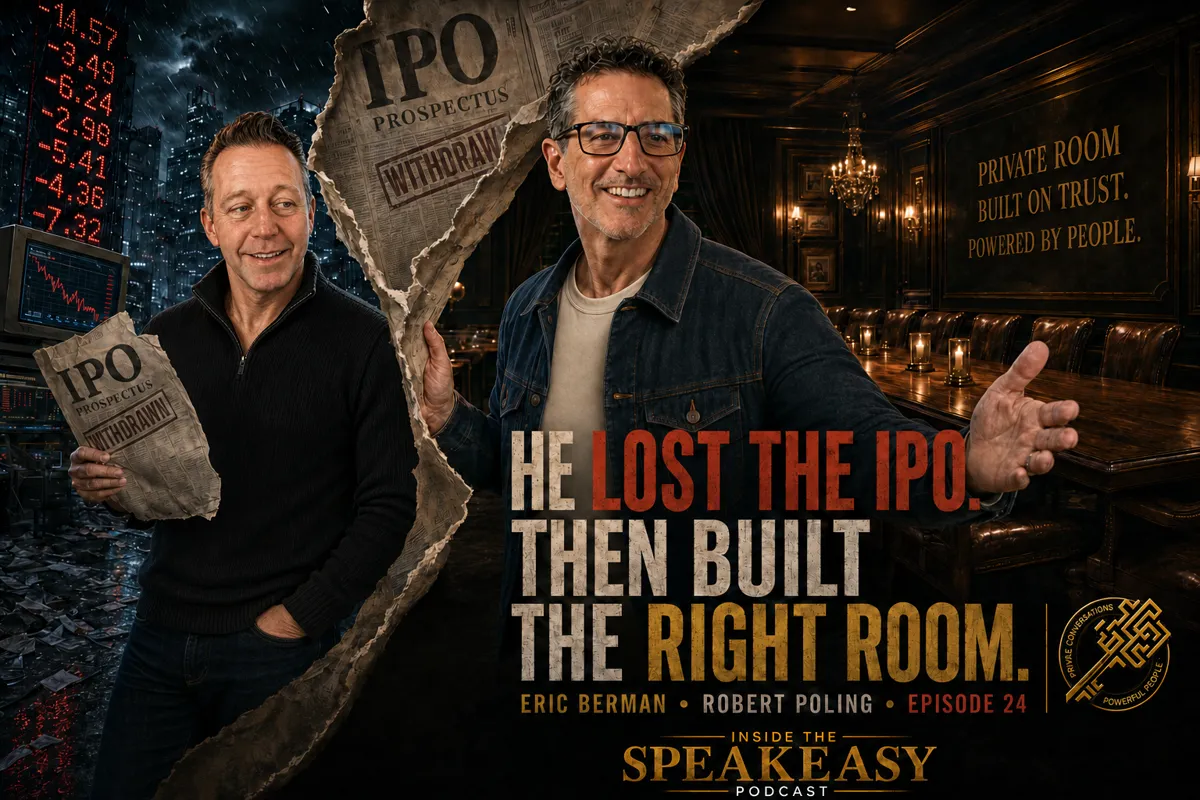
Eric Berman usually asks the questions on the Speakeasy Podcast, but in this episode he moves to the guest chair while his friend of more than 30 years and longtime business partner, Robert Poling, interviews him. Eric traces his path from graduating from UCSD at 21 to serving as COO of CollegeClub, an early social media company that grew to 400 employees and filed to go public, only to lose nearly everything in the 2000 market crash. He explains how offering to help Brian Tracy without a salary led to a partnership, then to the agency he and Robert built together, and how mastermind dinners started with John Assaraf in San Diego became the seed of Speakeasy Mastermind. Eric also shares what he calls entrepreneurial loneliness, the culture of abundance he protects in the room, and his ten-year vision for Speakeasy as a home for entrepreneurs around the world.
In this episode, you'll discover:
- How Eric went from COO of a company with 400 employees and over $100 million raised to starting over at 28 when the 2000 crash hit two months before its IPO
- Why Eric told Brian Tracy not to pay him a salary or anything at all until he made Brian money, and how that offer became a long-term partnership
- How a dinner group started with John Assaraf, Darren Hardy, and Mike Koenigs became the seed of Speakeasy Mastermind
- What Eric means by entrepreneurial loneliness and why a mastermind can act as a friendly board of advisors for business owners without one
- The two scoreboards Eric uses to measure Speakeasy's success: the energy he leaves each meeting with and the collisions between members that turn into business
Episode Summary
Eric Berman did not take the typical path after graduating from UCSD at 21. Instead of a starting job at around $40,000, he joined a few founders with a business idea and became COO of what he calls the original first social media company, before MySpace and Facebook. The company, CollegeClub, grew from three people to 400 employees and raised over $100 million. Robert Poling, who now interviews Eric for this episode, joined as one of its senior developers, and the two have been friends for more than 30 years.
Eric expected to retire at 28. The company had filed to go public, and he describes years of sleeping in offices and working seven days a week. Then the first market crash of 2000 hit while he and other executives were on their first vacation in five years, two months before the IPO, and a $10 million bridge loan meant to carry them to the offering dried up. Robert recalls that the company had 50,000 to 75,000 people on the site at any time, but investors who had said eyeballs were enough suddenly asked how it would make money. Eric says the money had been on paper, so the loss was easier to absorb, and the education and confidence he gained could not be taken away.
Picking himself back up, Eric was doing consulting when someone connected him with Brian Tracy, whom he had grown up listening to. He told Brian he was not an employee, did not want a salary, and should not be paid until he made Brian money. That began a partnership, and Eric brought Robert in on the tech side. When other thought leaders asked for the same help, Eric had what he calls the two-year conversation with Brian about working with other clients. Brian agreed as long as they took care of him, which Eric says they have honored for more than 20 years since.
That work grew into Brandetize, the full-service marketing agency for experts and gurus that Eric and Robert run together. Eric says the agency peaked at around $6 million to $7 million, short of the $10 million to $12 million he sees as the threshold for selling or rolling up an agency. He also felt a slight misalignment: he was a good marketing generalist, but his real genius was community building, finding great people and connecting the dots between them.
That talent showed up early. While Eric was partnered with Brian, John Assaraf suggested they get together to mastermind, with the understanding that nobody would worry about ideas being stolen and the answer to each other would always be yes. They brought in Darren Hardy, who was running SUCCESS magazine, and marketing legend Mike Koenigs. The informal San Diego Mastermind group grew to include speakers paid $10,000 to $30,000 to be on stage. Eric admits to some imposter syndrome as the organizer, but says the group taught him that assembling people and building community is a skill others find difficult.
Eric explains that members come for relief from entrepreneurial loneliness, a group that will call out their blind spots, and permission to talk business without seeming to brag. He wants members who are still in the weeds, open with their numbers, and ready to give as well as receive, typically running businesses at about $1 million to $30 million in revenue. He measures success by whether he leaves each meeting with more energy and by hearing about collisions, such as members from Austin and Boca who now do business together. In ten years, he hopes Speakeasy will be a true home for entrepreneurs wherever they travel.
Big Ideas Discussed
Losing Money on Paper Still Leaves the Lessons
Eric's first company was two months from going public when the 2000 crash hit, and the $10 million bridge meant to carry it to the IPO dried up. He had worked seven days a week, slept in offices, and expected to retire at 28. Instead, he says, the market moved so fast that almost everything the team had built was lost. His first lesson was that you can work extremely hard and still be caught off guard, so it pays to always look at what could go wrong.
He also reframes the loss. Eric says it is easier to lose money you never had in the bank than money you actually have, because his wealth existed only on paper while he lived on ramen and low rent. What he kept was the education, the confidence, and the experience of building something with real impact. Robert adds a second lesson from that era: investors who once said eyeballs were all that mattered quickly began asking how the company would actually make money.
Lead With Partnership, Not Employment
When Eric met Brian Tracy, he did not ask for a job. He told Brian he would build him something, that he was not an employee, and that Brian should not pay him until he made Brian money. Brian replied that Eric was his kind of guy, and the arrangement became a business partnership. When Eric called Robert to help on the tech side, Robert answered the same way, saying he was an entrepreneur and would partner rather than work for him.
Robert describes this as something hardwired in both of them: whenever they approach business, the stance is to do it with someone rather than for them. The same principle shaped how they took on new clients after Brian, telling other thought leaders they did not want to do the work for them but with them. Eric notes that the partnership with Brian survived a two-year conversation about taking on other clients because they promised never to abandon him, a promise he says they have kept for more than 20 years.
Entrepreneurs Need Permission to Talk Business
Eric uses the term entrepreneurial loneliness to describe what business owners experience. It is not that they lack friends, but that their employees will not always tell them where they are going wrong, and few people around them can look ahead at trends with them. A mastermind gives them people who push them, call out their blind spots, hold them accountable, and act almost like a secret board of advisors.
Robert adds his own example. At a dinner party, describing a teledermatology business and its influencer partners can sound like bragging, and he often realizes mid-question that the person he is asking has never run a business. Eric says the room also makes vulnerability possible. He has seen members ask for help for the first time with problems like payroll worries or possible layoffs, conversations they could not have with their own teams.
Abundance Only Works When Everyone Gives and Receives
From the start, John Assaraf set the rule that the answer is always yes and nobody worries about ideas being stolen. Robert remembers sitting in on quarterly meetings where established leaders simply handed over their playbooks, tips, and warnings. Eric explains why that works: everyone still has to execute, so giving away a big idea costs little and starts a flow of constant giving and receiving.
That is why Eric is selective about who joins. He does not want people who pay to sit quietly and absorb strategies, and he also passes on founders of huge companies who are so far out of the day-to-day that they cannot contribute. He wants entrepreneurs who are still grinding, open with their books, and open-hearted. In his view, a good mastermind should fire-hose members with value so that they leave every meeting with at least three or four new things to follow up on, and often with the problem they walked in with already solved.
Questions We Answer in This Episode
Who is Eric Berman?
Eric Berman is the co-founder of Speakeasy Mastermind and the host of the Speakeasy Podcast. He was COO of CollegeClub, an early social media company that grew to 400 employees before the 2000 crash. He later partnered with Brian Tracy and, with Robert Poling, built the marketing agency Brandetize.
How did Speakeasy Mastermind get started?
Eric Berman says Speakeasy began as an informal San Diego Mastermind dinner group that John Assaraf suggested they start while Eric was partnered with Brian Tracy. Darren Hardy and Mike Koenigs were among the early participants. Eric organized the group, and he describes those dinners as the seeding of Speakeasy.
What happened to Eric Berman's company during the dot-com crash?
Eric Berman says his company had filed to go public and was two months from its IPO when the market crash of 2000 hit. A $10 million bridge meant to carry it to the IPO dried up, and almost everything the team had built was lost. Eric was 28 and had expected to retire.
What is entrepreneurial loneliness?
Eric Berman uses the term entrepreneurial loneliness for the experience of running a company without enough people who will say where you might be going wrong. Employees do not always speak up, and friends may not understand business. Eric says a mastermind fills that gap with peers who push you and hold you accountable.
What makes Speakeasy different from other masterminds?
Eric Berman says some masterminds feel like an energy suck, very transactional, or unrelatable to members' businesses. Speakeasy focuses on relatable entrepreneurs who are still in the weeds and willing to share openly. He wants members to leave with at least three or four new ideas and often with their problem solved that day.
Who is Speakeasy Mastermind for?
Eric Berman says the entrepreneurs Speakeasy attracts typically run businesses at about $1 million to $30 million or more in revenue. They are fairly marketing-driven, still building their companies tactically, and willing to both give and receive. Eric describes the group as a friendly board of advisors for owners who do not have one.
How does Eric Berman measure the success of Speakeasy?
Eric Berman says his first measure is whether he leaves a meeting with more energy or feeling drained. His biggest win is hearing about collisions, when two members meet in the community and start doing business together, such as members from Austin and Boca. He says he is hearing more of those stories.
Full Episode Transcript
Read the Full Episode Transcript
Flipping the Script: Robert Poling Interviews Eric Berman
Eric Berman: No fluff, no filters, just the raw strategies, personal stories and mental models that move the needle. I'm Eric Berman. Now let's get into it. Welcome to Inside the Speakeasy Podcast. I am super duper, duper excited today because we get to flip this script. And I brought in a very special guest and I'm going to be sitting in the opposite chair as my buddy, friend of over 30 years and business partner now of over 20 some odd years. Robert Poling is going to be interviewing me and we're going to talk about a little about my backstory, how we got Speakeasy started, all the stuff that Robert and I are doing, the crazy entrepreneurial journeys that both of us have been through over these years and what a ride it's been. And I know a few people said, Eric, we got to put you on the hot seat. And I want to hear more about the story of Speakeasy and more. So here we are. We're going to make it happen today. Welcome, Robert. Thanks for joining me.
Robert Poling: Yeah, it's great. It's fun to be here. I finally get to be on the show. I've been hearing all kinds of really cool things about it. And even more fun is I get to sit in your seat today and be the one interviewing, asking questions and kind of digging in to what's going on here. You know, some of the behind the scenes at Speakeasy, you know, what was your journey, the thoughts along the way. It's going to be a bit of fun today. Let's jump in, let's get started. You know, I love it. Feels good.
Eric Berman: This is, I just stressful sometimes during the interview, you got to prepare, you got to get like, I got to stay focused. I can't have my normal ADD mind, you know, multitasking. I gotta, like, now. This is great. All right, you know, I mean, I'll.
Robert Poling: Be honest with you. We're just going to have a conversation. We're just, just going to go through it and we're going to make the best of it. I don't have a set of questions. I don't have a script that I'm going to read you. We're going to just, you know, go through it and hear the history of it. And let's start with, you know, the origin. How did this thing called Speakeasy Mastermind come about? Like, how did you originally get the idea for this? You Know, what were you thinking about before it happened? Tell me about the before.
From UCSD Graduate to COO of an Early Social Media Company
Eric Berman: Should we go way back in the journey that you and I first met each other? Because really, this, there's a lot of that baked into that. I mean really, we got here today. So for those of you, I guess probably a lot of people don't know the backstory of the career. And it's kind of fun story how you and I met after graduating at UCSD at a young right age of 21. Didn't jump into the initial, hey, go get a job out of this nice school and immediately jump into that $40,000. Back then it was $40,000. Can you imagine? Now people are getting a lot more job to start a biz. And I was just like had an itch about me. First guys I met had this business idea. I'm like, that sounds cool. Where do I sit? So I just immediately like just jumped in the fire on some idea these guys were playing. There's a couple ideas and fast forward that. It was three of us that turned into 400 employees and we raised over a hundred million dollars. And I was essentially the COO of a company which was the original first social media company before there was MySpace and Facebook and everything else. And here I am in my 20s going out there and discovering. I love to build things and I'm an entrepreneur. And I didn't really realize that until like you look back on life and along the way, of course, that's where you and I first met. You know, you came on as one of our senior stud developers, building out some cool stuff and some cool tech. And we went on that ride there together.
Two Months From an IPO When the Dot-Com Bubble Burst
Eric Berman: And unfortunately that didn't end well, that ride, because I thought I was going to be retired at 28 years old. We had filed to go public. Yeah, I know you were looking at your shares, I was looking at my shares and things were feeling pretty good at that point. That was the days of. Kind of hate to date myself, Robert, but you know, those are the days of sleeping in mattresses and offices, working. I mean, literally it was in a bubble seven days a week. I didn't have a life. And this was when I was 28. The first market crash of the year 2000 hit and we were two months from going public. In fact, I remember we taking our first vacation in five years, me and the a couple of the other executives. And we saw the market crash while we were in a very rainy day in Playa del Carmen. And the vacation got cut short. We had a 2 million, a $10 million bridge to take us to the IPO. And that money dried up. And that was when I went from thinking all this hard work was going to pay off. And, you know, first lesson of, wow, you know, you can work your ass off and you always look for what could go wrong in business. None of us expected market conditions changing like that so fast, where everything we had built up, we just pretty much lost. And that was a really tough time. You know, having gone through that, I.
Robert Poling: Think of it, you know, my recollection of it is there was something that important happened at that time too, which is, you know, at one point, it was just enough to have eyeballs, right? And we had lots of eyeballs at any moment in time. We had 50, 60, 75,000 people on the site at all time participating.
Eric Berman: We were the number one site in the college demographic and we were the 4 40th site on the entire Internet.
Robert Poling: Back in that day. Yeah, it was huge. But people would say, yeah, don't even worry about making the money. You know, if you have the eyeballs, the money's gonna follow. There is a little bit of truth to it, but I think that crash, that kind of dot com bubble crash happened because, you know, the people that knew a little bit about business were saying, well, how are you guys actually gonna make money?
Eric Berman: You know, that's right, that's right. The VCs are just spend market share, get eyeballs. And then all of a sudden, market crashes, they were nowhere to be found when it came to where's that money? You know, you want to bring this to. So that was a very, very interesting time. And I always tell people, I mean, I think part of your, you know, your first question about Speakeasy, you and I both have it, and I know you went on a little bit of an entrepreneurial journey after that. And then we came back together and, you know, there's a fire in our bellies, both of us, that we've been so close to that hit. And I always say that as hard as that was, it's easier to lose money that you don't, that you actually have in the bank than money you don't have. You know, all the money was on paper. You know, I was living off of ramen for years and, you know, low rent and all that kind of stuff just to get to that point. So it wasn't like I had all this, you know, millions of dollars pulled out of my bank account. And you can't take away the experience that you had. You're. I'm still 28 and this is over. And I'm like, okay, let's go. Pick yourself back up onto the next journey despite thinking that you were done. But the education and the confidence and the learning I got along the way was certainly powerful. And I think, you know, as we develop and where we're at now, it's like, yeah, we want to still build something huge that has impact. And that was one of the things I go back to when we were on the name of the company CollegeClub, when we were building that it was all about making huge impact and, you know, love doing stuff like that. And I'll share a story later as we'll get into it. One of the biggest things I love to see and stuff we build.
Rebuilding by Partnering With Brian Tracy
Eric Berman: But after that, I kind of picked myself back up. You went on and built some really cool tech and projects out there. And I went out there and was doing some consulting and met a family. Somebody who was a called me and said, hey, you know a lot about this Internet thing. This is back in 2001, you know, Brian Tracy. And I kind of laughed and I said, Brian Tracy, I'm a huge fan of his. Like, we used to listen to Brian and Tony in the breakfast room every morning, 6 to 7am and if you were late, you had to buy breakfast kind of thing. So, yeah, I grew up listening to Brian and I loved him. And he was in San Diego like myself, and he didn't help with the Internet. So I walked in and said, Brian, I'd love to help you. I can help you, but I'm not an employee, so don't pay me a salary. I'll come and build you something. Don't pay me until I make you money. And he's like, Eric, you're my kind of guy. And so that was fun. And that really was the beginning of you and I getting back together again. Because that led to me being business partners with Brian. And then I needed to bring somebody on tech side. And so I reached out to my old buddy Robert Poling and said, rob, you want to help me do this kind of stuff? You were consulting. We went out there and started working on Brian.
Robert Poling: I think we have that hardwired in our personality. Because you had been working with Brian for a couple of years. Yeah, for I got the phone call, I'd been doing some other things entrepreneurial wise. But then when, you know, you kind of explained who he was, how much reach this guy has, how impactful he has. Very important to you. I told you the same thing that you just said. It's like, hey, but I'm not an employee, buddy. I'm. I'm an entrepreneur and I'll partner with you on this thing. And it's almost like we have that same kind of reaction when we approach business all the time is like, yeah, you know, there's that common thread like, hey, I'm going to do this with you and it's going to be cool, but we're going to make something bigger than we can even imagine together.
Eric Berman: That's right. And it's funny because you look back on life and say, well, what did I know I was. Could have an entrepreneur. Like, when do you have that? Like, you don't like come out and say, hey, I'm an entrepreneur. You sort of just do things that's wired in you. You don't go through college. Everybody's sort of the same. You're like, well, this person went, got that job. But ultimately, I guess I was an entrepreneur. And you look back and see all the signals and you had the same thing too. It's just, that's how we were wired.
The Two-Year Conversation and the Rise of Brandetize
Eric Berman: And you know, I mean, going back to that story, you and I remember, we started getting approached by a lot of other thought leaders out there and said, hey, what you do for Brian can you do for me? And that ultimately became the beginning of. I remember what I called the two year conversation. You remember that? The two year conversation. How are we going to tell Brian that we no longer wanted to have a monogamous relationship with him anymore and that we want. We still loved him, we'd always take care of him, but we wanted to start working with other clients too, to sort of have a much bigger pie. And you know, fortunately that conversation went well and Brian is such an amazing guy and he basically understood and he said, Eric, you know, I get it. As long as you don't abandon me and take care of me and you'll always. And of course we've honored that ever since. 20 Some odd years later. And so we went off into Brandetize. I mean, you and I been running this full service marketing agency for experts and gurus for a while. And I would say, gosh, I mean, you and I started getting.
Robert Poling: I don't know if the exact dates, but I think you started more or less in 2000 with Brian, maybe Brian.
Eric Berman: 2001. February 2001. And then you and I incorporated in 2014, I believe, or 2015.
Robert Poling: We got together on the Brian thing. I think it was about 2005. And then we were doing it for several years and then we started getting those calls, hey, can you do this for me? You know, what you're doing for Brian is awesome. I'd love it. And it was the same kind of thing. We said, we don't want to do it for you. If we're going to do it, we'll do it with you because we're entrepreneurs again. It's that thing like, we'll do it with you. We're entrepreneurs. We'll do it together. I was that down.
Eric Berman: Yep.
Robert Poling: Yeah. So I think that was what, 2008. When we started acting as Internet. We were an agency.
Eric Berman: 2008. And then we finally officially, we did. We dabbled, but I think we did went all in on the [unclear]. Mid 2014ish, 2015ish. And then, you know, fast forwarding there. I mean, you and I are running and we [unclear]. I mean, we could talk a whole episode on life as an agency owner, but I don't want to get into that too much today. Let's just sum it by saying it's been a freaking lot of ups and downs. I mean, you and I have had quite a battle. Shifting, changing directions, and then really, I think, you know, bridging this over to Speakeasy. I mean, really, over the last few years, we're just like, what's our exit out of this? Like, I feel like when you run an agency, there's a couple of paths. You either just run this passive income business and go as long as you can until you burn out, or you have to get over. Like, I think in our life, it's at least 10 million, 10 to 12 million. And then you could sell or roll up with others. And, you know, I think we peaked 6, 7, 6, 7 million. And. And started losing the luster and getting too many gray hairs and saying, what's next? It's been a journey.
Hearing the Call to Connect With More Entrepreneurs
Robert Poling: I think it's more like a calling or a feeling that you have is like, okay, this is fine. We started this business and it's, you know, very successful and, you know, we're growing and we're doing our thing, but deep down inside, we're entrepreneurs and we're being called to something else. And I remember in the middle of us doing this thing, you were telling me, hey, I have this other idea for this thing. I feel like I need to. I feel like there's, you know, there's this entrepreneurial spirit. I want to connect with more of those people. Yeah. So can you tell me about, like, the very early days where you started to feel like, oh, you Know, I want to have the. I want to connect to more entrepreneurs and, you know, yeah, see what they're doing. What are they talking about? What are they experiencing?
Eric Berman: Well, I'll say a couple things to that. One is, and this is really the seeding of Speakeasy in a second. But I think I feeling a little bit like running the agency. I have almost a slight misalignment. And as you think through your gut and you think about the area of genius, I feel like I had confidence to run a business, any business. It just so happened we're running a marketing agency. But like my strength, where I'm great at, yeah, I could business development and meeting people and networking, connecting and bringing in clients, but doing the things and doing the roll up your sleeves marketing stuff. I was a good generalist, but I was never, like, amazing at it. What I was good at is like, you know, community building. Like, in hindsight, like, I was really good at finding the people and networking and bringing these people and connecting the dots and going all the way back to working with Brian.
John Assaraf and the San Diego Mastermind Dinners
Eric Berman: One of my closest friends, John Assaraf, who was another guru in the town of San Diego, said, hey, Eric, I know you're Brian's partner. Why don't we get together and mastermind and share ideas and, you know, what's working and like, come to the table and let's just not worry about, like, you know, stealing ideas, you know, let's get that out of the way. And we're all here to sort of level each other up. And the answer to each other is always going to be yes. Like, whatever you need, yes. And let's go bring in Darren Hardy who was running SUCCESS magazine and Mike Koenigs is another legend of marketing down in San Diego and a couple other people and let's get together. And I think secretly John knew that I was more the organized entrepreneur and that like, he's like, Eric's really on top of stuff and he'll help kind of get these things going. John's always one step ahead there. I love John. So that became a dinner group where we started masterminding and we brought incredible people together to share what was working in business, what was working for Brian, and what was working for other clients. And ultimately, Robert, that was the beginning. That was the seeding of what this dinner group was. It wasn't named yet. It was just, hey, we called it the San Diego Mastermind group. And then we started bringing other people and other guests. And sure enough, when I say other people, these are big name people that are getting paid like 10, 20, $30,000 to be on stages and there for time. And, you know, people are, you know, for their consulting, yet they're all showing up to dinner. I had a little bit of an imposter syndrome fact for a while. I'm sitting there bringing all these gurus together, and to me I'm like, I guess the value I'm playing here is I'm organizing them. Like, I'm not like the guy on stage, I'm not like the guy like the Mike Koenigs marketing legend, you know, but they all sort of loved the role I was playing. And they're like, no, Eric, you're bringing great ideas too. And I think it built up my confidence even as I started building it. But I also learned for the first time the power of just being able to assemble and organize and connect incredible people and building community, which is something I was so good at. And to others I learned, I mean, I learned in hindsight, that's a skill that to me felt so easy, but for others it was difficult. And I never understood that until I matured a little bit, you know, years later, that truly organizing and connecting and building community is something that's magical for others. And that was the seeding of Speakeasy.
Entrepreneurial Loneliness and Permission to Talk Business
Robert Poling: Yeah, yeah, thanks for going over that. So that was your secret sauce that you were bringing to it. I'm super curious. All these guys, big time guys, successful businesses, what were they getting out of that in the early days? Like, what were they feeling when they came there?
Eric Berman: Yeah, I think looking back, it was the feeling of just, there's a little bit of, I mean, there's a. The loneliness. There's the, hey, we're all out there running around our businesses and you know, I don't, when I say lonely, it's not like they're lonely, don't have friends. It's what I call entrepreneurial loneliness. Meaning when you're running their companies, it's not like your employees are going to tell you at a high level. Sometimes some good employees will, but sometimes it's like I don't have enough people to tell me where I might be going wrong or somebody else who is very future focused. That's like, you know, can look at it, look ahead in the crystal ball to some degree and say, hey, you know, here's where the marketing trends are going. Here's where you need to be like other high level thinkers. I think they really love the fact that they're surrounded by people to help them think, to push them as well. More than an employee would to call out their bullshit if they had bullshit. You know, it's nice to have people there that you trust that will call you out, that'll hold you accountable if you're going to say something and it's, you know, think of it. It's almost like a secret. It becomes almost like a secret board of advisors to some degree, too, but where you're getting a bunch of information and you're getting this close group that you can ask questions to. And there was something magical about that. There's a little bit of a FOMO, like, oh, my God, if I didn't show up, or what was I going to miss out on? So that really kept people to stick around. And I think there was something also about just getting out of your environment and having that commitment once a month just to get out of the office or house to say, hey, I'm going to get there and break bread with some people that are becoming friends and have permission to talk business. I mean, you think, how many times do we go out with our friends and for dinners and it's just like, oh, should we talk about business now? Or maybe like, I want a break from business. I feel awkward, you know, bringing it up because maybe they're tired or. And I can't hear because the waiter's constantly interrupting us and people are across the table and I'm talking to the people. Two people, that's it. So there's a lot of these little things that started coming into play.
Robert Poling: You know, it's funny when you talk about that permission to speak business, because I feel that too, like, like you said, you're at a dinner party. I can't just start talking to people about doing, oh, we're setting up this remote dermatology, teledermatology business, and we got these influencers and we're working with this guy. You almost sound like you're bragging or you sound like you're boasting and I'm just talking about business. And then, you know, if I want to go deep, I start to think like, hey, you know, what would you do in this? Then I realize as the words are coming out, well, you've never run a business before and you've never done this thing before. I don't really know that you can add to this. I don't know how good this information is that I'm going to get. So that whole, like, I know the idea, the thing that you just said is permission to speak business. Is that kind of really what you think is at its core, is that important? What do you think about that?
Eric Berman: I mean, I think that's. I think that's one of many things. I mean, just knowing and feeling confident that you could really say anything and be vulnerable, too, to this group. I mean, I've had times where I've had people go out there that are like, I'm going to ask for help. And I've never asked for. This is the only group I feel safe asking for help on God. And. Because I couldn't ask my team for help here, but, like, hey, we're really struggling. You know, money's been off. Anybody having ideas of something that can really help us right now. Because, you know, I'm worried about, you know, maybe I'm worried about payroll or I'm worried about, like, I may have to do some layoffs. Like, where can you have those conversations? And so I think getting in that. Into that world and, you know, one thing else about Speakeasy is also the kind of people we are. It's not just an entrepreneur to entrepreneur. I think we were a lot more relatable, which is the big. In hindsight, the big thing that I also think makes us different from other types of groups out there, too. That makes it. We can relate more relatable to each other.
Robert Poling: Yeah.
A Culture of Abundance Where the Answer Is Always Yes
Robert Poling: I mean, I think about the very early days of us getting together with Assaraf and Koenigs and Darren Hardy, like those people that you were talking about, you know, sometimes, occasionally, every once in a while, we'd bring all our teams in. Right. And I would be a part of that because normally, you know, you were off doing the dinner things with these guys once a month, and then every quarter or so, we'd bring the whole team together. I'd be in the room, and I couldn't believe. These guys are just like, here you go. This is exactly what we're doing. Here's our game book for stuff, you know, and they're sharing. Oh, don't do this, do this. Here's a tip, here's a trick. Here's something cool. And I realized it was something bigger. And I think the word is, you know, abundance. These guys knew it didn't matter. I can give you so much because there are so much more. Here's a small piece that I can give you right now. And they brought this abundance. Is that something that you tried to foster or culture or how did that come about?
Eric Berman: Yeah, I think I remember John always said, the answer is always yes. And it goes back to finding in our community. It's leaving the ego aside, it's realizing that there is abundance. It's like there's so much out there that we could all lift each other together and we all win together type of thing. And let's not hold the big ideas back. You know, the reality is everybody still has to execute on these ideas. And if you're out there to share and you're giving away a big tip, it's wow, well, cool. I received now. And it just gets this flow of constant giving and receiving and helping each other out. And it's important, you know, we're building a community where, you know, we also are trying to craft people that are all at a fairly decent, high level, you know, a little bit more marketing centric, marketing driven entrepreneurs that are still in the weeds tactically building their companies and they could share what's working and what's not working. And when you're in a room, we don't necessarily want people that are here, hey, I'm just here to learn the latest strategies and I'll pay, you know, all this money to be in this mastermind group and just be a fly in the wall. Like, we want people that are, that are to give and receive. And I think conversely, you know, there's been times where like, hey, let's bring this person, they built this, you know, bajillion dollar company, let's bring them by. And I'm like, they're nice to tell a story, you know, how they made it. And I'm not saying that wouldn't be a great story to hear and that'd be awesome for a meeting. But are they really going to be able to contribute when they're at such a high level out of the weeds of business? Now, we don't want those people either. Like, we want the people that are still grinding in business. And as you said, Robert, they're like, open the books, open, they're open hearted, open, you know, sharing and they have abundance. Let's all build together.
Robert Poling: Yeah.
The Soul of Speakeasy
Robert Poling: You know, if you think about it, you know, you have these great people, you have the events, you have people working together, you strip it all away, right? What really is the essence? What's the soul of Speakeasy?
Eric Berman: Gosh, the soul of Speakeasy is, man, I just think it's people are there with a big heart, not the ego. And they really care. I mean, they really, it's like you're having an extra family and it's just access, you know, we're all going to give access to each other. You know, we're Going to say, let me go out of my way to help you out. It's almost like a race to figuring out, like, how can I support this person? And so when everybody's collectively there to say, like, let's push each other forward, you know, I'm gonna give you open access to my Rolodex, to my ideas, and I'm gonna be there to share for you. And, you know, if you need me, I'm here for you. It's a lot of that where it's magical to find that.
Robert Poling: Yeah, that's definitely a feeling that I get when I'm in the room. It just feels like everyone will drop everything to help you succeed. Right. To help you grow, to help you get past your problem. Whatever. Whatever it is, whatever you're working on.
Eric Berman: Yep.
Common Misconceptions About Mastermind Groups
Robert Poling: I like to do this with the clients a lot of times, and I say, okay, that's the story. Right. That's part of the origin story. Although a brief one, that's part of the essence. It still has the word mastermind on it. Right. Speakeasy Mastermind. So what's the misconception that the world has about masterminds that, you know, is there even one that the world has about masterminds that you'd want to change? What do you think is different about Speakeasy? How would you want to tell the story different about masterminds? People are walking around with the. I don't want to go there. It's just a bunch of people that, you know, they get up on stage and they speak. I don't want to speak to anybody. You know, what is this mastermind group? I'm afraid, like, so what are the misconceptions people have about mastermind groups?
Eric Berman: I think it just depends because people have different experience with different masterminds. I think some people feel like, oh, I'm going to walk in and it's going to be an energy suck. Like, oh, they're just going to come in and ask me for all of my ideas and there's going to be nothing I get back in return. Or it's just gonna feel like a little bit icky or weird or I don't wanna name groups, but there's, you know, groups out there that it's all based on. Okay. Very transactional as far as, like, okay, you walk in the door and what do you have for me? Like, do you have a referral for me and, you know, more of that. So I. I think, you know, there's stuff out there, and I think there's also masterminds where you've been around groups and you're just like, okay, this is. I can't relate to what they're talking about. It's so out of the world. And that I'm playing in, that these are cool ideas, but, like, I'm going to yawn and go sit in the corner and start focusing on something else because they're talking about something that's nothing to do in the world I'm playing with. Or they're going to be some weird exercises that I got to sit around and do that are just like, you know, I don't know. I just want to, like, I want to walk in. I just want to just fire hose me with, like, value. What's working, what's not working? You know, let's present, let's learn a new topic, let's like, support each other. Like, let's just get in there and just grind quickly and just walk away saying, woo, I just got fire hosed. And like, every time I walk in the door, I walk away with at least, you know, minimum three, four new things I want to go look up or follow up with. The problem I walked in with got solved like, that day. Like, that's a mastermind to me.
Robert Poling: And that's definitely how I feel when I'm attending one of these events. It's just, you're just drinking from the fire hose of abundance and problem solving and generosity and people lifting you up.
A Friendly Board of Advisors for Growing Entrepreneurs
Robert Poling: So to what end? You know, if someone joins Speakeasy and they're fully invested, they're showing up every month and they're participating, you know, what is their journey going to look like? What is their transformation going to look like 12 months from now? What's going to happen to them?
Eric Berman: Yeah, you know, if they come in, I think they're just going to walk away feeling, like I said earlier, like, wow, they actually have a family, they have somebody they could rely on. I was thinking about this the other day. I was thinking about some messaging and a lot of us at the stages, you know, at least the kind of entrepreneurs we're attracting, we're typically, I would say, you know, million to 30 million plus, you know, revenue. We're not at the point where people are like, okay, we're $100 million companies with a full board of directors. We raised $100 million, you know, so ultimately my point is a lot of us don't have a true board of directors, board of advisors at the level where you can. And I say a friendly board of advisors, you know, you and I Dealt with companies where there's board of directors and damn, it's not like you want to go see the board of directors. That's like a negative experience. Oftentimes. This is like your friendly group of board of advisors that you're getting, and if you never had one and ones that are on your side, it's really cool because they're there to say, hey, what about this? What about that? You know, let's advise you along the way. Let's be there to support you. So I think, you know, this feeling of, oh, my, I have a family of people that actually genuinely care about me. They generally are concerned for my wealth, my health, my well being, my company. And I know I could rely on them. That's special.
Robert Poling: Wow.
Measuring Success Through Energy and Member Collisions
Robert Poling: Wow. Is there any way that, you know, you personally measure the success of Speakeasy? Is there, like a scoreboard that really matters to you, Eric?
Eric Berman: Well, I'm playing different hats. I would say, you know me as, you know, slash hat owner of, let's say, the companies you and I run. You know, I do it when I say, when I walk away. It's just a simple ROI meter. Like, I'm so busy doing stuff and like, it's always like, okay, I gotta get up, I gotta go drive out there. And I come back, do I have more energy? Is my cup more full or do I feel drained? Do I feel like, wow, I'm so fired up, I can't wait to go to my notes and share, like, with you oftentimes, hey, I got this and this. Let's do like, you know, you're just feeling, oh, my God, I met this person and they helped me with this. It opened up doors. So, like, that's a feeling of I got energy versus, you know, taken away my bigger Speakeasy from now running the whole mastermind. And I brought this up earlier, and I'm gonna close the loop on something I said earlier about impact is my biggest win is when I hear stories of two people that came together in the community that had an amazing connection and had a collision. They met and next thing you know, they're doing business together, they got a referral together. They both lifted up because of an experience they had in the community. And my favorite is I don't even. The less I even know them, and I just hear about it. It's like, damn, these are two people, because of what we built, entered in this community, had an amazing experience just like I have, and they're telling stories about it, and they're like, just out there doing Things. That's when I know we're winning, is when you hear more and more impactful stories of success that's happening. And I'm starting to get more and more of those. And that's, like, that's what gets me fired up every day to hear, oh, my God. Somebody connected from Austin to Boca, they never would have met if it wasn't for Speakeasy. And now they're doing business together.
Robert Poling: Cool. So crazy. Those are the two things that I think about, too. And I mean, it's like, every time you come back from the monthly meeting, you are fired up, man. You have energy. You definitely got that. You're super excited about things and about things that you weren't necessarily thinking about when you walked in the room, but when you walked out, you were like, oh, I have 20 new ideas, and there's like, five new concepts. It's super cool. That's an awesome one. The other one is, I can't think of how I've lost count of how many. How many times that connection has happened.
Eric Berman: Yep.
Robert Poling: Right. Where somebody walks in the room. It's almost like the Reese's Pieces chocolate and peanut butter just get next to each other, and it's like something magical just happened.
Eric Berman: I just interviewed Ryan Berman. No. No relation. He. And I love the word he's using. He says, collisions. He's like, I think it was just a bunch of collisions are happening. And he's like, I just. I don't even know what to expect. I walk in, like, the, you know, chocolate and peanut butter, like you said, or just something happens. He's like, I don't necessarily walk in even with a need, and I walk out like, damn, something happened. And now, you know, it's exciting.
The Ten-Year Vision for a Global Home for Entrepreneurs
Robert Poling: All right, so let's do another question that I love doing with our clients and say, you know, let's look into the future. Right? Let's go ten years from now, and we're looking back that the impact that Speakeasy had on the business world and the impact that it had on all of our members personally. Right. What is that impact that happened? What do you see, Eric?
Eric Berman: So if I go into 10 years and you say, I mean, for me, I would see that. I mean, this is going to continue to be a great global organization. Phenom, whatever you say. And I think the impact it's going to have is just the feeling that I have a true home of our avatar entrepreneur that we have where it's starting to happen now. But, like, anywhere I travel around the world, I have A family that I could go see. Like, I'm going to want to reach out and say, hey, I'm going to be in Portugal for business. I'd love to grab coffee or a drink with somebody who's a Speakeasy member and catch up and see how we can connect or just anybody needs help with something, they know they have a place to go that people are excited to kind of to collaborate, to give feedback on. I mean, that's where this is going is a true home. The knowledge base, the information that's on there, it's just like, damn, everything I need is going to be in here. And, you know, one thing I really try to hone in on is just listening, observing, and watching the entrepreneurs and hearing it, like, what the needs are. And, you know, my natural sort of visionary tendencies to say, like, what's not efficient? Let's make more efficient. Let's provide tools to make everybody's jobs easier. Like, that's the kind of stuff I see happening more and more. So as we grow this out.
Robert Poling: That's great. That's great. A true home for entrepreneurs all over the world. Speakeasy. Yep. Awesome. Cool. All right, well, I think that's great for today, right? You've been a great guest, Eric, to the show.
Eric Berman: Oh, thank you. Thank you. [unclear].
Robert Poling: Really love hearing the stories about how it went and what you were thinking about at each step. Yeah. Hopefully I'll have you on the show again sometime soon.
Eric Berman: Yeah, you're welcome back. We're going to flip the script next time. We'll get you on. I'll interview you and. And we could talk about some other crazy stories, but yeah, no, I appreciate the interview. And again, for those that are hearing about Speakeasy for the first time, love you to come check it out and, you know, join a city nearby or join our global community where we have our nomads hanging out and still connecting. And, yeah, are one of our big annual events. And more importantly, just I love to hear from everybody, like, what are their ideas? I'm trying to meet as many people as possible to see how they can connect them and support them. And I think what we're building is magical, and I'm excited for things to come. So thanks for listening today.
Robert Poling: It's been fun, Eric. It's been fun.
Eric Berman: And that's a wrap from the Speakeasy Podcast. If something sparked for you, don't keep it to yourself. Share it, review it, and pass it to the one person who needs to hear this right now. Want in on the real mastermind? Tap the link in the show notes to apply until next time. Keep scaling, stay sharp and don't be the smartest one in the room.

About The Guest
Eric Berman
Eric Berman is the co-founder of Speakeasy Mastermind, a community for experienced entrepreneurs that began as a San Diego mastermind dinner group, and the host of the Speakeasy Podcast. After graduating from UCSD, he co-founded and served as COO of CollegeClub, an early social media company that grew to 400 employees and raised over $100 million before the 2000 market crash ended its plans to go public. In 2001 he began working with personal development author Brian Tracy, a relationship that grew into a long-term business partnership. With Robert Poling, he went on to build Brandetize, a full-service digital marketing agency for experts and thought leaders. Eric has organized masterminds with entrepreneurs including John Assaraf, Darren Hardy, and Mike Koenigs, and he is known for connecting people and building community.