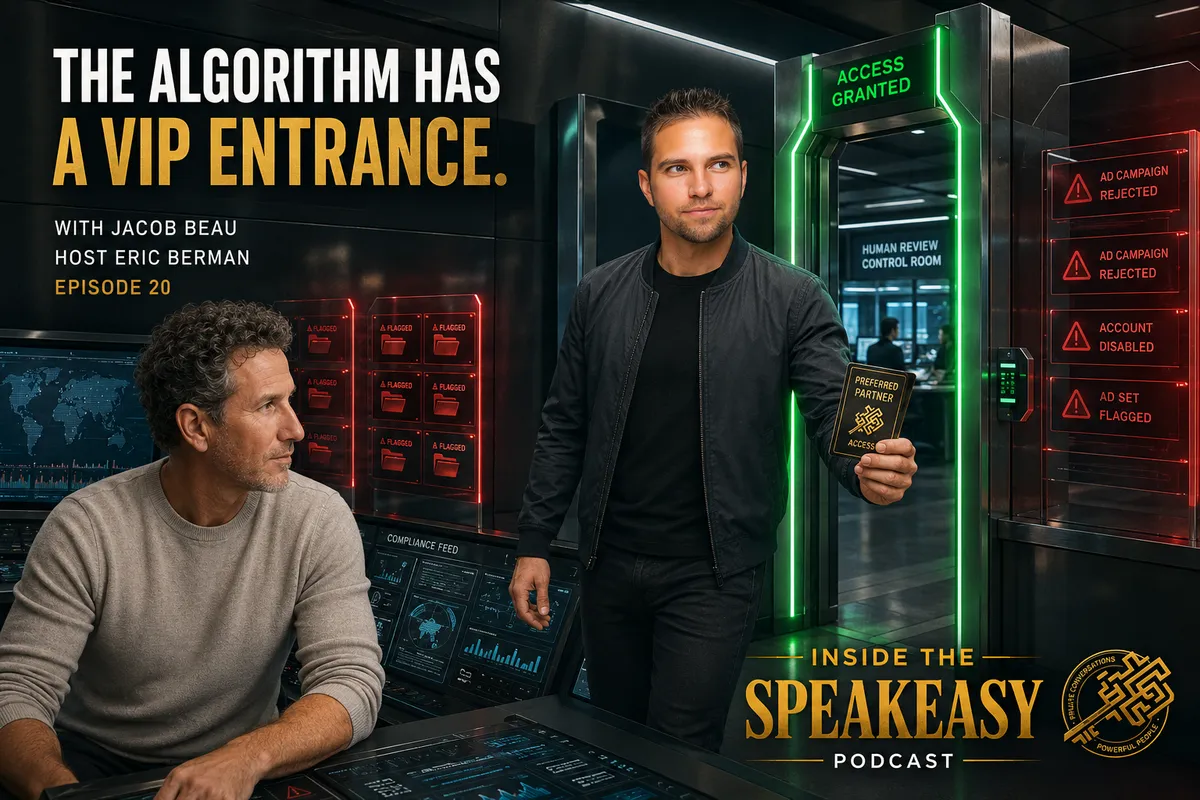
Jacob Beau, the former Facebook creative whom host Eric Berman introduces as the human cheat code to Meta ads, started out as a music and film producer in the San Francisco Bay Area. In this conversation, Jacob traces his path through Eventbrite and Salesforce, where he produced content for Dreamforce, to the creative ads team at Facebook, where he built campaigns for brands such as QuickBooks, United Airlines, and Uber and learned from the engineers behind the ad algorithm. He walks through the gamified Stories ad that made a random choice of restaurant feel like fate, explains how his agency now runs ads in regulated markets like cannabis, GLP-1 supplements, and crypto, and shares how a low-ticket offer helped him reach Meta's top partnership tier. Jacob also tells the surf-wagon story that taught him the value of personal branding and shows how he keeps two laptops running ChatGPT Agent.
In this episode, you'll discover:
- How Jacob's team built a three-part Stories ad for OpenTable that looked like a random game but always landed on the restaurant being promoted
- Why Meta tracks managed ad spend rather than personal ad spend, and how agencies, consultants, and coaches can use that to unlock partner benefits
- How a $1,500-a-month done-with-you program brought about 100 client ad accounts under Jacob's business manager, including some spending $2 million a month
- Why Meta prioritizes better cost per result on new features, and how Jacob used that when Stories was the new hot placement
- How Jacob runs ChatGPT Agent on two laptops at once to handle bookkeeping requests and full 30-day ad account audits
Episode Summary
Jacob Beau began as a creative, not a marketer. He was a fairly well-known music and film producer in the San Francisco Bay Area scene, performing at music festivals and producing LED background content for concerts by artists such as Taylor Swift, Justin Bieber, Britney Spears, and Ed Sheeran. That work caught the attention of people at Salesforce, where he started on contract and was eventually hired to produce content for Dreamforce, the week-long conference that takes over the city. Before Salesforce he had worked at Eventbrite, and when some of his Salesforce leaders moved to Facebook, they recommended him as a creative who could make great marketing material.
At Facebook, Jacob joined the creative ads team and, for the first time, saw himself as a marketer. Between roughly 2015 and 2018, he helped companies such as QuickBooks, United Airlines, Uber, Cheetos, and IKEA rework campaigns built for legacy TV commercials into social media ads. He explains that the story arc, engagement, and call to action all change on social, which is direct response rather than brand awareness. Because he had access to the engineers who built the ad algorithm, he learned how the ad auction decides who wins the right to show an ad, then designed creative to work with the algorithm. His ads performed so well that he ended up running a team of 12 under the Facebook umbrella.
One of his favorite campaigns came when Stories was new. Jacob notes that Meta prioritizes better cost per result on any new feature because it wants advertisers to use it. For OpenTable, his team built a retargeting ad across three video cards: tap to start, tap to stop a fast-flashing reel of cuisines, and land on Ruth's Chris Steakhouse every time, with a swipe up to book. He reused the concept on the spot for United Airlines as a spinning globe that always landed on Maui. The key, Eric points out, is that it only ran to people who were already thinking about that restaurant or destination.
After about three years, Jacob took some of the team with him and went direct to clients. He found that big brands ran ads through Facebook-owned agency accounts that most advertisers cannot access, and through his inside connections his agency gained access to the same kind of accounts. Today it holds what Jacob describes as the top level of Meta partnership available to an agency, with contacts at headquarters in Menlo Park. He says that lets the agency get real humans to review legitimate businesses that AI flags, and it runs ads for clients such as Cheech and Chong and Tai Lopez in regulated markets including cannabis, GLP-1 supplements, crypto, and online gambling.
Jacob's main tip for listeners is that Meta tracks managed ad spend, not personal ad spend. He says badged membership in the partnership program requires $5 million a month for six consecutive months, while his agency is doing $40 million a month. His high-ticket agency service costs $20,000 to $30,000 a month and might serve 15 clients, so he launched a done-with-you program at $1,500 a month that brought in about 100 clients whose ad accounts sit under his business manager. Some, like Paradigm and Agora, spend $2 million a month. He suggests agencies, fractional CMOs, consultants, and coaches could do the same with something as simple as a $100 ad account audit.
Jacob also explains that recovering a fully hacked business manager, like the one his team helped John Assaraf get back, requires inside connections at Meta. He shares that he saw Mark Zuckerberg often but never took a photo, and tells how giving a United Airlines executive a ride in his beat-up Isuzu Trooper surf wagon prompted him to buy a Mercedes-Benz that weekend. On AI, he describes running ChatGPT Agent on two laptops at once, one gathering statements for the agency's bookkeeper and one running a full ad account audit with competitor research from the Meta Ads Library.
Big Ideas Discussed
Meta Counts Managed Spend, Not Personal Spend
Jacob explains that Meta's partnership program is essentially a pay-to-play game: you have to spend a certain amount to unlock more benefits. Reaching badged membership, he says, requires $5 million a month for six consecutive months. The insight he shares with agency owners, consultants, coaches, and fractional CMOs is that Meta tracks managed ad spend rather than personal ad spend, so every client account brought under a business manager counts toward the total.
His own agency applied this by adding a $1,500-a-month done-with-you program alongside its $20,000 to $30,000 high-ticket service. About 100 clients came in, and because each one's ad account sits under Jacob's partnership, Meta credits the agency with managing their spend, including accounts spending $2 million a month. For anyone without a done-with-you offer, he suggests a $100 ad account audit that requires partner access. Bring in 200 clients that way, he says, and managed spend can climb quickly toward preferred partner status.
Design Ads for the Algorithm, Not Just for Beauty
At Facebook, Jacob did not want to make ads that were simply beautiful. He wanted them to convert. Working directly with the engineers who built the ad algorithm, he studied how the ad auction decides who wins the right to show ads to a target audience, and how to do that at the cheapest price point while getting the most conversions.
He then applied that knowledge to the creative side, building ads designed to make the algorithm work in the advertiser's favor. He calls it a key learning from his three years there, and says his ads started outperforming everyone else's. He also stresses that social ads need a different approach than TV: the story arc, the way people engage, and the call to action all change. Social media, as he describes it, is direct response marketing rather than brand awareness marketing, and creative has to be rethought with that in mind.
Gamified Retargeting Makes the Choice Feel Like Fate
Jacob's OpenTable campaign used the interactivity of Stories, where tapping, pausing, and swiping are all actions. Three video cards invited viewers to tap to start, then tap to stop a fast-flashing reel of cuisines. No matter when they tapped, the next card paused on what looked like the same frame and landed on Ruth's Chris Steakhouse, followed by a prompt to swipe up and book a reservation.
The concept worked because it ran only as retargeting, to people already looking at that restaurant. For United Airlines, Jacob adapted it on the spot into a spinning-globe game that always landed on Maui for a discount-ticket push. Eric sums up the genius: the viewer was already thinking about it, and the game makes the decision feel like fate. Jacob adds that Meta favors new features with better cost per result, which is why his team pushed hard on Stories when it was new.
Look the Part Until You No Longer Need To
After pitching the spinning-globe idea to United Airlines executives within about 10 minutes of meeting them, Jacob was asked by their director of marketing for a ride to the other campus. His car was a beat-up Isuzu Trooper with surfboards and a wetsuit in the back. He kept the deal, but went out and bought a Mercedes-Benz that weekend, and says the experience taught him the value of personal branding.
He also notes the twist he sees among his Silicon Valley mentors, some of whom have sold companies for $400 million. Once someone truly makes it, driving a beat-up pickup truck with surfboards in the back becomes a badge of honor, because it shows they do not care what anyone thinks. As Eric puts it, it goes backwards. Until a person reaches that level, Jacob's lesson is that how they present themselves still matters.
Questions We Answer in This Episode
Who is Jacob Beau?
Jacob Beau is a former Facebook creative ads team member whom Eric Berman introduces as the human cheat code to Meta ads. He started as a music and film producer in the San Francisco Bay Area, worked at Eventbrite and Salesforce, and now runs an agency that manages Meta ads, including for brands in regulated markets.
How do agencies unlock Meta preferred partner status?
Jacob Beau explains that Meta tracks managed ad spend rather than personal ad spend, so agencies can combine client accounts under their business manager to raise the total. He says badged membership requires $5 million a month for six consecutive months. His agency reached that level partly through a $1,500-a-month program that brought in about 100 client accounts.
How can a consultant or coach increase their managed ad spend with Meta?
Jacob Beau suggests offering a low-ticket service, such as a $100 ad account audit, that requires partner access to the client's ad account. Once access is granted, the consultant is credited with managing that account's spend. He says bringing in 200 clients this way could push managed spend high enough to unlock preferred partner status.
What was the gamified OpenTable ad Jacob Beau created?
Jacob Beau built a three-part Stories retargeting ad for OpenTable that asked viewers to tap to find out where they would be dining next. A fast-flashing reel of cuisines made the result look random, but it always landed on Ruth's Chris Steakhouse, followed by a swipe up to book. It ran only to people already looking at that restaurant.
Why should advertisers pay attention to new Meta features?
Jacob Beau says that whenever Meta rolls out a new feature, it prioritizes better cost per result in that feature because it wants advertisers to use it. When Stories was new, his team pushed hard to figure out how to advertise there, using interactive elements like taps and swipes to build gamified ads.
How does Jacob Beau's agency help businesses in regulated markets?
Jacob Beau says his agency has a preferred partnership with Meta, access to agency ad accounts, and inside connections at headquarters in Menlo Park. That lets real humans review legitimate businesses that AI flags. His agency runs ads in markets such as cannabis, GLP-1 supplements, crypto, and online gambling, for clients including Cheech and Chong and Tai Lopez.
How does Jacob Beau use ChatGPT Agent in his business?
Jacob Beau often runs ChatGPT Agent on two laptops at once. In one example, it gathered bank and credit card statements and emailed them to his agency's bookkeeper in about 15 minutes. At the same time, it ran a full ad account audit for a client, compared 30-day periods, and researched competitors in the Meta Ads Library.
Full Episode Transcript
Read the Full Episode Transcript
Cold Open: Rescuing One Account Creates a Ripple Effect
Jacob Beau: Our low ticket program is a great program to help people out. You get all the power of our agency, all of our inside connections at a fraction of the cost, and that's really just helped out so many. That's what John was saying, said we're a ripple that is helping so many more people. Because obviously I knew that we helped John, you know, get back into his business manager and recover the account, but he's helping so many people out there.
Eric Berman: Welcome to the Speakeasy Podcast where the real conversations happen behind closed doors with the boldest entrepreneurs, creators and growth minds in the game. No fluff, no filters, just the raw strategies, personal stories and mental models that move the needle. I'm Eric Berman. Now let's get into it.
Meet the Human Cheat Code to Meta Ads
Eric Berman: Welcome to Inside the Speakeasy Podcast. So stoked today to have a good friend of mine, Jacob Beau, who's at the table. He is known as the human cheat code to Meta ads. He knows all the inside secrets for having been working at Facebook at very high levels in the creative department. Also worked at Salesforce, knows what life is like on the big corporate side, also has got incredible creative chops. And I'm most excited to talk about how he's been able to help and rescue one of our good friends and leaders in the Speakeasy community. John Assaraf. Got him out of the Speakeasy doldrums where he had lost his account and Jacob saved the day and he's going to share with us those top secrets. Welcome, Jacob.
Jacob Beau: Yeah, thank you, Eric, for having me in. I'm really excited to be part of the Speakeasy Mastermind and meet a lot of really cool people in there. I've already connected with a bunch of people and so far we've been able to help out significantly. I know we worked with John and, you know, did a couple things with him that we could get into. John Assaraf, that's who we helped out. I think that's how we kind of first started out in the program or in the mastermind. That was like our first kind of connection there. But yeah, it's been really cool since joining.
Eric Berman: That's right. That's right. And I think I initially met you through somebody referring me to you that said, hey, who do you know that can get me out of the. We're stuck with Facebook. Can't get a hold of anybody and, you know, next thing you know, I was given your name. And ever since it's been great. But before we get into that, because, man, the more I got to know you, I realized, you know, super creative genius here. You've always been on that side of creativity. And a fun story because I love talking to people that have played both sides of the corporate fence, meaning, you know, they've been a creative, went into the corporate world, got out of the corporate world. And so many of us entrepreneurs, a lot of us in Speakeasy, you know, I always say are the unhirable ones, the ones that, you know, couldn't necessarily be in these corporations because they couldn't handle themselves. And you've seen both sides. So I want to get a little bit of taste of that because you've been at Salesforce, Facebook at, you know, high levels. And so I'm gonna have some fun talking to you about that. Let's go back to your history. I know you're out in the Bay Area and you mentioned you started as really a creative. Talk about a little bit where you started off and how you landed yourself at Salesforce.
From Bay Area Music Producer to Salesforce's Dreamforce
Jacob Beau: Yeah, so I did start out as a creative and that's always been kind of my background. I think that's why I got hired even at corporate companies. I actually was a pretty decently known music producer and film producer in the Bay Area San Francisco scene. So having a background in music, I would do a lot of like music festivals and then I would perform at music festivals. And I was kind of very networked into that whole industry and I got to have this really cool creative craft and outlet and I would just make really cool productions. I would produce music and that was just like my outlet and what I wanted to do. And I think I caught some of the right people's attention over at Salesforce at the time and they really wanted me to start just doing productions for them for their marketing material. Now at this time I had no intention to be in marketing or really didn't think about it too much, but I started doing just some contract work for Salesforce, eventually got hired on and then I would produce all of their content for they did this big conference called Dreamforce and it's like this week long event where they take over the whole city and I would produce all the content for it. Really cool creative content for whatever they were going to promote at Dreamforce. Film production, motion graphics, just making really cool stuff for them and doing their marketing material as well.
Eric Berman: Aren't they still doing that. That's like a big event. They do. They still got that going.
Jacob Beau: It's a big event. I've gone to it almost every single year. I still go to it and, you know, I would work at it for many years and I still go. And it's really cool. I've seen, you know, they always bring in, like the biggest bands to it. Like, I saw Metallica in downtown San Francisco in front of the Civic Center a couple years ago. The year after that, I went to Fleetwood Mac at AT&T Park, where the Giants play. So it's a really cool event. They really wine and dine you there.
Eric Berman: You have to go backstage and play with these guys at all, hang out?
Jacob Beau: Oh, yeah, yeah, for sure. I mean, I'm used to that because just in my time in the music scene, I was very networked in, I think, as a producer and just the guy who would do all the film production and just. I used to do it for these big pop artists too. So if you go to our website, you'll see, like, I worked with Taylor Swift and Justin Bieber and Britney Spears and Ed Sheeran, like all these big names. I would produce all of their LED background content for their concerts. So I'm used to.
Eric Berman: Well, I know this is not going to be the basis of our convo, but, like, now you got me curious. Like, you know, who is the coolest sort of big name artist that you actually had a chance to encounter with? That was actually really nice.
Jacob Beau: I thought Justin Bieber was super cool. Like, he's just like a cool dude, really talented. I mean, you know, people got different opinions and everything, but I just thought he was just like. He just seemed very relatable to me. I grew up kind of like surfing and skating. My background and he's got this skateboard background. And so we just kind of vibed and he just seemed like, just like a homie that I would kick it with to a friend. So, yeah, I really vibe well with him.
Eric Berman: What about Benioff? Did you guys chat with him over at Salesforce? The main man?
Jacob Beau: Oh, Benioff? Not really. Yeah, a little bit more. Just filming him. Like, he would do these like executive interviews and he would like Dreamforce, he would meet with who was like, Steph Curry or something like that. And he would sit down with Steph and talk about whatever they want to talk about, or Michelle Obama and they would like, sit down and like, do these fireside chat kind of things. And I didn't really get to kick it with him, but I definitely got to like film with him and whoever celebrity guests he was working with and you know. Cool. Yeah. Meet a lot of the higher ups in the industry for sure.
Climbing the Ladder From Eventbrite to Facebook
Eric Berman: And how'd you go from there to how did Facebook get you?
Jacob Beau: I think they just saw like in the corporate, like Silicon Valley tech world, people bounce around and they kind of like climb that corporate ladder. They get started over here, they move up to over here. And like before that I worked at Eventbrite, which is an online ticketing company.
Eric Berman: Oh yeah.
Jacob Beau: And then I got moved over to Salesforce and then I got moved over to Facebook. I think I caught the right attention. Some of my just higher ups that were working at Salesforce went over and started working with Facebook. And then they kind of recommended me as like this creative talent who can make great marketing material. And so this is like the first time that I actually like understood like, okay, I'm in marketing. Essentially, I'm not just a creative. I'm actually creating content for marketing purposes. And that's what I was doing at Salesforce. And so they brought me in strictly for a marketing role. I got hired over at Facebook on the creative ads team and I would create the content. I would create the ad content for the biggest companies in the world. So QuickBooks or United Airlines or Uber, it was my job to come up with the creative concepts and create the ads for these big name companies that would work on social media. And a lot of times this is like 2015 to 2018, these companies, they wouldn't know how to create content for social media. They were very good at creating content for legacy TV commercials and just other different styles of advertising. But when it came to social media, they didn't have that kind of skill set as of yet.
Eric Berman: That's interesting.
Rebuilding Big-Brand Campaigns for Social Media
Eric Berman: Let's pause you there because that's a little bit newish for a lot of us, you know, in our community and others. So is it the type of thing it feels like? Is it like an agency within a company, meaning like, okay, Uber in that example, don't they have their own creative department to make ads? Like, so are they hiring you guys on top of that? And is that sort of the way it worked?
Jacob Beau: Yeah, they would partner with Meta and then Meta would come in. I guess my team, you know, our Creative Shop team within, take their content that they would produce and then we would rework it and come up with our own content as well. And I could show you examples of that for pretty big companies. But we would build out full ad campaigns and, you know, kind of strategic concepts for these kind of companies. So like a company like QuickBooks would come through and say, we, we have a new campaign. It's about like our whole, like, marketing department wants to do this. It's called Backing You. And it is empowering entrepreneurs to like small time, you know, entrepreneurs, not the big companies, but like all these different entrepreneurs. How can they use QuickBooks to level up their business? And so they would have like, one gal is a florist, one gal is a pottery maker, Somebody like a guy is electrician, a truck driver. How do your everyday average people use QuickBooks to run their business? Right, yeah. And so it would be up to us to come up with and work with their marketing department to come up with these social media ad creative concepts that we could go to market with and that would crush it on the Facebook platform. Because their old way of doing it was how to do like a legacy TV commercial. Yeah, it doesn't work on social media. You have to rethink it. You have to. The whole story arc is different. The whole way people engage is different. The call to action, it's direct response marketing as opposed to brand awareness marketing. So all this stuff would change. And we are driving like app downloads for somebody like that. But you have to just think of it from a social media standpoint. And they would partner with Meta and then we would be the ones who.
Eric Berman: Would go for now how does that work? Do they actually pay? Is it the type of thing where Meta says if you spend x millions of dollars with us, you get access to our creative department? Or is it like this is like an add-on. On top of their ad spend?
Jacob Beau: You know, I don't know how they actually got to partner with them. I'm not quite sure.
Eric Berman: You're like, you just told, okay, here's the new campaign we're working on.
Jacob Beau: You like, you know, we worked with, like, I would one week go in and I'd be building all the ads for Cheetos and the next week I'd be building all the ads for United Airlines. And then I'd be building all the ads for QuickBooks and Zappos shoes and Ikea. I mean, our Rolodex. Like, if you go to our website, like, we worked with like the biggest Fortune 100 brands in the world.
Learning the Ad Algorithm and Building a Team Inside Facebook
Eric Berman: Nice.
Jacob Beau: Just because, like, my time at Facebook and what happened was they wanted more creators like me because the ads that I did, I really learned how the backend algorithm works. And so I didn't want to just make cool ads that were beautiful. I wanted them to convert. And so since I had access to the engineers who built out the ad algorithm, I really worked with them a lot and really got an understanding of how does the ad algorithm actually work, how does the ad auction work? Who gets to win the right to show their ads to their target audience? How do you do that at the cheapest price point possible and. And get the most conversions? And so I worked with them and really learned how the inside works. And then I took that knowledge over to my creative side and would make ads according to how to rig the ad algorithm in your favor. I think that was like a key learning over the three years that I worked there. And so my ads started just crushing it over anybody else. So they wanted more people like me, more creatives like me, but I wanted to manage them. And so instead of just getting, like, friends of mine hired in the Silicon Valley, I brought people in and essentially ran my own agency under Facebook. So I kind of created like my own department and my own creative team and doing it the way that I knew how to do it. And so it went from like, just me doing this to 12 of us doing this. And then my team would go off and work with, you know, Uber, and these guys would go work with TOMS shoes or these guys would go work with, you know, Intuit or something like that, and we'd all separate and then we would, you know, in one week, we would knock out like six different ad campaigns for six different Fortune 100 companies.
Eric Berman: So they were still employed by Facebook, but they let you bring them in, and then Facebook could cover it or they are under your agency and you started just subcontracting out?
Jacob Beau: They subcontracted by me.
Eric Berman: Oh, okay.
Jacob Beau: So I started building my agency under the Facebook umbrella.
Eric Berman: Interesting. That's pretty cool. So they let you just go ahead and do that and you're like, yeah, well, they're getting the results, keeping the clients happy. They don't care how you're doing it.
Jacob Beau: Yep, yep. And we were really good at doing it. And we became like the main team that built out all of these ad creatives for like, the biggest brands in the world.
The Rigged OpenTable Game on Stories Ads
Eric Berman: Anyone that comes to you as one of your favorites, like, wow, like, we knew this was good, but we literally crushed it for this one campaign.
Jacob Beau: Yeah, I could actually. I don't know if I can screen share here, but I can show you an ad campaign that we did that really crushed it, and it was really cool because Stories at the time was like the new hot thing on the market. And so with Meta, anytime they roll out a new feature, they're going to prioritize better cost per results in that feature because they want advertisers to use it. So at the time, it was Stories. And so we did a big push towards figuring out how to advertise on Stories and, you know, leverage the platform to the best we could get it to get the best results. And so with Stories, what's interesting about it is it's actually got. It's an interactive platform because there's all kinds of different things that you could do with Stories, Especially if you run it in like a three carousel. You can do things like swipe up is an action. You could click the profile button up here. That's an action. You could tap on it and pause. You could tap on the left and it goes to the next story. You could tap on the right, it goes backwards. So there's this interactivity to running ads on stories. And once you figure that out, you can be able to add creatives that are essentially interactive. And we would do that for companies and build out these interactive, like, almost gamified ads that we get people to play along with. And I've got a great case study of how we did that with a company called OpenTable. It's like an online. Yeah. Reservation platform.
Eric Berman: Yeah.
Jacob Beau: And I could walk through it if you want to see it.
Eric Berman: It's only because I think all the YouTube people watch on YouTube would see it, but the rest will be on audio listening.
Jacob Beau: I could explain it if you want it just. Okay, so. So this is the idea of, like, what we did. So I met with the executives at OpenTable and they wanted to run ads to, let's say, Cheesecake Factory or Ruth's Chris Steakhouse. And they wanted to do these as retargeting campaigns to get people to book reservations at these restaurants. So since they were retargeting campaigns, my idea was to come up with this gamified ad that would be rigged to play the game. And then when you pick where you're going to be dining, you always land where we want you to land every single time. Okay. So the idea of it is you've got three carousels, three video carousels that we use to do this. And the first carousel works by saying, do you want to know where you're going to be dining next? Tap the button to start. Right. And so we design this out and we've got these beautiful cuisine. And it says tap the button. You tap the button to start. And the buttons on the kind of the right hand side. And. And that makes you flip to the next sequence, the next video that's loaded up, right? So you tap, play there. It's pointing right here and it says tap the button right here. Now by tapping, it flips to the next sequence. Okay, so now we have a 15 second video that runs and it's flashing all of these different cuisines on on frame, right? And a prompt that says tap here to decide where you're going to be dining next. And it's flashing them very fast, right? So, so you just see all these delicious cuisines just flashing on your screen. And so it's like a random chance what you're going to land on, right? And it's. And that little arrow pointing down, it's all branded out really nicely. And it says tap here to find out where you're going to be dining next. So no matter when you tap it, it flips to the third screen and the third screen for a split second is rigged. So it looks like you landed randomly on the cuisine that we wanted you to land on, right? So Ruth's Chris Steakhouse, it's going to pop up. Ruth. It's not even going to pop up. It's just going to look like the exact same frame from the scene before, but it's going to pause there for maybe one second and then it's going to look like you landed on Ruth's Chris Steakhouse. And then since it's a video, then it flips and it says, great job, you landed at Ruth's Chris. Swipe up to get your reservation right now. And then you swipe up and then the landing page we lead you to is the Ruth's Chris Steakhouse landing page. So Ruth, you were always going to land on there, but it made it look like you randomly by fate landed on Ruth's Chris. You swipe up, boom, you book your reservations. And we only run it to people who are already looking at going to that restaurant. So it feels like this game that they played that was rigged to land where we wanted you to land every time. And what I love about this is I would do this for a company like OpenTable. And then I would go over and meet with the executives at United Airlines and they would say, hey, we want to push discount tickets to Maui for wintertime. And so we want to do this as retargeting campaign. So I would come up with this idea on the spot and say, ah, you know this idea like where you, that old game where you spin the globe and then you put your finger on the globe and that's where you're going to be going next. Well, Instead of cuisines. Right. We tell them to play the game. Where are you going to vacation to next?
Eric Berman: The key to this genius is that it's retargeting. So you're essentially saying the person was already kind of thinking of it and now it's just. It's fate. I got to go to this restaurant or I got to go to Maui now.
Jacob Beau: Exactly. Because they're already looking up Hawaii. We already know that. And all. All these destinations are popping up. They. It's a spinning globe this time. They put their finger on the globe and boom. What they land on happens to look like Maui. But it was rigged to land on Maui. Swipe up, there's your discount tickets to Maui. It feels like fate, but it was a rigged game. And that's the interactivity that we would do with these at the time, these stories, ads.
Eric Berman: I love it. All right, so thank you for sharing. That was a great share. And hopefully get some ideas. Who's listening? Did something cool like that.
Spinning Out an Agency With Fortune 100-Level Ad Accounts
Eric Berman: Let's go back to, you know, you're no longer at Facebook. You have your agency, and was that the same group that you started there and then you just completely spun it out or is that what happened there?
Jacob Beau: I took some of the guys with me that was working there. We started our agency concept. I was kind of already running it on the side at the same time. And I felt like at the time I'd worked there for three years. I had a really deep insight on how that the ad algorithm works, how the ad auction works. I knew how to make creative. That was my background. And so I figured I could do this for myself and go direct to client, no problem. And it worked. You know, there's some ups and downs. Like one thing I found out that, you know, these big companies, they would run with these accounts that were owned by Facebook. And so you're running with a Facebook owned agency account that now they call it the Fox program that they're in now. Not everybody has access to that. You got to be a Fortune 100 company to even kind of get access. So, yeah, through some means of my own and my inside connections, we are able to get access to those same agency accounts. Because I started running ads and in markets like finances or something like that or whatever it was, Silicon Valley, SaaS, tech, whatever it is, we would run ads and then we would deal with restrictions and rejections and all these different compliance policies. And it's only gotten worse since then. But what we were able to get was access to these same accounts as if you were a Fortune 100 company. I've got back end access and now that's what we use to run all of our accounts through.
Running Ads in Regulated Markets
Jacob Beau: And we run a lot of accounts for big name brands like Cheech and Chong is one of our clients. We run all of their cannabis ads through our backend connections and these agency accounts that we own or that we're actually brokering out some very big name brands in regulated markets like GLP-1 supplements, crypto, online gambling, things like that. Cannabis things that you can't normally run ads in. We do this for some pretty big names in the industry successfully because we've got the backend access to do so.
Eric Berman: And is it just more like they know that you guys are compliant and they don't have the risk because they trust you kind of thing?
Jacob Beau: Yeah, well, they want to make money. And basically, if you have a legitimate business, but your business is getting flagged by AI, what we have is a preferred partnership with Meta. So we've got like the top level of partnership that you could possibly have as an agency. And I've got inside connections at headquarters in Menlo Park. So between those two things, we can get real humans to work with us and not flag you. With AI that's kind of just run amok. So we got real reps and real, you know, people inside headquarters working with us that'll help us navigate these issues that people are dealing with. And that's what we're doing for, you know, one of our clients is Tai Lopez and he would get flagged for, you know, whatever business opportunities, you know, I'll help you make money or something like that. Well, his offer is legit, his business is legit. But if you get flagged, the AI, you know, is just going to drop the hammer on you left and right. How are you going to run ads at a scalable strategy if you're just getting blocked every step of the way? So, yep, run it through us, which we have backend access to these agency accounts and a lot of internal connections that can help us do this totally legitimate business. But now you don't have to deal with all the compliance headaches and now you can actually scale at a much faster rate and you can be a little bit more aggressive with your ads as well and therefore, you know, drop your customer acquisition costs too while you're at it.
How to Unlock Preferred Partner Status With Meta
Eric Berman: Love it. So based on what you're learning now, and for those that don't have that, that aren't able to work with you right now or don't have the cheat, you know, to Facebook. What suggestions? What are you seeing out there that's a good sort of like, you know, tip that you can maybe share with the people. Listen. Listening today.
Jacob Beau: Yeah. So one thing that I actually just spoke at Tai Lopez's mastermind about this exact subject on how you can get better access within Meta and get to preferred partnership status like we have. And so that once you get preferred partnership, you really start unlocking like cheat codes. You know, they called me the human cheat code to Meta advertising and I like to take those same cheat codes and teach people how they can do this for themselves. So one thing that we did really well and understand very well is that you have to spend a certain amount with Meta to unlock more benefits. It's kind of a paid play game. So one of the things that you have to do is you have to spend basically a million a month for consecutive six months to unlock, I think it's called. Well, it's in the partnership program, there's membership and then there's badged membership. And to get badged membership, you have to spend 5 million a month consecutively for six months. Now for us we're doing 40 million a month. So we have like the top tier you can possibly get. But what I like to tell people is that you can do this too, because especially an agency owner or a business consultant or a coach or fractional CMO, anybody who's running ads for other companies, for other clients, like agencies, the way you do it is knowing that Meta, what they do is they track your managed ad spend instead of your personal ad spend. So our company, our agency is running right now, it's 37 million in ad spend every 120 days.
Eric Berman: So you're basically saying you have to combine and group accounts together to get the manage which increases the volume.
Jacob Beau: Exactly. And the key to it is like what we found is like we have a marketing agency where we'll do your ad creatives, will build your sales funnels, will be your media buyers. All of that, right. That's going to cost a client to come and work with us. That's between 20 to 30,000 a month for us to come in as an agency and do that. Now we're not going to hire, we're not going to get that many clients in. Right. We might have 15. Right. At that level of the budget. However, if you. What we figured out was we launched a lower ticket program where it's a done with you agency services that unlocks all of the, the backend access that we have to Meta and we get A lot of clients coming in and we only charge $1,500 a month for that. So instead of just this, you know, the high ticket agency service, we opened it up to everybody at $1,500 a month. And it's kind of 80, 20 rule. You get 80% of the value at 20% or fraction of, you know, the cost. Right.
Eric Berman: Nice.
Jacob Beau: And so what that did, it brought in, you know, a hundred clients into our business that we have ad account access to. So we brought every single client that is paying us at the fifteen hundred dollar price point, we brought their ad account under our partnership, under our business manager, and Meta gives us credit as managing their accounts. Some of the accounts we brought in, even though they're only paying us $1500 a month, some of these guys are spending 2 million a month. Like we're working with like Paradigm and Agora, like they're only paying us fifteen hundred dollars a month, but they're spending, spending two million a month. We get credit for that. Okay. So that's how we were able to. So basically we launched like a lower ticket or a mid ticket offer instead of just our high ticket. Done for you. Agency service, our done with you service is a lower ticket program and we bring in as many clients as we can and now we get credit for managing all of their spend. So if you wanted to take this even a step further, what you could do is if you don't have a done with you kind of agency service, you could do like an ad account audit for $100 and just say, hey, for $100, my consultancy company, my fractional CMO, my whatever. Right. My coaching and business. Right. I will do your ad account audit for you for a hundred dollars. The way to do it, we have to get partnership access to your ad account and then you now are technically being credited as managing that account spend. So if you have a hundred dollar thing that you like, a super low ticket program, you could bring in 200 clients under your business manager and next thing you know, your managed spend goes through the roof. And now you've unlocked preferred partner status with Meta.
Eric Berman: Got it. Okay. So you got to just congregate, find people, and then collaborate that way. Totally cool.
Jacob Beau: Everybody will want to sign up with you if you can.
Eric Berman: Yeah.
Jacob Beau: And then you unlock these benefits, which makes you even more powerful as a fractional CMO or a business consultant. A consultant or coach. Because now you've unlocked the keys to, you know, become your own human cheat code that you have.
Recovering Hacked Business Managers
Eric Berman: So let me just turn over. Thank you. For that share. So that's great. So let's turn over into. Was it a similar concept, the way you were able to help my good friend John Assaraf and others who, you know, the story for those listening is, you know, there was recently there were people that were going in and scamming big publishers, big thought leaders and others pretending to do some cool things. Next thing you know, they're inside their Facebook accounts and now they're locking them out. And you know, just a scam out there. And a lot of people got affected by that. So are you. Well, just because back to this preferred status. Is that just a phone call now or is it more like you have connections there that are like, hey, you got to take care of my buddy, he's locked out kind of thing.
Jacob Beau: That level of like a fully hacked business manager, you're going to need like inside connections at Meta. And so I know, like, even when I work there, I know who was able to pull strings. And I still know a lot of these people and they've introduced me to people since then. And so we are very good at making sure they're happy. They're paid off and happy to work with us. And then we can basically skip the line and pull the right strings and push the right button.
Eric Berman: I got this vision, two visions. One is like the old school radio days when people are like, play my song and they send them like a case of beer. Like, I can visualize like the special lab coats in the secret room that's locked out that like these people have private security guards and, you know, every day there's another gift arriving in their at their workstation. Of the seven people that have magic keys.
Jacob Beau: When I worked at Meta, it was a total pay to play game. Like, you know, if you're Uber and you're willing to pay to work with this, you know, company at this higher level, you're basically paying for access. And that's how they run it.
Eric Berman: Yeah.
Zuckerberg, a Surf Wagon, and the Value of Personal Branding
Eric Berman: And so any Zuck run ins or any fun corporate stories at Facebook, I.
Jacob Beau: Did see Zuckerberg quite often. I don't know, I think Silicon Valley has this like, don't be a fanboy kind of mentality to it. It's like, you know, he shows up in jeans and a hoodie. It's like, you know, he's kind of one of the guys kind of thing. So I never wanted to be like, you know, go get a photo. I wish I did get a photo with them, to be honest. Just strictly for marketing my own stuff.
Eric Berman: Yeah, really helps credibility. Sure.
Jacob Beau: Yeah. Now that I look back, I'm like, dang, I actually should have done that. But no, I didn't, like, you know, go up and he was always busy and stuff. I didn't want to go.
Eric Berman: Yeah, yeah.
Jacob Beau: Or anything. I kind of wish I did. I did have this one story, and it taught me the value of personal branding a bit. I was working with the executives at United Airlines, and it was right after I pitched this whole idea of this spin a globe kind of concept idea. And I pitched it within, like 10 minutes of meeting everybody because I'd already done it for open table. So they're thinking like, wow, they called me the kid. They were like, this kid's like an absolute savant that he just thought of this on the fly. I just stole it from what else I did before, right? So they're like, oh, my God, this is like the marketing genius. Like, like, who did we get locked in with? Like, this is amazing, right? I met with the executives at United Airlines, and then we all leave, we all shake hands. We're going to get started on this campaign. They're all, like, pumped on me and everything. Well, their director of marketing is walking out to the garage with me and I had been driving this like beat surf mobile, like Isuzu Trooper. I think I had, like some surfboards in the background. And maybe my wetsuit was in the background or in the back of it. Like, just like [unclear]. It probably smelled like wetsuit. And like, that's just how I drove to work. I didn't really care. And it was just funny because I presented myself as this like, top level executive in the meeting. And then I'm walking out and then the executive, like the CMO at United Airlines is saying, hey, by the way, I parked at the other campus. Would you mind just giving me a ride over there real quick?
Eric Berman: No.
Jacob Beau: Yeah. And so this instantly was just like, trying to think of how to get out of this. And I'm like. And like, I had already saw my car up there and I'm like, yeah, let's go. And so, you know, I'm wearing a suit and everything. I look professional. And we have to hop in this just like, beat surf wagon. And, you know, that probably smelled like wetsuit and surfboard and everything. And I'm just like, okay. I went out and bought a Mercedes Benz that weekend because I could afford it. I just didn't. I didn't care. And so after that, I was like, okay, I understand the value of personal branding a bit. So that was a nice learning lesson for me. So. So that next week I showed up to Facebook in a blacked out Mercedes Benz, kind of looking the part a little more in case that ever happened.
Eric Berman: Did the car have you lose the deal or are you still okay? You survived it?
Jacob Beau: Oh no, I still got. Yeah, I still ran it. Like they were pumped on me.
Eric Berman: Like you had to get witty on that one.
Jacob Beau: Yeah, I just had to like kind of just eat it and own it. Yeah. Good learning lesson though. So no more was I the kind of guy being like, oh, I'm just going to show up and you know, like whatever car I want, like there really is a value there.
Eric Berman: I mean, it's weird. I mean I just. The corporate world out in San Fran. I remember interviewing people out in San Diego that were like, they were like moving from San Francisco and you could just tell a different cultural vibe. When I interviewed people from the Bay Area, it was so funny. And same with anybody in San Diego I talked to, you know, it was more like what's the job title? What's the career? Like it was all focused on. You could just tell they're so used to hopping around and in that corporate mentality. And it's just a weirdness on that.
Jacob Beau: When you really make it because I got some mentors in this game that work at like Y Combinator and they've exited out their companies and sold for 400 million and everything like that. Like these are some of my mentors in the game. When you actually make it to that level, then you drive a beat pickup truck in the Silicon Valley and then you throw your surfboards in the back and that's like a, like you really own it because then you really don't give a shit. You got to get to that level though to be like, I really don't give a shit. And then that's kind of a badge of honor. It's kind of weird.
Eric Berman: It goes backwards totally. Like I don't need any. Yep. No, it's great. I love it. Well, very cool.
Two Laptops and ChatGPT Agent
Eric Berman: And one thing I did forget to ask. What are you seeing and what are you most excited about in the AI in the world of, you know, paid media?
Jacob Beau: I would say right now I'm just super excited about ChatGPT Agent and what it's able to do with ChatGPT 5 now I always have like two laptops running at any one time because if I'm not utilizing agent all the time, I feel like I'm not being productive. Like if I can't think of anything, like I'll start Like this morning and sipping my coffee, I had my wife's laptop and it was running for her. She does like the bookkeeping for our agency and it was going through and pulling all of like the credit card statements and bank statements because she needed to send this over to our bookkeeper. And so I just ran Agent, it logged in to the bank, it logged into PayPal or whatever it needed to go into it was connected to it. It downloaded it to some sort of server on the inside and then uploaded it back into her Gmail and then wrote the email for her and sent it off and cc'd me to our bookkeeper. And he was like talking about this morning. She's like, I still need to do this. Like, I gotta get it done, but I gotta take the kids to summer camp and all this stuff. And. And I'm like, let me just. Let me just handle this. I literally like spun the computer around. I'm like, done. It just did it in like, you know, took about 15 minutes, but it got it done for her. And at the same time, I'm running my own agent on my laptop and it is going into one of our clients in our lower ticket program. It's doing a full ad account audit. It actually logged into the business manager for them, ran an audit 30 days back compared to the previous 30 days, looked for areas to optimize and improve. And then I had it go in and look at all of their creative and then dive into that Meta Ads Library of all the competitors and then figure out what they're doing and what is performing best for them and what this client can do. And then it even like did it like linked all the ads in there in Agent and spit out this full report. So both laptops are running like while I'm sitting there sipping coffee and I was actually like on a call and kind of communicating with my team. So I wasn't just chilling.
Eric Berman: Right. But meanwhile you just got way more done and you just like, holy shit, it's crazy.
Jacob Beau: Like, agent is the way to go. So if people aren't like tripling down on agent, it's you got it.
Eric Berman: I keep hearing in our San Diego mastermind group, we get some great people on the AI side and we're going to get. We'll get a San Francisco chapter out for you soon, I promise. We're working on some people because that's the kind of dialogues we're having. Well, and trying to.
Final Advice for Advertisers in Regulated Categories
Eric Berman: Is anything I didn't get a chance to ask that you wanted to share any of their final tips or words of wisdom.
Jacob Beau: I would just say if anybody's having troubles advertising on Meta, especially if you're in a highly regulated category, you're tired of restrictions, you're tired of getting blocked up, you're tired of bad results. Our low ticket program is a great program to help people out. You get all the power of our agency, all of our inside connections at a fraction of the cost, and that's really just helped out so many people. That's what John was saying that, you know, we're really. He said it pretty cool, which is kind of cool to hear. He said we're a ripple that is helping so many more people because obviously I knew that we helped John, you know, get back into his business manager and recover the account, but he's helping so many people out there. And so he said by me helping him, now he's able to get back and help so many people. So he gave me this video testimonial. Just saying like how we were like a ripple that is now helping so many more people, which I thought was really cool. So, yeah, if people are dealing with these kind of issues with Meta, you can absolutely dominate on the platform. You just have to have the right strategies and the right inside connections.
Eric Berman: Really love it. Well, thank you so much for your time today and hopping in and doing all the great things you're doing and look forward to our continued adventures together.
Jacob Beau: Yeah, Eric, thanks for having me on and hopefully we can sync up in San Diego. I'm trying to make some plans to come down and connect with you guys.
Eric Berman: Sounds great. And that's a wrap from the Speakeasy Podcast. If something sparked for you, don't keep it to yourself. Share it, review it, and pass it to the one person who needs to hear this right now. Want in on the real mastermind? Tap the link in the show notes to apply until next time. Keep scaling, stay sharp and don't be the smartest one in the room.

About The Guest
Jacob Beau
Jacob Beau is the founder and CEO of Concept, a creative and performance marketing agency, and a former member of Facebook's creative ads team. He began his career as a music and film producer in the Bay Area, producing LED background content for concerts by artists including Taylor Swift and Justin Bieber. After working at Eventbrite, he produced content for Salesforce's Dreamforce conference, then moved to Facebook, where he created ad campaigns for brands such as QuickBooks, United Airlines, and Uber and built a team of 12 creatives. His agency now holds what he describes as a top-tier Meta partnership, runs ads in regulated markets such as cannabis, GLP-1 supplements, and crypto, and offers a low-ticket done-with-you program that gives clients access to its Meta connections. Jacob is a member of the Speakeasy Mastermind community.



