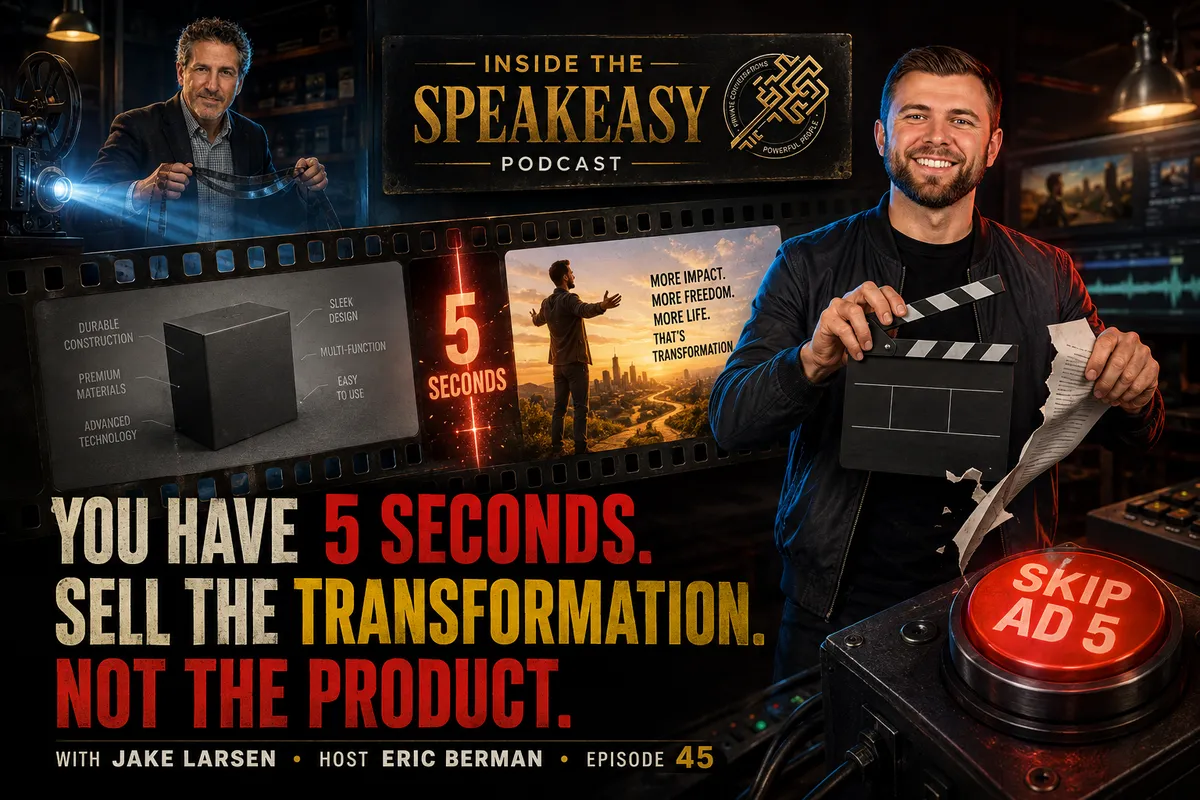
Jake Larsen, founder of the YouTube ad agency Video Power, joins host Eric Berman to explain why YouTube remains what he calls a blue ocean for advertisers, and why the businesses that get the video right often see results that rival or beat Facebook and Instagram. Jake shares how being one of 10 companies Google invited to become YouTube marketing ambassadors led him to leave his job at ZAGG weeks before his first child was born, and how a $20-a-day ad for a free course brought him clients and a stage at the Traffic & Conversion Summit. He breaks down the building blocks of a video ad, why the best ads market the transformation instead of the product, and why his team runs ads of 90 seconds to eight minutes against the advice of Google reps. He also covers what AI can and cannot replace, how to tell when a business is ready to advertise, a three-by-three testing framework for budgeting, and the basic gear needed to start.
In this episode, you'll discover:
- Why Jake believes the best video ads sell the transformation a product creates, not its features, with examples from supplements, agencies, and real estate
- How to write a hook that attracts your ideal customer and repels everyone else in the first five to 10 seconds
- Jake's three-by-three testing grid: three videos against nine audiences at $25 a day per campaign
- Why Jake's team makes video ads of 90 seconds or longer, even when Google reps push for shorter ones
- How the Entrepreneurs' Organization chapter in Utah used 15-minute member interviews to build video ads that Jake says bring in about 25 leads a month
Episode Summary
Jake Larsen opens with a simple test he runs when he speaks at events. He asks how many people in the audience advertise, and he says about 90 percent of hands go up. When he asks who advertises on YouTube, most of those hands go down. Jake calls YouTube a blue ocean and explains the reason for the gap: on Facebook or Instagram, advertisers can lean on headlines, text, and images to fill in for a weak video, but a YouTube ad can be skipped after five seconds, so all of the information has to live inside the video. That higher barrier to entry keeps many advertisers away, yet Jake says that for clients who clear it, YouTube has in many cases outperformed their Facebook and Instagram results.
Jake's own path started with video and creative work at ZAGG, the company behind the InvisibleShield phone protector,. He says his company was one of 10 that Google asked to become YouTube marketing ambassadors before skippable ads launched, and the data the new format revealed convinced him to start his own agency. His wife was eight months pregnant, so she asked for one condition: make sure the family had insurance. Jake lined up two clients on three-month retainers, then started running a YouTube ad for his free course at about $20 a day. That ad caught the attention of Ryan Deiss of DigitalMarketer, who invited him to speak at the Traffic & Conversion Summit around 2013 or 2014, and Jake says he has been riding that wave for the 12 years since. His ZAGG experience also taught him that creative and analytics teams belong in the same room, because creative needs data to know what to make.
On the craft of the ad itself, Jake describes building scripts from interchangeable blocks: the hook, the problem, a credibility section, and the call to action, so his team can test multiple hooks and calls to action. His central point is that weak ads talk about the product or service, while strong ads market the transformation. A supplement company sells brain energy rather than capsules, an agency sells a predictable growth engine rather than media buying, and a realtor sells the keys to the next chapter of someone's life. Jake also pushes back on the idea that ads must be short. His team makes ads of at least 90 seconds and as long as seven or eight minutes, which he describes as a mini VSL, because before people spend their money, they spend their time. A good hook, he says, should attract the right viewer and repel the wrong one, and some of the best hooks simply begin a story.
Eric asks how AI is changing the field. Jake says AI has made scripting, copy, and editing much faster, which has started to commoditize agency creative, but it cannot own a result or an outcome. Across the hundreds of video ads his team creates each month, he says the ones that last are still built around real people, such as founders explaining why they created a product or customers describing the transformation it gave them.
Jake's readiness test for advertising is straightforward: a product or service people love, testimonials, and consistent sales, because ads amplify what is working and what is not. He shares the story of a business coach who, he says, went from a couple of applications a week to hundreds after ads launched, and later hired salespeople to handle the calls. For budgeting, he points to a ROAS calculator he built and describes a three-by-three grid of three videos tested against nine audience segments at $25 a day each, which comes to about $225 a day. Jake says his clients range from about $5,000 a month to half a million a month in spend, that results start appearing within days, and that a true return on ad spend needs about 90 days. He adds an example from the Entrepreneurs' Organization chapter in Utah, where he serves on the board: interviews with five to seven members became about 10 video ads that, according to Jake, generate around 25 interested leads a month.
The conversation closes with connected TV, where Jake notes that YouTube ads appear on phones, tablets, computers, and TV devices, and with what he describes as YouTube's broader effect on organic search and direct traffic. His starting kit is a good camera, good audio, good lighting, and a solid script, plus a Google Ads account, a landing page, and conversion tracking. For people who would rather not do it themselves, Jake explains that Video Power handles creative, media buying, and reporting on a performance basis. His parting advice is that it's hard to read the label when you're inside the bottle, so business owners should get outside feedback from a team member, a mastermind, or an agency.
Big Ideas Discussed
Sell the Transformation, Not the Product
Jake's clearest rule is that a crappy ad talks about the product or service, while a great ad markets the transformation that product or service provides. He says many advertisers miss this and fill their videos with features and process instead of the change the customer actually wants.
His examples make the point concrete. A supplement company is not selling capsules and vitamins but the energy they can provide. An agency is not selling video editing and media buying but a predictable growth engine. A realtor is not selling listings or house tours but the keys to the next chapter of a buyer's life. Jake adds that video is especially suited to this because it can show the transformation rather than just describe it, and that the strongest ads often feature founders sharing why they built a product or customers describing what it changed for them.
Longer Ads Can Win When the Goal Is Customers
Jake says Google reps regularly tell his team that shorter ads will earn higher click-through rates. He agrees that they might, but argues that his clients need customers and clients, not just clicks. Before people spend their dollars, he says, they spend their time, so his team makes video ads of at least 90 seconds and sometimes seven or eight minutes.
Eric recognizes this as skipping the landing-page video entirely and putting the pitch directly in the ad, which Jake confirms works like a mini VSL. The key is earning the first five to 10 seconds, when every viewer's finger is hovering over the skip button. Jake's approach is to speak directly to the category and the viewer's situation, or to open with a story, such as a realtor describing a couple touring a house. He has even opened an ad by telling viewers they were seeing it because YouTube thought they were entrepreneurs.
A Structured Way to Test and Budget
Jake designs ads in building blocks: the hook, the problem, the credibility section, and the call to action, which lets his team mix and match and test several hooks and calls to action. For budgeting, he ties spend to the action items that grow a business, such as a booked call, an opt-in, or a survey form, rather than awareness alone, which he says is guaranteed.
His testing framework for a single offer is a three-by-three grid: three videos run against nine audience segments, starting at $25 a day per campaign, which he puts at about $225 a day. Within about a week, he says, it becomes clear which audience and which video bring the most leads at the lowest cost, though a true return on ad spend needs about 90 days. Smaller budgets still work, Jake explains, but they learn more slowly, which he frames as a choice between paying in money or paying in time.
AI Speeds Up the Work but Cannot Own the Outcome
Jake acknowledges that AI has been a game changer for writing scripts and ad copy and even editing video, and that it has started to commoditize agency creative. His question is what will stay the same 100 years from now, and his answer is that AI cannot own a result or an outcome.
Building a campaign involves many moving parts, from the message and its nuance to the format, the audience, and what gets tracked, and Jake believes that still takes someone with a mind, a heart, and experience of what works. People still want to be entertained, find value, and connect, which is why the ads he sees last longest still feature a human talking to the camera and sharing a real story.
Questions We Answer in This Episode
Why aren't more businesses advertising on YouTube?
Jake Larsen says that when he asks event audiences who advertises, about 90 percent raise their hands, but most drop them when asked about YouTube. He believes the barrier is the video itself: YouTube ads can be skipped after five seconds, so the entire message has to live inside the video rather than in headlines or text. In his experience, clients who get the video right often see YouTube match or beat their Facebook and Instagram results.
What makes a great YouTube video ad?
Jake Larsen says weak ads talk about the product or service, while great ads market the transformation it provides. He builds ads from a hook, a problem, a credibility section, and a call to action, then tests multiple hooks and calls to action. He also says ads with a real person sharing an authentic story tend to perform best.
How long should a YouTube video ad be?
Jake Larsen's team makes video ads of at least 90 seconds and sometimes seven or eight minutes, even though Google reps often recommend shorter ads for higher click-through rates. He argues that people spend their time before they spend their money, so a longer ad works like a mini VSL that covers the transformation and builds trust before the click.
How should you write the hook for a YouTube ad?
Jake Larsen says the first five to 10 seconds matter most because viewers are ready to hit skip. A strong hook attracts the ideal customer and repels everyone else, either by naming the viewer's situation or by starting a story. He notes that ads do not need an infomercial tone and can even acknowledge that they are ads.
How much should you budget to test YouTube ads?
Jake Larsen recommends testing one offer with three videos against nine audience segments at $25 a day per campaign, which he puts at about $225 a day. He says results start showing within days, but a true return on ad spend needs about 90 days. His agency's clients range from about $5,000 to half a million dollars a month in spend.
When is a business ready to run YouTube ads?
Jake Larsen says ads amplify both what is working and what is not. Before advertising, he looks for a product or service people love, client testimonials, and consistent daily, weekly, or monthly sales. Once a business has a working sales funnel and wants more of the same result, he says that is the time to start running ads.
Will AI replace video ad agencies?
Jake Larsen says AI has made scripting, copywriting, and editing much faster and has started to commoditize agency creative. However, he argues AI cannot own a result or an outcome, and running a campaign still requires human judgment about the message, audience, and tracking. He says the ads that last longest still feature real people telling real stories.
Full Episode Transcript
Read the Full Episode Transcript
Cold Open: Market the Transformation
Jake Larsen: If you have a supplement company, you're not selling capsules and vitamins. You're selling the brain energy that that can provide for your brain. What is the transformation that your product or service provides and market the transformation? Some of the best ads are telling stories. YouTube ads not only generate more clicks and traffic from the platform itself, but it also increases the organic search. I'll just leave it with.
Eric Berman: Welcome to Inside the Speakeasy Podcast. The private room where today's sharpest founders, innovators and renegade thinkers come to trade the ideas that move industries. This show is brought to you by HighLevel, the AI driven business operating system trusted by over 2 million businesses to help automate, scale and create real leverage. HighLevel isn't just a tool, it's the engine behind some of the most agile and high performing teams on the planet. If you're ready to streamline everything, amplify your reach, and actually build a business that works for you, you're in the right place. Visit www.gohighlevel.com/Speakeasy-mastermind-promo to get an exclusive 30 day trial. Being a listener of the Inside the Speakeasy podcast, Enjoy the show.
Why So Few Advertisers Are on YouTube
Eric Berman: Welcome to Inside the Speakeasy Podcast and I am so excited to have our guest today. We are going all things video ads in the world of YouTube, a place all of us need to be playing a lot more. The more I talk to Jake, our guest today, the more I'm realizing that I am failing because I am missing such a massive opportunity and I'm excited he's going to share what he's been sharing with me and how we all can understand a little bit more how we can start to play at the next level, take advantage, get ahead. All the way to. From Salt Lake City, welcome to the show. Jake Larsen.
Jake Larsen: What's up? Happy to be here, man. I'm excited.
Eric Berman: Yeah, me too. I mean I love this topic because I feel like we're just so like automatically it's like meta, what are you doing on Facebook, ig? Are you playing? You know, and we all know there's this big whale over here, YouTube, Google, we keep hearing it. We kind of know that like dude, YouTube is the future of TV. It's where we're going. And it's like why aren't more of us playing there like before we get into the wins And I want to get your story, but why do you think most of us don't play there as much as we should.
Jake Larsen: You know, it is crazy. So I'll go speak at events and I'll ask the audience how many people are advertising. And 90% of the hands go up. And then I'll ask, keep your hands up if you're advertising on YouTube. And then most of those hands go down. There's only a couple people left raising their hand. And it is, you know, the concept of a blue ocean, red ocean. It's such a blue ocean on YouTube. And I think the reason why is it's kind of you got to get the video right because, like, if you do Instagram or Facebook, you can test different headlines and you can, like, you can miss the video, but fill the gaps in easily using, like, you know, the text or images. But when it comes to YouTube ads, like, the ads you can skip after five seconds. All that information needs to live inside the video. And so if you don't get that video done properly, then it's not going to make that big of an impact. So I think maybe the. The barrier to entry is probably a little bit more.
Eric Berman: A little more friction, a little bit lack of knowledge, and people just aren't like, oh, I'll just do this. It's easier to just get into right away.
Jake Larsen: But those who are able to get that barrier entry and, like, do have that video, it's in many cases has outperformed a lot of Facebook and Instagram results that we see with clients. So if you get Facebook ads working or Instagram, like, chances are we can get YouTube ads to work. And there's a lot of scale right there.
Eric Berman: All right, so we're going to get into that. We're going to get into how to reduce that barrier to make it less scary before we get into that.
From YouTube Marketing Ambassador to Agency Founder
Eric Berman: And I know, like, and again, just to plant the seed of the audience here, I mean, we're talking. Jake's been like, he, like, grew up with YouTube. This has been. I mean, we all grew up with YouTube, but he's been growing as the player inside the YouTube Aura. He was brought out to YouTube headquarters when they started going as one of the big marketing icons out there. He's worked with Tony Robbins, he's worked with [unclear], he's worked with Fortune Builders, my friends over there back in the day. I remember those guys quite a bit. I mean, some of the biggest names out there you're brought out to work with. So again, I'm so stoked to get in there before you start working with these big names. I mean, shit, you got brought out to YouTube to kind of work with him as an early guy. Give me your story. Like how'd you get into all this?
Jake Larsen: Yeah, so I mean, I think not many people remember YouTube before there was ads on it, but that's how I started doing a lot of video and creative for businesses. And we would upload videos to YouTube and sometimes they'd take off and sometimes they wouldn't. But we are one of 10 companies asked by Google to become YouTube marketing ambassadors before they released the ads you could skip. They showed us this new way of advertising and I'm like, holy cow. We can see how long people watch the video. Do they click, do they opt in, do they purchase? And my mind was blown. Like this is a powerful tool. And so we came back. So they showed us like how it works. And then after a year of playing with it, I'm like, this is so cool. And not many people are doing it. I've always wanted to start my company, but I think I'll do that now. I'm going to quit the job and start my agency. But the challenge I had was my wife was eight months pregnant with our first child. And somebody, I remember bringing up that to my wife, I said, hey, I think it's time for me to quit my job. And she's like, you know, I'm having a baby next month. Right. I said, I was like, hello, I'm aware of that. She's like, you can do it on one condition. Just, just make sure we have insurance. She wanted that kind of financial safety in case something happened. So I made sure we had insurance. I ended up getting like two clients on a three months retainer. So I knew whatever happens, I had at least two clients coming in.
Eric Berman: Yep.
Jake Larsen: But once I did that, things started to go crazy. So I started advertising on YouTube. I created a video, put it on YouTube. I was spending like 20 bucks a day and watching like a hawk. And sure enough, like my views go up, website visitors go up. I was advertising a free YouTube course that people could opt in for. And then people would watch my ads, they'd go to my free course, they would buy a product and I'd get emails like, hey, this is a lot of work. Can you just do this for me or consult with us? So I'm like, sure would be happy to. So like once I started advertising, just like with anything, that's when you start to see these opportunities come in. In fact, one of them was I got an email one day from a guy named Ryan Deiss who was the CEO of DigitalMarketer. And I had no idea who he was. He's like, hey, I saw your ad. I bought your course. Would you like to come speak at the Traffic & Conversion Summit? I think this was back in 2013 or 14, but I'm like, sure, I'd happy to. And once I got on that stage, like, I came home with a bunch of emails of people wanting to work with me. And we've been riding that wave ever since. For the last 12 years, we're creating video ads, advertising on YouTube and just helping people grow their businesses.
Eric Berman: I love it.
Putting Creative and Analytics in the Same Room
Eric Berman: I love it. Kind of circle back. What was the company you actually quit to go start your new one? I mean, what were you doing there?
Jake Larsen: It was a company called ZAGG. They made the InvisibleShield. So, like, what kind of put us on the map is we'd get a phone with and put the InvisibleShield on it and we dropped bowling balls and hit it with hammers. So, like, that was one of the.
Eric Berman: And you're just, you're playing in the marketing world, video creative, and you're just like, wait a second, this is. Got it. So you got noticed as a creative in that company and then you're like, I can think I could do this myself. And then thus your entrepreneurial journey was born along with your child. Sort of the same time.
Jake Larsen: Yeah. And I think that's one of the value adds I think some people miss is like, within that company, we had like the creative team.
Eric Berman: Yeah.
Jake Larsen: And then you've got like the web or analytics team and normally people have them in separate departments. It's a huge miss because creative needs the data to know what to create. And then once the video is created, you need to see how it performs. And if it's not performing, then you got to go back to the creative to readjust. And so I think that's one of the unique things that helped with that company and with many other companies is putting the creative and the analytics team in the same, same room, make sure they're having conversations. Because to properly market, you need to play on both sides of the brain. Right. You need both the creative mind as well as the analytics mind to. To help scale.
Eric Berman: I mean, our actual web designers and creative designers aren't always right with their designs. I mean, I know they know, but I'm just joking as an inside joke from all those that are running and working with a lot of creatives out there. But you're right, it is missed quite a bit. And it's not only the data, but I think it's especially now, these days, the Access to the data, real time. And for us to all put egos aside and said, no matter what we think or what we think the best design is, it's whatever matters is the data willing to continue to test as it sounds like you were great at. Okay, so we fast forward. Here you are, I love what you said. You're drinking your own Kool Aid. I mean, obviously it seems, I, you know, it seems obvious in hindsight that so many of us don't even do that. And you said, well, if I can't run my ad and do what I'm going to be selling people, what the F am I doing in the first place? So you prove that out got noticed and, oh boy, did you. I mean, getting on the stage early then at T&C was obviously huge. I think I probably remember, probably. I was probably sitting in the audience remembering and saying, damn, team, we gotta get in this stuff here.
Building Blocks of a Video Ad and Selling the Transformation
Eric Berman: All right, so now that was then, this is now. A lot of time's gone on since the world of YouTube and video marketing. Let's dig in a little bit now. So more specifically, let's talk about what you're doing. Video ads within YouTube, maybe some tips, things you're seeing out in the industry right now.
Jake Larsen: Yeah, so when I think about ad campaigns, there's kind of several key, like, pieces. It's like, it's, you know, what is the offer or the product that you have, and then creating the message and putting that message in front of the right audience. So within ads, like, there's kind of like, what are we saying? Or showing what does the video look like? And then, you know what, how do we place that in front of very specific types of people? So as far as the video is concerned, and this could apply to any platform, not specific to YouTube. But like, you've got to get the right hook. Like, you got to get the hook. I get people's attention. Like, what can you say or show within 5 seconds, 10 seconds, that's going to get people's attention. And so we like to write scripts and create video with these kind of different building blocks. So there's the hook, there's the problem. The credibility section, the call to action. So what this, this allows us to like, mix and match and we'll test multiple hooks and multiple CTAs. But I'd say, like, the main thing that really makes a great video, I'll tell you what, what makes a crappy ad is when you talk about your product and service. But what makes a great ad is when you market the transformation that your product or service provides. I think people miss that a lot. They just talk about all the features and what the service can do and how it's done. But like, so for example, if you have a supplement company, you're not selling capsules and vitamins, you're selling the brain energy that, that can provide for your brain, right? Or like if you're an agency, we're not selling ads and video editing and media buying. It's a predictable scale and growth engine that we can pour gas on a flame and you know, grow that. Or a realtor, they're not selling property listings or doing a house tour. They're selling keys to the next chapter of that person's life. So think of what is the transformation that your product or service provides and market the transformation and then how quickly.
Longer Video Ads and Hooks That Beat the Skip Button
Eric Berman: Like let's go back to the hook. I mean you said a lot of great things in there. So. And I'm not the expert by any means on this and I know there's different rules. Like what's the whole, like how much time do you have to like really nail somebody? I mean isn't the ad usually like, okay, 5 second AD, 15 second AD, how does that work? Then I need to hook somebody.
Jake Larsen: Well, the length of a video ad is a lot like the mini skirt. It needs to be long enough to cover the important parts, but short enough could keep a little interest. You know, the length of the videos we'll do minimum at least 90 seconds. And then on the longer end we've, we created 7 minute, 8 minute video ads I think and this goes against what Google, the Google reps say. So we've had Google reps and they're always like, your ads need to be shorter. It's going to get a higher click through rate. And I'll tell the reps, hey great, I'm sure it will get a higher click-through rate. But the clients we serve, like they need customers and clients and before somebody buys a product or a service, they need to know what it is they're buying, what's the transformation. And they need to, before people spend their dollars, they spend their time. And so these videos are long enough to cover the transformation, a little bit of the process and build enough trust where people will click.
Eric Berman: So really it could be so okay, so you literally could have. And again, I mean I'm just so ignorant on this world a little bit. So you're saying the video doesn't need to be 15, 30 seconds, that leads to a landing page which then has a longer video. You're saying you just do it all then and there. If you could get somebody hooked out of the gates, obviously they'll just continue watching. And all of a sudden it's like a. It's like a video on a VSL where you're just sort of watching it now, but it happens. You're skipping all the stuff and you're just getting right to video.
Jake Larsen: Yeah, it's like a mini VSL. So. Yeah, that's exactly right.
Eric Berman: Wow. And that's working. Okay, and then how fast. How much do you say, what is the general rule about just getting the attention to get people? Like, where are people dropping off? How many seconds? You're like, okay, I got them now. Once you get past this trigger.
Jake Larsen: So everyone's finger is hovering over the skip now button, right?
Eric Berman: Correct. Yeah.
Jake Larsen: When an ad pops up. And so a great hook will attract your ideal client or customer, and it will also repel somebody who's not. And still I think of, like, what can I say or show in 5, 10 seconds that will attract that person? So if I am a realtor and I, like, I want to speak about, like, the category I'm in and what that person is looking for. So I could say something like, hey, are you looking to buy a house in the next six months? Or like, one of the biggest challenges that people have when it comes to buying a house is blank. And you can even do, like, it doesn't. Some people think that the ad has to be like some infomercial, like, are you sick and tired? Or da, da, da, like, you know, that car salesman type vibe. But.
Eric Berman: Right.
Jake Larsen: Some of the best ads are telling stories. So another one for keeping the same example is like, so I was showing this couple around this house that they were interested in buying, and then blank. So Right. Then the viewer knows this has to do with a house, and this person has a specific experience around that. So.
Eric Berman: Right. Interesting. Yeah. I mean, as you're saying those, I'm like, okay, I might stick around for another second or two just to see where the story goes. Yeah.
Jake Larsen: One I did. In fact, this might have been the one that Ryan Deiss saw, but I. I said something like, hey, you're seeing this video right now because YouTube thinks you're an entrepreneur or that you're a business owner. And so you can have fun with it. You can acknowledge that it is an ad and talk to somebody specific and you can have fun with it.
Eric Berman: Got it.
What AI Can and Can't Replace in Video Advertising
Eric Berman: Now, how was the advancements? I mean, that was a long time ago in T&C land. Old tech, new Tech obviously can't have a conversation while talking about AI tech. What does the world look like now within playing in the YouTube domain? And I guess maybe as I sort of plant that AI seed, I think instincts for a lot of people are going to be like, oh, I'm just going to go to GPT and just give the prompt, hey, can you create me a video that'd be good for YouTube that's going to catch people's attention. I want it to be blah, blah, blah, blah, like talk me through all these things. Now where are we at on the tech and are we crossing over the AI world?
Jake Larsen: Yeah, well, one thing as many things are changing and AI has been a game changer, right? Like you can write scripts really fast or create ad copy. It can even edit the video so you can create more faster, which has been a huge benefit, but started to commoditize. A lot of, you know, agencies are creative. And the question ask myself is with all the changes that AI is bringing, what's one thing that it can't replace? The same a hundred years ago, what's the same today, and what will be true 100 years from now? And at the end of the day, AI can't own a result, it can't own an outcome. Like, it can give you feedback and research. But there are so many moving factors. When it comes in to create an ad, it's like, what are we saying? Who are we talking to? What's the nuance around it? Should we have a conversation, a talking head? All right, we got the ad, now who do we show it to? What are we tracking? Like, there are so many moving parts to it that it does take somebody with a mind and a heart and the experience of knowing what works. And so yeah, what's changed? AIs made it a lot faster. But at the end of the day, people still like being entertained. They're all looking for value, they're looking for a deal, they're looking to connect. So while we create, yeah, some ads use AI and it happens faster. But you know, we've got, we're creating hundreds of video ads every month and the ads that, that last long that bring the biggest impact, it's when you can have an authentic interview or having the founder or the owner of the company share their story about how they create the product. And even more powerful, when we can interview clients or customers about the transformation that they're, that the product provided, people can see themselves in that story. So the video ads that we see work the best. There's still A human talking to the camera, sharing a story and you can feel the difference in it.
Eric Berman: Yep, people want the reel now. I definitely see that.
When a Business Is Ready for YouTube Ads
Eric Berman: So let's talk about the when. Okay, so I'm sitting here listening to this a lot of our listeners and again I think our default is going to be to go to our comfort zone of the Metas of the world and all that. So when is a good time for us to be saying, wait a second, you are missing a big opportunity. So who's the best avatars in your opinion? If I lot that should be really jumping in here into the YouTube land.
Jake Larsen: So ads amplify whatever you have working and it also amplifies what you don't have working. So I think the bare minimum, like what's the minimum cost of when you start advertising? You've got to have a great product or service that people love, that they enjoy, that they've gotten great results. And so I always look for do I have client testimonials or people that have had a great experience? Okay, box one. And then have I sold this consistently? Are we getting consistent sales on a daily, weekly, monthly basis? So like, because we can get. Views are guaranteed, clicks are guaranteed, even leads are guaranteed if you have something that a result like an opt in. But can you wanna. Typically people are looking for that high a booked phone call, a purchase and so being able to amplify the results. So if you have a sales funnel then you want more of those, then that's when you should start somebody ads. So we had a business coach come where she was doing the sales calls herself and she was getting applications. And so we started running ads and all of a sudden she went from getting like a couple applications a week to she's getting hundreds of applications every week.
Eric Berman: Wow.
Jake Larsen: And so she had, she ended up hiring two or three salespeople to follow up with the applicants and have booked calls with them.
Eric Berman: So it's a good testimonial and proof of that. I mean, okay, so other than the. So it sounds like a lot of us, you know, listening, you know, have that and we're just still not doing it. And I think like you said, there's a little bit of friction. Let's talk about. There's friction and knowledge and probably time to do it yourself.
Budgeting With a Three-by-Three Testing Grid
Eric Berman: For those that want to do it themselves, let's talk about costs, you know, whether they do it themselves, find somebody like you or others out there. I mean, what does it take? You know, I know everybody says, well gee, meta, I could just go out there and start with 50 bucks a day or a few hundred dollars and start getting the testing out there because it's easy to do that. So let's assume that we've been able to do enough research on our own to figure out how to create a video. And whether we hire somebody or not, we have a video out there, an ad, I mean, what's our budget? What's realistic for us to say, gosh, I could play this game. I only need X thousands of dollars to really get into this.
Jake Larsen: Yeah, well that's a great question. Like I got that question. So much as people want to know, hey, will this work for me? How much do I need to spend? And this is part of the reason I created a tool called the ROAS calculator. Like the return on ads, you kind of, you basically plug your some dollar figures in and based off your click through rate and conversion rate, you can make projections and see what type of return you would get. So that's a tool that I created. But outside of that, you basically what are the. I like to put the budget around the action items that are going to grow a business. So like yeah, people want awareness and like awareness is guaranteed. Like we need a step more than views and clicks. And so I think what are those two or three action items that you're wanting to amplify before somebody purchases? It might be a book call, it might be an opt in, it might be like a survey form. But I would create. This gets really geeky. So for every one offer, let's say you have a webinar or a training. Then I would take that one offer and I do think of a three by three grid, three videos going against nine different audiences so that there's nine different audience segments there. And then I would start 25 bucks a day on each campaign. So you know, be five times nine, that's like 225.
Eric Berman: I think my quick math, okay, so I don't like. So you could get in for that little. For 225 a day. How many days? Like in my head I'm like, is it like 10 grand to play this game? Is it like, gosh, you can start testing for two, three grand. Like what do we.
Jake Larsen: When I first started, I was only spending like 20, 25 bucks a day. But we have clients, we have clients spending 5k a month and we have clients spending half a million a month. So there's, yeah, there's quite a range. But I think you need to get enough so you can get the right data. And then once you're just learning slower.
Eric Berman: I mean if you pay 5k, I mean the reality is why here's that you could pay 5k, get in the game, you're going to learn a lot slower. But you could at least get some data and then iterate over time.
Jake Larsen: Yep, exactly. You know, do you want to pay in money or pay in time? Like the right. So again, so think about those nine different campaigns, 25 bucks a day. You'll quickly see which audience, which video is bringing the most leads at the lowest cost. So like you can be optimizing around leads and you can make those like let turn those campaigns on for a week and then you can start to optimize. Or if you're optimizing for a client, you're going to want to see how much you're spending to get that booked call for get a client. So I would say got it. At least give it night like give it 90 days for a true return on ad spend to come in to play. But once you turn campaigns on, you'll be seeing results within days.
Eric Berman: Got it. Well, we had a green room session after this, but I'm sitting there thinking for a lot of my clients, I'm like damn, I've been missing the boat. I gotta talk to my boy Jake here and figure out, you know, ranging from Speakeasy ads and getting some more good apps to my golf client and a few others, there's probably a lot of money. I'm, I'm missing out again. It's just I think for me as I listen to this conversation and what others might be thinking, I just go back to the same thing. I think there's just a little bit of a don't know what I don't know. And I think my team and everybody else I'm around more is just more comfortable in the other world. And you know, you tend to outsource some stuff to Google and I don't.
How EO Utah Turned Member Interviews Into Leads
Jake Larsen: Know, there's just to add to that because you might find this interesting. So I'm on the board for the Entrepreneurs' Organization. Yep, EO Utah, and trying to grow the chapter. And so what do we do? I'm like I picked five or seven members and I interviewed them. Hey, what's the biggest challenge you have as a business owner? How did you find about EO Utah? What's been the biggest benefit to you? Like what should people know about it? So I interviewed them for 15 minutes and then we just cut up their answers and we, I intertwined that their story and so we had like 10 different video ads running, we can target people who are in the top 30% of household income, living in Utah and even around. If anyone searches for business, Mastermind, networking, any of those keywords, they get shown a video ad, they click on it, they fill out an interest form, what, like what their revenue does business wise. Name, email, phone number and you know, we're getting 25 leads a month of people interested in that. So.
Eric Berman: All right, well, we'll definitely have to chat. You already get the playbook down for you and we're like one step, you know, just different avatar, slightly different playbook. But obviously a lot of our roots are built in sort of a, you know, the EO structure of meeting locally and all that with the entrepreneurs. So we'll talk offline. But I think that's great. I mean that's a great example. And again, it reminds me of, of so many of us that are missing the boat on not taking steps in this direction, as I'm sure you're seeing.
Connected TV and YouTube's Lift on Organic Search
Eric Berman: What do you see in the future? Like what gets you excited about, I mean you're still pumped many years later having been in this world for 20 years in the world of YouTube, Google, I mean we talked a little bit about AI, but like what gets you pumped? And I mean actually, and maybe I'm sort of. The two part question might be doing others is I'm hearing a lot about connected TV and obviously YouTube being its own channel. Like how does the stuff you do on YouTube, does it play a lot into connected TVs and all that, the world you're playing in?
Jake Larsen: Yeah. So not only do the ads kind of show up, you know, on your phone, but they show up on your iPad, they show up on your desktop computer and they are showing on TV devices at home. So anywhere there's a YouTube app, which is pretty much on all devices, you can show them too. But YouTube created got this crazy stat where it said something like before somebody purchases or works with somebody, they watch videos, they do a search, you know, they look up that person. And so when, like let's say with Speakeasy, somebody types in speak, like if they see an ad, a YouTube ad, and they oh, Speakeasy, then they're gonna maybe pause the ad, they'll go up and open a new tab and they'll type in Speakeasy. And so like YouTube ads not only generate more clicks and traffic from the platform itself, but it also increases the organic search. It increases like direct merch traffic. It's like the rising tide that lifts all boats. So it does Has a huge fingerprint and influence a lot of other traffic sources as well.
The Basic Gear and Setup to Get Started
Eric Berman: Nice. What about the basics? Such as? Like what should we have for home for the basic gear? Just to even feel like, you know again, I know how people want to make excuses for why they don't take steps and take action. Oh, I don't know if my, my lighting's right. I don't know if I have the right gear for YouTube ads. Like what do people need these days? It's just the basics you need, I.
Jake Larsen: Would say a good camera and good audio. The worst is when you have somebody like there's a nice video but the audio is crappy. So if you were going to do it yourself. Yeah, audio, good mic camera, good lighting and then having a solid script or bullet points that you hit again, focus on the first 5, 10 seconds. Make sure you have a good. You can show the transformation. With video, it's show, don't tell. You can talk a lot. But that's the power of videos. You can show what you're wanting to have happen rather than just telling them about it. And then creating a Google Ad account have a landing page you want to send traffic to, set up the conversion code and yeah, plug and play.
Eric Berman: Got it.
Doing It Yourself vs. Hiring a Performance-Based Agency
Eric Berman: Okay. Well I know some of us are like the self starters want to get in the weeds and tinker around and some of us are like, oh, I got a million things on my plate right now. I just don't need one more. I'd love to go out there and find somebody, you know, like a Jake or somebody else. I mean how hard is it like. Or any suggestions for like if they're searching around for people like you in agencies, what do people look for? Is it hard to get started with people and is it expensive? Like how does that work?
Jake Larsen: Yeah, I think that's a good question. Yep. We have a ton of resources on our website, videopower.com and there's a lot of people who want to do it themselves. In which case we do have, I call it the YouTube ads playbook that we have courses and training around that most people are like, I don't want to learn that. I want, I don't want to learn something else. I'd rather just have somebody else do it. In which case like we only want to work with people if we're an investment. So again I have this ROAS calculator tool where I can see if it's even worth partnering on and what type of results we could get with certain levels of ad spend. So we can do that before anyone makes a big commitment. But yeah, we, we handle everything. We do the creative, the media buy, the reporting and we're performance based. So we take a percentage of the growth that we were able to add. So nice.
Eric Berman: I love that ROAS calculator. And we'll get that link in there too. I mean, for me, that's kind of where my head's at. I'm like, okay, I don't know what, I don't know. So maybe I show them my performance, show my numbers, see if I can make some money off of this. And yeah, why not give it a go. I'm definitely actually excited. More so than before, you know, before talking to you. Really to say, talk to my team and others and say we got to get in on this. At least start testing it and playing a little bit more. I mean, appreciate you. I know how slammed you are with all your clients, everything going on. But now that we have the time, is there anything I haven't asked yet in this world that I maybe should have asked or left out?
It's Hard to Read the Label From Inside the Bottle
Jake Larsen: I'll just leave it with. It's hard to read the label when you're inside the bottle, right? So a lot of business partners and entrepreneurs, we've been in our business for so long and sometimes we think we know what needs to be marketed and we communicate or say certain things. But it's not landing inside the market or the audience. And it's so helpful to get somebody who's outside your bottle to give you feedback, whether that's hiring a different team member or joining a mastermind or hiring an agency to help you read that label and maybe create a more powerful label that will work better. And so I would say, like, don't be afraid to reach out and connect with those people who can get results and craft because chances are if you're the business owner, you've got something that's working, you've got a great product or service and you just need more people to see it, in which case, you know, the right ad campaign can, could make a huge difference.
Eric Berman: Love it. Love it. Well, thank you so much for dropping that knowledge in there. If anybody listening, I know a lot of our members you can certainly reach out to. Jake Inside the Community is one of our Salt Lake lives out in Salt Lake and he's there. You can obviously find him in the community and ask him some questions and check out his ROAS calculator and others or anything you have related to this world of YouTube video ads, which I'm excited about. So thank you and have a great rest of your day.
Jake Larsen: Sweet. Thanks for having me, man. Appreciate it.
Eric Berman: And that's a wrap from the Speakeasy podcast. If something sparked for you, don't keep it to yourself. Share it, review it, and pass it to the one person who needs to hear this right now. Want in on the real Mastermind? Tap the link in the show notes to apply until next time. Keep scaling, stay sharp, and don't be the smartest one in the room.

About The Guest
Jake Larsen
Jake Larsen is the founder of Video Power Marketing, a Salt Lake City-based agency that creates video ads and manages YouTube advertising campaigns for businesses. His work in YouTube advertising began when, by his account, his company was one of 10 that Google invited to become YouTube marketing ambassadors before skippable ads launched. Before starting the agency, he worked on video and creative at ZAGG, the company behind the InvisibleShield. After a YouTube ad for his free course caught the attention of Ryan Deiss, Jake spoke at the Traffic & Conversion Summit around 2013 or 2014, and he has spent the 12 years since creating video ads and running YouTube campaigns. His agency handles creative, media buying, and reporting on a performance basis, and he also offers a YouTube Ads Playbook and a ROAS calculator for forecasting results. Jake serves on the board of the Entrepreneurs' Organization chapter in Utah and is a member of the Speakeasy Mastermind community.



