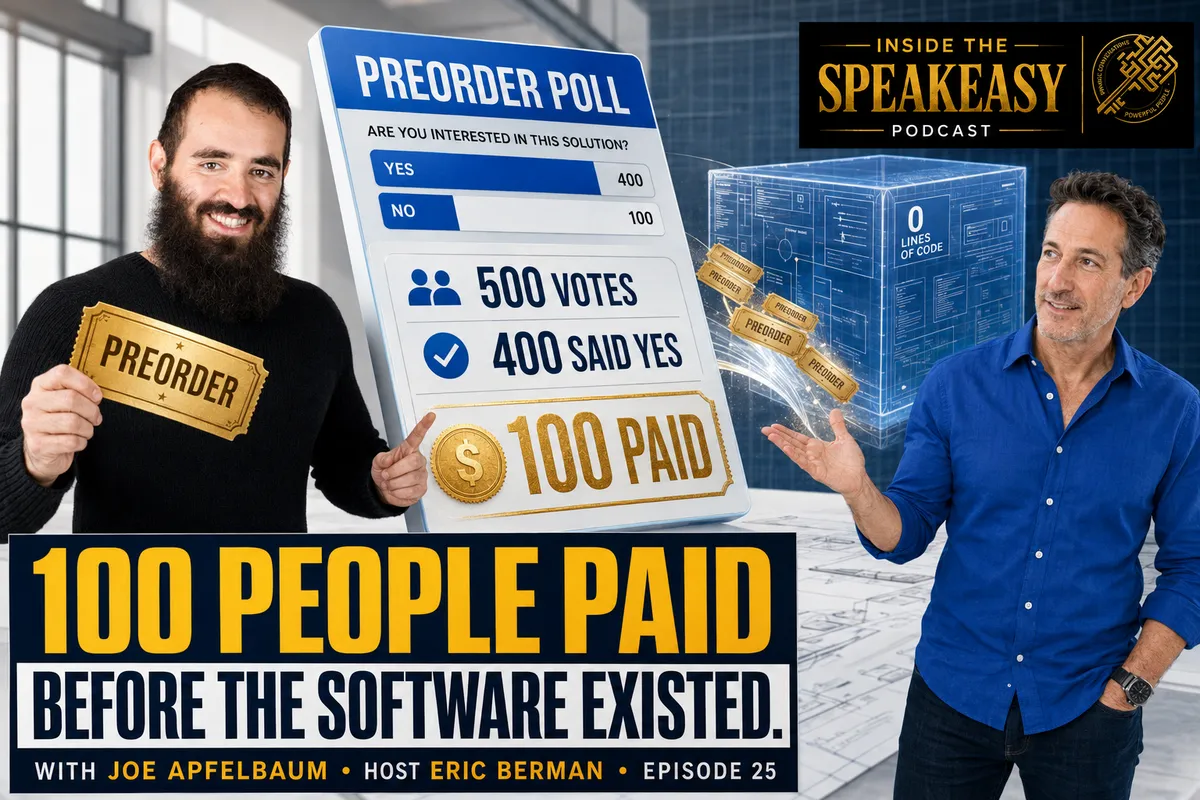
Joe Apfelbaum grew up in a one-bedroom basement apartment in Brooklyn as one of six children, trained to become a rabbi, and then taught himself web design and SEO at the Brooklyn Public Library. In this conversation with host Eric Berman, Joe traces how recurring SEO revenue turned his agency, Ajax Union, into an Inc. 500 company, how a divorce, COVID, and the arrival of ChatGPT forced him to rethink everything, and how a single LinkedIn poll led to evyAI, the SaaS business that reached a thousand paying clients in its first year. He explains why bundling and 10x pricing beat competing on price, how he pre-sold a course to 100 buyers before recording a single video, and shares two of his favorite LinkedIn hacks. Joe also makes the case that, as AI levels the playing field, deep relationships are the only competitive advantage left.
In this episode, you'll discover:
- How Joe used a LinkedIn poll to validate evyAI, then sent a Stripe checkout page to 400 interested people and got 100 paid customers in one week
- Why rolling the software into a bundle and 10xing the price, instead of matching ChatGPT's price, funded the company's growth
- How Joe pre-sold his 99 LinkedIn hacks course to 100 buyers at $99 and then used HeyGen to deliver it
- Hack number 44: searching LinkedIn and Google for Calendly links to book networking meetings with connections and second-degree contacts
- Why Joe believes relationships, not information, degrees, or money, will be the only competitive advantage once everyone has an AI agent
Episode Summary
Joe Apfelbaum grew up Orthodox Jewish in Brooklyn, one of six children living in a one-bedroom basement apartment. His father, who held a minimum wage job, wanted him to become a rabbi. His mother, fed up with the family's situation and without any formal education, borrowed money to buy sweaters and opened a clothing store on the Lower East Side of Manhattan. She grew to three stores and brought Joe, the oldest boy, with her on buying trips to France and Greece. Joe watched how hard she worked, but her business never passed a million dollars in revenue, and she put that down to bad luck. Joe knew there was a missing ingredient, he just did not know what it was.
After several years in Israel, Joe became a rabbi, then came home crying to his mother because he did not know how he would make money. She drove him to the Brooklyn Public Library and told him that formal education would make him a living, but self-education would make him a fortune. He learned computers, web design, and SEO, and by his early 20s he was building about a hundred websites a year. Because nobody visited those websites, he became proficient at SEO, which gave him results for clients and recurring revenue. With 1,100 clients paying $10,000 to $20,000 a year, his agency, Ajax Union, reached number 178 on the Inc. 500 within three years.
Despite that success, Joe carried a voice in his head telling him he was an idiot, which he traces to a third-grade teacher. Looking back, he decided his mother had lacked strategy, and he says he would have told her to hire a coach, join an accelerator program, and set revenue goals. Through Landmark, he called his father to address the tension he felt about not being a practicing rabbi, and his father told him he could not be more proud, because Joe was doing God's work by helping people every day.
Joe then went through a divorce during COVID and lost 75% of his recurring revenue within two weeks as clients in hospitality and other industries cut all marketing spend. He credits his LinkedIn skills with helping him keep more than seven figures in revenue without firing a single employee. The agency won clients back, but when ChatGPT arrived, clients began replacing $10,000 to $15,000 a month in agency fees with offshore staff using AI. Joe's answer was to become the AI. Many of the clients who left started hiring him to do their AI, and marketing agencies hired him to train their staff.
In January 2023, while chatting with ChatGPT on a beach in Mexico, Joe was told it was time to build software. He posted a LinkedIn poll offering an AI tool that would write posts, comments, and messages in the user's voice at 50% off for the first hundred people who paid in advance. About 500 people voted, 400 said they were interested, and 100 paid within a week of receiving a Stripe link. After a failed development partnership, he found a developer who delivered a working version, and he says he burned the boats, putting his savings and reputation behind it. Revenue stalled at around $20,000 a month until he rolled the product into a bundle and raised prices 10x, giving away his $10,000 course and a community alongside the software. Within the first year, evyAI had a thousand paying clients in 37 countries.
Joe repeated the poll approach for a course, pre-selling his 99 LinkedIn hacks to 100 buyers at $99 and then, on Claude's suggestion, using HeyGen to produce it. He shares hack number 44, searching for Calendly links on LinkedIn and Google to book networking meetings, and explains how a redirect from JoeLinkedIn.com sends people straight to his profile. Looking ahead, Joe argues that AI will level the playing field, gatekeepers will return as everyone gets an agent, and deep relationships will matter most. He describes how a referral brought him to Speakeasy, how he met high-caliber, tech-savvy entrepreneurs at the Austin event, and says he earned a 10x return in revenue from that first event.
Big Ideas Discussed
Validate With a Poll Before You Build
Joe had wanted to build software for a decade, but fear of launching and of getting sued kept stopping him. When he finally decided to move, he did not start by building. He posted a LinkedIn poll describing an AI tool that would write posts, comments, and messages in the user's voice, offered 50% off to the first hundred people who paid in advance, and asked people to reply if they were interested. About 500 people voted and 400 said yes. He sent a Stripe checkout page to those 400 people, and within one week 100 had paid.
When someone on a webinar asked whether the approach would work for a course, Joe tested it live. He posted a poll offering his 99 LinkedIn hacks to just a hundred people for $99, even though the course did not exist yet. Of the 171 people who voted, 151 said they were willing to pay, and 100 paid after receiving the Stripe link. Eric highlights the lesson: instead of wondering whether an idea is just personal bias, put it in front of your network and ask for money.
Raise the Price and Stack the Value
In evyAI's early months, Joe priced the product at a couple of dollars a month because he assumed people would only pay the price of ChatGPT. Revenue sat at around $20,000 a month and he did not know what to do. The biggest win, he says, was rolling the software into a bundle and 10xing the price. He still offers a $29 version, but the bundle is $197 a month, or $2,400 a year, so every client who signs up helps fund growth.
To justify that price, Joe delivers 10x the value. The bundle includes his $10,000 course and a community, plus unlimited posts, comments, messages, and AI research, agents that research connections, an AI strategy assistant, and live humans on Zoom. He credits Alex Hormozi's book $100M Offers, which he studied deeply, for the idea of making an offer so good that people would feel stupid saying no. His rule of thumb is that the offer should show far more value than the price, so a client paying $1,000 sees $100,000 worth of value.
Use LinkedIn to Network, Not to Pitch
Joe's hack number 44 starts with a simple search: type Calendly into LinkedIn, filter to first-degree connections, and book meetings with everyone who has a booking link on their profile. Level two applies the same idea to second-degree connections, with a note explaining that you sent a connection request, saw their booking link, and want to learn about their services and see who you can refer to them. Level three uses a Google site search for LinkedIn profiles that contain Calendly links and a target market keyword.
The point of those meetings is not to sell. Joe stresses that LinkedIn is a networking platform, so the goal is to educate people on what you do, find out whether they can make a referral, and ask for introductions through mutual connections. He says 80% of introductions turn into meetings. Eric adds that you should also look for ways to help the other person. Joe's second hack makes it easier to connect in person: a domain such as JoeLinkedIn.com, redirected for free through GoDaddy, sends people straight to his profile.
Relationships Are the Last Competitive Advantage
Asked about the future, Joe says the competitive advantage is no longer what you know, because all information is available, or how fancy your degree is, or even how much money you have. AI, he argues, is going to level the playing field. What remains is relationships. Right now the gatekeepers are gone and anyone can reach anyone on LinkedIn, but Joe expects that to change as everyone gets an AI agent that answers their calls.
His advice is to build deep, meaningful relationships now, while people are still accessible, by meeting in person and getting to know real people. If someone knows him well, Joe says, they will show up to his events and his community, and he would fly to San Diego to have lunch with Eric because they connected. He applies the same thinking to communities like Speakeasy and suggests every entrepreneur take the StrengthsFinder 2.0 assessment and share their strengths so members can lean on each other.
Questions We Answer in This Episode
Who is Joe Apfelbaum?
Joe Apfelbaum is the CEO of evyAI, an AI tool for LinkedIn, and the founder of the marketing agency Ajax Union. He grew up in Brooklyn, trained as a rabbi, and taught himself web design and SEO. His agency reached number 178 on the Inc. 500, and he now trains business owners and agencies on LinkedIn and AI.
How did Joe Apfelbaum validate evyAI before building it?
Joe Apfelbaum posted a LinkedIn poll describing an AI tool that would write posts, comments, and messages in the user's voice, offering 50% off to the first hundred people who paid in advance. About 500 people voted and 400 said they were interested. He sent them a Stripe checkout page, and 100 people paid within one week.
Why did Joe Apfelbaum raise his SaaS prices 10x?
Joe Apfelbaum says evyAI was stuck at around $20,000 a month when he priced it to compete with ChatGPT. Rolling the software into a bundle at $197 a month, with his $10,000 course and a community included, let every new client fund growth. He says he matched the higher price by delivering 10x the value.
What is Joe Apfelbaum's Calendly hack for LinkedIn?
Joe Apfelbaum's hack number 44 is to search LinkedIn for the word Calendly, filter to first-degree connections, and book meetings with anyone who has a booking link on their profile. He extends it to second-degree connections and to a Google site search of LinkedIn profiles. The goal is networking and referrals, not selling.
How does Joe Apfelbaum make it easy for people to find his LinkedIn profile?
Joe Apfelbaum bought the domain JoeLinkedIn.com and set up a free redirect through GoDaddy that sends visitors straight to his LinkedIn profile. When he meets someone in person or speaks on stage, he simply tells them to go to that address. He also uses subdomains that point to his posts and recommendations.
How did AI change Joe Apfelbaum's agency business?
Joe Apfelbaum says that after ChatGPT came out, clients began asking why they were paying his agency $10,000 to $15,000 a month when offshore staff using AI could produce similar output. Rather than fight it, Joe decided to become the AI. Many former clients started hiring him to do their AI, marketing agencies hired him to train their staff, and he went on to build evyAI.
Why does Joe Apfelbaum say relationships matter more in the age of AI?
Joe Apfelbaum believes AI will level the playing field, so knowledge, degrees, and money will stop being competitive advantages. He expects gatekeepers to return as everyone gets an AI agent that answers their calls. His advice is to build deep, meaningful relationships now by meeting people in person and joining communities like the Speakeasy Mastermind.
Full Episode Transcript
Read the Full Episode Transcript
Meet Joe Apfelbaum, From Rabbi to SaaS Founder
Eric Berman: No fluff, no filters, just the raw strategies, personal stories and mental models that move the needle. I'm Eric Berman. Now let's get into it. In this episode of Inside the Speakeasy Podcast, I am so pumped to bring on my good friend Joe Apfelbaum, who is going to. Absolutely. It just overwhelmed me with this incredible journey from rabbi and living in the basement with six siblings, starving in the cities of New York to now having so much abundance. He's out there dropping so many amazing nuggets that you're going to learn, especially when it comes to AI LinkedIn strategy and how he's been able to crush a SaaS business. Going from agency owner to crushing SaaS. Welcome, Joe.
Joe Apfelbaum: Thank you for having me on the show. I'm really excited about being here and I love our relationship and the way that it flourished so quickly.
Eric Berman: And it's like, you know, now, I mean, especially thanks to you, my eyes have been like wide open when it comes to the world of LinkedIn. We're going to talk about a lot about LinkedIn today. I know you haven't started in the. Well, maybe you did. We're going to learn a lot more about where your world started because you're one of the smartest guys I know and just a fire hose of info. And when it comes to leveling up our God, it's not even LinkedIn gaming. LinkedIn's part of it, but I think just you have such the ability to have, understand the psychology of just communication and how to be efficient and smooth and just like, like every time I talk to you, there's like, well, we could do it a better way, a faster way. So it's like, like you're the efficiency God. I love it.
Joe Apfelbaum: And I like that you like systems and processes. As a fellow agency owner, I totally get that.
Eric Berman: Yeah, a suffering agency owner. Let's get into that before we talk about all this. And I know you're going to drop some really killer LinkedIn nuggets. Every time I talk to you, there's always something new and cool. Before we get into that, though, I want to hear about the journey of Joe and how we got here. I know it wasn't probably like the rest of us entrepreneurs. It's, it's typically the rocky road. Let's go back a little bit. What's the early Joe life?
Growing Up Orthodox in a Brooklyn Basement Apartment
Joe Apfelbaum: So I grew up in Brooklyn, New York. I was raised and grazed in Crooklyn, as they say. So I got thick skin being from that area of the world and growing up, my father wanted me to be a rabbi. So we grew up Orthodox Jewish, and, you know, like, this is what his goal was. And I was like, okay, well, if that's what you want, I guess that's what I'm going to do. But I always saw tension between my parents because my mother wanted him to make money so that we can move out of the basement apartment. I had six siblings, so I'm one of six. And we're living in a basement with one bedroom. My parents are in one bedroom. We're living in the other bedroom. And it's very tight. And my father has a minimum wage job and my mother's not working and she's fed up. She's totally fed up. And she's like, I'm done with this. This is such bs. I need something. I need to make money. So she decided to take the entrepreneurial route because she doesn't have any formal education, and she decided to open up a clothing store in the Lower East Side. So the Lower East Side of Manhattan is where all the immigrants were able to open up stores. They were able to just give them a place to go work. And she found a shop across the street from my uncle's shop, and she decided to open up a shop. And she borrowed money to get some sweaters to sell in her store. Wow. And so she started selling sweaters and she started making some money. She started pedaling sweaters and people were buying it. And she was started researching and learning about clothing and couture, and she eventually went from one store to three stores in the Lower East Side. She started selling clothing from France. And I remember every time that she would go somewhere, she would bring me with her along because she needed a bodyguard and she couldn't take my father. So she took me and I would go with her everywhere. I went to France, I went to buy fur coats in Kastoria in Greece, and she took me all over the world with her. And I would always watch how hard she worked, and it was very inspiring for me.
Eric Berman: How did you get to travel over your siblings?
Joe Apfelbaum: Well, I was the oldest boy, and I was very savvy at pushing all the different buttons. So every time she needed me to help her with anything, I would be able to figure it out very quickly.
Eric Berman: So she kind of natural skills started young. Okay, you look back on that.
Joe Apfelbaum: Yeah, I'm like reverse engineering cash registers back in the day, you know what I mean? Like anything you need, I'm there for you to kind of solve problems. I didn't have a computer, we could not afford a computer. But I was really good at figuring out some video games. So my mother would give me quarters and I would go to the store and play video games for hours. And the like, you know, the Chinese pickle place over there. And they had some video games and I would figure them out and I would, for hours I would play it and I would have such a great time doing that. And from a very young age I love figuring out mazes and puzzles and all types of stuff. But I saw my mother crying often and she would cry because she wasn't successful. As much as she worked hard, she wasn't quite making it. Her business never hit over a million dollars in revenue. Forget about profit, even in revenue, she never did over a million dollars in revenue. And I would always ask myself why? And I would ask my mother why? Like, what is it? And she always said that she didn't have good luck. Like whatever she did, she didn't have a good luck in business. And you know, for whatever reason, I knew that there was a missing ingredient there. I just didn't know what it was. But for me, I was committed to finding a path to financial freedom. And when I turned 17, you know, I was on the route to becoming a rabbi. Eventually I went to Israel for several years and I became a rabbi. But I came back and I started crying to my mother. And my mother's like, why are you crying? I said, because dad wants me to be a rabbi, became a rabbi. But I don't know how to make money. I don't know how I'm going to feed. Like I want to have a family, I want to have kids and I don't want my kids to suffer and I don't want to suffer and I want to have money. So she got me into a station wagon. We had a used old ass station wagon. I don't know if you know what they look like, but there's basically fits all the kids, brown panels on the side and everything. And she drives me to the Brooklyn Public Library. And for a religious Jew, that's not somewhere you go. You don't go to the place that has all the non Jewish books. And she's like, go in there and learn. Learn how to make money. She's like, go in there. Dad has all the knowledge of the world. Go in there and learn how to make money. She said, formal education, going to college will make you a living. But self-education will make you a fortune. So I went in there and I learned computers, I learned web design, I learned SEO, I learned how to do things. And I started realizing that people will be willing to pay me thousands of dollars to build them a website. And so I was building a hundred websites a year for people, generating a significant amount, a nice six figure income for myself.
Eric Berman: And how old are you? You're like, what?
Joe Apfelbaum: I'm in my early 20s and this is what I enjoy doing. So I told my dad, I hope you're not upset at me. And I always thought my dad was upset at me. He looked at me as like, you're not learning Torah. Like, what are you doing? Like, why are you wasting your time trying to make money?
Eric Berman: The Jewish guilt is.
Joe Apfelbaum: Yeah, like, he didn't say that to me, but I. Exactly. He didn't say that to me. But that's kind of like the story I had running in my head, you know?
Eric Berman: Yep.
Joe Apfelbaum: I had a story running in my head that I need to be learning Torah and I'm wasting time trying to make money.
Eric Berman: Right.
Joe Apfelbaum: But at the same time, I'm giving charity, I'm making a difference for people. I'm getting married, I'm having kids, I'm doing all the right things.
SEO, Recurring Revenue, and the Inc. 500
Joe Apfelbaum: And what ended up happening was that I quickly built one of the fastest growing companies in America. You know, the famous saying is if you build it, they will come.
Eric Berman: Yep.
Joe Apfelbaum: I built many websites, but nobody came to those websites. So I had to become very proficient at search engine optimization.
Eric Berman: Okay.
Joe Apfelbaum: Being good at SEO provided me with two things. Number one, results for my clients, which became viral, and number two, reoccurring revenue. When I built a website, I would have to start by project with SEO. Clients would pay me somewhere in the range of 10 to 20 thousand dollars a year. And when you have 1100 clients, you're making millions and millions and millions of dollars in revenue. And that's kind of what happened. We were number 178 on the Inc. 500. Now it's called the Inc. 5000, but then it was called the Inc. 500. So we were one of the fastest growing companies in America. I personally didn't think it was a big deal because I had a little voice in my head telling me that I'm an idiot. No matter how much success I had, I always thought I'm an idiot and I'm just not good enough. And that's kind of like the little reoccurring voice I had in my head.
Eric Berman: The idiot was because you felt like you Weren't doing the stuff that dad wanted you to do or what part.
Joe Apfelbaum: Was the idiot combination of I'm not doing all the right things because I'm not a rabbi. I'm not practicing as a rabbi. I'm a rabbi, but I'm not practicing as a rabbi. Number two, I should have more money. I should be doing things faster. You know, it only took me three years to get on the Inc. 500. I should have done it in one year, even though it's required to do it in three years. But a lot of it, like, after doing a lot of personal development and doing plant medicine and going back and looking back from where I am now, they say looking back now, I can see everything clearly. When I was in third grade, one of my teachers, when I got up to speak, he called me an idiot and told me to sit down because the whole class was laughing. I just got up to speak, to read, and I read in a very poor way. And he called me an idiot and told me to sit down. Now, that's what I heard. It doesn't mean that's what he said. That got ingrained in me, saying, you're an idiot, you're an idiot, you're an idiot. And that's kind of like the voice that I kind of kept for my whole life.
Eric Berman: Wow.
Joe Apfelbaum: But I became. I. I've been on a mission to do two things. Number one, make people laugh. Number two, the second thing I was on a mission to do was strategy. So two things. Become really good at strategy and really good at making people laugh. And so I learned how to, like, be very strategic. So I look back at, my mother lacks strategy. That's why she wasn't successful as a reason I was able to get six figures in my businesses when I was doing all different types of businesses, including web design and graphic design and sukkah building and all types of stuff that I did. I was very successful at that because I was very strategic. But in my business, once I realized this concept of reoccurring revenue, then I kind of took off and it went crazy. And then I did it both in Ajax Union, which is my marketing agency. I did it again with Evergreen, which is my business training company where we train people on how to use LinkedIn and how to use AI. And then I did it again with evyAI. In the first year, we had over a thousand clients, a thousand paying clients in 37 countries around the world. We did that in a year. And we're just at the beginning of our business. We have 23,000 users and we're just at the beginning stages of our business. We're just getting started. There's a book called Predictable Success. I don't know if you ever heard of the book or read the book. There's different stages that a business goes through. We're at the fun stage. We're right just at the beginning. We got our first clients and we're now just starting to roll. So we're so excited about the way now that, you know, with my agency getting a thousand clients and servicing a thousand clients is a very difficult thing. We had 75 full time employees in three locations. Now all of our employees are virtual, they're all global. All of our clients are from 40 different countries around the world. So it's all global. And in terms of like being able to handle clients, we can handle a million clients.
The Missing Ingredient in His Mother's Business: Strategy
Eric Berman: So let's back up a second because you said some very interesting things. So a, it's great. You close the loop on what mom was missing. Strategy. And can we talk a little bit about, you know, I mean, what are the big strategies you're funding now that's been working for you? Yeah, I mean you said early on you're sort of learning business and realizing that, gee, I could put SEO recurring revenue versus just getting one and done. That was a strategic decision to say I gotta like, not just do what I'm doing, stay in the lane. I gotta add SEO and other things where I'm sure that if you went back to your mom, you probably would have said you gotta change the strategy and say, hey, like, well actually let's start there. What would you have told mom back in the day, knowing what you know now on what strategy she should take? And. And what are you doing? What have you done recently to help strategically evolve and scale like what you're doing now?
Joe Apfelbaum: I'm on a mission right now to help people be more strategic in their business. And I teach clients strategy, I teach them LinkedIn strategy, I teach them AI strategy, I teach them how to create a business plan, a marketing plan and a LinkedIn plan and then how to implement it in a strategic way. So that's something that I'm teaching clients right now. I'm actually not even charging for it. I'm giving it all away for free because I'm so excited about watching people go from 0 to 100k in profit or go from 100k in profit to $1,000,000 in profit just from the strategies that I teach them to be able to implement in their business. So if I had to Go back and tell my mother something. I would look at my mother and tell her to hire a coach to work with. In order for her to be more strategic, I would have her join the EO Accelerator program in New York City and. And have her surround herself with other entrepreneurs that are building their business from 250,000 to a million. And then be able to help her be able to figure out, number one is what is her business plan? How much revenue is do you want to generate? Because she never had revenue goals. She's like, whatever, God will send me, that's enough. But really, she never thought of, like, the idea of, like, okay, how many pieces do I need to sell in order for me to get to X place? In order for me to hit 10 million in revenue? Like, is this the best location for me to be? What is the demographic? Who are the people who are my ideal clients? Was referring business to me.
Eric Berman: She just started running and that never took a step back to stop and look out, look at the business from the outside and say, okay, zero.
Joe Apfelbaum: And also, like, women in the religious world didn't have any support because they're like, what are you doing running a business? You should be at home with the kids.
Eric Berman: Yeah.
Joe Apfelbaum: And you should be at home with the kids.
Eric Berman: I mean, imagine what you're going through in your own mind. The guilt. I mean, I'm under. What was going on through her mind. Of all the things that she was sort of doing, that was not the norm.
Reconciling With His Father Through Landmark
Eric Berman: Oh, man.
Joe Apfelbaum: I don't know if you ever heard of Landmark Education, but I did go to Landmark several times. And one of the times that I went to Landmark, they said, you got to, like, reconcile with the people in your life, especially your parents. That's one of the things that they tell you. And so I decided I'm going to make the phone call to my father. This was like the third time I went to Landmark. I didn't realize that maybe I have something with my father. I called up my father and I said, [unclear], you know I love you very much, and I know you love me very much, but there's something I never really told you. You always wanted me to be a rabbi. And I feel like there's a lack of integrity in our relationship because I'm not a rabbi and I'm not as religious as you want me to be and as religious as you are, because he's doing rabbinical stuff. He's doing kosher certification, and he's involved with learning every day and all. And I'm not doing any of that stuff. And so he looked at me and he said, I cannot be more proud of you. I'm like feeling emotional. And I was like, why? He's like, because you're doing God's work. You're helping people every day. And he's like, you know how many times people walk over to me and tell me you're Joe's father? Oh, my God, Joe changed my life. He's like, you tell me that over and over. I'm getting people coming over to him saying how I changed their life. He's like, whatever you're doing is much closer to God than whatever I'm doing. So keep doing what you're doing.
Eric Berman: Cheer up over here. That's amazing.
Joe Apfelbaum: I was like, wow. And in my head I had this story running that he's upset at me. Meanwhile, I'm doing God's work in his eyes.
Eric Berman: Wow. Wow. I mean, what a moment for you that must have been.
Joe Apfelbaum: Incredible. Incredible connection, incredible love. I've never seen him like that. I've never imagined that he would say that to me. And that makes me want to be there for my kids in that way as well.
Divorce, COVID, and the Decision to Build SaaS
Joe Apfelbaum: Because I have five beautiful children, I'm a single dad. And, you know, going through a divorce process was literally the most difficult thing that I've ever had to go through. And you know, going through the divorce process during COVID where I lost 75% of my reoccurring revenue within two weeks, and then getting Covid and then dealing with all the BS that I had to deal with during that time, that was one of the most difficult times of my life. Wow. But it was because of my skills of knowing how to use LinkedIn that I maintained a 7 figure revenue in my business. Even though losing almost all my clients, I was able to maintain over seven figures in revenue, not have to fire even in one employee, and just continue to be able to service clients and make a difference for people. And then, of course, really rethink what I want to do. You know, when you get to a revenue level that you're really questioning yourself, you start. You're almost like a seed again. And you start deciding, okay, what type of plant do I want to create if I was going to start over?
Eric Berman: Right?
Joe Apfelbaum: And the decision was, I'm not going to rebuild this agency to a thousand clients. Instead, let me do a SaaS solution and get tens of thousands of clients in the door. And I didn't know the first thing about SaaS. So my dream a decade ago was to build a SaaS. And I've built many, but I've never launched them because I was afraid. I literally was afraid to launch them. I was like, what if I get sued?
Eric Berman: Yeah, I'm actually that fear too. I mean, I talk to my partner all the time. Like, it just seems so overwhelming with the support.
Joe Apfelbaum: And it's a very high. It's a very high barrier of entry to do SaaS and a very difficult thing. And if you do the software right and you don't do the marketing right, you failed. If you do the marketing right and you don't do the software right, you failed. If you. If you do the software right and the marketing right, then you don't do the support right, you failed. If you did the marketing right, the support right, and the software right. But you don't have adoption. You fail all of it. You failed. And reoccurring revenue comes with a very high churn if you don't figure out how to add community. Oh, so now I have to be a community builder on top of a software builder, on top of a marketing builder, on top of a support and adoption builder. I have to do all that? Yes, you have to do all that. And you have to do it excellently and flawlessly. Otherwise you will fail.
Eric Berman: Wow. I mean, I wouldn't go down that rabbit hole. So, I mean, let's go back to code for a second. I mean, first of all, sorry to hear about the family stuff. I can't imagine how tough that must have been, you know, being a father of two new little ones myself. I can only imagine. But, you know, got through.
How COVID Hit the Agency and Why Agency Margins Are Thin
Eric Berman: Tell me on the business side, 75, I mean, you could talk either side, of course, but 75% of the business. How did you lose all that? What was the biggest reason for that?
Joe Apfelbaum: I mean, we had clients that were doing $40 million in revenue, and within one week of COVID they were doing $0 in revenue because the government said they're not allowed to do anything. Everything was closed. And so [unclear] was dependent on the hospitality. I mean, we had a helicopter company that was spending $20,000 a month with us besides ads, just $20,000 a month. Imagine you're reoccurring revenue somewhere in the range of 300k and your clients are spending 25, 30k, whatever. And all of a sudden they have to cut all spend because what were they going to do? Bleeding. They have no idea the world's ending. So the first thing they do is cut marketing. And they're like, listen, we love you guys. You're one of the Best agencies we've ever dealt with. But we can't spend a penny right now. That means we're done. Right now we're done. We're toast. So we had to diversify what we're doing. Law firms toast so many people, just their revenue standstill, zero, nothing. So we had to really figure out what we wanted to do. Thankfully, we had some clients on multi year agreements that were publicly traded that were willing to weather the storm and stay with us. So that was very good for us. But we made a strategic pivot to change our client base from the small business owner where it was like you know, 10, 15,000 a year to a hundred, 200, 300,000 a year. And that put us at risk of almost going out of business because those deals take a long time to close.
Eric Berman: Yep.
Joe Apfelbaum: But when they close, it's you know, 45,000 a month in just agency fees. That's like unbelievable, right? But you know, it's hard to come by. They're hard to close. But once you close it, it changes everything for your game. So those are the deals that we were doing and those are the types of clients we were servicing. But it was a very difficult thing. We needed a lot of employees for each client to service them and for.
Eric Berman: Those, you know, listening, I mean, doing some agency tips. I mean sometimes you think it's glorious getting 45k a month clients. But I'll tell you what, when they leave, you got a mega problem because you're sitting on costs and overhead and all of a sudden if you don't have somebody backing that up with a new client, it's a pain in the ass. Having to go up and down to the firings and you know, ups, you.
Joe Apfelbaum: Know, people think, oh, it's so much profit. It's so much profit. It's so much profit. I've never seen an agency that did more than really that really real profit at 10% in profit. So think about it. You're paying somebody 10k a month and they're making after again if they might be undercutting their own CEO and paying their own staff. So sweat equity. But if someone's getting a couple hundred thousand dollars salary after that, what type of profit do you have? Agencies don't have a ton of profit. They're not highly, highly profitable. If you're getting 10% or 20%, you're doing something, you're very lucky.
Eric Berman: As I say, unless you get to the 10 now probably 12 to 15 million revenue mark where you're a target to get, you know, acquired and rolled up and all that. It's just like you're stuck, you're stuck.
Joe Apfelbaum: And you get yourself a good job, but you're stuck and you're making good money. You're making hundreds of thousands of dollars a year salary. But is that what you want to be doing? If you want to get to the next level, you got to go from being a business owner to being an investor. And that's kind of like the stage that I kind of had to learn to go from. And by the way, when I went from freelancer to business owner, when I went from freelancer to business owner, where I was doing websites for people, to actually owning a business, I had to do deep focus. I had to do some deep focus. I had to get rid of. I had seven full time businesses and a full time job. I was a CMO of a luxury watch business and I was managing 200 people plus I had a little bunch of little side hustles doing and I was doing great financially. You know, don't get me wrong, I had a six figure, multiple six figure job plus I was doing multiple six figures between all my little businesses. But it didn't all equal to a million dollars, you know what I mean? With the agency, with the focus of the agency, I was able to do millions and millions and millions of dollars a year in annual reoccurring revenue. That was a very powerful thing and very profitable for me and very successful and it was great. But you know, Covid really blew us out.
Losing Agency Clients to ChatGPT and Becoming the AI
Joe Apfelbaum: And then the AI revolution was another hit. You know, we lost a lot of clients to the AI revolution that we won back after Covid. And all of a sudden ChatGPT comes out and clients are like, what are we doing here? Why are we paying you $10,000 a month when we could just hire an intern and have them use AI like literally like overnight.
Eric Berman: Let's get into that now because I want to talk about that. And really revolution to where you're at because it's fascinating. So you're running an agency, you get past Covid, you turn it back around, things are great hitting and your clients, what's the biggest thing they're starting to do that. What was the service that you were offering that they're now saying, I ain't paying this anymore, I got my intern doing this.
Joe Apfelbaum: Or the means, strategy, copywriting, research, like all that type of stuff that we were doing, blogging, social media, like all that stuff. They're like, listen, we're going to go to the Philippines, pay somebody $5 an hour, $6 an hour. And then just get them to use AI and maybe we'll pay a strategist 50 to $100 an hour to kind of oversee them for a couple of hours a month.
Eric Berman: Yep.
Joe Apfelbaum: And then why would we pay you $15,000 a month? What are we doing here?
Eric Berman: Yep.
Joe Apfelbaum: And so they cut their costs down to, let's say, 5k a month or 3k a month, and they still getting the same output, if not more output. So I'm like, I mean, I'm not going to argue with that. I'm going to be like, go do it. I mean, if that's what you want to do, then do it. You're going to need to, like, be more involved. But they're like, I'm willing to be more involved if I can cut, you know, 10, $12,000 a month or whatever it is.
Eric Berman: You're seeing the writing on the wall and you're seeing AI, and I'm seeing.
Joe Apfelbaum: The writing on the wall, and I'm thinking to myself, what am I going to do? What am I going to do? And the answer is, I become the AI.
Eric Berman: Yeah.
Joe Apfelbaum: So a lot of my clients that left started hiring me to do their AI.
Eric Berman: Yeah. Okay. So you're immediately. And I'm just saying you're probably in this interesting shift of you're in. Naturally you got this great skill set to run the agency, but meanwhile, this AI revolution hits and you're sitting there saying, wait a second. And I love to tinker in this shit. I'm naturally, this is the game I want to play in. You're probably going nuts. I bet there's many nights you couldn't sleep just looking at what's in front of you and saying, oh my God, the things I can now do.
Joe Apfelbaum: Right away. I started training business owners on how to use AI. I started training other marketing agency, and I still do. Right now, marketing agencies hire me to train their staff on how to use AI. And I hired a bunch of coaches to teach me AI. I bought all the courses and all the programs, and anytime I see a program, I buy it. And I spend an entire weekend obsessing over AI and automation and Make.com and building my own n8n and building my own Chrome extensions and vibe coding. And I am obsessed. I am deep in the world of it and I am constantly using it and all the different LLMs and talking to them.
Validating evyAI With a Single LinkedIn Poll
Joe Apfelbaum: And one of the things that came out, I was chatting with ChatGPT on a beach in Mexico, January of 2023, and it said, it's time for you to build software, get over your self limiting beliefs that you can't do it and I'll help you. And I was like, okay, this is my chance. If I'm going to do it, I'm going to do it now. So I put up a LinkedIn poll. You know what a survey is on LinkedIn? A poll?
Eric Berman: Yeah.
Joe Apfelbaum: Most people don't know how to build one, but I put up a poll and I said I'm building an AI that will help you be able to, whatever ChatGPT told me, write posts, comments, messages in your voice, blah, blah, blah. If you want to buy it, I'm going to offer you guys a special deal for the first hundred people that want to buy it at 50% off, but you have to pay in advance. If you're interested, let me know and just write yes on this poll. If you're not interested, write I'm not interested. If you want me to keep you in mind in the future. Right, I want to keep you in mind in the future. And then I just put it off on LinkedIn. 500 People voted on that poll.
Eric Berman: Wow.
Joe Apfelbaum: 80% Of them, 400 said that they were interested in paying now and getting involved. I was like, holy moly. This is holy. This is my organic network. People are saying they're dying for this. I said, okay, I'm going to create a Stripe checkout page. Okay, I'm going to create a Stripe checkout page and I'm going to send it to the 400 people that were interested within one week. A hundred people pay. Now I'm sitting on thousands and thousands and thousands and thousands of dollars in cash. And I had don't know the first thing about how to build a piece of software properly. And I'm scared. So I partner up with a team that of developers and I'm starting to get quotes from everywhere that I know. And I'm getting quotes from like $500,000 to build an MVP and I'm getting quotes of $10,000 to build an MVP. And I'm like all in between. And there's a guy that wants to partner with me and I'm like, okay, do it and I'll give you 50% of the revenue. And he builds it and he builds shit for me and it stops working and my clients are complaining. The people that paid that are using it are saying it doesn't work and I'm telling him to fix it and he's like, I don't know how to fix it and I'm having a lot of trouble. And finally I say, you know what? I'm going to just hire a bunch of people to build it for me. And I hired a bunch of people and they all failed except one person that built me a perfect solution and it worked perfectly. And the Guy quoted me $100,000, but he said, Pay me the first 5K and I'll get you a working version. And then pay me 100k over the year and I'll get you something that has every feature you want. And that's basically what I did. What did it end up costing? A lot more, [unclear]. It ended up costing me a lot more, and of course, to me, a lot more. But you know what? At the end of the day, I had something working and clients were able to start paying. So I put everything I have behind this and I said this, I'm burning the boats, I'm putting in my savings into this, and I'm putting my reputation into this. And I just started doing it and I just said, I'm going to go for it and this is what I'm going to do. Not knowing that I was going to be successful. In the first year, we only generated, even before we registered the company, we only had like 20k in reoccurring revenue coming in. I didn't know what to do with myself. But eventually I figured it out together with my team, together with my clients. In the first six months we were at 20k in reoccurring revenue or whatever. I couldn't figure out what to do. Within the first year, we had a thousand paying clients and we 10x the business. And then, you know, the goal is to 10x it again in the next year. So we're basically in the beginning of year two.
Bundling, 10x Pricing, and an Offer Too Good to Refuse
Eric Berman: Well, you skipped over something important there, which is what the hell happened? I mean, how did you overcome the 20k a month? You said you figured it out. What was it? Just by asking the customers, like, what was the biggest win? You think on figuring this out, the.
Joe Apfelbaum: Biggest win was rolling in a bundle and 10xing our prices. Instead of charging a couple of dollars a month, which I thought people would only want to pay the price of ChatGPT because they're competing with me. I was like, no, no, no, no, no, no. I'm going to give you $10,000 worth of value and I'm going to charge you $197 a month. Now, every client that signs up funds my growth.
Eric Berman: Got it.
Joe Apfelbaum: So Instead of charging 20 bucks, I. I still have a $29 version but I'm charging $2,400 a year. So think about if I get now the same amount of clients, I'm making 10x the revenue.
Eric Berman: Yeah.
Joe Apfelbaum: But I'm also delivering 10x the value. Cause I didn't want to give away my $10,000 course, so we had to give away a $10,000 course. Plus I had to build a community. Plus plus plus plus plus. And so just giving all that away, all that value to people, like even your team right now, I said, you know what? If you sign up to our bundle plus for you and Robert's account, I'm gonna give you the Inc. 5000 list, which is a $15,000 value on top of my $10,000 course. And you guys just sign up right here and I'll give you a bunch of licenses to use. And they're like, this sounds like a crazy deal. We're gonna talk to Robert and Eric and we're gonna get started on this. This is crazy because I'm giving you tons of value. And I learned from Alex Hormozi's book, $100M Offers. I studied that book deeply. Very, very, very deeply. And he says, make an offer that's so good that people would feel stupid saying no. So right now, when I get on the phone with somebody, the offer is so good, the offer is so nailed in that people would feel stupid saying no once they talk to me.
Eric Berman: I mean, it's easier said than done. Like where everybody's trying to make a good offer. I mean, would you say what goes in the good offers is really. Well, talk about that a little bit.
Joe Apfelbaum: There's a lot that goes into an offer. But I would recommend everybody read $100M Offers. You know, the concept of naming the offer, the concept of perception of value, the concept of your guarantee, the concept of making sure that your offer delivers a hundred times more value than what people are paying. So if somebody pays me a thousand bucks and I show them a hundred thousand dollars worth of value right there, they're like they're feeling so dumb if they don't sign up right now.
Eric Berman: Right.
Joe Apfelbaum: Like, that's the idea. And also it's like with all the guarantees, it's as soon as you get signed up, you're going to be on five conversations a day. You need conversations, you're on LinkedIn, you're not getting results. You sign up day one, you have five conversations. How could you say no to that? For a few hundred dollars a year, it's like a no brainer. They're going from no conversations to five conversations a day. Now they're going from no engagement to getting dozens of engagements on their post. They're getting unlimited posts, unlimited comments, unlimited messages, unlimited AI research. Now we dropped agents and we keep making it better and better. We have agents that will scour the web about every connection that you have. And we have an AI you can talk to that will help you 24. 7 With your strategy. Plus we have live humans that sit on Zoom all day to help you out if you need help. We have people that you can tune into and they'll help you.
Eric Berman: So it's almost like you just keep thinking, what else can I offer?
Joe Apfelbaum: What else? And I keep adding more and more and more and more. And if somebody wants a demo and they're listening, they can send the word demo to 973-841-8868 and they get a demo. Just send that with the word demo.
Eric Berman: There links in there. What we're talking about, by the way, for those who aren't over, is evyAI and that's E-V-Y-A-I dot com. Really some of the most sophisticated killer stuff just I was blown away when I saw it to just through LinkedIn and just automating the hell out of stuff you never even thought about automating.
Joe Apfelbaum: Yeah. But the crazy thing is these are all the things that I always wanted that I was doing manually or hiring somebody for a few thousand bucks a month to do for me. That now you have a piece of technology helping you out.
Eric Berman: Yep, yep.
Joe Apfelbaum: I know every podcast you've been on, every article you've written. I have all your contact information, I have your Myers-Briggs and I have your DISC assessment all done while the phone is ringing.
Eric Berman: Amazing. So great. So I'm going to go back to a couple things.
Pre-Selling the 99 Hacks Course and Building It With HeyGen
Eric Berman: One is I want to reiterate a point you made earlier that we went over fast. But for those listening, there's an interesting, really big tip there. It was a simplicity of a poll. You know, Joe had an idea and said, I got my own, you know, imposter syndrome, whatever it was. Don't know if this is going to be right. Maybe I like this, but am I biased? Threw down on a poll and look at the response he got. And he asked for money and he got 25% conversion on those that wanted the money.
Joe Apfelbaum: Well, yeah, what better way to know if people are interested? But I told that story six months ago on a webinar. On a webinar. I could do webinars. Very often they convert really well for me. So I'm on this webinar and I tell the story, and somebody in the comments is like, yeah, that works for software. Would it work for a course?
Eric Berman: Yeah.
Joe Apfelbaum: So I said, I don't know. I don't know if it'll work or not. I'm a marketer. Marketing is about testing. So I said, do you guys want to see me put up a poll right now and see if anybody votes? And everyone on the webinar says, yeah, go ahead, Joe. Put up a poll. I said, what should I sell you guys? And I said, you know What? I have 99 hacks in my head. 99 LinkedIn hacks. I have an idea. I'm going to put up a poll that says I have 99 hacks and a pitch ain't one of them. Okay, because that's funny. I have 99 hacks and a pitch ain't one of them. And if you want my 99 hacks course, I'm willing to give it to you. It's a thousand dollars. I'm willing to give it to you for a dollar a hack if you're interested. But I'm only giving it to a hundred people. That's it. A hundred people and that's it. If you're interested, write Yes, I want. Okay, that's all. And I'm closing the door. And if you guys want it, let me know. It's not ready yet, but if you're willing to get it for a dollar each, pay, and then I'll make the course for you and only give it to a hundred people, because I don't want to give my hacks away. It's $10,000 for my hacks. So the course would be $1,000, but if you want it, I'll give it to you for $99. 171 People voted on that course. They said, yes, I'm willing to pay. 171 People voted. 151 Said they're willing to pay. I send the Stripe link to the 151 people. And I kid you not, 100 people paid $99. Jesus, this is six months ago. I don't have the effing time to build a course. I don't. So what do you think I did?
Eric Berman: You gave them their money back or you just. I don't know, you offered them something else. You offered something else.
Joe Apfelbaum: I was gonna give everybody their money back, and then I asked Claude, I said, what do I do here? Claude said the following. Why don't you use HeyGen? Because they have a new plan where it's $29 to clone you and have HeyGen do the course and see if they're happy and if they're not happy, give their money back. So I said, okay. I took one of my assistants who knows how to edit videos and I said, I don't have time to deal with this. Go ahead and make me these videos. I said, you have six months to build it and if you can't do it in six months, I'm going to return everyone the money. This is six months ago on Labor Day. The guy finished the 99 hacks and we published it. We published it and people are thrilled. People are thrilled. They are thrilled. I bought a dot club domain from GoDaddy, so it's 99hacks.club and when you go there, I even use Suno to make a rap that you're going to love.
Two LinkedIn Hacks: Calendly Search and a Branded Redirect
Joe Apfelbaum: So even if you're not interested in any of the hacks and I'll tell you a hack right now, hack number 44, you ready for this one? Hack number 44, you can watch this hack. I put the example hack on 99hacks.club. Anyway, so hack number 44 is. Listen to this. If you want to book meetings with people, do you know what a Calendly link is?
Eric Berman: Yes.
Joe Apfelbaum: So if you search on LinkedIn through your first degree connections, the word Calendly, you're going to see all your first degree connections that have a Calendly booking link on their profile. So hack number 44 is search Calendly, click first degree and just book meetings with all your connections that have their Calendly links there. Now you're not going to want to sell them anything when you're booking meetings with them, because that's LinkedIn, it's a networking platform. You don't want to sell things to them. What you do want to do is you want to educate them on what you do for a living and find out if they can make a referral for you and you can see who your mutual connections are and ask them to introduce you. And 80% of introductions turn into meetings, not clients.
Eric Berman: Of course. You also want to figure out what you could do to help them out too along the way.
Joe Apfelbaum: Exactly what you could do to help them, of course, but that's a mutual thing. That's level one. Level two is you go to second degree connections on LinkedIn that you're not even connected to and you book a meeting with them, saying on the meeting request, I sent you a connection request and I saw you have a Calendly on your profile. I figured I may as well book a meeting because I want to learn more about your services and. And see if I can refer you to anybody in my network.
Eric Berman: Yep.
Joe Apfelbaum: Boom. That's level number two. Level number three. You go to LinkedIn, you type in site colon. You go to Google, you type in site colon, LinkedIn.com space, calendly.com space. Your target market. Google will give you every single LinkedIn profile that has a Calendly link on it without even going to LinkedIn, even if you didn't have a LinkedIn account for your specific target market. That's hack number 44.
Eric Berman: Wow. Boom. I can't drop this mic, but it's dropping. Can you. Can you give me one more?
Joe Apfelbaum: I'm going to give you one more. I'm going to give you one more. Here's another hack. Have you ever been on a podcast and you want people to visit your LinkedIn profile?
Eric Berman: Okay. Yep.
Joe Apfelbaum: What are you going to do? You're going to say go to. In slash. Eric Berman, spelled E R, I, K. What? So what's the fastest way to get somebody from a stage? I'm on stage. I have 3,000 people watching me. I want them all to look at my profile. What's the fastest way to get everyone to look at my profile? What do you do? You could have a QR code, but that's not the fastest way because then I have to visual and da, da, da. Someone's driving their car. This is what I do. I say, go to JoeLinkedIn.com and I set up a redirect on GoDaddy. So for $8 or whatever it costs to buy a domain, you set up a redirect. GoDaddy has free redirect if you go to joelinkedin.com. So whenever I meet somebody on an elevator and they're like, oh, my God, you have such good energy. How do I connect with you? I said, open up your phone. Go to joelinkedin.com. They're like, Joe LinkedIn. Just joelinkedin.com I'm like, yeah, go. And it goes straight to my profile. And they're like, how the hell did you set that up? I was like, oh, very simple. I have an arrangement with LinkedIn that allows me to. I'm like, what are you talking about? Just go buy Eric LinkedIn.com, buy Susan LinkedIn.com, buy Michael D'. Angelo. Whatever the name is. It's easy to remember LinkedIn. Com and you're good. Now if you Want to take it a step deeper. And this video is on 99hacks.club, available for free for anyone to check out. If you want to take it a step deeper, you set up a subdomain, which is posts that takes you to my post articles joelinkedin.com it takes you to my articles on LinkedIn recommendations joelinkedin.com it takes you to my recommendations on LinkedIn. And so now if I want to go straight to my posts, I just send people to posts joelinkedin.com and they can comment on any of my posts. Just like that. Boom. That's a subdomain. Redirect straight to my post. How cool is that?
Eric Berman: Love it. Brilliant.
Why Relationships Are the Last Competitive Advantage
Eric Berman: Brilliant. Okay, so as we kind of phase out of here, a couple last points. One is, I know you're so excited about the future. You got the SaaS going. Business is starting to really crush, take off. You're serving a lot of people. You know, you're doing God's work, as your dad would say, in an exciting way. You know, what's your crystal ball with this crazy world of tech AI looking at for you?
Joe Apfelbaum: I think people need to start building deeper relationships with other people. I think they need to join the Speakeasy Mastermind. Honestly. Really? That's a secret sauce. That's really. The secret sauce is building those relationships, meeting in person, getting to know people, getting on Zooms, getting to know real people. Because the only competitive advantage is not what you know, because all the information is available. The competitive advantage is not how fancy your degree is. It's not how, even how much money you have. It has to do with your relationships. Because AI is going to equal the playing field of how to make money. AI is going to make money for you. You don't have to make money. Forget about trying to have the most money because AI will help you be able to do all that. Right now what you need to do is build deep, meaningful relationships while you could still access people. Soon you're not going to be able to access people anymore. You're going to try to call me and my AI assistant is going to pick up, you're going to talk to my avatar. But if you know me really well, you're going to show up to my wedding, you're going to show up to my event, you're going to show up to my community. I know you really well. I would fly to San Diego to have lunch with you, Eric, because we connected. We built a deep, meaningful relationship with. But if I just interacted with your AI, I wouldn't Know anything about you? The gatekeepers are coming back. Right now, the gatekeepers are gone. You can attach to anyone on LinkedIn, but soon everyone's going to have an agent.
Eric Berman: Brilliant. Well said. And, you know, obviously that's why I'm fired up. I mean, you said it.
Joe's Speakeasy Experience and Knowing Your Strengths
Eric Berman: Tell me, how's your experience been in Speakeasy so far, man? What have you gotten out of the community?
Joe Apfelbaum: I attended. So my first exposure to Speakeasy, I was referred to Speakeasy by a client named Rhonda Scherman. She's a longtime LinkedIn trainer. So we train LinkedIn employees and LinkedIn trainers on how to use LinkedIn. That's how good we know LinkedIn. Don't watch the 99. Hacks will blow your mind. So Rhonda refers her clients to us even as a LinkedIn trainer. She's like, go speak to this guy. This guy's like, he knows what the hell he's talking about when it comes to LinkedIn. So lots of LinkedIn trainers use our software and use our training to learn how to use LinkedIn, because we're always reverse engineering and figuring out ways around things like strategies that no one ever thought of. And we also interview the top LinkedIn influencers every single year, and they teach all the different things. We have 1500 people that attend the event. It's called the LinkedIn Influencer Summit, and we've been doing this for a decade. So for me, my experience was as soon as Rhonda said, sign up to this, I spoke to you. I put my credit card down. I was like, yes, I'm in. That's how I think, you know, like, I'm in. This is a good investment. You didn't have to sell me on anything. And then you said, joe, why don't you come to the event in Austin? I was like, have my kids that weekend. I can't. And then my ex called me up and she's like, can I have the kids that weekend? I was like, you know what? I'll do you a favor. Anyway, so I let her have the kids that weekend, and I made it out to Austin and I met the most incredible human beings. By looking at the website, I didn't really realize the value meeting the actual people in person. Every single person that I met was a high caliber, tech savvy, smart, capable, incredibly connected entrepreneur that I was like, any person in this room, I'd want to have lunch with any person in this room. I knew dozens of people already from JVMM and from EO and From YPO and from Vistage and from all different places. But you guys have this melting pot. Not just like John Assaraf and you know the famous people that you have like Mike Filsaime who I went on a cruise with and I spent eight days like amazing guy. Not just those guys, but I'm talking about good diversity, like 50% women. Good diversity in terms of every ethnic, every type of entrepreneur from all over the world coming together to share their best knowledge at a table. I don't think that there's a better organization that for people who are tech savvy or AI centric who are seven figure multi seven figure entrepreneurs. Some people in the room are generating hundreds of millions of dollars. This is the place to be. I highly recommend it. If you believe that, that being in the right room with the right people is the way to go. There's no better organization than the Speakeasy Mastermind. Yes. Be part of EO too, be part of Vistage too, be part of YPO. Don't leave those groups. But this is different. Speakeasy is the layer that you need to be technically advanced. Everybody's walking around with a. I forgot what it's called with a Plaud device. Meta glasses. It's like you're walking into the future when you walk into Speakeasy. That's what I think.
Eric Berman: You're too kind. Thank you. I'm blushing and I wasn't necessarily asking for such a beautiful, beautiful testimonial, but thank you for that. And honestly it's fun because just like you being able to and I felt this in the way you talk about. I mean as you build stuff as an entrepreneur, I mean I get the most pride when I hear about the collisions that happen that I'm not even a part of. And I don't get to witness. I hear them [unclear] and I'm talking about the exciting versions of Joe meeting this person and next thing you know they're buddies and doing business together. And it was because of what we.
Joe Apfelbaum: I got 10x ROI from the minute I stepped in to the event. This is not a lie. Revenue in my pocket. 10X for what I spent. I got it from the day that I walked into in Austin that one day I walked in during that session, I already 10x my ROI.
Eric Berman: Wow. Well, that's amazing.
Joe Apfelbaum: In revenue. In revenue.
Eric Berman: That's incredible. Well, wow. That's amazing. I love, I love those. Thank you. Thank you. Wow, Joe, as we wrap here and this has been such an amazing conversation. Is there anything didn't ask that, should have asked, could have asked and that I believe we're missing today.
Joe Apfelbaum: I think you, you totally covered it. If there's anything I can do to add value to your life. I speak about Speakeasy at every place that I go to. I tell everyone to join it. And you know, Elisa is a client of mine and a good friend. She's going to be running Vancouver. I talked to Virginia, I told Virginia she has to sign up and run Speakeasy and in her state. And she's a long term client of mine as well and a good friend. And so any way that I could add value to you, I'm here and I appreciate you and thank you for having me on the podcast. I'm so humbled and honored that you're having me here and if I can add value to anybody about anything, please hit me up. My strengths are ideation, strategy, LinkedIn, networking, and personal development. Those are my top strengths as a person. And so I think that's a good question to ask people. It's like, what are your personal strengths? There's an assessment called the StrengthsFinder 2.0. I highly recommend every entrepreneur take it. And I think everyone should take that assessment and put their strengths on their profile on Speakeasy and, and I think everyone should know everybody's strengths so we can lean on each other.
Eric Berman: I love that. Brilliant. Well said and right back at you. I think anybody listening again to Joe, as you could tell, he's got such a big heart, he's so kind, he takes so many. I'd say please take advantage. Reach out to him while you can still talk to the real Joe and not the future AI.
Joe Apfelbaum: Future AI version of the agent. My cell phone's [number removed]. In case you want my cell, it's on my LinkedIn profile. To people like Joe, how do you put your cell phone number on your LinkedIn when you have 50,000 followers? I'm like, listen my most people that call me try to buy something from me. So why not put my cell phone number there?
Eric Berman: There you go, There you go. I love it. Well, thanks again and we'll talk more soon. Can't wait to continue journey together. And that's a wrap from the Speakeasy Podcast. If something sparked for you, don't keep it to yourself. Share it, review it, and pass it to the one person who needs to hear this right now. Want in on the real mastermind? Tap the link in the show notes to apply. Until next time, keep scaling. Stay sharp and don't be the smartest one in the room.

About The Guest
Joe Apfelbaum
Joe Apfelbaum is the CEO of evyAI, an AI-powered LinkedIn tool, and the founder and CEO of Ajax Union, a B2B digital marketing agency in Brooklyn. Raised in an Orthodox Jewish family in Brooklyn, he became a rabbi before teaching himself web design and SEO at the Brooklyn Public Library. He went on to build a hundred websites a year, specialized in SEO and recurring revenue, and built Ajax Union to number 178 on the Inc. 500. After COVID and the rise of ChatGPT reshaped the agency business, he launched evyAI, which reached a thousand paying clients in its first year. Joe trains business owners and marketing agencies on LinkedIn and AI strategy, created the 99 LinkedIn hacks course, and hosts the annual LinkedIn Influencer Summit. He is a member of the Speakeasy Mastermind community.



