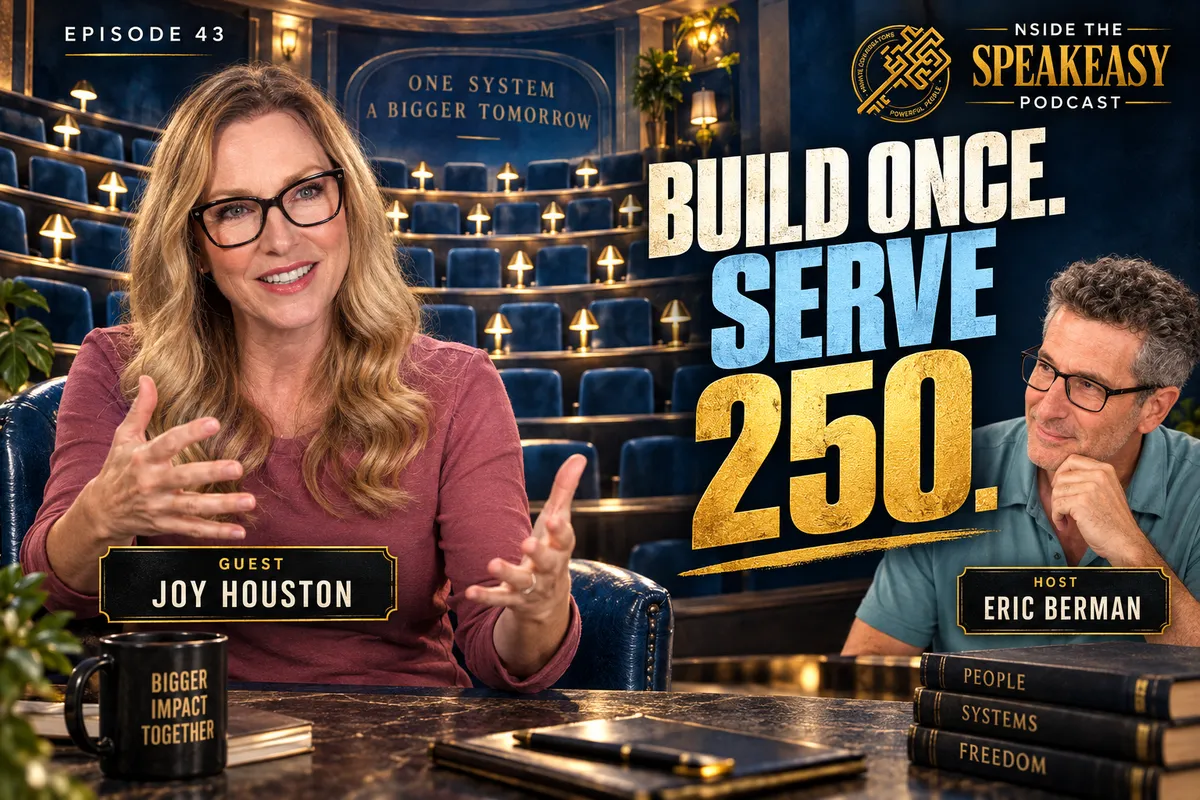
Joy Houston, co-founder of Heal at Scale and author of Get Cash Pay Clients, has helped more than 1,700 business owners and practitioners scale, including well-known names in the health and wellness space. In this conversation with host Eric Berman, Joy explains why so many skilled practitioners burn out trading time for money, and how turning a proven method into a scalable asset creates three offers for the same goal. She shares the 30 percent pricing exercise she uses to beat imposter syndrome, the burnout moment that led her to build Heal at Scale, and her double dog dare for making the leap from one-to-one to one-to-many. Joy also explains why she believes ad algorithms fill free lead magnets with freebie seekers, the three low-ticket paid offers that perform best for her clients, and the monthly Thrive Week that keeps her team and members from burning out.
In this episode, you'll discover:
- The three-tier offer structure Joy uses to turn a practitioner's superpower into a high-end one-on-one offer, an evergreen group program, and a hidden DIY course
- Why Joy has clients raise prices by 30 percent for the next three clients, and the success-story question she asks first
- The double dog dare that helps you treat your next client like 250 group members and turn your process into a repeatable system
- How Joy records a quick video, feeds the transcript to AI, and turns any task she dislikes into a playbook her EA can run
- Why Joy now sends ad spend to a $9.95 book, paid workshops, and lab tests instead of free lead magnets
Episode Summary
Joy Houston and her husband Travis Houston built Heal at Scale after niching down from a broad marketing agency, a decision that will be five years old this September. Joy explains that the niche came from a simple question: which clients did the team love most? The answer was health and wellness brands focused on helping people feel better, look better, and have a brighter future. Eric Berman highlights the lesson for any business owner: niche down to the people who energize you instead of chasing whoever seems to have the biggest budget.
Joy saw many health practitioners filling their one-on-one calendars until they were too busy to follow their own advice. Her answer is to turn a practitioner's superpower into a scalable asset with three offers for the same goal: high-priced one-on-one work, a live rolling evergreen group program with weekly access, and a DIY course that is never advertised publicly. That hidden third tier gives a sales team a way to recover acquisition costs from prospects who cannot afford the other two without turning what Joy calls a Tiffany's brand into a Target brand. She is clear that this model is for practitioners who already have a proven method, results, and social proof, not for people just starting out.
When clients get nervous about pricing, Joy first asks them to describe their latest success story, then has them raise their one-on-one price by 30 percent for the next three clients, and by another 30 percent after three yeses. A higher private price widens the gap that makes the group program attractive; in her own business, she says private clients pay 10k a month while mastermind members pay 2k. Eric adds that practitioners should ask clients what a result was actually worth to them.
Joy traces Heal at Scale to a moment of burnout while working with a highly regarded wellness professional, when a win she describes as adding close to a million dollars was quickly passed over for the next campaign. Around the same time, while interviewing patients for Dr. Sara Gottfried's Hormone Reset Diet campaign, Joy recognized her own symptoms. Joy says a local functional medicine doctor turned her hormones around quickly but told her she did not know how to get customers in the door. Those two experiences convinced Joy to make her marketing knowledge available to what she calls hometown health practitioners, an offer she says grew past a million dollars.
Joy names two obstacles to scaling: crossing from one-to-one to one-to-many, and having replicable systems for delegation. Her double dog dare is to treat the next client as if they were 250 people in a group program, and to spend one business day noting every low-ROI task. For each task, she records a short screen video, drops the transcript into AI to draft a standard operating procedure, and builds a playbook. Her Interest Compounding Playbook lets her EA turn one weekly livestream into a full set of content in rotation.
The second half of the conversation covers lead quality. Joy argues that ad algorithms know which users download free things and which ones buy, so she now directs most of her ad spend to paid entry offers. Her three best performers are a $9.95 client acquisition book, paid workshops that help people complete one clear task, and, for practitioners, lab tests that she says help close sales. She also explains how Travis helped her build an AI-powered book-writing process, which Eric is about to go through himself. Joy closes with Thrive Week, the last week of each month when her group programs take a break from live delivery, and with her favorite part of Speakeasy: members who openly share their wins and lessons.
Big Ideas Discussed
Three Offers for the Same Objective
Joy's core framework starts with a practitioner's superpower: the thing they do better than anyone, enjoy doing, and can prove with results. Once that becomes a scalable asset, she says, the brand immediately has three offers that serve the same goal. The first is high-priced one-on-one work, where the practitioner still trades time for money but at a much higher price. The second is a live rolling evergreen group program, where members still get weekly live access while the practitioner may be serving hundreds or even a thousand people.
The third tier is the one most people miss: a DIY course that is never advertised publicly. Joy describes it as brand protective. When a sales call reveals that a prospect cannot afford either of the first two options, the team can offer a lower-cost course, such as an $800 DIY program, to recover ad spend and sales time without turning a Tiffany's brand into a Target brand. Joy also argues that it is a delusion to believe clients will only pay for one-on-one access. In her experience, people who cannot afford 10k a month will happily pay 2k a month to join a community with weekly access to an expert.
The Double Dog Dare for Going One to Many
Many practitioners believe their work is too personal to systematize. Joy's answer is a mental exercise: take on your next client and, along with your team, act as if that one person were 250 people in your first group cohort. Every intake step, handout, form, and asset gets organized as if it had to work at scale. Joy says that once you do this, you start to see how formulaic most of the work really is.
Her argument draws on her own niche. Health practitioners often say every body responds differently, yet Joy says she has still helped doctors turn what they do into a formula. If that is possible in a field defined by individual differences, she believes it is possible in most businesses. She calls the result a straight line, the wire you walk across to get from one-to-one to one-to-many.
Turning Every Annoying Task Into an AI Playbook
Joy's second obstacle to scaling is delegation, and her method is practical. For one business day, write down every task you can feel is not a high-ROI use of your time, such as getting lost on Instagram, designing in Canva, or getting stuck in your inbox. Then, borrowing from what Dan Martell calls the camcorder method in Buy Back Your Time, record a screen video the next time you do that task, showing exactly how you want it done.
Joy then adds an AI step. She drops the video transcript into AI, asks it to act as a systems creator and write a standard operating procedure, and accepts that the draft may be 80 to 90 percent right before she edits it and adds links. Her Interest Compounding Playbook shows the payoff. Joy records one live video every Tuesday at 10am, and her EA uses the playbook and an AI agent to turn the transcript into YouTube descriptions, quote cards, carousels, and other content that can be reused months later. Joy says she only had to do the task once herself.
Why Joy Moved From Free Lead Magnets to Paid Entry Offers
Joy says she saw a sharp drop in audience and email list quality across 2025. Her explanation is that ad-supported platforms exist to make advertisers money, and their algorithms can tell people who watch videos, people who opt in, and people who actually buy. If you spend ad money promoting free guides, webinars, and checklists, she argues, you build an audience of freebie seekers instead of buyers. She still uses free lead magnets on other people's podcasts and stages, but on her own free platforms she now points people to a low-ticket paid offer.
Her three best-performing entry offers are a $9.95 client acquisition book, a paid workshop that gets people to one base camp on the way up their mountain, and, for practitioners, a lab test that costs a couple of hundred dollars and lets results guide the next conversation. Joy says that when the book ads first launched, they were returning $4.75 for every dollar spent, which she credits to a funnel with an audiobook bump and a one-time offer. As an interim step, she also replaced full opt-in funnels with one-word DM triggers through tools such as ManyChat, which she says created far more engagement and conversations her team could turn into sales in chat.
Questions We Answer in This Episode
What is the three-tier offer model Joy Houston recommends?
Joy Houston recommends turning a practitioner's proven method into three offers for the same goal: high-priced one-on-one work, a live rolling evergreen group program with weekly access, and a DIY course that is never advertised publicly. She says the hidden course helps recover ad spend and sales time without devaluing the brand.
How does Joy Houston help practitioners raise their prices?
Joy Houston first asks practitioners to share their most recent client success story, which puts them in the right headspace. She then asks them to raise their price by 30 percent for the next three clients, and by another 30 percent after three yeses. She says clients often report that prospects did not hesitate at the new price.
What is Joy Houston's double dog dare for scaling a one-on-one business?
Joy Houston challenges practitioners to treat their next client as if that person were 250 people in their first group cohort. Organizing intake steps, handouts, and assets this way shows how formulaic most of the work is. She says this creates the straight line from one-to-one to one-to-many.
How does Joy Houston use AI to create playbooks for her team?
When Joy Houston notices a task she should not be doing, she records a short screen video of herself doing it. She drops the transcript into AI and asks it to act as a systems creator and write a standard operating procedure, which she says is often 80 to 90 percent right. She then edits it and adds links so her EA can take over.
Why does Joy Houston avoid spending ad money on free lead magnets?
Joy Houston believes ad algorithms can tell which users download free content and which ones buy. She says spending ad money on free guides and webinars builds an audience of freebie seekers. She now sends most of her ad spend to low-ticket paid offers, while still using free giveaways on podcasts and stages.
What low-ticket offers work best according to Joy Houston?
Joy Houston says her three best-performing entry offers are a $9.95 client acquisition book, a paid workshop that helps people accomplish one clear task, and, for practitioners, a lab test. She says the book performs best because of its low price and because it establishes the author as a leader.
What is Thrive Week?
Thrive Week is the last week of each month, when Joy Houston's mastermind and group programs take a break from live delivery so members can implement what they learned. Joy says members told her the break helps them catch up, and she and Travis Houston use that time for vacations, new products, and their own implementation.
Full Episode Transcript
Read the Full Episode Transcript
Introducing Joy Houston and Heal at Scale
Eric Berman: Welcome to Inside the Speakeasy Podcast. The private room where today's sharpest founders, innovators and renegade thinkers come to trade the ideas that move industries. This show is brought to you by HighLevel, the AI driven business operating system trusted by over 2 million businesses to help automate, scale and create real leverage. HighLevel isn't just a tool, it's the engine behind some of the most agile and high performing teams on the planet. If you're ready to streamline everything, amplify your reach and actually build a business that works for you, you're in the right place. Visit www.gohighlevel.com/Speakeasy-mastermind-promo to get an exclusive 30 day trial for being a listener of the Inside the Speakeasy Podcast. Enjoy the show. So are you out there doing a lot of one on ones? Trying to just trade your time for money and just feeling more and more burnt out wondering how the hell are you going to be able to leverage your time and and scale faster? Well, you are in luck because today on Inside the Speakeasy Podcast, I'm so excited to bring somebody who's helped over 1700 business owners and practitioners help them scale their business. She's worked with huge names, big success stories like Dr. Daniel Amen, Taylor Dukes, Dr. Amy Myers, Dr. Chris Kresser, and Dr. Sara Gottfried on helping them scale their businesses. Welcome, my really, really, really good friend. So excited. I've been trying to lock you down for months and she finally has some time for me today. Welcome. Joy Houston.
Joy Houston: Oh, thank you so much for having me. I know we could have done this sooner, but Andrina likes to dominate my time when I'm with you, your little one.
Eric Berman: So no, I know, we come over, we just have fun, hang out here in San Diego, which I love and we've been friends, you and your husband Travis and God, we've had so many fun journeys together. But like it's so cool to say we actually got to sit down and talk because every time we sit down and and just rap like oh my God, nugget after nugget, it's just a fire hose back and forth like joy. We just gotta get you on a podcast cause you're just sharing with me and that's not fair to our community. You gotta share this knowledge to everybody.
Joy Houston: Yeah, let's share it. Let's bring some knowledge bombs that help people make more money this year.
Eric Berman: Yeah, let's do. So we're getting some cool stuff we're going to talk about. I mean the thing I love that you talk to me about all the time is really. And you guys have given me some great tips on how people are having a hard time just getting out of the weeds of the one on one, how they could scale to build so many other products and programs to serve their clients, how to get more leads in of qualified people to just get rid of the free stuff, stop giving away free shit and actually do stuff that's going to make you money. We're going to talk about that. We're going to talk about a couple of fun personal hacks as well and some just latest tips you found from the last 12 months or so. So, you know, I want to get. Let's get into a little bit. I know, I know. And to the listener today, we're going to talk a lot about. I know Joy's done so much work in the practitioner space. So certainly if you're a health practitioner, you're going to love this. And if you're not, I want you to think in terms of applying the same principles to any business because these principles do work. They work for me. We've talked about them a lot. It just happens to be you've done the smart thing and says, I'm going to take these things and niche down. Which is a whole other topic we get into is, is the importance of niching niches and the riches. And you've found a really good lane about these techniques with the practitioner space. Yeah. So. So why don't we talk a little bit about, you know, you've done so much work at your company, Heal at Scale. Heal at Scale. And you've got an incredible book called Get Cash Pay Clients. Is that right? That's the book name?
Joy Houston: Yep. Get Cash Pay Clients.
Eric Berman: Love it.
Joy Houston: Yep.
Eric Berman: Talk to me a little bit about. Let's just start with the work you've been doing at Heal at Scale. Just to give us a macro frame of really the problem that a lot of your clients have walked into. What are you seeing as the problem? And you're saying, okay, this is common, we're going to work together and I got the solution. Here's what it looks like.
Niching Down to the Clients You Love Most
Joy Houston: Yeah, well, it's kind of a spoiler alert. Like the name of the company is Heal at Scale. Right. So we decided to niche down. It'll be five years this September. So we decided to niche down from a very wide agency, much like Brandetize, you know, serving all the different types of clients. And then we started asking ourselves, like, who are the clients that we love the most? You know, like who Makes us jump out of bed. We can't wait for those client meetings. You know, their wins have us popping bottles just as if they were our own personal wins. And it was all of the people who were in that health and wellness and moving humanity forward, like, feeling better, looking better, having a brighter future. Right. And so when we decided to niche down, that's how we made that decision. So for all of you who were listening to his hidden hint that you need to niche down, I will reveal that that's how we made the choice to niche down and serve people in the health and wellness space, is because when we looked over all of our clients, they were the ones we loved the most. So that's a great place to look if you haven't niched down yet. So I'll start there.
Eric Berman: Who can I love? There's a gem there, [unclear]. And who's giving you the energy? Who do you love to talk about? Who's fired up versus what we tend to do? Joy, as you know. So it's like, who's got the most money or who's got, you know, who do you think's got the bigger dollars? And, you know, ultimately, you're gonna be miserable.
Joy Houston: Exactly. And it's that whole 80, 20 thing, right? It's like, you know, if you get bogged down by all these clients that you don't like and they're pulling your energy and you don't love it, like, you're not gonna be passionate about your business. And I think in the Brandetize community, one of the things that I love is like, yeah, we're all focused on helping each other make money, put systems in place, that kind of thing. But we're also focused on quality of life. Like, what's the point? You know that Miley Cyrus song about, like, oh, it's not about getting to the top. It's about the climb or whatever. This community is really good about that. So niche down to somebody that you love serving. It'll make you happier.
Eric Berman: I mean, Speakeasy. I know you're talking about the Speakeasy community. Of course. I know we're confusing my other agency, Brandetize. The Speakeasy community.
Joy Houston: Sorry, sorry. I know. Okay.
Eric Berman: We talk about a lot all the.
Joy Houston: Time, but yeah, no, keep exactly right there on. Just on the screen, distracting my blonde brain. Yes, the Speakeasy community. I think it's. Everyone's so loving and supportive, but not just about getting your marketing right and your sales right and your conversion right. And your fulfillment right. But also about doing it in a way that you get to spend more time with Andrina and Ariel and little Sebastian, you know, like, that's that matters to all of us.
Turning Your Superpower Into a Three-Tier Offer
Joy Houston: So I think when you niche down, make that choice wisely and then when we decided to niche down to that choice, the question became, what is the highest and best service of those people? Because the people who we served and we filled their one on one, that was a blessing and a curse, right? Because you can only trade so much time for money before you're like, shoot me now. What happened to my life and what I was witnessing is there were a lot of people in the health and wellness space that were becoming hypocrites while they were trying to fulfill the Hippocratic oath, right? So here they were making themselves so busy that they were getting sick because they didn't take the time to follow their own advice. And so not only did that affect their health and wellness and have them feel guilty and ashamed inside, like, oh my God, I'm not even having time to do the things I tell my patients to do. So the reason that we made our focus of Heal at Scale, how do we take your superpower? So what you do better than anyone else, you love doing it. You're great at doing it. You have social proof and results that show you've done it. You know, how do we take that thing and then turn it into a scalable asset? And as soon as you take your superpower and you turn it into a scalable asset, the way that I see it is you immediately have three offers for the same single objective that your brand is up to in the world. You have high priced one on one where you keep doing what you're doing, trading time for money, but at a much higher price point. And then you have a second tier which is a live rolling Evergreen group program where they have access to you and your content. They still get to see you every week, but it's once a week. And you might talk to 200, a thousand people who are in a group, right? And they still have live access to you. That's your rolling Evergreen offer. And then we keep an invisible sort of, I don't know, like a behind the scenes offer that we don't sell to devalue our brand. But if your sales team gets someone on a call and they can sense that the one on one's too high and even the group program, it might get the hard no because they just can't do it. It's brand protective to be able to say, we'll take your brand for as an example. Okay, well, if you can't afford to work with Brandetize one on one and you can't get into our very stellar community program, then Eric is so committed to you having access to our processes and information. There is a DIY course that you can go through and it's this price. So then the brand still shows up as this, you know, this Joan of Arc for the mission that you're on. And there is like a cost effective option. And then of course, that third option, if you don't advertise it publicly, it doesn't devalue the brand. Right. It doesn't turn you a Tiffany's brand into a target brand. It doesn't do that. But it does give you a way to recoup all the ad spend and marketing and sales team time that was spent on that person. So maybe you recoup a, I don't know, an $800, you know, DIY program. Well, heck, that does a lot towards, you know, reimbursing you for the cost of acquisition of that lead. Does that make sense?
Eric Berman: Totally. And I love it. To me, like, a lot of that stuff was. I think a lot of people have a good sense of that. But just even I think that to me, the, the learning just there was that don't necessarily publicize your low ticket item. I mean, keep it higher. So that's really the process. And so you're finding people that are stuck. A lot of us, I think now intuitively, when they come to you, they kind of know these things already. Do they have like, do they have a concept of, yes, I should be doing these things, but I just don't know where to start? Or is a lot of people that when you talk to for the first time are like, oh, my God, I didn't realize I could do all these things? Both.
Joy Houston: But what happens is they come to us and they realize, man, I'm really good at this, right? So it might be someone who's like, oh, I'm really good at optimizing men with peptides and hormones to reach their physical goals. Maybe they even specialize in like the marathon space or the weightlifting space, right? They know that's their avatar. They know they get results. They're freaking good at it, man. They have a ton of testimonials and social proof, but they're starting to feel it. They're like, whoa, this is not sustainable. I've hit a cap like a. I'm feeling either burnout or a financial cap that I just can't quite bump through. It right? Then that's a sign that it's good for you to leverage what you're doing and it's good to move into group programs and even that hidden DIY course option, right? So someone has to have confidence and social proof that they're good at what they do before I can help them at all, honestly. So this is not for a person who like just graduated from, I don't know, health coaching or just got out of medical school and they haven't cut their chops. They don't know what they're good at, they don't know who they're going to help. They don't have a proven protocol or process or method. That's certainly not my jam to help those type of people. It's more for people who are like, holy crap, I'm good at this. I'm really good at this. And I've got proof that I'm good at this based on my clients results, right? And now I'm ready to democratize access to my own brilliance by making a group course available where people can still be with me. Here's the thing, when you put people in a group setting, I think there's this delusion that, well, people who pay me one on one and maybe as a brand leader you can speak to your thoughts on this, okay? But there can be a delusion that we put ourselves in when, where we lie to ourselves and say, oh no, no, no, clients would never pay for anything other than one on one access to me. That's it. Right? No, there's no way that they would ever do that. They have to have that. That is absolute 100% bullshit. Because if you have cred in the space, remember I talked about those three levels of reaching the same objective. If you have cred in the space like me, I have cred in the space for changing the profitability of all those health and wellness brands, right? So if people see that and they're like, well, I can't really afford 10k a month to help me, okay? But I would happily pay 2k a month to be part of a community, bring all of my questions to her at the weekly sessions and still get my ass kicked by someone who knows what they're doing in the space, sign me up all day long, right? So that's the delusion we can like put live under and then we just keep trying to pile on one on one or maybe we add more team. But I don't know about you, but overseeing a big team, that freaking adds stress to my life. It doesn't necessarily make my life easier at a certain point. Like obviously having your EA, having the help that you need in certain departments. Yes. But I have no interest. I like a lean team. I love a lean team. You know what I mean? So there's that delusion. Yeah.
Eric Berman: That's like myth number one. Like, you know, no, you could still have value, people will still pay. I mean, I would argue, I mean, I'm going to probably go down the path because I see this a lot.
Imposter Syndrome and the 30 Percent Price Increase
Eric Berman: Tell me a little bit about imposter syndrome too. You think about even their own pricing. I imagine you probably, you know what happens when you meet somebody and you look at their pricing. You typically, I imagine, pushing it up a little bit. They don't believe they're worth that much. I mean, talk with me.
Joy Houston: Yeah, I definitely end up having to do that. And I need to have them bump up their one on one pricing in order to make a really attractive price structure for their group program. Right. Because even just use my example, if it's 10k to work for me a month and it's 2k. Sorry, if it's 10k a month for my private clients to work with me and it's 2k a month for my mastermind members to get their ass kicked and access to our, all our funnels and ad strategies and everything. Right. Then it is the gap between what high end private clients are paying and what they want access to. Right. That gap of that price difference is what makes the working with me in the group setting so much more attractive. Do you see it? So if I was to leave my price at 5k or whatever, well, that's still a gap, but it's not as big of a gap. Right? Yeah. So when they get imposter syndrome and they get nervous to raise their prices, the first thing that I do is ask them to tell me the last success story story that they had. So that puts their body in the energy of oh, go brush my shoulder off. I do get people results. Right. It puts them in the right headspace to hear what I have to tell them next. And then after they tell me a win that they've gotten for a client, then I tell them, would you be willing to bump up your price by 30% for the next three clients and after you get three yeses, would you bump it up 30 again? And they do it and I get these hilarious text messages or emails like crying tears of happiness that like, oh my God, you were right. Didn't even, you know, they didn't bat an Eye at the new price.
Eric Berman: You know, I mean. I mean, it's. We all hear it, but it's just so obvious, and it's hard. I think. I think that's like, again, if you're listening, just go, try. Go increase your price. Like, see what happens. Like, and I love the example, the mindset you said. I mean, when you really dissect that, not only the mind, you're putting your. In that mind space, but I would actually ask. The question is, tell me the story of what you did for somebody and then ask that customer, what was that worth to them? What would they have paid for that end result they've had? And they're gonna be like, oh, my God, that was like, worth like 30, $40,000 to me. Like, and you only charge them five. Like. Like, there's a difference there. They would have paid more for that. And I think people don't realize that. I mean, the other thing I've also realized, too, is that when you're good at that thing, you tend to think that others are kind of okay. Or is it really that good? Is it really that special when you're good at that thing? You tend to under. We tend to undervalue ourselves for our time for those reasons, and I love that. That's a. I think you had some really great tips in there, so thank you for that.
Joy Houston's Burnout Story and the Birth of Heal at Scale
Eric Berman: So great. So let's get into the. You know, a couple questions here for you. Was there a moment that you were sort of burnt out? Like, you know, you help a lot of professionals break from the burnout they have. Like, were you burnt out and you found something? Like, how did you get to that point yourself?
Joy Houston: Yes, yes, yes. I won't mention any names, but I was working for a very highly regarded wellness professional, and as, you know, being a part of their marketing adventures, I remember that we had just come off a win that was damn near adding a million dollars to the bottom line. And at the post, you know, I feel like there needs to be, you know, after the campaign was done, you know, everybody meets, okay, what do we like doing? What do we not doing? What can we take into the next campaign before you sort of get on the next mission? And the whole sort of assessment of what. What had happened in the campaign and the success that we had created was damn near stepped over and, like, what are we doing next? Kind of vibes, you know, And I immediately had this sense of, like. Like, oh, my gosh, you know, like, it almost feels a little bit like, what. When is it ever enough, you know? What? I mean, can we take at least five minutes and, like, celebrate the win and take the extractions and learn so that we ever, you know, so that we're always improving our systems and the team is really enjoying the process? And there was something in that moment about the. I mean, it felt honestly like a little bit of a lack of gratitude, a little bit of caring that the team enjoyed the process of making a win at that level for the brand. And that was the time that I just kind of went home and was like, wait a second, like, all of what I'm doing, you know, is accessible for way more people than just these really big name clients with big budgets. And as the universe would have it, right, because we always get these interesting signs and interesting things that are happening. I was helping another one of my clients, Dr. Sara Gottfried, with the Hormone Reset Diet campaign, right? And I had been interviewing all these people who Sara had gotten amazing results for. And one women was talking about her hormone disruption. And she said to me, joy, I feel like I need to wear one of those white jackets that tie in the back because the emotions that I'm having don't feel like my own. Like, I logically know that thing that happened, let's say, between her and her husband was like a 1. I should have reacted on a scale of 1 out of 10, but I reacted like a 15. And I know that's not me. And as she's telling me the story, I'm thinking to myself, oh, my God, that is how I feel some days. And other things she was sharing, like her eyebrows slowly disappearing on the outside, all of these things that she was saying, I was like, that's me. And so I talked to Sara and she was like, you need to get a functional medicine doctor locally. So I did. And by the way, it was not Sara who I had this problem with. Sara's amazing to work with. So I found a local doctor and she helped me with my hormones. She turned it around really quickly, and at my follow up appointment, I could tell she just looked. Looked bad. She was like a bag's under her eyes. She looked like she was gonna cry. And that's when I asked her, like, hey, girl. Like, I feel like you saved my life, my marriage, my sanity. Like, do you mind if I ask you, is everything cool? You know, and, you know, like many of us women will do, if we're holding it all together and someone says, what's going on? Then you start crying, right? So, like, the waterworks started happening. And I said, she shared with me like, man, I'm so good at what I do. I know that I'm so good at what I do. I'm born to do this. But I don't know how the hell to get customers in the door. I don't know how the hell to help more people. And it was on that day that meeting went awry, and I just felt shitty about what was going on with one of my high end, one on one clients. And so it was like the. Those two things happening at the same time made me say I need to democratize access to the knowledge that I have for marketing and health business strategy. And I need to make it available to all of the hometown health practitioners just like her, you know, and I need to make this available to everybody. And that's when I came home to Travis and I said, hey, I want to change the game. Let's do something different. And he's like, babe, if you believe you need to do that, let's do it and let's give it a go and let's see if hometown health heroes everywhere are even willing to do that kind of work. And it started, honestly, Eric, as a test, like, let's just see. Let's just play and see if providing that to more practitioners would be of interest. And then it was. And you know, as soon as we got that to be over a million dollar offer, we were like, let's go, you know, let's make this available to everybody.
Eric Berman: Of course, obviously, in this case, that whole seed in the back is now the level of appreciation is at a whole different level now. Now it's just like, wow.
Joy Houston: Yeah, because you have some people, like, you could add a hundred, two hundred, three hundred thousand with a little marketing initiative, and they're okay, what's next? You know, as compared to you get an extra 50 grand into a hometown health practitioner's office that's been struggling. You are getting flowers and text messages. And you know what? I'm like, they're crying. They're literally crying happy tears. Not because they're sad, but they're like, I never thought this would happen for me kind of vibes. And when you have a whole community of people like that, like, of course, like, I jump out of bed to serve them every morning because it makes my heart like, I love it to do that, you know, I love it.
The Double Dog Dare: Treat One Client Like 250
Eric Berman: So, you know, a lot of people in our. And thank you for sharing that. A lot of people in our audience, probably intuitively that aren't doing these things know a lot of these things. What do you Think prevents people from scaling and getting these leverage points. What's getting in their way?
Joy Houston: I'd say that there's two things. One, they don't have the. They haven't figured out how to cross that great. What feels like a great divide from what their superpower is in the one on one space over to the bridge where they're one to many. Okay? So I think that's a very intimidating bridge. And would it be okay to pause and just give people a little pointers on how to do that? So maybe if they're thinking about it, they feel brave. Yeah. So if you're thinking about making the great leap, right? It feels like it's so far away. Okay. If you're thinking about making that leap, here's my double dog dare for you, okay? I want you to take on your next client, and I want you to, in your own mind. And if you have a team, have your team do it too, okay? In your own mind, I want you to say to yourself, this person is not one person. This person is 250 people in my group program. And so every asset that you give them, the order that you do, everything from your initial intake to the very first steps, I want you to start turning that into a board game, a process, right? Because the moment you take what you do one on one and you start seeing how formulaic the majority of it is, okay? As soon as you treat that one client like 250 people in your group in your first cohort, your brain starts to operate differently, right? It starts to think, oh, okay, I need this as a handout or I need this as a Google form, or I need this as a whatever, like a Notion board, whatever. All the geeky cool shit you use to make sure that you're serving your clients well, you will be surprised at how many of those things are formulaic. And I know that to be true. Because how unique is the health practitioner's journey in going from one to one to one to many? Because the human body is so unique and so different. And so if I can help doctors who. Everybody's body responds differently, right? If I can help doctors take what they do and turn it into a formula, given the uniqueness of the human body and how every human body reacts differently, then I know you can do it. And what you do, okay, so that's my double dog dare for you, is take on your next new client and pretend it's 250 people and organize all of your assets into mental blocks for yourself where you can see a straight line and that straight line will be the wire that you walk across to get from one to one to one to many.
Eric Berman: Love it. No, totally makes sense. You think. You said you had two things, did you have a second one?
Joy Houston: Yeah. So that's the first thing is to get yourself together to make the leap from one to one to one to many. The second thing that you have to do is you have to have replicatable systems in place to delegate the things that you currently do. And you have no confidence or trust in turning it over to someone else to do the way that you want it to be done and to the level of excellence that you expect it to be done. If you don't have those two things in play, if you don't have a clarity in how what you do one on one, can be done in a one to many format, and you don't have systems in place to delegate when you scale. Right. Because if you're burnt out by the handful of clients that you have now, what's going to happen when you have a thousand people, two thousand people in your group, like, you absolutely are forced to put systems in place.
Spotting Low-ROI Tasks and Building AI Playbooks
Eric Berman: Let's dig into that because I think if I'm listening to that, you know, obviously I don't have. I'm here, I'm like, okay, I like what you're saying. I can go down that path. Great exercise. Thank you.
Joy Houston: Yeah.
Eric Berman: But I don't have the team, staff and all that stuff now because I'm not there yet. So, yeah, maybe give me some examples of what would that end look like if you were scaling? What kind of team would I need? What's the assets account? Seems overwhelming. I don't want employees, I don't want all these people. What does this look like?
Joy Houston: I get it, I get it. Okay, so then my double dog dare for you would be that you go through your next business day. Okay. And as you're going through your next business day, just take a sticky note or whatever you need to do and write down any task that you're doing that you can literally feel in your body that this is not a high ROI task for me to be doing. I'll give you a few examples. Okay. You're doing your. You log on to Instagram to do your own post and you find yourself lost an hour later. You know, in your body. You can feel it. You're like, oh, I should not be doing this right now. I should actually be doing what I know makes money. Right. That would be an example. Being in, I don't know, like Canva. To make some stupid design that you're not a designer. That's another example. Right? Right. If you find yourself feeling like, you know, your inbox is distracting you from your to do list that you know is money making tasks, then that being in your inbox needs to be something that gets delegated. Right. So I want you to keep track of what are the things that you can tell you should not be doing because they're not high ROI tasks. Right. So for you, Eric, it's like you doing outreach with other businesses. Like, like that's going to make money in your business. You speaking, that's going to make money in your business. You, you're writing your book with us in February. Right. So you taking the time to write a book that is going to be a very low cost offer in the online space which will filter out the freebie seekers and the tire kickers and actually get the right people on your list and in your audience that is a high profit, high roa use roi use of your time. Do you see what I'm getting? Is that enough examples? Right? Yeah.
Eric Berman: And so, and so question would be, and again, this is not so much for me but for the, for the avatar listening and said this. I mean I imagine right now obviously they can hire people like you and others. Other than that, is it just a matter of like, I guess there probably is a fear out there and I guess I'll help. You know, part of my answer my own question would be, you know, the world of AI now has never been a better time to say a lot of these things we're even talking about. You know, it's easy to find somebody to leverage AI to just knock some of the stuff out. You don't have to spend lots of money to get these things done. And you're right. The things that you're finding yourself spending energy doing when you know you shouldn't do it. And you know, I always talk about genius zone. You know, what's your area of genius? What do you love to do? And you're good at like stay in that everything else get off your plate.
Joy Houston: Exactly. So let's keep going a little bit because the double dog dare task for those people was just in one business day. Notice all the things you know you should not be doing, you hate doing, they're not a good use of your time. Just notice that them. And then for each one of those things, if you had a playbook that included. Okay, well for me, like when I have to do any process in my business, a lot of them have an AI process in it, right? Like, I have either an AI agent that's built or at a bare minimum, I have a prompt stack to do that, right? So when I recognize a task that I should not be doing, my first order of business. And if you guys have not read Dan Martell's book, Buy Back Your Time, it's definitely worth. I recommend you get it on Audible actually, so you can listen to it while you're walking or doing other things. Okay? What he calls it the camcorder method. Okay, I have a slightly different version of it, but, like, he calls it the camcorder method. As soon as I see something that I know I should not be doing, it's not a good use of my time, I immediately fire up my recording system on my desk. I do a little video and I'm like, okay, I log in here and then I do this, and then I run this prompt and here's how what I do with the answer, and here's how I filter it. And then I come back into this Asana task. And every little piece of any task that bugs the shit out of me, I make a playbook for it. So for me, I'll give you an example of one of my playbooks, okay? I don't mind doing my one content video a week. So every Tuesday at 10am I do a restream. It goes live on YouTube, LinkedIn, Facebook, all that shit, right? So I don't mind doing that. I love doing it. It's great. But you know what I don't like doing, like, being responsible for that video being spliced and diced and quote cards pulled and carousels made. And it's on LinkedIn and it's on, right? All the shit that has to happen for that one piece of content to have, all the assets that make it a rotatable piece, like an asset for my business that can be not just released this week, but also brought back a month from now or three months from now or six months from now, so that I have really good content in rotation. I hate that. I hate it. I know it's not my excellence. It's not my zone of genius. And so I have one playbook called the Interest Compounding Playbook. And the Interest Compounding Playbook walks my EA step by step through the process of taking the transcript of that. Like, they just go to the video, they pull the transcript, they drop it into an AI agent, it turns it into the YouTube description, it starts doing the video, like, everything, that whole entire process to turn it into a Shit. Ton of content to be rotated through. That's an example of a playbook. So I did it. You know what I mean? I know how to do it. I don't like to do it. I don't want to do it. It's not a good use of my time. So I do it one time. I film it. I have a Google Doc that is a playbook for it and a tutorial video for her that's in that top of that doc. And she does it all.
Eric Berman: All.
Joy Houston: All of it.
Eric Berman: Yep. Amazing.
Joy Houston: All of it. So your job, double dog dare you notice what you shouldn't be doing and then make a playbook for all of those things. And I know it will be frustrating to make that little playbook. But you guys, here's an AI hack for you. If you do a Loom video or however you want to record, you can do a Zoom clip, you can do whatever. You have easy access to recording. Don't fret about the technical side of recording, okay? But I want you to be able to do that recording where you're sharing your screen and you show exactly what to do and how to do it and how you want it done perfectly your way, where you're in a little bubble up here in the corner. You guys know what I mean? Okay, when you're done with that video, I want you to grab the transcript of that video and drop it into AI and tell the AI I want you to act like an organized systems creator for the world's leading businesses. And I would like you to create an SOP, a standard operating procedure, so that I can have my team take this over and it will make you a step by step by step by step by step by step by step. And it might be 80, 90% right. And you might have to make a tiny little bit of edits. And then I recommend that you add links, right? So in my Interest Compounding Playbook, I add the link to my Heal at Scale YouTube channel so she can do it really fast. I add the link to my Canva folders for the right thing so she can get to it really fast. I make it easy, right? I try to save her time, but that playbook is done in a matter of minutes as a result of the transcript from that video, though. Does that help, Eric?
Eric Berman: No, I love it. No, I love it. You're right. I mean, these are things it's just do it. If you're pushing us, we got to get it done. And for listening, if you're there, you're still stuck. Hopefully that Helps.
Why Algorithms Fill Your List With Freebie Seekers
Eric Berman: Now you threw in something. I'm going to kind of turn directions a little bit. You planted a seed there. And I'm going to. You know, selfishly, I should say I'm excited because next month I'm going to be going to another program. Because you were building out thinking of all your systems and tools. You guys are so good at building systems and tools for people. You've got a great system and tool for, for writing. Not only writing a book and putting a book together, because there's a lot of them out there, but being able to put a book together with the landing pages, with the best selling offer, with the lead magnets. And I'm going to then segue into the other thing that you and I have been talking about, which is the concept of, you know, attracting buyers, not we're going to talk about talking buyers, not borrowers. And one of the biggest things you learned over the last year, so I'm kind of melding in a couple concepts here, is, you know, talk a little bit about just the concept of how you're doing, helping people write the book and the importance of getting a book out there and why we should all be doing this in some form or fashion, how to leverage it properly. And then we'll turn into the last topic. Yeah.
Joy Houston: And they kind of go together. They definitely go. These two topics go together. So basically in the last year, and I might be merging these two topics together a little bit. So forgive me if I set this up of why we even had to create a book writing process. So I just want to make it clear why we even went down that avenue. We were finding that certainly in the last half of last year, but Honestly, all of 2025, what we were finding was an extreme drop in the quality of audiences and email list members. And so as I started digging into it and I started talking to all the people I know on all the different platforms who have anything to do with any of the algorithms, anything to do with running ads, anything to do with the way that those free platforms work. What I started to suss out is the better the algorithms get at doing their job. Okay, so we should pause here for a second and say, what is the algorithm's job? Right. The algorithm's job is to keep you on the platform to satisfy the advertisers who spend money on those platforms, because all of those free platforms are ad supported.
Eric Berman: Keep me on my Instagram for an hour. Like the example you said earlier. Algorithm was winning.
Joy Houston: Exactly. And they not only want to keep you the User on the platform, who do they want to make happy? Who are those algorithms really in service of the advertisers. Exactly. And so if we know the core mission of those self improving, self learning algorithms is make our advertisers more money and do that based on predicting their behaviors, then doesn't it make sense that an algorithm that complex would be able to differentiate a user that likes to watch video? We know that it can do that because we can buy video view ads. Right? We know that we can also run conversion ads, so it knows which people like to opt in for things. Right? We can also run direct sales ads, so it knows which users are actually buyers. Right? So if we lean into all the crazy nuance the algorithm understands about each user and we know that the algorithm's sole purpose is to make more money for the advertisers. Okay, Keep people on the platform. Yes, but for what end? To make more money from the advertisers. If we take all of that logic to heart, then what we know is if we spend money trying to attract audiences who will opt in for free stuff, right, your free guide, your free webinar, your free checklist, all free console, all that free stuff, then what you are doing is growing an audience. Downloaders of freebie seekers, right? And not necessarily downloading an audience of people who are buyers. So in taking all this to heart, we just sort of ran an experiment. Okay, okay, let's do it ourselves. And then when we had success, we told our members and then they started doing it. We started a difference there, okay? Drastic, drastic difference. Okay? So what we started noticing is if we went from, yes, we still do free content on free platforms, okay? I'm not saying that there's not a place for your free opt ins and your free lead magnets. There is. And just so we don't step over that, I'll tell you where that is. If you're in someone else's podcast, yeah, give away your free lure and get that email list growth from that. That's amazing. If you're speaking on stage and they let you say, then yeah, get the list growth from that. But what I'm specifically talking about is going free content on free platforms. Stop going from free content on free platforms to free lead magnets, free webinars and start filtering out the freebie seekers by going free content on free platforms, that leads to an entry level offer, right? I'm talking about your low ticket offer, you guys. So in our world, there were three that performed the best. Do you want me to tell Your people, what they are.
Eric Berman: Yes, I'm saying, please inform me. Yeah. And I think just to clarify the last point, you know, go from free to pay. But I think a lot of it is that I imagine you're gonna talk about the time frame to go from free to paid. Because a lot of what we've been told for years in the marketing world is get your lead magnet, you know, nurture them for a while and eventually try to get that low ticket offer. I think what you're talking about is condensing that time to get the buyer faster. Right, right. Is that we're going to get into. And then now you're talking about how.
Joy Houston: It depends who you listen to. Because the times, they are a changing. Okay, so there's two things I would say about that. One, there are four personality types, right? And two of the four, the competitive and the spontaneous, they buy fast. Like some buyers are fast buyers. And if we're ignoring that, we're being idiots. If we like, would you like to have a one year nurture cycle or would you like a buyer in a day? You know what I mean? Like, if my buyer wants to buy to me from me today, I'm fine with that. Like, let's go, let's get done, let's earn you more money. Right?
Eric Berman: Let's start up rethinking that. Everybody thinks like we do, we all think differently. And there are the different personalities.
Joy Houston: And then if you lean into some of the amazing marketing coaching from people, like Taki Moore, they're having really interesting conversations in the space that I admire and I find to be true, that it's not the duration of time between when they find us and they buy that we've been focusing on how long is that nurture sequence? How long does it need to be? It's how much content that they consume. So if I can get someone to consume 12 hours of content in two days because they binged my shit on YouTube and they loved it, I'm gonna get a buyer in a couple of days. So we really need to be a little bit more focused on, hey, how quickly can we get them binging on the good stuff instead of how long do we need to kiss their ass until they decide we're good enough to work with?
Eric Berman: No, I love it. I mean, I. It's something, you know, I've been thinking a lot about lately too. It's like, you got to give them enough, enough really, really good meat, really high quality content. But it's got to be not too much if it's Too much they don't get to the end. And we think we're over. We think we're delivering so much value. Hey, I'm giving them so much stuff they should buy from. Yeah, like, yeah, but they haven't gone past the first, you know, 10% of all the crappy gave them the good crap. Yeah, no, I love.
Joy Houston: Exactly.
Replacing Lead Magnets With DM Keyword Offers
Joy Houston: And actually, I think it's worthwhile to mention that there was a nugget that I got from Laurel Portie, who I love her content on Facebook ads. If you guys don't know who she are, she's. She's really smart woman. I love what she does and what I took away from my, from her many, many things. But the one thing that you need to know this is I stopped having the team build out allure. Like I call it allure. You guys probably call it a lead magnet and opt in or whatever. I stopped doing as much of that before I have this little interim step of if I'm going to do free content on free platforms and then I'm going to. I've chosen to make my first opt in, a paid opt in instead. Like, I want that first tiny little sale. And I'll circle back and I'll tell you the three ways that I find the three low ticket offers I think perform the best. Okay? But instead of like just going cold turkey, breaking the habit of having them opt in for a free lure and then nurturing them them, what I did as a stopgap to test things out actually got me a shit ton more engagement. Okay. And what I did was instead of building out the whole funnel with the opt in page and the delivery and the nurture emails, I would just do free content and free platforms. And then I would say, hey, if you want this spreadsheet, if you want that, DM me the word such and such. You know, one word trigger. Like set up a ManyChat or do it on your GoHighLevel, right? If you want this, I'll give it to you. No opt in, no nothing. I'm not going to follow you with a bunch of emails for a while. Just DM me the word calendar and I'll give you my marketing planning calendar or whatever. Right? And so what that that did, Eric, was it had. It had so much more engagement with my site than they would follow me and then they would DM me and then they would send me the word. And then now that they've DMed me, guess what I can do or my team can do because I have a playbook for it. Sell by chat. I can get them talking about themselves and their problems and say, hey, do you want some help with that? Right. So like the whole thing of like we got to the cell faster than some 6 to 12 month nurture, you know what I'm saying?
Eric Berman: Well, well, in that if I break down the psychology of what you're saying, I mean, I love the ManyChat too. Something we're doing a lot more of as well. But I think you gave them something, they, you tease them with something cool, he delivered it immediately. It wasn't an overwhelming thing. It was like a cool tool or a cool hack. They looked at it and now you're engaging, but you're listening. You're giving something more important than something as you're giving them the ability to. Wow, I'm being heard and somebody cares.
Joy Houston: About me and I get them talking about themselves.
Eric Berman: That's right. That's right. So you're being so that. And that's a huge gift. Yeah, you're exactly. And somebody's listening to me. Somebody cares and they're actually, it's a micro commodity of time and they're feeling that dopamine hit of somebody actually listening to them. So now you sort of, I could see how you've, you've decreased the timeline from how much time until they're ready to buy from you or trust you and all that. And you're giving value. I mean you're giving. It's not like you're just, you know, doing Houdini on them. You're giving them real stuff. So.
Joy Houston: And there's something else that you might have missed. But I want your audience to know. Know. Yeah, I'm sort of taking advantage of the fact that they're tired of our marketing with our six month nurtures and like sending them all this spam that they don't want. Like, I'm also kind of making it a positive that like they don't have to deal with us.
Eric Berman: Yeah, we're just authentic. Look, I'm not going to follow you. Just do this. If you want it, great.
Joy Houston: If you want it, great, let's chat, whatever. And do some people just take it and run? Yeah, fucking fine. No worries. But do some people engage and love it and tell me about what's going on? Not. And then of course I have a sell by chat playbook for my people to do this for me so I don't have to do a lot of that, you know, but that getting them talking about themselves and being real about what's going on in their business. And having straightforward conversations, that's like I can close in chat. Sometimes I don't even have to do the consult.
Eric Berman: Yeah, I love the con. The again, the psychology of it. Because there's a little bit of a. I don't really need you, like, here you go. But I don't need you, like, like it's almost like, you know, I'm thinking the whole, you're not chasing me down that to think, you know, know you're still the prize because here you go. And I don't really need, you know, you want to come back to me. Great. Still here.
Joy Houston: Yeah, exactly.
The $9.95 Book as a Paid Entry Offer
Joy Houston: Exactly. Okay, so I promise to tell you when we started discovering this, okay? So if the algorithms can tell if we're a downloader of free things or if we are a buyer of things to actually solve our problems, if the algorithm can tell that, then it makes way more sense for me to dedicate the vast majority of my ad spend to an entry level offer rather than to a free thing. Now, to be transparent, that doesn't mean I don't spend money on like video view ads to get a pixeled audience or something like that. That's true. But I would much rather have the bulk of my ad spend go towards, okay, I did free content on free platforms and I'm going to make a paid invite. A low, very low. Not a book. Like this book is 9.95. When they buy it from me and they get all these AI toolkit shit to help them and it's like way gangster. They could buy it on Amazon if they want it. When they buy it for me, they get better stuff, right? So I'm asking for a bare, very small investment, right? And the quality of leads behind a 9.95 barrier is infinitely better than everybody who's opting in for a free webinar about how they should be doing what I'm telling people to do in this book. Like it's night and day, Eric. It's like, it's just. The difference is insane. You know what I mean?
Eric Berman: For the 9.95, they get that right away. But how quickly are you selling them the next thing after that?
Joy Houston: That. Oh my God, dude. Well, when the ads first launched, we were at a put a dollar in, get 475 out. Right? But that is a factor of the funnel that we built, right? We, this is not our first fucking rodeo. We've been marketing for a while, so we know we have that 9.95. We have a bump offer with the audiobook and you know, and Then there's a one time offer upsell after that. So like, like again it's not our first rodeo. We know how to do marketing campaigns so that the front end client acquisition, you know, is I'm happy the front end client acquisition is back, is break even because then I'm growing my list with good leads because I think that where people get disheartened with their marketing and they get like they start to hate their own audience is because they put too much time and energy into content that basically sets them up in the marketing and business equivalent to a romantic relationship of landing in the fucking friend zone. Like what they want is to be with the girl and they end up in the friend zone. Right? So like they can inadvertently do that. If they do all this free content and the free webinars and free books and free opt ins and all of that, they can end up in the friend zone with where their audience is. Well, I can just milk this brand for as much free stuff as I can. You know what I mean?
Eric Berman: Training them, you're training them just to you're going to get more free stuff. Just wait.
Joy Houston: Exactly, exactly. Which means you're also making fulfillment a lot harder for yourself because you're bringing in a ton of clientele that is reluctant to pay for the solutions that they need. They're reluctant to pay for solving the problems that they have. And that's not what we want. We want proactive, willing to invest clients so it grooms the clients right from the beginning that you are someone who they're worth investing in. So it was the book that's my number one highest converting. So of the three, if you're gonna go from paid, you know, you're gonna do free content on free platforms but you're gonna make that small initial investment, hey, buy just this small inexpensive thing for me to get this result. Right, Right. The book is number one because the price point is so low. Right. Because we can sell a book at 9.95 with an upsell downsell and we can have a CAC. That's amazing. Right? Our, our customer acquisition costs for those of you who don't know. Right. Our customer acquisition costs can be very. We can get leads for free, you guys, seriously. Okay, so book is number one because of the price point and because it establishes you as a leader. It might seem cheesy, you guys, but even just having a book out, like I just got featured in an MSN 10 leaders in the Health medicine space or whatever. Right. For all because of that book. And like I Didn't do anything extra. I didn't do whatever I've been doing what I've been doing for a long time. And it was the stupid book that had people be like, yeah, like, all of a sudden, we should talk about this person. So for whatever reason, society just gives you more cred when you have a book, okay? And you guys, it's not your life story. It's like intentionally a client acquisition book, which is a completely different formula of it. You know, just having fun writing a book, doing it for your ego. It's a completely different game, you guys. So book is number one.
Paid Workshops and Lab Tests as Low-Ticket Offers
Joy Houston: The other thing that works really well for that initial paid transition is a paid workshop. Like, something where you take the whole mountain you help them climb. And what's one task you can accomplish on the way up that mountain? Like, think of it like base camps. A workshop should be something that gets them to one base camp, one success step on the way. And if you can get people into a paid workshop, Taki Moore is doing this, like, go check out what he's doing. It's amazing. And he does them. We have had great success with $95 workshops. And they accomplish one clear thing, and it's a get shit done session. It's not a webinar. It's not a sales tactic. Now, do we make sales from it? Hell yeah, we do. Because they're like, oh, if she could help me accomplish this in three hours, what could I do? If I was with her in her mastermind for the year and had access to all of her funnels and ad strategies and everything? Right. So do we make sales? Yeah. But for those of you who don't like hard selling, it's. You're setting yourself up to win, you know?
Eric Berman: Well, the secret behind that too, I think. And you'll probably. I'm stepping on your toes here a little bit. But to me, when you say that is. I love how you said it's a get shit done workshop. Meaning back to the other thing where you're giving somebody something for free or even a book to some degree, they still have to consume it. And we're waiting for them to consume it before really, our best bet is to sell them right after they consume it. Now, if you're helping them consume and they're paying, they're basically paying you. And now you're helping them to get to the endpoint and consume. They're ready to buy. Like. Like you've already achieved that.
Joy Houston: Exactly. And for us, like, full transparency on ours. So you can see the inner Workings here. For those of you who don't know Travis Houston, he's a genius in the AI and in the agentic AI space specifically. And so when they come to those workshops, their minds are blown that I'm walking them through an agentic process, like an AI agent process. And it goes from step one to two to three to, and it builds on each other and they end with an amazing asset or thing accomplished. And it's done in that three hour workshop. And then we wrap up by, okay, well now it's done like we did one where they were creating their entire offer document and then we wrapped up with, okay, why don't we have some fun and make all your emails and your social media promotions in just five minutes. Shall we do it? And of course they're like, oh my God, yes, let's do it. You know, so because we've leaned into the AI agent space, because I have Travis in my world keeping me in the forefront of all of that, that he can show up and blow their minds on how much we can accomplish in such a little amount of time.
Eric Berman: Yep, yep.
Joy Houston: Okay. But there was three, I promise to tell you all. So in our world, the three best performing things, when you want to go from free content on free platforms to a small paid invitation, was number one was the book by far. Number two was the workshop where they're actually accomplishing something. That's the ticket there. They have to get something done and have a positive experience with you. And the third one in my world that works for practitioners is a lab test. Right. And that's what this book was about was the wild financial successes. When practitioners started saying hey. Instead of trying to sell some 10k 3 month program with people, if they offered the lab, they said hey, but you don't even know if you need this. Right? So they could have a conversation about someone's pain or symptoms and say it very may well be your hormones or your immune system or your metabolics or whatever, whatever. How about if I give you access to this lab test? Well, that meant instead of them making that huge 10k investment, they're just making a couple hundred dollar investment in a functional or precision test. They see the test results, the test results help them close the sale. Bob's your uncle. Sales are going crazy. It's bananas. It's fun. So because so many practitioners in my community were just slaying it profitability wise from that, that's how come I ended up writing the book.
Writing a Client Acquisition Book With AI
Joy Houston: And where these things dovetail is, is having a book. It was the number one way to make the low ticket sale, that was the number one way. And then in order to write my own book, I partnered with Travis to create an AI powered process to make a sales conversion book. Like a book that was focused on addressing the problem in the market, presenting a clear solution for that market, and then showing how you walk through that market with case studies and testimonials that come kind of prove it and then calling them to action to implement that. And then of course there's a natural inherent, well, I would like to do it with you. And then so the book becomes an acquisition tool. So in order to write my own book, I partnered with Travis about the prompt sets that I was using and the refining tools I was using. And he helped me turn it into a. That made it possible for people to get a client acquisition book done in a matter of days. And then we layered on tools where we could have AI help us decide. Well, when we go to publish on Amazon, wouldn't it be nice to have the sort of gangster behind the scenes numbers on what category can we choose to debut in such that we are almost guaranteed to be number one? Because there's only so many. Like we're basically showing up as a really big fish in a small pond, so we know we're gonna end up as number one. And you know, Travis, he's like such a research and such a systems guy who's like, I can hack this, I can do it. And so he was able to come up with also an AI powered tool that helps us determine which category do we wanted to view in so we can grab that screenshot of our book being number one. And I'll tell you, I was nervous. Is this going to work? But in the the last cohort is called Book to Buyer Blueprint that offer that we have. Everybody who published on Amazon using his process got to number one with their book like without fail. So I was like, okay, awesome. This is so cool, so fun, I love it.
Eric Berman: And so for that, just to close the loop. So for those listening, so excited. I've been waiting to do this for a long time and I get the honor and privilege to getting. I was able to hit the last spot of your upcoming event. In about six weeks we're having this podcast will come out probably six, seven weeks. When you're listening to this DM me or you know, message me and ask me how the process went, I'll tell you all about it. Hopefully by then I'll be asking big favors for you to buy my book. That we get out there. But anyway, title, TBD and the whole flow [unclear], probably somewhere around networking and community. We'll get there. But anyway, I'm excited to see the process firsthand. And last before I go to. I'm taking a lot of your time. I've gone over time here. We have a fun time.
Thrive Week: Building Implementation Time Into Every Month
Eric Berman: You know, Travis, you, my wife and I just getting together, hanging out. You guys have great personal hacks and I've always been interested in. And you guys have something cool that I just. I'm jealous. Love to get in there. Figured out you guys have something called you and your husband work together a lot, Something called Thrive Week. So tell us about Thrive Week on a personal side and why you love it and you share.
Joy Houston: Yeah, totally. Okay, so first of all, credit where credit is due. This comes from Nick Peterson, who wrote a book called Bumpers. You can get it on Amazon if you want to find it. It's a tiny little book, but I'll give you the nutshell about it. I found out about this process. I mentioned Laurel Portie, who's amazing in the Facebook ad space, especially if you want to learn how to run your own ads when you're getting started. So I was working with her, and she had this last week of the month where she just didn't show up. There were no calls, no nothing. And I was like, oh, this is really interesting. And she set it up as well. This is your time to go do what I taught you to do. Basically, like, okay, I can only teach you so much. If you don't implement, then you're not going to get the results anyway. So it was queued up in a way that I was like, oh, that's really genius. And I was scared shitless. But I was determined to try it with our community. Like, are they gonna have a heart attack? Is everybody gonna quit? Are they all gonna leave? You know what I mean? And so we implemented it slowly. So we started like, you know, there's so many weeks in a month. We started by taking off the last Friday, then Thursday, then Wednesday, and before you know it, the whole last week of the month. We do not deliver. So we deliver fulfillment in our mastermind and any of our group programs. We deliver week one, two, and three, and then the last week. Sometimes there's five weeks in a month, so sometimes it's two weeks off at the end of the month, we do not deliver. They go, they implement, and they love it. Okay? Not only do they feel like they get stuff done and get caught up so they never waste their investment in us because it's a fire hose of good information around here. Because we're keeping people like, okay, this ad's firing on all cylinders. This process is, oh, we just did this with our EAs. We're constantly giving them all the nuggets that we find in our business, in our private client businesses, so it can be like a fire hose. So that time off they reported back to me, that gap gives me the time to feel like I'm not wasting my investment in being in this community, because I always have a little bit of time to catch up and implement. And if I didn't have that, I would feel bowled over by everything that you give me, and I would feel like I was wasting too much of it. So those last week or week, two weeks of the month, that's when Travis and I take our vacations. That's when we sometimes, like, if we need to film a new product or if I need to write another book or whatever. Like, we take that time. We see it in the whole calendar year. We know exactly when it's coming, and that's how we stay really passionate about what we do. We don't want to burn ourselves out so bad that we don't love working for our people.
Eric Berman: So I love that. It's brilliant. And is that you guys do your own implementations that week too, then, so obviously vacations. But also, is that the week when you guys are taking all the learnings you're having from your conferences and things you guys go to integrate?
Joy Houston: Exactly.
Eric Berman: Got it. So I love that. Anybody listening? I mean, that's, you know, Thrive Week, implementation week, whatever it is. I'm in my head, I'm like, geez, okay, that's interesting. Just take a. Well, I'm going to have my Thrive Week when I'm with you out in Vegas doing my book, because that'll essentially be an implementation week, shutting off the noise of everything else in my world. I am scared, as you know. That's my biggest fear. But customers up before, and you can't hear from me that way week. That's why I love it.
Why Speakeasy Members Are Better Together
Eric Berman: So what, is there anything else out there? I mean, you sent so many amazing nuggets. Thank you so much.
Joy Houston: The only thing I would want to share with your people, Eric, is we're all in this together, right? So Speakeasy. Like, you can find me. You can find Travis. Like, if there's something that we said here today that you're like, tell me more. You know, like, you know, we're better together. Reach out. Just let me know.
Eric Berman: Thank you. And speaking of which, what's. And that's what you said. Like, what is your favorite thing about Speakeasy? You know, Trav and I know. So Travis has been a lot more kind of as helping me out in San Diego, and you've been there guesting as often as you're able to. We get you out there. But what do you like about the community?
Joy Houston: I love that better together vibes. Like, I love it. I love that there's people who will come. And rather, I'm going to just share. Like, I have been in masterminds where my experience is, man, I know that guy just had a stellar launch or a stellar ad campaign. Like, I know through the grapevine that something's popping off in their business really well. Well, why are they not sharing that in the mastermind? Like, why are they not sort of opening up the closet and letting us see, like, how it, like, we're all here to, you know, rising tide lifts all ships kind of vibes, and, you know, people want to keep things close to the vest. I get it. Like, competition vibes. I don't think that is necessary. I think that, like, you know, I'm in my lane. If I shared anything today that helps somebody in Speakeasy, like, make more money, have a better life, like, yay, let's go. Like, take what works for me and run with it. And that willingness to share successes, even share pain points that might protect someone, that's. That's the best. That's the best part of it.
Eric Berman: Well, I appreciate that. Thank you. And we're better together with you, so thank you so much for that and thank you for coming in today and glad we made it happen and looking forward to our next adventures together. And we'll see you soon. Thank you, Joy.
Joy Houston: All right, give my love to Ariel and Lil Saban, Sebastian and Andrina. I miss them.
Eric Berman: And of course, Scuttleburg will be on the scene. Sorry about that. Yeah. Thank you.
Joy Houston: No worries.
Eric Berman: All right, say hi to Trav and Joy, and we'll talk soon. And that's a wrap from the Speakeasy Podcast. If something sparked for you, don't keep it to yourself. Share it, review it, and pass it to the one person who needs to hear this right now. Want in on the real mastermind? Tap the link in the show notes to apply until next time. Keep scaling, stay sharp, and don't be the smartest one in the room.
About The Guest
Joy Houston
Joy Houston is the co-founder of Heal at Scale, which she runs with her husband, Travis Houston, to help health and wellness practitioners scale beyond one-on-one work with marketing systems, group programs, and AI-powered processes. Before narrowing her focus to health and wellness, she ran a broader marketing agency and worked on campaigns for well-known names in the wellness space, including Dr. Sara Gottfried's Hormone Reset Diet campaign. She has helped more than 1,700 business owners and practitioners scale their businesses. Joy is the author of Get Cash Pay Clients, a client acquisition book about how practitioners can use offers such as lab tests to grow cash-pay practices. With Travis, she also runs Book to Buyer Blueprint, an AI-assisted program for writing and publishing client acquisition books, and she hosts a weekly livestream on the Heal at Scale YouTube channel.