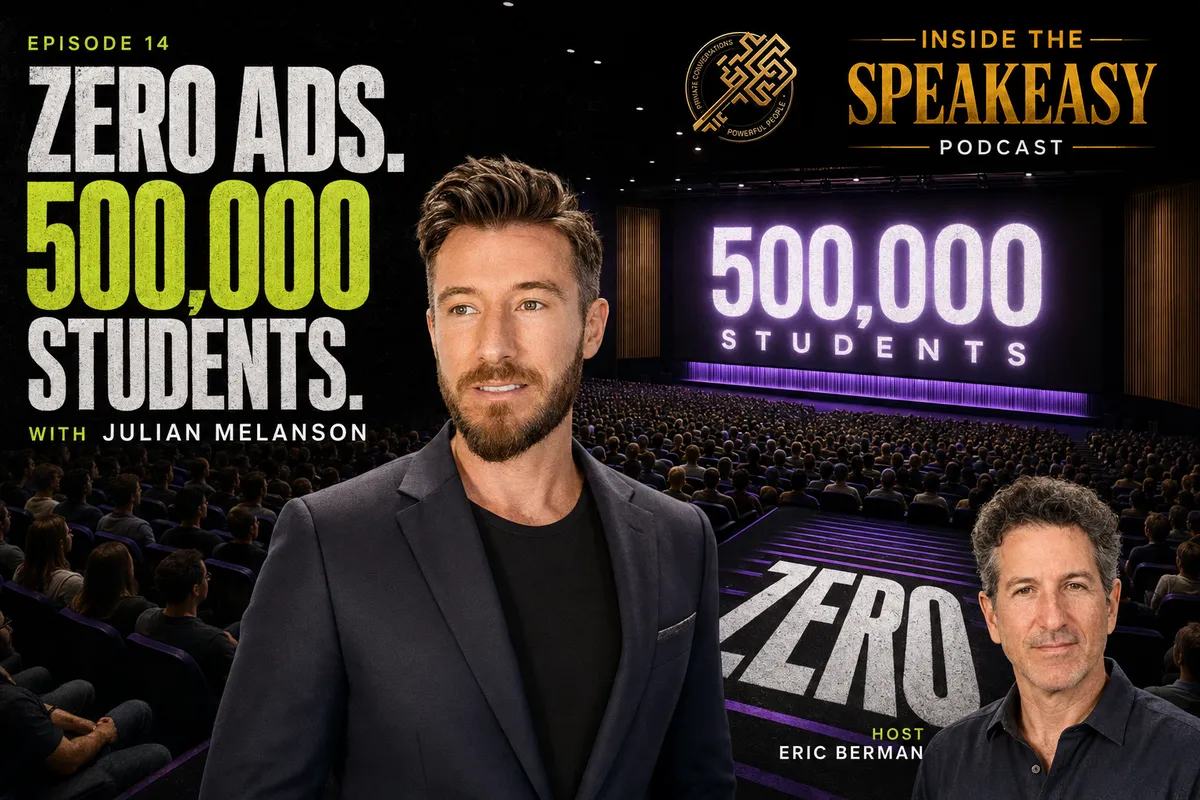
Julian Melanson, co-founder of Leap Year Learning and creator of The Complete AI Guide on Udemy, spent more than a decade as a freelance filmmaker before he realized the work no longer felt right. In this conversation with host Eric Berman, Julian explains how growing up with synesthesia shaped his love of video and how a chance introduction on a retreat led to his first bestselling online course. He describes walking out of a 10-day Vipassana silent retreat, seeing ChatGPT for the first time, and telling his business partner to stop every other production. He then explains how that course grew to 280,000 students without a single paid ad, the global AI-assisted workflow behind two new hours of content each month, and why he believes the future of education looks less like long courses and more like AI agents.
In this episode, you'll discover:
- How Julian turned a few months of research on ChatGPT into a course that grew from 12 to 36 hours and now enrolls around 6,000 new paying students per month
- Why Julian has never paid for an advertisement and instead doubles down on the course trailer, title, and thumbnail
- The workflow that spans Argentina, Los Angeles, and the Philippines and uses AI and custom GPTs to add two hours of new content every month
- How Julian validates a course idea before filming, using tools like Udemy Insights, vidIQ, and Google Trends to avoid niches that are too small
- Why Julian believes long online courses will give way to short lessons that teach people to use an expert's custom GPTs and AI agents
Episode Summary
Julian Melanson has been a member of Speakeasy's Los Angeles chapter for over a year and has hosted the last two chapter gatherings at his home just north of Santa Monica, with 25 to 30 people each night. Eric opens by explaining why Speakeasy prefers homes and offices over restaurants: interruptions from servers break up the moments when someone is sharing something valuable. Julian adds that attending a recent global Speakeasy event, instead of a training he had planned that weekend, has already led to multiple business ventures and ideas.
Julian says he was born to be a video creator. As a child of five or six, he would hear a few seconds of a song in the car and see the music video playing in his mind. He later learned he has synesthesia, in which his visual and auditory senses are blended, so sounds also arrive as colors, shapes, and physical sensations. He says it can let him watch a movie and estimate how old the editor is. In school, though, the input was overwhelming. He describes it as putting a terabyte of content into a small SSD drive, and he was a C and D student who photoshopped his report cards.
Too timid for the stunts his skateboarding friends were doing, Julian picked up a camera and filmed them instead, posting the videos on a brand-new site called YouTube. That led to more than a decade of freelance work with Red Bull, Discovery Channel, music videos, and documentaries. Over time, using his creativity to sell products people did not need, or to promote songs with negative messages, left him feeling empty. While on a retreat about eight or nine years ago, someone introduced him to an online course creator who told him he had an audience. His first course, a complete filmmaker guide, instantly became a bestseller, and Julian realized he could earn hundreds of small paychecks from students instead of one or two large ones from clients he did not believe in.
Julian describes a pattern of reinvention he credits to taking time away from being busy, including what he calls a midlife crisis at 21. He stopped accepting client projects he did not believe in, then stopped client work altogether to focus on education. After finishing a project that produced 60 online courses in 12 months for an education company, he went on a 10-day Vipassana retreat with no phone, laptop, or notebook. Shortly after he returned, a friend showed him ChatGPT. Seeing it with what he calls an empty mind, he told his business partner to stop every course in production, a decision he calls the best business decision of his life. He ties that clarity to being out of survival mode.
Analytics showed the ChatGPT keyword, only a few months old, already outperforming long-established keywords like cinematography. Julian and his partner spent months researching, contacting experts on LinkedIn, buying the few courses that existed, and watching YouTube videos before structuring the material into a course filmed by a team in Los Angeles. The Complete AI Guide started at about 12 hours and is now 36 hours, covering more than 50 AI tools, with 280,000 students and skill paths for entrepreneurs, business owners, employees, and creatives. A team in Argentina uses AI and custom GPTs to research and draft new curriculum, Los Angeles films it, and editors in the Philippines finish it, producing two hours of new content each month. Julian's company, Leap Year Learning, also builds custom courses for businesses, including a 10-hour Midjourney training for 5,000 Samsung graphic designers.
Julian says he has never paid for an advertisement. He focuses on the course trailer, title, and thumbnail, prices courses between about $10 and $40, and relies on volume and on reviews in a public marketplace as his best business card. He argues that Udemy suits creators who want to reach many students, while a platform like Kajabi suits those with a warm audience and a funnel. Looking ahead, he expects AI to do to many skills what IKEA did to woodworking, and believes experts will sell short lessons on using their custom GPTs and agents rather than long courses. Eric, a father of two young children, agrees that schools will be forced to change, and Julian closes with a call to use AI maturely rather than to siphon wealth from others.
Big Ideas Discussed
Quality Is the Filter That Replaces Paid Advertising
Julian has never paid for an advertisement to drive sales of his courses. Instead, his team puts its effort into three assets every Udemy shopper sees first: the course trailer, the course title, and the course thumbnail. In his words, it is about the right course at the right time for the right audience with the right messaging. He acknowledges that free lead magnets and price ladders have their place, but he believes quality is an excellent filter in a market crowded with content.
The marketplace itself does much of the selling. Julian compares Udemy to Amazon and Yelp: anyone can claim thousands of five-star reviews on their own website, but publicly verified reviews in a marketplace carry weight that self-published claims cannot. He calls those reviews the best business card there is, and says the visibility also brings in business clients with large budgets for custom courses. For creators deciding where to sell, his advice is to match the platform to the goal. A warm audience and a funnel suit a self-hosted platform like Kajabi, while reaching as many students as possible suits Udemy.
Get Out of Survival Mode Before You Make Big Decisions
One of the threads running through Julian's story is that his biggest career shifts came from what he did outside of work. He calls himself a video producer, meditator, and yogi at heart, and says the time he took away from being busy is why his reinventions happened in his twenties rather than his forties or fifties. He first stopped saying yes to projects only for the money, then stopped client work entirely to focus on education.
The clearest example came after his 10-day Vipassana retreat. Returning with no next project in mind, he saw ChatGPT and immediately told his business partner to halt every course in production. Eric points out that Julian was able to act as a visionary because he was not worried about paychecks or clients banging on the door. Julian agrees and says being out of survival mode is rarely discussed. When people are focused on rent and food, he argues, life carries them along, but when they move beyond that fight-or-flight state, they can start choosing where they actually want to go.
Build a Workflow That Multiplies Your Team
Keeping a 36-hour course current in a field that changes weekly would be impossible with a traditional production process, and Julian says as much. His solution is what he calls a Star Trek workflow. A team in Argentina uses AI to find the latest tools and tutorials, takes the transcripts, and synthesizes them into curriculum using custom GPTs. That material goes to Los Angeles, where the team films what happens on screen and on camera, and then to editors in the Philippines who add screen captures and overlays and assemble the final lessons.
The result is two hours of new content added every month. Julian's broader lesson for business owners is to zoom out and design the workflow first. He recommends finding virtual assistants through onlinejobs.ph and training them on the AI workflows you have built. As he puts it, using AI yourself can make you feel like 10 people, but training your VAs to run those workflows can give you the output of a hundred employees.
Courses Will Shift From Teaching Skills to Delivering AI Tools
Julian, who still creates eight-to-30-hour courses, believes that format is headed for major change. He uses woodworking as an analogy: craftsmen once spent their lives building tables by hand until IKEA modernized the process, and he expects AI to do the same to many skills. He once spent hours teaching color correction, but now a person can simply ask an AI tool to make footage look like The Matrix without learning the technique.
His prediction is what he calls AI companion learning. Instead of a five-hour course, an expert might offer a 20-minute course on how to use their custom GPT or agent, giving students a done-for-you button for work that once required hours of study. Rather than selling a course on Facebook ads, he imagines selling a one-button Facebook ad agent. He also notes that one-to-one learning is the most effective style and a course with 100,000 students is the least, and he sees AI making personalized learning possible at scale. He adds a caution: because the internet is only about 21 or 22 years old and AI is newer still, these tools need to be used maturely.
Questions We Answer in This Episode
How did Julian Melanson get into creating online courses?
After more than a decade of freelance video work for clients like Red Bull and Discovery Channel, Julian Melanson felt empty making content he did not believe in. While on a retreat, he was introduced to an online course creator who told him he had an audience. His first course, a complete filmmaker guide, instantly became a bestseller.
What is synesthesia, and how did it shape Julian Melanson's career?
Synesthesia is a condition in which senses blend together. For Julian Melanson, visual and auditory senses are crossed, so sounds also arrive as colors, shapes, and physical sensations. It made school overwhelming, but it fueled his love of cinematography and led him to video production and, eventually, online education.
How did Julian Melanson decide to build an AI course?
Julian Melanson saw ChatGPT shortly after returning from a 10-day Vipassana silent retreat. Analytics showed the new keyword already outperforming established ones like cinematography, so he told his business partner to stop all other productions. He calls it the best business decision of his life.
How big is Julian Melanson's AI course on Udemy?
Julian Melanson says The Complete AI Guide started as roughly a 12-hour course and is now 36 hours long, covering more than 50 AI tools. It has 280,000 students, adds around 6,000 new paying students per month, and receives two hours of new content every month. He expected it to cross 300,000 students within a few months.
How does Julian Melanson sell courses without paid advertising?
Julian Melanson says he has never paid for an advertisement to drive course sales. His team focuses on the course trailer, title, and thumbnail, prices courses between about $10 and $40 for high volume, and relies on publicly verified marketplace reviews, which he calls the best business card there is.
How can course creators validate an idea before filming?
Julian Melanson recommends pre-production research before producing anything. He uses tools like Udemy Insights, vidIQ, and Google Trends to check search volume, aiming for a flagship course on a large, in-demand topic. He warns that very small niches may never find a big enough audience.
How does Julian Melanson think AI will change online education?
Julian Melanson expects long courses to give way to what he calls AI companion learning. Instead of teaching every technique by hand, experts will offer short lessons on how to use their custom GPTs and AI agents. He also believes AI will make personalized, one-to-one style learning possible for far more people.
Full Episode Transcript
Read the Full Episode Transcript
A Cold Open and Hosting the LA Chapter at Home
Julian Melanson: What does this mean for online courses? What does this mean for selling products? Because of my specific background, I know that I've spent hours teaching people how to do color correction, let's say in a video editing application. Well, now you can just say, make my footage look like it's in the stylization of the movie The Matrix and you don't need to know the technicalities and the nuances of how to make that yourself. So content and education and free versus paid is really going to go through an interesting transformation. I had a bit of a pessimistic view.
Eric Berman: Welcome to the Speakeasy Podcast where the real conversations happen. Behind closed doors with the boldest entrepreneurs, creators and growth minds in the game. No fluff, no filters, just the raw strategies, personal stories and mental models that move the needle. I'm Eric Berman. Now let's get into it. In today's episode you're going to learn from Julian Melanson out of our LA chapter who has the top selling AI course out there. He's cracked the code on Udemy. He's one of the biggest content creators and course creators out there and his journey to how he got there is quite incredible. Going from an interesting superpower he didn't realize he had as a kid and ultimately finding his path after going on a ten day silent retreat only to walk out of that to be discovering ChatGPT and what happened after that is an incredible story. So excited to bring to you today.
Julian Melanson: Julian Melanson, thank you for having me. Yeah, I'm excited to chat, I'm excited to, you know, catch up. It's been a minute and I've been a member of Speakeasy now for over a year and you know, we actually been hosting the last two speakeasies at my house.
Eric Berman: I hear you have a great house out in what, Santa Monica area?
Julian Melanson: Yeah, Santa Monica, just north of Santa Monica. A great turnout, 25 to 30 people each night. Amazing crew and it's been actually really fun to host at my house. Done for that style of networking event.
Eric Berman: Yeah, it's cool. I mean that's part of the vibe here is like we don't want to do the restaurants, right? It's all about the houses, the offices. Creates that little, that bond and it's just a different experience. I know when we tried it years ago we were doing restaurants and it's like every time somebody be dropping a nugget it would be like, okay, can you like to add more water to your glass? Can I get you something else? And it's like ah, right in the middle of it. But thank you for hosting. That's awesome. I heard your house is amazing and LA Chapter is growing on fire and I was stoked to be able to needle you and come into the global event we had. And you had a great time in there. So thanks for coming to that.
Julian Melanson: I'm glad I did that one as well. I was going to be at a [unclear] training for that weekend, decided to move that went to the event that has already led to multiple different business ventures and ideas. It's been really cool.
Eric Berman: Awesome, awesome. Well, really cool. So let's dig in.
Synesthesia and a Kid Born to Make Videos
Eric Berman: I want to hear you told me a little bit briefly when I met you, but I want to hear more of the story because from what I was told, it's some really cool stuff, your background. So just walk me through how'd you before you became the online course the AI guru, just crushing on Udemy and other platforms. How did you get there?
Julian Melanson: Yeah, I mean it's a great question. I fully know this in my heart and my soul. I was born to be a video creator in this life. It's no other way around it. When I was five or six years old, I would be sitting in the car with my parents, driving at the time, hearing music in the car and seeing the visuals, seeing the music video, seeing the movie that would be playing to the songs I was hearing. And even at that young age, I thought it was a certain amount of wizardry and magic that I could hear two seconds of a song and it would instantly change my state, instantly inspire, instantly fearful, scared, excited, whatever it was, joy. All from one little bit of the song. And I don't know, for some reason that just really stayed with me throughout childhood. And I was always listening to things. I always appreciate cinematography from a really young age. And I actually have a condition called synesthesia where some of my synapses are. My visual and auditory synapses are slightly blended together and slightly crossed. Other people have it a lot more intense where. Where they taste sounds, they hear sensation, they smell visuals. I have it blended with the visual and auditory part of my mind so I can see and hear colors and shapes from specific. A violin will sound a certain way. I didn't have any words to this when I was growing up. It was actually quite overwhelming in middle school and high school, so there was so much going on in my mind. It was difficult for me to socialize at times.
Eric Berman: Give me an example. So you're a kid. What's happening to you that's different from others?
Julian Melanson: So essentially that amount of data that I would be taking in is a much. What I know now is a higher amount of data than the average individual. So when I see a song in the first few beats of the song, I can already. The music video is already playing out of my mind. What the shots are, what the visuals, the color, the tonality. But it'll also come in shapes. It'll come in sensation in the body. A spiky sensation from a certain sound or a smooth sensation. And it'll be an auditory, visual, and also physical sensation in the body. I didn't really know until I started to research it a little bit more as I talked to friends. And when I would watch a movie, I'd be so entrained in what I was seeing on screen. That's also what I wanted to give to other people. Which is why I got into the video production. Because as I was saying, I didn't excel in school. I was overwhelmed. There was already a whole thing going on here. How to talk to 30 other students in my class when I'm already having so much input. It legitimately felt like putting a terabyte of content into a small little SSD drive.
Eric Berman: Scary. You're probably wondering what's wrong with you, like, what's the deal? And you're like, don't you guys all see this too?
Julian Melanson: Exactly. So there's visuals that I'd be constantly seeing and people that would speak. I would also be able to feel. Feel what they were feeling. So it's also empathetic, energetic sensitivity there too as well. Where I can feel why a video? I can watch a movie and tell pretty closely how old the editor is. If he's cutting on the beat, the song choice, coloring choices, if he's cutting before the beat, after the beat, the pacing, all these things I can feel. The person that did the content never heard that.
Eric Berman: So it's quite fascinating. Interesting. Okay, so keep going.
Julian Melanson: These were all things that were a double edged sword that I didn't expect.
Photoshopped Report Cards and the Early Days of YouTube
Julian Melanson: I was a C and D student. I photoshopped my report cards. So that led to me finding the camera because I was overwhelmed with what I was sensing, feeling. I was honestly into skateboarding at the time and I never had that type of daredevil style. So I was like, wow, all my friends are doing these things. I gotta do something cool. So I might as well get a camera and film the cool things that they're doing.
Eric Berman: Yeah.
Julian Melanson: And this was back when YouTube is getting started. So there was this brand new thing called YouTube. We didn't. There was no influencers, There was no social media authorities or people monetizing their following at this time. So I started creating content as a teenager and uploading it online and started to get feedback from people that started to follow my account. We didn't know what a follower was at this time. There was no ecosystem around this. And I went through school, like I said. I photoshopped some report cards to get through that. I did not excel that later down the road is why I got an online courses, because I couldn't sit in a room with fluorescent lighting, air conditioning, a teacher that I don't align with. It was hard for me to be in that learning environment and I wanted to give other students what I would have excelled in, which would be an online course where I could learn at my own pace, with a teacher that I like, that I could do it at my own speed, with cinematic shots, with great sound, with all quality. That I felt was a great combination of the two.
Freelance Burnout and a First Bestselling Course
Julian Melanson: So it's funny how the childhood and all those things kind of lead. Long story short, there was years and years, over a decade of freelance working with Red Bull, Discovery Channel, music videos, documentaries, traveling. And that also lost its charm. I had a lot on paper, but I felt a little empty, to be perfectly honest.
Eric Berman: Interesting. I mean, you were finding that you're. I mean, you're loving doing the stuff, but it worked with your strength and you sort of found your superhero strength inside of you, but you started getting burnt out by it.
Julian Melanson: The creating content, using my creativity to sell another person's product that people don't really need, or to make an amazing music video where the song itself had violence or negativity in it. It started to just kind of wear on me after the funness of like, oh, I just got this $10,000 project. Like, that was amazing at that time. But then that started to wear on me. And strangely enough, my whole career has actually been developed through what I did outside of my career has always fed my next path in my success. So I'm more of a meditator yogi at heart. I'm a video producer, a meditator, a yogi at heart. And I was on a retreat. Someone I met through a crazy circumstance introduced me to someone who was an online course creator and he said, you should do this. You have an audience. And I never thought that. I thought people would Google it for free or go to school. I didn't realize that there's this whole middle ground. This is eight or nine years ago. And I said, okay, cool. I made an online course for filmmaking, a complete filmmaker guide, and it instantly became a bestseller. It blew up online. I had no idea what I was doing. And that was a total light bulb moment. There was many light bulb moments that led up to that, but that was a total aha moment. Said, wow. I can make hundreds of tiny paychecks from individual students that are benefiting from my content versus one to two large paychecks per month directly from a client that's making a product or a video that I truly don't believe in.
Eric Berman: Right. So I mean, that's the key there. I mean. Cause it's interesting as you share the story. Your talents and skills were there before, but your heart wasn't in it because it wasn't something you believed in. Now all of a sudden, the entrepreneurial light bulb goes off and says, well, wait a second. Rather than doing that, I'm going to build my own. Obviously, I believe in my own stuff. I'm passionate about it now. You're really finding a lane right now that you're loving. Love it. So, okay. I said, you're just getting the inspiration. This is great. Okay, keep going.
Julian Melanson: And I think that those reinventions of myself happened. I always tell people I had a midlife crisis at 21 because I woke up. I said, why am I sprinting towards death? I'm just. I went through school, now I'm working, and then where am I even actually going towards? So I was always plugging and getting away out of the to do list of life. That allowed for me to continue to get to the next level of, you know what, this is not doing it for me anymore. I know there's something deeper. And I would go and I would switch into a new career. There was a phase of, oh, well, I'm not going to take on client work anymore if I don't truly believe in it. And then I stopped saying yes to projects for the money. And that was a whole. I felt that in my stomach. That was scary. And then it got to, well, you know what? I'm not even going to do these client projects anymore. I'm going to only focus on education. And that was another evolution. But those evolutions only happened. Maybe it was should. It would have happened in my 40s or 50s, but it happened so much younger because of the time I took off, not being busy.
Eric Berman: Right.
Julian Melanson: Those breakthroughs of changing the career.
Eric Berman: Oh, you signed you take risk early on. I mean, you gave up what a lot of people have a hard time and don't figure out for a while. But I think deep inside of you, you listen to yourself. So that's fantastic. Good on you for that.
A Vipassana Retreat and the Discovery of ChatGPT
Eric Berman: So now you're making the courses, you get the film one, you're getting these little micro checks people are buying, they're loving what you're building, they're like, I want more. So what happens?
Julian Melanson: So I essentially start with doing filmmaking courses, video editing, pre production, post production, cinematography, and expanding the different courses that I was offering personally. Doing a lot, writing the course, being on camera, editing it. I had a small team, but honestly my team that I was doing the video production, I did, there were so many iterations before that to real estate, walkthrough videos, music videos like fashion films, and it wasn't really hitting. So when I got to that phase I started to get a large online following now for this whole filmmaker side of me. But then that also started to not be my full self as well too. And strangely enough I went on a Vipassana retreat. And I don't know if you've heard but it's 10 days in total silence. No phone, no laptop, no journaling notebook, nothing but you with you, with you, with you. That's the technique of meditation that came from the east.
Eric Berman: Yeah.
Julian Melanson: And so I just emptied, did what I do to reset and to find where I'm going next, which was to not focus on my work, which is probably the opposite advice in some people. It's worked for me. It's so wild because I don't know, my, my life's been orchestrated in a very interesting way. So when I left, I finished a huge project for education company. We produced 60 online courses in 12 months. 10 Hour course each a different teacher was flowing from around the country. A course on psychology, physics, chemistry, biology, calculus, everything finished. This huge project, built out a whole studio, went on this trip, had no idea what I was going to do next and I come back and one of the first things after I get settled back into town that my buddy shows me is a thing called ChatGPT. I never heard of it, never knew what it was. And we had multiple courses in production of some music production, video production courses. And I'm so empty and seeing something with so much clarity that this was the next thing. So I told my business partner we need to stop everything we're producing right now and we're going to make a course on this. And that clarity alone was the best business decision I've ever made in my entire life by far.
Eric Berman: So it's almost like you didn't have the part of it is you're operating sometimes not worrying about the paycheck, the fear, the clients. You're just operating from what makes sense and what's right. Like you said, an empty mind at that point didn't have all these things clouding you and clients banging on your door. You just had the ability to be a good visionary, really.
Julian Melanson: I agree, I agree.
Getting Out of Survival Mode to Make Better Decisions
Julian Melanson: And I think that's something that doesn't really get talked about a lot is being out of survival mode. Because when you're out of survival mode, you can expand onto newer, bigger, higher versions of yourself and possibilities of life. So when we're in survival mode, we're due to our fate where our fate where life is almost taking us. But when we get out of that survival mode and there's just different levels of survival mode, putting food on the table, paying rent, you know, there's all different intensities of it. But when you get beyond that and you can expand into something higher and you're not in that fight or flight, how am I going to make this next thing work? Then you can get more into your destiny where you're crafting where you truly want to go. And I don't really see that. Talked about a lot. Big believer in energy and I'm a big believer in you create your reality. Your reality is we're having this conversation. It's two realities combining into one to create a collective moment, a collective consciousness between just you and I.
Eric Berman: Right.
Julian Melanson: And your past is determining your reality. My past is determining and that's coming together and creating this new third entity.
Eric Berman: Right.
Julian Melanson: And so yeah, being free and luckily getting into the online course business, luckily building the passive income streams, luckily being able to go to a 10 day retreat, luckily being able to come back. That was a non scarcity that allowed for this brand new thing to just drop on my lap. Completely effortless.
Eric Berman: But so the shining star was ChatGPT. You come in, it's like calling on you glowing with all your sensory [unclear]. Like all the shapes are hitting you. When was this? Because obviously when does somebody hit, you know ChatGPT? Is it right at the beginning when it comes out?
Julian Melanson: It was November of the year. It really when GPT-3 was released. I don't know if it was 21 or 22.
Eric Berman: Okay. So yeah, I don't remember either. But yeah. So that long ago already. My gosh. Okay.
Julian Melanson: Honestly, a little bit scary how long ago that is.
Researching and Building The Complete AI Guide
Eric Berman: Yeah. Okay, so now you see it and you're like, this is our future. Everybody stopped the presses, we're going all in. That would happen.
Julian Melanson: I looked at some analytics and saw how it was just out for a few months, but already performing higher than keywords that have been here for years, like cinematography. So it was just a no brainer. We made that decision, just went into full research mode. I talked to every single expert I could speak to on LinkedIn. I went and down purchased every single course. There was only a few that existed at that moment, every single YouTube video. We started synthesizing every single bit of important information that we could find online that about ChatGPT, about AI, about the intricacies of it, synthesizing all that content and then started to structure it into a course. Because that's where my expertise comes from is how do you take a concept and remix it and place it into the outline of a best selling course?
Eric Berman: Hmm.
Julian Melanson: It's similar to a book, similar to writing a book. So we went into that research mode using ChatGPT and just using the online courses that we could find the YouTube every single avenue we did for months. And we started to put the pre production plan together, my business partner and I and hired the team to produce all of it in Los Angeles. It started out as a, I think a 12 hour course. Now it's a 36 hour course with 280,000 students. So we're going to cross 300,000 students in the next few months. We get around now 6,000 new students per month that are paying for this course. And it went from just the ChatGPT course to now over 50 different AI tools for entrepreneurs, business owners, employees, creatives. There's a whole skill we whole. We did. It's really exciting actually. I just, we did a whole revamp on the course because now it got built out so much it's hard for one student to go through 36 hours of content. We now created skill paths where if you're an entrepreneur, you'll go through section 5, section 10, section 12, and there's a path for you. Creative business owner, really.
Eric Berman: So really the whole overall promise of the course, if you're looking from before you jump in, is no matter where you're at, what your position is, we're going to educate you on how to leverage AI in the world you're playing in kind of thing. And we have a bunch of modules that are custom to you and what your needs are and we're gonna teach you whatever existing tools are. And then what? When new tools come out, you're gonna be exposed to that. Is that sort of the concept?
Julian Melanson: Pretty much. It's a complete handbook to bring you from a complete novice of AI, the architectures, the models, to proficient, confident in using it in your daily life. So we break down everything prompt engineering, we break down all the different reasoning models, we break down how LLMs work. There's all theoretical training chapter is like a full on education, it's a full on certification on how to use AI.
Eric Berman: Wow, that's amazing. And so where do people find this? Like what, what's it called? Where find this thing?
Julian Melanson: Yeah, this is The Complete AI Guide and it's on udemy.com and it's actually the top selling AI course in the country. And like I mentioned, this was from years of building, ready for something like this, for this to happen and evolve.
A Global AI Workflow for Two New Hours of Content a Month
Julian Melanson: So we add two hours of new content every single month we have. And that's the other interesting thing I think for business owners that's relevant is the workflow. There's only so much you can do with your team and your current workflow. But we now have a team in Argentina that's using AI to research the latest tools online, finding tutorials for the newest updates, taking those transcripts, synthesizing everything. So basically taking the best newest content on the best newest AI updates, synthesizing those into a curriculum using custom GPTs, and then sending that here to Los Angeles where we film what's happening on screen or on camera. And then that gets sent to the Philippines for all of our editors to then put in the screen captures, the overlays, edit everything together. So we've completely have what I call Star Trek workflow that allows for us to create two hours of content. It's impossible to keep up. It's impossible. But zooming out and getting that workflow in place, having VAs that you can find onlinejobs.ph, one of the best websites you'll ever use that are trained on AI workflows that you've developed. And you train your VA on that takes you turning into 10 people, but you train your VAs how to do it. Then you can get a hundred employees, essentially.
Eric Berman: Wow. Oh, that's incredible. Okay, so you got just a factory going. You got efficiencies using AI. You're obviously drinking your own Kool-Aid, if you will, of the courses you're going out there. I mean, it's funny because, you know, I go online everywhere you see, you see other people throwing off courses. Oh, AI course this and we're going to teach you that. And the reality is they're all chasing you right now. It seems like as far as the being the number one AI course content that's out there and now and how do people measure it? I mean is it.
Leap Year Learning and Custom Courses for Samsung
Eric Berman: You said Udemy, is there other places you sell or is that the platform and how's that experience?
Julian Melanson: Leap Year Learning is the education company that I co founded and that is all AI and coding based courses. So we host our courses through there as well and we also do consulting for companies and we've worked with other businesses like Samsung and developed complete custom courses for their employees.
Eric Berman: Got it.
Julian Melanson: So we did a 10 hour training just for what was an insane number, 5,000 of their graphic designers and showing them how to use Midjourney. So clients will come to us needing a course or client that's built from scratch on AI or they'll come and wanting to white label our course and have it for their employees as well. But yeah, you can find everything on Udemy. Leap Year Learning is the account and then leapyearlearning.ai is our website.
Eric Berman: Amazing.
No Ads, Low Prices, and Quality as the Filter
Eric Berman: And then like what's, I mean I have no idea the business model, like what's a course go for these days? What are you able to charge, you know, based on the world of. Because I always think about, you said something earlier which I thought as well, like the world is moving towards free because there's so many people out there just like, hey, get my free course on so and so. Because they're then trying to upsell you into something bigger. Whether it's, you know, one on one, you know, a lot of people obviously turning into AI consultants out there and they give away free courses. Clearly they look at your, you know, list of stuff and how good quality is. How are you able to charge for that and how have you seen that world play out?
Julian Melanson: Yeah, I mean it's an interesting world right now because what is a value when anyone can create anything with the English language? I've been thinking five years ahead ever since I originally saw ChatGPT of what does this mean for education? What does this mean for online courses? What does this mean for selling products? Because of my specific background, I know that I've spent hours teaching people how to do color correction, let's say in a video editing application. Well now you can just say make my footage look like it's in the stylization of the movie The Matrix. And you don't need to know the technicalities and the nuances. Of how to make that yourself. So content and education, free versus paid is really going to go through an interesting transformation. I had a bit of a pessimistic view this past year, before this past year, now this year, in this last six months, I actually, I see a lot of amazing possibility which we can get to that. But to answer your question, I mean, I'm the video lover of cinematography at heart, so I've always spoken. You won't believe this. We don't do any advertising, any marketing. I've never paid for an advertisement to drive any of these sales. We double down on the course trailer, on the course title and the course thumbnail. So it's all about the right course at the right time to the right audience with the right messaging behind it. So I believe if you're truly offering value, yeah, there's of course lead magnets. You want to offer things for free and get people into your, you know, your price ladder so you can upsell them. But a free course is something you can use as a technique. I just always feel that quality is an excellent filter. You know, there's so much quantity of content. There's ways to hack algorithms where it's not really quality content, but it still rises to the top. But at the end of the day, we've always focused. I'm not a marketer. I've always been more of the creative. I don't want to sell you on something. I want you to see what I created and if it resonates with you and you feel it, then you, you.
Eric Berman: Want to buy it.
Julian Melanson: Like, that's been my mentality.
Eric Berman: Well, I think just in listening to my belief is probably goes back like you said, the quality. You know, people will look at somebody else as, hey, get my free so and so. And then they look at yours, they see the trailer, they see what's going on, they say, oh man. They see the number of downloads probably more than anything else in ratings. They're probably like, damn, why is this thing been downloaded this much?
Julian Melanson: Right.
Eric Berman: I suppose the person who, you know, you're probably, I'm going to guess your target or your avatar is more of the person that's generally interested in investing in themselves to make them better versus just a looky-loo who's kind of like just experimenting and playing around, but not that serious to get in there and say, I really need to learn this. I'm a professional graphic designer. In that example gave earlier. I need to really get my poo poo together to save my job and my career. Probably I better go in here and do the and this has got to be high quality. And they just know that it's going to be the right thing and they're going to learn from it. So that's probably your winning. Is that fairly accurate would you say?
Julian Melanson: Yeah, I mean quality first. I also believe in making education available to the masses. So I'm not selling a $3,000 high ticket item. These courses sell between 10 to 20, 30, $40 but at high volume. High volume, 6,000 enrollments per month. You're selling your courses at a grade with upsells and other things in that ecosystem. I truly want to help the planet. That's my vision. So I do believe in focusing on you know and dialing in is like following what your own remix of business. You know I've, you know what I learned online and Udemy might not make sense to some people. They think it's, you know, you only should host your course on Kajabi own platform. That's great. If you have a warm audience with people that are ready to buy and you have a marketing funnel then you can host your own platform. If you want to focus on creating a high amount of courses that have a high amount of students. Udemy is a good platform. So yeah it really depends on the individual what their goal is. My goal is massively affect the entire planet on a massive scale. So reach as many people as possible.
Eric Berman: What would you say your is your percentage mix of sales? Probably what 80, 20. Udemy and like way higher on Udemy than your main site.
Julian Melanson: It's kind of funny like as far as students. Yes. But then we'll get business clients, you know, massive budget to do a custom course.
Eric Berman: That's I can see that they probably see a Udemy see the quality. See you're legit. Like who are these guys behind the scenes? Oh let us go build something out.
Julian Melanson: It's the best business card because it's a marketplace like Amazon. I can have a shower filter on my own website and I can tell you that it has 10,000 five star reviews. I could say whatever on my own website when it's a public marketplace with publicly verif like Yelp is a marketplace. Amazon is a marketplace. Udemy is a marketplace. So we have 50, 60,000 reviews with 4, 5 out of 5 stars. So I don't need to sell you on that. That's the best business card that there is when it comes to this type of you know, when an online course or just reviews in general.
Eric Berman: I mean that's A whole killer sort of. Even within our community. I don't know how many people really crack the code of Udemy. So I think that's great for anybody listening to know they could reach out you for that as well. I mean of course creation.
Pre-Production Research and the Shift to AI-Powered Courses
Eric Berman: But Udemy, I mean did it take you a while to crack that code or does it just go back to. I just had great content that I was passionate about and I went in there and doubled down on that at the right time. Right quality. Yeah.
Julian Melanson: I would say it's a lot easier to create a course that does hardly any movement than it is to create a bestseller. So the goal is to create a flagship course on a specific large topic that's high in demand. That's just a bestseller. Just like an Amazon product. You want to get that bestseller badge even if it's not on Udemy. It's just the right course and where that comes from is the pre production research. So there's different tools Udemy Insights, vidIQ so that you can see search volume on YouTube. Because if people are searching AI for beginner on YouTube 4 million times a month, that's probably gonna be a decent niche to go after. There's Google Trends as well. There's just an endless amount of keyword listing analyzers that you can use. But really analyzing that if it's so niche around horse training, you know there's like so many small niches that we're not going to have a massive audience. You got to be a little bit careful with those offerings. But you just. Yeah, you want to do your pre production, I call it pre production. I come from the film world. But your preparation, your pre planning to really do your research before filming, before getting all down the rabbit hole of what you're going to produce and all that stuff, I've seen that happen to a lot of creators and it can be a little bit dangerous. You want to verify your idea first.
Eric Berman: Right.
Julian Melanson: The interesting thing too because that's. That's one thing education is going to change a lot. I come from this world where I'm creating a eight to 30 hour course, you know, and there's other people that create the short form where I really see this going. People aren't going to need to know the exact skill set. Like there used to be a day and age where people were woodworkers and they all they would do is build a table with wood their entire life and they could churn out 100 tables in 10 years. Then something like IKEA comes along and just totally modernizes that whole thing. The craftsmanship of woodworking is now not in the masses. AI is really going to do that same thing where I'm not going to need to know all the techniques that I would teach someone in a cinematography course. They're just going to need to know how to do a good prompt the way courses in my mind. I have thought about this a ton. Is of course AI companion learning. You want to teach your audience, monetize your audience. Not by having this crazy long course that's five hours. You want to have a 20 minute course on showing your audience how to use your custom GPT, how to use your custom agent, how to use something that they used to have to learn for 10 hours, that it's a done for you AI button that they now push. That's where education is going to go. So regardless on Udemy, that's something is super, super, super important that I don't want anyone out there to waste their time doing courses and trying to monetize the old fashioned way.
The Future of AI Education and Using AI Responsibly
Eric Berman: Very interesting. I mean you just touched on the last topic I want to hit is the future. I mean what do you see for. I mean you're finally in your lane. You're on fire right now. You're feeling great, you're doing things like you said, your mission, you're helping affect the lives of thousands and thousands of people to get educated and making a real difference and impact out there. Where do you see it going in the future? Yeah, your business and other.
Julian Melanson: Yeah, I mean I see creating other AI millionaires. I see that what this whole future is holding is a complete explosion of, of education and of being able to transform the way content is created. So for example, my buddy Sammy who you know, he went and got a test done and he turned the test results into a podcast so that he could learn about what his test results were versus reading a art, a breakdown from the doctor's office. He is having his kid instead of passively consuming content and watching whatever the kids show. You know, used to be Teletubbies. It's something different now. Yeah, Cocomelon. Instead of passively watching now with the iPad, he's saying, hey, what do you want to create today? Oh, I want to create monster trucks. Okay, great. Let's hop on a ChatGPT. Let's generate some monster trucks that you can, you can watch and play with and edit. How big do you want the monster truck tires to be? So kids are now going to be able to be content creators generating videos. Everything from a young age. So what happens when I can turn a PDF into a podcast, a photo into a video, an article into a song, all so that I can understand the world around me and ingest content in a brand new way of this multimodal synthesized thing where anything can get created for the betterment of us. Understanding the world around us.
Eric Berman: God is, it's crazy. I didn't even think about that. The imagination really just going to be anything you want.
Julian Melanson: Zero height to where we can go. But the downside is that we have to be mature around how we use these tools. The Internet is only I think, what, 21, 22 years old since it was something around that. So it's old enough to drink. It's still very immature young. It's not even an adult yet per se. And AI is just this little thing that we're just now learning. So we have to use these tools in a mature way to benefit ourselves and not just siphon wealth from the community and other people. So education is going to be going from. I'm going to show you the nitty gritty of how to do this thing by hand. For my example, okay, I'm teaching people how to use AI. Instead of having a long course, I'm going to offer a set of automations and agents that give you the benefit of what the course used to give. You're going to be able to just go like boop. I don't need to learn how to do all this crazy intricate stuff. I can just use this person that's a authority in their topic to hit that button and they're going to be able to create everything that they would have had to take a 20 hour course to learn. I'm going to have my own set of custom AI offerings and all entrepreneurs, I believe it's going to go this way. Instead of teaching you how to run Facebook ads and selling that course on Facebook ads, I'm going to sell my done for you one button automated Facebook ad AI expert agent.
Eric Berman: And I think about this too all the time. Having two little kids right now about, I mean my mind, I'm like, I was talking to my wife, I'm like, I can't imagine, you know, high school is going to be anywhere near what it is today. And I know education is typically slow to catch up, but I don't think they have a choice. I think it's going to be forced. Where I mean you said kind of earlier like whatever the kid wants to learn, like if you force them down a path or there's not going to be that's not inside of them versus being able to pull out where their gut is and what their personalities are going and be able to go deep into that faster, quicker, they can excel so much better. And just having the creativity to not learn necessarily from the, from the classroom teacher right there, but from this world out there. I mean something's going to change. In my opinion there don't know when, where it's just exciting. But like you said, we got to protect, protect ourselves.
Julian Melanson: Yeah. One to one learning is the most effective style. So if you have a one on one coach, you're going to get the most benefit. If you have one teacher with a classroom full of 30 students, you're going to have benefit. It's going to be smaller. If you have one teacher that has an online course with a hundred thousand students. It's actually, to be honest, one of the flaws of online courses that's the least effective. Now AI. What happens to education when I want to learn about ancient Egypt and I can just go and prompt an entire cinematic movie on the exact time period overview with visuals, audio, sound, design instead of reading in a textbook. There's going to be an education explosion because. And then on the other side of that, you're not going to need an expert that is a historian on Egypt that you have to find that one person or buy their course. I'm just going to prompt the exact thing that I want to learn. So the Egyptian expert should be the one that's selling that they could get.
Eric Berman: In their head and work with somebody like you to go get that course in there. So that Fantastic.
Street Smarts, Superpowers, and Next Steps
Eric Berman: Well, I greatly appreciate your time. This is so fascinating and congrats on all the success. I mean, I want to close the loop on something you said earlier. I mean if you go back to that, being that kid in school, if you had AI back then, you could have created a much easier Photoshop C and D report card than you did today. And did you ever tell your parents about that?
Julian Melanson: Yeah, it came. The truth came out, you know, 10, 15 years later, the truth came out that I had street smarts, but not as much book smarts I love.
Eric Berman: Well, you're not alone, obviously in our community, I think a lot of us probably were that same kid sitting around with whatever the thing was, you had a cool little superpower there. A lot of us with our own version of a superpower, adhd, whatever you want to call it, and wondering who are we realizing we're all these, you know, credible entrepreneurs that are dying to do big things and want to get out of the box. And you clearly did that. So congrats on your journey and love what you're doing. I'm excited. We'll talk offline. Love to have you kind of come into. Maybe we'll do a fun virtual one of our virtual events and have you on there with some of our other big course creators talking about course creation and or AI and what you're seeing, and we'll have some fun with that. So perfect.
Julian Melanson: It sounds great. Sounds great. Thanks for having me on.
Eric Berman: Well, thanks. And I look forward to digging in your course myself.
Julian Melanson: Amazing. Amazing. Yeah, looking forward to it.
Eric Berman: All right, Julian, thanks. Have a great day. And that's a wrap from the Speakeasy Podcast. If something sparked for you, don't keep it to yourself. Share it, review it, and pass it to the one person who needs to hear this right now. Want in on the real mastermind? Tap the link in the show notes to apply until next time. Keep scaling, stay sharp, and don't be the smartest one in the room.

About The Guest
Julian Melanson
Julian Melanson is a video producer, AI educator, and co-founder of Leap Year Learning, an education company that creates AI and coding courses and builds custom training for businesses, including a Midjourney program for Samsung's graphic designers. Before turning to education, he spent more than a decade as a freelance filmmaker working with brands and outlets such as Red Bull and Discovery Channel on music videos, documentaries, and other projects. His first online course, a complete filmmaker guide, became a bestseller, and he later led production of 60 online courses in 12 months for an education company. He is the creator of The Complete AI Guide on Udemy, which has grown to 36 hours and more than 50 AI tools, with 280,000 students at the time of recording. Julian is a member of the Los Angeles chapter of Speakeasy Mastermind and has hosted chapter gatherings at his home.