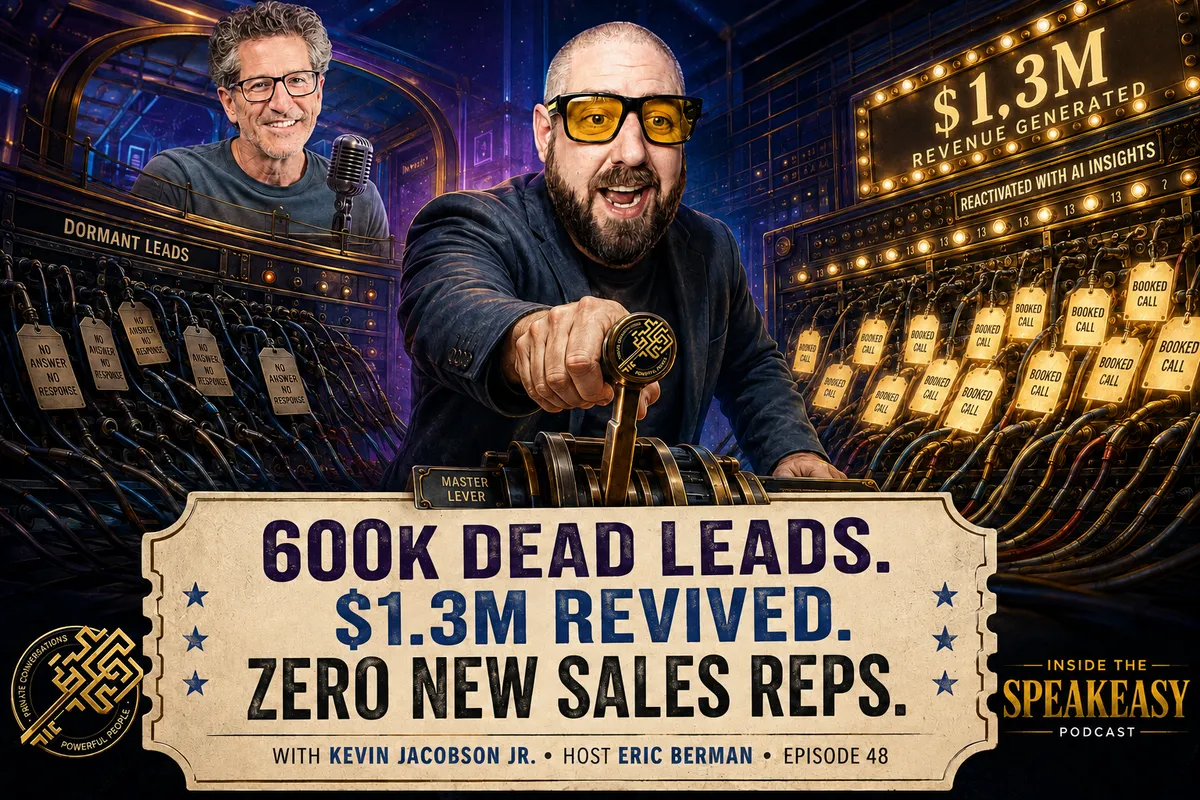
Kevin Jacobson Jr. has been selling since he was a teenager, and today he helps businesses build AI sales systems through his company, Levrg AI. In this conversation with host Eric Berman, Kevin explains why most entrepreneurs chase shiny new tools instead of finding the real bottlenecks in their sales process, and he breaks down the four areas where he sees AI create the most leverage: qualification, segmentation, nurture, and follow-up. He shares how a voice AI replaced an overseas call center for a GLP-1 brand and collected payment on the phone without human intervention, how soft credit pulls at opt-in let one live event tailor offers to buying power, and how a lender reactivated three years of dormant leads without hiring a single new sales rep.
In this episode, you'll discover:
- The four places Kevin sees AI creating the most leverage in a sales process: qualification, segmentation, nurture, and follow-up
- How a trained voice AI replaced a call center that cost about $6,000 a month and now closes deals and collects payment over the phone
- Why Kevin says appointment setting "was never supposed to be a human being's job" and how AI nurture can free setters to become closers
- How a lender with a 55-person sales team booked about 1,700 AI-scheduled calls from 600,000 old leads instead of hiring 30 to 50 new reps
- Kevin's "stop the bleed" approach for small teams: run a time audit and a conversion audit before buying any new AI tool
Episode Summary
Kevin Jacobson Jr. remembers throwing up on his first day of sales, a summer job selling hot tubs over the phone. Fear did not stop him. His father was in an MLM when Kevin was a teenager and introduced him to Jim Rohn's teachings, which Kevin credits with showing him there was more out there than the town he grew up in. He went on to work the phones for infomercial-style offers, calling people who had requested a VHS in the mail, which he jokes meant he was running a VSL before VSLs existed and working as a setter before he knew the term. In his early 20s he became the top sales rep in Southern New England in his first year at Verizon Wireless.
Eric introduces Kevin as someone who later built an e-commerce business, lost it to Covid, and returned to sales. Kevin says he went all in on AI in late 2022 and early 2023 for a practical reason: he was co-managing a sales team, closing, helping with setting, and supporting marketing while being paid only a commission as a closer. Using the Pareto principle, he realized most of his energy was going to work that did not directly produce revenue, and that decision fatigue meant he could show up to a hot call too burnt out to close it. Solving that problem for himself grew into the work he now does for clients, which he says has covered more than 200 clients over the past couple of years, each with a custom build.
Kevin's first piece of advice is to stop chasing shiny objects and instead audit where time is going and where human beings are the bottleneck. He then walks through qualification. Early on, a solopreneur may take a call with anyone, but at scale the same approach becomes the problem, and every extra form or hurdle can increase bounce rate. He argues there is a balance: overqualifying creates rigidity, while underqualifying leaves the sales team stuck talking to people who are not ready. His Shopify background shapes the view, since a 1% lift in conversions on high-traffic stores meant multiple five figures, and he says the same lift in a high-ticket service business can mean multiple six figures.
The centerpiece example is a GLP-1 e-commerce brand that was paying roughly $6,000 a month for an overseas call center with what Kevin calls atrocious conversion rates. His team trained a voice AI that now closes deals and collects payment over the phone, while buyers who are not ready are handed off to a person in real time or booked on a calendar. Kevin describes a recording in which the AI asked a woman who was driving to pull over safely, check a text with a one-time discount link, and stay on the line until she checked out, which she did by credit card without human help. Asked whether customers will accept talking to AI, Kevin says it is simply conditioning, comparing it to how people once resented phone menus at credit card companies.
On tools, Kevin describes himself as an AI broker who is not married to any platform. He says he helped with HighLevel's AI employee rollout after Shaun Clark asked him to consult, and he names RizzDial and Charlie AI as voice AI platforms he likes, partly because their founders come from sales. One internal motto sums up his view: tech people build tech that works, salespeople build tech that converts. For segmentation, he points to LeadFi, which runs a soft credit pull at opt-in so offers can be matched to real buying power. He shares a story from its founder about a live event that used different colored lanyards based on attendees' available credit and, according to Kevin, tripled back-of-room revenue with nothing else changed.
For nurture and follow-up, Kevin compares standard SMS marketing to a billboard and AI SMS to an actual sales conversation that can answer FAQs, reschedule missed calls, and keep prospects moving. He criticizes the high-turnover setter model, saying the average setter lasts 90 to 120 days. His biggest case study is an alternative business lender in New York doing about $150 million a year that planned to hire 30 to 50 more reps to work 600,000 old leads. Instead, an AI reactivation campaign produced about 1,700 booked calls in the first 30 days and, by Kevin's recollection, roughly $1.3 million in additional funding revenue within 30 to 60 days. He says the lender is now on pace for $200 to $250 million without adding a sales rep. Asked what humans will do in sales, Kevin predicts a new golden era of creativity, and for small teams he recommends triage first: find where you are bleeding time or money and fix that before chasing new tools.
Big Ideas Discussed
Find the Bottleneck Before You Buy the Tool
Kevin's most repeated point is that the biggest mistake he sees is shiny object syndrome. Rather than adopting whatever AI tool is trending, he says entrepreneurs should do a time audit, map their sales process, and find the places where human beings are the bottleneck. That is where AI creates real scalability.
He ties this to a project he is involved in: a Guinness World Record attempt for the most people certified in Stop the Bleed at the Tennessee Titans stadium. His AI work follows the same logic. First triage the business, find where the most time or money is being lost, and stop that bleeding. For a solopreneur or a team of 10 or fewer without budget for outside help, he recommends starting with a time audit and a conversion audit and focusing only on what will buy back time or increase revenue.
Voice AI Can Replace a Call Center, Not Just a Phone Menu
Kevin's GLP-1 client was paying around $6,000 a month for an overseas call center that, in his words, made up in volume what it lacked in skill. His team replaced it with a voice AI that he says is trained well enough to close deals over the phone and collect payment, while routing buyers who are not ready to a live person or booking them on a calendar.
He shares a recording he calls his favorite use case, in which the AI handled a caller who was driving by asking her to pull over safely, check a text message with a one-time link, and stay on the line until she completed checkout. Kevin adds that parameters are set so callers cannot waste tokens or troll the system. On customer acceptance, he argues people will be conditioned to talk to AI just as they were conditioned to phone menus, and the only question is who adopts it first.
Appointment Setting Was Never Meant to Be a Human Job
Kevin believes the setter model popularized in high-ticket sales created a churn-and-burn recruiting pipeline, with the average setter either fired or moving on within 90 to 120 days. That revolving door, he says, is a bottleneck in many high-ticket businesses.
His alternative is conversational AI that keeps nurturing prospects through SMS and voice, answers questions from the company's FAQs, confirms calls, and reschedules people who cannot make it instead of letting them cancel. He compares standard SMS to a billboard and AI SMS to a real sales conversation. In his view, this does not eliminate people but promotes them: setters who want to be closers get that chance because more leads are reaching sales calls, and closers have more energy to be present on those calls.
Reactivating Dormant Leads Instead of Hiring More Reps
Kevin's largest example is an alternative business lender in New York that he says was doing about $150 million a year with a 55-person sales team. The company had 600,000 leads from the past three years sitting in a long-term nurture sequence and planned to hire 30 to 50 more salespeople to work them, a move Kevin says would have cost millions and likely alienated existing reps.
Instead, his team built an AI system to re-engage, requalify, segment, nurture, and book those leads without human intervention, rolled out in phases because of messaging regulations. Kevin says the first 30 days produced about 1,700 AI-booked calls and, by his recollection, roughly $1.3 million in additional funding revenue within 30 to 60 days. A year later, he says, the lender is on pace for $200 to $250 million, with higher booking, show, and close rates and no additional sales reps hired.
Questions We Answer in This Episode
Where does AI help most in a sales process?
Kevin Jacobson Jr. says the most common opportunities are qualification, segmentation, nurture, and follow-up. He recommends starting with a time audit to find where people are the bottleneck, then applying AI there instead of chasing every new tool.
Can voice AI really close a sale over the phone?
Kevin Jacobson Jr. says yes when it is trained properly. He describes a GLP-1 brand that replaced a call center costing about $6,000 a month with a voice AI that closes deals and collects payment. In one call, the AI guided a driver to pull over safely and complete checkout without human help.
Will customers be comfortable talking to an AI sales agent?
Kevin Jacobson Jr. believes acceptance is a matter of human conditioning. He compares it to how people once resented calling a credit card company and hearing an automated phone menu. In his view, AI is the next step after outsourcing calls overseas, and the advantage goes to businesses that adopt it first.
How does a soft credit pull help segment leads?
Kevin Jacobson Jr. explains that LeadFi can run a soft credit pull when someone opts in with their name, email, and phone number, so offers can be matched to real buying power. He shares a story from the founder about a live event that gave attendees colored lanyards based on available credit and, he says, tripled back-of-room revenue.
Will AI replace appointment setters?
Kevin Jacobson Jr. says appointment setting was never supposed to be a human job; it only was because the technology was not ready. He sees AI nurture as a way to promote setters who want to be closers, since more leads reach sales calls. He also points to setter turnover of 90 to 120 days as a major bottleneck.
What results can AI database reactivation produce?
Kevin Jacobson Jr. describes a New York business lender with 600,000 old leads that planned to hire 30 to 50 more reps. He says an AI reactivation campaign booked about 1,700 calls in the first 30 days and, by his recollection, produced about $1.3 million in additional funding revenue within 30 to 60 days, without new hires.
Where should a small business start with AI sales tools?
Kevin Jacobson Jr. recommends triage before tools. A solopreneur or small team should run a time audit and a conversion audit to find where they are losing the most time or money. He advises ignoring the hype and focusing only on what will buy back time or increase revenue.
Full Episode Transcript
Read the Full Episode Transcript
Cold Open: A Voice AI Walks a Caller Through Checkout
Kevin Jacobson Jr.: So when we hang up, it's gone. The woman is literally like, hey, I'm driving right now. And the voice AI is intelligent enough telling a woman if you can find a place to safely pull over your vehicle and park and check the text message I just sent you, there is a one time discount link for you to check out for this offer that's only available while we're on the phone and I will hang with you until you do and talks her through, like, hey, did you find a safe place to pull over yet? It's incredible.
Eric Berman: Welcome to Inside the Speakeasy Podcast. The private room where today's sharpest founders, innovators and renegade thinkers come to trade the ideas that move industries. This show is brought to you by HighLevel, the AI driven business operating system trusted by over 2 million businesses to help automate, scale and create real leverage. HighLevel isn't just a tool, it's the engine behind some of the most agile and high performing teams on the planet. If you're ready to streamline everything, amplify your reach, and actually build a business that works for you, you're in the right place. Visit www.gohighlevel.com/Speakeasy-mastermind-promo to get an exclusive 30 day trial for being a listener of the Inside the Speakeasy Podcast. Enjoy the show.
Meet Kevin Jacobson Jr. and Why Sales Is an Exchange of Energy
Eric Berman: Whether you like it or not, everything we do in life to succeed in business has a component of sales. And I'm so pumped today because in today's episode of Inside the Speakeasy Podcast, we're bringing a guy that's been selling. Talk about lemonade stand. This guy goes all the way back. His entire career, when he's a teenager, started selling, hasn't stopped over 24 years. Everywhere he went, he was number one sales guy, crushed platforms, he went into the world of e-com, rose to top 1% in the Shopify e-com stores, continued to crush Covid, actually then took them all the way down, got struck to Covid, but then it's come back into the world of sales and leveraged this beautiful AI world. We have combined it with sales and now is absolutely helping so many companies take advantage of AI in their sales systems to just go 10x the things they're doing. You're gonna have a lot to learn today. So excited. Kevin Jacobson from Nashville. Welcome aboard.
Kevin Jacobson Jr.: Yeah, thank you. Newly to Nashville, New England guy and you know, just got down to Nashville Less than a year ago. And that's, you know, that's when our story began.
Eric Berman: So we won't talk so much about the allergies that you're getting out there. Your first trip of allergies. So I won't. I won't warm you and. But thanks for showing up today. I know you got a lot going on and you've been sick and catching up, but, dude, I'm excited. You know, I was just talking to my wife last night, and you know who's like, the anti opposite on sales. She's like the last person on sales, but, like, she's excited about something, you know, about her business and doing things. And I'm like. I'm like, babe, remember, sales is just an exchange of energy about something you're excited about. And she goes, yeah. I go, you're not really selling it if you love what you're doing. Right? And she goes, no. Like, so don't be so scared. I mean, so. I mean, in general, do you see a lot of people scared of the word sales? Like, what's your take on that? Like, you obviously are not afraid of it. You just love it.
Kevin Jacobson Jr.: Yeah. I mean, you hit it, right? Like, you know, the exchange of energy and something that you're excited about. And I think that's ultimately why I love sales, because if I'm not pat, I'm a Gemini. So if I'm not passionate about something, I don't have any interest in it to begin with. So when I get passionate about something, I don't really shut up about it. So, you know, I turned that into a lucrative career. Sales is one of those things. It's like, you need it in your business no matter what. And it's one of those things that everybody wants to outsource, and I'm a firm believer in it should probably be one of the last things that you outsource.
Eric Berman: Yep.
Kevin Jacobson Jr.: So.
Eric Berman: Yep. No, I love it. And you're going to want to listen today because, I mean, we're going to talk, Kevin, about, you know, AI being everywhere right now, and. But it's more about. Yes. There's so many tools. I'm overwhelmed. But I just want to know, as an entrepreneur, and we're going to get into a second, you know, what can I actually do today to make my life better in every part of my business? You know, I got my marketing. I got this, I got that. But sales, I mean, is everything. I agree with you. It is something that we all kind of want to let go, but nobody's going to be able to sell the passion better than the leader and the founder. And we know we have a lot of entrepreneurs and Speakeasy, a lot of entrepreneurs listening today. So I want everybody to really pay attention because there's some great things. You're getting some great nuggets. We're going to learn today that Kevin's going to share about how you can optimize leveraging AI. And even if you don't love it, there's going to be so many tools now, I imagine, to help you get through it. So, that being said, I just wanted to drop that seed so you could stick around before we get into that again. So, 17 years. Let's just rewind for a second. Then we're going to jump into some good nuggets here. You know, 17 years, you're on the east coast, and you've been through everything. I mean, I mean, what any. Just. You started. You were number one at Verizon in your area. You remember you telling me, Is that right?
From Hot Tub Phone Sales to Top Rep at Verizon Wireless
Kevin Jacobson Jr.: In my early 20s, I believe I was, like, 20 or 21. I was the top sales rep in all of Southern New England. My first year, I started working at Verizon Wireless. That was fun. All the top sales reps from all around the country. We got to play a softball game in Fenway Park right in front of the Green Monster. So that was. That was fun in the 20s to really crush it, but. And especially because it was. It was my first, like, serious sales job. My first sales job was just selling hot tubs over the phone. And it was a summer job. And, like, I remember the first time I hopped on the phones, I definitely, like, threw up. I don't remember if it was, like, before or in the middle of calls, but that first day, I, like, puked. I, like, I was scared. I was scared of sales just like everybody else. But I'm. I am the type of person where, if I know something is necessary, there's good fear and there's bad fear, right? There's like, your fight or flight that, you know, your primal instinct to survive. And then there's that fear that, you know, you need to overcome to level up in life and in business. And for me, thank God, my father was in an MLM when I was a teenager, and so he put me on to Jim Rohn's teachings. And, you know, we got a lot of OGs in here that probably maybe even knew Jim Rohn, right? And so that helped me out a lot. It put me. It helped me realize that there was more out there for me. Than the town I grew up in. And so I started pursuing, you know, greater things. And so that was one of the ones that, like, I'm like, it was the old original VSL. You would see a commercial like Dean Graziosi infomercial, like, at midnight, type of, like, type of thing, right? Where it's like, you see the commercial, you call the number, they send you a VHS in the mail. I was the guy on the other side of the phone when you called in and said, hey, I watched the VHS or hey, I noticed that you got your VHS outbound dialing. And so I was running a VSL before VSLs existed. And I was a setter before I knew what a setter was, right? And, you know, fast forward to what I do now. It's pretty ironic because how I help my clients the most is in the setting process, in their sales process and converting more of their leads in. In that part of the sales process.
Eric Berman: We should dig into that. And, you know, I'm going to. We'll jump around in your career because I know we have some cool things to talk about on the commerce side. But now let's go to more. Like, what's going on today? You just said you're helping your clients today with that. I mean, first question, you just kind of, let's lean into it. Like, what is the number one thing? And I know we have two different. A lot of. We have some solopreneurs, we have some entrepreneurs that are doing a lot more, you know, what is the, you know, biggest thing you're seeing? Maybe the biggest thing that you're seeing people are doing wrong or incorrectly as entrepreneurs, that they can probably show up right away.
Shiny Object Syndrome and the Closer Burnout That Led to AI
Kevin Jacobson Jr.: Well, you know, for me, it's, you know, I think, I don't remember who said it, but I think it might have been Bill Gates said, you know, juvenile delinquents or, you know, B or C students make the best entrepreneurs. Right? Because we're always looking for ways to optimize and, you know, maximize efficiency rather than we want to work hard and work smart. And so for me, the main thing that I notice that people are doing wrong is just the shiny object syndrome rather than really doing like a time audit and like, looking at their process and figuring out where the bottlenecks are and how they can actually integrate AI into those bottlenecks to create more scalability in the areas where human beings are the bottleneck. And I didn't get into this space when I went all in on AI in late 2022, early 2023, which was earlier than most people. Now everybody's like, AI, AI. Right. For me it was just I had gone back to sales after losing my e-commerce business to Covid and all these other crazy things that happened all within a short amount of time. And I was just trying to solve an internal problem on the sales team that I was managing. I was co managing, I was closing, I was helping with the setting and I was like integrated into the marketing team. But I was only getting paid a commission as a closer. And so for me it was out of desperation to like maximize my efficiency and reduce all this busy work that comes along with being a closer. And you know, you talked about the energy, right. And for me, at the end of the day it was about the Pareto principle of, you know, where is 80% of my work going that actually isn't directly revenue producing? And all this energy, these little micro commitments and these little, you know, the decision fatigue that by the time I get on a call and I have a hot lead, I may not close that person because I'm just burnt out. And they might have been a lay down sale, but because I wasn't able to be present because of all the other, other things that I had going on. So for me that's what I was trying to solve for and then it evolved from there.
Eric Berman: So that was your pain point. So let's talk about what was the first thing or maybe it worked backwards. Like what are the maybe a simple, the simplest things or a couple things that you'd say for this. You know, those who are listening that people might. That you're finding almost all clients. We could talk to you like we gotta start here. We just gotta automate this right now.
Kevin Jacobson Jr.: Yeah.
Eric Berman: Like what are you finding Mostly is.
Kevin Jacobson Jr.: Very common qualification, segmentation, nurture and follow up.
Qualification: Avoiding Bottlenecks Without Wasting Sales Time
Eric Berman: Let's spend some time on each of those. So first qualification.
Kevin Jacobson Jr.: So, so on the qualification side of things you have before AI, you had a couple options, right. You create intentional bottlenecks in your pipeline, right. It's you block people from getting to the next stage, whether it's a filling out a form or you know, whatever the case may be. Right. But when you're a solopreneur, if you don't have leads like in volume, then that is too risky. You kind of just want to flood everybody into your account.
Eric Berman: Everybody. Yeah.
Kevin Jacobson Jr.: And take a call with anybody when you're first starting out and then, you know, let God sort them out. Right. Versus and then when you get to scale, it becomes the opposite problem. And so what got you to this level is usually not what's going to get you to the next level. And that's where most people are kind of keeping those same processes as they scale. And it becomes the bottleneck. The thing that was working is now the thing that's causing you to not be able to level up. And so for the qualification aspect of things, those sticking points are the things that increase bounce rate. And so you always want to have people in a sales conversation. This is why my experience in the Shopify world is so clutch for me now. Because when you're running hundreds of thousands of visitors to a website every month and a 1% increase in conversions is multiple five figures in revenue because your average cart value is like 40 bucks when you go and you apply that, that thought process and that meticulous, you know, thinking to a high ticket service industry. Now that 1% increase in conversions is multiple six figures.
Eric Berman: Right, right.
Kevin Jacobson Jr.: And so I just look at people's sales process. The qualification aspect is it's important to qualify. There's a balance that's necessary. Right. If you overqualify, you're, you're creating rigidity in the conversion. Right. And so if you're driving 10,000 leads a month, but then you also don't want to have your sales team spending so much of their time in the problem unaware, solution unaware phase of your nurture. Right. And so you have to. The way that people are solving for this pre AI is like a lot of long form content. They're reeling people in with short form and then they're nurturing and indoctrinating them with long form content. But now you have this whole other element of your business that you need that requires your attention and a lot of time and energy and team as well.
Eric Berman: Right.
Kevin Jacobson Jr.: And so if you're able to drive a decent amount of traffic, they're decently qualified people and you just have the right segmentation along the way. Financial qualification, you segment them based on that. Maybe it's a down sell to a low ticket where they don't require a sales call and then only the people that are financially qualified actually make it to the booking page. Right. There's so many different ways to do it. That's why even though we've worked with over 200 clients doing this over the past couple years, everything we do is, is still pretty custom. It's not, it's not templated.
Replacing a $6,000-a-Month Call Center With Voice AI
Eric Berman: Yes. So, so back to the AI part of qualifications. What's it now with AI? What have you been doing to help that process out?
Kevin Jacobson Jr.: Yeah. So Mainly it's feeding leverage for the sales team with chat AI, voice AI in those pipeline stages. Right. So like one example I'll give you is we have a GLP-1 like e-commerce brand, but they use a call center and they use, you know, they use SMS marketing. Right. When they came to us, that was their process. And with them we just incorporated a highly trained voice AI to replace the call center. And so rather than this, I think it was like something like six grand or a month for the call center. And the conversion rates were atrocious, like absolutely atrocious. What they were losing in skill, they were making up for in volume. Or at least that was the reasoning behind paying $6,000 a month for something like that. And ultimately we just came in and we trained out robustly trained out a voice AI to the point where now they have a voice AI that actually can close these deals over the phone and collect payment.
Eric Berman: Damn, that's what.
Kevin Jacobson Jr.: And so they replace that entire call center overseas. Higher quality calls, higher conversions. And now the people who are ready to buy don't even have to wait to get on the phone with the actual person. But the ones that aren't ready to buy are being handed off and nurtured, either handed off in real time to someone who's available or being booked on a calendar conversationally so they're not slipping through the cracks.
Will Customers Accept Talking to an AI?
Eric Berman: Let's get into this one because I think everybody's now or a lot of people out there have seen, hey, insert a AI, sales rep, voice AI in there and there's this fear of, or I'd say lack of knowledge or just confusion on, come on, can this person really answer these things? And what about the customer on the line talking to an AI agent? Does that. Like, how does that feel? So walk me through and I want to just ask a few questions. You can hit them all at once. Is like, you know, a what tech have you found that you like in the voice AI out of those that are interested in this topic? And then what about just the consumer worried they're talking to an AI and you know, how good is the AI? So kind of three questions in one there.
Kevin Jacobson Jr.: Yeah, I mean, I'll answer the last one first because it's the quickest. It's just human conditioning. We're going to be conditioned to talk to an AI and it's just a matter of who's going to adopt it first and create leverage for themselves within their business. It's going to happen. You know, a decade ago people were irritated that they had to talk, they had to call their credit card company and talk to an IVR before they could get on the phone with a real person. Now you're lucky to get on the phone with a real person in any capacity. And if you are there overseas, right? And so now that the next phase of evolution in this process is we're not outsourcing overseas now, we're outsourcing to AI. I literally had a call with PayPal today and their voice AI if anybody who's watching or listening, I actually, I just became a beta member of a company that Dan Martell is part owner in and it scours your social media for people to like find connections like second and third degree of separation with people that you know. So I would love to get in contact with somebody at PayPal because their voice AI is, is horrible. And you would think a huge corporation like that would really have this stuff like dialed.
Eric Berman: I think Venmo is the worst UI user experience of an app that is so popular. Like I don't know, I don't know about you, but like I get so annoyed with Venmo and like how slow it is. Like you're putting a name and it just sits there and thinks and like, you know, like, wait, I just Venmoed him last week. Can't find Kevin again.
Kevin Jacobson Jr.: Like I have a mom and pop client out of Florida that has a voice AI that literally it's my favorite recording of all of our use cases because it was like this deal is only available over the phone. So when we hang up it's gone. And this is that GLP-1 client. The woman is literally like, hey, I'm driving right now. And the voice AI is intelligent enough and this is where it comes in to like how you train it and what I like to refer to myself as an AI broker because technology is changing so quickly. I don't, I'm not married to any platform. I helped with the entire GHL AI employee rollout. Shaun Clark asked me personally to come in and consult for their voice AI stuff because I was providing support to other voice AI companies that they were vetting for their product. Right. I say all that to say I've been around the block and it's incredible to me that I have a voice AI that my client is using that is telling a woman if you can find a place to safely pull over your vehicle and park and check the text message I just sent you, there is a one time discount link for you to check out for this offer that's only available while we're on the phone, and I will hang with you until you do and talks her through. Like, hey, did you find a safe place to pull over yet? It's incredible.
Eric Berman: I'm an AI agent. I'm on the client. There's plenty of me. I'll go all night with you. Let's. In fact, let's have a conversation for two hours till you get home.
Kevin Jacobson Jr.: Well, yeah. And you set parameters around that to, like, ensure that they're not, like, wasting tokens and people aren't just, like, trolling the AI and stuff like that. But, you know, ultimately, it closed the deal. It collected 3,000. It was like a $5,000 GLP-1 offer, and it was 2,500 on the call only. And that woman paid over the phone with her credit card without any human intervention.
Eric Berman: Love it.
Choosing Voice AI Platforms Built by Salespeople
Eric Berman: So what AI tech are you liking today? I know you're a broker. That might change by the time the podcast comes out. But who are you recommending on the AI agent side?
Kevin Jacobson Jr.: So I like to build relationships with the founders directly after I vet the platform, and then I become, you know, kind of a champion for their products. So I have a great friend that I've been working with for over a year at RizzDial. His name is James. And their platform is absolutely incredible. I wouldn't even do it justice to where he's gotten it. At this point in early 2026, I need to actually get caught up on how extremely, like, how just how incredible the feature rollout has been. He just took Les Brown, actually, as a client. I was talking to TR about it because they both have Les now as a client, I'm like, I gotta meet this guy. He's bucket list. So. But yes. So RizzDial is incredible. And then I have a great relationship with the guys over at Charlie AI that specifically, I like to work with tech platforms that are. That the founders have a sales background. And that's something that we also. It sets us apart from everybody else. Right in this space, really is one of our little mottos here internally is tech. People build tech that works. Salespeople build tech that converts. And so, you know, we're focused on what is the output, what's the revenue production of the product. Not just plug in a SaaS and, you know, figure it out.
Eric Berman: I love it.
Segmentation: Soft Credit Pulls at Opt-In
Eric Berman: Okay, so we talk qualifications. You kind of threw in a little bit of segmentation here. I'm looking into your list of four. What else in segmentation are you seeing with AI tech? That's helping out.
Kevin Jacobson Jr.: Yeah, segmentation again. Make Friends with the founder and then I become a champion of their product if I think that their product is great. And so my friend Douglas James is the founder of a company called LeadFi and I can, you know, we can plug if you want. I can get you like discount links and stuff for all these platforms because again I have a relationship with the founders for the listeners. But these guys on just opt in. So your opt in form, standard opt in form name, email, phone number, they're able to do a soft credit pull on every single person that opts into your funnel. And so you're able to segment based on real buying power now.
Eric Berman: Nice.
Kevin Jacobson Jr.: And so that works incredibly well for high volume, high ticket sales companies. Right. But it also works extremely well for live events. So one cool thing that he, you know, he had mentioned to me is that nothing changed year over year from the live event that the client that he was working with except for they put LeadFi on the front end of the opt ins and they 3x the revenue back of room once they made the pitches from stage.
Eric Berman: Oh wow.
Kevin Jacobson Jr.: Because they were, they gave people different colored lanyards based on like what's available in their home equity line of credit, in their other business line of credit versus instead of the guy with the fake Rolex pretending to be rich and the guy that's, you know, kind of being low key but he's actually a billionaire, there's no lying anymore. You opted in for us to know what you have available and we're crafting our offer based on that.
Eric Berman: What do you do? A live event? How did you put the people of the white lanyard in room number one and the different group, like how do people know where they're going?
Kevin Jacobson Jr.: Yeah, they were giving them different colored lanyards based on their buying power rather than like, you know, I went to Tony Robbins Business Mastery and it was incredible. And because of my relationships I was able to hang out with Eli Wilde while I was there. And we had different colored lanyards, but it was based on what we paid to be there versus this event was the lanyards were based on, you know, who we are in our financial level.
Eric Berman: What if they gave that information? Well, you're blue because you're richer than this guy in red. But anyway, sure, they didn't.
Kevin Jacobson Jr.: Yeah, I mean it's part of the opt in language. Right. You know, we're going to be able to market to you and all that when you opt in. But now the opt in language says we're also going to be doing a soft Credit pull to make sure we craft offers that fit your financial.
Eric Berman: And based on that poll you can immediately have a whole different VSL and everything else based on that first name. Almost like page one. Okay. Page two is now different based on the segmentation of that information. Okay, that's cool. So that's segmentation.
AI Nurture and the Appointment Setter Revolving Door
Eric Berman: And what about the nurture side?
Kevin Jacobson Jr.: The nurture side is this bandwidth. Right. How long do you think that your sales reps are nurturing leads? How long especially listen, the biggest human bottleneck in this industry. And you know, God bless Cole Gordon, he created a lot of millionaires with his process but he also created with his solution. He created a bigger problem and that is that low barrier to entry kind of churn and burn, low skill level appointment setter recruitment pipeline process which is just like they got a 90 day revolving door. Your average setter doesn't either gets fired or finds a different offer to close for in 90 to 120 days. And that revolving door is a bottleneck in so many high ticket business businesses.
Eric Berman: Got it. Okay. So the nurture AI does what?
Kevin Jacobson Jr.: It's conversationally nurturing people, continuing that conversation. You know it is, it's meeting people where they are. You know, I like to refer to standard SMS marketing as a billboard versus AI. SMS is actually a sale. You're actually having a conversation with a trained sales professional. It's the difference between what Russell talks about, a website and a funnel. You're walking through a sales process with SMS marketing. If someone doesn't convert, you just throw them in a follow up sequence and it's like if they buy or die. And that's the mentality.
Eric Berman: Right.
Kevin Jacobson Jr.: But there's no actual nurture. There's unless you have a setter in there.
Eric Berman: Right. So this is helping replace the setters so they're having the conversations.
Kevin Jacobson Jr.: The AI's appointment setting was never supposed to be a human being's job. It just had to be because technology wasn't there yet. What we're doing is we're allowing those setters who want to be closers anyway to have the opportunity to be promoted into a closer position. Because now more leads are being converted into close into sales calls.
Eric Berman: Got it, Got it. Okay, walk me through as a recipient, as somebody who's going through, if I'm a customer going through a funnel that's got the AI nurture setter if you will. What's happening? I've opted in. And now is it back to like the first thing we talk about where I'm talking to an actual live agent is or more through text dialogue and email dialogue. That's just having the conversation. Like what's going on there?
Kevin Jacobson Jr.: I mean, it depends on the sale, the current sales process. But you know, you know, think about the last thing that you opted in for, right. When you opt in, maybe you book a call, maybe you don't, maybe you opt in for a lead magnet, right? What happens? Hey, thanks for opting in. Now you're on their email list. Now you're on their SMS list.
Eric Berman: Totally. Yep.
Kevin Jacobson Jr.: And then they're going to keep blasting you until you opt out or you block the number and. Or you buy or you book a call. Right now instead you're getting those same SMS notifications, but now you're getting a separate text message which is what used to come from that triage person. Right. It's like, hey, this is Kevin. I know you booked a call with Eric tomorrow. I wanted to make sure I sent over the proper homework and everything to make sure that you're going to be on camera ready to go for the call. Right. And maybe you'll get a phone call the same way with from the voice AI to ensure that that show rate is good. But then what happens? And it usually says this is coming from, you know, you're not able to reply to these messages. Right. Normal standard sms, right. But now they're in a conversation with and whether you want to disclose this or not disclose this or you know, depending on TCPA, like all these different regulations and there's ways to go about it to ensure that your client and prospect feels like they're receiving a concierge white glove service from your AI. Not being handed off and not acknowledged properly by AI. Right. Because you don't have time for them, right. Versus so but now they're able to say, hey, actually I'm not able to make it to the call. The AI can now reschedule them instead of them just going and canceling it. Right. So your show rate's increasing or it's like, hey, I noticed this on your website. Now it's trained on your FAQs, right. It's trained on continuing to nurture that sale. Every sale is different. Every buyer is different. Right? So you have buyer Personas, right. And then you have your nuanced things that go on in your sales process that prior to implementing something like this, those were just fall offs. That was just same reason why Hyros is so successful, right. 30% Of your ad budget is wasted because of garbage tracking and that's what Alex Becker solved for. Well, that's what we're solving for on this side of things with the SMS and the voice AI, Right.
Eric Berman: Love it, love it. I mean, I could see that even in Speakeasy and others, you know, this, the follow through and the nurturing and that was the last one, right?
Follow-Up: Reactivating 600,000 Dormant Leads
Eric Berman: Follow ups, right. So you need nurture and follow up. So what? Talk to me on how you're solving that or how AI is solving that.
Kevin Jacobson Jr.: Yeah, So I mean, you know, again, like throw them into a long term follow up sequence. Right. How many of those people convert? We don't know, you know, I mean, you know, you can look at your dashboard, you're probably converting at maybe 1 or 2%. Fantastic. Amazing. But now what if you're actually meeting people where they are? What if you're, you know, what if they're. Your AI is trained to answer those actual questions without them having to get on a call with your team at the end of the day. And that's the why? You know, I mean, we're rebranding now, but that's why our company was named Levrg AI. Right. Because ultimately what we're doing is we're creating leverage for the sales team. I want more people getting across the finish line than was ever humanly possible so that the sales team has the bandwidth and the energy to be present on those sales calls. Again, 80, 20. If you're spending 80% of your time doing things that aren't revenue producing now, you only have 20% of your energy left for actual cash collected revenue producing activities. And so then you're kind of burnt out when you get to those calls versus now. The sales teams that I've worked with. I'll give you an example. I got $150 million a year alternative business lender out in New York a year ago. They came to me, they're like, we have a 55 person sales team. We have 600,000 leads that we've accumulated over the past three years that are just in a long term nurture sequence that are doing nothing. Right. We're going to hire 30 to 50 more salespeople. So they were going to double their sales team.
Eric Berman: Oh God.
Kevin Jacobson Jr.: To work those three year old leads, it was going to cost them millions. And they were probably going to lose about one third of their existing sales force because they were probably going to be pissed that they were giving all their leads to new salespeople because the company created a bandwidth restriction even though those leads belong to them. They don't have time to work though.
Eric Berman: Yep, yep.
Kevin Jacobson Jr.: Right. Because they're competing on leads. Every month they have 12,000 or so new leads coming in, and they have like three to five other competitors. So that team has to be like, convert those people in a week or two and just move on. Right. So now we come in, we create an AI system that re engages as many of those 600,000 leads as possible, requalifies them, segments them, nurtures them, books them all without any human intervention. Over the next 30 days. They had, I believe the numbers were 1700 AI booked calls on their calendar from those 600,000 leads. And that was just phase one, because we can't just hit 600,000 leads at once. Right. There's A2P. There's all these different regulations. Right. But 1700 additional appointments on their existing sales team's calendar in that first 30 days or 60 days. And this was about a year ago, pardon me, that I don't know the exact numbers, but I think it was 1.3 million in additional funding revenue that came directly from that AI database reactivation campaign in the first 30 or 60 days. And then from there. Now here we are a year later, they're on pace for about 200, 250 million, and they haven't hired one additional sales rep. Their close rate has gone up.
Eric Berman: Yeah.
Kevin Jacobson Jr.: Their booking rate has gone up. Their show rate has gone up. Their sales reps are spending more time closing deals, so their commission has gone up. So they're happier employees.
Eric Berman: Of course.
What Humans Will Do in Sales Next
Eric Berman: So. So with all the stuff going on, you know, my next question is, let's look ahead into the future. What is the human going to be needed for on the sales side at some point?
Kevin Jacobson Jr.: Again, it's leverage. It's just that 80, 20 principle of what are the high. What's the cream of the crop? What are the things that I need to spend 100% of my time doing? And that is, you know, that is working with your clients. I mean, you think about even the back and forth between when you're a solopreneur, everybody can relate to this. You spend all this time trying to acquire a client, you have an influx of cash, and now you have to deliver. And now you take your eye off of revenue and focus on client success. And then we got to go through that cycle all over again when money starts to get low.
Eric Berman: Yeah, that's right. And you got to go scramble and rebuild all that shit. Yeah. I mean, could there be a world where even the closers are replaced by the agents and maybe the job ultimately becomes the AI strategist of the funnel that says all right, I got my whole team of agents, I got my setters, my follow up, my nurturers, my qualifications agents. My job is to now look at the data and just sit there and say, all right, I might need to reprogram my agents to now have this answer. When these things happen, I mean, could that be the future? I mean, are we going to lose, Are we going to lose closers next?
Kevin Jacobson Jr.: I mean, don't listen. Don't we want to?
Eric Berman: Right.
Kevin Jacobson Jr.: Like even the people who are listening right now watching that are closer. Wouldn't you rather be a solopreneur? Wouldn't you rather be a founder? Right. If you're an appointment setter, wouldn't you rather be a closer? Like at the end of the day, we're stepping into a golden era that's going to free up less. All the minutia, all the things that we don't like doing are going to be done better by AI and then we can focus more of our time and energy in our life.
Eric Berman: Yeah.
Kevin Jacobson Jr.: On things that we want to do that we're passionate about. You think about like what the Roman Empire, right. When things got. What came from that. Right. Like the Renaissance era, the art, the music, all the things that we don't have time for. We're stepping into a new golden era like that that we're going to have. You know, who's going to win in 2026 and beyond? The visionaries, the creators, the ones who are creative but don't have the bandwidth for focusing their time and energy and their life force on that creative endeavor. Right.
Eric Berman: We're going to get it back. Yeah. No, I love it.
Where Small Teams Should Start: Triage the Bleeding
Eric Berman: Okay, so I'm going to kind of now bring it all back a little bit now. And we covered a lot and you dropped a lot of great tips and tools and kind of got us thinking about the future. Now I'm listening here and I'm overwhelmed and I'm like, okay, maybe I have a smaller, let's go to the smaller type of team now because we kind of talked about the bigger companies and all that. Now I'm smaller, I'm a solo, or maybe I have, you know, 10 people or less on my team and we're doing, we're still making good revenue. That great example you gave earlier about the person who's like, yeah, we got our hand of clients, but don't know, you know, if we lose two, I got to really hustle. Where should we start? What would be the first place you'd recommend if they didn't have the Ability, let's say they didn't have the budget today to go hire somebody like you or others to help them rebuild their AI sales. What would you suggest to them?
Kevin Jacobson Jr.: You know, it's funny because I think, you know, you know about this, but the client that I'm working with now, where we're renting out the Tennessee Titans Stadium and we're throwing this big Guinness World Record event. Something that is so interesting about my involvement in that event is we're setting the world record for the most amount of people certified in Stop the Bleed certification ever. Right. And it actually is directly tied to what I do in my AI business, if you think about it. Because what do I do? I come in and I look for where I triage people. Right. Think about if you're bleeding out, we have to stop the bleed first.
Eric Berman: Yep.
Kevin Jacobson Jr.: When I come in, I'm going to triage you first. We have to look at where are you bleeding out most? Where's the most amount of time or money being wasted?
Eric Berman: So we have to do a self triage. We essentially have to look at it and say, where are we?
Kevin Jacobson Jr.: Full time audit and do a conversion audit.
Eric Berman: Yeah, yeah. Where are we hustling? Okay, that's great. You got me thinking. Even in the Speakeasy world, you got my head spinning here with some, you know, really need to rethink things. Cool.
Final Advice: Ignore the Hype and Find the Signal
Eric Berman: Well. Well, is there any last minute sort of tips or maybe even a tool or two that you love that something or maybe something. I didn't ask you that. You wish I did. Now that we're wrapping up the chat.
Kevin Jacobson Jr.: Here, I don't know. There's so much even. There's so many tools. There's so many. There's so much noise. I think rather than like what is out there and what's great, I would say advice is don't get caught up in all the hype.
Eric Berman: Right.
Kevin Jacobson Jr.: Just focus on where you're at right now and what's going to buy back time or increase revenue. And don't get distracted by shiny object syndrome. Like, you know, I think it's the like Family Guy where he's like, ooh, piece of candy. Ooh, piece of candy. That's 95% of everybody that's doom scrolling on social media, whether you're a, you know, eight figure founder or solopreneur. Right. Is there's so much noise, where do we find the signal? And the signal is where are you bleeding out time or money?
Eric Berman: Love it, love it. Focus there. That's great. Well, cool, Kevin. Thank you. So much for spending some time inside the Speakeasy Podcast. Was great having you. Great to know, get to know you more. And then you got my head spinning on the sales side and I think, and it's so important. Love what you said. I'm gonna go triage after this call probably soon and figure out and stop some of my own internal bleeding here. And thank you so much. Looking forward to more chats with you.
Kevin Jacobson Jr.: Yeah, absolutely. Thank you so much, Eric, for having me. And anybody, you know, if you want to reach out and have a conversation about, you know, like, what is going on in your business or where, like where you're bleeding out, because sometimes it's hard to see the label when you're in the bottle.
Eric Berman: Right.
Kevin Jacobson Jr.: And so, you know, I've had the pleasure already. Even though I'm a new captain and we haven't even launched my chapter yet, I've had the pleasure of working with some of the Speakeasy members and have great client relationships with them already. So feel free, just reach out in, you know, Facebook or if you're in Speakeasy, you know where, and we'll drop.
Eric Berman: Some links in there for you too. So definitely you'd be able to find Kevin. Awesome. All right, man, well, thank you so much. Have a great day and feel better.
Kevin Jacobson Jr.: Yeah. Thanks for having me.
Eric Berman: Appreciate you. And that's a wrap from the Speakeasy Podcast. If something sparked for you, don't keep it to yourself. Share it, review it, and pass it to the one person who needs to hear this right now. Want in on the real mastermind? Tap the link in the show notes to apply until next time. Keep scaling, stay sharp, and don't be the smartest one in the room.

About The Guest
Kevin Jacobson Jr.
Kevin Jacobson Jr. is the founder of Levrg AI, which builds AI sales systems that use chat and voice AI to support qualification, segmentation, nurture, and follow-up. Originally from New England and now based in Nashville, he started selling as a teenager, worked the phones for infomercial-style offers, and became the top sales rep in Southern New England in his first year at Verizon Wireless. He later ran an e-commerce business before returning to sales and going all in on AI in late 2022 and early 2023. Kevin says his team has worked with more than 200 clients, and he describes himself as an AI broker who partners with platforms founded by salespeople. He is also a new Speakeasy chapter captain.