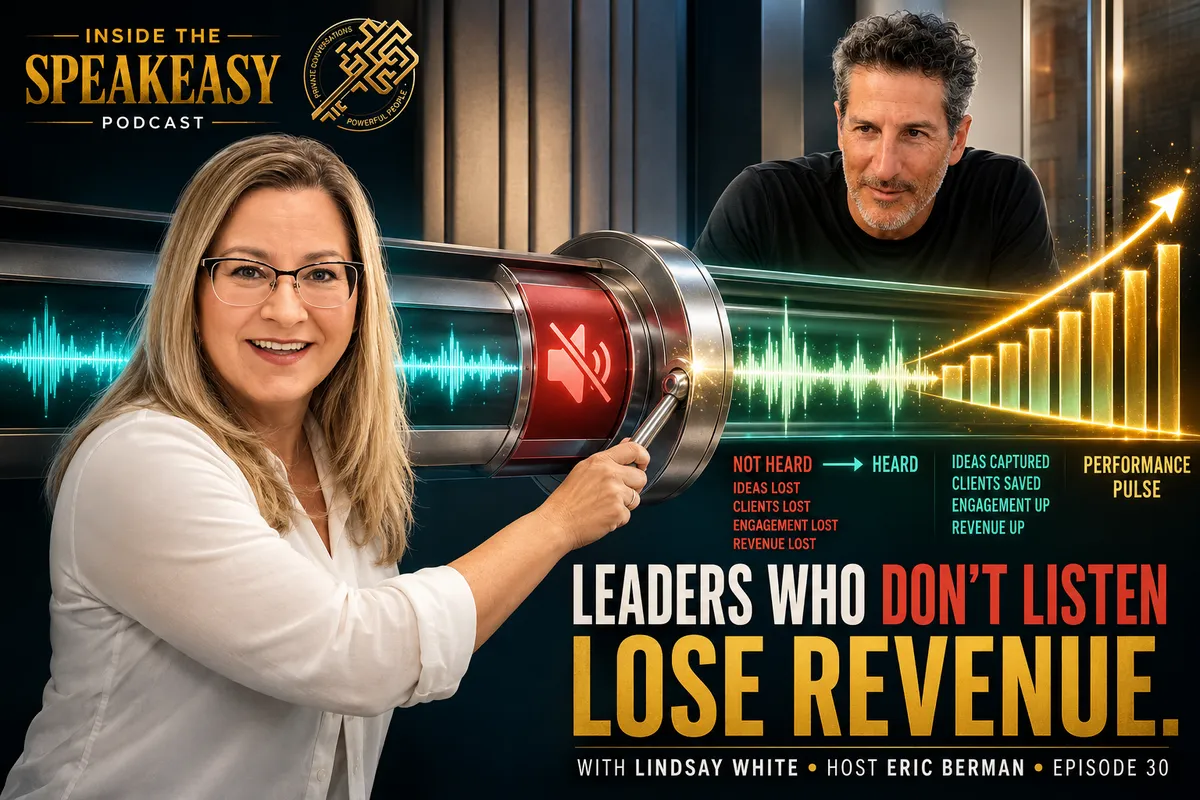
Lindsay White, a people strategy expert and leadership coach who spent ten years of a 20-year corporate career in HR, argues that most founders are losing revenue without realizing it, because their team is not operating at full capacity and they are not leading it like a CEO. In this conversation with host Eric Berman, Lindsay explains what she looks for first when she walks into a growing company, why the number one problem she sees is leaders who have stopped listening, and how the scramble of startup mode leaves smart people juggling work they should not be doing. She walks through her LPC Method for leadership, people strategy, and culture, then gets practical about writing job descriptions, designing interview questions, building a six-month onboarding plan, and leading a virtual team with intention instead of by accident.
In this episode, you'll discover:
- The difference between listening to respond and listening to connect, and the follow-up questions that turn a conversation into valuable data
- Why Lindsay asks every CEO she works with to sort their own job into work they love, work they have to do, and work they would happily never do again
- How to build a one-, three-, and five-year people strategy that sits alongside your business plan
- Why a strong job description should lead with the person you want, the hours, and the pay before it talks about your company
- The simple rule for virtual leaders that Lindsay says will disengage a great employee faster than anything else when it is broken
Episode Summary
Lindsay White calls herself an accidental entrepreneur. After a 20-year corporate career, ten years of it in HR, she worked for a boss she describes as very toxic and quit in the middle of a meeting with her. She already knew she wanted to be a coach and holds two internationally recognized coaching designations alongside her HR background. While she was finishing her coaching certifications, a colleague asked why she could not start her own business, then held her to it as a form of accountability. Six years later, Lindsay works mainly with entrepreneurs and small business owners, with a particular focus on female founders, who are ready to scale quickly and recognize that their current team and leadership will not get them there.
When Lindsay runs a discovery with a company, she starts with the founder or CEO: how they show up, what motivates them, and how the vision, mission, and values translate into everyday behaviors. She then runs what is essentially a SWOT analysis with the team, asking the people on the ground what is working and what is not. From there she looks at coaching needs, organizational design, and whether people truly know what is expected of them and are rewarded for it.
The most common problem she finds is leaders who are not listening because they are so focused on execution. Lindsay describes a first level of listening that is only about responding, and a deeper level that pairs listening with curiosity and follow-up questions. Eric admits that not really listening is the feedback he hears most from his own team. Lindsay's second issue is communication: leaders who believe they have been clear when the message has not landed. She suggests asking people to send back what they heard as the priorities, avoiding CEO jargon, and standardizing which kind of message goes to which channel.
Her third common issue is what she calls bouncing balls. In the move from startup to scale-up, well-meaning people pick up every task they see until they are doing 15 different things and feeling like they are failing. Lindsay applies the same thinking to the CEO, sorting the role into work they love, work they must do, and work they should hand off, so they can take on the culture champion and storyteller role. If a founder only wants to be the genius behind the product, she says they should let someone else step into the CEO seat, because a company led by someone who has abdicated that responsibility feels rudderless.
On motivation, Lindsay says that since COVID, people have reevaluated how they express values such as family and integrity, and they want more flexibility. What has not changed is that people want to do valuable work, have ownership over it, and see it make an impact. Her LPC Method covers leadership, people strategy, and culture. It includes treating everyone as a leader, building a one-, three-, and five-year people strategy across the full employee life cycle, and creating a culture where people feel they belong.
The second half of the episode gets tactical. Lindsay recommends flipping the job description so it opens with who you are looking for, the terms, and the pay, then your mission and values, then the accountabilities. She warns against letting AI write it from scratch and against generic top-ten interview questions, though she uses AI daily once it has good inputs. She defines onboarding as the first six months, with the first five days mapped out in detail and a peer assigned for the questions people are afraid to ask. For virtual teams, she urges leaders to plan their connection time on purpose and never to keep bumping one-on-ones. She closes with advice drawn from her grandmother: listen more than you talk, get curious about your people, and ask for honest feedback about how you are showing up.
Big Ideas Discussed
Not Listening Is a Revenue Problem
Lindsay's opening argument is blunt: when a team is not operating at optimal capacity and the founder is not leading it like a CEO, the company is losing revenue. The number one cause she sees is leaders who are so focused on execution that they have turned their ears off. She stresses that this is not malicious. It is a distraction that becomes a habit.
Her fix starts with recognizing two levels of listening. At the first, a leader listens only to respond, because they feel they must solve every problem themselves. At the second, they listen to understand, using prompts like "tell me more" and "help me understand." Lindsay points out that the idea an employee is trying to share could be a new line of business, a new offer, or the warning that keeps a client from leaving. Eric adds that real listening also tells employees you care enough that they will share ideas again. Her practical advice is simple: put the phone down, turn on do not disturb, lean in, and make eye contact.
The CEO Job Has Non-Negotiable Parts
Lindsay evaluates the CEO's role as closely as anyone else's. She asks founders what is on their plate, what they love doing, what they must do even if they do not enjoy it, and what they would die happy never doing again. The goal is to clear out leftovers from startup mode so the CEO has room for the work that often gets dropped: championing the culture, telling the story, and enrolling people in the vision.
When Eric asks whether an introverted, product-focused founder can delegate that work, Lindsay says yes and no. A COO or other leaders can carry part of it, and coaching can help a CEO become comfortable with it. But she does not let her CEOs off the hook. If a founder truly wants to stay the genius behind the product, she says they will be happier letting someone else take the CEO seat. The alternative, a founder who will not let go of either role, leaves the organization feeling rudderless.
Treat Hiring Like Marketing to Your Ideal Candidate
Lindsay says the first and most important hiring mistake is a weak job description that spends almost a full page on company history before describing the job. She flips the order. Open with who you are looking for, their attributes and competencies, and the practical terms, such as part-time at $45 an hour. Then explain why the company does what it does, and only then list the accountabilities. Just as you would define a target client, she says, define your target candidate.
She applies the same reverse engineering to interviews. Rather than searching for the top ten interview questions, decide what you need to learn, such as how a candidate shows integrity in tough situations, and write questions that reveal it. Lindsay uses AI tools every day and is comfortable using them to draft interview questions, but only when they are given a strong job description and the company's mission, vision, and values. Her rule is garbage in, garbage out.
Virtual Teams Need Intentional Leadership
In an office, Lindsay says, leaders could lead by accident through hallway conversations and quick questions before lunch. On a virtual or hybrid team, those moments disappear, so leaders must decide deliberately who they need to connect with, why, and how often. That does not mean hour-long weekly meetings for everyone. It might mean a 15-minute stand-up on Monday and another on Friday afternoon, tested for three months and then reassessed.
Her firmest rule is not to bump people. If a one-on-one is scheduled, it should not move unless something is truly urgent, and never more than once. Lindsay says nothing will disengage a great employee faster than repeatedly pushing their meeting aside, because it tells them they are less important than everyone else. Eric connects this to founders who prefer to stay heads-down building, noting that a remote setup makes it even easier for them to drift away from their people unless the time is on the calendar.
Questions We Answer in This Episode
What is the most common leadership mistake Lindsay White sees in growing companies?
Lindsay White says the number one problem is leaders who are not listening. They become so focused on execution that they stop paying attention to their teams, often without realizing it. She says this costs companies valuable ideas and information that could lead to new offers or keep a client from leaving.
What is Lindsay White's LPC Method?
The LPC Method stands for leadership, people strategy, and culture, which Lindsay White calls key levers that get overlooked as a business grows. It includes treating everyone on the team as a leader, planning talent as strategically as capital or marketing, and creating a culture where people feel they belong and can do impactful work.
What is a people strategy?
Lindsay White describes a people strategy as the talent version of a business plan, mapped over one, three, and five years. It covers who the company will need, what they will do, and how that connects to goals and KPIs. She says it spans the full employee life cycle, from job design and recruitment through onboarding, growth, and exit.
Should a founder who doesn't want to lead people stay the CEO?
Lindsay White says culture, vision, and storytelling are part of the CEO job, and other leaders such as a COO can support that work. If a founder only wants to be the genius behind the product, she believes they will be happier letting someone else take the CEO seat. Otherwise, the rest of the organization can feel rudderless.
How should you write a job description, according to Lindsay White?
Lindsay White recommends opening with who you are looking for, their attributes and competencies, and practical terms such as hours and pay. Next comes the company's mission and values, followed by the accountabilities. She advises against letting AI write a job description from scratch because the result is usually bland.
How long should employee onboarding last?
Lindsay White defines onboarding as the period from signing the employment agreement through roughly the first six months, or up to a year for highly technical roles. She plans backward from what the person should be able to do on their own at six months, maps the first five days in detail, and assigns a peer to answer everyday questions.
How can leaders keep a virtual team engaged?
Lindsay White says virtual and hybrid leaders must be far more intentional, because the casual hallway conversations of an office disappear. She suggests asking each person what kind of check-ins they need and testing a schedule for three months. Her firmest rule is never to keep moving a scheduled one-on-one, because it tells employees they do not matter.
Full Episode Transcript
Read the Full Episode Transcript
Why People Are the Overlooked Growth Lever
Eric Berman: No fluff, no filters, just the raw strategies, personal stories, and mental models that move the needle. I'm Eric Berman. Now let's get into it. Welcome to Inside the Speakeasy Podcast. And in today's episode, you are going to be blown away. I'm so excited. We are so focused mostly on business strategy and growing the business, but there is such a critical part of our business that if we don't do it well, we are all going to blow up and crash, and that is the people. We are all failing because we're not taking the right care of our people in most cases. And there's some easy, fundamental tweaks we could be making and thinking about as a leader to grow our business and to win with our people and our people strategy. And you're going to learn tons of valuable lessons today. Welcome, Lindsay White.
Lindsay White: Yeah, thanks for having me.
Eric Berman: Yes, of course. Thanks for coming. And I'm so excited because, you know, we all talk about and think about, let's just grow the business. Let's start, you know, building and what's the latest tactic and strategy and AI and this that's going to work. And let's just throw these bodies at and we'll figure it out. And it's like we forget about, like, probably the most important thing. Like, we kind of need people to make these things work, don't we?
Lindsay White: Yeah. Because you can have the best strategy and the best business plan and even the best AI. And if you don't have the right people making it all work together, you got nothing.
Eric Berman: And you're going to share today. So I want everybody to stick around because you're going to talk a lot about your LPC method, which we're actually crushing with just getting our people to perform and building an amazing culture. And you're going to share some fundamentals, some tips that we can all really get into and start working on immediately to really just get way more out of our people. Otherwise, I feel like we're spinning our wheels, spending a lot of time and just banging our head against the walls because we're like, why can't my team do these kind of things? And it's like, it might be a me problem, right?
Lindsay White: Well, yeah, part of it probably is a you problem. And also you're losing money. Like, it's when your team is not operating at optimal capacity and you're not leading that team like a CEO you are losing revenue. It's that simple.
Eric Berman: Ouch. Yeah, you're probably right. And I hate to tell everybody that. Let's get those mirrors out. Because I have a feeling as we go through this call, we're going to learn a lot of this, like you said, is a me problem. It's us doing certain things wrong. Good intentions. I always say we have good intentions, but sometimes it's, you know, one little tweak here and there, as you said, could save us a lot of money.
Lindsay White: Yeah, it really can.
Eric Berman: So cool. Well, before we get into that. Cause I'm really excited. Let's just take a couple quick minutes. How did you get into this role of being the most incredible. Just awesome. Your growth as being an incredible people strategy expert?
From Corporate HR to Accidental Entrepreneur
Lindsay White: Yes. So I am an accidental entrepreneur. I had a, you know, 20 year career corporate. 10 years of that in an HR role. And like so many of us, I worked for a very toxic boss. It happens in HR like it happens everywhere else.
Eric Berman: Yep.
Lindsay White: I quit my job in the middle of a meeting with her because quite frankly, I just couldn't tolerate it any further. I knew I wanted to be a coach, so I am. I have two internationally recognized coaching designations as well as being an HR professional. And I know negotiated my severance like you do. And then I left and I went in and started my coaching certifications and one of my colleagues actually challenged me. It was literally started a business off a triple dog dare, essentially.
Eric Berman: No way. I love it. I mean, that's great. Gave you the confidence and said, look, I know you have it. Start a business. Is that kind of how that conversation went?
Lindsay White: Yeah. Well, I knew I didn't want to go right back into a corporate HR job. And my colleague looked at me and said, well, why can't you start your own business? And. And I was like, what? I can do that. You know, like Elle Woods. What? Like, it's hard. And I was like, oh, yeah, I could try that. And she's like, okay, that's your accountability. And I was like, oh, shit, wait a minute, what have I done? And now, you know, six years in the business, you know, here I am.
Eric Berman: And then who. Who are you primarily serving out there? What kind of business owners are still the big corporations? Is it more small businesses?
Lindsay White: Yeah. So my clients are entrepreneurs and small business owners. I do focus quite a bit on female founders, but I always say that I don't care what your plumbing is. I care what kind of person you are and what kind of business you want to build. So I have some really great guys in my practice, but that's what I do is I focus on organizations that are ready to scale and grow very quickly and recognize the team they have today and the leadership that they're working with today, not going to get them where they want to go tomorrow. So I like people that move fast, are ready to make decisions, but are also problem aware. Right. They recognize that something isn't quite working, they're not getting the lift and they know it needs to change.
Eric Berman: Yep. So that's great. I love it because pretty much all of us, at least in the Speakeasy community, seems like you hit target here. You know, it's. Which is, I'm glad to have you as a member. I think it's great because, you know, it's such a need that we, again, I think we tend to overlook and we'll get to that later and we'll fix those problems later. But I don't want to speak for you, but I mean, let's start from the beginning.
What Lindsay Looks for in a Company Discovery
Eric Berman: Let's get into the trenches here with what you're teaching. I mean, what do you find that most of us. [unclear] doing wrong or some common, the most common things we are making mistakes on that I can relate to. And, or maybe if you're to walk in a company, what are the first things you're looking for? And then we'll kind of go down the path of how do we fix it.
Lindsay White: Yeah. When I'm invited to come and do a discovery with an organization, there's a couple things that I'm looking at first. And number one on the list is leadership. So that starts with the founder or the CEO. What are they doing, how are they showing up and really trying to understand what motivates them as a leader, what's important to them. Right. Of course I layer into that, you know, the vision, the mission, the values. And not just the values as words, but like what are the behaviors we try to drive because that's where values really come to life. And then I also want to get into it with the team. You know, we do what is essentially a SWOT analysis. What's working, what's not, what do they think? Like, let's ask the boots on the ground what's happening and actually get some ideas from them around what we could make differently. And I love doing that work, like just really getting into all of the nitty gritty, pulling back the layers of that onion and really understanding what's happening in this organization. Then we can talk about, okay, what do we want to prioritize here? Right. So when it comes to working with the leader or the CEO or maybe it's their leadership team, okay, we need to do. Maybe there's some skill development, but actually maybe there's some coaching, maybe there's some integration that needs to happen here. Are we looking at some org design stuff? Do we have the right people doing the right things right? Or have we just kind of cobbled it together because we've been a startup and it was all hands on deck? And wait a minute, now we get really smart people actually doing work they shouldn't be doing anymore. How do we want to organize that differently? You know, are we really managing performance? Like, do people really know what the expectation is and are we rewarding them for that? So there's lots of different directions, but you got to get in and get your hands dirty first.
Eric Berman: So it always starts with the big group assessment. Talk to the leaders, talk to the team. You walk out of that and you're just like, oh, okay. Like, immediately you're like, all right, what are you seeing? And maybe. Maybe there's no answer to this question, but is there, like, maybe a common top three or that? Yeah, you're saying, you know what? It's almost these things, if you were to guess it is.
Leaders Who Stop Listening and the Levels of Listening
Lindsay White: So, I mean, number one on that list is leaders that aren't listening. Right. Like, we are so focused on execution that we have turned our ears off. And so we're not paying attention again, not because we're in any way trying to do something negative or malicious, but because we get distracted on the execution side. So we need to actually stop and listen.
Eric Berman: I've been told that in my assessments. That's probably the number one thing I get railed on by my team, is you're not really listening. And can you take that one step further? Because I think there's probably a definition of, I'm hearing you and I hear the words, but are you really listening? So can you go up with people? Because I think that's probably where a lot of us fail.
Lindsay White: I love that, and I love that you are conscious as a leader. That is something that you need to continuously be working and focusing on. Like, that's actually not easy for people to admit. So I want to acknowledge that there's levels of listening, and one of the first levels is we're just listening to respond. And that's where a lot of us get stuck, because we think we have to solve all the problems all at once as the CEO. Right. And so we just are listening to respond. The next level is listening to really connect and understand what is this person in front of me really trying to tell me and turning on our curiosity. Right. So it's listening coupled with deep curiosity and that includes follow up questions. Tell me more. What about this? Help me understand. Here's what I heard you say. Right. So we're really engaging in the listening and I know that sometimes that's tricky. I hear from CEOs well, you know, I don't have a lot of time but if you don't take the time, you're missing important and valuable data that could be costing you.
Eric Berman: I would say as you're saying this and what I've learned, it's not only the data is telling the employee you care enough.
Lindsay White: Yes.
Eric Berman: What they have to say and then not afraid of sharing ideas the second time around to get ignored.
Lindsay White: Right. And that idea could be a brand new line of business, could be a whole new offer, could be a customer that doesn't walk out the door because they've given you information, you can fix it and make it right. And then that client comes back to you and says here's more work.
Eric Berman: Love it. Yep.
Lindsay White: Yeah.
Building Communication Channels the Receiver Can Use
Lindsay White: So listening is number one. And then from there it's really about the communication channels. How are we communicating with each other and what I find. I'm just working with a client this morning and you know, they think that they have actually told people. They think they've been clear with the accountabilities and yet something isn't happening. We're not shifting. So going back, what have you heard? What do you need from me? Again, really deeply connecting and questioning, pulling out on all our beautiful curiosity so that we can actually create communication channels as a sender so the receiver can get it. Because that's what's happening.
Eric Berman: So is that just a matter of taking that extra question and doing the whole. So let's review what we talked about. Can you tell me what you heard and can we just like, like just getting them to repeat back to you sort of communication 101 that we skip over 100%.
Lindsay White: So it could be the reflecting. You know, we've had a big meeting, there's been a lot of information. Take this away, send me an email tomorrow and let me know what you heard as the priorities here. And then let's make sure we're on the same side. It could also be the language that we're using. Perhaps we're speaking CEO. Right. And that's not the lingo that they are working in. So we need to be careful about our choice of language. We got a million different communication channels. We got Teams, we got Slack, we got email, we can text, we got WhatsApp. Like all the things, where does this communication need to go so that it's as effective as possible. Right. And let's standardize some of that so we always know that this type of connection and communication with goes in this place.
Eric Berman: Got it. Just having. Okay. And even think about that, it's almost an SOP for types of communications. Go here, this goes there could be, wow, okay.
Lindsay White: Could be that simple. Like that's the tricky part, right. We don't know unless we actually get granular with it.
Eric Berman: Yep. So would you say. So those are the top three. Any other ones that sort of stick out? I threw a number of three out is right. There are sort of high top ones. You said listening, the communication, the types of communication.
Bouncing Balls and Organizational Design
Lindsay White: I think one of the things I see most commonly when I start working with an organization that's really moving to that scale up stage is, I mean, you know, in the HR speak I would call it organizational design. But the analogy I use is it's the bouncing balls. There have been so many bouncing balls and everybody, you know, wants to do work that's valuable. They want the organization to be successful and they see a ball that's bouncing and they think, oh my God, I gotta pick that ball up. And suddenly they have a whole bunch of balls and none of them actually make any sense. They're doing 15 different things, trying to have 15 different levels of expertise. And in fact what it does is it slows us down, it gets in our way and they feel like they're failing. It's just the product of moving from the startup to the scale up space. And so we actually need to understand what are all the things and then what actually makes sense, who should be doing that particular task or role and how do we resource that effectively so that everybody gets to do the work that they love and they feel valuable doing.
Eric Berman: Got it. So you're saying a natural evolution. If I'm hearing what you're saying is as we scale and grow, we probably get in the habit of this thing goes to this person, they seem like the right one to do it. We just keep throwing more and more without ever taking a step back and saying well wait a second, yeah, at this now next phase or jump. Just because they're title X doesn't mean they're necessarily the right person to do this task. Back to your earlier comment. Another example how we're losing money. I can weave that into a few things you said. You know, number one, I mean, all these examples, I could see how we're losing money. Right. You have the wrong. Wrong butt. Right. Wrong seat to do it. They're less motivated. Motivated. They're failing. They're feeling frustrated. You're then getting frustrated and the task [unclear] correctly. Money lost, not listening, missing that big idea, money loss, not communicating correctly, or people, you know, failing to do the job. Simple thing.
Redesigning the CEO's Own Role
Eric Berman: So why do you think we're failing as leaders? What suggestions do you have? Because again, we're all overwhelmed. You know, chaos. I get to my emails, my calls, I'm too busy. But you're going to say, that's all great, but you're not making it a priority over other things, I imagine. And so how do we prioritize these things and make this simpler for us?
Lindsay White: Yeah, I think one of the important things that I do with the CEOs that I work with is we actually evaluate your job too. What are you doing? What is on your plate? What do you actually love doing? Because I. What I find personally and with my clients is that actually as CEOs, we end up doing a bunch of work we really don't love. And then what is the work that maybe you have to do? Listen, there's part of every job that we probably don't really like, but it's, you know, it's gotta be part of that job. And the CEO is the same way, but. And then what's the work that if you never did it again, you would die happy. And how do we reorganize your role so we start to include the important things that perhaps are getting left out, like being the culture champion, telling the story and enrolling people in the vision. Maybe for some people it includes being the face of the organization, being more involved in business development. I hear that a lot. Right. And then what are the things that actually are still on your plate, left over from startup mode, that don't belong there anymore? Let's figure out how we resource that differently. Free you up so you can go and be an active listener, so that you can go and really connect and be curious and that actually you can start to help other people manage their roles differently.
Zone of Genius and Whether a CEO Can Delegate Culture
Eric Berman: I love everything you're saying. It's brilliant. I think it does. Start back with us and putting it. So the next obvious question you might get from this, and I imagine there's a lot of people, I always talk about the genius matrix, which is kind of what you talked about. Right. You want to go to what you're good at and what you love to do as much as possible and get rid of the other quadrants of, you know.
Lindsay White: Yes.
Eric Berman: Get the quadrant of you hate doing this work and you're not doing. Yeah. And you're not good at it.
Lindsay White: Yeah, exactly.
Eric Berman: Or team members should not be in that quadrant.
Lindsay White: No.
Eric Berman: But what if me as a leader. Because you're getting in. I'm also going to my days of learning through Entrepreneurial Operating System, EOS and all that. And the leader being the visionary culture.
Lindsay White: Yeah.
Eric Berman: Deals, all that kind of stuff you just described. So what happens if I'm the founder leader here? But maybe those things you said I'm not actually good at, maybe I'm a big introvert and don't. And I'm not saying it's introvert extrovert thing, but I mean you could be an introvert, but you know, sharing the vision, you know, communicating and you know, I'm more of the hermit, let's say or the person that doesn't want to talk to people as much. I just want to be behind that. I want to go be building things, you know, building the product.
Lindsay White: Then I think that's an entirely different conversation. Yeah, I think then we have to discuss, right. What is the right role for you? Because the CEO job does include some of those things. Right. Or is there a way that we resource that work differently so that you are free to do the work where your genius lives? I mean I love the phrase zone of genius, but how do we start to do that differently? Are there other people that we can include as a culture champion? Maybe you have a COO that can actually embrace that role in a bit more of a present day to day way. You still gotta do some of the lifting, right. You want to be in the CEO chair with great responsibility. What's the phrase? With great power comes great responsibility. I don't let my CEOs off the hook.
Eric Berman: Right.
Lindsay White: You got a job to do like everybody else and sometimes there are parts of it that maybe aren't your favorite. That's okay. Let's figure out how to make that authentic for you. What does feel right?
Eric Berman: So here's a good question. So I love what you're saying. This needs to happen from the CEO. Or there's certain things that need a require of the CEO. So if I'm here, is it a matter of. So I guess the question is, can you delegate those types of things, the COO and stay in the CEO seat? Or you're like, you know what? At some point, you got to put your ego aside and say, this is the role of CEO. Maybe you need to have a different C title and still feel good about yourself and get your ego stroked, but you can't do both. You can't have that title. So is it really a title thing? The role of the CEO has to do these things. And if that's not you and you're not willing to step up and learn and make this comfortable, then you got to get out of that seat.
Lindsay White: Yes and no. Do I think that in most circumstances that is the right move? Is that if you want to be the CEO, this is part of the CEO job, and if you're not comfortable with it, let's do that coaching work, right? Let's get you into a space where you feel calm and confident that you can deliver that message. Perhaps a bit more support from your C suite, right? There's a space for everyone to play a part in that work. And if all you want to do is be the genius behind the thing, then go be the genius behind the thing. Let someone else step into that work, you're going to be happier. And the truth is, again, get the right bum in the right seat.
Eric Berman: And sometimes it might be letting our ego go and say, you know, I need to take a different role and put somebody else to do this job. And I think what you're saying and what I want people to hear is those roles are fundamental to the success of the business, those cultural, thinking people roles. And if we don't have the ability or desire to want to do them, then we got to get out of the spot and it's critical. And so. Okay, and you said, if not, you're losing money, you're actually hurting your own company, is that. I don't think anybody else wants to do that.
Lindsay White: And I don't see that CEOs set out to do that. But I certainly. I mean, it breaks my heart because I see organizations where the CEO just cannot let it go. Like, I have to be the founder and the genius, but I also have to be the CEO. And in the meantime, chaos reigns, right? The rest of the organization feels rudderless because they don't have somebody at the top of the pyramid saying, this is where we're going. This is how we're going to get here. This is what we're going to do to make it happen. We have someone that has abdicated that responsibility, and the rest of the business feels it.
Eric Berman: Love it.
What Motivates Today's Employees
Eric Berman: Let's turn to the team now, to the employees. What are you seeing these days on what are their motivations? And, you know, I had bigger teams, less teams, and I have smaller team now. So admittedly, I'm probably doing. It's strange, you know, less employees, I think, is giving me. I'm just looking at myself and saying, I'm doing less of this work now because of less employees. So I feel it's less of a priority. And that's a mistake. I know you're gonna. You're gonna slap me later or give me a virtual slap later. But, you know, I remember when I was more on it, you know, as thinking of these things, I was always looking at what is the motivation of people these days. What are you seeing?
Lindsay White: Yeah, well, I mean, I think, you know, in every. And when we talk about, you know, particularly this younger group of workers that are coming into the space, we tend to, you know, use pretty broad brushes when we talk about it. But certainly, I think what we're seeing, particularly since COVID is that people really reevaluated what they care about the most, their values, and that those have shifted. I don't think that you stop having one value and necessarily start having a different one. But I think their level of importance and how we want to express that value shifts and global pandemic, hands down, going to change the way that lives. And so, yes, we see people that actually their value of family has. It looks different because we got trapped with ours for, you know, a year and a half, or maybe we didn't get to see family free. And so that value has shifted. Things like integrity. Right. Value of integrity right now, especially as we see things shifting in the political landscape, being very challenged for people. Right. And so we are, whether we define it that way with that word, that we're really feeling that. And so, yes, I think people are looking for things like flexibility more than ever before. But I think what doesn't change is that we all want to do work that adds value. We all want to have some level of ownership over that work. And for the vast majority of us, we want to feel like that work's going to have an impact. And if we can figure out what that looks like for the individuals on our team and we can help them create that. And be clear, they get to create it. We set the table, they make it happen. That actually is incredibly engaging for people. And to your point earlier, we let them know that we care about them. Right, Right. We actually give a shit about them as a human being.
Eric Berman: Right. And other than listening the last point, because I think it's such an important one that I remember what, other than just repeating back to them and active listening, Any other. Any other suggestions you have for us to, you know, let our people know that we do care about them and that we are listening?
Lindsay White: Put your phone down and turn the ringer off. Like, I cannot tell you how many times I see leaders and they're like, oh, yeah, I totally had a conversation with them. And you checked your Teams 15 times. Like, I could tell you're looking at your team on the other screen. Turn it off, put it on. Do not disturb. It's okay. You can have a half an hour conversation with someone. The world's not going to fall on itself. And if it is, they'll call or text or whatever. But like, literally have presence with them. If you want to show people you care, just show up the right way. Like that. That's number one. Right. Like and physical. Your body language. Lean in, make eye contact. Right. Again, you're back to comms 101 here. But we forget. In our busy multichannel world, we forget.
Eric Berman: Got it.
The LPC Method: Leadership, People Strategy, and Culture
Eric Berman: I love it. When we were talking earlier, you have your own LPC method. What does that stand for? Tell me a little bit more about your LPC method.
Lindsay White: Yeah, so it stands for leadership, people, strategy, and culture. And I think that these are three key levers in our business, especially. Especially as we are looking to grow and scale. And you said it. They get missed, they get overlooked.
Eric Berman: Right.
Lindsay White: So leadership for us. But also, I believe everyone on your team needs to think about themselves as a leader. How do we define that? What does that look like individually and collectively? And then a strategic approach to our talent. We have a strategic approach to our capital, to our marketing, to our operations. But very rarely do we have a strategic approach to the people that get the work done. People add all the value in our organizations. Right? Like they create something out of nothing for us. And they're the ones that are linked in with our clients. They got great data for us. They're linked in with our vendors.
Eric Berman: Right.
Lindsay White: And so if we are not really thinking strategically about our people, we're missing out.
Eric Berman: Can you dig a little bit deeper? Because I want to make sure I fully get that people strategy. What's an example of thinking strategically about our people?
Lindsay White: Yeah, so just in the same way that you would have a one year, three year and five year business plan, you need a one year, three year and 5 year people strategy. What are you going to need? Who are you going to need? What are they going to be doing? And how does that connect to the goals and the KPIs and all of that. Right. So when I do this work, it is very, very strategic. So it's bums in seats, but bums in seats at the right time and who's driving the bus and what's the [unclear] on all of it and what are the systems that support performance?
Eric Berman: Got it. Like as. Does that mean like, like reviews and communication systems or what do you mean by that?
Lindsay White: Yeah, I mean the whole ecosystem. So you know, in HR language we talk about the employee life cycle. So it's everything from, you know, we would look strategically at what are we trying to accomplish in our business plan in the next three years. Okay. What does the organizational structure need to look like to support getting that work done? And that includes communication channels. But it's also what are, you know, we get granular. What are the roles that we think, what are the skills and experience we're likely to need? And so everything from designing the job through to recruitment and onboarding and then how do we help people enhance and grow through performance and learning and all of those things all the way through to what does the next level look like or potentially what does the exit look like as the business shifts and changes and maybe that role isn't needed anymore. Right. Is it a consultant or a contractor? Is it employee? Is it full time? Is it part time? Right. But really thinking high level strategy around who's on the bus, where, when, why and what are they doing.
Eric Berman: Love it, love it. Okay, thank you for that. And then the c. The culture, the last letter. Yeah.
Lindsay White: Wrapping it all up in a culture where people feel like they belong. Because when people feel like they can truly show up as themselves and they, you know, can deliver work that's impactful, makes a difference, they deliver great work, they'll do more work better.
Eric Berman: Right? Yeah, I love it. I love. Okay, so on all three of those. That's brilliant. And then I have a feeling, I know we're going to go on this one too because this is really helpful for, I mean, you know, I know everybody talks.
Job Descriptions and Interview Questions That Work
Eric Berman: Hey people, can you tell me about hiring? Like how do I hire? And other right. People and what do I do? And you know, I gotta imagine a lot of us running, you know, the rat race for running. We go out there, do the quick hire, throw 'em in the fire and say let's go wonder why they don't perform all the time. So what do you see that's common mistakes? And what could we all be doing a better job of on the hiring side and onboarding.
Lindsay White: One common mistake. The first and foremost and probably the most important is writing a really shitty job description. Right. And I see it all the time where we talk for the first almost full page about our business and how we started and what we do and the product we sell and the people we work for and then we start talking about the job.
Eric Berman: Okay.
Lindsay White: And I flip that on its head actually. I think what you got to do first is you got to talk about who you're looking for. What are their attributes, what are their competencies, what you know, speaking if you love doing this, this is the perfect job for you. And then you know, here's what the job, it's part time and it's $45 an hour and we're going to start it. You know, give them the information they want right up the front to identify if this aligns with who they are and what they can deliver and also, you know, fits the budget.
Eric Berman: Right, right.
Lindsay White: Then start talking about and here's why we do what we do. Bring in your values, bring in that mission that you're on. You're changing the world. That's the stuff that gets the perfect candidates attention. Then get into the bullet points around the accountabilities. Don't let chat write your job description because the reality is it's just going to give you back something that is very bland. Well, that's not who you're looking for. Right. And be clear about who that human is.
Eric Berman: Yep.
Lindsay White: Just like we identify with who our target client is, do that level of work on your target candidate.
Eric Berman: Love it. Love it. What you said. Because we are all going to the law of expediency and trying to get things done faster, quicker, using AI. And if we just use AI to throw in our descriptions, you're going to be like everybody else. So spend the time, do it the right way. Listen to Lindsay. Okay, so you got the resume. What are other common things we're missing on that we can improve on the.
Lindsay White: Yeah, we do silly things like Google best interview questions, top 10 interview questions. Well they have nothing to do with your role, the person you're looking for, the culture in your organization. So I think you take the job description and then think really carefully about what do you want to know? Like what are the answers? And then you reverse engineer it. Okay, what are the questions that I need to ask? So if I'm looking for someone in this role that has really high integrity. Okay, what do I need to ask that is going to help me understand what integrity means to them? And how they show up in integrity in really tough situations. Now I can create a great interview question.
Eric Berman: Would you allow me to use GPT for help me write questions based on the right prompt?
Lindsay White: As you just said, Yes, a hundred percent. Listen, I use chat every day. I use a couple different platforms every day. There's nothing wrong with using them. The thing is, as we all know, it's only as good as the information you primed it with if you're not doing a great job in the first place. Garbage in, garbage out would be my argument. Right. But yes, I mean you could take, if you had a well written job description, you could go to chat and say, here's my job description. You know, the culture, the vision, the mission, the values. We already have those inputted. And what I really need is some great interview questions that are going to help me define if they have these skills, these competencies and really live these values. Give me some ideas. And then of course you got to design it, right? What is going to make sense for you to ask? It's got to have flow, right? But yeah, I mean using AI to do some of this heavy lifting, there's nothing wrong with it, but if you don't start with great inputs, you're not going to get great outputs.
Eric Berman: Right. Got it.
Onboarding Beyond the Office Tour
Eric Berman: Okay, so this is fantastic. So now we're getting better candidates, we're getting through. You're bringing them on now systems, they get in. I'm going to imagine you see a lot of crappy onboarding, right? I mean, what are some simple things we could be doing to fix that?
Lindsay White: Yeah, I'll use the word onboarding loosely because you're absolutely right. There's a lot of organizations where it's like, well, we walked you around the office for the first day, you should be good. Right? That's not onboarding, my friends. Onboarding is really the time from they sign their employment agreement all the way through to, you know, their first six months in some roles. It may even be a year in if it's really heavy, technical and very specific. But let's just consider that it's the first six months. And so what you need to think about again, reverse engineering. Where do you want them to be competency wise in six months? What should they be able to do on their own with little to no supervision? Okay, so that's your first key measure, right?
Eric Berman: Yeah.
Lindsay White: And then you're building backward. I always, when I build an onboarding program, the first five days are incredibly well articulated. So we're going to have you come at 10am or show up online at 10am I'm going to be here to welcome you because I'm your leader. Then we're going to go and we're going to start with a few introductions because let's not introduce them to 50 people on day one. Like that's so overwhelming. And then we build day two and day three and day four and five. We do checkouts and check ins. We have regular intervals along the way. And actually they get assigned a peer, someone besides their leader that they can ask the stupid question. Now, in smaller organizations, that can be a little tricky if you only have 15 people, you know, some we got to massage that. But in all reality, it is really great to have someone who's been a little longer in the organization. You can say, hey, Eric, where are the washrooms? Right. That question you don't want to ask your boss because you don't want to feel like a knucklehead.
Eric Berman: Yep. Yeah, got it.
Intentional Leadership for Virtual Teams
Eric Berman: Love it. All right, so I'm going to turn a little bit to a lot of us in playing in the world of virtual land. Yeah, so I struggled this others do went from in person, lots of employees to now everybody in Zoom Land. What are some tips do you have to help us just become better leaders, more engaged with our teams and just build a better culture when we're in a virtual world?
Lindsay White: I'm so glad you asked. This is actually one of my favorite topics. I think when you are in a virtual or even a hybrid situation, you need to be much more intentional about your leadership. When we were in person, we could lead by accident. You bump into people at the water cooler or you talk to them after a meeting in the hallway or hey, I'm just popping out, but let me ask you this before I go for lunch. You don't get that when you're virtual. You actually have to be very thoughtful and very intentional about who do you need to connect with, why are you connecting with them and how are you creating space for that? Right. And we're not talking hour long meetings necessarily. Not everybody needs that every week. So really thinking quite clearly about who is this human asking them what do you need? What would feel right for you? Okay, let's try that for three months and see if that works. Right. So maybe it's only a 15 minute stand up on Monday and one on Friday afternoon and they feel good about that. Okay, well let's give that a shot. See if that actually is functional for us. If you are not getting what you need or you as the leader you're not getting what you need, then you reassess. Right. But I think we just, we have to be really planful because if we're not, our calendars just go crazy and it falls apart.
Eric Berman: So what I'm hearing you say is it totally makes sense. You know, I'm going back to the extreme of a leader who might be more into building the thing and being the creator. And they're just like, I want to go hide in my dungeon and go build stuff. And you know, getting less time on the phones and calls is my happy spot. You know, it's gonna be more difficult. I would say you have to say no, you have to intentionally plan those champions because you're not having the, hey, I'm walking over to lunch. Well, come with me. Let's catch up. How's things going? You have to. And those are on schedule. That's on your calendar. Just happens because you're walking around. So it's easier to get away with that when you're like you said, you're accidentally [unclear]. So I love the way you said that you have to intentionally plan your, your check ins, your one on ones, your whatever it is you're doing. Love it. And God, I hope people are listening and taking that into effect because that is so critical. Otherwise, back to the people, they're just like, okay, they're not hearing me. They're not listening. Do I care? What am I doing here? You know, do I get a chance to talk to him? I look at his calendar, it's full. I don't want to bother him.
Lindsay White: Yes, him or her.
Eric Berman: You know, I should say, can I.
Lindsay White: Also add, don't bump people. Like if you schedule someone to meet on Monday at 1:30 in the afternoon, unless it is urgent, like something is on fire or the business is in full meltdown, do not move that meeting. And if you have to, do not move it more than once. That is such a dick move to set up a one on one with someone and then constantly just kick that ball down the road. I'll tell you, nothing will disengage a great employee faster than doing that.
Eric Berman: Wow. I love it. It's so true. So true, right? I mean, it's so easy for us to just feel like they're not that important, they're less important, they're the least important people. Because everybody else that calls me ahead of you is more important than you.
Lindsay White: Exactly. That's exactly the message it sends, whether you intend it to or not. It tells me the employee that you don't care. So what am I doing here?
Eric Berman: Yep.
Lindsay White: Yeah.
Eric Berman: Love it. This is great. What other I can go on you for a long time. This is fantastic.
Where to Start, and Lindsay's Speakeasy Experience
Eric Berman: So maybe I'll just round this by saying at some point, hopefully everybody gets an opportunity to work with somebody like yourself. But for those of us that aren't able to do that quite yet, whether it's just timing or financial or they're just not there yet, where do you start? You know, what are maybe one or two things we should just, you know, just really think about as you listen to this podcast that they should just start because we covered a lot of topics today.
Lindsay White: We sure did.
Eric Berman: Yeah.
Lindsay White: Yeah. I mean, first of all, let me say working with someone like me does not have to break the bank. Although I have long term, fractional engagements with my clients, I also do very time delineated, very monetarily affordable engagements so that I can work with a variety of people who actually just need a little help in the moment or need a little strategy work or just need their tires pumped a little bit. Right? So don't shy away. Like, be clear about what you're looking for, be clear about your budget and then there's help available. So don't not do it. But I think, you know, in terms of what can you do today, as my grandmother would say, use your ears and your mouth in the proportion they exist on your face, right? Do less talking and more listening. Get deeply curious. You're an entrepreneur because you have curiosity and you like to break things and, or fix things. So use that curiosity to get deeply curious about the people that work for you in your organization. And also bring a mirror, right? Get deeply curious about what's going on. Like the, you know, the Karen Walker what's going on here? Like, get deeply curious about how am I showing up. Maybe go out and ask for some feedback. Like, you know, put your big pants on, get some bravery and go out, say, hey, I need some reflection here. What am I doing? Right? Where am I missing it? What should I be doing differently? Right. I think those are things we can all do. They don't cost you any time, they don't cost you any money, and they're going to give you great information that you can take away and actually then start to action.
Eric Berman: I love it. I love it. And I think that first point you said is important. I think for those of us to understand it may not cost a lot to get somebody like a Lindsay in your camp just to have that, that extra sounding board in this world that is so important. And I think what I took away is from you today and thank you so much is just, you know, the awareness of what our roles are as leaders and being honest, you know, is this something you're willing to work just as hard in, if not harder in this, you know, than playing in the sandbox of building the cool widgets and growing and scaling and doing all that thing. And if not, you're going to have a difficult conversation. Think about what. Because you're ultimately going to pushing the boulder up the hill, you're now adding a lot more mud up a hill. If you don't fix and you're not working on the team, you're just going to take that much longer and as you said, you're going to lose a lot more money along the way is something we all need to be thinking about. And I love the act of listening more, really more than anything. So thank you so much for that and I guess as we'll change one last topic. I know you've been an amazing, an awesome member. I hear great things about you in our Calgary chapter. What have you enjoyed so far about Speakeasy Mastermind?
Lindsay White: Yeah, I think for me and what I love particularly about our group here at Calgary is the diversity of backgrounds, experience, thoughts, perspectives. I need that. Right. Like I need others that have been in different industries and done different work, that have bought and sold and built and bought businesses right over again. People that work in a high end space, people that work in a learning space that has been absolutely invaluable to me and we've created such a beautiful connection and culture. Everyone is open, everyone is super giving and I love that about Speakeasy in general. Right. There's this real feeling of generosity and reciprocity and I mean those are huge for me as values. So I love that. And of course then I get to go and I get to sit down and have a really great supper and a great conversation with some people that I find deeply intriguing. Right. Like they light me up and then we get to talk business. I mean it's the best of both worlds, right?
Eric Berman: Yep, yep. Yeah, I love that. Well, thank you. I'm glad that's been your experience and that's what we like to see as we build that culture up, you know? Yeah. Culture of being there to give and being accessible and helping you. Let's lift each other up on all that. So. Well, thank you so much. I look forward to coming out and visiting Calgary once again and others should come by and check out the chapter and come visit you and get a chance to meet you in person. And thank you so much for your time today. I learned a ton.
Lindsay White: It's been my pleasure. Thank you so much for being interested in this conversation and this work. That's my mission, right, is to help CEOs be better leaders. So getting to, you know, share the platform with you today has been a real pleasure.
Eric Berman: Excellent. Well, thank you. And that's a wrap from the Speakeasy podcast. If something sparked for you, don't keep it to yourself. Share it, review it, and pass it to the one person who needs to hear this right now. Want in on the real Mastermind? Tap the link in the show notes to apply until next time. Keep scaling, stay sharp, and don't be the smartest one in the room.

About The Guest
Lindsay White
Lindsay White is the founder of High Voltage Leadership, a Calgary-area firm that helps founders and small business owners build strong leadership, teams, and culture as they scale. She spent 20 years in corporate roles, ten of them in HR, before starting her own business, and holds two internationally recognized coaching designations alongside her HR background. Lindsay works with entrepreneurs who are ready to grow quickly, with a particular focus on female founders, offering fractional people leadership, strategic deep dives, and shorter, budget-friendly consulting engagements. Her LPC Method centers on leadership, people strategy, and culture, and she hosts The People Side of Business podcast. Lindsay is also a member of the Speakeasy Mastermind Calgary chapter, where she values the diversity of experience and spirit of generosity among members.