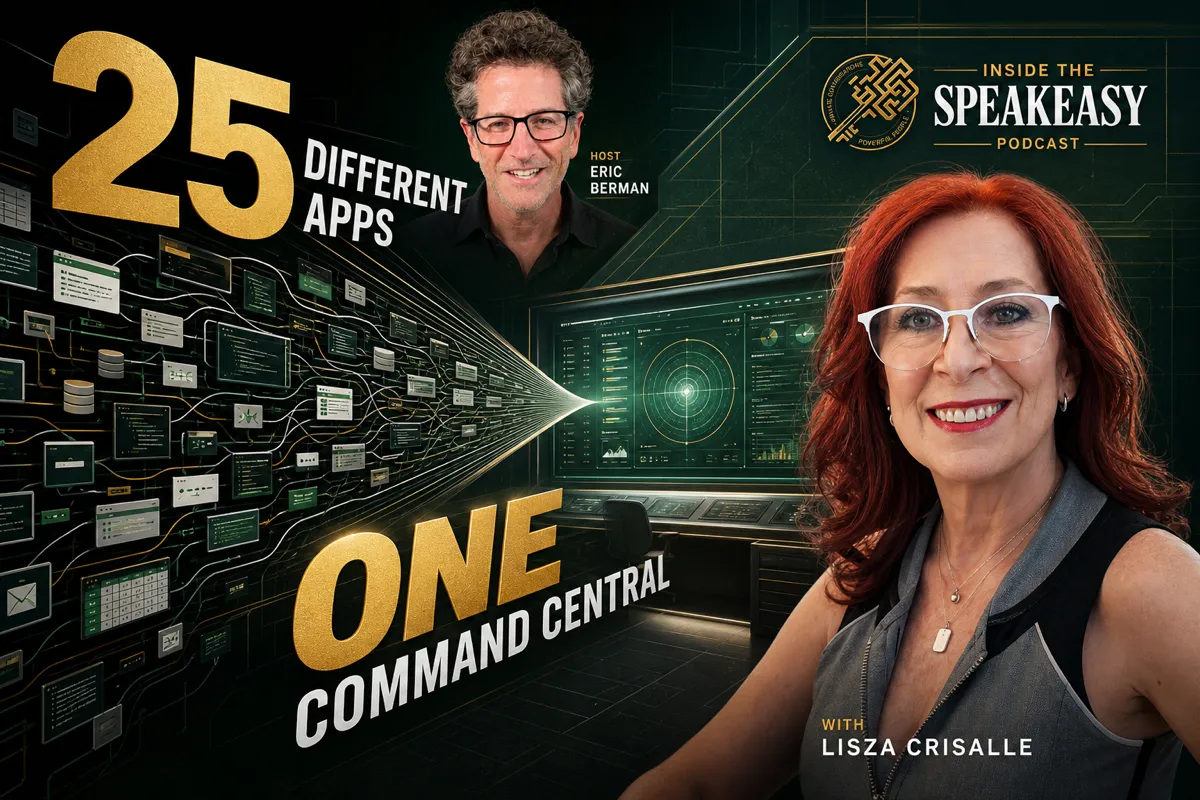
Lisza Crisalle, co-founder of What Works Academy and a founding member of Speakeasy's Las Vegas chapter, has spent more than two decades helping businesses replace manual work with systems. In this conversation with host Eric Berman, Lisza traces how she and her husband Lucho moved from 1ShoppingCart to Infusionsoft, ClickFunnels, and finally GoHighLevel, and why they tested every platform on their own business before moving a single client. She explains how her team maps a CRM migration around a client's most profitable areas first, why she has seen businesses running on as many as 25 different apps, and how AI-powered prospecting and follow-up can hand a sales team pre-qualified booked calls. Lisza also shares the AI employee that answers calls at 1:30 in the morning, a GoHighLevel feature many users never touch, and what keeps her coming back to Speakeasy.
In this episode, you'll discover:
- Why Lisza ran Infusionsoft and ClickFunnels side by side for three years before switching, and how that experience shapes the way she migrates clients today
- The strategy-first approach to switching CRMs: start with your highest-profit areas, run trial runs, and show the client the full map before anything moves
- How an AI-powered follow-up system with more than 17 touchpoints researches prospects and turns cold leads into pre-qualified booked calls
- Why Lisza says follow-up now takes between 8 and 12 touches before people respond, up from three to five in the past
- How GoHighLevel's Communities feature works like a private Facebook group or Skool, complete with scheduled posts and gamification
Episode Summary
Lisza Crisalle opens the episode with a story that surprises even her: a new client, a firm of CPAs and financial advisors, still ran every appointment by hand, with staff calling each other to check availability and prospects falling through the cracks because nobody followed up. Host Eric Berman introduces Lisza as the automation queen of Speakeasy's Las Vegas chapter, someone who, together with her husband Lucho, has spent over 20 years working across nearly every marketing and CRM platform. Their weekly open office hours call, she says, is where clients regularly share what they automated and what it freed them to do next.
Lisza describes the evolution that led her there. She and Lucho have been online since 2003, starting with 1ShoppingCart, then spending about 15 years on Infusionsoft. Because it still could not do everything they wanted, they ran Infusionsoft and ClickFunnels in parallel for three years. They were introduced to GoHighLevel at the end of 2018, used it on their own company for an entire year before bringing clients over, and launched their agency at the beginning of 2020. Their business has grown mostly by referral, which is why their client list is so diverse, including a cruise line in South America that came through a Speakeasy member.
Eric jokes that Lisza spent years dating multiple CRMs, and she agrees that the long overlap was deliberate. That experience now shapes how she helps clients overcome switching fears. As a business strategist, she maps where the client is and where they want to go, then reverse engineers the move. Her team transitions the components that produce the highest profit margins first, tests everything, and runs trials before the full switch. Seeing the step-by-step plan, she says, is what makes clients comfortable saying yes.
Asked why GoHighLevel has grown so quickly, Lisza points to clearly separated components for CRM, sales, and automation, and to what she calls an all-in-one command central. She has worked with clients juggling as many as 25 apps, each with its own login and its own way of breaking when something updates. She compares early all-in-one platforms to the first three-in-one printers, and compares a connected system to a self-driving Tesla that frees up mental bandwidth. She is clear that no platform is perfect, and that her team handles some advanced AI work outside GoHighLevel while tracking everything inside it, but says most of her clients are less advanced with AI and the platform lets them ease in.
The most advanced system she discusses is the WWAI Profit Accelerator, a follow-up process with more than 17 touchpoints that begins with what she calls intelligent prospecting: AI that researches a prospect and engages with their social media before outreach. She shares the story of an attorney who did not know he had won an award until the system congratulated him and sent him the post. When Eric asks whether prospects will tire of AI outreach, Lisza argues that custom, research-based messages are different from templates and that she reviews every interaction before a call. She also says follow-up used to take three to five touches and now takes between 8 and 12 before people respond.
Lisza closes with her current projects and advice. She is creating short AI-generated ads, mostly around 30 seconds, and has a new collaboration with Speakeasy member Brian Hong. She warns that businesses not adopting AI will be left behind by competitors who can produce more, describes a 24/7 AI employee built in GoHighLevel that answers and books calls at any hour, and highlights GoHighLevel's Communities feature. As a founding member of the Las Vegas chapter, she says Speakeasy's curation, collaboration, and annual events have helped her business grow.
Big Ideas Discussed
Migrate by Profit, Not by Feature
Lisza knows the pain of switching platforms firsthand. She and Lucho paid for Infusionsoft and ClickFunnels at the same time for three years, and then used GoHighLevel on their own company for a full year before moving any clients. That caution became the foundation of how they handle migrations today.
Her approach starts with strategy rather than software. Her team identifies where the client currently makes the most profit, transitions those components first, tests everything, and runs trial runs before the full switch. Lisza says the key to calming switching anxiety is showing the client the entire step-by-step map in advance. For any business considering a platform change, her framework is a useful filter: protect the revenue engine first, and move the rest only after it works. She adds that having lived through those overlaps herself is exactly what lets her team guide clients through the same transition, including large ones like the South American cruise line referred by a Speakeasy member.
One Command Central Instead of 25 Logins
Lisza has worked with businesses running anywhere from five to 25 different apps and programs. Each one adds another login to remember and another connection that can break when something updates, leaving the owner to figure out whether a zap failed or code changed. She calls that mental load one of the biggest burdens on business owners.
Her analogy is the self-driving Tesla, a topic that came up in her Las Vegas chapter: when the pieces work together, the driver's brain is freed up for what matters. Lisza is careful to say no platform is perfect, and compares early all-in-one tools to the first three-in-one printers that did not do every job well. Her point is that consolidation, whether in GoHighLevel or elsewhere, gives owners back focus. Her closing advice in the episode echoes this: if you are still logging into five or ten platforms to run your business, she says it can be a lot easier, and the transition is not as difficult as most owners fear.
Follow-Up Is Where Leads Are Won or Lost
Lisza argues that leads are only the first part of the process, and that a lead you paid for is worthless without follow-up. Her team's WWAI Profit Accelerator uses more than 17 touchpoints, starting with AI-driven research and social media engagement so that by the time a prospect books a call, they already feel recognized. The sales team's job becomes closing.
She says follow-up used to take three to five touches and now takes between 8 and 12 before people respond, yet most businesses simply do not follow up that much. Eric agrees that follow-up is where most entrepreneurs fail. When he asks whether prospects will eventually tune out AI outreach, Lisza says the difference is personalization: messages built from real research rather than templates, with a human reviewing what happened before every call. She illustrates the effect with an attorney who learned about an award he had won only because the system found the post and congratulated him, which made him want to thank whoever had noticed.
The AI Employee That Never Calls in Sick
When Eric asks what it costs a business to keep putting off automation, Lisza says the cost is high. In her view, businesses that do not adopt AI will be left in the dust by competitors who can produce more output at a higher level. She frames AI as creating options rather than taking jobs, letting people specialize while repetitive work gets automated.
Her bare-minimum recommendation is an AI employee that works 24/7. If someone calls at 1:30 in the morning and nobody answers, she says, they will call another business. Her team has built AI agents inside GoHighLevel that answer, schedule, and book calls around the clock. Eric suggests every owner grade themselves from 1 to 10 on systems and automation, and get help if they are not near the top. Lisza notes that people's schedules are unpredictable, which is why she considers round-the-clock intake one of the most valuable automations a service business can add.
Questions We Answer in This Episode
Why do businesses struggle to switch CRM platforms?
Lisza Crisalle says switching is a big deal because owners are running their business day to day while the move happens. She helps clients by mapping a strategy first, transitioning their highest-profit areas, and running trial runs before the full switch. Seeing the full step-by-step plan, she says, is what eases the fear.
What is an all-in-one command central for a business?
Lisza Crisalle uses the phrase to describe running an entire business from one platform instead of many. She has seen clients use as many as 25 different apps, each with separate logins and connections that can break. She says consolidating into one system, such as GoHighLevel, relieves that mental load, though she notes no platform is perfect.
What is intelligent prospecting?
Intelligent prospecting is how Lisza Crisalle describes AI that researches a prospect and engages with their social media before and during follow-up. It is part of her team's WWAI Profit Accelerator, which uses more than 17 touchpoints. Lisza says the goal is for prospects to book pre-qualified calls already feeling that a relationship exists.
How many follow-ups does it take before a prospect responds?
Lisza Crisalle says it used to take three to five touches to get a conversation going, but it now takes between 8 and 12 before people respond. She adds that most businesses simply do not follow up that much, which is why she favors systems that handle personalized follow-up automatically.
Will prospects get tired of AI-driven outreach?
Eric Berman raises this question, and Lisza Crisalle says the difference is personalization. Her system does not send templated statements; it builds custom messages from extensive research on the person. She also reviews every interaction before a call, keeping a human touch in the process.
What is a 24/7 AI employee?
Lisza Crisalle describes an AI employee as an agent that works around the clock, never gets tired, and never calls in sick. Her team has built AI agents inside GoHighLevel that answer calls and schedule appointments at any hour. She says if a business does not answer at 1:30 in the morning, the caller will find another business.
What is GoHighLevel's Communities feature?
Lisza Crisalle describes Communities as similar to a private Facebook group and patterned after Skool. Groups can be private or open, paid or free, and posts can be scheduled from the platform's social planner. It also includes gamification so members can earn points, and Lisza notes it avoids paying extra for a separate tool.
Full Episode Transcript
Read the Full Episode Transcript
Cold Open: A Financial Firm Still Booking Appointments by Hand
Lisza Crisalle: We have a new client. They're a financial advisor company. They still literally run all of their appointments by hand. They call each other, hey, are you available? They had no automations whatsoever. And so one of their challenges was their clients, their prospects would get unhappy because there'd be a call and something would fall through the cracks or nobody would follow up with them. And they did all that. They're still doing things manually, like in 2009. So I would say the biggest challenge is they're trying to automate, but they're still holding onto their old systems. They're still holding onto their paper and pen, trying to get them into an automated calendar system for an automated sales process.
Meet Lisza Crisalle, the Automation Queen
Eric Berman: I have a question for you as we start off today's episode. What marketing or CRM platform are you using out there in your business? Actually, the answer doesn't really matter because in today's episode, we have Lisza Crisalle, all the way out from the Las Vegas chapter, and she is the automation queen, I like to say, when it comes to all platforms, all things automation, she's been doing it and her husband Lucho, for over 20 years now. If there's a platform, they've either dabbled in it or they become experts in it. And they're the go to when it comes to figuring out how to automate, make things efficient, how to get through all the craziness. And a lot of us just dabble, but, like, there's probably usually like 90% more you can do. You never know what to do. Well, Lisza's who you call, so welcome to the show, Lisza inside the Speakeasy podcast. Glad to have you.
Lisza Crisalle: Thank you. Thank you. I'm excited for today.
Eric Berman: Awesome. Well, you just, I mean, automation. Automation, which I absolutely love too. It's always fun when you do it. It's scary, but once you do it, it's like, oh, you know, freeing. It's freeing, isn't it? So, and do you get to see the excitement in your customer's voice, your client's voice, when you're like, oh, my God, I didn't know I could do.
Lisza Crisalle: This all the time. In fact, we do. We actually do a weekly open office hour call with all of our clients. Whoever hops on, hops on. And every week someone's sharing, like, they implemented or they did this and now they're able to do that. And, you know, it's just, it's really cool to see how they can then move on into the next thing in their business and not get stuck.
Eric Berman: Okay, we're going to do some cool little automation hacks today. So get ready to hear some of these ideas and really what's working today. Especially for those of you on GoHighLevel, they're really doing a lot of work. Lisza, you told me a lot of work in GHL and of course others, but that's certainly a very common, popular one. One of our great sponsors out there. Thank you, GHL.
From 1ShoppingCart to Infusionsoft, ClickFunnels, and GoHighLevel
Eric Berman: Before we get into that, I mean, how do you just decide one day I'm going to be a platform automation guru? Like, how do you just back into this world?
Lisza Crisalle: It was an evolution. Yeah. Both my husband and I are complete computer geeks. We have been in the online world since 2003. We started off, I'm going to age myself, but we started off with 1ShoppingCart back in the day. And that was the cutting edge thing at the time. But that's how we kind of started our business there. And we were, we have clients all over the world and eventually we ended up moving into Infusionsoft. Many of you know it as Confusionsoft. It's a massive platform and it, you know, it was a lot. We were there for 15 years and the last three years because we, it still wasn't able to do quite what we were looking for. Right. Like, we knew there was just something that could help us really create what we were looking. And we hoped it was a ClickFunnels, but we moved into ClickFunnels, had an overlap of ClickFunnels and Infusionsoft for three years. You know, ClickFunnels is great for what it was intended for, but it wasn't what we were looking for. And then we were introduced to GoHighLevel, literally at the end of 2018, right when they first started, very, very beginning days, we started looking at it, testing it, playing with it. We started with our own company, we started moving everything over in our company and we used it ourselves for an entire year before we started bringing our clients on board. Because we wanted to make sure, because it was like, okay, this looks really good, like, we can do this and we can do this. So we started bringing it over, running all the tests. And the beginning of 2020, we started our agency, started bringing our clients on board and they were referring others. And our business has grown mostly on referral basis, which is why we have such a diverse group of clients right now. But yeah, it's all about systems. And when we finally found a system that was about systems, right, and how we could automate all of these functions for our clients. So that they could focus on what they do best. Right. And then let the systems work and then, you know, work and improve upon them as you go.
Dating CRMs and Easing the Fear of Switching Platforms
Eric Berman: Love it. Well, I feel as you're sharing that story that you guys are like very serial, non monogamous. You just kind of dated multiple CRMs. You kept switching over. You were like, you know, I'm going to go date this new tool over here for a year before I break up complete with the other one. Right. I mean, it's just like, I mean, emotionally I'm sure you were like, like you was like, like dating somebody and you're like, I don't know. We're so invested into this relationship we have with the CRM. I mean, can we do it first of all? I mean, was there a lot of that kind of feeling?
Lisza Crisalle: It was a lot like, that's like, in fact why we had Infusionsoft and ClickFunnels overlapping for three years. You guys, we were paying for both platforms because again, we didn't just jump and we also wanted to make sure the functionality was what we needed. But it was also really great for us now because now when we work with clients who are making a transition from another platform, really experienced on that, we can really, really help them make that transition. And we, we have an entire process of full SOPs worked out that we do when we help them with their transition, when they transition over.
Eric Berman: Well, I know you guys must be good at what you're doing just to the fact that you build enough systems to be able to make that leap. Because I know how painful switching costs are for people on that. I imagine that's one of your biggest objections you get.
Lisza Crisalle: Right.
Eric Berman: And for those listening here, like, I mean, what are the fears? Like how do you help people through the switching costs? Paranoia.
Lisza Crisalle: People go through so really the way we help them. Because again, it's a big deal. It is a big deal. It's, you know, like they're just running their business day to day. So having a map or a strategy, because I'm a business strategist, so I'm always looking at, we want to get here, you know, how do we get here, from here to here. And then we reverse engineer it. So it's all about strategy. Because once you understand what they're at, what are their, what are the most important pieces, we begin to transition the most important components. Meaning where are they making their most profit from right now? Like that's where we have to focus initially, right? Their highest profit margins. How can we make a smooth transition there so we have everything set up, everything tested, we test and we run everything. We do trial runs before we make that full switch over. So it's all about the plan. I'm going to tell you it's all about the plan. So when they feel comfortable and you have, we spent the time and we map out that whole strategy and they see step by step what's going to happen, that really eases it. Right. That, that is the piece that helps them say, okay, let's do that. Done this with a few really big companies. So one of our, one of our amazing clients is a cruise line out of South America and they're absolutely incredible. By the way, that is also thanks to one of our Speakeasy members who referred us so of our organization, how we all support each other and collaborate. But they had a very big transition. That was a process and actually, you know, still doing some key points on there. So it's strategy.
Eric Berman: Wow. Okay. So that helps a lot. Ease of the pain. I like that they get to see what you're doing. I can see that because it's like, oh, but then you're showing them the way. Makes them feel better.
Why an All-in-One Command Central Beats 25 Apps
Eric Berman: Why did you know you talked about Infusionsoft and ClickFunnels for those that maybe not be as, you know, I'll even say myself, you know, I'm not necessarily in the under the hood as much. Again, I know enough about these tools. I hear about them, but like, you know, when I try to get under there and log in, I get like my hand slapped and like, Eric, what are you doing in here kind of thing. What was. I intuitively know the answer to my question, but I like to hear it more. Not exactly what did GHL, why are they winning and crushing right now? Like, as you're going through there. And I know this isn't a big, you know, talk about them, but for those, again, that are looking around and not understanding all the tools, what did they do that was so magical and different that got everybody to say, I need to go date that. That one.
Lisza Crisalle: Yeah, that's a really good question. So it was interesting. Number one was that we felt like the components of GHL were easy to differentiate. Meaning there's a CRM, there's a sales platform, there's automation platform. Like, they have each of the components really clearly outlined. Right. They have all of these pieces. The other thing that attracted us, and this is really interesting saying this, but we love, we call it our all in one command central. It's literally running your business from one place. Because the biggest challenge that's happened previously is that, you know, Most people have 5, 10, 12. I've had clients that had as many as 25 different apps and programs and softwares that they use to run their business. And they're logging into all these different things and they've got to remember the logins and then if something changes as an update, then it breaks the, you know, the pattern, right. And then you got to figure out where is the prop, where did it break and what. Right. And it's all these things that are just way too much mind issues for the business owner. Right. So in the past, and I want to do a really good analogy here. So back in the day, again, I'm going to date myself when they first came out with those printers that were like the 3 in 1 printers, they could scan, they could print, they could copy. In the beginning they were not good because they couldn't do all three well. Right. In the beginning they couldn't do like they would copy good, but they didn't scan very well or whatever. Right. So in the beginning, you know, it was a rough transition for them until they finally improved upon it.
Eric Berman: Got it.
Lisza Crisalle: But what happened when we were with Infusionsoft or ClickFunnels is we just couldn't find that thing that was able, allowing us to be able to keep everything in one place to run our business.
Eric Berman: Right.
Lisza Crisalle: And so that's what we were looking for when we first found that in GoHighLevel. We're like, okay, this makes sense and we got to test it, but we're able to bring all of that in so we don't have the bandwidth and trying to figure out what connects and did the zap break or did this break or did the code change and all of the things. Now I'm not saying GoHighLevel is perfect, it's not. There's no one perfect platform. But what it does for business owners and entrepreneurs is it helps, you know, relieve the tension and stress of having these 10, 12, 20 different places to run your business all in one place. You know, having it all in one place. And I'm going to use a great analogy here because there's a chat going on in our Las Vegas chapter right now all about the Tesla self driving Tesla. And I don't. You've seen that, Eric. Whole concept of how the self driving Tesla helps open our mind up, right. It eases some of the stress instead of, you know, when you're in the car and you're driving and you're trying to talk to someone and figure out where you're going. Right. Completely different experience than when you're in your Tesla. That's self driving. This is actually a topic of discussion in our last meeting. It's the same thing. And this is a great, it's a great analogy to what I say would GoHighLevel. When all of the pieces are working together, it relieves our brain function. Right. It helps release some of that so that we can focus on the areas that we need to. I think that was a, that just came to me, but I'm going to use that analogy again.
Eric Berman: I love it.
Easing Clients Into AI Automation
Eric Berman: Well, we could talk more about, you know, we could get deeper into GHL, but let's get some nuggets. I mean, let's talk about automation. I mean you're, you're in there. And again we have a lot of GHL users and others who are using other platforms. Give me some examples of. I'd say, I always say like, what do you see as the most common thing that we're all doing? And maybe it's a two part question, maybe like what's a common mistake we're making that we should be fixing, number one. And maybe like what's a common, maybe tool set or use set within a GHL or automate people don't even realize is there? You know, if I were to use my old analogy, it's like people would use Microsoft Excel or Word and say, God, you're only using like 3% of the capabilities. You didn't know these are there. Like maybe both of those questions in there are different. Yeah.
Lisza Crisalle: So I'm going to do this, which is we run the majority of our business through GoHighLevel. Okay. But a lot of our AI automations, you guys, like I know all of you know, we're keeping up with, you know, the AI is moving faster than the speed of light, right? Like it's just, it's moving so fast. So we've learned that there's portions of it that are handled outside of GHL, but we're tracking and managing everything within GHL. Obviously the big conversation now is how can AI help our, you know, our systems and our processes. Right. So a large portion of that can be done within GHL, a large portion of it. For those of us who are a little bit more advanced in AI, you know, obviously there's components that are much, you know, farther ahead outside of GoHighLevel, but then we incorporate it in. But for our clients and our prospects, most of them are not nearly as advanced as most of Our Speakeasy people are right. Like they're not living in the world of AI, that many of them are afraid of AI or they're concerned or they're not quite sure or right. So what I found in the HighLevel platform is it allows them to ease into it. So it allows them like we could show them you can use AI to help write your automations, right? To write what we call workflows. I work with things that are the automatic follow up sequences. So as they start again, whether they're beginner or advanced, the more automations that we can create or they create or we create with them, the less they have to think about it. And so we're easing them in using AI right now. So I think that, I hope that answered your question, but I would say AI seems obviously it's the topic of conversation right now, but we don't, if we're not all encompassing, just GoHighLevel where what we do is, when we talk we're like, what are your challenges? What are the things that you do? And then we have something called the AI powered growth ecosystem. And from our ecosystem we say we have a solution that can help with that. Right. I don't want to just throw before them what is your challenge, what is your problem? And then we can help you with X. And so we bring what are the.
Eric Berman: Common problems you're finding? People come to you. Is it just like, you know, if I'm listening, I know, I know not all Speakeasy members are listening or we have other people, you know, listening. So like what are people finding? Or you're seeing you talk to a customer for the first time, you're doing that audit like a discovery, you're like, oh man, like this is a common thing that people are doing wrong or not doing at all. This show is brought to you by HighLevel, the AI driven business operating system trusted by over 2 million businesses to help automate, scale and create real leverage. HighLevel isn't just a tool, it's the engine behind some of the most agile and high performing teams on the planet. If you're ready to streamline everything, amplify your reach and actually build a business that works for you, you're in the right place. Visit www.gohighlevel.com/speakeasy-mastermind-promo to get an exclusive 30 day trial for being a listener of the Inside the Speakeasy podcast. Enjoy the show.
The Most Common Gap: Manual Follow-Up and Paper Calendars
Lisza Crisalle: A common thing is that they just, they either don't have real automations or either doing everything manually still, meaning they have office staff, they're doing manual either follow ups and things are falling through the cracks. I'm telling you, we're still bringing clients.
Eric Berman: You're saying more on the sales side. Like which part of the companies are.
Lisza Crisalle: You finding more sales intake, onboarding, like all of it. I'll give you an example. We have a new client who is their finance advisor, company finance or their CPAs and financial advisors. They're incredible. Anyway, they're in the south. They still literally run all of their appointments by hand. They call each other, hey, are you available? Like they're. They had no automations whatsoever. So one of their challenges was their clients. Their prospects would get unhappy because there'd be a call and something would fall through the cracks or nobody would follow up with them. And they did like oh, they're still doing things manually like from 2009, like just [unclear]. But here's what's surprising to me is we're still finding that like that's not uncommon. It's surprising to me because I've been on Google Calendar for 25 years. I don't even know however long it's been around. So I would say the biggest challenge is they're trying to automate but they're still holding onto their old systems. They're still holding onto their paper and pens. You know, paper and pen. Right. Writing everything down manually like trying to get them into an automated calendar system or an automated sales process.
Eric Berman: Right.
Lisza Crisalle: You know we take everything now. We're already getting them not just but the qualified booked appointments. So we're doing all the follow up automated. They're literally just getting on the phone and making and closing the sale. That's it.
Eric Berman: Right, Right. Wow, that's great. So I mean, I mean, I mean it would seem like probably a lot of the issues is it's kind of like I go to the quadrants, if you will. It's almost like the quadrant two of what Stephen Covey teaches where it's important but never urgent. So they continue to use the same old arcane systems they've had forever. And they're like they're going to get to it someday and they just keep never getting to it. And time just passes. And so you know, I guess if anybody's listening and saying gee, that might be me, maybe there's areas of your business that you're not automating. And I almost the analogy for me is almost like what we're seeing in AI right now. I think a lot of it's too just habit of questions. We're asking, you know, are you asking the questions how can I automate this versus just continue to do the same thing? Well, gee, can it be automated? Can I do this thing that I'm doing every day now versus the old way?
Lisza Crisalle: And a lot of people, they're, you know, they've been doing their business the same way for a long time. Right, I get it. You know, especially if you're talking about service based businesses, attorneys, financial planners, you know, HVAC, whatever, they're just so used to doing these things. So when you start to share with them, you know, what can be done in the background without them even being involved, it frees them up and it's really cool to see when somebody is open and this starts implementing it.
Intelligent Prospecting and 17 Touchpoints
Eric Berman: Yep. Okay, so let's go, let me see if I can get you to think of a, of an advanced automation. So like let's go to the. A more advanced listener. All right, so yes, of course, come on in and automate my intake of leads to my, you know, my team to the automatic responded emails that go out, text messages, et cetera, et cetera. What's like some fun really advanced, like wow, you actually really impress somebody with some cool event automations.
Lisza Crisalle: Yeah. So we have two really big ones right now that we're really working with. One is what we call the WWAI Profit Accelerator. And this is our follow up system. So not only leads, okay, because everyone talks about leads. Leads, leads. Leads are only the first part of it. If you're not following up with them, those you know you paid for, it's worthless, right? You've got it. It's about getting qualified book calls. So it is about getting in through the gatekeeper, qualifying them and what it does, it has over 17 touch points. And so this is really cool because it goes out and we do first what's called intelligent prospecting. So we go out and we it researches about this person and what are they involved with, what are their kids do. It responds to different things in social media. So all of a sudden this person is seeing, you know, you show up on your commenting or it's, they're seeing you, they're starting to see you. Right. And they're recognizing, oh hey, this person's like following me, knows what I'm commenting on different things. And our, again our AI is doing this, it's intelligent prospecting. And we do a series of these follow ups with them and we actually had one. This is amazing. It was with an attorney and the attorney had been awarded an award for something and it was done on social media. And so our AI went to him and said, hey, congratulations on your award. And the attorney, he's like, I don't recall getting that. And so our AI went back to the Post, got the Post and sent him the post with the award. And he was like, huh, I didn't even know I won this. And he got on the phone with us, he goes, I don't know who your person was, but tell them, please tell them thank you for like finding that for me. We're like, that was our system. And so you guys like, I mean, for those people who know AI, it's just so advanced, it can do so much. And so it takes the pressure off of the sales team now because the sales teams now become literally, they're doing their job of closing sales. We get these 17 touchpoints and these people are then choosing and they're booking an appointment once they've been pre qualified. So when they get on that call, they're on a call with a salesperson. They already know you, they already know you've been following them like, right. They're like, how did you like, know this? And they get on a call and it's already built that relationship.
Eric Berman: And how much longer do you think? And maybe because I'm more on the front edge of these things and everything, all these LinkedIn messages, everything I'm getting, I'm like, AI, AI, I mean, what do you think? I mean, how much longer until we get away with this kind of marketing? Until people are like, okay, this is just AI bots chasing me down.
Lisza Crisalle: Well, here's what I'm gonna say. Where ours is different, it's, first of all, it's not a template, so it's not a like templated statement, right? I'm not going, hey, you know, Eric, I saw you on Speakeasy, right? It's not that it's gonna be, hey, Eric, we saw your daughter just, you know, her baseball or her softball team just won, you know, won their thing, right? Whatever, you know, so it's like creating real conversation. So it's actually not that easy to tell that it's necessarily AI because it's literally taking information from your socials, it's going in and it's researching you, and it's extensive research. So how long? I mean, they might. But the piece is like, I'm always notified, I'm always going to know what those conversations are. By the time I get on the phone with you, I'm going to know that we reached out about that because I'M following. You know, I can go in and look at my report on you. If once I know you've booked a call with me, I'm going to see everything that transpired, you know, with a human touch. That's the important part. It's not a bot that goes out and does a standard, you know, the templated response. A templated response. There's a lot of software that do that. You have to write out your templates and that's what it sends. It's a very different thing than that.
Eric Berman: Got it.
Lisza Crisalle: These are really custom conversations.
Eric Berman: Yeah, no, it's going to be interesting. I mean, I mean either way to me, I mean I feel like, well, at some point if it starts to lose its luster, then you just go to the next thing and. Next thing.
Lisza Crisalle: Exactly. [unclear]
Eric Berman: The key is if you think about how many steps along the process, whatever that lead step is, it's the next one and the next on the next one and the follow through and the follow ups and delivering and you know, certainly, you know, in the world I play in, as you know, I mean just the art of follow up is just most people fail and suck at it and especially entrepreneurs, they're just bad at it. It's not their core. And having systems and tools that can deliver things to us efficiently and say, here you go. I mean that's worth so much savings and time.
Why Follow-Up Now Takes 8 to 12 Touches
Lisza Crisalle: It used to be back in the day it would be like three to five touches, right? Like three to five times a follow up, back and forth and then you could probably get a conversation going. It is now between 8 and 12, before people will even respond. So it's become, and I'm telling you, people just don't follow up that much. They just don't do it. So having a system that is doing it for you behind the scenes that you can follow, that's still personalized, that's still custom. Again, we can apply it in so many ways, but it makes it. They feel like they're being seen and heard and that's the first, the most important thing about building relationships.
AI-Generated Ads and a Speakeasy Collaboration
Eric Berman: Nice. What else? Any other fun automations that you guys are proud of like that you've knocked out recently or. I got another question after that, but go ahead. Any other fun that you could think of?
Lisza Crisalle: This is actually so cool. I'm actually [unclear] and I got Speakeasy involved with it and I'm super excited because we actually have a new collaboration with a Speakeasy member.
Eric Berman: Wonderful.
Lisza Crisalle: I am doing AI funny ads and having so much Fun with it. Just for me, it's the creative side for me really creating these fun, crazy, you know, they're real people. I mean, it can be real people. It could be cartoon. There's so much that we can do in AI now. So I'm getting short ads anywhere from 8 seconds to no more than a minute. Most of them are 30 seconds right around in that range. And really fun, creative stuff. And so I put out in Speakeasy, I said, look, I'm looking for some case studies, right? I'm looking for a few more case studies here because I have some different, you know, industries that I'm doing and just connected up with a couple people and have a new collaboration going and it's a lot of fun because again, I can, you know, people want to have fun with stuff like you want. Again, whether it's an ad or just social media post, you got to stand out. You got to do something crazy. Whether it's. I did me as like I'm Lisza's AI bot, you know, I had a blast with it where I did a spokesperson, her, you know, this beautiful girl, her head on a flying pig when pigs fly. And then I did a whole ad campaign on, you know, talking about the elephant in the room. And I had this really cool elephant in the room with Lucho and I.
Eric Berman: And it's just, oh my gosh, that's fun. Are you allowed to share? I forget, I don't even know who you're collaborating with in the community on that one. Who's. Who are we working with?
Lisza Crisalle: Yeah, sure. Mr. Brian Hong is awesome and he's like, yeah, let's do this. And he's open minded and he wants to do some fun stuff. And I've been working on some cool things behind the scenes.
Eric Berman: I love it. I love hearing all the stories of people collaborating and making things happen that. And obviously I'm biased because I think as I even mentioned earlier, with this AI world out there, we need to surround ourselves with real to know who he can collab with.
The Cost of Not Automating and the 24/7 AI Employee
Eric Berman: So, okay, so going back to, you know, the why and it sounds like a lot of people who aren't automating or the people that are late adopters probably, they're just in their old, their ways and they're. It's just not an area that they're probably good at and they're scared of. And then the people that are a little bit more forward. What is the big like, I'm listening to this show right now, I'm hearing this, I'm talking Hearing from Lisza and like, okay, this sounds cool. What's preventing me or what can you tell me right now to just get me off my ass to say whether I do it myself? Call Lisza, you know, whatever it is. What are you going to, how can you motivate me to say what am I missing out on by not doing it? What's the cost?
Lisza Crisalle: Yeah, I think the cost is high. We're still in somewhat early stages. You know, I wouldn't say early early stages, but somewhat early stages for early adapter adapters for businesses. And what I will say is if you have a business and you're not adopting or adapting in with AI, you are going to be left in the dust because your competitors are going to have a huge competitive advantage. They're going to be able to produce much more than you can produce. They're going to be able to have output at a much higher level than you will. And so it will be a competitive advantage or disadvantage. It's not taking away jobs, it's creating more options. Right. It's giving, letting people get specialized in what they do and do what they do best. But automating the things that are repetitive. And that's really it. What is the repetitive components of your business that could be automated? That. And also this last piece is the bare minimum. That's an AI employee. They work 24 7. They never get tired, they never call in sick, they never have an attitude. Right. Like they, they know your stuff, they're going to do it perfectly. And if somebody calls your business at 1:30 in the morning, they're going to answer and they're going to be lovely and they're going to do it exactly the right way. And they're like, oh my gosh, we never had this before. It's brilliant. Because guess what? If you're not answering your phone at 1:30 in the morning, they're going to call another business and they're going to find something.
Eric Berman: Your favorite use of a 24/7 AI employee is what is the, is the intake person on a lead on a call?
Lisza Crisalle: Absolutely. Like there is no reason why you can't because people, you never know what their schedule is. They're looking for somebody.
Eric Berman: Yeah. What software do you like and you're recommending right now for the AI intake?
Lisza Crisalle: We're using HighLevel for it right now. We have our AI agents all built out and answering 24/7 and scheduling and booking calls.
Eric Berman: And is that a tool within the GHL?
Lisza Crisalle: That's part of it, yeah. Part of it, yeah.
GoHighLevel Communities: A Built-In Alternative to Skool
Eric Berman: And speaking of GHL. Maybe back to that other question. I know you're GHL and more, but what is maybe a favorite tool than GHL? And maybe this is the one we're just talking about now that all of us GHL users may not be as familiar with that should get familiar with it.
Lisza Crisalle: Oh, wow. There's so much in there. This is just one of my little favorite things. So GHL has something called communities. Communities. Think of communities as like a Facebook group. It's also patterned after Skool. S-K-O-O-L for Skool. It's literally patterned after Skool. But I like to think of it as a Facebook group. A private Facebook group that can be private, it can be open, it could be paid, it could be free. So we're building these communities and these communities are brilliant because you get to manage everything, right? You. You don't have to have Facebook out there advertising to your people for a month for another group, which just drives me insane.
Eric Berman: Oh, wow.
Lisza Crisalle: So they're in your group. But here's what's really cool. Not only do you have communities, but within the marketing platform where they have a social poster, I can also schedule my posts within the community. So I can set up, like, if there's every Monday there's a phone call, my Monday reminder, or whatever it is, or I do a social post in there, I book it just as if I'm posting to Facebook or LinkedIn or whatever, I can do the same thing within the community. So now again, it's creating like, this community is so powerful. And there was also gamification in the communities.
Eric Berman: Right?
Lisza Crisalle: People are active and involved. They can earn points. It's this brilliant piece that I don't think a lot of people use, and they're all like, well, what about Skool? And I'm like, yeah, but you got to pay extra for that. So I found that in my platform.
Eric Berman: I love it. That's cool. Didn't know that.
Lisza Crisalle: There you go.
Eric Berman: Excellent.
Fewer Logins, More Focus
Eric Berman: Well, as we get closer to wind down, is there anything about automation or the world you're playing it that maybe I didn't ask that I should have, or you wish I had, or.
Lisza Crisalle: I mean, there. It's a lot. So, I mean, there's so many avenues we can go down. I think that just being open to and seeing what's possible. What I will share is if someone's listening to this and you're still on five or ten different platforms to run your business, I will just say it can be a lot easier. Okay. You don't need to be logging into 5, 10, 15 different things to run your business. So I just encourage you to talk to somebody, find out what is possible because it's not that difficult to transition over. It's really not whether it's GoHighLevel or something else. My thought is I talk to entrepreneurs about how can you be more efficient and effective with your time. Right. And not being worried about all of these different things and how are they connecting and what's working or not. Once you take that burden off of your shoulder, it's just like the self driving car, right. Your brain is freed up to a focus on the things that you do best.
Eric Berman: Love it. Love it. Yeah, I agree. And I think everybody needs to look in the mirror and ask and grade themselves on a level of 1 to 10 and how good they are at, at creating systems and automations. And if they're not near the, the 9, 8, 9, 10 mark, then you know, pick up the phone, make a call, talk to somebody like Lisza or somebody else that, that you're comfortable with. And it's just crazy what happens when the efficiencies are built. Cool.
Why Lisza Loves the Las Vegas Speakeasy Chapter
Eric Berman: Last question. I mean, you've been one of our amazing members since the beginning. Tell me, you know, what do you love about Speakeasy?
Lisza Crisalle: Ah, well, I'll tell you this. I knew from the very first. So we are founding members of the Las Vegas chapter. And I think, correct me if I'm wrong, wasn't Las Vegas chapter like the second or third chapter? I think it was the third.
Eric Berman: It was probably, I think it might have been number four.
Lisza Crisalle: Oh, four. Okay. So number four. So early days. We were invited to that first big meeting and Lucho and I looked at each other and we said, we knew that this was different, we knew the format was different. We weren't interested in another networking group like, you know, this and this is Vegas, there's a million of them. We knew it was different and so we were in from, you know, from hello. So we knew right away, we know that they curated a really great group of people. We knew that we had the opportunity to grow our business with the other businesses. Right. Like each month we get, you know, we know each other's businesses so intimately and now we're bringing in, we have some new members. It's really exciting. And just the opportunity, like our business has grown because of the collaborations, because of the connections, because of the opportunities that we've had because Speakeasy opens the gate, right, to having these other connecting with other people and hanging out in the swimming pool with John Assaraf. Doing a video and there's no shirt on. Like, hey, what could be better than that?
Eric Berman: That always helps, right? That's the cherry on top.
Lisza Crisalle: But like, whatever. So, hey, we have a lot of fun. And that's the other thing. It's business where, you know, yes, there's a lot of collaboration and lots of amazing brainstorming and connecting, but we also have fun and I'll tell you, the, you know, the annual events is a absolute no, you know, there's. We wouldn't miss it for anything in the world. It's just, it's brilliant.
Eric Berman: Awesome. Well, thank you and thanks for contributing so much and we appreciate you and thanks for the time today. I know how busy you are. Time for you you to go back and probably have 10 automations to go build right now before the day ends.
Lisza Crisalle: I have some funny videos to create actually, so I'm excited.
Eric Berman: All right, well I'll do one of those videos. We'll get them out there. [unclear], if you're listening, obviously the information about Lisza will be posted in here and can always connect and hopefully you'll come check her out and check what she's doing as well as the community. And thanks Lisza. And that's a wrap from the Speakeasy podcast. If something sparked for you, don't keep it to yourself. Share it, review it and pass it to the one person who needs to hear this right now. Want in on the real mastermind? Tap the link in the show notes to apply until next time. Keep scaling, stay sharp and don't be the smartest one in the room.

About The Guest
Lisza Crisalle
Lisza Crisalle is a business strategist and co-founder, with her husband Lucho Crisalle, of What Works Academy, a Henderson, Nevada company that helps business owners automate sales, follow-up, and operations with AI-powered systems built largely on GoHighLevel. Lisza and Lucho have worked online since 2003, moving from 1ShoppingCart to roughly 15 years on Infusionsoft and a period on ClickFunnels before adopting GoHighLevel at the end of 2018 and launching their agency in early 2020. Her team helps clients migrate from older CRMs, builds AI follow-up and intake systems, and hosts a weekly open office hours call for clients. Lisza has also mentored and consulted with health, fitness, and wellness professionals on building profitable lifestyle businesses. She is a founding member of the Speakeasy Mastermind Las Vegas chapter.