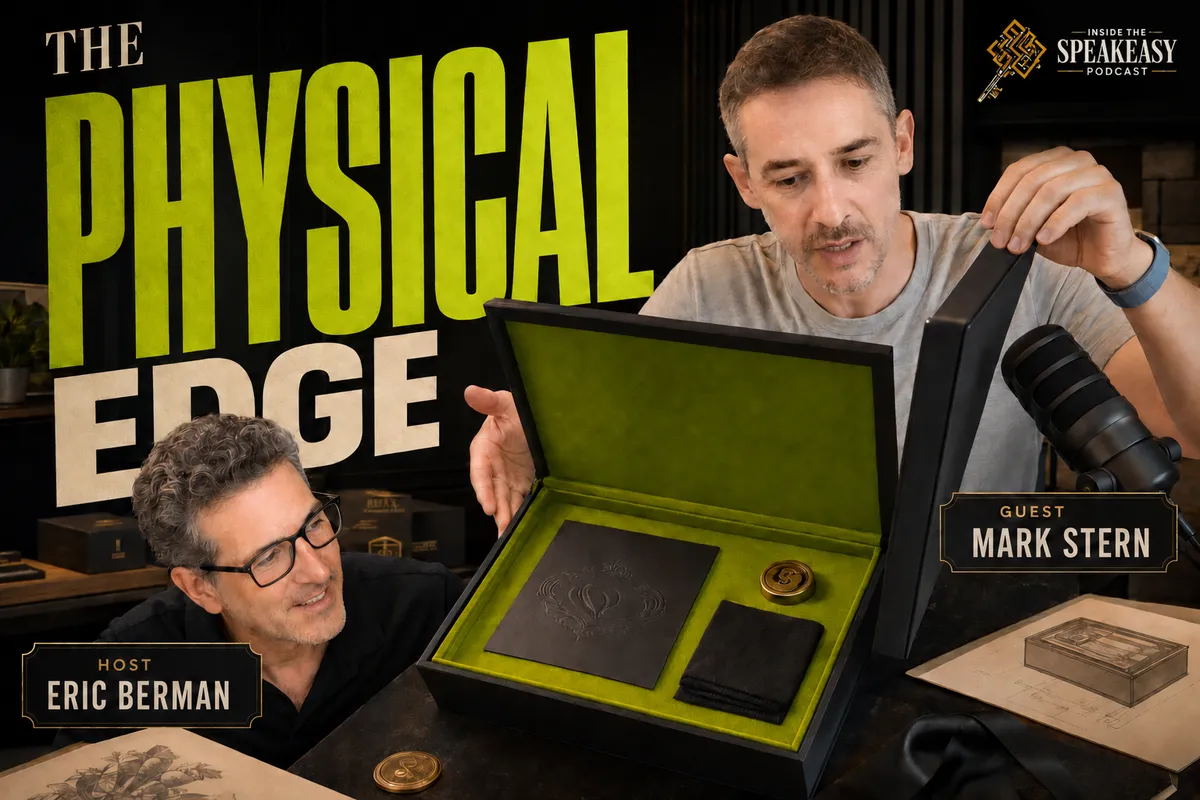
Mark Stern, founder of Custom Box Agency, spent years as what he calls the poster child of corporate America before a sleepless night in December 2017 convinced him his Deloitte career would kill him if he stayed. In this conversation with host Eric Berman, Mark traces his path from a Duke MBA and Deloitte to virtual summits, a printed publication that customers unboxed on camera, and the COVID-era decision to shut down a three-year virtual event business and go all in on boxes. He breaks down how he designs physical customer experiences around a clear definition of success, why he says swag means stuff without a goal, and how the Spartan race trifecta medal shows the power of giving customers something to strive for. Mark also opens up about the health wake-up call at 39 that reshaped how he shows up in business.
In this episode, you'll discover:
- Why Mark believes specializing in one thing makes it far easier for other good businesses to refer you, and how saying no to opportunities helped his business grow
- The three phases of the customer life cycle and why defining success in binary, yes-or-no terms is where every customer experience should start
- What goes into a typical custom box experience, from the welcome note and getting-started guide to a journey map and the tools customers need
- How collectible box series, bookshelf-friendly design, and replayability keep customers engaged long after the first purchase
- How a 39 percent body fat reading at age 39 led Mark to hire a health mentor and drop from a high of 250 pounds to 173
Episode Summary
Mark Stern grew up in a Jewish family in Alabama and was taught that life followed one natural progression: high school, college, a good job, grad school, and then the dream job. He jokes that he was the poster child of corporate America. He was president of his high school, president of his class all four years of college, and worked on national marketing campaigns for liquor brands such as Absolut, Jameson, and Malibu. He then earned his MBA at Duke, where he was one of the co-student body presidents, and joined Deloitte Consulting, where he worked his way up to become a top-rated strategy consultant.
The reality did not match the dream. Mark graduated from Duke in 2012 with $165,000 in student loan debt and a two-year commitment to Deloitte, and spent six years flying to clients every week. His contract also meant that anything he built inside or outside the firm would be owned by the firm, so starting a business on the side was not an option. About a year and a half into the job, he booked a ticket to Mindvalley's A-Fest, where meeting digital marketers shattered his bubble. Then, on December 27, 2017, during a promotion year when he was on track to become a junior partner, he woke in the middle of the night with a feeling that the job would kill him if he kept doing it. He gave notice in Dallas on January 3 and stayed until May.
With no clear plan, Mark joined Russell Brunson's Two Comma Club mastermind for $18,000, one of the boldest and most stressful decisions he had made, because he knew he needed community and support. On someone's advice, he ran a virtual summit and interviewed more than 40 people. Feeling the 24-hour viewing format overwhelmed buyers rather than served them, he turned the best insights into a printed publication called Entrepreneur Elements and mailed it to ticket buyers. People began posting reveal and unboxing videos, and the physical piece set him apart from competitors who only delivered digital products. For his second event, he interviewed 10 people about high-ticket sales and turned the insights into a box, and recipients spent an average of three to seven minutes showing it off on video.
Demand for boxes kept growing, so Mark launched the Custom Box Challenge to teach the process, and people who went through it began asking him to build boxes for them. When COVID hit, a mentor told him that half the people he asked called Mark the box guy and the other half called him the virtual event guy, and told him to pick one. Mark shut down the virtual event business he had been building for three years and went all in on boxes. He contrasts this with Deloitte, which trained him to be the world's best generalist, and explains that entrepreneurship rewards being known for one thing because it makes you easy to refer. Eric admits he is guilty of juggling several things himself.
Mark then walks through how Custom Box Agency approaches the customer life cycle: acquisition, delivery, and retention. He points to ClickFunnels' Two Comma Club Award as a model of recognition, because it defines success in black-and-white terms. His formula starts with the end in mind by defining success so clearly that it becomes a yes-or-no answer, the way a marathon medal or a diploma does. From there, he works backward to onboarding and a clear pathway. A typical box includes a welcome note, a getting-started guide, a journey map, and the tools and resources customers need, as in a box he shows for Annie Grace's coaching program. He also urges listeners to engineer replayability into their products rather than send swag, which he jokes means stuff without a goal.
The conversation closes with Mark's personal transformation. At 39 he read that the average American lives to 78, began getting ocular migraines in December 2023, and learned from a DEXA scan that he was 39 percent body fat. Seeing his life as three domains of personal, professional, and self, he realized his health was the weakest link holding back his business. He hired a health mentor at a fraction of the cost of a business mastermind and went from a high of 250 pounds to 173. He now thinks about which decisions build or give up power, keeps clear non-negotiables, and quit drinking in January, a choice he held even at a bachelor party at an all-inclusive resort.
Big Ideas Discussed
Being Known for One Thing Makes You Easy to Refer
Mark was trained at Deloitte to be good at everything, a strategist who could also implement and handle the details. Entrepreneurship, he argues, rewards the opposite. Through what he calls the law of reciprocity, he wants other good businesses to succeed and assumes they want the same for him, so his job is to make it easy for them to explain what he does and send people his way.
His example is a business owner who runs a YouTube ads agency, a podcasting business, a social media management service, and a VA staffing company. That person becomes hard to recommend, and a specialist who puts all their mental energy into one craft will beat them most days. Mark lived this lesson when a mentor told him people were split between calling him the box guy and the virtual event guy. Shutting down a three-year virtual event business to go all in on boxes, and saying no to opportunities outside his wheelhouse, is what he says truly changed the game for him.
Define Success in Binary Terms Before Anything Else
Mark believes most businesses do a poor job of defining success for their customers. He points to the systems that do it well: a marathon has clear prep, race, and post-race phases and a medal at the finish, Taekwondo has belts, Boy Scouts have ranks, and college has a diploma. In each case, there is no doubt whether someone has succeeded.
ClickFunnels applies the same idea with its Two Comma Club Award, which recognizes customers who generate a million dollars through a funnel. Mark says people keep paying their monthly fee because they want that recognition, even some who do not love the platform. His advice for anyone who wants to improve customer experience without building a box is to start there. Define the outcome as a yes-or-no metric, then go back to the beginning to plan onboarding that reduces overwhelm and a pathway that leads to that outcome. Once success is defined, every other part of the journey becomes easier to design.
Swag Means Stuff Without a Goal
Mark wants listeners to stop thinking of a box as a swag box. His agency's joke is that swag stands for stuff without a goal, and his alternative is intentionality: send customers the tools and resources they actually need to get started. He remembers spending $2,000 to $10,000 on programs that then required him to print or buy materials before he could begin, which created exactly the kind of friction that leads to someday I'll get around to it. Eric connects this to Brian Tracy's idea of Someday Isle.
Intentional design also means building things people keep. Mark designs boxes that fit on a bookshelf with a branded spine, and some clients send numbered series, such as box 1 of 4, that create an open loop and make customers want to complete the set. He also points to replayability, citing CDs, cassette tapes, his father's eight-track and vinyl records, and a Monopoly board passed down from his mother. His challenge to business owners is to engineer that replayability into their products so customers return to them again and again.
Your Weakest Domain Caps Your Business
Mark divides life into three domains: personal, meaning relationships, friends, and family; professional, meaning how you make money; and self, meaning sleep, fitness, nutrition, and relaxation. At 39, his business was thriving, but his body was not where it needed to be and his relationships could have been better. He realized that if his body was only good enough, his business could only be good enough, because it was all part of him.
Asking for help was the turning point. He hired a health mentor who started with blood work, prescribed supplements, required daily weigh-ins and photos every Monday, and limited him to three 35- to 45-minute workouts per week. Mark notes that the program itself was a great customer experience, taking him from no motivation to not missing a day. He says taking care of himself had a direct impact on revenue because it changed how he showed up for other people, and he credits his mentor with holding a bigger vision for him than he held for himself, which he believes entrepreneurs should do for their own people.
Questions We Answer in This Episode
Why did Mark Stern leave Deloitte?
Mark Stern spent six years traveling to clients every week at Deloitte, carried $165,000 in student loan debt, and could not start a business because his contract gave the firm ownership of anything he built. On December 27, 2017, he woke with a feeling that the job would kill him if he stayed. He gave notice that January and stayed until May.
How did Mark Stern get into the custom box business?
After running a virtual summit, Mark Stern turned the best insights into a printed publication called Entrepreneur Elements and mailed it to ticket buyers, who began posting unboxing videos. His next event became a box experience about high-ticket sales. During COVID, a mentor told him to choose between boxes and virtual events, and he went all in on boxes.
Why does Mark Stern recommend specializing in one thing?
Mark Stern says entrepreneurship rewards being known for one thing because it makes you easy to refer. If you run several unrelated businesses, people struggle to remember what you do, and a specialist focused on one craft will usually win the referral. Mark says choosing boxes over virtual events, and saying no to opportunities outside his wheelhouse, helped his business grow.
What is the first step to improving customer experience?
Mark Stern says the first step is defining success so clearly that it becomes a binary, yes-or-no outcome, like a marathon medal or a diploma. Once that outcome is clear, a business can go back to the beginning, plan onboarding that reduces overwhelm, and map a clear pathway to the result. He says this can be done digitally as well as physically.
What goes into a custom box experience?
Mark Stern says a typical box includes a welcome note that anchors people on the experience, a getting-started guide, a journey map that shows the process ahead, and the tools and resources customers need. It can also introduce other ways the business can help. He adds that no two boxes are alike because no two businesses are alike.
What does "swag means stuff without a goal" mean?
Mark Stern uses the phrase to push businesses away from generic branded gifts. Instead, he wants them to send intentional items that help customers get started and reach an outcome. He also encourages designing things people keep, such as boxes that fit on a bookshelf, numbered series customers want to complete, and products with replayability.
How did Mark Stern transform his health?
After a DEXA scan at 39 showed 39 percent body fat, Mark Stern hired a health mentor. The program included blood work, supplements, daily weigh-ins, weekly photos, and three workouts a week of 35 to 45 minutes. Mark went from a high of 250 pounds to 173 and says the change had a direct impact on his revenue.
Full Episode Transcript
Read the Full Episode Transcript
Cold Open: Why Being Known for One Thing Gets You Referred
Mark Stern: Think about it in this way. Law of Reciprocity states, you know, for me, I truly want other good businesses to succeed. Therefore, Law of Reciprocity states, probably other good businesses want me to succeed. How do I make it easy for other people to make help me succeed, make it easy to communicate what it is I do and how I can help? I have a YouTube ads agency, but I also have a podcasting business, but I also have social media managers and I also have a VA staffing business. All of a sudden you just made it so much harder for people to recommend you. Because if there's someone who specializes in growing a YouTube channel or specializes in podcasting, they're going to beat you out any day of the week because they're putting all their mental capacity towards their craft.
Eric Berman: Welcome to the Speakeasy Podcast, where the real conversations happen behind closed doors with the boldest entrepreneurs, creators and growth minds in the game. No fluff, no filters. Just the raw strategies, personal stories, and mental models that move the needle. I'm Eric Berman. Now let's get into it. In today's episode of Inside the Speakeasy Podcast, you're going to be so excited to learn from Mark Stern, who's gone from the crazy corporate world of Deloitte & Touche and other major, major companies into the world of entrepreneurship where he's sharing his genius, especially when it comes to creating custom boxes. Incredible retention experience with your customers and out of the box ideas to acquire new customers. Some that you probably never heard of and some basic, basic tips to help you get more from your existing clients. Welcome, Mark Stern.
Mark Stern: Eric, I'm thrilled to be here, so thank you for having me.
Eric Berman: Yeah, we've had some good dialogue and really ever since, I mean, you really opened my eyes the first time we chatted and you're doing some incredible things on just custom box experiences, the onboarding, you know, building community here at Speakeasy and realizing the importance of that proper onboarding, the struggles we're going through. You know, our first conversation, you really helped guide me a lot and opened my eyes into some obvious misses I had. And you know, if okay with you, I'd love to get in some of that a little bit later in this chat.
Mark Stern: Let's do it.
Eric Berman: But before we get into that, because you do some incredible, you know, custom boxes, you know, just general customer journey that you've really got to learn. I was so fascinated. We talked and I love having you as one of our great members in the community because we have a lot of members that are almost like the anti corporate, you know, they go in through the, I always say the unhirables, you know, the people that are like, oh, I could never go be in the corporate world. And they just out there rolling up sleeves and building stuff on their own. Yet you have a cool background where you were in that corporate world, you were the guy who was just crushing out there and you went the opposite way. And I'd love to hear a little bit of your background, some of your entrepreneurial story, if you could share, like what you learned along the way and how you got to this point.
From Alabama to Duke and Deloitte
Mark Stern: Yeah. Oh, gosh. So I grew up in Alabama, a Jewish family in Alabama, which you're automatically kind of like the token representation of your faith as a kid. But like I was just told and everyone was taught the same thing around me, that there's just one natural progression to life. And you know, you graduate high school, go to college, you graduate college, you get the job, then you go back to grad school and then you get the dream job and the White House with the picket fence and life is great. And you know, I thought that was it, that was the pathway. So I used to joke and say I was the poster child of corporate America because I was president of my high school. When I went to college, I was president all four years of my class. Like I would go to the extremes. I had one job from undergrad to grad school. I had this dream to work on national marketing campaigns in the liquor realm. So like Absolut and Jameson and Malibu, we'd incubate and launch these national campaigns for them, which was amazing. I got my MBA at Duke, was one of the co student body presidents there, then worked for a big five consulting firm, Deloitte Consulting, and worked my way to be a top rated strategy consultant, thinking this is life. Like this is like the game. And you wake up one day and realize, and this was back in 2012 after I'd graduated from business school.
Eric Berman: You are on that ladder, that ladder that you thought it was right straight into it, crushing. Get into the corporate, you know, fun corporate job.
Mark Stern: You think that's because everyone I knew was like that. Like we were all kind of playing and drinking the same Kool Aid and playing the same game. And then it was 2012, I graduated Duke. I had a two year commitment to Deloitte. I had no quality of Life because at 4:45 every single Monday, a car picked me up to take me to the airport to fly to my clients and literally lived weekly as a road warrior flying to my clients for six years and you realize I'm $165,000 in student loan debt. And now I have this job that I have no quality of life. This can't be, you know, the dream at the end of the tunnel.
Eric Berman: When do you realize this? So you.
Mark Stern: How many.
Eric Berman: You said six years.
Mark Stern: You started so it was 2012. When you stare back at saying you have $165,000 in student loan debt. And I think I've always had an entrepreneurial spirit. Nothing is worse to an entrepreneurial spirit than filling this black cloud of student loan debt. And then here's the other twist. Deloitte by contract. Anything that you do in and outside the firm's owned by the firm. So you're signing away ownership that if I were to start a business, the firm would own it. And so the idea of becoming an entrepreneur, I truly didn't have a choice that if I wanted to scratch the itch, I had to leave the firm. And that they just means that they did to protect themselves. Especially after the whole Enron scandal, how they started to separate and compliance in terms of what it takes if you're. Because you get access to proprietary client information, they want to protect themselves. And as a result, for me it was crippling that you had to burn your bridges or burn the ships down if you truly wanted to go all in on the auction.
Eric Berman: Well, just catch up though because I mean, for a second, for those of us haven't been in that world, you know, you're out of Duke, you're doing what you're supposed to be doing. You're fired up, you graduate, you're like, gets that sexy job at Deloitte. I got a two year contract, which is probably really exciting. High fiving, celebrating. And how much time are you grinding until you all of a sudden start to say, well wait a second, is this really what it's meant to be? And you're having these thoughts about the debt and the, you know, you can't do anything on your own. How long did it take you to realize that?
The A-Fest Trip That Shattered the Corporate Bubble
Mark Stern: So indirectly it took me a year or two. And what it was, I attended a conference I had no business being at. I saw a YouTube video for this conference by Mindvalley. Are you familiar with Mindvalley?
Eric Berman: Of course, yeah.
Mark Stern: A-Fest. And I saw a YouTube video of this event called Awesomeness Fest, which was TED Talk speakers in the daytime, Burning man parties at night, a bunch of entrepreneurs apply only. And like for me, I was at this place in corporate America where because I was traveling so Much. This is about a year and a half or two years into Deloitte, I was realizing, this can't be it. Like, this can't be life here. And really the low of lows happened at the time was I realized when I finally was transitioning off my current client project, waiting to transition onto the next project. You have this moment of there is nothing ahead in my life to look forward to and to be in a position that you're like, I have nothing to look forward to because all I'm doing is working. That's what made me book this ticket to A-Fest. And I thought my friends from business school, they were like, this looks really cool would go with me. But when it came to taking out the credit card, I was the only one who did it. And, you know, I was like, regardless, if no one goes, this is calling me and going to that event. It was like living in a bubble that you thought like, your bubble was secure. And then going to an event and seeing effectively. It introduced me to digital marketing. Andre Chaperon and Yanik Silver, Ryan Deiss, all these people, Dane Maxwell were there, all these digital marketers. And I had no idea what that was. And I even remember sitting down talking to someone and they were like, I just paid 25k to get mastermind certified. And I just stared at her like, you did what? Like, none of these words made sense to me because none of them were like the people I came from. So this is kind of where that bubble shattered. And you go back into corporate realizing you just, like, had the rug pulled from under you, and you're now seeing, you know, having a fulfilling professional career through a new lens. And it took me from, like 2013, when I had that instance to 2018, to finally muster up the courage to say, now is the time for me to make the transition out. You have these golden shackles when you work for Deloitte because they literally pay for everything and. But you have no quality of life.
Eric Berman: Right? Right. Yeah, it's interesting. I mean, it's very self aware. You had. You sort of tasted that over here. These entrepreneurs are going through. And I see it so clear because my brother, who was a corporate guy, you know, started. Did. Actually started MySpace and did some interesting things and.
Mark Stern: Wow.
Eric Berman: And watching that go from, you know, that world to corporate News Corp. Taking it over and we're watching the culture shifts and then talking to people that he knows that are all these corporate guys. It's just such a different world when you cross over into, I call it the marketing entrepreneurs that are out there, it's. I could totally see you getting a taste of that. So you get in there and five more years. And what was the straw that broke the camel's back there?
The Night That Ended a Deloitte Career
Mark Stern: Oh, goodness gracious. So what it was the last year that I was there, like I was on the verge of becoming a junior partner. It was like, it's so predictable when you're going to get promoted because of just how big the machine is. If you hit the certain, you know, if you did the role for a certain number of years, you're hitting certain scores in terms of like your ratings in the firm, you just know you're going to get promoted. And this was a promotion year for me to become junior partner. What ended up happening was every time I would get on a plane, I literally could feel my body breaking down. And it manifested like the only time your brain slows down in that career is between Christmas and New Year's because your clients shut down. The firm is shut down. It's the only time you feel good about taking off time. And it was literally. I remember to a T Dec 27 of 2017, went to bed and weirdest feeling I've ever had in my life. I woke up in the middle of the night and it was this like premonition that said, if you keep doing this job, it will kill you. That was the feeling that I had and it just brought me to tears. And I had to be in Dallas on January 3rd for one of our client partner meetings. And I sat down with the partner I reported to and just said, I can't explain it, this is not a two week notice, but I have to put in my notice and leave. I don't want my title to change, but I'll stay as long as you need me to. And ended up staying from January to May. But, you know, that was, I don't know what my entrepreneurial career. Like, I didn't have the mental capacity because everything was Deloitte at the time. I just knew that if I could let go of Deloitte, I could at least free up the clarity to figure out, you know, and get creative again about what could I do or what impact can I have as an entrepreneur?
Eric Berman: You didn't even know what was next. You just said, I gotta create that separation. I gotta get out.
Mark Stern: It was a bold and scary move. But like, when all of your mental capacity is just so focused on because it's 24 7, you're just like your phone vibrates. You die for it in that world. And I don't think I realized how, like, toxic the behavior and the habits I was developing were. But that was. It was that, like, I had to have faith that I. I would figure it out. But you never know. You don't. But it felt I was comfortable enough to say, even though I don't know what it is, it's going to be okay.
Eric Berman: Wow, that's impressive. I admire you for that. And I think there's a lesson in there for all of us to be thinking about that time when we're just, you know, not satisfied. And there's that scary moment. I think we've all been to that. I mean, I kind of. I have that thought all the time. Like, you know, it is scary. And especially as you have, you know, more financial responsibility, it gets even scarier, right, not to have that clarity of revenue, but I commend you for that. And obviously you look back and we're probably pretty happy. So what's next?
Two Comma Club and a Virtual Summit Education
Mark Stern: I joined, which was like, the craziest thing is I never had joined such a big mastermind, but I was exposed to Russell Brunson's ClickFunnels community. I attended his Funnel Hacking Live, and he pitched this Two Comma Club Mastermind, which was about how to go from zero to a million dollars. And I remember being like $18,000, which, like, as someone who's trying to figure it out, was one of the boldest, most stressful things that I'd ever done. But I know I needed some type of community, and that's what it brought me was community and support. Because, like, just the mental game of entrepreneurship is pretty heavy. And it was perfect for what I needed at the time, but ended up starting out by somebody told me to do a virtual summit, which was the ability to. And the way that traditional summits were done was like, it was almost as a lead gen tool or play where you would interview all these people and create kind of your own virtual conference. And then, you know, over five days or so, you'd release a subset of the speakers you interviewed and it's all prerecorded and you tell people they have 24 hours to watch the interview, otherwise they have to buy the all access pass. And I did it because it was like, you build a product, you learn how to build a funnel, you learn email, you learn community management. You have to interview people. So you have to go through that process. So in terms of like an. A little MBA on the digital marketing space, like, no better place to do it. But I did it my way. And of course, I interviewed like over 40 people. And what it revealed to me, which was early days of kind of where we are today with Custom Box Agency, is it felt like such an overwhelming amount of content that I was producing and telling people, you have to consume as much as you can in 24. And I'm like, I actually want to help people and serve people. And by creating this urgency in this capacity, I'm not serving them. And if I'm trying to upsell them into some offer, having 40 disparate, different points of view isn't going to lead people naturally to the outcome that I wanted them to take.
The Printed Publication People Unboxed on Camera
Mark Stern: And so I took the best insights, built a publication from it, and for anyone who bought the ticket, I sent them this publication. And what I didn't expect was when they got this physical publication from the event, the publication was called Entrepreneur Elements. What I didn't expect was that people would start doing reveal videos and unboxing videos of this publication, taking pictures, posting on it. And I was getting all this organic attention. And all of a sudden it separated me from everyone else because everyone else did digital only. But now I was marrying something physical that had legacy and lasted beyond the event. And literally just got off a call with someone about a week ago that her husband still carries that publication in his backpack because he loves it so much he was saving it. Years later, we're literally talking like, what, seven years later, since I did that. And get your digital logins for all those programs that you buy. You know, sometimes I bought things again that I didn't realize I bought because it's been years. But something physical takes up space, like the books behind you. You know, there's something about. Like, there could be books you've never read, There could be books you've read once. There could be books you go back to and reference many times. But there's something about a book that we keep it.
Eric Berman: That's right. So that's incredible for a few reasons. So one is you probably now look back on that and say, I guess I am an entrepreneur. Like, you sort of had to take your wings out, leave Deloitte. And now you're like, wait a second. You know, you're building confidence. And I bet you had the most fun. Probably one of your most fun times, I imagine, is being able to just fly on your own and figure it out. And whether you're failing or succeeding, you had the freedom to do you wanted to do.
Mark Stern: Totally. And I think that the other thing on top of that people don't realize is that when you're hired into a corporate job, you're hired into a bracket and there's a top and a bottom of this bracket, but you're only as good as your bracket. So in terms of understanding your potential as an individual, when you're hired into a bracket, you could be exceptional at your job, but you're still capped at saying, do I actually know how good I am? And I think that was one of the coolest things about entrepreneurship, is that every time I had the thought around, oh, I can't do that, then I realized that I'm the only person limiting me because there is no bracket in the game that I'm playing. And then all of a sudden I can have a bigger impact because I'm not limited based on a corporate structure.
Eric Berman: God, that's so interesting. I mean, I think some of us who've never gone there, it's almost, it's almost a blessing in a weird way that you had that experience because you a appreciate different things. And now, you know, it's almost like that motivation level, you know, you're right. There's no box that's going to force you to limit you. I mean, is that really the seed of your current business today? I mean, there's publications in the printed.
From Virtual Events to an All-In Box Business
Mark Stern: What you did there, you know, I think it was kind of like the echoes or the whispers that like, I didn't. If you told me I was going to start a box business in the capacity, I would have probably told you coming out of business school, you've lost your mind. Like, it was never a dream of mine to do it. But all of a sudden what ended up happening was when I did my second virtual event, seeing the response, I was like, I truly want to like set people up. So rather than interviewing 40 people, I interviewed 10. It was all about high ticket sales because I wanted to get smart on high ticket selling. And I converted all the best insights into a box experience. That was the high ticket online box that not only spotlighted the speakers, but, but it just was designed to give people a quick win or outcome on their journey in that model to building their own high ticket offer, which then had a perfect natural ascension. What I didn't expect with that was every person who received the box would do an average of three to seven minutes showing off the box. Even though they're all showing the same stuff. Everyone wanted to do their own unboxing and it just solidified that there's something with physical blending with digital. And that was kind of where it just became, it's a no brainer. It didn't become the business until Covid, really, because more and more people started saying, how are you doing these boxes? Launched a challenge called the Custom Box Challenge to teach people how to do it. To buy back my time. I was building this business in virtual events, Right. And people just kept on saying, how are you doing this? And then they go through the challenge and call me back up and say, but we want you to build. We want a Mark Stern box.
Eric Berman: Yeah.
Mark Stern: And launched an agency in concurrent of launching, you know, growing this virtual event business. I started. And then Covid happened, and it was my mentor who looked at me and said, I talked to a bunch of people. Who is Mark Stern? Half of them say you're the box guy. The other half say you're the virtual event guy. So you're confusing people. So pick one. And it made sense to pick virtual events because we're at the beginning of COVID and I had experience in it. My gut said there's something about these boxes that is an untapped game that is such massive potential for businesses that I just had to get there and, like, listen to people and just listen what they were asking and killed. This virtual event business I'd been building for three years went all in on boxes. And that one strategic decision of just going all in on focusing on one thing truly changed the game for me.
Eric Berman: Wow. It's the old. I always look back in life and say, it's the choose your own adventure, you know, really pivotal times in life. I mean, you had it just in this conversation, obviously the big pivot to change. You go in this route, and now there's another major. Choose your own. Which path you're going to go down. Yeah. Show the box path. I love the lesson in there, which so many of us fail to do, self included, is the just go on one thing, which has led to the success and versus trying to drive, which most of us entrepreneurs probably would have said, screw it. I could probably do both at the same time. Let's see what happens. And you did that. Yeah.
Generalist vs. Specialist: Making It Easy to Refer You
Eric Berman: Go ahead and you're. Say something.
Mark Stern: Yeah, no, I have to say, because there's something really important here, and this is it. And so this was kind of like the backwards. Like I was taught at Deloitte to be the world's best generalist, be good at everything. Like, that's what Deloitte wanted you to be good at is everything. They celebrated the fact that you were not only a good strategist, but you could turn around and implement the strategy and you can get in the nuances. And you just had to be good at everything. Entrepreneurship doesn't value being good at everything. They don't want you to be the world's greatest generalist. They want you to be known for something to justify why this is important. Think about it in this way. Law of reciprocity states, you know, for me, I truly want other good businesses to succeed. Therefore, law of reciprocity states, probably other good businesses want me to succeed. How do I make it easy for other people to make help me succeed? Make it easy to communicate what it is I do and how I can help? And if you do, I have a YouTube ads agency, but I also have a podcasting business, but I also have social media managers, and I also have a VA staffing business. All of a sudden, you just made it so much harder for people to recommend you because, like, I don't know which one of those, which is if there's someone who specializes in growing a YouTube channel or specializes in podcasting, they're going to beat you out any day of the week because they're putting all their mental capacity towards their craft as opposed to splitting it between so many different domains. And if I know you do podcasting and you run a podcasting agency, when someone says, who does podcasting? I'm going to recommend the person that's all in on it. More so, because it's going to be more second nature to me than the person that does 30 other things. So just the power of niching down just makes it easy for me to help you win.
Eric Berman: Dude, I appreciate you saying this. That is so obvious in hindsight what you said, that it's so profound for again, all of us. You know, again, I'm looking at myself in the mirror, or at least at this screen as I look at myself talking to you and saying, you know, I'm guilty of this and you're right and you're going to get me to switch because I am juggling a couple things. But as you say that, you're absolutely right. It's. How am I supposed to expect somebody, they have such limited time, if they're kind enough to refer me, I'm making their job so much worse by having them think, exactly. Remember what Eric does. But a bunch of stuff. And then versus you know, or whoever. But you're right. Be known as the guy. Because now, you know, I love it. I mean, it's obvious. But when the way you said that is brilliant. So thank you for that.
Mark Stern: Yeah, I know. It's crazy, too. It's like I didn't see it either because it's so easy to chase whatever opportunities in front of you. Even just saying no to opportunities, things that we could do, but it's just not in our wheelhouse or our domains, has also helped grow the business.
Eric Berman: I love it.
The Customer Life Cycle and the Two Comma Club Award
Eric Berman: All right, so let's get into, you know, your unique, your focus. We just talked about that. What you are known for, what you're great. I know you're great at a lot of things, but what you've just talked about, you know, let's walk away with what you're known for, what the great thing you do and what we're all missing. I mean, I want some. There's some great lessons in here on what you've been able to do for people in the custom box experience. And walk me through that a little bit.
Mark Stern: Sure. So where we anchor things is customer life cycle. If you think of the customer life cycle, there's three phases. You acquire a customer, so how do they find you to buying your products and services, Then you deliver your products and services. So this is onboarding to the outcome of whatever promise you made when you sold them, whatever your product service is. And then the third thing is retention. Retention can be anything from introducing the next journey in terms. And so we're talking about extending lifetime value. Recognition is a big part of retention, giving people the goalpost of things to strive for. Perfect example is ClickFunnels does this brilliantly with the Two Comma Club Award. You know, if you are playing their game, they define success as in you've generated a million dollars using ClickFunnels and a funnel, black and white, easy terms. People keep paying that monthly fee to ClickFunnels because, you know, they want that recognition. So that's kind of what we anchor on is when we talk to clients, they may come to us saying, we're launching a new program. We are launching this new product or service. Can you help us really streamline the journey to get the outcome? So we can work with you saying, here's onboarding, here's. Here's the end result, and let's build the pathway so it's a recipe so people know exactly where they are in the process, you know, and then from that we can build out a physical box experience, but we can do the same thing on the acquisition and on the retention side. So this is kind of where we just say, how can we start to, like, truly set up our customers or clients for success out of the gates? Part of this is sending them all the tools and resources they need. And this is why I love box, is that, you know, I don't want. And I. This is my big struggle when I started as an entrepreneur is I would spend 10,000, 2,000 to $10,000 on products. And to get started, I would need to print out things or go buy things and get things. You put up all these obstacles that wouldn't allow me to get started. Like, off the bat, had you just sent me what I needed, I can remove all those obstacles and get out of this idea of someday I'll get around to it.
Eric Berman: Right.
Mark Stern: So this is kind of where that if I can gamify your business and incentivize behavior and give people a clear pathway to follow, then I can build a whole physical product around that. And I promise you that not only is it gonna reduce overwhelm and attrition, which is what's typical in the onboarding part, but it's gonna get results faster. So then you can introduce the next product or service to your clients or customers.
Eric Berman: Right. It's the psychology of. I love how you said, someday, I'll get to it. My partner for years, Brian Tracy, calls it Someday Isle. Someday I'll, you know, you take a trip down Someday Isle. Lovely says that really, it's the psychology of being able to, like you said, once you get the momentum. Why are we creating friction? We just got the customer bought, sold, engaged, and now we're creating friction to get them to actually take action, which ultimately leads to, you know, referrals, more sales, more consumption, et cetera, et cetera.
Mark Stern: More social proof.
Eric Berman: Yeah, all the social proof. So what's the magic?
Defining Success and Building the Box Experience
Eric Berman: Tell us a little bit about the custom box experience. So what am I getting? And, you know, obviously, whether we, you know, somebody works with you or just in general, you help them create some ideas. Talk me through. Like an example experience.
Mark Stern: Yeah, it's a great question. And I can show you some of the strategies that we're deploying with our own products that we've introduced in the marketplace as well. But there's a certain formula that we take every client through. But what we try and look at is, with any experience, you always start with the end in mind. So what is outcome? What is success and defining success? Defining success is critical to me. Businesses do not do a good job of this. And what I mean by that is I'll use a marathon as an example. If you ever run a marathon or if you're familiar with a marathon, I know that a typical marathon is broken down into three phases. Before you start the marathon, it's all about prep. Then when you cross the starting line, I know you are no longer prepping, you are now in the race. And I know that when you cross the finish line, you are no longer racing. You've completed the race, and now it's post race. So if we have phases that are race and post race, like, what is the defining marker that tells me your transition from one phase to the next? Well, crossing the starting line, I know for a fact you're not prepping for the race anymore. Crossing the finish line, I know you're not running the race anymore. And then what's a marker or emblem that represents success? I know if you have the medal, that's the medal that they give you at the end of the race. Without a shadow of a doubt, you've completed the race because you have something that represents success. So it's very clear. Same thing with Taekwondo. If you want the black belt. Having the black belt, we call them jewels. Having that jewel, without a shadow of a doubt, I know that you've gone through the training to earn that rank. So they define success. Same thing in Boy Scouts. If you have Eagle Scout ranking, like, again, I know that you've achieved a certain degree of success, but they've defined what success is. Even in college, they have a pathway. Freshman, sophomore, junior, senior, when you graduate and have the diploma, I know without a doubt you have been successful on the journey of graduating. Businesses don't do a good job defining success for their people. So they know without a shadow of a doubt, have I been successful with your product or service? And so that's something that we look at is what is the outcome, but what is the metric that allows us to know without a shadow of a doubt? It's a binary. Yes or no, they have been successful. Once we have that, I go back to the beginning to say, how are we educating and onboarding them to make them not feel overwhelmed? And then what is the pathway that's going to get me this outcome? And we'll build all that out. A lot of times within a box experience, which you'll typically see is not only do we have, like, a welcome note in the box and a getting started guide. This is the path box. This is Annie Grace. She has a coaching program to help people conquer their relationship with alcohol. She's a New York Times bestselling author. But within her box, you know, I always want a welcome note that anchors people on the experience. I always want some type of guide that, like, prepares them for the journey. What are the tools and Resources you have access to, what is the process you're about to begin? And then seeding your universe of, like, how else can you support them when they're ready for it? This is a powerful sales piece, some type of journey map. You know, a little chaotic in terms of how we laid out the journey map, but some people have it almost like a Candyland board. Just a clean one pager that shows them this is the process that you're about to go through to get the outcome, and then all the tools and resources they need for that experience. That's a pretty typical box experience. But boxes can truly be whatever you need them to be. No two boxes are alike, because no two businesses are alike. And so when we go through it, there's just certain staples that we want to see. But the question we ask is how we define success, how we presented a clear pathway and have a good onboarding plan, and have we sent them all the tools and resources they need? And, you know, you'll see that a lot of our boxes typically are.
Eric Berman: Those are beautiful. Yeah, those are nice.
Mark Stern: Smaller. And boxes can be so many different modalities. But I know when you read a book, you put it on a bookshelf. And so why aren't we building experiences that fit perfectly on the bookshelf? We can brand the spine. Even the design of the box can be a strategic enabler because, you know, we have clients like Insider, that's three boxes that when they stack together on the bookshelf, they create a series. So I can send you box 1 of 4 and tell you, this is box 1 of 4, and print that on the side of the box. But it's creating this open loop to say if you want to collect box 2 of 4, 3 of 4 and 4 of 4, to get the pieces to the other parts of the journey, you have to keep playing the game. And you can even see on this one, we even play it off of the fact that as they collect the boxes, even the design as it appears on the bookshelf, people want to complete those series. So there's just so much that you can do.
Eric Berman: It's. I mean, to me, psychologically, there's so many wins in there. Just to kind of like, from my take on this, I mean, first of all, you are to some extent bringing the thought of play when you see a box. I think we probably go to the world of games as kids and like this concept of, oh, this looks like much more fun way to start to engage in whatever it is I just bought. I mean, number One, that psychology hits me when I see that number two is, is the dopamine or the psychology of. I know when we make a purchase, we want our purchase validated that it was a good decision. And then getting this really cool experience after the purchase, which most people fail to do, which I see you're not feeling, you're helping people have that positive experience is such a win. Because now it's like the world of just even people buying beauty products. You know, the boxing is such a beautiful box. People keep that box that per. I mean, and so it makes that decision so much better. But why not do it for all the other products, which is what you're doing, which is genius. It's like, why not create that same. The other analogy I came up with as you're walking through this is like I think about back in the day, you know, as old as I am, when I used to get CDs and even albums back as a kid. Like, I still remember a couple of those CDs. Like, do you remember when you got like some of those? It wasn't just the typical, but it was like the full on Mega box with stuff inside of it. It was like, that's the one I would just always keep at the top. I'm like, God, that's the coolest, like CD cover. It was such an experience.
Swag Means Stuff Without a Goal: Designing for Replayability
Mark Stern: Like, the other piece that I'll say is this is the power of intentionality. And so when we, like for those who are listening, like, I don't want you to think about a swag box. We joke and say, swag means stuff without a goal. Stop sending people stuff. Like, truly give them the tools and resources they need. And so in the art of intentionality, you know, there are things that we naturally save in our lives. And again, we use the book as like things you reference and put on the bookshelf. Things we save. But what you just referenced is things with play, with replayability are things we say like, I still have my CD collection from high school. I had my cassette tapes. My dad has his eight track and vinyl records. He has no means to play it, but he still keeps them. VHS tapes. I don't even think we have a VHS player. But for some reason, things with replayability. This is why we say board games. Because you don't play Monopoly once and throw it out. The replayability keeps it that the Monopoly that I play was the same one that my mother played. It was the same game board that she had kept from generation to generation sporting equipment. Like things with that replayability. How do we engineer replayability into the experiences that we're creating? So I could say, hey, when you go through this product today, I want you to do it again in six months because I promise you, you're going to have change, your environment's going to have change and it's going to be a different outcome and experience. So now like how do we give life to our products in a bigger way that can be engineered?
Eric Berman: Love it. Love it.
A First Step for Better Customer Experience and the Spartan Trifecta
Eric Berman: So now for those listening, I mean clearly you got my eyes opened up and hopefully others listening to this about that experience upon purchase and creating that, you know, what's an easy first step if they don't necessarily go into the box, which you know, hopefully many of us do. Any recommendations or tips you have for those listening on what they could just do to like take one step or a couple steps above the typical what we do on customer experience?
Mark Stern: Yeah, I mean again, this gets back into making sure that the outcome, like what is success and what is the outcome of completing your this product or service in front of them? If you just start by that. Defining the backend anchor, to me that is something that like what we're trying to do for from a customer or client standpoint is minimize, overwhelm and give them something very concrete to strive for. And so this is why I think that Two Comma Club Award's so powerful because it's so black and white. There could be people who say I don't like the ClickFunnels platform but they want that award and it's enough to push them over the edge. I can give an example of one that has inspired me and my business too. Just to see like the power of a jewel or a physical emblem that represents success in a journey. But for me, when I was born, my feet toed in pretty badly and so like running, I would trip over my feet. I was never someone who self identified as an athlete just because I wore braces on my legs as a kid. It took me till my 30s that something I saw it was a Groupon ad for a Spartan race and went and did the Spartan race and almost talked myself out of doing it because it so wasn't me and somehow mustered up the courage and didn't tell anyone I was doing this because if I made a fool of myself, I didn't want anyone to know, but did it and loved it and it was this amazing experience. But what Spartan did so brilliantly was they gave me the medal at the end of the race to signify I completed the race right, but brilliantly they gave me a third of a medal on the medal and said, okay, now it's time for you to go for your Spartan trifecta. Which means I had to do an 8 to 10 miler and then a half marathon, and you have to do it in the same calendar year. And they put the constraints in place that made me go from. If you said, mark, you're gonna do a half marathon mud run, I'm gonna tell you, you lost your mind. But when I started this process and they gave me this third of a wedge and I knew I was gonna do one more race and got the second wedge, if I had to drag my body across the finish line, I had to. I was gonna do whatever it took to get that last wedge. So. And I actually have. This is actually that one from 2015. You can see they come together and make a brand new [unclear], all that say 2015. But the significance as a business owner is for Spartan, for me as a customer to Spartan races, it was about an identity shift. It was about achieving something that felt bold and bigger than me. For Spartan, it's about lifetime value. They engineered a system that made me pay them more money in order for me to realize my own goals. And so that idea can be reimagined and rethought of for any business that you don't like and you don't need to overcomplicate it. It could be all done digitally as well. But this is kind of why giving people something to strive for, we call them jewels. What's the jewel at the end of the journey that they could strive for? In college, it's the diploma, super bowl, it's the ring. There's something at the end of the journey that just defines success. So however you're giving them that marker of success, easy place to start. Because once you have that, I can go back to the beginning, define onboarding, and then start to map out a clear process to get that outcome.
Eric Berman: God, that's so brilliant. And I love. This has been so powerful because it's just simple things we could be doing right now. And so many of us focus way too much on getting just that first customer in the door, get that check and okay, onto the next customer and missing that huge opportunity. And a lot of it's just lack of knowledge and understanding of these little things. And, you know, if they spent just, you know, a little bit of time figuring out, you know, the outcome of success and coming up concepts like you're talking about, I mean, how much more can we all do Together. So thank you for all that.
A Health Wake-Up Call at 39
Eric Berman: Now, I know we're probably running out of time, but I hope we could carve out a couple more minutes because as you were talking about running the race, you got me to remember that we talked earlier in the quote, green room about something you went through personally that maybe we could share and I'll learn from as well on the quote, midlife crisis journey went through. And again, we all, probably, a lot of us probably go through that as you went from. You know, I'm looking at you now and you're a healthy, skinny looking, athletic guy, you know, and yet that wasn't always to be so. So what happened?
Mark Stern: Yeah, no, thank you. And I have a mustache now. No. So I read an article when I was 39 that said the average human lives to 78 in the US and being at 39, I don't think I ever thought about the mortality of life. I just assume you wake up another day and you know, c'est la vie. And it was the first time like I started getting ocular migraines. This was December of 23 and I was overweight. I did a DEXA scan, which people are kind enough to remind me that it's the industry standard, told me I was 39% body fat, which clinically makes me morbidly obese. And it was this immense fear of I'm going to transition to the second chapter of life. What if I find out the things that I could have been better about? It's too late, right? And I don't know, I was just in a really dark space and then 40 is knocking on the door and I'm not really good about asking for help. I think I've gotten much better about asking for help.
Eric Berman: Well, you said you're in a dark space, so where are you in the business? It sounds like business is going well then. And. But the health isn't. Is that what's happening?
Mark Stern: And so how I would break it down is. Let's just break it down to three simple categories. If you have life is made up of, you know, this is how you spend your hours, your day, personal, know your love and relationships, your friends, your family, professional, how you make money, your business and then self like how you take care of your body. So sleep, fitness, nutrition, relaxation, meditation, all that stuff. If those are three different domains. You know, I had this breakthrough that was my business. I feel like I want it to be world class, businesses growing and business is thriving. Body is not like where it needs to be. And then my relationships could be Better. If you've ever heard the saying like you're only as good as your weakest link. I may have a world class business, but if my body is just good enough. Right. My business can be as good enough because it's all part of me. And so I think that was part of this idea of like if I really want to have the impact and take the business to the next level, stop focusing on business strategies and start focusing on optimizing self or optimizing relationships. Because it direct impact on business and it has. And I think that was kind of like how those pieces all start are interwoven which I never saw them as interwoven. That was a big part of the journey that made me go, okay, you've always put business first but never taken care of yourself. What's going to happen if I take care of myself? And taking care of myself had a direct impact on revenue because it is how I showed up, how I approached other people, how I approached the relationships I had. And so that's kind of where that interconnectivity comes in place. But it literally, if you see the transformation from beginning of last year to now, you know, it's almost unrecognizable in the sense of not only physically but the man that I am. It's not a forego. It's always the identity of Mark was always there. I just don't think I ever allowed myself to embrace that version of me until I really started to prioritize health.
Eric Berman: So can you give us a sense, do you mind sharing? Like where were you at? Like, I mean how much weight did you lose and everything else?
Mark Stern: Highest weight was 250 during COVID I kicked off last year. I was in the two twenties. I'm five eleven and I think I store weight really well. So I don't think people knew how big I was. I don't know if I really understood how big I was either. But Now I'm at 173. My goal is to get down to not my goal. The guy I'm working with goal for me is 165.
Eric Berman: Nice.
Mark Stern: Because he's like he wants you to get down to that six pack lean. But I never held that. This is another belief. I never held a vision that I would ever be six pack lean in my life. It was just never something I saw for me especially as a kid who wore. Who was just never an athlete.
Eric Berman: Yeah.
Mark Stern: And to have a mentor that held a bigger vision for me than I held for myself. Which I think is a Responsibility of entrepreneurs. We should hold a bigger vision for our people. The fact that he held that vision for me is what gave me the motivation to keep going on this journey too.
Eric Berman: Amazing. And summarize, tell us mentally, how do you feel now? I mean, you had to do a major or what was the biggest thing you did to get to drop the weight? And then how do you feel today?
Hiring a Health Mentor, Power, and Non-Negotiables
Mark Stern: Yeah, I had to ask for help. And so I hired a mentor that like. And it's weird because it's like I've always hired business mentors and to hire someone on health is a fraction of the cost of hiring. Joining a Business Mastermind.
Eric Berman: Interesting.
Mark Stern: I remember thinking, like, I'm going to spend that much money on a mentor. And then I was like, did you spend like four times that on Business Mastermind? It was the greatest investment I could have ever made. Blood work. They start with a blood panel to see where you're deficient, which I'd never done. And then they prescribe supplements based on your deficiencies to kind of balance out and optimize body. They make me weigh in daily. They make me take pictures every Monday so they can see the transformation. So I have a degree of accountability. I get messages almost every day. And they give me a new workout every eight weeks. It's tailored to me. Those are the things that. And they set the rules. And I think this is what's really powerful. I'm only allowed to work out three days a week. I have to have a 24 hour break between working out. You can run between. But, like, they're very strict and the workouts are like 35 to 45 minutes because they understood their avatar and their lifestyle. And so all of the workouts, how they onboarded me through it, beautiful experience that they built. This is the power of defining a really good experience because they took pretty.
Eric Berman: Amazing custom experience right there. Yeah, it's a good customer journey. You're like, yeah.
Mark Stern: They took me from literally having no motivation to go into the gym to not missing a day since starting the program.
Eric Berman: Mega accountability, mega structure. Got it. I love it. Love it. How do you feel? How do you feel today?
Mark Stern: Oh, I feel amazing. Like, I think that if anything, the other thing that, like, from a mental perspective is thinking pretty heavily. And this is a whole another conversation for another day though, is this idea of what is power? Like, what decisions do you make result in you giving up power versus decisions you make that help build power. That has been an interesting conversation because there's things that we do that we do at the cost of us for the benefit of someone else. Just being a little bit more conscious of when you are choosing to let go of power and when you are collecting power. This idea of power has also helped rewire my mindset and build confidence in a way of and an easy exercise you can do is what are your non negotiables in terms of how you navigate? I don't think I was clear on the things that were just like this is just not me or it's just not a good fit for me. Having those non negotiables is a power play because you know, right now I'm not drinking. It is a decision. I quit drinking in January. I don't need alcohol and I was just at a bachelor party. I was on an all inclusive resort two months ago. Alcohol didn't phase me because it was a non negotiable. It's just not something I need. So even peer pressure didn't slow me down.
Eric Berman: Right. Amazing. Impressive. Well, I mean your whole story is impressive. Thank you so much for sharing it with us today and so many good nuggets. Hopefully everybody got some great takeaways from today's and I've certainly have some notes for myself that I can't wait to implement. So appreciate the time today. Thank you so much and looking forward to hanging out with you back in Austin when I get back out there again.
Mark Stern: Yeah, absolutely. Let me know when you're in town.
Eric Berman: All right?
Mark Stern: Yeah. Appreciate it, Eric.
Eric Berman: Thank you. And that's a wrap from the Speakeasy podcast. If something sparked for you, don't keep it to yourself. Share it, review it and pass it to the one person who needs to hear this right now. Want in on the real Mastermind? Tap the link in the show notes to apply until next time. Keep scaling, stay sharp and don't be the smartest one in the room.

About The Guest
Mark Stern
Mark Stern is the founder and CEO of Custom Box Agency, which designs physical box experiences that help businesses onboard, engage, and retain their customers. Before becoming an entrepreneur, he worked on national marketing campaigns for liquor brands, earned his MBA at Duke University, and became a top-rated strategy consultant at Deloitte Consulting. He left Deloitte in 2018 and built a virtual event business, where a printed publication and a box created for his summits drew unboxing videos from attendees. During COVID, he shut down that business to focus entirely on custom boxes. Mark builds each experience around a clear definition of customer success, a defined onboarding pathway, and tools that remove friction for customers. He is based in Austin, Texas, and is a member of the Speakeasy Mastermind community.



