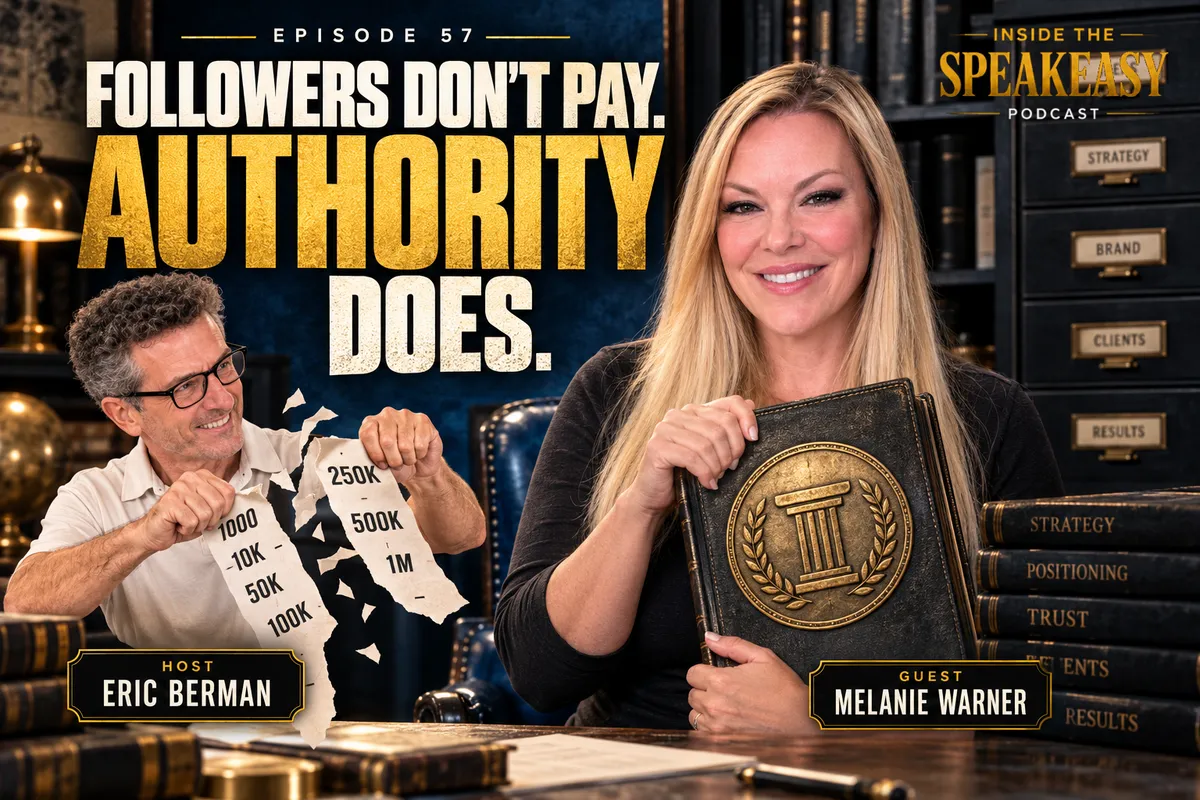
Melanie Warner, founder of Defining Moments Press and a Forbes contributor, argues that most entrepreneurs are chasing the wrong prize: attention instead of authority. As she puts it, you can't deposit followers in your bank account, and a viral post is not the same thing as a profitable business. In this conversation with host Eric Berman, Melanie lays out the order she says most smart people get wrong: define your expertise and offer, write a book around it, build a book funnel, and only then chase visibility on podcasts, stages, and TV. She shares how a $4.99 book with order bumps can pay for its own ads from day one, how a legally blind financial advisor grew his annuity business from $3 million to $20 million with a book, a funnel, and more than 100 podcast interviews, and why vulnerable stories now build more trust than polished credentials. Her own story, rebuilding from $3.6 million in debt after losing her son, shows what that authority cost her to earn.
In this episode, you'll discover:
- Why Melanie Warner says authority compounds while attention fades, and why a huge following without a monetization plan often leaves influencers broke
- The four-step order Melanie recommends: define your expertise and offer, write the book, build a book funnel, then pursue podcasts, stages, and TV
- How selling a book for $4.99 with order bumps lets paid ads cover their own cost and moves buyers into a 5K-plus offer within days
- What a legally blind financial expert did to grow from $3 million to $20 million in annuities using a book funnel and 100-plus podcasts
- Why vulnerable defining-moment stories, not polished credentials, now create trust, and where Melanie believes AI helps or hurts when writing an authority book
Episode Summary
Melanie Warner opens with a distinction she believes most entrepreneurs miss: attention is not the goal, trust is. After roughly 30 years in media, including years owning city regional magazines where she says her team could turn a local doctor into "the Dr. Oz of their hometown," Melanie argues that today's crowded, low-trust market rewards specialists rather than generalists. Her comparison is medical. A general practitioner juggles a huge patient load, while people take time off work and wait months to see a specialist. Followers and emojis, she says, do not pay the bills, and many people with millions of followers do not know how to monetize their platforms. Her summary line is that attention can make you famous, but authority makes you wealthy.
Melanie describes authority as a formula of proximity, proof, and positioning, multiplied by repetition. She warns that visibility without a way to convert it is like a bucket full of holes: people flow through a TV appearance or a big talk without ever becoming clients. Branding assets like books, media, and stages add third-party credibility and let you own a category, and she notes that people automatically assume you are an expert when you wrote the book on a subject. She also makes the case for vulnerable storytelling, recalling how an Esquire article about Elon Musk's heartbreak made him seem human, and contrasting it with a doctor who wanted his magazine ad to feature a mask and a syringe. A strong story, she says, casts the expert as the trusted guide in the listener's own journey.
The emotional center of the episode is Melanie's own defining moment. She says she had built businesses since age 18 and was earning a million dollars a year when an accident left her losing more than 80% of her blood. She survived; a few days later, her infant son did not. The loss prompted her first book, Defining Moments: Coping with the Loss of a Child. Melanie describes shutting down, losing a 16-year marriage and a 20-year business, two homes to foreclosure, and going through bankruptcy and tax court, ending up $3.6 million in debt as a single mother of three. Struggling to finish her first book, she recalls mentor Mark Victor Hansen telling her to think about who the book would hurt if she never finished it. After a woman in her hometown took her own life following the loss of a son, Melanie decided to become what she calls a hope dealer.
Her book journey was not smooth. Melanie says one publisher sold its company and the book went with it, and she was never paid by the next major publisher. She trained in Tony Robbins's Strategic Intervention program, became a grief coach, eventually reclaimed the rights to her book, self-published, and within a few weeks reached number one bestseller status. By putting an offer on the back end of the book, she says she went from negative $3.6 million to positive $4 million in 18 months. That experience shapes her view on AI: her company uses it mostly as a research tool and a partner, not a replacement, because AI can offer perspective but not lived experience, and editors and producers want stories of real tension and transformation.
The most practical stretch covers sequencing and funnel economics. Melanie's four steps are defining your expertise and offer, writing a book that introduces your proprietary system, building a book funnel, and then pursuing visibility. She says her team built a million-dollar funnel on a hundred-dollar ad budget and the book still is not on Amazon. Pricing the book at $4.99 with order bumps and upsells, she explains, lets $4 clicks pay for themselves once front-end conversion reaches about 10%, and she cites a financial expert who grew from $3 million to $20 million in annuities in one year through a book funnel and more than 100 podcasts, with no paid ads. When he stopped promoting the book, she says, his business stopped.
The conversation closes on long-term reputation and the value of the right rooms. Melanie points to Dr. Oz and Dr. Phil as experts who built credibility before they built visibility, and she describes ghostwriting for well-known clients who lack time to write. Her final advice is to protect relationships and reputation, because authority compounds like money, and to write a book people will still discuss in 100 years, not a crappy AI book. As a global Speakeasy member, she credits the community with joint ventures, collaborations, and a single funnel suggestion from a fellow member that she says lifted conversions by 25%.
Big Ideas Discussed
Authority Makes You Wealthy While Attention Only Makes You Famous
Melanie Warner's core argument is that entrepreneurs confuse visibility with value. A large following feels like progress, but she points out that you cannot deposit followers in your bank account, and that many influencers with millions of followers are broke because they never learned to monetize their platforms. In her view, attention fades while authority compounds, because authority is built on trust, and trust is what moves someone to buy.
She frames authority as proximity plus proof plus positioning, repeated consistently. Specialization is the lever. Melanie compares a general practitioner with a broad patient load to a specialist people wait months to see, and notes that even generalists refer to specialists. For a business owner, this means picking a narrow area of expertise and owning it, which she connects to Russell Brunson's idea of becoming a category king or queen. Melanie says the market pays more attention to perceived certainty than to raw talent, so the goal is to be recognized as the expert, not simply to be seen.
Build the Book and Funnel Before You Chase Visibility
Melanie says really smart people make the same mistake every day: they do things out of order. Her sequence has four steps. First, define your expertise, who you help, how you help them, and what you charge. Second, write a book that introduces your proprietary system. Third, build a book funnel around it. Only then, fourth, pursue visibility through podcasts, stages, TV, and media.
Skipping ahead is expensive. Melanie says people land Good Morning America or a TED Talk, or earn a standing ovation as a paid speaker, and still leave money on the table because nothing on the back end converts the audience. She compares it to surfing without the right equipment. Her example of the order working is a legally blind financial expert who wrote a retirement book, did over 100 podcasts with no paid ads, and sent every listener to the same funnel. She says he grew from $3 million to $20 million in annuities in one year, and that his business stopped the minute he stopped promoting the book.
Sell the Book Instead of Giving It Away
One of Melanie's most specific lessons is that free offers attract the wrong buyers. She says that for years she followed big-name gurus and gave away free content, only to watch people fail to show up. The shift came when her company and its clients began charging, even $4.99, for the book. According to Melanie, that small purchase ascended buyers into a 5K-or-more offer within five days.
The math, as she explains it, is what makes the model scalable. With a $4 cost per click and a $4.99 book, a front-end conversion rate of at least 10% means ads pay for themselves from day one, especially with order bumps and upsells that she says bring the average purchase to $150 to $400. Once those numbers hold, she says, you can spend as much as you want on ads. Melanie also notes that 20 to 30% of readers of a well-built authority book want to work with the author, and that some buyers hire you without reading it at all, simply because you wrote the book.
Vulnerable Stories Build Trust in a Trust Recession
Melanie believes businesses are steering away from personal stories because they see vulnerability as weakness, when the opposite is now true. In what she calls a trust recession, transparency and vulnerability create authenticity and connection. She points out that Elon Musk has more followers than his companies, and jokes that you cannot invite a brand over for dinner. People want to know the person behind the company.
Her own authority, she says, was earned through hardship: losing her son, her marriage, her business, and going $3.6 million into debt before rebuilding. Melanie argues that this is exactly what AI cannot supply. AI can offer a perspective, but not the experience, and editors and producers want clear positioning, real transformation, and tension that shows how someone worked through a problem. She uses AI as a writing partner, but says the human story is what makes an authority book worth reading, and what keeps it from being just another crappy AI book.
Questions We Answer in This Episode
What is the difference between attention and authority for entrepreneurs?
Melanie Warner says attention is visibility, such as followers, likes, or a viral moment, while authority is earned trust that leads people to buy. She argues that attention fades but authority compounds, and that many influencers with millions of followers are broke because they cannot monetize their platforms. In her words, attention can make you famous, but authority makes you wealthy. She defines authority as proximity plus proof plus positioning, reinforced by repetition.
In what order should entrepreneurs build authority, according to Melanie Warner?
Melanie Warner recommends four steps in a specific order. First, define your expertise, who you help, how you help them, and what you charge. Second, write a book that introduces your proprietary system. Third, build a book funnel around it. Fourth, pursue visibility on podcasts, stages, TV, and media. She says doing visibility first leaves money on the table because there is nothing on the back end to convert the audience into clients.
Why should you sell your book for $4.99 instead of giving it away?
Melanie Warner says free offers attracted people who did not show up, while a paid book attracts qualified buyers. She explains that with a $4 cost per click and a $4.99 book, a front-end conversion rate of at least 10% means ads pay for themselves from day one. Order bumps and upsells, she says, raise the average purchase to $150 to $400, and her team has seen $5 book buyers ascend into a 5K-or-more offer within five days.
How did a financial advisor grow his business with a book funnel and podcasts?
Melanie Warner describes a legally blind financial expert who wrote a book about retirement and sent every podcast audience to his book funnel. She says he did more than 100 podcasts with no paid ads, sold about 5,000 books through the funnel, and grew from $3 million to $20 million in annuities in one year. Buyers moved from the book to booking a call. She notes that when he stopped promoting the book, his business stopped.
Should entrepreneurs use AI to write a book?
Melanie Warner says AI should be a partner, not a replacement. She believes a person and AI working together will write a better book than either alone, but that writing should not be hands-off. Her reasoning is that AI can give perspective but not lived experience, and her own credibility came from what she went through. She warns that relationships and reputation matter more than ever, and that a book worth writing should outlast a crappy AI book.
Why does vulnerability help build authority in business?
Melanie Warner says there is a trust recession, so transparency and vulnerability now create the authenticity and connection buyers want. She notes that people want to know the person behind a company, pointing out that Elon Musk has more followers than his companies. A commercially powerful story, she explains, creates an emotional connection and positions the storyteller as the trusted guide. She also says editors and producers look for stories of real tension and transformation.
How does writing a book increase an expert's credibility and income?
Melanie Warner says people automatically assume you are an expert when you wrote the book on a subject. She explains that bestselling authors see their speaker fees, credibility, and client fees rise, and start receiving media requests. According to Melanie, journalists often choose bestselling authors as sources, and courts look to bestselling authors when selecting expert witnesses. She adds that 20 to 30% of readers of a well-built authority book want to work with the author.
Full Episode Transcript
Read the Full Episode Transcript
Cold Open and Why Your Message Needs Authority
Announcer: Welcome to Inside the Speakeasy podcast, the private room where today's sharpest founders, innovators, and renegade thinkers come to trade the ideas that move industries. This show is brought to you by HighLevel, the AI-driven business operating system trusted by over 2 million businesses to help automate, scale, and create real leverage. HighLevel isn't just a tool, it's the engine behind some of the most agile and high-performing teams on the planet. If you're ready to streamline everything, amplify your reach, and actually build a business that works for you, you're in the right place. Visit www.GoHighLevel.com/Speakeasy-Mastermind-Promo to get an exclusive 30-day trial for being a listener of the Inside the Speakeasy podcast. Enjoy the show.
Melanie Warner: Some people, they're afraid of losing their job. Mine was, I was afraid of getting a job because I've been working for myself since I was 18. I'm a horrible employee because I'm so used to doing things a certain way. So I'm like, I gotta figure this out. So I decided to write my book. I had a big publishing deal with Chicken Soup for the Soul at the time. And then I remember I was struggling to finish writing the book, and my mentor at the time, Mark Victor Hansen, he said, stop thinking of who your book is going to help and start thinking of who it's going to hurt if you don't finish it.
Eric Berman: So many of you listening have an incredibly, incredibly powerful story or message that is inside of you. It's burning, and you have not figured out the way and how to get it out or what to even do with it or if anybody would even care, but you know it's burning. You know it has power. So today is the day. I'm so excited to bring on Melanie Warner, who's going to talk to us about how to get that message out, and also tell us what's arguably more important than being the smartest person in the room or having an amazing business, or what some of the people that are missing, what they need. And honestly, it's just being perceived as one of the biggest authorities out there in your space and how to get that message to help you become that authority. So we all need this. I'm excited. I just want to do this myself, and I'm super pumped. You know, Melanie Warner is a bestselling author, Forbes contributor, TV producer, and founder of Defining Moments Press, where she helps entrepreneurs, CEOs, and experts turn their knowledge into authority, media exposure, and high-ticket clients. She's known for her seven-figure book method. She teaches business leaders how to leverage books, podcasts, stages, and television to become the go-to authority in their industry. She's also the producer of the PBS television show Recipe for Wellness, airing in 240 million households, and has helped experts build brands that create both impact and income. Her clients have generated over 150 million from her authority process. Wow, wow, wow. So excited to have you today. Welcome, Melanie.
Melanie Warner: Thank you so much for having me, Eric. I love being here. I love your group. I had so much fun getting to hang out with you in person in San Diego and meet so many of your amazing friends, just being in the room with people that are doing life and business at a whole other level. It's just so much fun. So thank you for all that you do as well.
Why Trust and Authority Beat Followers and Attention
Eric Berman: Yeah, well, I think that's kind of you. I appreciate it. So you've been in media for 30 years. And what is the biggest sort of misconception entrepreneurs have about what it really takes to get attention and how to keep it? How does one become an authority? And why is that so important?
Melanie Warner: Well, it's more important today because it's more about global authority. A lot of people could dominate a market. It's called, like, being a small fish in a big pond. So it's kind of easy to dominate a smaller market where you live and people know you. It's easier to build trust and authority. I owned city regional magazines for a long time, so we were able to build somebody into, like, the Dr. Oz of their hometown, you know, on a fairly regular basis, but then they would outgrow the market. And people think attention is the goal, but trust is the goal. And especially nowadays, where you've got so much competition, it's not about being the generalist, right? Think about how you have a general practitioner who has to have this broad knowledge of humans, just from a medical perspective. And they have 1,500 to 1,800 patients by demand. They can't possibly go deep and actually really help people. And so when you're a specialist, people take off work, they spend months waiting to meet with you. You have this instant authority. Even the generalist will refer to a specialist. So if you want to become a global authority, you really need to specialize in something, especially in today's busy, crowded economy, and there's a trust recession going on, which we know all about. And a lot of people make the mistake of thinking that building visibility is about getting more followers, but you really can't deposit followers in your bank account. I don't know if you know that. A lot of people think emotions, like, emojis are not real emotions. So being viral does not necessarily mean being profitable, because a lot of influencers, you know, think about the people you know that have millions of followers, a lot of them are totally broke. They don't know how to monetize platforms. So authority compounds, whereas attention fades. And entrepreneurs can use noise with positioning, but attention can make you famous, but authority makes you wealthy.
Eric Berman: I love that. Thank you for saying that. You're right. And I think it's a big mess of the ego too, right? People are out there thinking, oh, I got all these followers and everybody loves me. And all of a sudden they're just like, if I just do this, this, and if I just give it more time, the money will follow. And yet they're not an authority. So therefore, big, big difference. And I think you nailed it. So let's kind of work backwards. Like, what does that mean in your definition to be an authority?
Melanie Warner: So there's a very specific framework of how authority can monetize. So you start with authority, which equals proximity plus proof plus positioning, and then repetition. So it's being able to get your message out to a lot of people, but it's more about that visibility issue, because a lot of people think, oh, I'm just going to go on Good Morning America, or I'll do a TED Talk or something. But if they don't know how to monetize those platforms, then it's kind of like you've got this lead, you've got this bucket, and you've got holes in it. People are flowing through it, but they're not ascending into becoming a client. So when you add authority and you add visibility with branding assets like books and media and stages, it adds third-party credibility, and you get a chance to own a category, right? Russell Brunson talks about being a category king or queen, and the market pays more attention for perceived certainty than raw talent.
Eric Berman: Interesting. I kind of love how you're saying that. So right, so they just know because you're a specialist and you're an authority, there's an implied assumption that you're going to get the result.
Melanie Warner: Yeah, especially if you wrote a book on something, then people automatically assume you're an expert because you wrote the book on it.
Eric Berman: Right, right.
Melanie Warner: I made the mistake of writing books years ago, and I didn't have those credentials. I didn't know that people would see me as an expert on that subject. I mean, it kind of seems silly to not know that now, but when I went through the process, it was more about just creating this asset that I thought was going to help people. But I left millions of dollars on the table by not understanding the authority that that created.
Storytelling, Vulnerability, and Being the Trusted Guide
Eric Berman: Okay. So let's talk about the authority pieces that we could have. You mentioned there's a book. You mentioned being on the local TV show. Like, you obviously teach these frameworks and help your clients do that. What are the most important things we need to be thinking about in order to become an authority?
Melanie Warner: Well, a lot of people, especially business owners, are leading away from their story because they think, oh, I can't share anything vulnerable because that's weakness in business. But it's actually the opposite now, because there's such a trust recession. Transparency and vulnerability create authenticity and connection, and that's like a new currency. And this is where a lot of people failed in their personal brand. If you think about it, Elon Musk has more followers than any of his companies. So it's his personal brand that makes people want to do business with those actual brands. Like, we joke and say you can't invite a brand over for dinner. So you wouldn't just invite Tesla, but you want to get to know the person behind the company. A commercially powerful story includes something that creates an emotional connection when you hear their stories. Like, I remember reading an article about Elon Musk several years ago. I think it was in Esquire, and he was talking about this heartache and heartbreak that he had about the girl that got away. It's not something you would have expected him to be vulnerable about. And it really intrigued me about him as a person, because I saw him as finally somebody that was human and not, like, just this... He was a solar guy back then, and this was right when Tesla was coming about. And I thought it was a very vulnerable article that really made me think differently about him as a high-powered CEO, because I saw him as more human, who had a broken heart, right? It established credibility. It made me curious about him as a person. It also helped solve a very high-value problem. So when you're talking from an authority perspective and storytelling, you're getting people's attention. Like, when we do our TV show or our podcast about defining moments, we share a defining moment in somebody's life or business, and it makes the audience see them in a vulnerable way. And then it leads to what they're doing now in their life, which gives them that authority piece. And this positions the person as the guide, right? We talk about Joseph Campbell's hero's journey, where every story needs a hero, a trusted guide, and a villain. And so that story naturally lends itself for you to be the trusted guide as the authority piece. And it leads naturally into an offer, which we always recommend: have a good high-ticket offer on the back end of your story. And my own story has a lot personally. And I know a powerful story doesn't just connect emotionally, it changes buying behavior. And so by sharing these parts of us that we think, in business, oh, we can't do that, right? Like, I remember having a doctor who wanted to do an ad years ago in one of our magazines, and he wanted to put his face out there with his beady eyes and his mask with a syringe, because that's what he does. And I'm like, nobody's gonna do that. Nobody's gonna respond to that. And he thought that was building credibility and authority as a doctor. But I'm like, you are going to terrify people. They are not gonna like you. And so sometimes people get so caught up in trying to just be authoritative that they forget to tell the personal story that makes them more human.
Income-Generating Assets Versus Renting Attention
Eric Berman: Very, very interesting. Okay. Well, there's a lot to unpack there. I want to get to your personal story, which is just tough. I mean, I read it and I'm like, wow. And you wove story into my question, which I love. So whether it's a book or getting on a show, you said, well, it really starts with the story and being vulnerable, you know, because that'll help get you to the authority place. Once you have that story figured out and you can weave that in, is it usually a book as a first sort of stepping stone into anything? Is that what you want to see if we're all trying to go down this path to eventually become the trusted authority that has this story out there and the vulnerability?
Melanie Warner: Well, I think this is where a lot of entrepreneurs get visibility wrong, right? Because the idea is, you know, people go out and they just start posting endlessly with no strategy. They're trying to be everywhere. And I know it feels overwhelming. I feel that way too sometimes. And I'm like, I don't want to be on X fighting with people. I don't want to dance on TikTok. I'm a horrible dancer, right? They try to do generic branding. There's a lack of differentiation, so you don't stand out as an actual specialist, and then you're chasing algorithms instead of building assets. But when you actually create what we call income-generating assets, which means a book, a book funnel, which becomes the marketing vehicle to help get people to ascend into your offer as an authority figure, then all of those things start to become branded assets and build your personal story, but also create it in a way that when you take it out there and put it on a podcast or you're featured on TV or radio, then it makes it easier for people to follow you and ascend into a high-ticket offer or a funnel. So, yes.
Eric Berman: I imagine a common thing you hear is the imposter syndrome. Do I have it in me? Why do people want to hear from me? Is my story really that good? Is it really that moving? I like what you said earlier. Well, first of all, what are you a specialist in? What makes you different and unique?
Melanie Warner: I was going to say, I hear that a lot. People are like, who am I to write a book? You know what I mean? And I hear this a lot too. People say, that kind of book's already out there. Well, guess what? I have this book called Think and Grow Rich. It came out almost 100 years ago. I still read it every day. It's still relevant. And these are authority builder books. These are thought leader ideas that are going to transcend and become a legacy for us, right? If we do it right, all of our books are going to outlive us. And it becomes a way for people to, like, what we want to be known for. And so many people, especially entrepreneurs, they're out there renting attention on social media instead of owning authority assets. Because once you build and create these assets, they literally become income-generating assets, not just as a product. Like a book, you can sell your book. As a speaker, you can speak for free, but you can actually sometimes monetize the back end better if you're not getting paid to speak, because you can sell books. You can promote something. You can do joint venture partnerships and affiliate relationships with people on a stage. And so most people don't realize the value of their authority, especially if they work for somebody else. You know, I have a friend that worked as a global director for 32 years at the same company, and they invested over a billion dollars, with a B, in his brain. And when he retired, I'm like, it is kind of selfish to retire with all that knowledge when there are so many people out there that don't know, they don't have the same authority, and they're willing to pay you to learn a faster path. If you can compress time and teach somebody everything you know about logistics, or in that specialty, that high-level specialty industry, there are competitors of that previous company you worked for that would pay millions of dollars. As a result, he went out and did a consulting deal with somebody who paid him $800,000 for the first year, which was three times what he was making as an executive, for the same knowledge. It's crazy.
Eric Berman: So is it just a matter, for those of us, self-included? I was that person until somebody pulled that out of me. Is it just a matter of finding somebody like yourself that understands, or a coach that says, look, you have that story in you. Like, let's talk about it. What are you good at? Like, there is something magical in helping bring that to life a little bit. I imagine you do that a lot with your clients.
Melanie Warner: I do. I find that it is much tougher sometimes to take somebody who's been trading dollars for hours, right, to see themselves as an authority, because they've been so beat down to be paid as an employee for so many years, they don't value their own expertise. And they tend to value specialized, like, they tend to value knowledge from, like, a formal perspective of going to school and where they graduated from. And there's nothing wrong with formal education, but it doesn't always equate in the marketplace.
Eric Berman: Right. Yeah.
Melanie Warner: And so when you invest in yourself to learn these skills, and I've spent way more money, I'm sure you have too, investing in myself as a business owner than I ever would have going to college, just my college degree. It's like, you never stop learning. And they say that leaders are readers. So when you look, there's a correlation to the people that make the most amount of money and how many books a year they read. And you look at the people that have a smaller income that don't read as many books, and it's a really interesting correlation. So if you want more high-end clients, and you write books for them that solve problems for premium people that are willing to pay a fee to solve something, then you're naturally not only going to position yourself better as an authority, but you're going to write the book that they want to read, not just the book you want to write.
Melanie's Defining Moment: Loss, Grief, and Losing Everything
Eric Berman: Right. Love it. Okay, let's talk about story and how you got here, because these are some amazing lessons you're teaching, and you've had quite an interesting, very traumatizing background. And your story is just mind-blowing, how you were able to come out of what you came out of to get to where you are today. And I think it's important for the listener to hear the story. So tell us a little bit about where you started in business and then ultimately the tragic story and how you came out of that.
Melanie Warner: Thank you. I appreciate that. I've been working for myself since I was 18. And I worked really, really hard from the time I was 18 all through my 20s into my 30s, owning businesses, building media companies, you know, trying to conquer the world. And there was a point where I literally had everything. I was married, I was making a million dollars a year, I had a business, I had employees, I felt like I had finally arrived. And I had a couple of kids. And I remember looking in a drawer one day, and I found a bucket list that I had written when I was 18 years old with all the crazy things I wanted to do in my life. And when I started looking at that bucket list, everything that I thought would take a lifetime to do was marked off except one, which was write a book. And a week later, I found myself in the hospital after an accident, and I was on the gurney, and the doctor looked at me and said, this is life-threatening and you might not make it. And I literally was bleeding out. I lost over 80% of the blood in my body. I later found out I came about 90 seconds away from dying. And what I thought of immediately in that split second, when they say your life flashes before your eyes, it was so true, Eric. I remember thinking, did I manifest this? Because I found that bucket list that I wrote when I was 18, and my 18-year-old self said, things I want to do before I die. And then I found the list just a week earlier and marked everything off, so there was nothing left on the list except one item. And my first thought was, did I manifest this? Did I actually create this? This was happening right now. And, you know, what about my family? What about my laundry, like all the unfinished business? And then what about that book? I never got to finish writing a book. And I had this sense of panic of like, I really, I can't die. I have things unfinished in my life. And luckily, I survived. Unfortunately, a few days later, my son did not survive. And I held my son as he took his last breath. And as a parent, it was my worst nightmare. There was nothing that prepared me for it. I went into this dark spiral. Even though I survived, I couldn't deal with this grief. And so I shut down. I was married at the time. My husband shut down. We both dealt with grief differently. And then I learned that there's a whole process of what happens when a child dies. And that was what prompted this first book that I wrote, called Defining Moments: Coping with the Loss of a Child, right? And so I realized at that moment, I didn't know how to deal with any of this. And it's in the 90s, like 90-plus percent of people get a divorce after they lose a child. Well, I shut down so hard, I lost everything. I had spent 16 years in a marriage that crumbled, 20 years building a business that was basically gone overnight. There was also the recession that was happening. So it was just kind of like all my parachutes failed. I had two homes. I lost both into foreclosure. I went through bankruptcy. I went through tax audits. I even had to go to tax court and represent myself in federal tax court and prove that I didn't owe the money that I was accused of owing. And at one point, I was negative $3.6 million in debt.
Becoming a Hope Dealer and Rebuilding Through a Book
Melanie Warner: And I finally found a solution. I said, I have to rebuild my life. I can't just go get a job. Like, there's no job that's going to pay enough to get me out of this hole. So to try to wake up every day and deal with the grief, the loss, feeling like the biggest loser on the planet. Who's ever going to listen to me again? Talk about authority. I thought there is no way I'm ever going to be able to. I can't even help myself. How can I be in self-help in this industry? I felt like the biggest hypocrite. So I told myself so many lies at that time. I'm never going to love anybody again, because it hurts too much. I'm never going to be an authority again. No one's ever going to take me seriously. All these things that weren't true but felt like the end of the world at the time. And so when I finally realized I have to figure out a way out of this hole, because now I'm a single mom, I had three kids, and I had to figure out how to make money, and I had to do it quickly. And I knew some people, they're afraid of losing their job. Mine was, I was afraid of getting a job because I've been working for myself since I was 18. I'm a horrible employee because I'm so used to doing things a certain way. And I love being an entrepreneur, and, you know, it's an up and down, as you know. It can be like this all the time, but that adrenaline drives me. So I'm like, I gotta figure this out. So I decided to write my book, and I wrote my first book, and I had a big publishing deal with Chicken Soup for the Soul at the time. And then I remember I was struggling to finish writing the book, and my mentor at the time, Mark Victor Hansen, he said, stop thinking of who your book is going to help and start thinking of who it's going to hurt if you don't finish it. Well, the next day, a woman in my hometown stepped in front of the train and took her own life because her son had passed away 15 years prior. And I felt horrible. I didn't know her, didn't know her son, but I knew her pain, and I knew that I had a resource of hope for people. And so I decided at that moment, I'm going to be a hope dealer, because we got enough dope dealers, right? And so everything I did from that day forward was about trying to help give people hope when they were struggling with something, giving them resources like books, mentorship, courses, like things to help people get through it. And I went back to my other mentor, Tony Robbins, at the time. And I'm like, how do I help these people, right? Because even though my book came out, I didn't feel like an authority, and I definitely wasn't a grief coach. And so people started asking me, hey, you wrote the book on this, you're the authority. Can you fix me? Can you help me get through this pain? And I still felt like an imposter, because I still was trying to rebuild my life at that point. And so I took a course from Tony called Strategic Intervention, where I learned very specific tools to help me heal myself first. It empowered me, and I was able to become a master life coach and a business coach within like eight to 12 weeks or something. And I felt more confident having these tools, and then learned I could actually charge people to teach them the tools and walk them through the steps of what I went through, and actually help people find that peace and healing for themselves. So I became a grief coach for a little bit of time and released the book. And the book came out, but not with them. In the middle of all this, they sold their company. So my procrastination, now I lost this poor lady who could have benefited from the book, because my insecurity and fear and doubt literally cost somebody their life. And then I waited so long, they sold their company, and then the book went along with it. And then I went through another major publisher, took another two years, the book was out. Then finally, that's when people started calling me and saying, can you help me? But even after all of that, Eric, I got paid zero from that publisher to this day. Not one dime for my books that were sold. And so another two years went by, and I got the rights back to my book and then started self-publishing. And within a few weeks, I became a number one bestseller. I was able to rebuild my entire life. And I learned how to put an offer on the back end of a book and start building the funnel. And I went from negative 3.6 million to positive 4 million in 18 months after all of that. And so talk about the price you pay to learn what you know. And I just want to shorten that process for a lot of other people who don't want to go through all of that just to learn what I know.
Real Credibility in the Age of AI-Written Books
Eric Berman: Wow. Amazing. Thank you for sharing that. Wow. What a story. And so sorry about your loss.
Melanie Warner: Thank you.
Eric Berman: You did get your book done. So that's the positive: rebuild your career and have all these things. And so good for you for just having that tenacity and drive. And I think the story in that, as we talked about from the beginning of this call, I think even you're saying, is, what am I an expert in? I mean, you essentially just, you found it. You had the imposter syndrome along the way. You got that push in the back from Mark Victor Hansen, and it's a similar conversation. I think we all need to think about that. So, just turning topics a little bit, thinking in today's world where anyone can claim they're an expert, how do you build real credibility that people trust and are willing to pay for? Is it just, great, I wrote a book? I mean, and now, let me add more to that question with AI and where it's headed. And I know there's this concept of, well, people are gonna be able to read through what is an AI book, and, hey, I'll just use AI to do my book, and now I'm an expert. So talk me through that topic a little bit.
Eric Berman: Everything you hear on this show comes back to one idea: proximity. I wrote the book on it, literally. Proximity Pays, my bestselling book, available now at proximitypays.com.
Melanie Warner: If you've ever asked AI, tell me about your childhood, it's pretty interesting answers, right?
Eric Berman: Wow.
Melanie Warner: And so, in the face of AI, it's really fascinating to see how story, human stories, and emotions are still more powerful. I am an advocate of AI. I do believe it has a purpose. In our company, we don't usually use it just to write the book. It's more of a research tool. I do believe that if you and AI partner together, you're going to write a better book than either one of you on your own. But I don't think it's something that should just be hands-off. And here's why. One of the reasons I got asked to write for Forbes is because I'm an experienced business owner since I was 18 years old, and I'm also a journalist. And when a journalist writes a story, they're looking at it through a different lens. And so a journalist, like, it's interesting that people writing as journalists for a lot of these big publications and media platforms aren't actually entrepreneurs, right? Because they're journalists. They're employees at this organization. And, you know, AI can give you a perspective from somebody, but it's not going to give you the experience. And it's hard to, like, explain. Something like what I went through in my life is not something that I can explain. I had to experience it in order to gain the credibility and authority that I have today. And my life literally had to fall apart for it to come together before I realized that I'm more valuable having been broken and putting those pieces back together in the world of business than if I had never had any hardship at all. I didn't see that at the time when I was going through it, but looking back, I can connect the dots so much better. So what editors and producers are really looking for today, and it gives you kind of the insider status: they want clear positioning, they want transformation, they want stories about transformation where you get to interview actual business owners, not just, like, repackage or repurpose a story from the Associated Press or a PR stunt. They want something that shows tension and shows how somebody had to work through it. And what's working in the business space is sharing these failures and being open and transparent about, hey, this is my biggest screw-up that led to, like, everything where my life fell apart, that I thought my life was over, and it is directly related to the success I'm having today.
Eric Berman: We want the vulnerability and the transparency [unclear] other people, yeah, because it's more relatable to say, like, not everybody succeeds 100% of the time, right? Nobody. So we have to have those stories to be believable.
Melanie Warner: Absolutely. And so when you can offer a unique perspective, and you're a specialist, and you have the case studies and the background, it makes you more of an authority naturally. But when you're also a bestselling author who literally wrote the book on that subject, people see you, perceive you, as the expert. I mean, there's like Jesus and bestselling author. And then all of a sudden you have, and you know, because you just experienced this, like, all of a sudden people look at you differently, like, oh, you're Eric Berman who wrote that book, you know? And at the same time, your speaker fees go up, your authority goes up, your credibility goes up instantly. You make more as a consultant. You start getting requests for media. In fact, for most journalists, 80% of the time, they will choose somebody that's a bestselling author on the subject. Same for case studies, for court cases. When they're looking for an expert witness, they're looking for people that are bestselling authors in that field, and they use that as a way to measure their credibility of whether or not they're going to be an expert witness in a court case, and they pay for that kind of stuff. So it's leveraging your expertise in multiple ways. And the other thing is, if you're going to write articles, it's different between having yourself featured in PR, being on a podcast, but when you're going to be a journalist and write these stories as an authority figure in your space, that's an even higher level, because you need to offer a very unique perspective. You already need to have that credibility, and you need to make sure that your voice is relevant in a crowded marketplace. This is not about being a motivational entrepreneur, because nobody in media is looking for just another expert. They're looking for a trusted voice with a very specific, distinct point of view.
The Four Steps: Expertise, Book, Funnel, Then Visibility
Eric Berman: Okay. Let me kind of wrap this up, because I love what you're saying here. Kind of tie a bow on what you're saying. So I'm getting the authority side. I get my book done. You have the funnel. All these pieces come together. What's next? You mentioned media and all these things. What's, like, the next lowest-hanging fruit that you work with your clients on, or you see people? You mentioned your speaker fees could go up. So what do you see as easy low-hanging fruit for people that want to go through this path?
Melanie Warner: There are four critical steps that I recommend, and it took me so many years to do this the wrong way. It's kind of like trying to surf without the right equipment. You're just tumbling around in the water. And I see people make this mistake every day, really, really smart people. They do things out of order. So step one, you've got to define, what are you an authority at? Like, what is your level of expertise? Who are you helping? How are you helping them? What does that process look like? What are you charging them? So step one is really just being clear on that piece of, I'm an expert in this space, and here's who I help. So define that expertise and whatever offer. Step two is then write a book around that expertise. And your book basically introduces people to your system that is proprietary to you, to the steps and the tools that are specific to your experience and background and expertise. And then the third step is then build a book funnel around that book. And then the fourth step is visibility. Now, if you try to do visibility without the other three pieces in that order, you know, like I said, going on Good Morning America, doing a TED Talk, you don't make money when you just get on these platforms. And so many people make that mistake. Even if they're paid speakers, they get on a big stage and they get a standing ovation, and they leave money on the table because they don't have these other authority pieces on the back end. And so there's a couple of things, another framework I would recommend. Just be, number one, be really clear on the problem. Have a very clear outcome, so people know what is the result that you're offering people. Have a unique methodology. You want to have an emotional connection by sharing your story with people. You need proof, like social proof, testimonials, case studies, and then you need premium positioning. And that is really kind of the core elements and the framework of a seven-figure message, or a million-dollar message, because the biggest challenge I see is there's confusion around their message, and a confused message creates broken systems, broken funnels, and a broken business.
Book Funnel Economics and the $20 Million Podcast Example
Eric Berman: Right. Let's say you have steps one, two, and three. You didn't go out of order. What do you see, at least these days? What is the best, most successful next step? You got your message down, you got the book, you got the funnel. Where should people go first? Is it just driving ads into your funnel to sell books, and then you go through your funnel? What's the best media you recommend people go to once they have those in place?
Melanie Warner: Great question. So we built a million-dollar funnel with a hundred-dollar ad budget, right? And we sold thousands of books. So that funnel did over a million dollars. The book's not even on Amazon to this day. And so you can build authority by having a book that solves a problem for people specifically in an industry. Another example is I have somebody in the financial space that I talked to recently that is a financial expert who wrote a book about retirement. He was at 3 million in annuities. In one year, he went to 20 million in annuities because of his book and his funnel. But he also did over 100 podcasts, and he sold 5,000 books through the funnel. So the funnel ascends people into your particular offer, and it instantly builds authority and credibility. And that helps people ascend into your high-ticket offer.
Eric Berman: But in that example, he bought ads, and he went on podcasts? So podcasts was one media, obviously.
Melanie Warner: That example, no ads, just went on podcasts. And he literally said the minute he stopped promoting his book, his business stopped. So you have to constantly be going on podcasts. Oh, and I forgot to mention, he's legally blind, by the way, and wrote a book and has a funnel. Pretty powerful. So the idea is he built this funnel. It wasn't perfect. He just drove people to the funnel, so he would go speak on podcasts. All roads lead to that funnel. Every podcast went to the book funnel. People bought the book, they ascended into booking a call with him, and then committing to working with him and buying annuities. And that's how he grew it from $3 million to $20 million in one year, using a book and a funnel in that space of financial wellness. And he did over a hundred podcasts because he couldn't get on stages and speak. So that was no paid ads.
Eric Berman: Wow.
Melanie Warner: That was just podcasts. The key thing is the funnel.
Eric Berman: I mean, what you're saying, it's like once you know you have that funnel, then you can almost reverse engineer what your ROI of time is, or even, you know, you can even pay to be in certain places if you know that you're going to have the audience, and you know your conversion numbers.
Melanie Warner: And one of the things, the biggest thing we learned, Eric, is for years, I was following the gurus like Tony Robbins, Russell Brunson. I'm like, okay, give your book away, do a masterclass with a free ticket, do a free consult. So I was attracting all these, what I call [unclear], people that want free stuff, and they weren't showing up. They were ghosting us. And I was like, what is going on? And we were giving all this stuff away for free. And what shifted for our company and so many of our clients is when we simply just started selling the book, even for $4.99. Like, a $5 book was ascending into a 5K or more offer in five days. So that's a thousand X return in a couple of days.
Eric Berman: Let me actually pull something out that you're not saying, but I just want viewers to hear, because I understand this business. These people are paying $5, and I guarantee you most of them aren't reading the full book. It doesn't matter. They made a purchase, and there's an authority. There's an understanding that, oh, you're going to be the expert. They've read enough to see it, and now they're going to the next level because you've earned their trust. And there's order bumps.
Melanie Warner: That's true. And there's also, back up for a second. So you buy the book for $5, and there's also order bumps and upsells. So sometimes, like, our AOV is anywhere from $150 to $400. Our CPC is $4 when we run an ad. If you're paying $4 to sell a free book, you're going to be upside down. When you get a front-end conversion of at least 10% on paid ads, where you have a $4 click and you're selling the book for $4.99, a $4 click at $4.99, your ads are paying for themselves from day one, and that's exciting. Then you can spend as much money as you want, because you know that those conversions are there. And what happens is very qualified people come through that book funnel that you know are ready to buy, because they've bought some of the other items in the funnel. And here's the really funny part. When you write an authority book, which we call a client conversion model formula, using kind of the steps that we talked about here, we found that 20 to 30% of people that read it want to work with you. But there's a lot of people that never even read the book, and they're going to go and work with you simply, yeah, like you said, simply because you wrote the book on it. They trust that, and they don't even read the book.
Eric Berman: Right. They just want to, they just know you're the authority. They want a shortcut.
Melanie Warner: They have the money, and we like those consumers.
Visibility After Credibility: Dr. Oz, Dr. Phil, and Ghostwriting
Eric Berman: Cool. So there's a lot you're teaching. What's the core of what, if somebody wanted to work with somebody like you to get that book done, what's the core thing you do for people?
Melanie Warner: So we always start with, they either already have a book, or they want to write a book and they just don't know where to start. So it depends on which of two buckets they fall into. If they need help creating the first few assets, like the book and funnel and whatever that offer is on the back end. Like, think of Dr. Oz and Dr. Phil. They were already experts in their own right before they went on Oprah. They were already business owners that had credibility, that went to medical school. They weren't beginners starting out, trying to just wave a wand and have credibility. They paid the price to become experts already in their field, and then they started going with visibility. Then they built spin-off shows and books and newsletters and started building their personal brand, and then lending their name to other products and services. Now they're, like, two out of the 10 highest-paid doctors in the world. We know that Dr. Oz is worth anywhere from three to 500 million dollars, because he recently ran for Congress and had to disclose his net worth. And what's interesting is they're probably the same level of skill as our doctors down the street. The difference is their visibility. And so it doesn't help you to have visibility if you don't already have the authority and credibility, because the visibility is just a way to expand. What we call the income-generating assets is your expertise slash offer, your book, and your funnel first, then visibility. So we really just evaluate where people are in that process. We meet them where they are. Some people want to build their own funnels. Some people are like, funnels, that scares me, I don't want to do that. Some people want to write their own books. It's a transformational experience. Some people just want us to write them for them. We have a lot of famous people that we've been a ghostwriter for, and we don't always disclose that, because they don't always want people to know they have a ghostwriter. But there's a lot of successful people out there that think they don't have time to write a book. And we have a very, very quick process to help with that.
Relationships, Reputation, and Life Inside Speakeasy
Eric Berman: Yeah. Wonderful. Wonderful. Well, very cool. Is there anything I didn't ask that we skipped over, you wanted to cover today?
Melanie Warner: Yeah, I feel like the biggest thing is just knowing, in the AI world that's coming out there, just knowing the value of your relationships and playing and doing business in the long run. It's like having relationships, protecting your reputation, being able to do what you say you're going to do. Like, all of these things, you're under this microscope when you're out there in visibility: being consistent, compounding authority, and focusing on assets over trends. Because most people, they just quit too early. There's a great story in Think and Grow Rich about don't quit three feet from gold, right? And so the biggest thing I want people to understand is that authority compounds exactly like money does. So it's one of the greatest ways to build wealth. And if you create a book that's going to outlive you, that we're still talking about 100 years from now, then you know you've influenced people beyond just writing some crappy AI book.
Eric Berman: That's a great quote. Thank you for that. Well, cool. And my last question for you is, I know you are one of our global members at Speakeasy. We don't quite have a city launched out where you are in Central California, but how have you enjoyed being in the community so far?
Melanie Warner: Well, I love this community. Just being in the room, the trainings, I've learned so much. There's so many amazing people at such a high level, and they've been so generous with their time. I've just found consistently, everybody that I've met, I've been able to create some really amazing collaborations with people inside the group. It's just been really rewarding, because it made me realize how there were years I was in the wrong rooms, right? I was in rooms talking to people that were more beginners, like the someday people, aspirational people, as opposed to these seven- and eight-figure entrepreneurs that are just literally changing the world. And you can learn so much by being in the room with people that are on that same journey as you are. And I always say, like, listen to the people who have what you want, and don't reinvent the wheel. And so the advice that I've learned, even just being in San Diego at the event, hanging out at the pool party, sitting on the couch, talking to somebody, you know, a new friend I met there that did ads for Grant Cardone. And he looked at my funnel and tweaked one or two things and made a suggestion. That one suggestion helped us convert 25% more buyers. Just one little thing. And so you just never know. Like, being in the room, having so many amazing conversations at high levels, and even just things like that, where it's just one little hinge that can open a big door. I just think that represents so much about this group. I've created joint ventures and partnerships. And I have a lot of clients that are in that group that have worked with me, that I met in person or through connecting online. So even though I feel homeless, like, not homeless, I just have a few different houses and they're spread out, so I don't know where to plug in as a local member. But the global membership has been really kind of fun, because I can float around to different groups and plug in where I'm traveling. And yeah, I just met some really amazing humans, and I'm just so grateful. I feel like you guys created this network of some of my favorite people and some of my new best friends in business. And they're already, like, it's just, it's already put together, and I just kind of walked in and was able to connect with so many people. So thank you so much for that. It was great.
Eric Berman: Well, thank you for the kind words, and thanks for being an awesome member, and thank you for your time today. Thank you so much, and we'll look forward to speaking with you soon.
Melanie Warner: Thanks so much, Eric.
Announcer: And that's a wrap from the Speakeasy podcast. If something sparked for you, don't keep it to yourself. Share it, review it, and pass it to the one person who needs to hear this right now. Want in on the real mastermind? Tap the link in the show notes to apply. Until next time, keep scaling, stay sharp, and don't be the smartest one in the room.
Eric Berman: Hello, I've been noticing you've been following along to the Inside the Speakeasy podcast. And if the conversations I'm having out there resonate with you, then I'd like to invite you to apply to learn more about becoming a member of Speakeasy.

About The Guest
Melanie Warner
Melanie Warner is a bestselling author, Forbes contributor, TV producer, and the founder of Defining Moments Press, where she helps entrepreneurs, CEOs, and experts turn their knowledge into authority, media exposure, and high-ticket clients. She is known for her 7-Figure Book Method, which teaches business leaders to leverage books, podcasts, stages, and television to become the go-to authority in their industry, and her team also ghostwrites books for clients. Melanie has worked in media for about 30 years, including owning city regional magazines. She has run her own businesses since age 18 and trained in Tony Robbins's Strategic Intervention program before working as a grief coach. After losing her son, she wrote Defining Moments: Coping with the Loss of a Child, and after rebuilding from $3.6 million in debt she became a number one bestselling author and now focuses on helping experts share their defining-moment stories. She is a global member of Speakeasy Mastermind.