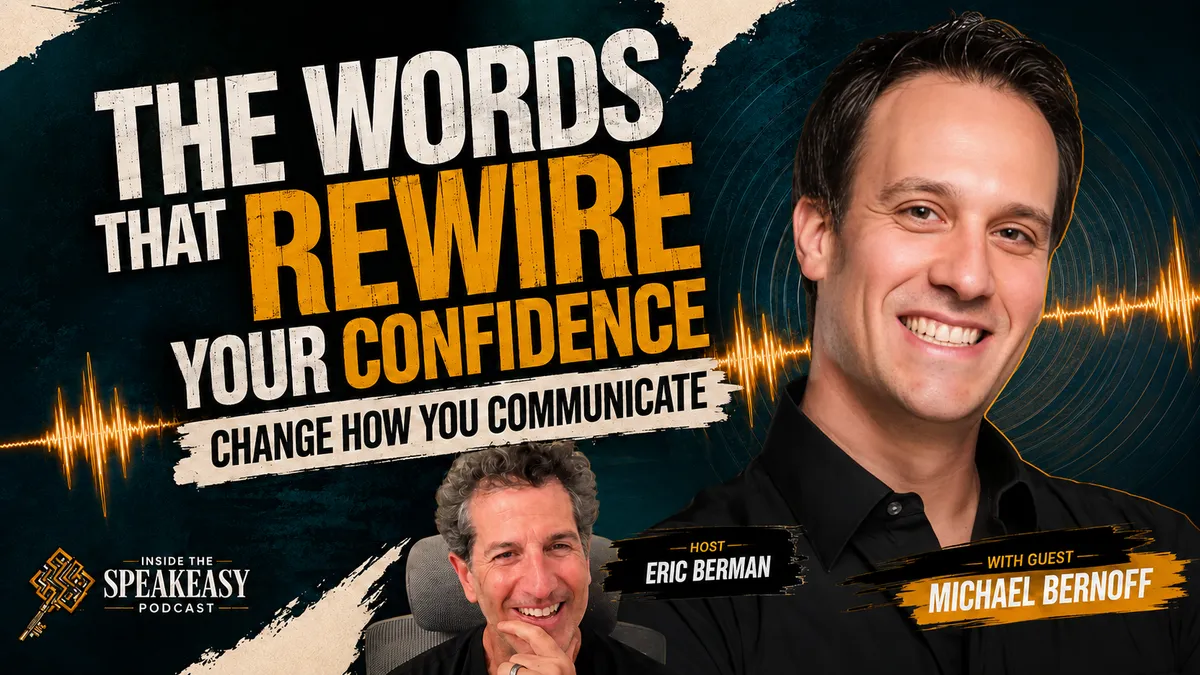
Michael Bernoff, founder of the Human Communications Institute and author of Average Sucks, believes minor tweaks in language can change everything. In this conversation with host Eric Berman, a friend of roughly 15 years, Michael explains why he treats mindset as the vehicle for results rather than an add-on, and why saying "of course you did" builds more confidence than "great job." He traces his path from being told he had ADD and failing out of Arizona State to discovering neuro-linguistic programming before he turned 21. Michael also shares how he reframes panic attacks as patterns of pictures, sounds, and feelings, how to motivate kids and teammates by letting them come to you, how to turn a gatekeeper into a leader, and why he does not believe in work-life balance.
In this episode, you'll discover:
- Why "of course you did, that's what someone like you does" builds legitimate confidence in a way that ordinary praise does not
- The difference between the average you have and the average you want, and why Michael compares people to what they are capable of rather than to others
- How Michael reframes a panic attack as a pattern of pictures, sounds, and feelings, and what he tells his figure-skater daughter about butterflies
- The one sentence that turns a front-desk employee or gatekeeper into a "leader of the company" who wants to help you
- Why Michael tells overwhelmed entrepreneurs to pick a lane and master a couple of things instead of trying to win on every platform
Episode Summary
Michael Bernoff and Eric Berman met roughly 15 years ago through an affiliate conversation while Eric was helping Brian Tracy, and Michael was one of the first speakers at the small San Diego meetups that came before Speakeasy went global. He remembers being asked to speak for 10 or 15 minutes, then answering questions about language and communication for about an hour as the happy hour was brought into the room. He says he made some of his closest friends at that first event.
Michael describes his focus simply: figuring out what makes high-functioning people, from athletes to business owners, do their best. His main modality is communication and language, because the way people talk to themselves and others shapes their actions, results, and influence. Where most people treat mindset as an add-on, his company treats it as the actual vehicle. He illustrates this with the way he responds to a team member's win. Instead of "great job," which only pleases the inner child, he says "of course you did, that's what someone like you does," and instead of "I'm proud of you," he says "you should be proud of yourself," letting the person keep all of the glory.
The pair then discuss the "Average Sucks" shirts they both wore to the recording. Michael, who wrote the book of the same name, grew up middle class in New Jersey and always wanted more. He argues that each of us has an average, the things we do every day, and that this average, not our ambition, is what holds us back. The point is not to compare yourself to others but to what you are capable of, and real change comes from changing your standards.
Michael's own story is far from linear. Told he had ADD, he was sent by a $3,000 college counselor to Arizona State instead of the University of Arizona, which had the testing support he needed. After poor grades he moved to Mesa Community College, valeted cars, and learned sales at Alamo Rent a Car. A teacher's reading list introduced him to How to Win Friends and Influence People, and the cover alone convinced him that influence could be learned. Later, a man named Tom asked whether he had heard of neuro-linguistic programming, and an event a few months afterward sparked an obsession with human nature and communication.
Eric recalls calling Michael in a panic before speaking, and notes that Glen Ledwell had an almost identical conversation with him. Michael explains that everything in memory is just pictures, sounds, and feelings, so what people call a panic attack is a pattern they have not yet learned to communicate through. He applies the same thinking to parenting and leadership: offer help but let the other person come to you, empower gatekeepers by calling them leaders, and accept that people with skill can use influence for good or bad.
In the final stretch, Michael says the people he coaches are overwhelmed and that the ones winning are picking a lane and ignoring the rest. He rejects the idea of balance in favor of calendaring commitments, putting family first while honoring event commitments, and building a business flexible and profitable enough to solve the problems that come up. He closes by praising Speakeasy as a diverse community worth protecting and offering his Scottsdale building, with its 36-by-18-foot video wall, as an alternative to paying hotels for events.
Big Ideas Discussed
Let People Keep the Glory
Michael explains that most leaders unintentionally steal the credit from their teams. When someone closes a deal or a campaign converts well, the instinct is to say "great job" or "I'm proud of you." According to Michael, that pleases the inner child that wants praise, but it keeps the power with the person giving the compliment. His alternative is "of course you did, that's what someone like you does," or "you should be proud of yourself."
He describes the reaction he looks for as the smirk, and says the response releases dopamine and a little oxytocin, then serotonin, the feeling of doing the right thing. The result, he argues, is legitimate confidence in who the person is rather than dependence on approval. Eric admits that simply imagining the frame made him feel better, and recalls a team member, Wendy, who regularly goes above and beyond. For leaders, the lesson is that a few changed words can turn routine recognition into lasting self-belief.
Your Average Is What Holds You Back
The idea behind Michael's book Average Sucks is that people are trained to live at their average. There is the thing we do every day and the thing we want to do, and he says the gap between them is what keeps people stuck. If someone looked at all of your data, he suggests, they would find an average of how you live, which is not necessarily the life you want.
Michael is careful to say this is not about comparison with other people. It is about comparing yourself to what you are capable of. He uses parenting as an example: putting on a movie after an exhausting day is fine every once in a while, but an above-average parent breaks out a craft project. In business, he points to people who take the same vacation, make the same investments, and hire the same kind of person 45 times. Until you change your standards, he says, your average does not change.
Make It Their Idea
Michael believes our own insecurity makes other people insecure. When a parent or manager rushes to give the answer, the message received is "I'm confident, you're not." He shares a story from a podcast in Orange County where the host asked how to motivate his son to get better at basketball. Michael told him to say, at breakfast, that if his son ever wanted to get better, he had a couple of ideas, but not now. The next day the boy asked for help, and the father joked that he did not know whether to love Michael or kill him because now he had to hire a coach.
The same approach works with salespeople and teammates. Offer help, then let them come to you when they are ready. When they do, Michael suggests applauding them for having the courage to ask. The goal, in his words, is to empower the people in our lives so that our own lives get easier.
Pick a Lane and Stop Trying to Do It All
Asked what he sees most in his one-on-one clients right now, Michael answers bluntly: overwhelm. He says nobody can be the master of LinkedIn, YouTube, AI, Facebook, and Snapchat while also being the greatest parent in the world. When he started, the options were a phone book, an ad in the back of a magazine, or a simple opt-in page, and there were no Facebook ads or pixels to manage.
His advice is to choose a couple of channels or skills and get really good at them, especially for entrepreneurs whose companies have fewer than 10 or 12 people. He sees the same principle in his own family, where his daughter decided she could not be a highly competitive figure skater and a serious dancer at the same time. Michael applies a similar honesty to his schedule: rather than chasing balance, he calendars everything, puts family first, and accepts that a full, chaotic life will never be perfect.
Questions We Answer in This Episode
What should you say instead of "great job" when someone on your team succeeds?
Michael Bernoff recommends saying "of course you did, that's what someone like you does," or "you should be proud of yourself" instead of "I'm proud of you." He explains that this lets the person keep the glory rather than handing it back to the leader. According to Michael, it builds legitimate confidence instead of simply pleasing the inner child that wants praise.
What does "average sucks" mean?
Average Sucks is the title of Michael Bernoff's book and one of his company's core sayings. He explains that everyone has an average, the things they do every day, and that this average is what holds people back. The goal is not to compare yourself to others but to what you are capable of, and to change your standards so you have the average you want.
How does Michael Bernoff explain panic attacks before public speaking?
Michael Bernoff says that everything already experienced is stored as pictures, sounds, and feelings. Rather than having a panic attack, he believes people have a pattern of those pictures, sounds, and feelings that they have not yet learned to communicate through. He tells his figure-skater daughter that pre-competition butterflies are a good sign and something to welcome.
How do you motivate a child or teammate without pushing them?
Michael Bernoff suggests offering help while making it their idea, for example by saying that if they ever want to get better, you have a couple of ideas, but not now. When they come to you later, they feel confident about asking. He then recommends applauding them for having the courage to step up.
How do you get past a gatekeeper on a sales call?
Michael Bernoff frames the gatekeeper as a leader. On a call, he says he is glad to reach one of the leaders of the company, then asks them to lead him in the right direction to reach the decision-maker. He says this is not a cheesy tactic but a reflection of how people want to feel.
Is NLP manipulative?
Michael Bernoff says that everyone manipulates all the time, and that manipulation is only negative if you make it that way. He points out that good people use skills for the right reasons and bad people use them for their own reasons. He also notes that acting insecure or helpless is itself a common form of manipulation.
How does Michael Bernoff handle work-life balance?
Michael Bernoff says he does not believe in balance. Instead, he calendars everything, puts his family first, and keeps commitments he has already made to people at events. He advises entrepreneurs to build a business that offers flexibility and makes enough money to solve the problems that inevitably come up.
Full Episode Transcript
Read the Full Episode Transcript
Cold Open: "Of Course You Did"
Michael Bernoff: When someone accomplishes something, whether they make a big sale, they get something done. Like, hey, Eric, I got this thing done. A lot of us like to say, great job, you're awesome. And that gets the little kid happy. Like, yeah, thank you. What we say in our company is something a little different. We. Of course you did. That's what someone like you does. And you watch the smirk and the smirk, I call it the shit eating grin. What that does is this gives you dopamine and a little oxytocin. You feel proud of yourself. This builds legitimate confidence in who you are as a person. It leaks what's called serotonin, which the feeling like you're doing the right thing.
Eric Berman: Welcome to the Speakeasy podcast where the real conversations happen behind closed doors with the boldest entrepreneurs, creators and growth minds in the game. No fluff, no filters. Just the raw strategies, personal stories and mental models that move the needle. I'm Eric Berman. Now let's get into it. So excited for today's episode of Inside the Speakeasy where Michael Bernoff, a legend in human performance, is going to be dropping some amazing, amazing tips. Just a lot of nuggets. So you got to stay and really listen and strong because there's probably about six or seven takeaways. You're going to walk away from this podcast saying, oh, damn, those are some great tips. I can't wait to implement immediately. We're going to share some fun stories and we're have a great time today.
A 15-Year Friendship and the First Speakeasy Meetup
Eric Berman: And hello, welcome to the Inside the Speakeasy podcast. I am so excited for today's guest, my good friend from many, many years. How long has it been now, Mr. Michael Bernoff. How long has it been?
Michael Bernoff: I think it's been 14, 15 years.
Eric Berman: Probably 15 years.
Michael Bernoff: 15 Years, yeah. Before Maya was born. She's 13 now. Deborah and I were just got married. So yeah, it's been about 15 years.
Eric Berman: Oh, well, I'm so pumped. I think there'll be a lot of people excited to listen this, I'm hoping because there's a lot of people love you, especially within our community, especially. And I love you so.
Michael Bernoff: I love you guys too.
Eric Berman: Yeah, I mean, how did we meet again? So we know I went to one of your events.
Michael Bernoff: We met prior to that. We met through. I think Matt introduced us when you were helping Brian Tracy with stuff. I think it was just literally an affiliate conversation. Was one of the original Speakeasies, you guys. It was either John or Matt introduced us and said we should connect and they maybe did a promo or Something for. With Brian. And that's how it started.
Eric Berman: That's right. And we've been brothers ever since. And then we met and then you actually we got. Became friends and you were one of our first speakers at our first. When we had a little mini Speakeasy events before it was a global Speakeasy. We had a little mini meetups in San Diego with a bunch of people and you came and that was awesome. You rocked it.
Michael Bernoff: I would say that that was fascinating. The first one you asked me to speak at, I tell that story a lot. I speak at events. I said I'm in this room and. And 90% of the people that I admired their marketing or their business accolades. Your brother was there talking about starting one of the founders of MySpace or something like that. It was nuts. The level of the people that were the first one. And I remember he asked me to speak for about 10 or 15 minutes at that. And I don't know what happened. Everyone's like, can you go a little longer? And you had a happy hour going afterwards. They brought the happy hour in the room and I think I spoke for an hour answering questions about language and communication. So I made some of my closest friends from the first Speakeasy we ever did and it was amazing. Business and friendship wise, it was a big impact. One of the best events I ever attended in my life.
Eric Berman: Oh, well, thank you. And it was so awesome to have you and you really helped us get going. But I mean you just mentioned it. So for those of you who don't know and I want to share a personal story that you've helped me and in fact, the podcast that I just did with Glen, we talked about you as well and we both had a similar issue you helped with.
Language as the Vehicle for Mindset and Confidence
Eric Berman: But let's just take a step back for those that don't know you and the amazing work you do with curiosity, human performance, communication, just give a quick intro to what you actually focus on.
Michael Bernoff: Yeah, my focus is simple. Like I love figuring out what makes high functioning people do their best, whether it's athletes, whether it's business owners. And the biggest modality that we work on is communication and language. We found that the way people communicate with themselves and others impacts the actions they take, the results they get, the influence they get in this world, and the minor tweaks in language to change everything. And the language is like your mindset. So people always like, oh yeah, I work on mindset here and there and I will tell people that the majority of the world looks at mindset as an additive Afterwards, our company treats it as the actual vehicle. Like how you've set your mind is, has everything to do with the results, the performance, how people respond to you, what you do. So whether it's communication, whether it's influence, that's the game changer. So that's the two second version. I think you'll learn more about me as we talk more.
Eric Berman: Yeah, no, I have some Bernoff-isms in my head that I still, you know, continue to think through. I think the one that you did actually at our last event, you talked about I should be so proud of myself instead of. You should be. That was one great example of just that alone. Right. The way you reframe that whole conversation.
Michael Bernoff: So like I'll just give an example. So we in our company, so whenever you're talking with people, there's who you're actually talking to and how they got to this point. So this isn't like psychology or psychotherapy. It's psychology, but it's not some weird psychological thing. Like we do things because of what we did. So what happens is when we're dealing with people, we've got this inner child inside of us that really wants praise and said good job, it'll be okay and blah, blah. Cause all of us as kids and then we got this like badass inside of us that like wants to conquer and destroy and you never know who you're gonna get. So one of the frames that I have, and it's great for every company. Like have you ever had anybody in your company do something really well? Like just someone accomplished something, like did something?
Eric Berman: Of course, yeah.
Michael Bernoff: Like give me an example of something somebody did really well.
Eric Berman: I'll just think of somebody, Wendy in our team who's just, you know, working over in the Philippines doing all sorts of things, 40 hours a week, working on Speakeasy stuff. And you know, I'll give her a small task and she'll come back and just like, wow. Went above and beyond and like just was thinking the way I think.
Michael Bernoff: Yeah. So when someone accomplish something, whether they make a big sale, they get thing done. Like, hey Eric, I got this thing done. A lot of us like to say, great job, you're awesome. And that gets the little kid happy. Like, yeah, thank you. What we say in our company is something a little different. We. Of course you did. That's what someone like you does. And you watch the smirk. And the smirk, I call it the shit eating grin. What that does is this gives you dopamine and a little oxytocin. You Feel proud of yourself. This builds legitimate confidence in who you are as a person. It leaks what's called serotonin, which is the feeling like you're doing the right thing. So the example you had earlier was all about when somebody says, does something great, you don't say, I'm proud of you. You say, you should be proud of yourself. And the reason we say that is we want to let them have all the glory, all the power. We typically love to steal the power, the glory of our team. So when someone gets a big sale, close a deal, marketing campaign goes well. They're like, oh, you know, our conversion rate was great. Go. Of course it was. Of course it is. That's why you're on this team, right? And that little line gets the right chemicals going. They feel empowered, and you give them the same thing they've wanted their whole life to feel good about themselves.
Eric Berman: It's amazing. Just even you're saying that I put myself in that frame and I'm like, God, it does feel, like, a little bit better. Like, yeah, like, well, you had confidence in me. Like, yeah, I wasn't expecting anything at her. This is how good you are.
Michael Bernoff: You are that good. That's why you're on this team. Why do you think we brought you on in the first place? I wouldn't have you here if you weren't. You know what I'm saying?
Eric Berman: Yeah, yeah. Oh, it's amazing.
Why Average Sucks
Eric Berman: Well, let's talk about the shirts. I mean, you and I both walked into this call, and we're both wearing the same shirt, and so we're not watching it. It says, average sucks. Where does that come from?
Michael Bernoff: Yeah, it's one of our sayings. We say, I wrote the book Average Sucks for a reason. It's really about. Really a testament to how I grew up as a person. I grew up very middle class in New Jersey. I always wanted more. I watched people that were wealthy and rich and happy and did all things. My parents love each other. But then I saw that other couple, like my friend's parents, all over each other, loved each other differently than. My parents are very. My parents are great. They love each other their way. But then what I realized in life is that many of us are trained to be our average. We do what we do every day, and there's the thing that we do, and then there's this thing we want to do, and it is our average that holds us back in life. Like, people do the same thing every day. Like, if I were to call, I don't know, Mark Zuckerberg personally, I've met his sister Randi. But if I were to say, like, hey, Randi, sneak me in the office, I would find out what you clicked on, where you went, how much money you spent, what went on, all the data. And I'd find there's an average of how Eric lives his life, which is not the life you want, which is the life you live. Our average will never make us happy. Our average is good. It's nice, it's okay. And the reason I say average sucks is you should make sure you have the average you want, not the one.
Eric Berman: You have because really you should have that one. And that's what you're expecting because we are better than.
Michael Bernoff: Yeah, we're so much more capable than what we're doing. We know you are. The reason we stay up late at night is not because we're doing bad, is because we know we could be doing better as parents. We could be better parents. It's like you ever with your kids, you sit down like, oh, you're exhausted at the end of the day and you just like throw in a movie. Fine. Every once in a while. Yeah, fine. But above average parent gets out of craft project and starts doing something totally different parenting, totally different game. So there's above average and average. It's not about comparing yourself to others. It's comparing to what you're capable of.
Eric Berman: Got it. I love that. And that's such a good. Even just a small little example. You're right. And it's just that extra push. You're right. It's going above average and doing the extra. And we can. Life's gonna be better when we push ourselves out of that.
Michael Bernoff: If your average changes, like most people go on the same vacation every year, have same amount of money, invest the same thing, have the same returns on thing, hire the same person 45 times until you're willing to change what your average is, period. It's a changing of your standards.
Eric Berman: Love it. Love it.
From Failing Out of College to Discovering NLP
Eric Berman: So we're going to go on the time machine here and you talked a little about. You grew up in Jersey, so we know you grew up in Jersey and we knew you did, you know, life was okay. It was average, had a good life.
Michael Bernoff: I mean, I think we literally had a white picket fence up front. I grew up a Gen Xer. Yeah.
Eric Berman: Okay. And then what happened? Like, how did you get into this amazing. Where you're in front of, you know, very high paid, sought out, you know, speaker and coach and, you know, mentor for so many and big stages. How'd you get to that point?
Michael Bernoff: It's an interesting question. I have a good story, too. So I'm a child of the ADD generation, right? So I didn't like to pay attention in school. They told me I had ADD. I wasn't really good even taking my medication. I was going to. My parents finally found this guidance counselor that was going to find the right college for me that was going to give me, like. This is a funny story. They were going to give me, like, these extra time on tests and where I could go to college and where I could go. And my parents paid $3,000 to find. To take this test to find a way to go to college. This is three grand, 1994, okay? And they found this counselor, and I'm gonna. They go, oh, you gotta go to Arizona. And they found a school. And it wasn't until they sent me to Arizona State. It wasn't until my junior year when I needed this, like, extra special help on the testing. I realized it wasn't available. I found out three years later, she sent me to. Instead of University of Arizona, which had the program for me, it sent me to Arizona State, which is the largest party school in the world, right? And which is nuts, right? So I'm at the school second year, I think I was invited to not come back, like, because my grades were horrible. I went to a junior college, right? Mesa Community College. I don't think you even know the story. And I failed out of school. I got a job valeting cars, and I work at Alamo Rent a Car, learning sales. I'm 18, 19 years old, and I take a class at the junior college from real teachers that run real businesses.
Eric Berman: At this point, though, you got natural good communication skills. I know you learned a lot, but, like, you must have good gab even at that part, though, right?
Michael Bernoff: Good gab. Because I was an insecure child, okay? I was insecure, so I had to play. I had to, like, come up with stuff. Like, I was very insecure as a kid. I had to, like, figure it out. So I. A little bit of gab. I went to junior college class, and there was a teacher there. He owned a couple restaurants. Another one recommended this. And I remember, like, there was a list of books we had to read. I hated reading. And you could pick a book. One was like, wealth of nations, you know, One was, you know, the American Economy. One was How to Win Friends and Influence People.
Eric Berman: Okay?
Michael Bernoff: Still got the copy today, this book, I didn't even read it at all, but I understood the cover And I'm like, wait a second. You can get better. I thought influence was for, like. You got to remember, this is before personal development for coaches. Before everybody was doing this, though. This is mid-90s, right? I had no idea I could become influential. I thought you were either born that way or you're not. I had no idea. So I get the book, start reading it. I got a little business going on the side, and I got a little personal development. It wasn't until a couple years later, I met a guy named Tom at an event. I got holes in my shoes. I'm promoting this direct sales product. I'm not even 21 yet. And he said to me, have you ever heard of neuro-linguistic programming? And I said, heard Tony Robbins talk about it, but what is it? And he goes, you know, Michael, I think you'd be pretty powerful guy. Believed in me. You should check it out. I asked him, said, whatever. And then, long story short, a couple of months later, I wound up at an event, said, I've been thinking these thoughts my entire life and activated something inside of me. I don't think it was attending an event. It was while I was there. Something clicked inside of me. Go, wait a second. I've been having these feelings my entire life. This is big. And from that moment on, I've been obsessed with human nature, communication, what makes people do what they do. It helped my business grow when I graduated, and then boom, from there, I said, I'm way better off helping people than just selling a product.
Eric Berman: Wow. I love it. That's a great story.
Michael Bernoff: There's way more to it than that. That's that we have a few minutes on the podcast version.
Eric Berman: Well, it's also fascinating. Again, you know, we're only off to the races with this podcast, and that book has now come up twice within the handful. It's one of my favorite books, too. It's incredible. Just the, you know, the story. So that's. It's interesting how that's being woven in already.
Rapid Presentation Mastery and Speaking to What the Audience Needs
Eric Berman: Yeah. And my first experience, you know, I had an amazing experience with you too, where you sort of helped me get over. You know, I came over there and taught us how to be on stage, how to spit me. So that's scary. I mean, you have multiple products. I mean, you have multiple stuff. One is fear speaking. Or not just how to present or how to be on stage, how to tell the story on stage. And then you have, what are the four main channels again? You got.
Michael Bernoff: So I have. I have literally how to run your life, how to run your mind to be able to do whatever you want to do. I have how to control your unconscious mind, which is human interaction technology. How to speak to people at a deeper unconscious level to get them to create real change. And we teach people how to present effectively, how to share information. Information in a way that works for them, not in a way that makes you happy, a way that makes them be what they want. So most people, when they do a presentation, write the presentation they want versus the one the person needs to hear.
Eric Berman: Got it. I think. What was the one? I can't remember the one I went.
Michael Bernoff: You went to Rapid Presentation Mastery. I haven't done that live in a while. I have a virtual course of it now, but it is. That was life changing. I stopped doing it because I marketed it wrong. I kept on marketing it to people that didn't speak instead of people that were already speaking. So I was having to get people to even speak.
Eric Berman: Got it.
Michael Bernoff: Helping people improve their speaking. Now I do that stuff one on one with people.
Eric Berman: Very cool.
Panic Attacks, Butterflies, and Pictures, Sounds and Feelings
Eric Berman: Very cool. And then my other personal story I just have to share because again, it's just amazing. How this came up in yesterday's podcast I was doing is just, you know, I called you in a panic and we talked about that. I had a panic attack. And it was coming up again, the feeling. And I've come to find that my partner in this business, Glen, had the same issue, almost had the identical conversation with you.
Michael Bernoff: Same human, different accent.
Eric Berman: Same human accent, yeah, exactly. But same issue, right? And just helping people get over that fear of speaking. And really it's not only that. It's just that panic attack that you get right when you're on stage and you're like that oh, shit moment where you start to sweat and all of a sudden you can't speak. And you help get through that. Anything you want to share? Any tip on that or. I know it's.
Michael Bernoff: I think a lot of times, I mean, people say people got a fear of public speaking. I help people with everything. I help people get over major challenges. I worked with famous influencers that now's a boxer. I helped him get over girlfriends in his head. Like, I've helped people, all kinds of people with their major challenges. And a lot of what it is, everything in life is just picture sounds and feelings. That's all it is. Anything that's already occurred, all that's left is a picture, a sound and a feeling. So based on what picture it is, what sound it is and what feeling it is, that's all that's going on in your head. So people like I have panic attacks. Actually, you don't. You have a set of pictures, a couple of sounds, and the feelings that make this occur. So I don't believe that you actually have a panic attack. I believe you have a pattern that creates something that you call a panic attack, which is a form of breathing, a form of stuff. So I'm not denying that it doesn't exist. Exist. Forgive me. What I'm saying is we have a world full of people that have not learned how to communicate with themselves effectively yet. Because the first time you went on stage, if you would have had that panic feeling. Like, I tell my daughter, she's a competitive figure skater, my little one. And she goes, I'm getting the butterflies. I'm like, great, that's awesome. They're back. And she goes, yeah, they're back. I go, flap your arms. It'll make us go bigger. And we leave those butterflies as we're driving. We let them off on the side of the road. We left a couple in Burbank. We do it. And the funny thing is, I tell her, if we don't get them, I'd be scared. Like, I hope to God you get them. Because if not, we can't compete today.
Eric Berman: Right.
Michael Bernoff: That's how a parent needs to respond about that. But instead you go, holy shit, what's wrong? What am I doing? What's wrong with me? I can't breathe. And someone's saying, you're having trouble breathing right now, aren't you? I am. Good, Good. That's good. That means you're about to talk. We just need to take a deep breath now and get calm. What's amazing is it's how you respond and other people respond as parents listening, careful. When your kid's getting that, do not call it a freaking panic attack. You just can say you have not learned how to communicate with yourself emotionally at this type of moment. And let's work on coming up with something. Boom, boom.
Eric Berman: Love it. Thank you for that. Oh, that was awesome. And it's really helped ever since then. And just hearing you say that, and I love it. I remember the other tip the last time I was. You got. I think every time I'm sitting you in a room, I get some great tips. We're going back to parents, so parents listening. We're going to get some good tips for you today.
Make It Their Idea: Motivating Kids and Teams
Eric Berman: Well, there was two, actually good ones you dropped when I was at Amber's forums event.
Michael Bernoff: Yes. That was supposed to be up marketing and sales, and everybody wanted to Talk about their families.
Eric Berman: Yeah, yeah, it was good. Like, how do I get my child who's not listening to, like, do it? And you just sort of said, like, I think I had to do, like, well, when you're ready, come talk to me. Like, it was more versus pushing them into something. Yes.
Michael Bernoff: Our own insecurity makes people insecure. So what happens is, as a parent, we bow up and we're like, I'm better than you, and I know more than you do. And I do it, too. I'm guilty of it. So the key is how this happened is there's a podcast that I was on in early this year in Orange County, and I'm on this podcast, and the guy says, okay, Michael, how do you motivate your kid? I go, well, motivate your kid to do what? He goes, like, want to be better at basketball? I said, here's what I want you to do. Tomorrow morning at breakfast, I want you to go up to him. Now, I know you know you can help him, but you need to make it his idea. So I want you somewhere at breakfast to look him in the eyes and say, son, if you ever want to get better at basketball, let me know. I might have a couple of ideas, but not now. Just come to me later. If you give him the answer now, it comes from, I'm confident you're insecure, and I make you more insecure. Kid comes into the next day, and remember he called me on the phone. He goes, Michael, he goes, I don't know whether to love you or kill you. I go, why? What's up? He's like, I did the thing with my kid. And I go, what'd you do? He goes, I said the thing. And now he came to me the next day and says, daddy, I want help. And now I got to get him a freaking coach. I don't know to kill you or love you, Michael. But the point is, why am I saying this? Because if you got a salesperson or a teammate you want to help, hey, listen, I got a few things that might help you. Not now. You come to me when you're ready. When they come to you, they feel confident. And then when they come to you and say, you know what? I really want to applaud you for stepping up. Be proud of yourself, my friend. The fact that you actually have the courage to come ask me about this says a lot about you. Then they feel confident. So the goal is, how do we empower the people in our lives so our lives gets easier because we have empowered people not weak, pathetic people around.
Eric Berman: Right. Empower. And that was the other example. I love. That was the word I stuck into is too. Just really honing in and reminding people it's all about empowering others.
Turning Gatekeepers Into Leaders
Eric Berman: Even on that, that sales call, when I can't get past. I can't get past the front desk person or whatever it is, like, you can't close that sale. They're not responding. They're not letting you in. You had a great tip on that.
Michael Bernoff: The sales call. Like, I. One of my favorite ones, I was in a hotel checking in, and the lady said. I said, hey, is this the best? Most people check in at a hotel. They just check in. I walk up to the lady at the front desk and I go, is this the best room you can get me? And which is a command. Give it a shot. If she gets you better room better. And she goes, yeah, well, it's the best one I can get. If not, I have to talk one of the leaders in the company. And I looked at her and I said, you're a leader. Yeah, you figure it out. So when I call people, I'd say, Julie, I'm glad you picked up the phone. I always love getting one of the leaders of the company to talk to. Well, now they're a leader of the company. They're not going to give that back. Now. The leader of the company said, great, so could you lead me in the right direction? Could you show me how is it best to get a hold of David?
Eric Berman: I mean, you're right. Because if they don't, they basically are telling themselves they're not a leader anymore, that they're lesser than you just put them on the pedestal to be.
Michael Bernoff: You got it. And it's not tactic. It's not cheesy. It's literally, it's the way people want to feel. Our kids should walk around thinking they're great because they've done great things, not thinking they're great because they did nothing. They should be walking around. Our team should feel like the fact that you're here, like I always tell everyone, if I'm still talking to you, we're good. If I stop talking to you, we got a problem. Right. So I'm talking to you. I want you here. We win every day.
Eric Berman: Yeah. So you said something is ring.
Is NLP Manipulative?
Eric Berman: It's not. You said it's not bad. Like, so you actually got me to think about something. Every once in a blue moon, you hear the naysayers say, oh, this NLP stuff. And it's, you know, if you do it the wrong way. It's manipulative. Like I hear that word. It's a manipulative.
Michael Bernoff: It is. So we're always manipulating. I'm telling you, we're all manipulating all the time. Manipulation is only a negative word if you make it that way. Haven't you manipulated your body to sit in a car?
Eric Berman: Yep.
Michael Bernoff: I mean, I get it, I'm with you. But what I'm telling you is good people do things for the right reasons, bad people do things for that reason too. So. Sure. But also manipulating someone, you want to know, big form manipulation, acting like you don't know what you're doing and acting insecure. Manipulates someone to do it for you.
Eric Berman: Love it. Yeah. I mean, your bottom line is you're saying, look, if you have a skill, you could do good with a skill, you could do bad with a skill. Sure. You can probably turn it, make people real bad, do bad things, if that's really what your interests are, which I know they're not. So that's interesting. That's a good, good response to that.
Overwhelm and the Power of Picking a Lane
Eric Berman: Currently. I know we talked about some stuff, but what are you seeing right now? You know, we're in this new world now. There's just. You talk to a lot of people, you do a lot of one on one coaching and people are paying you big bucks through that coaching. What is the kind of current state that you're seeing people in? Whether it's just what's going on in this world, maybe it's just AI, maybe just people in general. What are you finding the most that people need help?
Michael Bernoff: I feel like people are very overwhelmed. I'll just be very frank. They're overwhelmed. There's a lot going on. Especially us Gen Xers. We grew up in a simpler time. There's a lot going on and trying to keep up with it all. And where I'm seeing people win the most right now is picking a lane and running with it and ignoring the other stuff. You can't do it all. You can't be the master of LinkedIn and the master of YouTube and the master of AI and the master of Facebook and the master of Snapchat and be the greatest parent in the world and do this. You can't do it all. It's just, it's not possible. Like when I got started, there was the option of a phone book and you could put in the back of a magazine. Okay. I had an opt in page on like business opportunities.com or something like that. I could put a little classified ad or something There were no Facebook ads. There were no pixels or anything. So pick a lane. If it's online marketing, it's online marketing. If it's social media, it's social media. If it's a little bit of both, it's a little bit of both. But I think there's a lot of overwhelm going on in the world right now because a lot of people are trying to do everything and I don't think enough people are saying, pick a couple and get really good at those couple things. Pick your modality. Like, my daughter had a tough conversation. Do I love gymnastics? I love dance, but I cannot be a highly competitive figure skater and to dance at the same time. So she does a little dance in school, the dance class. But you can't be a master of many things, especially as an entrepreneur with a company that's got less than 10, 12 people.
Eric Berman: Got it. Got it. Love it.
Why Michael Bernoff Doesn't Believe in Balance
Eric Berman: I've known you for a while and you have an amazing wife, amazing family, amazing kids. Probably, you know, question that many might have, I would have. What is the Bernoff method? If, you know, how do you deal with just the balance? I mean, you got a lot going on. You just said there's a lot of overwhelm. Your kids are doing amazing stuff out there. Look, I mean, they're all. They got a lot working in your office and they're hustling. They love it. They got, like you said, a world class figure skater. How old was your daughter?
Michael Bernoff: And yeah, she's 13. Tara's got her own art business. It's impressive.
Eric Berman: Obviously, you have an amazing dad who's able to teach in the right way. What else? What other tips do you have? And also the balance, like, how much time, how do you balance out with your family and all the work you do?
Michael Bernoff: Well, number one is we don't try to balance. We go first thing, next thing out, like, as soon as the podcast's over. I'm running to a competition today, literally. I'm literally gonna leave here eventually and boom, get in the car, go to the competition. They're either gonna go with them or I'll meet them there. The reason I'm bringing this up right now is I really don't believe in balance. I believe you're gonna have to calendar stuff. I put my family first. If for some reason I book one of our masterminds or events the same weekend as a family thing and it's already been booked, I'll do my best to move stuff, but I'm gonna do the event that I Had to do. Cause I committed to people that have to do it. We calendar this stuff out, but at the end of the day, we did not decide to be average. We play at a ridiculous level. Like, I'll just give you my life is crazy. Like, I booked three plane tickets to go to Vegas to an event last week. Had to book my rooms at the Green Valley Ranch four different times. Does that make sense? Four different ways to get the room. I've got to get two extra rooms attached so we can get up and work in the morning while Maya's still sleeping. I missed our flight because we were at the dance thing and had to have a driver drive us there. So my idea is you need to build a business that gives you some flexibility and makes you enough money to solve the problems you have.
Eric Berman: And for those, obviously nobody knows what time you and I are talking. I mean, you just gave that example. It's 2:30 in the afternoon and he's talking about running out and going to the recital after this at three in the afternoon.
Michael Bernoff: And I have three in the afternoon. Get in the mindset. Three in the afternoon, Run to the house, get my little Team Bernoff jacket, go to the rink. Does that make sense? And not the rink here, a different rink in town. She's competing at six o' clock tonight. And I'm going to fit all that in. And if for some reason we got to go, we'll figure it out. So a lot of it is realizing it's not going to be perfect. And I'm building a house in the middle of all this. Do you know what I'm saying? Like, it's crazy. My life is nutty. But we love chaos, we love craziness. We love a lot at once. I'm not looking for steady and easy. I'm not a guy that likes to sit on the beach. I do when I want to, but I do not want to just sit around.
Eric Berman: I feel like sitting around doing nothing is very stressful to me. It sounds weird, but it's just like,.
Michael Bernoff: I think it's a trauma from childhood.
Eric Berman: Right? Yeah. It's like, oh my God, that sounds horrible.
Sharing the Message and Protecting What Makes Speakeasy Special
Eric Berman: So as we got to sort of wind down, you know, I guess back to that. Okay, so you talked about, you know, just trying to stay in one lane. Let's talk about you and what you're focused on. Like, how could the community for anybody, like, what's your favorite thing to do if somebody says, wow, I want to get together with Michael. Or what is this top thing right now? Or maybe a New project you're working on. How can we support you?
Michael Bernoff: I love to share what I'm doing with people that work with communities that want to make a difference. And I love sharing my message. So that's my favorite thing. The reason I love Speakeasy is I love time time. I get to share there. I love sharing what we do because what I do is universal. It's communication. So I love working with like I just spoke to my buddy Adam. I'm going to get him involved with the community as well. He's out of Colorado. Do you Colorado group.
Eric Berman: Denver group, yeah. Denver, Yep.
Michael Bernoff: You're going to love this guy. Great guy. I spoke to his group of roofers, absolutely amazing. And I got a chance to connect, share, just share. And he shared with me. I love sharing the value of communication influence with other entrepreneurs, their tribes and organizations. And if somebody finds that would be valuable, that's my favorite thing. And that's how we do what we do. And if some people are interested in doing stuff, great. That's wonderful. I love that is my biggest, favorite thing in the world to do is to share.
Eric Berman: She got it. Awesome. Any other final words of wisdom or thoughts for the entrepreneurs of Speakeasy?
Michael Bernoff: Well, you got a great group. This is a very special organization. It's community, it's an organization, it's a family, it's a team. It's very special because it's made up. It man, it's diverse. It is unique and diverse and different and a little everything. Am I right, Eric? It's like if you ran this group through Facebook and you try to build lookalike audience, it wouldn't look like anything, you know what I'm saying? It is a little bit of everything. So my advice is whatever you've got to do in your market to really protect and keep and keep this ball rolling called Speakeasy because it's special. It's not your typical mastermind, but man, it really is what a mastermind truly is. It's really groups, people getting together, connecting. Like, I don't love going to the dinners at other events and doing all that stuff and this. But at your events, like the big one. I love it when we do it at my building or I get a chance. I like it. I have to like throw people out at like 10 o' clock at night because I love hanging out. So I love for some reason the heart of what's going on with this. That's my big, my big takeaway for everybody is really whatever we got to do to protect and keep this thing rolling and bring more people like my buddy Adam in Denver and that whatever we got to do because this is our network, this is our support group.
Eric Berman: I love it. Well, I appreciate that so much.
A Scottsdale Event Space Instead of Hotel Ballrooms
Eric Berman: And for anybody out there that wants to connect with Bernoff, you'll find him in the community. He's out of Scottsdale. Come visit the Scottsdale chapter or come meet him. And if you're lucky, we're doing it at his incredible office. And by the way, shout out if anybody's looking to do an event out in Scottsdale, he's got a world class facility like it would blow your mind. And how big is that? How big is that TV? That av?
Michael Bernoff: 36 Foot by 18 video wall, all the tech built in. You could do a two way video screen. I know one of your other members, Alison Aslan's doing a full blown zoom here. Her entire event. She's doing her entire, what do you call it, our entire course for scale event is in the building. So if anybody needs anything. I'm not a big fan of paying hotels money guys. I don't think anybody in this group owns a hotel, do they?
Eric Berman: Do you not think so? And I will echo that. But yeah. Say you're.
Michael Bernoff: I hate giving hotels hundreds of thousands of dollars. You come see me for a couple of grand between a couple of grand to whatever you need. I got all the AV techs, everything built in. So I don't think it's fair. We've all spent probably proportionally talk to Walker and everybody else, probably a few hundred million dollars between Unsworth and all the people over the years and Glen on hotels, if we can save you some money, I'd love to help you guys out.
Eric Berman: Yeah, I appreciate that. And add to that, I mean for those when we obviously recently in the Austin event, those that went to me love that we did it. That found the central library and my God, if people can understand, you know what we paid what we got for that compared to the hotel, it's night and day and not one person complained about the experience. And most thought it was great. You just got to get creative. You got to go to do a full loop here. I mean going to a hotel is average slash less than average. You push yourself a little bit more and you get above that and there's way really cool ideas to have your events. Well, thank you so much for your time. I know you got a lot going on, including the ice skating, the figure skating and thanks for carving out time for me and the community today. And I'll look forward to our next conversation. Love you brother.
Michael Bernoff: Love to do this again. I'll bring even more goods next time.
Eric Berman: I love it. Thank you. And that's a wrap from the Speakeasy podcast. If something sparked for you, don't keep it to yourself. Share it, review it, and pass it to the one person who needs to hear this right now. Want in on the real mastermind? Tap the link in the show notes to apply until next time. Keep scaling, stay sharp, and don't be the smartest one in the room.

About The Guest
Michael Bernoff
Michael Bernoff is the founder and president of the Human Communications Institute and the author of Average Sucks. He developed Human Interaction Technology, a communication method focused on speaking to people at a deeper, unconscious level to create lasting change, and he works with entrepreneurs, athletes, executives, and business owners on communication, influence, presentation skills, and mindset. Raised in a middle-class family in New Jersey, Michael attended Arizona State University and Mesa Community College and began studying neuro-linguistic programming before he turned 21. He has known Speakeasy co-founder Eric Berman for about 15 years, spoke at the early San Diego meetups that preceded Speakeasy, and is now based in Scottsdale, where his building and event facility host community gatherings.



