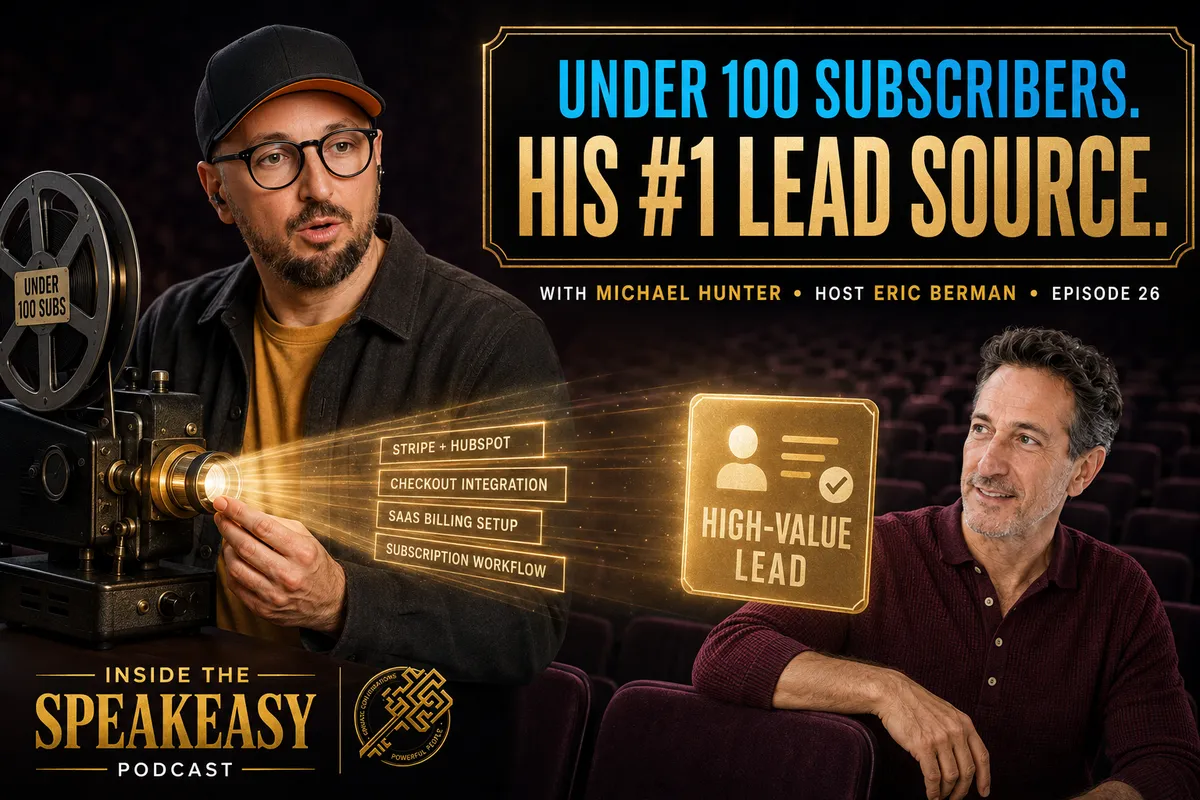
Michael Hunter started his marketing company during his senior year at Arizona State University, at the bottom of the recession, and went on to become one of the first full-time marketing hires for Brendon Burchard, helping launch courses with Oprah's team and Larry King. In this conversation with host Eric Berman, Michael explains how his small boutique agency turned its checkout and product launch work into Spiffy, a bootstrapped checkout and payment platform he says he built into an eight-figure valuation business with zero social media. He shares why he took a job at Infusionsoft when he felt like a sellout for doing it, how niching down to personal brands compounded his results, and why the right strategy at the wrong time is still the wrong strategy. Michael also reveals how a YouTube channel with fewer than a hundred subscribers became Spiffy's number one source of growth.
In this episode, you'll discover:
- How Michael and his partner Jeremy Abraham turned a productized checkout service into Spiffy, starting as an app for Infusionsoft that reached about half a million dollars in revenue with zero marketing
- Why Michael sold Spiffy subscriptions at $300 a year before customers could even log in, and took credit cards over the phone
- How Spiffy used Baymard Institute's 130,000 hours of e-commerce research to build a checkout that Michael says out-converts other platforms by at least 10%
- Why implementing stage four strategies at stage one, two, or three causes most of the overwhelm thought leaders feel
- How low volume, high value YouTube videos with fewer than 500 views each became Spiffy's number one growth channel
Episode Summary
Michael Hunter had his first taste of entrepreneurship at 17 in commission-only sales, where he discovered personal development books like Rich Dad Poor Dad and Think and Grow Rich. He heard that public speaking was the highest paid profession and that most people would rather keel over than speak on stage, and after discovering Tony Robbins he felt a calling to have that kind of impact. Raised in Denver, Michael went to Arizona State University for its architecture program, and he still lives in Scottsdale. He realized he understood sales but not marketing, so he started a marketing company where other people would pay him to learn how to do it for them.
Michael launched the business in 2010, going into his senior year with 21 credit hours, because friends graduating a year ahead of him in the recession were not getting jobs. After graduating in 2011 he niched down to authors, speakers, coaches, and thought leaders. He started as a paying attendee at Brendon Burchard's events, then volunteered at the sales table, and he and his business partner Jeremy Abraham became Brendon's first full-time marketing hires. Working at a CMO level, they built Brendon's first full marketing team, launched his course on Oprah.com, and launched Larry King's course on communications.
Earlier, in 2013, Michael had taken a role on the marketing team at Infusionsoft, which was headquartered in Arizona and had just raised $50 million. He felt like a sellout for taking a job, but he had been losing $5,000 and $10,000 deals to former Infusionsoft employees who simply had better positioning. He calls it moving at a 45 degree angle. When the culture became political ahead of a planned public offering, he went back to being a partner, teamed up with Jeremy, whom he had met while at Infusionsoft, and the work with notable names followed within about a year.
Michael and Jeremy had become known for product launches and custom-coded, mobile optimized checkout experiences with logic-based one-click upsells, back in 2013 and 2014. Because not everyone could pay them $5,000 to $7,000 for one page of a funnel, they turned their template into Spiffy. Out of about 20 software ideas, they picked the one with the highest upside and least downside risk, started with an app for Infusionsoft, and reached about half a million dollars in revenue with zero marketing in around 18 months. Michael says the company has never raised money and is bootstrapped, profitable, and debt free.
On personal brands, Michael explains that he bought personalbrand.com in 2013 and only built an agency around it in 2023. In December 2019 he and Jeremy decided to focus entirely on Spiffy and wound down the agency, and when COVID hit in March 2020, the blog's traffic jumped from about 4,000 hits a month to 40,000 to 60,000. He calls it the worst decision they ever made, and it shaped his view that the right strategy at the wrong time is still the wrong strategy. He describes four stages of a thought leader business and warns against complexity.
Michael walks Eric through how Spiffy works today: it takes over at the buy button with an optimized checkout, logic-based upsells and downsells, and subscription management, and it integrates with HighLevel, ActiveCampaign, HubSpot, Stripe, and PayPal. He explains how the team keeps a customer support mindset, why it is building sister products instead of adding complexity, and how keyword-rich YouTube videos drive growth. Michael closes by describing the value of the Speakeasy community and its Scottsdale chapter, a new podcast about first six-figure milestones, and why staying focused on one thing for a decade is a superpower.
Big Ideas Discussed
Build Software Around the Service You Already Deliver
Michael always knew he wanted to get into software, but he is not a developer. What he did have was a productized service. His agency had become known for driving results through optimized, mobile-friendly checkout experiences and custom-coded one-click upsells and downsells. Because not everyone could afford to pay $5,000 to $7,000 for one page of a funnel, he and Jeremy asked how they could package their template into self-service software. The path went from serving anyone, to serving personal brands, to productizing product launches, to building software out of that productized service.
He tells agency owners that they hold a massive advantage because their hands are in the trenches, using all the tools and seeing their limitations firsthand. Spiffy started by solving one problem for an existing community: Infusionsoft's outdated e-commerce platform, which Infusionsoft was afraid to touch. Michael calls this moving in 45 degree angles. Instead of building the big dream first, they found a pond they could fish in, gained traction and revenue there, and then made the jump into the ocean as an independent platform.
Get Paid Before the Product Is Finished
Michael believes the market demands less than founders think. People just want a problem solved, and you do not need the Ferrari from day one. He points out that if raising money and hiring good developers were the recipe for success, every VC-backed company would win. The real sauce, he says, is understanding and solving a real problem in the marketplace that people are willing to pay for.
Spiffy sold annual subscriptions at $300 a year before there was any way for customers to log in. The team manually entered data, sent customers a code snippet to drop on their Infusionsoft forms, and Michael took credit card information over the phone. He describes that first version as a skateboard that got people there a little faster than walking. Over several years they reinvested profits to add an engine, doors, and better wheels, and today he calls Spiffy a Ferrari. He admits that if they had known how hard it would be, they would not have started.
The Right Strategy at the Wrong Time Is Still the Wrong Strategy
Michael has codified the thought leader business into four stages, and he says the biggest source of overwhelm and stress is trying to implement stage four strategies at stage one, two, or three. He learned it himself: after filling events of 1,500 to 2,500 people for big-name clients, he assumed his own events had to be that big, without the ad budget or the confidence to sign a large hotel contract. Good strategy, he says, should feel simple, and if it creates more complexity, it is not good strategy.
That includes social media. Michael says he built Spiffy into an eight-figure valuation business with zero social media, and that people who do not enjoy creating content do not have to. He also describes the gear shift from initial success to sustainable success. Early on you create and launch offer after offer to find what works, but eventually you cannot run twice as many ads or maintain twice as many products, so you need to simplify a collection of offers down to a sustainable business model.
Low Volume, High Value Views Beat Going Viral
Because Spiffy handles people's payments, Michael says you cannot run an ad and expect someone to move their entire business to a company they have never heard of. Spiffy has grown through word of mouth, channel partners with other agencies, and CRM marketplace listings, but the number one source of growth has been YouTube. He credits his friend Robert Gruler with putting words to the strategy: low volume, high value views.
Spiffy's channel has fewer than a hundred subscribers and fewer than a hundred videos, and most videos have fewer than 500 views. But they are the right views. Videos with titles like best Stripe integration for ActiveCampaign or best Stripe integration for HubSpot answer what buyers are actively searching for, and they share helpful information about native integrations and their pitfalls rather than just promoting Spiffy. Michael says everyone can implement this strategy, but most people do not because they are chasing vanity metrics.
Questions We Answer in This Episode
Who is Michael Hunter?
Michael Hunter is the co-founder of Spiffy, a checkout and payment platform, and a partner in PersonalBrand.com, a brand and business strategy firm for authors, speakers, coaches, and thought leaders. He started his marketing company in college and, with Jeremy Abraham, became one of Brendon Burchard's first full-time marketing hires. He is based in Scottsdale, Arizona.
How did Michael Hunter turn his agency into a SaaS company?
Michael Hunter's agency became known for optimized, mobile-friendly checkout pages with one-click upsells, but many clients could not afford $5,000 to $7,000 for one page. He and Jeremy Abraham packaged their template into self-service software called Spiffy. They started with an app for Infusionsoft, which reached about half a million dollars in revenue with zero marketing in around 18 months.
What does Spiffy do?
Michael Hunter explains that Spiffy is the checkout form and all post-purchase steps, taking over when a buyer clicks the buy now button on a page built in tools like ClickFunnels, WordPress, or HighLevel. It adds logic-based one-click upsells and downsells and helps manage subscriptions, failed payments, and billing updates. Michael says Spiffy will out-convert any other platform by at least 10%.
How did Michael Hunter validate Spiffy before it was fully built?
Michael Hunter sold annual Spiffy subscriptions at $300 a year before customers had any way to log in. His team manually entered data, sent customers a code snippet for their Infusionsoft forms, and he took credit card information over the phone. He says the market demands less than founders think, because people mainly want a problem solved.
Why does Michael Hunter say the right strategy at the wrong time is the wrong strategy?
Michael Hunter says most overwhelm comes from implementing stage four strategies at stage one, two, or three of a thought leader business. He learned this when he tried to run his own events at the scale of his big-name clients without the budget to support it. He believes good strategy should feel simple, and if it adds complexity, it is not good strategy.
What was Michael Hunter's biggest missed opportunity?
Michael Hunter bought personalbrand.com in 2013, and in December 2019 he decided to wind down the agency and focus entirely on Spiffy. When COVID hit in March 2020, the blog jumped from about 4,000 hits a month to 40,000 to 60,000. He calls stepping away from personalbrand.com at that moment the worst possible decision they ever made.
How does Michael Hunter use YouTube to generate leads for Spiffy?
Michael Hunter uses a strategy of low volume, high value views. Spiffy's channel has fewer than a hundred subscribers and most videos have fewer than 500 views, but keyword-rich videos such as best Stripe integration for HubSpot reach people actively searching for a solution. He says YouTube has been the number one area of growth for Spiffy.
Full Episode Transcript
Read the Full Episode Transcript
Meet Michael Hunter, Agency Owner and SaaS Founder
Eric Berman: Welcome to the Speakeasy Podcast, where the real conversations happen behind closed doors with the boldest entrepreneurs, creators and growth minds in the game. No fluff, no filters, just the raw strategies, personal stories and mental models that move the needle. I'm Eric Berman. Now let's get into it. In this episode of Inside the Speakeasy Podcast, you're going to learn from the amazing Michael Hunter. Some incredible nuggets and really how he's been doing over a billion dollars of payments through his SaaS after getting absolutely crushed in Covid. Absolutely doing something really wrong at the wrong time that's come back to haunt him. But he's made a mega, mega comeback that we're all going to learn some incredible stories from, including being the man behind many major brands and building courses and strategy behind people like Oprah, Larry King, Harvey Mackay, Brendon Burchard, Jim Kwik, and many more. Welcome to the show, Michael Hunter.
Michael Hunter: Eric, thanks for having me excited to have a productive conversation today.
Eric Berman: Yeah, well, thank you so much for coming. I know, like, you and I have been trying to schedule and reschedule between our crazy calendars. It's been nuts, but we finally made it. I'm fresh off of a flying back in from Panama. Just got back last night and I'm sure you've been running around like crazy. So here we are.
Michael Hunter: Yeah, we're fresh off of our three and a half day event last week and so, you know, things are rocking and rolling over here.
Eric Berman: Nice. What were you doing?
Michael Hunter: Your event, the event's called Brand and Business Breakthrough. Just helping people step into their next level of leadership, teaching brand strategy, business strategy and yeah, really helping people get out of their own way.
Eric Berman: I love it.
Michael Hunter: I love it.
Eric Berman: And actually I've been hearing behind the scenes people are raving about the stuff you're doing in the new event. So congrats on that. We're going to talk about a lot today because I know you have personalbrand.com. You got Spiffy as well on your, your SaaS product. Cool, cool stuff. I've always been really envious, frankly, you know, watching what you've done because you and I actually say, you know, have shared similar agencies, you've done a lot farther and done some really magical things. What I want to jump in at some point is you've been able to do what a lot of us agency owners want to do, which is to create way more value than the clients coming on, you know, to create more enterprise value for your company by building that SaaS and have wild success. It's so tough to think about how you can build a SaaS and pull off yet you've done it. So I'm really interested in getting into that. But before we don't dive into that, I want to start from the beginning. I threw out some big names that you worked with. You don't just come to walk off the street and say, hey, I'm building courses for Larry King and Oprah and Brendon Burchard, CMO for a couple years and, and all that stuff. How the hell did you get here? Like, give me a little of your backstory. How did you, like, you don't want to just become an agency owner and say, hey, one day I want to be an agency owner. Where I grew up, it's in the back end of those things. So give me a little backstory.
From Commission Sales at 17 to Starting an Agency in College
Michael Hunter: Thanks for asking. My story starts when I was 17. I had my first taste of entrepreneurship when I was 17 years old, in commission, only sales. At the same time. I was holding just a normal hourly job. And that was a pivotal moment. I got introduced to my first personal development books. Rich Dad Poor Dad, Think and Grow Rich. Went to my first, like, kind of, you know, mini sales training. There was, I don't know, maybe a hundred people in the room. It wasn't anything big, but that was my first introduction to personal development public speaking. And early on in my entrepreneurial career, I heard that becoming a public speaker was the highest paid profession and most people would rather keel over than speak on stage. And so my little 17 year old brain, I was like, wait a second, like there's a lot of money to be made there and most people don't want to do it. All I have to do is crack that code and figure that out someday. Like, okay. I mean, I felt like I had like, you know, the secret recipe to success in life. And then I got introduced to Tony Robbins. And then shortly after that, I got introduced to Anthony Robbins. And then shortly after that, I realized they were the same person. You know, 17, 18.
Eric Berman: Where's baby Michael Hunter at this point? What city you in?
Michael Hunter: Yeah, I grew up in Denver, Colorado. This was the summer between my senior year of high school and freshman year of college. I came out to ASU in Arizona for college. Still live here in Scottsdale today. And so anyways, I got introduced to Tony. I saw the impact that he was having. I'm like, he gets to have like this big impact on so many people's lives. Like, he's impacted my life. Like, that's so cool. I want to do that. Someday. But I'm 18. I have no idea anything about life, let alone, you know, to be able to say anything meaningful in front of an audience. And so I just felt this calling on my heart. And I was going through school, you know, felt the calling, felt the calling, felt the calling. And I kind of had the sales skill set down, but I didn't really, like, didn't really know and understand the value of marketing. I was like, unless I'm sitting across the table from someone, putting an offer in front of them and, like, taking their order and, like, swiping their credit card, like, how the heck do you even make money? Like, it didn't make sense. But then I started to look at what Tony was doing. He's filling these rooms, and he's doing all these different things. I was like, all right, what's the other skill set I need to learn in order to be able to do that someday? And marketing came up as like, okay, I need to learn how to do marketing, to fill the rooms, to sell the things, to get message out there, to make the money marketing, something I know nothing about. So I'm going to start a marketing company where other people will pay me to learn how to do it for them. And so that's really where that started in 2010. And at first, I started working with anyone and everyone that was willing to pay me.
Eric Berman: So is this right after ASU? Let me cut you off there so you get out of ASU. I'm just thinking back to your story a little bit. Like, you already know you're on a success track. Because if anybody knows ASU and going to college at ASU, most kids at 18, 19 are thinking about a lot of other things other than sales and marketing. Tony Robbins. So you're already up, you know, already winning at that point, saying, all right, I'm going to focus on that. You get out of school. Okay, so now you're out of school and you like.
Michael Hunter: So it was actually my senior year of college, so I actually went to ASU because they have one of the top five architecture programs in the world. And I really wanted to be an architect. I wanted to own my own architecture firm. At some point, I had this little entrepreneurial bug. I thought that was my path. But what I realized is architecture, marketing are very similar. They're part science, part art. Like, you can't architect a building and design a building that's so abstract that it can't support itself. And in marketing, there's rules, and there's times to break the rules. And so what I found was that was more interested in learning and helping people, architect businesses and income streams and lifestyle and having an impact versus just creating living spaces. And so, you know, again, we're talking, I'm in college 2007-2008-2009-2010. I'm going into my senior year. This is the bottom of the recession. All my friends graduating a year ahead of me aren't getting jobs. So I was like, all right, I'm not going to wait for an opportunity to present itself. And a year from now, like maybe kind of sort of be begging for a job. I'm going to use my senior year to build a job for myself was kind of my mindset at that point of time. And so going into my senior year, I've got 21 credit hours. I start a business, I had no time to do anything else. And Fast forward to 2011, I graduate, and later that year I niched down to only working with author speakers, coaches, thought leaders, personal brands. And at that time, I didn't really know that many people that were authors. But I got introduced to Brendon Burchard. I started attending his events as a student and I started immersing myself into his content and running in those circles in those rooms. And then Brendon started Experts Academy and started teaching people how to do what he was doing. And so, you know, I started working with a lot of people that were attending his events and slowly started working with bigger and bigger names, started working with people that were coming across Brendon's stages, all the way to the point where one day Brendon was like, you guys are getting these results for all these people all my friends are coming from.
Volunteering for Brendon Burchard and Becoming His First Marketing Hires
Michael Hunter: And so transparently, I started as a paying attendee at Brendon's events and then I transitioned to volunteering for Brendon's events at the sales table, helping set up the events, run the events.
Eric Berman: And.
Michael Hunter: And because I was in close proximity, me and my business partner, Jeremy Abraham were actually the first full time marketing hires that Brendon ever made. He did all of his marketing before by himself, before we came on. So Brendon was already massively successful. So I can take no credit for Brendon's success. And we came in at a CMO level and built out Brendon's first full marketing team. Through Brendon, we had the opportunity of launching Brendon's course on Oprah.com, so I worked with Oprah's team. We got launched Larry King's course on communications. And so that one opportunity really allowed for a lot of really cool experiences in my life.
Eric Berman: Amazing. And I mean, I Think that's such a great, powerful story. Others can get inspired by the amount of work you put into just even getting that opportunity. I mean, you found the right stage and you hustled and you worked your way and you weren't intimidated. I'm sure you were intimidated, but you just said, I'm just going to keep going and I'm just going to prove it and work my ass off. And you got your name out there.
Michael Hunter: Yeah, exactly.
Eric Berman: That's powerful. All right, so now you're working as a CMO for Brendon and are you working? Sort of. You had your agency and your agency was there serving as kind of a cmo, working on these. Okay, so you did that and then you with him for a while, then you started working on other clients. Is that that the kind of way it started evolving?
Michael Hunter: So we started working with other clients and really Brendon was a client again. We, we had a very small boutique agency. When you were starting off this podcast, you were saying that you're, you know, kind of looking up to me. I've always looked up to you with like what you've built with your agency. You know, we never had like a massive team. We were like a really boutique agency. And so ultimately working with Brendon and like really focusing in, we started transitioning or ending our, our other projects and really focusing in on delivering for Brendon.
Turning a Productized Checkout Service Into Spiffy
Michael Hunter: And then a few months before we started working with Brendon, we started this little side hustle thing called Spiffy. So early on in my agency career, always knew I wanted to get into software, but I'm not a developer and so I didn't quite know exactly how that would work because of how we were implementing our services for our clients. We became known for doing product launches and driving insane results through optimizing checkout experiences and custom coding. Logic based one click upsells and down sells. Creating mobile optimized checkout experiences. This is back in 2013, 2014, like before anyone was doing this on the cutting edge of mobile commerce. And so one day I turned to my business partner, Jeremy and we really productize this service. We've gotten this like template that made everything mobile optimized, but still took a long time to custom code all of their content and like making it look and feel more like their brand. Ultimate turned to Jeremy and like, hey, like not everyone can afford to pay us like 5, 6, 7k just for one page of their funnel. I feel like there's some type of software here. Like we have this template. How can we package this into a software and make it self service so everyone can kind of build their own checkout page. And so through a lot of mind numbing, brain crunching, figuring things out, we actually figured out how to build the software around our service. So we went from an agency rendering services for anyone and everyone, to running services just for author speakers, coaches, thought leaders, to productizing our service around product launches, to building a software product out of our productized service. And so if you're an agency owner out there, you have massive advantage in the marketplace of having your hands in the trenches, using all the tools out there to know what's working, what's not working, the limitations of all the existing tool sets. And so, you know, it's definitely not easy, but you're at a very unique perspective to really recognize opportunities to leverage your existing team to build something that's a little bit more scalable.
Eric Berman: Amazing. I want to unravel that a little bit because what's interesting is I learned, you know, many years after running an agency that you almost want to figure out a SaaS. I mean, you sort of just seems like from your story you just built it out of sure sort of market opportunity, market gap of how do I find something that was almost like your lower price product, if you will, and you build it that way. Whereas now what I've learned in time was having that SaaS takes the value of your company up 10x more than just being an agency. And it's actually the real value is those lifetime customers on a SaaS. So it sounds like you sort of backed into that, not necessarily knowing that, saying, holy shit, we actually end up creating more value for ourselves by building. That's something you kind of found out almost after in hindsight, like, damn, I'm glad we did this for that reason.
Choosing the Idea With the Most Upside and Least Risk
Michael Hunter: I mean, it was quite strategic and intentional. And this is kind of where the conversation bridges agency, you know, growth agency software services to like personal brand. This is part of the story that I tell on stage. My keynotes is that we built this agency, we had a small team, but our brand in the marketplace was that we were the miracle workers that we could make anything happen. That when your back is against the wall, Michael and Jeremy can make it happen. And so like time and time and time again, we got handed these really complex scenarios and every single one of our clients had insane expectations. Regardless of what our pricing model was, regardless of what our website said, regardless of our positioning statements, like we were trying to like pull all these different levels of our branding, where my distinction is that your branding is what you say about you, your brand is what the market says about you. And so ultimately the word on the streets was that we could make anything happen. So no matter how much we proactively communicated or set expectations or, you know, whatever, it was like we could never outrun our reputation in the marketplace. And so ultimately tying this back to your question is, we saw the writing on the wall that running an agency wasn't the quality of life that we wanted for the next 20, 30, 40 years. We didn't expect to like necessarily shift the gear as fast as we did, but we definitely wanted to transition our supplement augment and over time transition from agency to software. We had about 20 different software ideas that we thought could be million ideas and most of them were just million dollar ideas. And so we actually created a framework that we teach at our personal brand workshop, Brand and Business Breakthrough, where we go through like, hey, when you feel like you have so much opportunity in front of you and you could go all these different directions, like, how do you objectively choose where your time, energy and effort should go? And so just out of pure necessity, like we didn't raise money, bootstrap, profitable, debt free to this day. But we were also in our 20s. Like we didn't have deep pockets so we had to start like very small. Like what is the idea that we can execute that has the highest upside potential with the least downside risk? And for us it was building Spiffy because ultimately a lot of times, you know, startup companies, they're building in an industry where all of a sudden legislation comes through and your entire business industry dries up overnight or shifts and now your business model doesn't work. But for us, building a custom payment platform, there was no risk in it. If we want to pivot and become a CRM for yoga studios in two weeks, like we could adapt our platform. Like when you own and build your own billing platform, one, it's insanely difficult to do. Most people don't do it. There's a moat inherently there. But like nice have it. Like there's really no risk. Like we could go start a brick and mortar storage company, you know, something completely outside of our industry and we'd have our own billing platform that we could quickly adapt. So long story short, that that was kind of some of the thought process behind how we decided what to build. And we didn't start building the big dream first. I call us moving in 45 degree angles. So we didn't start building our own platform first. We solved the existing problem. We solved the problem for an existing platform. So the first step that we took, and again, this isn't right or wrong. There's no right or wrong path. This was just how we did it, is that we built an app for Infusionsoft as step one. Then we solved a problem for an existing community with people who are looking for a solution, and they were willing to pay for the solution because it was that visceral. So we scaled about half a million dollars worth of revenue with zero marketing in about 18 months and had the who's who of the industry as clients. And then we just reinvested profits.
Eric Berman: And I'll make sure people are listening, really hone in that, because I can relate so much to that. Having, you know, my business partner running an agency, thinking so many times about what SaaS to run, should we build out of SaaS. And I love what you're saying. You're saying, well, you know, try to find a thirsty, hungry market that's got a big group, that's rabid, based of fans that have a massive problem. You're listening to it, you're hearing everybody complaining about this thing. And you said, I'm gonna. I know how to solve that. And you solved it. And then you were able to leverage that. I know there's some backstory about. You just mentioned Infusionsoft. You did some work there. Right. And what part. When did you work there in this timeline of as you were going through this.
Taking a Strategic Job at Infusionsoft
Eric Berman: Yeah.
Michael Hunter: So that's a big defining moment in my story as well. I had my marketing agency. I was a Infusionsoft partner. This is, you know, 2010, 2011, 2012. And then I believe it was. Yeah, it was 2013. I finally started getting traction in my marketing company. And at the same time, I have an opportunity to join the marketing team at Infusionsoft. And, like, it was literally at this point where I had been struggling so hard in my life, my business, not, like, thinking that I was a problem. And this is one of the things I really work with a lot of our clients to, like, identify. It's like you really have to know when you're swimming upstream against the current and when you're swimming downstream with the current, and whether your offers your services that need tweaking and dialing or whether it's just the conditions of the market. And so I didn't realize what was going on in the economy because that was all I knew as an adult was the aftermath of the recession. And so I finally start to get some traction, and I get this opportunity, and I had spent so much time, energy and effort building an identity as an entrepreneur that even considering taking a job, I felt like a complete sellout. And I knew I wanted to get into software and I didn't want to move to Silicon Valley. And being here in Arizona, Infusionsoft's headquarters are here. They had just raised $50 million. And so I saw it as a divinely orchestrated event where, oh my gosh, like, I can join a fast growing startup. I can swallow my pride a little bit. Oh, wait, like, they're all about supporting entrepreneurs. I pursued the opportunity. I learned that they're all about supporting entrepreneurs. I learned that they actually encourage their employees to have side hustles, to have businesses. So I actually didn't need to wind down my agency. I could keep it going. Obviously I wasn't, you know, bringing out as many clients. I didn't have the capacity for it, but I didn't actually have to stop doing what I was doing. And I got to pursue that opportunity to join Infusionsoft. So because I was a part of that Infusionsoft community, I knew people that worked there. And when they left, I was losing deals to these people who just said that they worked at Infusionsoft, that I knew a fraction of what I knew about marketing and business and building an online marketing strategy. But just because they said they worked at an Infusionsoft, I was losing these deals. These are people from the customer service team that like, kind of sort of help people set some stuff up, but, like had zero, but they were, you know, I would lose a 5,000 deal here, $10,000 deal here to these people that ultimately just had slightly better positioning. Uh, and so I knew that I wasn't just taking any job. I wasn't going to flip burgers, I wasn't going to like wait tables or I wasn't doing anything. There's nothing wrong with those jobs specifically, but if you're going to have to take a job, make sure it's strategic. And so I knew deep in my soul that this was like moving in a 45 degree angle where it wasn't a direct step towards what I wanted in life. But whether I was at Infusionsoft for five months, five years or 10 years, that afterwards the connections I would make, the credibility I would have, would accelerate me to what I wanted actually faster. So actually, one of the principles I teach is sometimes the scenic route is actually the fastest route versus traversing the mountains and the rivers and the ravines and all these different things. And so that is Ultimately, what happened while I was at Infusionsoft, they raised their second $50 million of funding. They were prepping to go public. The culture shifted. They started kind of putting the pressure on people to, like, not do their side hustles. And so it got political on the inside. And so I was like, oh, I'm just going to be in a partner again. Like this. You know, all this, you know, political red tape isn't what I signed up for. I signed up for the startup culture and the growth and the flexibility and all the things that, you know, were promised at the beginning. So I just went back to being a partner, and then that's when Jeremy, my business partner, and I linked up. And ultimately within about a year afterwards is when we started working with a lot of the notable names that we mentioned.
Eric Berman: So you went from to back to the timeline. So you started your agency, you were kind of struggling agency owner, making a little bit of money, hadn't quite figured out, like, the, you know, what was working, what wasn't, you know, the conditions weren't great.
Michael Hunter: Wow.
Eric Berman: First of all, commend you. That's a big effing decision to think about, like, oh, my God, the freedom of an entrepreneur. I did it. Like, it's hard to get entrepreneur. I'm an entrepreneur now. Like you said, you swallowed your pride, as you mentioned, to go work for the big name, which is tough knowing you have clients. Are you like, can I just do this a little bit more? Maybe I can get more clients. Why do I want to go work and get a paycheck? I mean, damn, that takes some cojones. So you did that and like you said, it worked out really well because then you can leverage the name. Then after that, you then went and.
Michael Hunter: Did the whole Brendon thing.
Eric Berman: Is that was after Infusionsoft? Yeah.
Joining Forces With Jeremy Abraham and Niching Down
Michael Hunter: So while I was at Infusionsoft, I met Jeremy Abraham, and he was doing the same exact thing that I was doing. He was building websites, doing marketing automation, running ads for small businesses, specifically author speakers. Just kind of the circles he was running in. And so we just kind of found out that he was working with some of my past clients. I was working with some of his past clients. We're like, why are we competing? Like, let's just do this bigger, better, faster together. And so as soon as we joined forces, it kind of like permeated. Good news traveled fast, and everything started to pick up from there. And so, like, it's just a testament too, to, like, you know, you can go really fast alone and you have Lots of flexibility, but you can definitely go further together. And so, you know, Jeremy is my business partner and Spiffy and is my best friend.
Eric Berman: So congrats on that story. And then obviously again you mentioned that because you're in Infusionsoft's [unclear] as a partner, you got. I'm going back circle to your story. You're able to see the issues going on within the Infusionsoft community, thus ultimately building Spiffy. One of the things you talked about I don't want to gloss over because we share a similar story. Running an agency and going from almost identical story, going from a niche brand that some authors like, you know, we went author speakers and we went wide and said, hey, we're open to everybody. And then realizing that exactly what you said, you're just attracting things that don't really fit what you're good at. And you're just, you know, clamoring to take on any kind of business because, oh, it's another client that's going to help pay the bills. I'll go take that client on. Ultimately, you nailed it. I can't remember the exact quote you said about your brand, but I think, you know, ultimately not being known as, you know, what are we known for? It's just like an agency doing what? Oh, we do everything. What do you mean? What are you good at? Like, what do you know? What do you guys really. And I remember giving the ask that question and so like, you know, it was a struggle and then as soon as we went down to sort of like thought leaders and similar, it like all of a sudden opened up, it tend to open up a lot more doors. So like I really believe and witnessed. I'm just echoing what you said, but I'm kind of putting down the foundation for people listening. How important is that? You know, the riches are in the niches kind of thing. And the more you got clarity, I imagine it's a similar story, right? The more you got clarity on the personal brand, then the customer says, oh, you're probably more aligned for me than that other big agency down the street who's just some general agency working with Subway. Even though they got the big client, maybe they don't know me as well as personal brand.
Michael Hunter: Exactly that what you went through.
Eric Berman: I mean, similar story.
Michael Hunter: Yeah, 100%. And especially when you're agency and you can really produce results for everyone. Like one of the key indicators is like, okay, when I produce results and I get an exceptional end result for a client, like is that client running in circles of other Clients like them, like so much of business is like, there's so many different verticals that we could do branding for nowadays. But specifically personal brands, authors, speakers, coaches, they run in circles with other author speakers, coaches. So when we over, when we get really focused on our niche, when we get really focused on who we serve and how we serve them, and we crush it for them, just naturally it's going to bring more business to us. So niching down, you need to find your ICP. Like it's been so, like cliche ized, if that's even a word. It's been so discounted and it really is everything. It's not because, like, you need to tailor your marketing messaging, but because, like us as small business owners, we only have so much time, energy and attention and we only have so many resources where niching down allows us to focus our resources in an area where we're able to actually compound our efforts versus having our efforts just like, feel like we're stretched in 17 different ways. So there's a lot of strategy that goes into choosing the right niche market. Who do you serve just within a specific industry, like what size of business, solving a very specific problem where when you create a raving fan just by doing your work, it actually fills your funnel?
Eric Berman: Yeah, no, I love that. I love that. It's interesting, you know, that's the niche you chose. That's to some degree I always talk about now and I'd be interested to get your take on this. And maybe it's just because we are missing the boat and who knows? You know, I talk about the sandbox, you know, playing in, you know, like the market you're going after in that. But I think probably Spiffy is a big part of maybe this answer. And I'm going to talk about Spiffy after this too, and is, I love that you found the niche and I agree with that. But sometimes I look back and say, how big of a sandbox that niche? How big of a customer? You know, we hear the stories of the customers that are paying lower dollars tend to be the more difficult customers than getting a client who's got a budget of, you know, hey, I got a client at five grand a month, or I got a client at 30, 40, 50 grand a month, and the one paying five is really harder to work with than the client at 50. Have you found that? And how do you, like, how do you reconcile that? Do you regret, like the niche you're choosing even though you do that, or like, where's your head out There.
The Right Strategy at the Wrong Time
Michael Hunter: Yeah, it's a great question. I think as most businesses fail not because of a lack of resources or lack of good products, it's like implementing the wrong strategy at the wrong wrong time. Even the right strategy at the wrong time. That's usually what I say. It's like implementing the right strategy at the wrong time. I have bought the domain name personalbrand.com in 2013 and in 2023 we started actually building an agency around it. And so I knew this wave was coming. Covid really accelerated it.
Eric Berman: Oh yeah.
Michael Hunter: And I missed that wave and I knew that was just the first wave. And that wave is really, really small. And so to answer your question with a little bit more of a firm point, yes, the number of authors, speakers, coaches, thought leaders that can afford, and not even just afford, but where it's actually a strategic multiplier for their business, where brand can actually accelerate the results forward is a very small pool. And when it comes to those lower price points, it's just about building a scalable business model where we're not rendering agency services, we're doing workshops, we're forming a community or our life force energy isn't dragging people who aren't quite a good fit for our services across the finish line by rendering agency services, but we're educating, we're leading, we're teaching, we're helping them get ready to become an ideal client for us to fit that ideal customer profile where agency services.
Eric Berman: Interesting.
Michael Hunter: Makes sense. So that's really where we're moving now. We're kind of in this like meta experience now where like we're building what we teach. We teach our clients how to build an eight figure, scalable, sustainable business model. And regardless of whether you want to build an eight figure business, even if you want to make mid to high six figures or low seven figures, it's way more fun, there's way more capacity of life engineering everything as an eight figure business model so that you operate your business with a lot more excess capacity. And so we're doing that now. We started with high ticket agency services, we have our live events. Next year we're launching our community, we'll launch a high end mastermind. So like we're building out what we teach our clients to do ourselves. And so it's a really cool season in our business to lead by example and to like be able to coach, teach, train our clients like while they're watching us build it.
Eric Berman: Yep. Okay. I love it. I'm about to transition to Spiffy because I'm really fascinated about what you've done there. But before I jump into that road, I'm going to talk about one more thing on the personal brand stuff. You're out there teaching a lot of courses, a lot of content, thought leader yourself that you become are on stages. What are the top? And we have a lot of thought leaders that are in the community even and others that are listening. What's maybe the top one or two tips you have for people working on their own personal brand? Maybe the biggest things you're finding people are doing wrong and a couple tips you could offer.
The Four Stages of a Thought Leader Business
Michael Hunter: Yeah, so this took me a long, long time to figure out and ultimately we codified the thought leader business into four distinct stages. And the number one source of overwhelm, frustration, stress, all the negative emotions we feel when we build our business are trying to implement what I call stage four strategies at stage one, two and three. And this is one of the things that I really had to, I learned this out of my own internal head trash. Like I went from filling live events with 1500, 2000, 2500 people to like wanting to do my own live events, thinking they had to be that big and thinking I had to pull the levers that I pulled for all of my big name clients for myself. But I didn't have that ad budget, I didn't have the ability to confidently sign my name on the dotted line for a huge hotel contract and a room block. And so like I really had to like, okay, I don't need to start at stage four, I need to start back at stage one. So that's the number one thing is just like there's a right strategy at the wrong time is still the wrong strategy. And most of the time the information that's being fed to us through our news feeds on social media or even going to a marketing event. It's really smart, it's really cool stuff that works and most people aren't ready for that. And so the biggest thing that I say is that good strategy, if it creates more complexity, it's not good strategy. So ultimately strategy needs to feel effortless, it needs to feel simple and you need to lean into your strengths. And there's so many people, even with all of our clients today, like they have, like they're, they're really not technical people and like the fact that they have to log into a CRM and set up an automation and leads and send out a newsletter, it's like, you don't have to do that. Like I built Spiffy into an eight figure valuation business. With zero social media. Like, I don't post on social media that often, but the illusion is that in order to be successful, you have to post on social media, and that's a great avenue to do that. If creating content lights you up, if, like, being in that creative flow and publishing content, have that interaction with people is fuel to your soul, lean into it. That's your strength. But for a lot of people, they don't want that. They don't like doing it, but they think they have to. And that's where there's a misaligned truth that you don't actually have to be on social media in order to build a very successful business.
Eric Berman: I mean, just to quote. I mean, I love that I wrote that down. You know, the right strategy, the wrong time doesn't necessarily make it a good strategy. And I think that's really powerful for a lot of us who are running around racing for the next big thing as entrepreneurs. You know, I just went to an event and I saw this. We got to implement that. And, you know, I even hear that from some of my clients who, like, you know, all of a sudden they're at events and they, like, come back saying, we had to jump and do this, and they, like, try to screw up the timeline. You're like, well, wait a second. What about this thing we're working on? Yeah, but this is such a great idea. I heard Michael Hunter on stage, and he told me to do this. We got to go do it. And, you know, so it's the kind of. Yeah, but if it's the wrong time. But I wish all my clients would understand and hear that.
Michael Hunter: But yeah, yeah, and then the other piece is just, you know, really shift. This is where we help our clients the most, is like, shifting the gear from initial success to sustainable success. Initial success is you have to create a lot of different things to figure out what works. And all of a sudden, you create this course and you launch it, and you're like, oh, my gosh, like, we made some money. Let's create. Let's do that again. And you create another course, and you launch it, and you create and you launch and you create and you launch. And all of a sudden, like, it's working until it doesn't work, until you can't create anymore. You can't go to twice as many live events. You can't run twice as many Facebook ads. You can't create and maintain twice as many products. And so ultimately, there's a gear that needs to shift of, like, going from having a Collection of offers to simplifying down to a sustainable business model. And so that's another key distinction. And a big mistake that we make is just like really understanding. Like we've heard it before, we've heard what got you here won't get you there or whatever the cliche phrase is. But there's so much truth and depth to that. And just knowing when to shift those gears is critically important.
Eric Berman: Right. I love it. Okay, so I'm going to jump over to something that's really exciting, obviously is Spiffy. I've seen bits and bites of it at events and I've talked to people that use it and they just love it.
Michael Hunter: So what was.
Eric Berman: And you went, I'm going to go back to 20 minutes ago in our conversation, the big problem that you saw out there that you've now solved, and tell me what's now happened because of that through Spiffy.
Selling Spiffy Before Customers Could Log In
Michael Hunter: Yeah. So there's how we got started and there's kind of where we're at now. And so the intention from day one was that we would solve the most basic, easiest problem to solve that people were willing to exchange money for. And then we would reinvest profits to invest back into the business, reinvest profits back into the business to build out all the other bells and whistles. And so this is one key distinction, especially when it comes to software, is that the market actually demands less than we think it does. People just want a problem solved. You don't need to have the Ferrari from day one we started and the landscapes changed a little bit these days with AI and like the ability to create an MVP really quick. But cheap software development's kind of been a thing for like the last 10, 15 years, albeit with overseas help and whatnot. Right. But like, if the recipe for success was raising funds and having good development talent, then every single VC company would be successful. So that's not the sauce. The sauce is understanding and solving a real problem. The marketplace that people are willing to pay for and usually the big VCs are backing. These things are just like pie in the sky ideas where if they hit, they're going to hit really big, but it's probably not going to hit. So they're just. There's this illusion that you need to raise money in order to build a software, but at the end of the day, it's like distilling something down to the most simple thing that you can solve for, where someone's willing to pay for it. And so ultimately we were really close to the Infusionsoft space. Infusionsoft had a poor or outdated e commerce platform. Everyone was begging them to fix it, but they built this house of cards where, like, if they changed something, they were afraid it was gonna break something else. And so they ended up just not touching it and just really focusing on their. The core of their business, which was their CRM and marketing automation. And so we had a little bit of perspective that they weren't going to apply resources to fix it. And so we applied resources to fix it. So we started selling annual subscriptions to Spiffy before there was even a way for customers to log in to a Spiffy account. So we were manually entering things into the database. We're getting this little code snippet. We're sending it to them to drop on their Infusionsoft forms. They started paying us 300 a year before there was even a place to log in to manage their credit card to do any of these things. Like, I was mainly taking credit card information over the phone, directly inputting into our model.
Eric Berman: Right. I mean, build it as they go, you know? You know, taking your assumptions, here's what we're going to do. Are going to people pay for it? They may say they are, but now give me your credit card. I know you're paying for it. Okay, we're onto something here.
Michael Hunter: Exactly. Got paid. You know, we built something that worked, but it wasn't the Ferrari. Like, I would say it was like a skateboard. You know, it's like it kind of sort of got you there just a little bit faster than you could just walk it on your own. And so ultimately, over the past several years, we ended up, you know, building an engine and building, you know, getting some nice doors on it, some nice tires and wheels and upgrading the tires and wheels. And now Spiffy is a Ferrari. But we didn't start there. And so from day one, the goal was to solve a problem for an existing ecosystem who. Or we could essentially have a pond that we could fish in very objectively. Like, this is the area where we can put our time, energy, effort, and resources to solve a problem. These people want the problem. They're willing to pay for the problem. All we need to do is be known in this little pond that we're kind of already known for, and then we're going to make the jump into the ocean with traction, with revenue. And so ultimately, we parlayed our version. One Spiffy product was an app for Infusionsoft into an independent platform that works with HighLevel, that works with ActiveCampaign, that works with HubSpot, you name it. You can integrate any tool. We integrate directly with Stripe, PayPal, NMI by the end of the year.
Eric Berman: If you don't know Spiffy and you're listening to this, you're like, okay, what is this thing like? What is the average person doing without Spiffy and what's their life like? With Spiffy. If I can ask it that way.
How Spiffy Uses Baymard Research to Out-Convert Checkouts
Michael Hunter: Yeah, it's a great question. Yeah, Spiffy is really geared for people who are doing a couple hundred thousand dollars a year in revenue. We realized that all the existing tools out there weren't staying on the cutting edge when it came to implementing best practices for conversion optimization. And Spiffy will out convert any other platform by at least 10%. So especially when you're doing a couple hundred thousand or several million dollars, just imagine an extra 10% pretty much directly dropped to your bottom line because you probably have some, you know, costs that are already covered. So what we did was. I'm going to share some secret sauce here. This is a teaching point for strategy. You don't have to do all the work, you just need to find other information, other data, other work that you can leverage. So there's a company out there called Baymard Institute and they've done over 130,000 hours of third party e commerce conversion research, independent research firm, they published their findings. It's mainly for traditional e commerce. So what we did is we paid a couple thousand dollars a year to have access to all that data and we built Spiffy based off of the findings of 130,000 hours of cutting edge third party e commerce research. And we just implemented all of the best practices. We stayed up to date with all of their new research studies, all their case studies, all the findings. And we just built the best tool in the marketplace so we didn't have to do all the research. We implemented the best practices and the findings of another company whose sole purpose is disseminating that information.
Eric Berman: Yeah, well, I think there's a good share in that. And as much as your secret softener, I think there's, it's. You're not giving yourself enough credit for sure. I mean, I think that the learn there is, you're right. I mean first take a step back and if the data exists out there, go take somebody else's data, but actually do something meaningful with that data. Just, you know, people buying a research report, most of it just sits in some of these emails, some analysts in some company and do anything with it. But you being able to actually take that and say, I know my customers, I know how to take this data and make something really powerful out of it is more than just, okay, the secret sauce of knowing the data exists. So I think there's a lot more to it. But yes, as you know that as well.
Michael Hunter: Yeah, for sure. I mean, yeah, it's, anybody could have done that. And I think that's also part of, you know, there's so many other people in the Infusionsoft community, other agencies that were generating millions of dollars more than us that were like way better positioned to do what we did, but they just didn't do it. And I think that's also like, like part of people's hesitation is like they have an idea, they might feel hesitant. Like, well, is it really that good of an idea? Like if it was, someone else would have already done it or those people over there are more well resourced than we are to do it. And so much of it's just having a vision, putting a little bit of intention in strategic thought and then just taking action. If we would have known how hard it was to build Spiffy from day one, we wouldn't have done it. It's been that difficult. Right. But like we just keep solving problems and solving problems and solving problems.
Eric Berman: So I have two sort of follow ups to this. One is back to the making sure that people understand what it does. So if I have a cart, I'm running a couple hundred grand revenue, 20, 30, 40, 50 grand a of revenue on my site. I just have my own, you know, WordPress or you know, Woo or something else out there or GHL, whatever I'm using, they go to my landing page, my shopping cart, they put their credit card information in, you know, whether it's a one, two page form, three page form, whatever it is, maybe an OTO you're coming in. At what point does your sort of layer sit on there? And is it more like the whole checkout process from the time that somebody like, do you advise on, like here's what your landing page form should look like and we'll take it from there. Like where do you fit in?
Michael Hunter: Yeah. So we are the checkout form and all post purchase steps. So essentially like you have your offer, you're selling a course, you're doing a product launch, you would build out all of your pages and ClickFunnels or WordPress or you know, Squarespace or HighLevel. And then when people click the buy now button, that's where Spiffy would take over either going to a dedicated Spiffy page, having Spiffy embedded on a page in whatever page builder you're using or as like a pop up on that page. So ultimately it's that checkout page that we've dialed in to be so optimized, fast loading, streamlined. There's about a hundred different micro optimizations that we're doing to the checkout process both on the back end of the front end and ultimately you know, the other value proposition. The first value proposition is we'll convert more customers at checkout. The second is that we'll actually generate more revenue through logic based one click upsells and downsells. So we have a drag and drop builder where you can build out a, what we call a checkout flow where depending on how they interact with the checkout you can show them different offers as one click upsell offers and downsell offers after the fact. And so that's the revenue collection side. One of the biggest missing pieces in a lot of platforms is they actually make it kind of easy to take the money when it comes to managing subscriptions. Line of sight into failed payments, editing existing payment plans, changing next billing date. Like all of the management make it easy for customers to update their billing information like switch out their cards. There's a lot of other aspects of the business that we create a lot of efficiencies in helping your team do their day to day jobs more effectively. And so while conversion optimization is definitely what we geek out over, we've also made end to end really amazing product for not only making more money but but making your time more efficient and then also making it easier for your customers to interact.
Eric Berman: Wow. Okay, I got more follow up questions. It's so fascinating. So that's so cool. The first question I have is, you know, as an agency on running this and others and I do love the fact that you added on a SaaS.
Michael Hunter: To create more value of all the.
Eric Berman: Other kind of stuff. No brainer. I mean massive enterprise value. I've been scared. You know, I talked to my partners, more of a builder, you know, I've always been intimidated to say that's a whole other beast to build a SaaS, all the customer support, everything, it seems really intimidating. Like how have you been able to navigate through that? You know my follow up to that is why really? Oh maybe it's a three part question is why do both companies. It seems like there's way more value in enterprise value of this. So what's the point of keeping two in split focus. So really it's based back on the support split focus. And my third question to this, I'll throw it at you once is and maybe it's a tip for other SaaS companies out there is where are you finding most of your all your leads, most of your customers coming from? Is it back to the Infusionsofts of the world? So sorry, it's a three part question. I'll let you go of that and they'll kind of wrap cause I've taken up a lot of your time or I'll start to close this out. Cool.
Support, Split Focus, and Missing the COVID Wave
Michael Hunter: So yeah, like when it comes to support, especially early on, it's really important to keep things so simple where like a lot of support isn't needed. And so for the first two years of Spiffy it was a pretty simple app and so we would just create proactive tutorials that showed people how to use it. And it was like pretty simple where one the product was designed intuitively where most people could just go in there and figure it out. There wasn't too many places to click and then the value proposition was pretty straightforward. But as 50 has gotten more complex, we've just had the revenue to hire support team and ultimately having the culture and the ethos where you know us as a product led growth company, meaning we're not VC backed, we're not spending money on advertising, we're leading with having a great product. From our customer support rep on the front lines to our CTO, everyone is a customer support. Right. So that's the biggest challenge is like really getting your entire team to have that customer support mindset while also solving, you know, taking in customer requests, fixing any issues that may arise and then also moving the company forward. So ultimately it's about building a team that can really be like Seal Team 6 or like a SWAT team where they can do whatever needs to be done. Then it's just a matter of managing expectations and priority. But yeah, key to the support side and honestly an area where in my opinion we've built a little bit too much complexity into Spiffy. Currently you can just do a lot of different things. We're starting to move to building sister products that integrate well versus you know, putting a lot of extra things that people feel like they don't know how to use in the so for instance, we really want to solve the problem for live event ticket sales, live event registration, not everyone does live events. So instead of building that into Spiffy just because a lot of our big customers do live events, we'll build a separate product that deeply integrates with Spiffy. But it's kind of like an add on tool. So that's like another way of thinking of just keeping things really simple and then solving edge cases outside of the main core value proposition. The next question was about split focus. So between 2018 and 2023 we were almost entirely focused on Spiffy. How we self funded Spiffy was that anytime that we were like really close to like having enough revenue to bring another employee, we would go out and we'd bring on another client. So we'd bring on a website development project or some type of product launch or brand strategy to make that quick 20, 25, 30k so that we could, you know, accelerate a hire on the Spiffy side. And so it was really the combination. We used our agency as a superpower to help bridge some revenue gaps on a software side. And we got to a point where In December of 2019 we had just moved all of our agency under the name personalbrand.com. We had a few, you know, I'll just say difficult clients that we really overextended ourselves, attempt to make happy. And at the end of the year we did our pro forma. December of, you know, 2019, we looked back, we're like, shoot, like all that effort on the agency side, like kind of sort of broke even, like it wasn't worth it. So the previous two years we were publishing weekly blog posts. We're publishing all this content. The blog was growing. We were starting to get some traction. We had our team and then we decided, hey, like we need to focus on Spiffy. Our time, energy and effort is way more valuable focusing on Spiffy. So January we start breaking the news to our team. February we start transitioning them, getting them jobs with some of our clients, current, past clients, you know, just really taking care of our team. And then obviously March 2020, we know what happened world, you know, it was like two weeks to slow the spread. And all of a sudden I'm looking at our Google Analytics stats and our blog goes from about 4,000 hits a month to 40,000, 50,000, 60,000 hits a month on personalbrand.com. And all of a sudden like we had just transitioned our entire like when I say earlier in this conversation that we missed the wave, like we missed the wave. Like we stopped moving forward with personalbrand.com in December of 2019 and it was the worst possible decision we ever made. And like that really had an impact on me to like see the vision to see that was the future and then to make the wrong call. And in hindsight, right, like Hindsight is always 20/20. Right. And so ultimately from 2019 to 2023, December of 2019 to 2023, Spiffy was the main focus. And just given the nature of where our product sits in people's businesses, we've tried to pull a lot of different levers and ultimately Spiffy, there's a couple levers that we haven't pulled as far as bringing on strategic money from like customers who have audiences of ideal customers and to really accelerate the trust. But like when your product is handling people's payments, you're not going to run an ad and all of a sudden somebody's like, oh, I'm going to move my entire business over this company I never heard of and let them, you know, see all my data and have all my revenue. And so what we found is that it's been, you know, challenging to accelerate growth. Like we're growing, we have been growing and it's because people talk about us, it's because we've built a really great product. We have channel partners with other agencies, we've had good relationships with our CRM integr marketplace listings.
Low Volume, High Value YouTube Videos for Lead Generation
Michael Hunter: And the number one area that we've grown, our business is actually through YouTube. So I think that was like the last part that you were talking about is with leads. And so my friend Robert Gruler is someone who put words to the strategy that we were implementing. But it's basically the concept of low volume, high value views through YouTube. Everyone's trying to go viral, everyone's trying to build a huge following. Our YouTube channel has been a critical piece of building our empire. On the Spiffy side, we have less than a hundred subscribers, we have less than a hundred videos and most of our videos have less than 500 views. But those videos have the right views. You know, the videos are best Stripe integration for ActiveCampaign, best Stripe integration for HubSpot. Right. And so like we get these keyword rich YouTube videos where again, we're not going viral, we're not getting famous, but people are searching for that information. We're providing helpful information that's not just promoting Spiffy. Obviously it does that too. But it's like, hey, here's like the native integration, here's what's possible, here's the pitfalls of this and here's why we built this. That's how we've generated leads and you get to word of mouth and is a Strategy that everyone can implement but most people don't because they're chasing vanity metrics.
Eric Berman: Yep. Amazing. How much of your time is on Spiffy versus personal brand?
Michael Hunter: Currently a lot of my time is on personal brand again. We've started personal brand services back up again in 2023 and so what I found is that people are a lot more receptive to what we've built on the Spiffy side. Once we've established credibility and authority on the personal brand side, we designed some really sexy websites and brands and like that's really what captures people's attention. They get in the room with us. We're able to talk about our experience when it comes to checkouts.
Eric Berman: So it helps obviously with lead gen and credibility and just the audience. Interesting. Cool. Well, cool. As we sort of wrap and wind down. I mean I appreciate all this is great. I got a chance to learn more about your story and wow, it's quite impressive what you've done and your career that turns and I appreciate all the shares of what's working. Even that last one was such a good gem that again, people out there thinking they need to go out there and blow up, you know, spend all this money on paid media, you're like, nope, just go target it in the channel. I do agree YouTube leads could be some of the best leads. YouTube and podcast leads right here is really solid. That was great stuff in there about that. I got a chance to meet you over at Flight Club and then now you've been such a great Speakeasy member. How has Speakeasy been beneficial to you? How's it been helpful and your experience so far, have you enjoyed it?
Speakeasy, Live Events, and Staying Focused for a Decade
Michael Hunter: Yeah, Speakeasy's been insanely valuable. It's so much fun meeting other like minded people on a monthly basis in our local market and then the network of people across the entire country and globe. Now I've been this industry a long time. I know the names, I see the people, some even people I haven't necessarily even reached out to or contacted, I see their names in the directory, like the who's who of online marketing world of entrepreneurship. Speakers, authors, coaches, change makers, like they're in Speakeasy. And so even if you know, you might feel like your local Speakeasy chapter might not have synergistic relationships, like just being a part of that community, being a part of like minded individuals and having access to the global community, like you know, the global event is always a blast and highly encourage people that to get involved in your local chapter, make it out to the annual event. Make it a priority to get out to the annual event every single year, because that's really where, you know, deep relationships can be formed. Live in person, as we're doing this as a strategy in our business, while everyone else is going zoom and AI and digital, we're zagging so hard into live events in person, personal relationships. And so that's really what Speakeasy is providing, is it's bringing humanity back to marketing, to business, to. To small business, to entrepreneurship.
Eric Berman: Well, I really appreciate the words of it. That was kind. I'm glad. I'm glad it's meant that to you and it's been helpful. I know you've been a great member, and I hear people having connected with you in the community, and they're so glad they got a chance to meet you. And especially you guys have such a great chapter in Scottsdale. So if anybody is listening and whether you're a member and come visit Scottsdale, come meet Michael and the rest of the great group out there, or if you're somebody looking to maybe join and you're out in Scottsdale, come check them out. Get a chance to meet Michael and others. Anything else to wrap? Anything I didn't get a chance to ask you that we're going to regret.
Michael Hunter: I mean, I think just another little piece to incentivize people if they're traveling out to Scottsdale is a new podcast I'm launching. So if you're in town for Speakeasy, let's drop in on a podcast. I'm recording in person, live conversations. It's all the Six Fig Pods, People telling their stories of how they made their first six figures in a year, in a quarter, in a month, in a week, in an hour, in a minute. And just helping people realize it takes a long time to become an overnight success. Hopefully. Listening to this podcast, you gotta hear a little bit about my story. And, you know, while it's a condensed time frame, 40, 45 minutes, like, I'm talking about almost 15 to 18 years of experience. I mean, almost 20 years of experience going back to when, you know, I first got started in entrepreneurship. And so it's easy to hear how I talk about all these different things and how am I able to articulate this story and this message and the cool things that I'm doing, the cool clients I'm working with. But it really is about having a vision and just taking steps towards that vision every single day. And over the course of, you know, 10 years, you can look back and say, man, look how far I've come. It's one of my favorite Tony Robbins quotes. Like most people overestimate what they can accomplish in a year and completely underestimate what they can accomplish in a decade. And especially with where AI is and technology and it's kind of our microwave mentality of society doing hard things. Staying focused on one thing for an extended period of time is going to be a superpower. So stay the course, have a vision, do the work. And I firmly believe that if you stay focused on one thing for a long enough period of time, you'll figure it out and you'll be massively successful.
Eric Berman: Hell yeah. Love that. Way to end it. And thank you so much and I can't wait. And sign me up. I'd love to be a guest on your podcast and help we get going. We'll do that, we'll chat. And thanks for coming today again. I know how busy you are. I'm glad we got a chance to connect and I'm looking forward to seeing you soon.
Michael Hunter: Thanks, Eric.
Eric Berman: And that's a wrap from the Speakeasy Podcast. If something sparked for you, don't keep it to yourself. Share it, review it, and pass it to the one person who needs to hear this right now. Want in on the real mastermind? Tap the link in the show notes to apply until next time. Keep scaling, stay sharp, and don't be the smartest one in the room.

About The Guest
Michael Hunter
Michael Hunter is the co-founder of Spiffy, a bootstrapped checkout and payment platform for creator brands and online businesses, and a partner and Chief Strategy Officer at PersonalBrand.com, a brand and business strategy firm for authors, speakers, coaches, and thought leaders. Raised in Denver, he studied architecture at Arizona State University and started his marketing company during his senior year in 2010. He and business partner Jeremy Abraham became Brendon Burchard's first full-time marketing hires, building out his first full marketing team and helping launch courses with Oprah's team and Larry King. Michael also worked on the marketing team at Infusionsoft. Spiffy began as an app for Infusionsoft and now integrates with platforms including HighLevel, ActiveCampaign, HubSpot, Stripe, and PayPal. Based in Scottsdale, Arizona, he hosts the Brand and Business Breakthrough event and is a member of the Speakeasy Mastermind community.