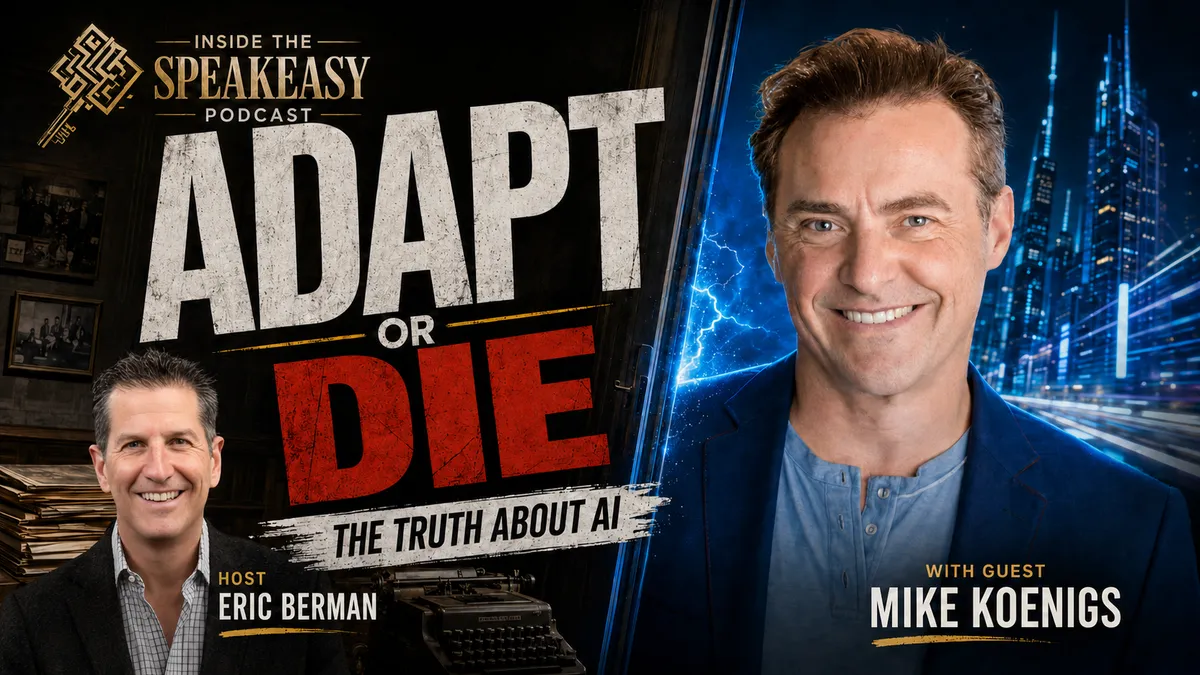
Mike Koenigs has spent decades spotting what comes next, from one of the first digital marketing agencies to Traffic Geyser to teaching generative AI to Peter Diamandis's Abundance360 patrons. In this conversation with host Eric Berman, a friend of nearly 20 years and fellow member of the original Speakeasy mastermind, Mike pulls back the curtain on the cost of that run: a $9.1 million launch built on heavy overhead, a stage three colorectal cancer diagnosis, two partner exits, and a dark stretch of depression after selling You Everywhere Now. He explains how one piece of advice from Dan Sullivan led to his book Your Next Act and the Superpower Accelerator, why he calls this the tractor moment for humanity, and the four quadrants he believes every founder should focus on to use AI as a time machine rather than a toy.
In this episode, you'll discover:
- Why Mike believes founders have roughly 18 to 36 months to embrace AI, and why that adoption has to be led from the top
- The hidden cost behind a $9.1 million launch: 50 employees, quarterly events, heavy refunds, and a business that had to launch to survive
- The simple Dan Sullivan advice, meet with 10 founders and listen, that pulled Mike out of depression and led to his next act
- Mike's four AI quadrants: your capability amplifier, a one-person marketing team, a category of one, and agents that scale without adding people
- How Mike used ChatGPT to write a "Searching for a unicorn" job ad that landed two integrators, and why a great COO is the best gift a founder can give themselves
Episode Summary
Mike Koenigs grew up in Eagle Lake, Minnesota, the son of a barber and the oldest of four kids. A neighbor loaned him an Apple II computer when he was 14, and he taught himself BASIC with the goal of writing video games. That path led him through building and selling IBM PCs, writing vehicle simulation software, and working for one of the first Mac game companies before he started Digital Cafe, which he describes as one of the very first digital marketing agencies. Digital Cafe became known for games, including Chex Quest, a CD-ROM game that shipped in 6 million boxes of breakfast cereal, and was sold to the Interpublic Group through Campbell Mithun Esty. From there Mike studied copywriting and product creation, met early online marketers at Armand Morin's Big Seminar, and built Traffic Geyser, one of the first platforms to automate content distribution.
Traffic Geyser took off after a mini documentary with Frank Kern in which Mike pushed a submit button and, he says, had a top 10 search result in less than 20 minutes. The company went from roughly $75,000 to $100,000 a month in recurring revenue to multimillion-dollar launches, including the Main Street Marketing Machines launch, which Mike describes as the largest launch in online history at the time at $9.1 million, with $3 million made in a single day during a 14-hour broadcast. Behind the scenes, he explains, the business was paying affiliates 50 percent of revenue, carrying about 50 employees, running events every quarter, and absorbing heavy refund cycles. The company was only as good as its last launch.
In 2012, Mike was diagnosed with stage three colorectal cancer, at the same time his marriage was strained and his first partner wanted to be paid out of an equal partnership, a separation he says cost millions of dollars in cash. When he told the original Speakeasy mastermind, including Eric, Darren Hardy, John Assaraf, and Bob Serling, the advice was to shut down the company, but Mike explains that pre-sold products and fulfillment obligations made that impossible. Ed Rush stepped in to keep the wheels on the bus, with help from Paul Colligan and others. While Mike was away for surgery, chemo, and radiation, he spotted Amazon's coming self-publishing shift, wrote his first book, and turned it into Publish and Profit, keeping the company's momentum alive.
The darker chapter came later. Right before he sold You Everywhere Now, the model broke, paid ads quit working, and Mike was burning a couple hundred thousand dollars a month. He describes being a depressed, anxious mess who could not sleep and was having panic attacks, and he credits Eric and the Brandetize team for bearing with him. Through Strategic Coach, he asked Dan Sullivan what to do next. The advice was to meet with 10 founders and listen. Those conversations revealed a shared fear of not being able to reinvent after an exit, and that insight became the book Your Next Act and the Superpower Accelerator, which Mike says is now about 80 percent of what he does. He also shares that he just hired two integrators, using a ChatGPT-written job ad, and calls a great COO the greatest gift a founder can give themselves.
The conversation then turns to AI. Mike recalls Brad Costanzo texting him in November 2022 to show him ChatGPT, which led within days to a Capability Amplifier podcast episode with Dan Sullivan, an invitation from Peter Diamandis to teach his Abundance360 patrons, and speaking gigs for Tony Robbins's audience, MIT, YPO, and EO. He admits that building seven products in five months was a big mistake and says he would not build AI products as a company right now because the next version of ChatGPT can make them obsolete. He says he rewrote 60 percent of a presentation in less than a week because the tools changed that fast, and that business owners have roughly 18 to 36 months before AI adoption becomes a race.
Mike lays out his predictions and four quadrants: founders must lead the culture of AI from the top, generalists who prototype and iterate at the speed of customer feedback will win, and brand matters more than ever. He explains how AI acts as a time machine, how compound prompts can turn tools like Genspark or Manus into a one-person marketing team, and how he used AI to lift the first 65 percent of campaigns built from Bob Serling's report and his Thousand Dollar Cup of Coffee offer. He closes with his biggest fear, that AI can multiply misinformation and a lack of resourcefulness among young people already struggling with mental health, and his advice for the next generation: be resourceful, have grit, study history and civics, and learn to play a real instrument.
Big Ideas Discussed
AI Is a Time Machine, If Founders Lead From the Top
Mike's first prediction is about mindset rather than tools. He argues that founders cannot simply tell their teams to use AI or lose their jobs; they need to understand what is possible themselves so they know what is a reasonable ask and what is not. He calls this the culture of AI, and he believes it has to start at the top. The first of his four quadrants frames AI as a capability amplifier and a time machine, because it can turn a pile of data and information into something meaningful in seconds or minutes, faster than a founder could explain the vision to a person.
Eric adds a practical layer from his own company: start by asking whether AI can help with a task, begin with personal research if business uses are not obvious yet, and have team members share their workflows so that people at different levels can help each other get more efficient. Mike's example is personal. He did not know how to write a great ad for an integrator, so he described what he wanted to ChatGPT, had a draft in about 10 minutes, and ended up hiring two people who each told him they were the unicorn he was looking for.
The World Belongs to Generalists
Mike believes traditional, focused, white-collar specialist thinking is exactly what AI does best, which shifts the advantage to generalists. The people who win, in his view, can prototype in real time and iterate at the speed of customer feedback, a cycle he sums up as innovate, iterate, monetize. He calls it a game of first to market, and he stresses that brand matters more than ever because AI can help collapse the time it takes to build trust and a following.
He pairs this with a warning about resourcefulness. Not long ago, the answer to most questions was to Google it or look it up on YouTube. Now, he says, resourcefulness and grit matter more than ever, and unresourceful people have no place in any position in any business, because anyone can learn how to do almost anything and refine their thinking with AI. Being agnostic about which tool you use is part of the same mindset: as Eric puts it, what matters is the output.
Your One-Person Marketing Team and a Category of One
Mike's second quadrant is the one-person marketing team. He describes compound prompts that ask an AI tool to study your websites and content, build a style guide for your voice and brand, research your ideal customer profile, review your top 10 competitors, and rewrite your website copy, all in one request that tools like Genspark or Manus can complete in 10 to 20 minutes. He is candid that AI still produces plenty of weak work and that humans need to find what is good, but he says it turns weeks of back-and-forth with a creative team into hours or days.
His third quadrant, a category of one, is about making your brand the best, the only, and the most expensive, finding higher-quality customers who pay more. He shares how AI helped build some of the most lucrative campaigns in his company's history, including a Thousand Dollar Cup of Coffee offer for people who want to pick his brain, a webinar, and a $37 guide built with Bob Serling's customer-driven framework. AI did not do all of it, he says, but it lifted the first 65 percent. His fourth quadrant uses agents to scale without adding people: more money, fewer people.
Selling Your Business Can Mean Selling Your Momentum
Mike names what he believes is the greatest fear founders share: am I going to lose relevance? Having had several exits, he says that when you sell a business you may get a check, but you also sell your team, part of your legacy and identity, and your momentum, and it is unbelievably hard to get your legs under you again. After selling You Everywhere Now, his life looked great on paper while he was privately depressed, anxious, and having panic attacks.
The turning point was Dan Sullivan's advice to meet with 10 founders and listen. Mike found that many shared the same fear of not being able to reinvent after an exit. He uses the Dan Sullivan Question, which asks what needs to happen over the next three years for someone to be happy with their progress, along with the D.O.S. of dangers, opportunities, and strengths, to help founders find their superpower. Mike calls it the most healing work he has done, both for his clients and for himself.
Questions We Answer in This Episode
What does Mike Koenigs mean by the "tractor moment" for AI?
Mike Koenigs borrows the phrase from Gary Vee to compare AI to the tractor. Not long ago, close to 90 percent of the world's population worked in food production, and now it is in the single digits. Mike believes AI will make many jobs obsolete but, as technology has historically done, create many more jobs and opportunities.
How long do founders have to adopt AI, according to Mike Koenigs?
Mike Koenigs says it is his opinion that business owners have roughly 18 to 36 months before AI adoption becomes a race to whoever incorporates it first. He says the tools are improving so fast that he rewrote 60 percent of one presentation in less than a week.
What are Mike Koenigs's four AI quadrants?
Mike Koenigs's four quadrants are AI as a capability amplifier that gives you time back, a one-person marketing team, a category of one that makes your brand the best, the only, and the most expensive, and agents that scale a business without adding more people. He also advises being agnostic about which AI tools you use.
Why does Mike Koenigs say the world belongs to generalists?
Mike Koenigs believes AI handles traditional, focused specialist work better than people can. Generalists who can prototype in real time and iterate at the speed of customer feedback gain the advantage, in a cycle he calls innovate, iterate, monetize.
What advice did Dan Sullivan give Mike Koenigs after he sold his business?
When Mike Koenigs was depressed and anxious after selling You Everywhere Now, Dan Sullivan advised him to meet with 10 founders and listen to them. Those conversations revealed a common fear of not being able to reinvent after an exit, which led Mike to write Your Next Act and build the Superpower Accelerator.
How did Mike Koenigs keep his company running through cancer?
When Mike Koenigs was diagnosed with stage three colorectal cancer in 2012, his mastermind peers advised him to shut the company down, but pre-sold products and fulfillment obligations made that impossible. Ed Rush stepped in to keep the business running, with help from Paul Colligan and others. During treatment, Mike wrote his first book and turned it into Publish and Profit.
Why does Mike Koenigs say a great integrator is so valuable?
Mike Koenigs calls a great COO or integrator the greatest gift a founder can give themselves. He says it is hard to hold yourself to a high standard and hire someone who will put you in your place and keep track of everything, and that while it is expensive and risky, it is worth every penny. He recently hired two integrators using a job ad drafted with ChatGPT.
Full Episode Transcript
Read the Full Episode Transcript
Cold Open: Founders Must Lead AI From the Top
Mike Koenigs: Founders need to embrace AI and lead from the top. You can't just dictate and say if you don't use AI, you're not going to have a job. You need to know what's possible and what's a reasonable ask and an unreasonable ask. That's. The first one is the culture of AI and the mindset. The second one is I think the world belongs to generalists, not specialists. Traditional focused, white collar PhD thinking AI can do it better, but being a generalist and being able to prototype in real time and then iterate at the speed of customer feedback. It's innovate, iterate, monetize.
Eric Berman: Welcome to the Speakeasy podcast, where the real conversations happen behind closed doors with the boldest entrepreneurs, creators and growth minds in the game. No fluff, no filters, just the raw strategies, personal stories and mental models that move the needle. I'm Eric Berman. Now let's get into it. In today's episode, big question of the day. Am I going to lose relevance? That's a question that was posed to my good friend Mike Koenigs, who's going to share what he went through. Ups and downs of somebody who we've seen such a positive of. But there's some stories behind the scenes that are quite scary. When Mike was in the middle of anxiety and panic attacks and how we sort of turn this all around, he's going to share some big words of wisdom he got from Dan Sullivan that basically saved his life, he thinks, as well as many of his other entrepreneurs and what he's up to today. And of course, from the amazing prognosticator, we're going to learn from Mike, what are the biggest trends he sees in the world? AI. So excited to bring on stage my good friend Mike Koenigs.
Twenty Years of Friendship and the Original Speakeasy
Eric Berman: All right, welcome to another installment of Inside the Speakeasy Podcast. And I am so pumped today to have really, when I say a good friend, this is generally a good friend that I've known for Mike how many years now? 15, 20 Years now?
Mike Koenigs: Yeah, we're going on 20 years.
Eric Berman: Yeah. You say good friends. When you have somebody actually that goes to your wedding in Mexico, then you know they're a good friend. So thanks for coming. By the way. That was a fun chest.
Mike Koenigs: Fix it out in the good times and the bad.
Eric Berman: That's right. And speaking of Mexico, we're out live in what? Todos Santos, Mexico is where you're at, right? Your second home.
Mike Koenigs: Yeah. We've been living here now. This is six months, our sixth month. And I'll be coming Back the end of this month, living in San Diego again. And then we just got word. I just got videos three days ago. Our place in Malaga is finished. So we'll be between three different countries.
Eric Berman: Damn. All right, so if anybody wants knowledge on Todos Santos living out there, what it's like to get residency or just get a house out in Mexico, not the main focus today. That's. We'll call that a bonus for today. But when we talk Speakeasy, the original Speakeasy, we're going to talk in some backgrounds and some history was really formed. And the original. One of the original OG OGs was Master Mike Koenigs right here. So welcome, Mike Koenigs, to the show. When we started our mastermind with you and John Assaraf and Darren Hardy and a couple others, that was the beginning.
Mike Koenigs: So it was good times. And think of all the cycles that we've gone through in a lot of ways. It's when the Internet was really monetizing and now we're sitting at the edge of what is, interestingly, I heard Gary Vee say the tractor moment. So it wasn't too long ago and close to 90% of the entire population of the planet was involved in food production in some sort. And now, you know, it's gone to single digit or below a single digit. And this is the tractor moment for humanity with all technology, and that is what AI is doing and think about. There's going to be a lot of jobs are going to be replaced and obsolete, but in the meantime, historically speaking, technology always creates a lot more jobs and opportunities, even though, you know, everyone thinks it's the end of the world. So we're living in interesting times.
Eric Berman: Well, I want to get into that a lot because for those that don't know, you've been nicknamed the ultimate Disruptosaurus with some ideas and. Or the great prognosticator. I had a hard time saying that word a few times. But just because you're so into, you know, you talk about early adopters and what I've always loved about you, other than the amazing things you've taught me in my world and been such a great mentor and teacher, is, you know, you're the guy I go to and it's like, hey, what's next? Or what's coming up? And we got to watch what you're doing. So I got to imagine you're just like, wake up so excited every day these days. Like, just like, excited, scared, nervous. What's going to go on? Like, getting ahead of everything. And I want to get into all that because I know you got so much to share on what you're thinking. But before we do that, let's just take a few minutes. Just going all the way back because so many people in our community, when they hear you're part of Speakeasy, they love that. They've heard of you, they've gone to your event, they've read your books. Let's go to the beginning. Like, I know you were from Minnesota, I think you were. Humble beginnings out in Minnesota and all the way to. How'd you get to where you are today?
From Eagle Lake, Minnesota to Chex Quest
Mike Koenigs: Yeah, I grew up in a little town called Eagle Lake, Minnesota. My dad's a barber. He's passed now. Oldest of four kids. I started working full time the day I turned 16. But when I was 14, a neighbor loaned me an Apple II computer. So we didn't have the money to buy a computer. But I did everything I could to go up to the University of Minnesota and spend time in a computer lab. And I taught myself BASIC with the goal of writing video games someday. So if you fast forward. I started consulting and building computers. IBM PCs, I sold them, then I started consulting and then I got a full time job writing code for a company that basically wrote vehicle simulation software for General Motors and Freightliner Kenworth, like trucking and cars. And then I wound up taking a job writing video games. I ended up working for one of the very first Mac game companies.
Eric Berman: Wow.
Mike Koenigs: And from there, got exposed to the agency world and started a company called Digital Cafe in 1989. And we were one of the very first digital marketing agencies. Mind you, that's before there was an Internet. So I was advertising and marketing on CompuServe, Prodigy, AppleLink. The Murdochs had a platform even they became clients. But we got known for creating video games. One of which was a CD Rom based game called Chex Quest that shipped in 6 million boxes of breakfast cereal sponsored by AOL. Wow. All right, so we sold that company in 99 to the Interpublic Group. They're a big publicly traded company and at the time the largest ad agency, one of the largest in the world. It was called Campbell Mithun Esty. They're about a billion a year in billings.
Eric Berman: Okay.
Mike Koenigs: And then that was my first real exit. And then I studied copywriting and product creation and went to one of the first events called by Armand Morin called Big Seminar. That's where I met folks like Alex Mandossian, Jeff Walker, some of the original OGs.
Eric Berman: Yep.
Mike Koenigs: Started creating products. Yep.
Traffic Geyser and the Frank Kern Video
Mike Koenigs: And. And fast forward a Couple years I started Traffic Geyser Instant Customer, had a couple partners, sold that to an investment.
Eric Berman: Bank and we did Traffic Geyser Instant Customer. That probably is what the first, probably in our world that we kind of playing. That was one of your first big babies, right, that you got known for?
Mike Koenigs: Yeah, it was one of the very first platforms that did content distribution and automated it. So at the time it was push button SEO. And what we got known for really got made by Frank Kern. He and I became friends when we moved to San Diego and I was working with him on some stuff. He wasn't doing video at the time, so I was doing a ton of video and I helped him with a couple of his launches. And then he said, show me Traffic Geyser. We made a mini documentary and while we were on camera I showed him how to. We made a video without him having to be on camera. Pushed a submit button with Traffic Geyser, it got distributed to a ton of websites and we had top 10 SEO in less than 20 minutes. And that became a viral video that really launched Traffic Geyser to the online marketing world. And from there it turned into multimillion dollar launches and lots of things just blew up.
Eric Berman: Yeah, no, I remember that really. I feel like because I've known you for so long, you almost became, you know, for better or for worse, we'll talk about some, maybe some learns along the way. I mean you became really addicted to creating another SaaS, another product and going through that cycle. So I mean share a little bit, you know, goods and bads. A few of us, you know, a lot of us, that community building products and sasses and. Yeah, what can you share?
Hypergrowth, Burnout, and a Cancer Diagnosis
Mike Koenigs: Yeah, well, I'll tell you the ugly stuff. So right around the time, let's say at the 2008, 2009 period of time even really 2006, 2007, that's when the Frank Kern moment happened. We really blew up and we went from making probably 75 to 100 grand a month in recurring revenue to we had a $9 million launch. It was really Andy Jenkins who powered that thing. I met with Andy, I had spoken at the time event called StomperNet a bunch of times. We were always one of the highest selling partners. So I'd go there and speak from the platform and 50, 60, 70% of the room would convert into buyers on a $2,000 product. Those were the days when millions of dollars were just moving all over the place. And they used to call the gang of big online marketers the syndicate. We all kind of promoting each other. And you remember those days.
Eric Berman: Yeah.
Mike Koenigs: So here's the ugly side of that is I was putting, or we were putting most of our money back into the company because we had to grow so fast. And what happened is this oscillation would happen where we'd create a product, do a product launch. And this is happening three times, sometimes four times a year. And back then you'd give 50% of your revenues to your affiliate partners, right? Well, if you're financing the launch and doing product bonuses. And then we had a phone sales team. We had a lot of overhead, a lot of developers. At one point, we had about 50 employees we had to launch to survive.
Eric Berman: Right.
Mike Koenigs: You were only as good as the last launch. And back then you had a lot of people who were in chasing shiny objects and they'd buy a product and then there'd be a heavy refund cycle and then you'd do an event to make more money. And so I'm doing an event every quarter and you know, anywhere from three to 800 people in a room, which is expensive, it's a lot of risk, it's a lot of liability, but more importantly, it's a ton of burn on your body. And, you know, only so many people can put up with that for years and years at a time. And so in 2008, when we had the Main Street Marketing Machines launch, it was the largest launch in online history at $9.1 million. We made $3 million in a day broadcasting a show. Yeah, it was a 14 hour, like telethon.
Eric Berman: Right.
Mike Koenigs: And again, we were the first to do it at scale and we had huge overhead. And then in 2012, I was diagnosed with stage three colorectal cancer. And it was sort of all of the lifestyle, all that stress coming to roost.
Eric Berman: And you think a lot of that stress, what you felt led to a big part of that.
Mike Koenigs: And then Vivian and I were going through a cycle, not getting along. And it was because I just wasn't present, I wasn't around. I was constantly stressed. I was an a hole. You know, that happened about the same time. So, you know, put gasoline on the fire. And then around then, our first partner, there were a variety of things going on and he wanted to get paid. So the cost of dividing an equal partnership, which again was a big mistake. You know, everyone has a story when it comes to partnerships and disillusion, but it cost us millions of dollars in cash, which of course meant we didn't have cash to build and grow that business. And then if you fast forward a couple years later, my second partner wanted to exit and leave as well. And by then I was weary, tired. We had to go through, like any kind of software product, you reach us a stress level and the platform starts to break. Technology wasn't working the way it used to because all the search engines started changing their algorithms so fast we couldn't keep up with just. It pretty much broke me physically and mentally. And of course I have to put on the smiley face. At least that's the belief I had that everything's okay and it wasn't okay.
Eric Berman: Well, Mike, just to cut you up there, I mean, there's so much woven in that story and thanks for sharing because I don't think people see this side. You know, everybody see, like you said, people see the happy face and things are great. But so many times I've seen in talking to entrepreneurs and people running businesses that it's the big pissing match of, hey, we did a 9 million, we did this. And people just think they're going to make it and they're going to crush it. But you just nailed so many things. I mean, there's a, the mental stress, the family, the, you know, when you're selling that product that you think. And I'm just recapping what you said. I mean there's. The cogs are putting together and then if the stick rate isn't necessarily there and people like aren't, especially when customers think they're going to use it and they don't use it, then they want to refund it. Like you said, you got to constantly go back to the well, make more millions. You're just chasing that down. And so the glory, it's almost like just be really careful if you're going to go down that world of building SaaS on Truly, I mean, the biggest lessons I've seen some again is really watching your overhead. And too many times I see people like, oh, I'm going to make it. It was so easy, let's just go spend the money. And they don't realize how much of a nut they have and all the problems are going to come down the pipeline.
Keeping the Business Alive and Spotting the Self-Publishing Shift
Mike Koenigs: Well, I remember because it was one of the original Speakeasy masterminds and it was Darren Hardy, John Assaraf, Bob Serling, you. Yep, Stephen, and probably a couple other guys. And we're all sitting around and you were, other than telling my parents, you were the second group. I, I said I've got cancer and I'm about to get, I'm gonna have surgery and the advice from everyone is, shut down your company. And I was at the time, I'm like, you have no idea what an unbelievable crap show that would be. Because. Because when you've got a machine like that, the liability, the risk, you know, we pre sold products, we've got fulfillment obligations, financial obligations, jobs, you know, if I shut it off, it cost millions of dollars to keep it going. Costs millions of dollars. I'm between a rock and a hard place. And fortunately, Ed Rush, who is also in the mastermind, said, I'll come in. Thank God for Ed Rush because like, he kept the wheels on the bus. And Paul Colligan's another one, a couple other people on the team. And during that time, there was something else that was happening from a market perspective. Amazon had come out and they were about to release what became KDP. So their self publishing model, which disrupted publishing. So while I had cancer and I'm away for surgery, chemo, radiation, that's when I wrote my first book. And that turned into what became Publish and Profit, another product. So in a way, it was God raising his mighty hand, saying things can't be the same way. And I was lucky enough to spot a market shift and not lose all the momentum that we had gained and. Right. But it's complicated.
Eric Berman: So you're there, you come up. So you saw again, once again, one of your biggest skills is your ability to identify market opportunities, especially in the tech and software. And you found an opportunity. I mean, I mean, this is how crazy you are. We love you, but we're just like, Mike, what are you doing? You're there trying to take care of yourself, and yet you're coming up with another product and thank God you're well, obviously we should say that we all were just there. I mean, we were all praying for you all the time. That was such a heavy. I mean, it's hard. I mean, you're one of the close friends I had. You hear the stories. But shit, I mean, friend this close, that actually have it. I'm so glad we made through that. And I know you went through a big battle. And again, another topic, if anybody has questions on that or has a loved one that's going through cancer, please reach out to Mike. He's written a book on it, he's talked about it a lot.
Mike Koenigs: Yeah, grab cancer. Read it before you have it or someone you love does. And I didn't have any resources as a business owner, entrepreneur. I had no one to talk to who had gone through it, who could give me good advice on how to run a business, not let your marriage fall apart, your relationship with your kids and the mental prep and the marathon because you lose a year and a half of your life.
Eric Berman: Crazy. Wow. Thank you for sharing that. And that just goes to show what kind of great guy Mike is. I mean, even there, he's there trying to take care of himself. He's out there saying, well, how am I going to serve others now that are going through the same thing I am? Because this is crap. This is that I'm going through here, and it's not what can I do about it? So thank you for that. That's what. Productized cancer. Yeah. Yeah. So we get through that, and I want to get fairly. So I want to get into the world of we're in today. I mean, we get through cancer. Obviously, you get in product launch form. It was amazing. You crushed it on that. So you come out of cancer, you get this new product out there. And you had some big success with that for a while. And I know you ran with that for a while and sold that too, right?
Selling a Business and the Fear of Losing Relevance
Mike Koenigs: Yep, that's right. You Everywhere Now was that business. And we had a private buyer. And then somewhere in between, we did another business called Make Market Launch It with Pam Hendrickson and Chris, who she had worked with Tony for years, and there was a period of time when she actually left the Robbins organization. Just needed a break because, you know, working for a giant personality. And during that time, I created a couple products with Tony and, you know, Business Mastery launched. We created a product called The New Money Masters. And that's really payback for, you know, we introduced Russell Brunson, Brendon Burchard, Jeff Walker, Yanik Silver, Dean Jackson. Some of the legends participated in that product. Well, and. But the point I was getting at is, you know, anytime you're around a nuke, a celebrity energy, all the benefits that it has, which are profound, there's also physical and a mental cost of just being in that energy sphere for an extended period of time and recognizing when you need a break and knowing that our greatest fear, I think, as founders is am I going to lose relevance? It is hard to spin up that wheel when you lose momentum. And having done it a few times, having had a couple exits and realizing one day when you sell your business, you might get a check, but you basically sold your team a bit of your legacy, your identity, but also your momentum. And it is unbelievably hard to get your legs under you again after doing that.
Eric Berman: That's interesting. God, we can Go down that whole rabbit hole for a while. Just the mental side of selling it and what's next and all that. And as you say, you know, Your Next Act is one of your other things you're working on. I mean, that really. I mean, you did that next. I mean, you talked about what your next act. We get into that and then I really want. And then digging into this wave of AI that just came, and immediately I'm like, oh, my God, Mike's going nuts when this is happening. I know. He's so excited. So talk about your next act, because you had your next act and you're doing that.
Dan Sullivan's Advice and the Birth of Your Next Act
Mike Koenigs: Yeah. So here's what happened with Your Next Act. When I sold You Everywhere Now. What I don't share with a lot of people was I on paper, life should have looked great. Inside, I was a depressed, anxious mess. I couldn't sleep. I was having anxiety and panic attacks. And some of it was at the time, it was right before I sold You Everywhere Now. The model broke and all of our paid ads quit working. I was burning a couple hundred grand a month and suddenly I had a big hole and everything broke all at once and I couldn't, in my heart of hearts, I didn't want to do another damned event. And you remember that time. I mean, we're working together during that time and it was rough for both of us. You know, I got to give you a ton of credit and the Brandetize team for just bearing with me during the just miserably difficult times. It was like so up and down. And I just realized I wanted something to kill me. That's how depressed and sad I got. It was definitely, I'm not a suicidal guy, but I was in a dark place. And so I was in Strategic Coach and I asked Dan, what do you think I should do next? And he gave me some advice. And his advice was meet with 10 founders and talk to them. And if you listen to them, you'll know exactly what you should do next. And interestingly, what I found after talking to a bunch of founders was the fear of being able to reinvent themselves after they have an exit or feeling completely suck and unable to have this kind of conversation with them, which is, I am afraid I'm not going to be able to reinvent and re innovate my way out of this. Struggling with either aging teams or those who can't keep up with them, and either marketing or advertising agencies that aren't getting it. And they're like, we got to do something different. So I wrote the book Your Next Act, which is this is it. And the subtitle is the six growth accelerators for creating a business you'll love for the rest of your life. But it really spoke to founders who sold and want to do their next thing or they're stuck and want to move on, or they realize that having a strong personal brand will multiply everything they touch the rest of their lives.
Eric Berman: By the way, that advice was incredible advice there. And that really just turned you from being depressed into finding your next act, which ultimately is funny. And that's the name of what you're selling there.
Mike Koenigs: Yeah. And it was really running people through what's known as the Dan Sullivan question, which is a future paced question. You know, Eric, if you and I were meeting here three years from today, what needs to happen personally and professionally for you to be happy with your progress and magic comes out of people's mouths? It's really a deep question. And then what he calls the D.O.S., which is dangers, opportunities and strengths or superpowers. So what dangers prevent you from getting there? What opportunities would you like to take advantage of? And then the third is, you know, if you know what your, what he calls your unique ability, I call your superpower or your zone of genius, what is it and how do you spend most of your time there? But from there, I wrote the book and started reinventing founder entrepreneurs. And that's really what is now the Superpower Accelerator and about 80% of what I do.
Eric Berman: Right, right. And I've heard, I mean, everybody I've talked to who's been through your program and just absolutely raves about it. I just like almost watch them in tears when I talk to your customers today about what you've done, which is, I mean, it's funny because as you share your story again, there's so much of your story that's interwoven into this. Again, just you having that mental what the hell am I going to do? And it's interesting as you bring it up, that that word, I wrote it down, you know, just, you know, am I going to lose relevance? There's other CEOs that are going through that, saying, what the hell am I going to do next? I've been doing the same thing for over and over. People see me in this light being the man or the woman doing this thing, you know, am I going to be bored? I can't sit around and do nothing, where's my money coming from, all that stuff. So that's amazing. And to watch and to talk to some of your Customers that have gone through that and see how excited. Ultimately almost every one of them is more excited about this than what they've been on anyway because it's just been so. They're so over what they're at and they're just like so excited about this thing that's inside of them they couldn't do forever. Now they finally have clarity and a coach and somebody to walk them through that path.
Mike Koenigs: It's probably the most healing work I've done and it's healing for the people going through it and it certainly is for me every time. And we're great at it now. You know, after seven years, we're really good.
Why Every Founder Needs a Great Integrator
Mike Koenigs: And I'm excited to say not only did we add a new integrator who just started two weeks ago, who is a rock star in your guidance when mine left, you know, you and I chatted, I call you were the first person I said, I have a high quality problem here and gave me some advice and I put my want ad in front of you and then I got a good referral and then we just hired our next person. So I have a number two that started today. So we have two integrators now. And good God, having a great COO integrator is the greatest gift a founder can ever give themselves. And it is so hard to hold yourself to a high standard, to hire someone who will put you in your place and keep track of stuff. And it's expensive and it's a big risk and worth every penny.
Eric Berman: Yeah, well, you just said the magic words. There is. I think we're all surrounded, especially a lot of us with the kind of personalities that often we have as entrepreneurs is the yes and yes men and women around us. And I learned that lesson early on. I got to give credit to my first big company. I did. And I remember the founder CEO said he goes, the best people want around me are the people that tell me I'm full of shit. He actually used to, I remember he used to motivate his reward. He literally would take out a hundred dollar bills and it says the first person to call my shit a hundred bucks and to say something that's not popular. And he would mentally train us to all like get rewarded. And it was really cool because I kind of learned that early on. I'm like, yes, that's what I want. That's great, you're right. And so they're going to hold you to it and I love it.
The ChatGPT Text That Changed Mike's Business
Eric Berman: So, okay, so that's a lot of what you're up to today. Plus, of course, you know, wave of AI stuff. What are you seeing today? What are you. You're also teaching it, too. In addition to Superpower Accelerator, what else are you teaching the AI world and why and what are you excited about?
Mike Koenigs: Well, so again, I'll give you a little story because I got to give Brad Costanzo credit for this. It was November 20, 2022. I get a text and I had been watching. I knew OpenAI had made their launch and I was busy all day. And he texted me and he goes, dude, have you tried on ChatGPT yet? And I'm like, no. And he goes, get on Zoom with me right now. Let me show you something. And he just showed me something in the interface because my first impression was the same. The first time I saw text messaging on a mobile phone, when you had to use T9, you know, as your one button three times to get A or B or C or whatever. And I was like, text chat is stupid. And, you know, the iPhone or it was really. The BlackBerry is what made texting incredible and incredibly efficient. And if you had a mobile phone, you could run a company from your mobile phone from anywhere in the world, because the BlackBerry network was so damn good.
Eric Berman: Yep.
Mike Koenigs: You didn't have to have voice, but if you had T9, if you have that little alphanumeric keyboard, everything changed. And so I looked at that chat window and I got the download from God and I dug into it and literally two days or three days later, I had already built a whole presentation and I was doing a podcast episode of Capability Amplifier with Dan Sullivan. I showed Dan what I was doing, and two days later, Peter Diamandis called me up and said, Dan told me you're doing stuff with ChatGPT. Do you think you could teach my Abundance360 patrons, generative AI? And I'm like, I sure can, you know. And he said, well, when can we meet? And it turned out I was going to be up in LA the next day meeting Dave Asprey for some meeting. I said, I'm actually coming up tomorrow to meet Dave. And he goes, well, why don't we meet in the afternoon? So I go up to LA, I meet with Peter, and I had put together a presentation deck with about 10 use cases. And he said, you got enough, you could teach him tomorrow. And I'm like, yeah, I think I could. And he goes, well, you got two months, put something together. Really great. So that started something. And then right after I finished teaching at Abundance360, I got a buzz from Tony's office and I had a chance to go to Tony's to teach AI to his Platinum Partners. And so that snowballed into MIT and YPO and EO and just like stacks of speaking gigs. And then we created products. We had seven products made in five months. Big mistake. Big mistake. Such a moron, man. I can't help it. Oh, and you know, started a software development thing, the training. But now it's basically speaking the AI accelerator course and advice consulting. We've rolled it into all of our products. But development, I wouldn't touch AI development as a company right now. At least making products because I think you're young will be eaten so fast. You know, you build this cool product and the next version of ChatGPT is going to make that product obsolete. You know that's right.
Eric Berman: So scary.
Mike Koenigs: Yeah, it's crazy. But I genuinely the most exciting time to be alive. And I think what's happening right now with the latest generation of agents, you know, two weeks ago I spoke in Mexico in front of a bunch of family offices and investors. And that training, like this weekend I spoke at your best life with Dean Ennis and that team. And I rewrote 60% of my presentation less than one week apart because that's how much changed in a week. That's how good the tools got. And I hadn't had a chance to experiment with some of them. So the curve right now, the hockey stick is happening at such an insane pace that you know, the struggle I think we all have, every business owner is it's my opinion that 18 to 36 months is the time you have before. Now it's a race to whoever uses it and incorporates AI first in their organization.
AI Predictions and the Four Quadrants
Eric Berman: Because it's so hard to make predictions right now because as you said, everything's obsolete in three, four months and maybe 18 months. Maybe we have to do more generalizations. I mean, let's go way into the future. I mean, what are some of your predictions here?
Mike Koenigs: Yeah, so here's the first prediction is more of a mindset, which is founders need to embrace AI and lead from the top. You can't just dictate and say if you don't use AI, you're not going to have a job. You need to know what's possible and what's a reasonable ask and an unreasonable ask. That's. The first one is the culture of AI and the mindset. The second one is I think the world belongs to generalists, not specialists. Traditional focused white collar PhD thinking AI can do it better. But Being a generalist and being able to first of all prototype in real time and then iterate at the speed of customer feedback is so it's innovate, iterate, monetize. And this is a game of first to market. Realizing that, thank God we've got IP protection, but man, you've got to have, you've got to use AI to collapse the speed of trust and build a following of trust. The brand matters now more than ever before.
Eric Berman: Interesting.
Mike Koenigs: And digital orchestration. That sounds like such a generalist statement. I got to come up with a catchier way of framing it. But I know now, like, we've got our AI accelerator event that we're doing as of right now in a couple weeks and our promise, you know, I've thought a lot about, like, what matters most? What should you be focusing on? So there's four things. We call them the four quadrants. The first one is AI is your superpower accelerator and your capability amplifier. And that just means how quickly can you use AI to get your time back? Because AI used properly is a time machine.
Eric Berman: That's right.
Mike Koenigs: And we can, you know, you think about it through the lens of I can grab a whole bunch of data and information and produce something meaningful in a matter of seconds or minutes, faster than I could communicate a vision or delegate it to a human.
Eric Berman: That's right. That's right.
Mike Koenigs: So that is a time machine.
Eric Berman: I'm just telling people like that. I see. And you know, two notes off that is, you know, I'm nowhere near the world of you are as a tech early, but to me, I'm just sort of, you know, I, I see things and I just start acting on it like that and just, I'm just like, just start, just start thinking, start making a habit of like, can I use AI for this? Can I like just ask that question.
Mike Koenigs: And get a habit?
Eric Berman: I always say, if nothing else, start with personal, just start with your own research, things you're doing. Like, if you can't think of business like, like whatever it is, you'll start to get in the habit of it. Yeah. And what I did with my company recently, because we sort of said, all right, let's use today to share what you're using. I said, more importantly, if you feel like you're not even running efficient, bring up what you're doing as a workflow and I bet somebody else on the team can help you because there's always going to be people at different levels in your company and all of a sudden you're have this little level of people that might have been, you know, maybe not at the higher level of pay are going to help the others out. And it's going to be really interesting where those that step in a learn are going to be really valuable. But keep going on number two.
Mike Koenigs: Yeah, so just one little thumbnail. You know, it wasn't too long ago you'd say, well, just Google it or look it up and learn how to do it in YouTube. Now resourcefulness and grit are more important than ever before. Unresourceful people have no place in any position in any business any longer because you can learn how to do anything and refine your thinking with the help of AI. You know what was standing in the way of getting my great integrator. I didn't know how to write a great ad for a great integrator. So I had ChatGPT do it. I had a draft in about 10 minutes and I just described everything that I wish I had and what I wanted and needed. And it made a really good ad. And the headline that it gave it was Searching for a unicorn. Now both people who are now have jobs both said, I'm the unicorn you're looking for. So that's AI number one. Number two is your one person marketing team. Now I don't necessarily mean that literally, but here's what it does mean is you can ask ChatGPT, you can basically, you know, a command will be as simple as I want you to study my websites and all my content, do deep research and create a style guide that I can give to ChatGPT to write in my voice.
Eric Berman: Boom, right?
Mike Koenigs: Do the same thing with your brand. Then you can go out and have it search for your ICP or ideal customer profile and then you can go and say now write copy. Now give me, you know, look at my top 10 competitors and tell me what they're doing with their copy and content on their websites and then review my website and tell me how I can improve it and write updated copy in my voice for my ideal customer profile. It's compound prompt. Genspark or Manus can do that for you with one compound prompt and be done in 10 to 20 minutes.
Eric Berman: Right?
Mike Koenigs: So, and I think where AI has its place right now, it still can't polish a turd and it still produces a lot of turds. Humans need to find what's good, but at least your one person marketing team can come up with four or five really good ideas that you can synthesize and instead of going back and forth with the creative team over a Period of three weeks. You can go back and forth once in three hours or three days.
Eric Berman: That's right.
Mike Koenigs: That is where that's the state of things at this moment. The third quadrant is in increasing. I call it your category of one. But it's making your brand the best, the only and the most expensive. So it's finding higher quality customers who pay you more and elevating the status and authority of your product or service. It's packaging, positioning, messaging. So as an example, we used it recently to create several marketing campaigns that have been the best and most lucrative campaigns in our history. One was a special report that Bob Serling gave me. So it's based on some of his content and it's the customer focused.
Eric Berman: Is this the one he shared at your house that one time? That. Wow, that's great.
Mike Koenigs: Yeah. So Bob shared this report.
Eric Berman: Use the AI Knowledge hub to search Bob Serling in the AI knowledge base to figure out what we're talking about here.
Mike Koenigs: Customer driven framework. That's what it is. He gave me the report and I looked at that and I'm like, man, I'd love to write this report, but it's three weeks of labor, it would suck. So what I did, and I did this with Bob's acknowledgement, you know, I get full credit as I always do. And I took a webinar that we had done that converted really well and it was using another campaign we had created called the Thousand Dollar Cup of Coffee. So you know when you get someone who says, hey Eric, can I pick your brain? It'll be like, well, you spend a lot of time picking your brain and if you don't pay, you don't pay attention. And you want people to value the time and also come with an outcome, a goal and a result. So now if they've got a thousand bucks invested to spend 30 minutes with you, they sure as hell want to get value out of that conversation. You're going to just talk and they're not going to take notes and they're not going to execute. So. And I got that idea from a interview that Joe Polish did with Ron Lynch. So I took that interview and I basically said, my name is Mike Koenigs. Here's what I'm selling. Make a thousand dollars cup of coffee for me. And that becomes the first iteration in about 20 minutes. My copywriter polished it, we launched it, produced a whole bunch of clients right away. And that led into six figure conversions with one call. So then I made a webinar out of that and I applied the customer driven framework to it to build a $37 guide self liquidating offer. Boom, turn that around again. AI didn't do all of it, but it lifted the first 65%. So the point of this is how do you elevate your status, your authority? Well, you use it. Use AI to do that and you want to be focused on your top 2% of your best customers and get more like them.
Eric Berman: Right.
Mike Koenigs: Or something. That's three to ten times more money. All right. And then the last state is using agents to scale without adding more people. So more money, less people. And at this moment that we're speaking Manus, Genspark, Blackbox AI are three of the best agentic technologies. And you know, right behind that are all the other big 800 pound gorillas trying to figure this out as well. But I think being agnostic to the tools is the other secret.
Eric Berman: Yep. To be able to, whatever tool it is, whatever you see out there, whatever you hear, you just got it. Yeah, exactly. As long as it does the output, it's insane. I mean, the level of productivity. I'm just thinking for you, especially with all these ideas in your head, this has just got to be just candy store for you right now. The things you could do and create at the speed and quality, you know, what are you afraid of?
The Existential Risk of AI for the Next Generation
Eric Berman: I guess, what's your fear right now?
Mike Koenigs: Yeah, well, there's some existential threats I see right now. So if you look at what happened with phones and kids and then you mix the lockdown with that. Vivian right now is working on a platform called the Bad Mom Podcast and Project Grit with her foundation, that's her latest thing. And she's really just exploring mental health with young people. So in the past she's been here doing her humanitarian work with Just Like My Child Foundation on the ground in Uganda and India, to some degree in the U.S. but she's like, there's a global epidemic right now with not just young people, but anyone who's been made anxious as a result of putting heroin in the hands of her children in the form of an iPhone. Compare myself to someone else getting in a echo chambers multiplication of things that aren't true. It's dangerous. So I think AI has the potential to multiply stupid at an epidemic level and multiply a lack of resourcefulness. And also in this moment right now that we live in, when it's like, I don't know if there's going to be a job for me. I don't know, like, where do I have a place here? Where do I have value. And it's hard to see that if you're a young person, especially if you're wounded with mental health issues already. Now, to those who are resourceful, who have grit, this is the greatest moment ever. When you not only have a time machine, but you've got a tool that can teach you anything, make you faster at everything, know everything and make something without time capability, money or geolocation, you know, it doesn't matter what color you are, what language you speak, you can speak everything, right? But to live in a world of abundance, I think is hard for humans when you're in a state of shock by something so infinite. And so I think that's the existential concern I have, isn't for me, but for the next generation to see this as the tractor moment when a lot of people are worried that they're not going to have jobs because they can't work in fields doing inhumane work in inhumane conditions, you know, wearing out their joints and their eyes and dust and chemicals and whatever else. And it's like this is really abundant. Where do I fit? That's my long winded short answer. But I spend a lot of time thinking about it and talking to a lot of parents and adults about this topic.
Eric Berman: So no, you're dead on. I think about this with my two little ones too. It's. It is the biggest fear I think about too is just how you know and is there going to turn into laziness for certain people? Just be depend on the machine to go talk to it and get it. I mean, are they going to be able to have is the society just, you know, getting out of the house and talking to people versus your robot? I mean all these things are just. Who the hell knows where it's going to go. But thank you for sharing all that and a lot more.
Free Books and the Superpower Accelerator
Eric Berman: I know we're a little bit over time. One thing I wanted to talk to you and I took a lot of your time, I should say going all day with you, but I'm on a respectful. I want to have how we could serve you. You got a lot going on right now. The community loves you, they hear about you. What's the biggest thing, like if somebody wanted to, you know, work with you? I know you have a couple options. One, you know, real high ticket for the one we talked about, another one more on the AI side. What's the kind of the easiest way.
Mike Koenigs: Or I'll start with some giveaways first because the easiest way to digest this and get in the mindset is with some of my content. So I'll share my screen, but I'll also give you a couple of goodies. Okay. One of them is my book, AI Accelerator. For anyone who doesn't have it, it's just aiaccelerator.com, free. So that's the book, the downloadable book. And my son Zach actually took the book and made an AI mic version of the book which you can get at mikekoenigs.com/aipodcast so we took the book, turned it into an audio book and it's a podcast, so you don't even have to go on audible to get it. And then Your Next Act, which you can get at really it's just mikekoenigs.com free. But if you're watching this, you can scan the QR code. That's just the book book. And then the audiobook of Your Next Act is at mikekoenigs.com/ynapc which is Your Next Act podcast is what that stands for. Beyond that, if someone wants to learn more and work together, what I do is head over to superpoweraccelerator.com there's a little 11 minute video that talks about working together. It describes what we produce. It's basically, I always say it's three hours, three days, three months. But we spend three days in person together creating your next act based around your superpower and building the pitch, the offer, all the content, the videos. We've had people walk away and close a million dollars worth of business that weekend and they get to go either.
Eric Berman: To San Diego or. Are you doing those in Mexico now?
Mike Koenigs: In Mexico now, yeah. San Diego, Mexico and soon, Malaga, Spain. We'll meet there. Spend three days in person manufacturing whatever your better future self needs to be or can be or should be.
Eric Berman: I love it. I love it.
Final Words: Resourceful Kids and Real Instruments
Eric Berman: Well, anything. Any last words of wisdom for the audience today? I mean, we've covered a lot, so appreciate all that.
Mike Koenigs: Yeah, resourceful children with grit, man. Cut them off fast and like learn history. I think history and journalism I look forward to. If college is going to continue, it should be dedicated to civics, civility and the liberal arts and learn how to play a damned real instrument. And a dj. A DJ deck is not an instrument. Pianos have been like, no one wants a piano anymore. They're being disposed of, dismantled, just abandoned. As soon as there are very few of them, it's going to make a comeback. And I guarantee you the next kids, like your kids generation, are going to be enthralled and real drums and have a real audience. With no phones, no technology, no AI. And I love AI music. You know, I like. I don't mind EDM, but it's not real music.
Eric Berman: And our good friend, when you and I had a dinner about a month ago over our good friend Roland Frazier's house, all those keyboards he has that like, oh my gosh. I mean, the values of that's going to go up and down.
Mike Koenigs: Synthesizer collection I know of is Roland Frazier a man with a beautiful addiction.
Eric Berman: It was cool. It was cool. And on that note, Mike, thank you so much for your time and always a pleasure and. And love you, brother. Thank you so much.
Mike Koenigs: Love you too. Thanks.
Eric Berman: And that's a wrap from the Speakeasy podcast. If something sparked for you, don't keep it to yourself. Share it, review it, and pass it to the one person who needs to hear this right now. Want in on the real mastermind? Tap the link in the show notes to apply until next time. Keep scaling, stay sharp, and don't be the smartest one in the room.
About The Guest
Mike Koenigs
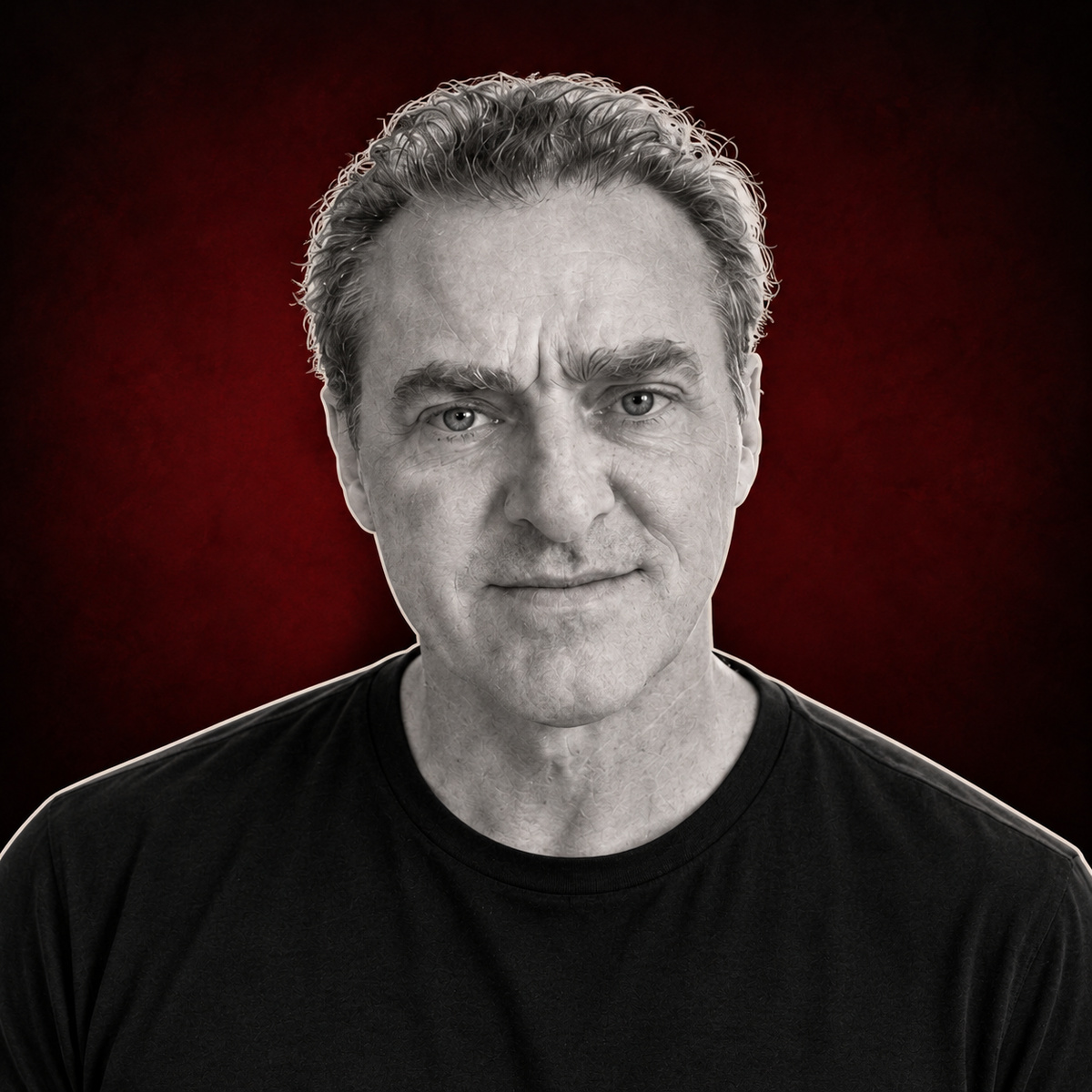
Mike Koenigs is an entrepreneur, author, and speaker known for spotting technology and market shifts early. Raised in Eagle Lake, Minnesota, he taught himself to code as a teenager and co-founded Digital Cafe, an early digital marketing agency behind the Chex Quest cereal-box game, which was later acquired. He went on to build Traffic Geyser, one of the first platforms to automate online content distribution, along with products including Publish and Profit and You Everywhere Now. A stage three colorectal cancer survivor, Mike is the author of Your Next Act and The AI Accelerator, co-hosts the Capability Amplifier podcast with Dan Sullivan, and runs the Superpower Accelerator, a three-day in-person intensive that helps founders reinvent their business, offer, and personal brand. He has taught generative AI to audiences including Abundance360, and he was a member of the original Speakeasy mastermind with Eric Berman.