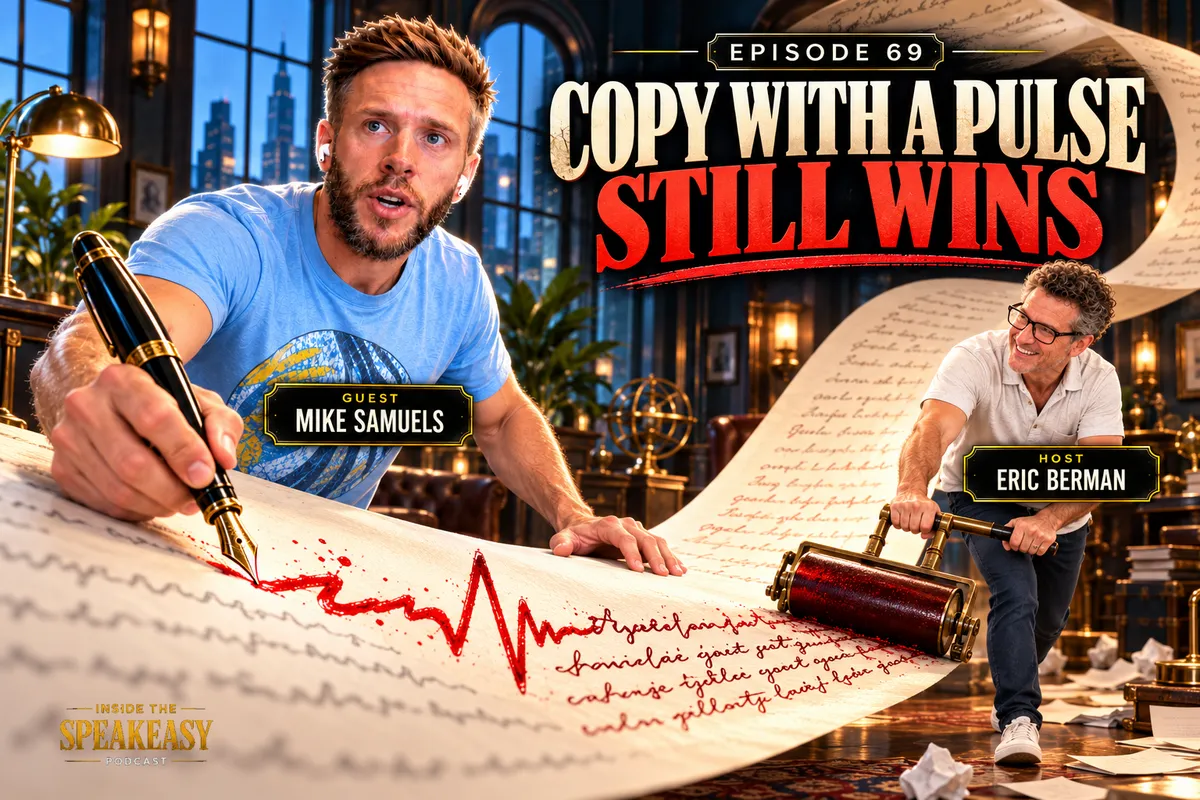
Mike Samuels, a direct response copywriter since 2013 and the creator of Action-Based Psychology, argues that the businesses swapping their copywriters for AI are trading a short-term saving for a long-term credibility problem. Mike is not anti-AI. He uses Claude to compress roughly 25 hours of client research into about two, and he will happily let AI churn out 500 ad hooks so he can keep the best hundred. But for the words that actually sell, especially high-ticket offers, masterminds, and personal brands, he still writes in a flow state. In this conversation with Eric Berman, Mike explains why people seem to place less value on work they believe is AI generated, why the best-performing emails often have the worst open rates, and how a fly painted in the urinals at Amsterdam's Schiphol Airport pushed him toward behavioral psychology. For founders deciding what to automate and what to keep human, it is a practical map of where the line sits.
In this episode, you'll discover:
- Why Mike Samuels uses AI for research, brand voice documents, and data analysis but still writes high-stakes sales copy himself to avoid sounding like a machine
- What a study on AI-labeled art suggests about buyers, and why Mike believes high-touch offers like masterminds, retreats, and coaching need visibly human marketing
- How to judge emails and ads by revenue instead of open rates or cost per click, especially when a 25K client may buy years after the first click
- The swipe file, disconnect hooks, and emotional power words Mike uses to lift a bland subject line from a 5 out of 10 to a 9
- How a fly painted in Schiphol Airport urinals and a French versus German wine music test reshaped Mike's copy around subconscious behavioral triggers
Episode Summary
AI has made it tempting for business owners to replace copywriters and content creators with a chatbot and pocket the savings. Host Eric Berman opens the episode by warning that a backlash is building, and Mike Samuels, a direct response copywriter in Speakeasy's London chapter, spends the conversation explaining where AI genuinely helps a marketing team and where human writing still earns its cost.
Mike's path into copy began with a setback. In 2013 he was running a mobile personal training business, driving 200 pounds of kettlebells around in his car and training clients from 5 a.m. to 11 p.m., while building a side income writing fitness articles. When the content company he wrote for accused him of fabricating references, a charge he says was false and later learned was cover for cost cutting, he lost more than half his income overnight. With few options, he released a diet ebook he had been sitting on to an email list of a couple of hundred people. It brought in more than a thousand pounds on day one, which he says was about a week's pay at the time. That result pulled him into studying copywriting, then into online coaching with 50 to 60 clients, then into writing for other fitness professionals, and finally into full-time copywriting in 2016.
Mike says the market has shifted away from the hype-heavy biz op style he learned early on, with its hard closes and twist-the-knife pain points. He describes himself as a storyteller who actively sells in only about 10% of his emails, and he believes authenticity matters more now that so much online is easy to fake. His core email rule is to write things worth reading. For launches he favors a Jeff Walker style sideways sales letter that spreads social proof, story, and a unique mechanism across the sequence, and he deliberately varies his broadcast emails so readers cannot predict what is coming. For hooks, he keeps a swipe file inbox of offers, looks for disconnects that put two unexpected ideas together, and points to a free power words list he credits to John Carlton for emotionally charged language.
On data, Mike admits he has changed his tune. He watches cost per click, click-through, and open rates more closely than he once did, particularly with rising cold traffic costs, but he warns that many clients read the numbers too shallowly. In his experience, the emails that make the most money often have lower open and click rates because exclusive messages attract fewer but better buyers. For high-ticket offers, he argues for tracking from click to sale over months or years, because a $300 opt-in can be an excellent return if that person later spends 25K a year.
Mike describes his own AI journey as a rollercoaster. Early tools struck him as rudimentary, then improvements around 2022 and 2023 left him worried, especially for newer copywriters he teaches who lack a network and portfolio. Today he sits in the middle. He uses Claude daily for research and analysis and once turned a client's books, podcast appearances, and social content into a roughly 20-page brand voice document in about two hours. He avoids editing AI drafts because he thinks it can make his own writing start to sound like AI. He cites a study in which people who believed art was AI generated were less likely to buy it and would pay far less, while noting he may not have the exact numbers right, and he sees a market split where tech buyers care little but high-touch services increasingly do. He finds AI useful for high-volume ad hooks, SEO and technical writing, and instructional emails, and he now builds brand voice guides and runs workshops that he says get a team's AI output 70% to 80% of the way there.
The episode closes on persuasion. Mike recommends real video because the pratfall effect makes experts more trustworthy when small flaws show. He then tells the story Eric teased at the start: a Rory Sutherland course on behavioral psychology described how Schiphol Airport stopped urine spills not with signs but with a tiny fly painted in each urinal. That story and a supermarket test where French or German music shifted wine sales without shoppers noticing changed how Mike writes, and he says the course he then created to teach other copywriters these ideas became a $110,000 launch. His conclusion is that copywriters who understand how to subconsciously influence behavior will stay in demand as AI copy spreads.
Big Ideas Discussed
Use AI Around the Copy, Not for the Copy Itself
Mike Samuels draws a clear line between the work surrounding copy and the copy itself. He uses Claude daily for research, data analysis, and pattern spotting. For one client, a well-known author and speaker with around seven books, Mike gathered book transcripts, podcast appearances, and social content in about two hours, and AI turned it into a roughly 20-page brand voice document he judged about 90% as good as his own work in about 5% of the time. Previously, he says, that research would have taken about 25 hours and continued for weeks.
The writing, though, he does himself, in a flow state. Mike sees writing as more art than skill, and he believes that having AI draft copy and then editing it risks making your own voice start to sound like AI. For entrepreneurs, the practical takeaway is to aim AI at research, analysis, and preparation, where time savings are large and the risk of sounding generic is low, while protecting the words that carry the brand.
Human Effort Raises Perceived Value on High-Ticket Offers
Mike believes buyers increasingly place less value on work they think is AI generated. He describes a study where two groups saw the same artwork, one told it was AI generated and one told a human made it. By his recollection, which he says may not be exact, about 50% fewer people would buy it when they thought it was AI, and those who would buy offered about 68% less. His explanation is that humans inherently value human effort.
He does not think this applies equally everywhere. In tech, Mike says buyers who trust a product or founder may not care whether the copy is AI written. But for a high-end mastermind, a retreat, or high-touch services in accounting, legal, or coaching, he expects the human element to matter more and more. Anyone positioning themselves as a thought leader, he argues, needs marketing that shows their thinking is original rather than the output of a prompt. For founders selling premium offers, the cost of a human writer may be cheaper than the perceived value lost.
Judge Marketing Data by Revenue, Not Surface Metrics
Mike says he has become much more of a data person in recent years, particularly with cold traffic as ad costs keep rising, but he warns that many businesses stop at the first layer of numbers. Clients often show him the emails with the best open and click-through rates. His follow-up question is how much money those emails made. In his experience, the emails that earn more frequently have lower engagement because exclusive messaging filters for serious buyers.
The same trap applies to ads. A low cost per click means little if those clicks never turn into sales. For high-ticket businesses, Mike recommends analytics that track a person from click to sale over long periods, since a buyer of a 25K program may convert six months to two years after first seeing an ad. Paying $50 a click and $300 for an opt-in can be a strong return if that person buys for three years straight. Eric's takeaway was to avoid killing six ads just because a seventh won on click-through.
Behavioral Psychology Beats Telling People What to Do
Mike's turning point came from a Rory Sutherland course on behavioral psychology. Sutherland's first story was about Schiphol Airport in Amsterdam, where signs telling men not to pee on the floor, and then politely asking them not to, did not fix the problem. A tiny picture of a fly painted in each urinal did, almost overnight. Mike's lesson is that direct instructions and polite requests often fail, and the effective incentive is frequently one people do not notice.
He saw the same pattern in a supermarket study where playing French music sold more French wine and German music sold more German wine, while shoppers did not even realize music was playing. Mike says big brands such as Red Bull and Amex use these triggers well, but copywriters rarely do. He now builds copy around subconscious influence as well as hooks and headlines, and he believes writers who master it will not go hungry for business as AI copy spreads.
Questions We Answer in This Episode
Should business owners use AI to write their marketing copy?
Mike Samuels recommends using AI for the work around copy rather than the copy itself. He uses Claude for research, brand voice documents, and data analysis, but writes sales copy himself because he thinks editing AI drafts can make a writer start to sound like AI. He says AI copy is reasonable for high-volume ad hooks, SEO and technical writing, and instructional emails, while high-ticket and personal-brand marketing benefits from a human writer.
Why might customers value AI-generated content less than human work?
Mike Samuels points to a study in which people shown the same artwork were less likely to buy it, and would pay far less, when told it was AI generated. He recalls roughly 50% fewer buyers and about 68% lower prices, while noting he may not have the exact figures. His view is that people inherently value human effort, and he expects that to matter most for masterminds, retreats, coaching, and other high-touch services.
How does Mike Samuels use Claude for copywriting research?
Mike Samuels uses Claude to build brand voice documents quickly. For one author and speaker client, he gathered book transcripts, podcast appearances, and social media content in about two hours, then asked AI for a document covering brand voice, values, what the client stands for and against, and language used. Mike says the roughly 20-page result was about 90% as good as his own work, compared with around 25 hours of manual research.
Why can emails with lower open rates make more money?
Mike Samuels says exclusive messaging often attracts fewer but better buyers, so the emails that earn the most can have lower open and click-through rates. He has seen clients celebrate their best-engagement emails only to find other emails generated more revenue. His advice is to judge emails and ads by sales, and for high-ticket offers to track buyers from first click to purchase, which may take months or years.
What is the Schiphol Airport urinal fly story and why does it matter for copywriting?
Mike Samuels learned the story in a Rory Sutherland behavioral psychology course. Schiphol Airport in Amsterdam tried signs telling, then asking, men not to pee on the floor, and neither worked. A tiny fly painted in each urinal solved the problem almost overnight. Mike took it as proof that people resist being told what to do, and that persuasive copy often works through incentives people do not consciously notice.
How can entrepreneurs write email subject lines that get opened?
Mike Samuels keeps a swipe file, a separate inbox subscribed to many offers, to collect hooks worth modifying. He looks for disconnects that pair two ideas that should not go together, such as how to get rich slowly, and he recommends a free power words resource he credits to John Carlton for adding emotional words like furious, embarrassing, or grotesque. He says one strong emotional word can lift a bland subject line from a 5 out of 10 to a 9.
Should founders use real video in their marketing in an AI era?
Mike Samuels says real video matters now more than ever because audiences want authenticity. He cites the pratfall effect, the idea that people trust experts more when they show small flaws, and says he leaves some ums, ahs, and side tangents in his webinars. For founder-led businesses and personal brands, Mike suggests doing more video unless you are truly terrible on camera, because it gives people another way to know you.
Full Episode Transcript
Read the Full Episode Transcript
Sponsor Read, a Dutch Bathroom Teaser, and the AI Copy Backlash
Announcer: Welcome to Inside the Speakeasy podcast, the private room where today's sharpest founders, innovators, and renegade thinkers come to trade the ideas that move industries. This show is brought to you by HighLevel, the AI-driven business operating system trusted by over 2 million businesses to help automate, scale, and create real leverage. HighLevel isn't just a tool. It's the engine behind some of the most agile and high-performing teams on the planet. If you're ready to streamline everything, amplify your reach, and actually build a business that works for you, you're in the right place. Visit www.GoHighLevel.com/Speakeasy-Mastermind-Promo to get an exclusive 30-day trial for being a listener of the Inside the Speakeasy podcast. Enjoy the show.
Mike Samuels: As men, we are very weird, and if we see something in a urinal, we're going to aim our pee at it. And if that's right in the middle of where it all goes down the drain, you're going to get less urine on the floor. And that sort of opened up my eyes to thinking, or not even thinking, but understanding behavioral psychology, as in when you tell people to do something that they do it, when you ask them to do something that they do it. Often that incentive has to be something that they don't even realize is happening.
Eric Berman: Gosh, one of the great things about AI we all think as business owners is that we can just replace our copywriters, our content creators with our favorite GPT, Claude, Grok, whatever you're using these days, and save a bundle. But you are in for a big surprise, because the backlash is coming hard. Latest report shows that almost two thirds of businesses that are just using AI to create copy are getting massive backlash. And so I'm so stoked to bring on one of our top copywriters we have out in Speakeasy, Mike Samuels, who has had the biggest copywriting breakthrough, actually. For him, it didn't come from Halbert, Kennedy, or Caples. It came from a Dutch bathroom where guys couldn't stop peeing on the floor. I love this story. And that one revelation went on to be a catalyst behind a $100,000 launch he's had. And he's been involved with direct response copywriting since 2013, way back when, and full time in 2016. He's worked with Clients on Demand, Organifi, NewMarket Health, Nick Cheadle, the YMCA, Daniel Priestley, many others. Absolute copywriting sensation. And I am so excited to hear how we are battling this AI world from his perspective. Welcome, Mike Samuels.
Mike Samuels: Thanks, Eric. I have to say, as a copywriter, I want to stand up and give you a round of applause for that intro. That was possibly the best hype man intro I've ever had for a podcast, so I like it.
Eric Berman: All right, well, that's good feedback. I'm honored that I was able to do some good copy on the fly from a copywriter. But I want to get into some of these big things, because I talk about it all the time with some of my partners. Like, okay, when do we bring in, you know, we just hired somebody to help us do some copy, and we're like having that decision. Like, you know, do we use AI, do we not? And I want to get there. But before we go there, you had a great story that I started with. You gave me a good teaser story that I kind of planted. And I want to kind of rewind the clock back to 2013. So 12, 13 years ago, how did you even get into this world? Like, what were you doing that all of a sudden, like, you wake up one day and say, hey, I'm going to be a superstar copywriting business, you know, entrepreneur? How did that happen?
From Mobile Personal Trainer to a First-Day Ebook Windfall
Mike Samuels: Yes. So 2013, I was actually working full time in fitness. So I had a personal training business, which had taken off. My whole thing was mobile training, so I used to drive around to people's houses. I had like 200 pounds of kettlebells in the trunk of my car. I'd drive around and train parents, train city workers, train all these kinds of people from 5 a.m. through to 11 p.m. at night. And it was fun, but it was crazy, and I was burning out. When I started doing some online work, I'd always wanted to get into writing. If you've got any sort of old school fitness aficionados watching or listening, I was big into like T Nation, EliteFTS, Men's Health, all that kind of stuff back in the day. And I'd started to do a bit of online writing on the side around fitness. I gradually started to build that up as a business while winding down my fitness work. While I enjoyed that, I was very much thinking, well, fitness stuff, I have to be in a certain place at a certain time. If you don't show up, you don't get paid, and all that kind of stuff. So I was building up this writing business. Then all of a sudden, the guys I was working for, they were a media company, a content company, I just got an email out of the blue saying, we believe you've fabricated a reference, there's some plagiarism in one of your articles. Basically, we're removing all your writing commissions. There's no way you can come back into the program. I hadn't fabricated a reference. I found out later down the line, they were actually looking to cut costs, and they got rid of a lot of writers, and they needed a reason to do that. But essentially overnight, over half my income had gone. And I thought, as much...
Eric Berman: They accused you of plagiarism to cut costs, and you didn't do plagiarism. Wow. And they just cut off your income. And I just got to go on a tangent, because I didn't properly introduce Mike being in our London chapter, and you can actually tell that with the accent. And immediately, I'm sitting here being in California, and I'm like, oh my God, if that happened to an employee in California, you're talking about a mega lawsuit out here in these States. But keep going.
Mike Samuels: Yeah, the company definitely played fast and loose with that. But in a way, at the time, it sucked. But ultimately, looking back, it was amazing for me, because I kind of got in that position where I thought, okay, I've got two options here. I either go back to doing more personal training, which I didn't particularly want to do, because I'd worked hard to cut down my in-person hours and have something that was a bit more online based and a bit more freedom. I'd actually written a dieting ebook a few months back, but I hadn't done anything with it, and it had just been sitting there on my hard drive. I had all the sales copy around it. I had some emails written, but I'd not put it out there, because I was like, I don't really know what to do with this. Getting fired from that content position made me think, well, that's my only other option. Let's put this out there. I had a small email list at the time that I was only really emailing sort of tips and articles and stuff to, and I had no expectations whatsoever. I think my list was a couple of hundred people, and the ebook that I put together, I thought, I'm going to sell it for 20 bucks. So I put it out there, no expectations whatsoever. And in that first day, I made over a thousand pounds in sales, which is like, what, $1,300? And I was just amazed, because that was like what I earned in a whole week at the time. And that was my epiphany of going, okay. Looking back, obviously, for a lot of us, a thousand pounds, a thousand dollars in a day is not big numbers whatsoever. But for a 23-year-old who had no income online apart from this writing, it was massive for me. And I was like, okay, this is pretty cool. This sales copy, marketing stuff obviously works. How can I do more of that? And that just sort of led me down the rabbit hole of looking at copywriting. I hired a couple of mentors and coaches who introduced me to all the greats, and mentoring from [unclear], from people like John McIntyre. I'd bought courses from Gary Halbert, all those people. So yeah, that was the start of the journey 13 years ago, I guess, all from getting fired for not plagiarizing stuff, but being accused of it.
Eric Berman: Oh my goodness. All right. Well, yeah, stick it to them. They missed out on a good resource, on what could have been. Did you enjoy writing when you were in college and school and all that? I mean, did you like that?
Mike Samuels: Yeah. I was always kind of creative. I never really excelled in any one thing. I sort of enjoyed the data stuff, like the maths and science and that kind of thing. But I also enjoyed creativity, but it was never something that I particularly set out to do. It was more that when I was getting into fitness, it was the guys that I loved to read online. I was super into reading fitness articles. And yeah, so I have no formal training whatsoever, but it was more just a passion project I picked up that kind of took off.
Building an Online Coaching Business and Going Full Time in Copy
Eric Berman: And you did the things that we, you know, a lot of us tend to not do enough of, which is, you know, learn from the best. And you went out there and you had some favorites, and you said, okay, I could do this. All right, so you do that first, that ebook, and you get a little glimpse of what could be. You start studying. What's next? When did you actually have your next kind of big hit? Like, okay, I'm actually getting some momentum here.
Mike Samuels: So from that, I thought, okay, well, selling ebooks is great, but it's a one-off purchase. Like, people buy once, and if you've got nothing else to [unclear] them, then you don't have much of it. You have a product, you don't have a business. So I started offering online coaching, where I basically took what I was doing with people in person and did it with them online. So I'd write training programs, I'd coach people on diet, that kind of thing, and built that business to the point where it was relatively successful. I had about 50 or 60 online clients, and had then other fitness professionals reaching out to me saying, I like what you've done in taking your business from in person to online. Could you help me do that? And I was like, I don't know. I might be able to. Let's find out. So all of a sudden, I was writing blogs for other fitness people. I was writing emails, not really knowing still what I was doing. It's very much, I'd learned a bit, and obviously at the time I thought I was amazing, and, you know, you think you've figured everything out with copy and marketing and whatnot, and you look back and think, yeah, I didn't realize how naive I was. But I think I was charging like 50 bucks an email or about a thousand dollars for a sales letter. But it kind of, again, just took off very naturally, very organically. It wasn't one of these things where it was, you're making no money from copy, and then you're hitting, you know, five-figure months or 20K months or whatever. It was very much just, okay, I was still doing fitness stuff, and I might have made an extra couple of thousand dollars a month from copy one month. Three months later, that was up to four or five K. And it got to the point where in 2016, I had a chat with a mentor of mine at the time, a guy called Dan Meredith, and he said, you need to choose what you're doing. Are you doing fitness stuff, or are you doing copy? I strongly advise you do copy, because you're better at it. It's more interesting. There's more freedom. It pays more. What are you going to do? And I thought, yeah, you make a good point. So I wound down the fitness business. That kind of closed up within about three months. I just sort of gave every client a bit of notice. And then, yeah, basically just over 10 years ago, I went full time into copy and marketing.
Eric Berman: Wow, love it. And well, I think also the other thing you probably in hindsight realize is that when you market with people on the fitness side, not to generalize, but a lot of people that are out there in fitness probably aren't necessarily the best marketing folks. And certainly, you know, they're not necessarily the creative, knowing how to do that. So it was really good, probably a good niche. You know, looking back, as you've been doing copy all these years and all the things you learned, like, how much has it evolved?
How Copywriting Shifted From Hype to Authentic Storytelling
Mike Samuels: Yeah, I'd say there's a twofold answer to this, because one, I think the market definitely has changed to a degree. So when I got into it, it was very much the biz op style of copy was the thing to do. It was that you learn about the super catchy headlines, you learn how to write a very hard close, you learn how to really hook people in. It was all about the, I don't want to say pushy, but it's much more the kind of amazement style copy. Everything was the next best thing. Everything was, you know, we're going to give you more of this and more of that, and we're going to twist the knife on the pain points. And I think over time, in most markets, that's become less and less effective. It still works in some markets. It still works very well in biz op, in survival, in certain health niches as well. But on the whole, I think it's got less effective. But also, from a personal standpoint, it was never the style that I liked writing myself. So I've often had clients whereby that type of copy has worked really well for them, and I've written that. But my style has always been much more... I'm a storyteller. I find that interesting. I like to buy through stories. I like to see people's weaknesses, their real side. I've never sort of considered myself a marketer, so to speak, as in, I am, but I also, yeah, I only actively sell in about 10% of my emails. I keep it very organic, very natural, that kind of thing. I feel like more and more people are starting to do that now. It's a cliched thing, but people want authenticity. There's the TikTok influencer who talks about authenticity while sitting in a fake private jet and getting paid $10,000 to promote a product they've never used, and then actual authenticity, where you're telling stories, you're, you know, showing the ups and the downs, all that kind of stuff. So yeah, for me, that's always been more my style. And I do see that coming through as being more and more effective, now that it's so easy to fake stuff online, that people want that realness and that rawness.
Eric Berman: Yeah, they want to see the vulnerability, the journey, something that's relatable, I imagine. And so when you're doing, I mean, what's your preferred modality when you're doing copy? I mean, do you do a lot of like, hey, we'll do an email campaign with multiple emails where it's kind of like, you know, give, give, give, story, story, and then email five is the ask? Or is there like a certain formula? What would you advise the listener today on as a cadence when you're building out story?
Writing Emails Worth Reading and Finding Hooks That Stop the Scroll
Mike Samuels: Yeah. So my overall advice is always write stuff worth reading. I think if you're not doing that, you're never going to get people opening your emails. You're never going to get people reading to the end. So as much as I am a fan of these stupid catchy subject lines, I love strong hooks, all that kind of stuff, ultimately, people have got lots of things fighting for their attention now, whether it's other emails, whether it's social media, whether it's Netflix, podcasts, all that kind of stuff. You have to make sure that you are writing things they want to read. As obvious as that sounds, I think we often forget that. Then certainly when it comes to things like launches, I like to have a bit of a variety. I'm a fan of the Jeff Walker approach, the sideways sales letter, where you're effectively taking what you'd have in a sales letter. So you've got some social proof, you've got some story, you've got some unique mechanism, you've got some rejection handling, and you make sure all of that goes into a launch. I think if you are only giving testimonials, or if you're only telling stories, you're only doing short, sharp emails, you're going to be missing a lot of stuff there. And then I also think that as humans, we quite like unpredictability. We don't like to be able to know exactly what's coming. The minute, in my mind, someone knows what's going to be in your email, that's the minute they switch off. When I'm writing broadcast emails, sometimes it might be a really short, what you would call a hand-raiser type email. It might be, and I'll use the cliched one here, I wouldn't use this exact copy, but it's kind of like, hey, I'm looking for five business owners who've got lists of 50,000 or more people but are making less than $10,000 a month. I want to work with you to install my client generating engine into your business and get you to 50K a month of email revenue. Let me know if that's you. That kind of thing can work really well if you put it in once every 10 emails. If every email is like that, people get bored a bit. Likewise, if every email is a 3,000-word story about what you did at the weekend, again, people want to know about your life, but they don't want to know about it that much. So my whole thing is, I don't want anyone to open the email thinking, I know exactly what Mike or Mike's client is going to say to me today.
Eric Berman: And then you mentioned something, the hooks. So obviously, and we all kind of get that, it's an attention-getting business. We're all in with all the options. I mean, is there any go-to, without giving all your best secrets away? I mean, is there any kind of go-to hooks that you've noticed that you're saying, okay, at the end of the day, I've got to get that attention? I have a couple of go-tos that I really like to use, that helps.
Mike Samuels: Certainly, in terms of resources that I look at, I keep an email swipe file. I've got a separate email address where I sign up for loads of different offers. There's so much stuff in the health space that's great about that. The classic example is things like, I'll probably get the exact wording wrong, but the one food you should never eat on an airplane, or these foods explode in your stomach. If you have a good swipe file of emails coming through, you'll still see that kind of stuff coming through, even though those headlines were written decades ago. My thing is, have a think about what would make you stop and need to open something, and keep that swipe file of those ideas, and you only need to modify it slightly. Again, it's stuff like disconnection, the lazy man's way to get rich, that kind of thing, or how to get rich slowly. Everyone else is saying how to get rich quickly. You say how to get rich slowly. People are like, okay, that's different. So for example, I've just released a new training today, and a lot of people are talking about, oh, my training can [unclear] an income in this amount of weeks or days or whatever, and you just have to use AI prompts. I went with the hook of saying, there's this free training, it's an hour and 15 minutes long, and you can't fast forward it. You have to watch all of it, because I want to go against the grain. With a lot of stuff, it also calls out the right type of person. But think about disconnect. If you can put two things together that shouldn't be together, that always works. Or the other thing is, I think it's still a free resource, John Carlton's power words is great. If you just want something that can very easily spice up a subject line or a headline, have a look at that, because it's got all these words that evoke an emotion. And often you can take quite a bland, boring subject line and insert a word that evokes the emotion, like furious or embarrassing or grotesque. And that can take a subject line from like a five out of 10, oh, it's okay, but I'll [unclear] that later, to a nine out of 10. Oh my goodness, what's this going to say? I have to open this now.
Reading Data Deeper Than Opens and Click-Through Rates
Eric Berman: Love it. Okay. So a lot of us start out there, writing copy and doing things. Hopefully we got some good tips there. And again, I'm going to get to the AI question shortly, because I'm very excited to hear your thoughts on that, as I'm sure people watching are. But one more thing, you kind of talked about it earlier, the importance of data. Like, we all get lazy. We're all doing things, going from one to another. This is your world, obviously. How much do you feel like we're missing the boat by not analyzing? Like, if we're not hiring a Mike Samuels and we're just doing it on our own, or we're doing stuff, how much do you think we should be paying attention to data? How many people do you see don't pay attention to data? And like, what is it costing us? Meaning, like, we're just throwing stuff out there, moving on to the next thing and saying, well, damn, you actually didn't even analyze or go back to see what's working or what's being opened. Like, how much do you see it in your clients? How much should we be focusing on this?
Mike Samuels: This is something that I've probably changed my tune about quite a bit in recent years. I used to be very much a guy who said, if you're making money from [unclear], don't look into it too much. I think your bases are covered with that. More so the last few years, I think, when markets are getting more competitive, and I think where everyone is looking for that edge, it has become more important. I do this probably more with cold traffic, because obviously ad costs are pretty much always rising, platforms are always changing. I'm more of a data guy when it comes to ads. I'm looking always at cost per click, click-through rate, that kind of thing. Same with emails. I will study open rate. I'll study click-through rate the same. But I also think a lot of people probably look at the data wrong. I've worked with a lot of clients who will say, well, these emails got our best opens and click-through rates. I'm like, okay, that's cool. How much money did those emails make? And they'll say, well, they made this much. And I'll say, okay, that's fine. But actually, the emails that made more money had lower opens and lower click-through rates, because often, to get good clients who are going to buy, you have to be exclusive. And when you're exclusive, actually, you get lower opens and click-through rates a lot of the time. So some people look at that first level of data. The same with ads. People will say, oh, this ad got our best cost per click, and you're like, cool, but what was the quality of the click like? Did those clicks lead to sales or not? So I am much more a data guy than I used to be, but I also think you have to go deeper than the surface level data. That's why I find the more complex data analyzing platforms to be really useful, because you can track someone from click to sale, even if it happened months in advance. And certainly the higher priced offers you're working with... It's less of an issue if you're working with a client who's got some $7 ebooks, let's say. But if you've got a client where their main program is a 25K program, most people aren't going to buy from clicking on an ad. They're going to buy six months, 12 months, two years down the line. You need to be able to look beyond that initial data and say, right, how did this person come into our world? And it might have been an ad that you were paying, I don't know, $50 a click and $300 for an opt-in. But if that client turns out to be someone who spends 25K on a program and does that three years straight, that's a pretty good ROI.
Eric Berman: Okay. I love that. One of the biggest takeaways I just had from that is how much we all get stuck in a silo, looking at one data point and saying, okay, let's take the seven ads, take the one with the best click-through, get rid of the other six, and go deeper in those ads. And you're like, wait a second, you might be missing a big opportunity there. And the second takeaway, of course, is the niching down part, which, don't be afraid to do that, which I think we all know intuitively. But sometimes I think the data can get us lost and going in the wrong direction.
Riding the AI Copywriting Wave From Skeptic to Daily User
Eric Berman: Okay. So let's get into one of the most exciting topics I wanted to talk to you about today, which is obviously, you know, this proliferation of AI, especially when it comes to copy and content. I want to go through the emotions you had when all of a sudden the swarm started hitting, you know, however many years ago we want to talk about. And like, the panic you may or may not have had, or maybe the excitement you may or may not have had. Walk us through the emotions of somebody in the world that you play in when you saw this coming, the tidal wave. And now that we're in the tidal wave and it ain't going anywhere, how have you adapted, and tell us what we should be thinking about within the world of copy. A lot of questions in there. But yeah. Everything you hear on this show comes back to one idea: proximity. I wrote the book on it, literally. Proximity Pays, my best-selling book, available now at proximitypays.com.
Mike Samuels: No, no, no, it's good. It's definitely been a bit of a rollercoaster. I remember the first time I became aware of AI copy, I was working with Clients on Demand, and this would have been probably 2020, I think. So obviously there were bits and pieces before this, but I think that the first main platform I was aware of was, it was either called Jasper and it turned to Jarvis, or Jarvis and then Jasper. It's one of those. But I remember doing some stuff with that and thinking, this is fine, but I can't really see it doing anything special. It was very much quite rudimentary. I remember we were on a call once with the Clients on Demand [unclear] team. We all laughed, because one of the things it could do very well was do different voices. So we put some copy into it, and we said, like, make this sound like Brené Brown, and it did it. And then we said, make it sound like Dan Kennedy, and it took the same copy, and it started with the line, listen up, woman. And we're like, okay, that's actually quite fine. It's quite clever. It's very Dan-like. But it didn't seem too much of a threat at the time. It seemed like if you're a content writer, or if you were running your own business and you just needed content to be present, it was probably fine, but it wasn't going to do much. Then I think around about 2022, 23, it started to pick up. And yeah, I'm not afraid to say I was slightly worried about it, slightly concerned, because I thought, oh, actually, a lot of what I do is possibly going to be replaced by AI. I felt that for me personally, it was probably fine, because I had the relationships. I'd been doing this for seven, eight years by then. I was fairly comfortable. But part of my business is teaching other copywriters, and I was thinking, actually, I don't feel nearly as confident for someone coming into the market now who doesn't have that network, doesn't have that portfolio. How are they going to stand out? And then I'd say 18 months ahead again, I hadn't seen it advance that much from a copy perspective, and I made my position more anti-AI, and I kind of called out a lot and picked up flaws in it and all that kind of thing. And I think now I sit somewhere in the middle. I use it daily myself for certain things, but I don't particularly use it for generating copy. I like it a lot for research. So when I'm starting with a client, I always use this example. So I started with a client about 18 months ago, and he's a well-known author, business speaker. He's on podcasts all the time, got, I think, about seven books now. In the past, the research involved in that would have been probably the whole... I'd have spent 25 hours doing research, and then the research would still be an ongoing process for weeks after that. As it was, using AI, I could get PDF transcripts of all his books. I could get podcast appearances. I could get social media content. It took me about two hours to get it together. I put it into AI. I said, can you make me a document that's got some brand voice stuff in it, that's got brand values, what he stands for, stands against, language used, all that kind of thing. And it basically gave me this sort of 20-page document that was probably 90% as good as if I'd have done it myself. But it took, what, 5% of the time. So I love it for that kind of thing.
Eric Berman: I love it. And what AI tool were you using for that? What's your go-to there?
Mike Samuels: It's mostly Claude. I've played around with different bits, and I'll happily admit I'm not an expert. If you asked me to compare tools, I would have absolutely no idea. But I think Claude generally does a good job for that kind of thing. And yeah, that kind of analyzing data as well. It's really useful for analyzing data, spotting patterns. So when it comes to the writing, I still very much write in a flow state, because that's how I work best. And I think there's an argument, say, you could get AI to do your copy for you and then you edit the AI tells out of it. I think that's risky, because I think you can potentially start sounding like AI in your own copy if you do that. So I just don't like doing it. I, as sort of, I don't know, as fancy as it sounds, I see writing more as an art than a skill. So I like to keep the art and the human side involved. But for the stuff around the copy, I think AI is awesome. I'd encourage everyone to use it. But from a writing standpoint, I think that, as you mentioned in the intro, we're seeing that backlash to AI copy. There's quite a lot of data to say that many more markets are catching on to it, and they're seeing lower perceived value when they see something as AI generated, and they just feel like the brand doesn't care about them as much. So I think if you can get ahead of that and stay as a skilled writer, sure, use AI for everything around the copy, but for the copy itself, I'm still a big fan of writing it.
Why Buyers Place Less Value on AI-Generated Work
Eric Berman: Got it. Do you feel like we're all, as humans, going to start to be able to detect, like, just get really good at saying, okay, this is just AI versus not? Not that it's good or bad. I'm thinking of me as a consumer, like, it's more of an acceptance. Okay, this is just AI, versus, oh, there's something special. Almost like by not doing it that way, maybe subconsciously, as people, the audience, review and read it, perhaps it's almost like, wow, this is high quality, because they intuitively know this is not AI. Is that sort of what you're going for and seeing out there a little bit more of?
Mike Samuels: Yeah, absolutely. A couple of interesting points. I think it's niche dependent. I certainly think if you are in the tech space, let's say, you're going to care less about it. If a product's great, if you know the founder or the creator or whatever is smart, you're not going to care if the copy is AI generated. I think, if anything, you might see it as an advantage, just because you like that kind of thing. But there's been a few interesting studies. One of them basically took two groups of people, and they showed them the same piece of art. One group was told this art is AI generated. The other group was told this piece of art is made by a human. And I won't get the numbers exact on here. But the first question they asked was, would you buy this or not? It was something like 50% fewer people would buy it when it was AI, or when they thought it was AI generated. And then they said, if you would buy it, how much would you pay? And the group who were told it was AI generated would, on average, spend about 68% less, just because as humans, we inherently value human effort. And I think you can probably translate that to copy as well. So same as before, if you've got a low ticket product, is it going to make much of a difference? Unlikely. If you're selling a high-end mastermind or a retreat, if you're selling a high-touch service in, like, accounting, in legal, and coaching, anything like that, I think more and more it's going to start to make a difference, and we're going to want to know that companies, brands, people, whatever, have made an effort to actually write that, or at least generate the ideas. Because if you're positioning yourself as a thought leader, I want to know that your thoughts are original. You've not just put a load of stuff into an AI and said, what's the best way I can sell this? So I can see there being a split in the market. So I'm not saying it's good or bad. I'm just saying that if you are selling something that requires more of a human touch, I think that needs to come through in all of your marketing.
Eric Berman: Love it. Okay. There's a couple of things I want to unwind there. One is imagining a listener watching this, and you're trying to take away, okay, bucket one, you should go get focused on building proper copy, whether you do it yourself or hire somebody like you. Or, all right, I'm okay just to, you know, go to AI, go to my Claude or whatever tool I like to use. In your mind, like I heard right now, high ticket offer, do it, you know, get copy, get proper copy. Low ticket, maybe some explanations. Like, what else? Like, what else falls in the bucket of, okay, maybe you really need to reconsider not being lazy here, besides high ticket, you know, sales offers, that kind of thing?
Where AI Copy Works and Training Teams to Use It Well
Mike Samuels: So I think a lot of it will come down as well to how well you can prompt AI. I've seen a lot of people who say, well, my AI doesn't sound like AI. And I look at stuff and I think, actually, it kind of still does. But I think there's a small percentage of people who are very good at doing AI prompts and coaching AI to sound like a human. And so, for instance, I've got some clients who require a high volume of ad copy. Actually, once you've given AI enough data and you've told it enough times, no, don't use that obvious tell, don't use that phrasing, all that stuff, coming up with ad hooks, it can be great. So if a client says to me, we're shooting in two days' time, we need 10 different sets of ads, each with 10 different hooks, I'm like, okay, that's a lot of work to get done in a short timeframe. AI can be great for that, because I could even ask it to generate 500 hooks, and I can just take the best 100 out of that. Technical writing as well. Anything like, obviously SEO isn't as much of a thing as it once was, perhaps, but anything SEO based, I think AI copy can be fine for that. Anything that's a bit more mechanical. So again, you can get good and bad here. It's not necessarily that there's a cover-all that fits every situation. But I think if you're writing an instructional email to someone at your work or in your business, AI can do that pretty well. I also think that when I've seen people use the AI voice-noting software, that's actually pretty good as well, because it kind of picks up your voice relatively well. So anything like that, I think, if it is basic, if you're communicating just essential information, I've got nothing against people using AI.
Eric Berman: Got it. And I think another thing you said, which I think is important, and I'm kind of rooting for the Mike Samuels of the world, is that finding somebody like you, or others, that even could help you be the expert on the prompting side. I imagine you're now finding another lane for yourself outside of the high-end copy, of just saying, look, you could use me to make sure even your high... the lower quality copy that you need to produce a lot of, if you're going to do it with AI, do it the right way. I'm going to make sure that you have the right prompts, the right... you're asking all the questions, you're loading up your AI skills accordingly, so you could do that. And I imagine finding an expert like you is probably, if you're going to do it, do it right, do it the right way. Are you seeing some of that?
Mike Samuels: Interestingly, yeah. It's almost been not a service I ever thought I'd offer, but I've had a few people request it now, basically saying that we've got a content team, a marketing team, that kind of thing. Maybe we don't have the budget to hire a copywriter full time, but could you do stuff like brand voice guides? Could you help us train our AIs? Could you share sort of the do's and don'ts of AI copy? So one thing I'll often do with people is either go into a company for like half a day or a day and sort of do almost like a workshop with them about what good copy is and how to use AI with it, or I'll create them a bumper document, kind of like the one I mentioned earlier with the client, that's got the brand voice guidelines, all that kind of stuff, where even if all you do is give that to AI, it's not too bad. It gets you about 70% to 80% of the way there. Obviously, I'm biased. I'm a perfectionist. I like it more than that. But I think sometimes, actually, if it's the case of, we can't afford to drop 10K a month on a copywriter, but what's the next best option? Okay, dropping 5K once to get one of these guides done. Yeah, it's not a bad trade-off.
Real Video, Visible Flaws, and the Pratfall Effect
Eric Berman: Yeah, that's cool. I could see that as another opportunity for you to be out there doing that. That's great. What about, how much do you like to include video? And I'll say real video, not, you know, not HeyGen, ElevenLabs-produced voices of me talking Spanish all of a sudden. How much do you recommend that as part of the strategy, in the world of us trying to show authenticity?
Mike Samuels: Now more than ever, definitely. I used to be very much a written guy, and I quite like getting on podcasts and that kind of thing. But just kind of going off what I said earlier about authenticity, I think it's becoming bigger and bigger. And I think you want to have a certain persona, right? You don't want to just be... there's realness, and then there's just being too real, as in, you know, taking a video of yourself while you're in the bathroom. I mean, that could be a marketing tactic, obviously. But, you know, you don't want to always do videos like that. But I do think that people want to see the real you. Part of... I do a lot around behavioral psychology, and one of the concepts I love is called the pratfall effect, which is basically saying that people like to see some flaws in the person as well. When there's an expert, they don't trust them if they're too perfect and polished. And I think that if you're doing videos, if you're doing lives, if you sit on a podcast or that kind of thing, that can sort of utilize that concept really well, because you will see someone's slight flaws, slight tics. You might see them mess up a little bit. So whenever I record a webinar, I might edit it slightly, but I'm not going to be there necessarily sitting in the studio and making sure every last bit is perfect. I'm going to keep in some of the ums and ahs. I'm going to keep in the weird side tangent I went off on for 30 seconds that has nothing to do with it, because if you've got a kind of a founder-led business or a personal brand, I think that kind of stuff should make it in. So yeah, I like video, because it's also a different way for people to get to know you. Some people actually respond better to videos, some to written copy. So I think, yeah, unless you're absolutely terrible on video, probably start doing a bit more.
The Schiphol Urinal Fly and Behavioral Psychology in Copy
Eric Berman: Yeah, I tend to agree. I'm a big fan of it. And I think that's a big opportunity for those that find ways to get behind the camera, and we're going to be wanting it more, because we're going to want to know what's real. All right, so I'm going to go full circle as we kind of close out a little bit. I talked early on, I dropped the seed about your biggest breakthrough came from a Dutch bathroom where guys couldn't stop peeing on the floor, and that was a revelation that went on to be a catalyst behind a $100,000 launch. So I need to hear the rest of that story.
Mike Samuels: Yeah, it's a great hook. So this was, I think, probably around the time I said I was getting a bit worried about AI copy. I'd made my living for eight years just writing traditional sales copy, and when I saw AI coming in, I was like, maybe I need to diversify a bit. And I did a course by a guy called Rory Sutherland, who is a British star. He works at Ogilvy. I think he's the vice chairman of Ogilvy Advertising in the UK. Really smart guy, super funny, great speaker, great on podcasts. And I took a course from him, and the first thing, the course is about behavioral psychology, and the first story he told was about Schiphol Airport in Amsterdam. They had a bit of a problem that was in the men's bathrooms. They were getting a lot of urine on the floor. And apologies to anyone who's eating their dinner or breakfast or whatever while they're listening to this, but they had that problem. And obviously, if there's a lot of urine on the floor in an airport, people get it on their shoes, they trek around the airport, it's really not that great. And if you've been to Schiphol Airport, you know it's quite a nice airport. It's very big, it's very polished, it's just got a nice aesthetic. So they thought, well, what can we do? Okay, let's just put up a sign that says, don't pee on the floor, because that will fix it. So they did that, and surprise, surprise, it didn't fix the problem at all.
Eric Berman: Yeah.
Mike Samuels: Exactly. So yeah, because people don't like being told what to do. I mean, I don't know what type of man you've got to be to then go and deliberately pee on the floor. But anyway, there's probably some. So they thought, well, what else can we do? Right? We've tried just telling people. Let's be nice instead. Let's put up a sign that says, please don't pee on the floor. You know, we want to keep the airport clean for everyone, all that kind of stuff. So they did that and thought that'll fix the problem, gave it a bit of time. No, problem wasn't fixed whatsoever. So then they got together and thought, well, what can we do? What else can we try? And what they did was they put a tiny picture of a fly in every single urinal, and almost overnight, that fixed the problem. The idea being that, look into this however way you want, but as men, we are very weird, and if we see something in a urinal, we're going to aim our pee at it. If that's right in the middle of where it all goes down the drain, you're going to get less urine on the floor. That sort of opened up my eyes to thinking, or not even thinking, but understanding behavioral psychology, as in when you tell people to do something that they do it, when you ask them to do something that they do it. Often that incentive has to be something that they didn't realize is happening. You'll get the same thing. Once you start seeing this stuff, you see it everywhere. So it'll be things like in supermarkets and grocery stores, where things are positioned. There's some absolutely fascinating studies around this, in terms of how senses influence what we buy. So they did a big study in a supermarket, in the wine aisle, and they tested out playing French music one day and then German music the next day. And what they found was that when they played French music, more people bought French wine. When they played German music, more people bought German music.
Eric Berman: Wow.
Mike Samuels: But when they interviewed people afterwards, people didn't even notice the music. They said to them, do you know what music was playing when you bought that? And they were like, oh, I didn't even know there was music playing. And so all of that showed me how easily we can be influenced when companies and brands are touching on the right triggers. And that was sort of my transition to bringing that into copy. So I now come at copy much more from that standpoint. So I still write hooks and headlines and that kind of thing, but I much more look at the behavioral psychology around it, because I think a lot of big brands do it very well. So brands like Red Bull are amazing at it. Brands like Amex do it fantastically. But in copy, we don't really look at it. So that was sort of my catalyst to begin doing that. And then, yeah, that was when I created the course around teaching other copywriters that ended up in a $110,000 launch. But yeah, I've kind of been teaching that ever since, just because, firstly, I find it fascinating. I love it, because it shows, even if we think we're not easily influenced and we like to think we're in control of all our decisions, we are absolutely not. And secondly, I just feel the market's moving that way more and more with AI copy and that kind of stuff. I think that if you can understand how to subconsciously influence human behavior, you're never going to go hungry for business.
A Clock Stuck at 9:04, Farewells, and an Invitation to Speakeasy
Eric Berman: I love it. I love it. Okay. Well, as we wrap, a random question, because for those that are watching on YouTube, you have some interesting artwork back there. And initially, I looked at that and I'm like, wait, is it 9:04? So behind Mike, he's got what looks like a clock that's just sitting at 9:04, like it's the time 9:04, but it hasn't moved, and it's not 9:04. What does that represent?
Mike Samuels: Oh, no, it's genuinely a clock that just stopped. It's one of the ones that, you know, you have like the flip ones that flip down.
Eric Berman: Yeah.
Mike Samuels: It stopped working a while ago. I have no idea how to get it working again. So it's been 9:04 for like the last 10 months in here.
Eric Berman: Nice. Now also known as an art piece called 904.
Mike Samuels: Well, I'll sell it for millions.
Eric Berman: Yeah, that's it. All right, well, thank you. I'm so glad I got the opportunity to get to know you better today. So thanks so much for sharing all your words of wisdom and getting us to think in the right direction about where we're going in the world of copy. And I'm looking forward to our next adventure together. Thanks so much, Mike.
Mike Samuels: Thanks, Eric. Really appreciate it.
Announcer: And that's a wrap from the Speakeasy Podcast. If something sparked for you, don't keep it to yourself. Share it, review it, and pass it to the one person who needs to hear this right now. Want in on the real mastermind? Tap the link in the show notes to apply. Until next time, keep scaling, stay sharp, and don't be the smartest one in the room.
Eric Berman: Hello, I've been noticing you've been following along to Inside the Speakeasy podcast. And if the conversations I'm having out there resonate with you, then I'd like to invite you to apply to learn more about becoming a member of Speakeasy.
About The Guest
Mike Samuels
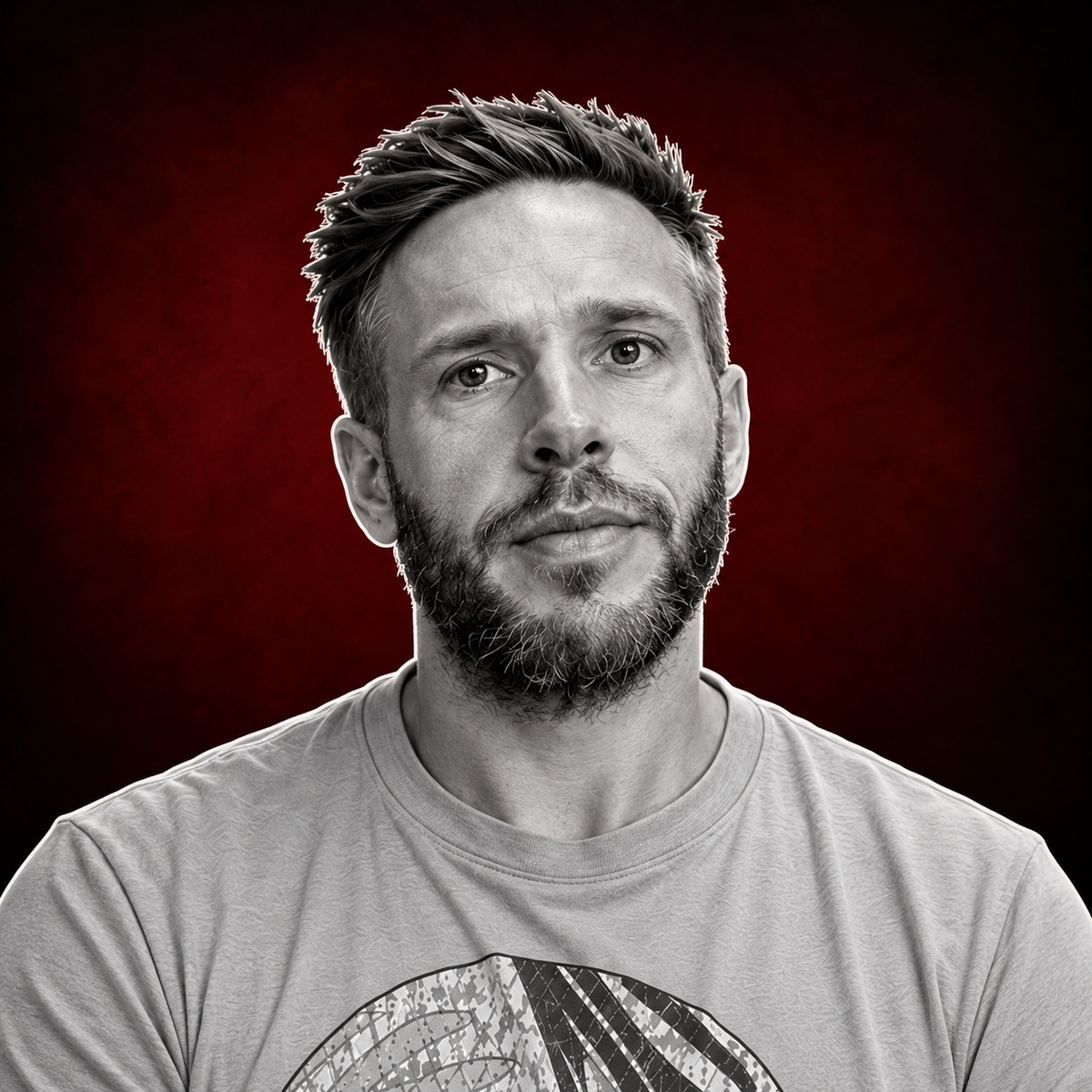
Mike Samuels is a direct response copywriter and the creator of Action-Based Psychology, a copywriting approach built on behavioral psychology. He got into copywriting in 2013 and went full time in 2016 after building and then winding down a mobile personal training and online fitness coaching business. His website lists clients including Organifi, Daniel Priestley, Clients on Demand, NewMarket Health, the YMCA, and Nick Cheadle, and he says his behavioral psychology course for copywriters produced a $110,000 launch. Mike describes himself as a storyteller who actively sells in only about 10% of his emails. Alongside client work, he teaches other copywriters and helps companies use AI responsibly through brand voice guides and half-day or full-day workshops on what good copy looks like. His approach was shaped by studying behavioral psychology with Ogilvy's Rory Sutherland. Mike is a member of Speakeasy's London chapter.