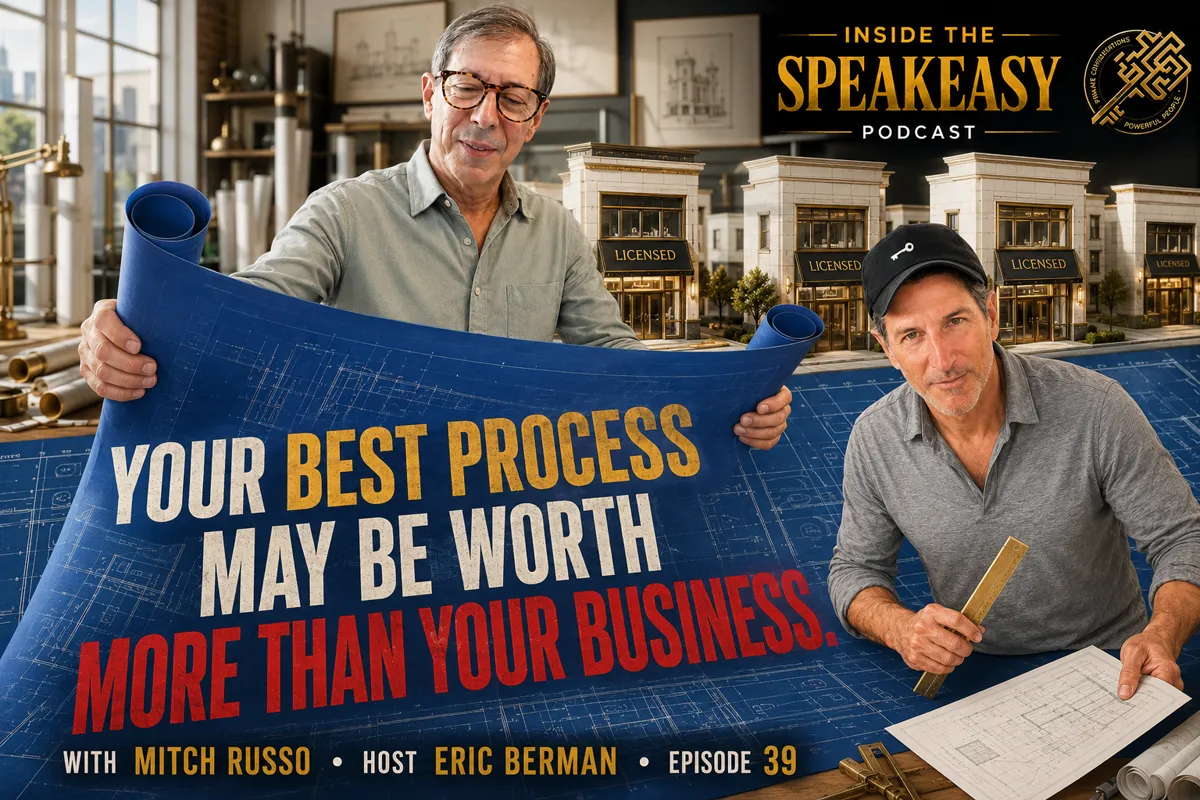
Mitch Russo, the software founder who built Timeslips into a company with 250,000 customers before selling it to Sage, now helps coaches, consultants, and software companies turn what they already do into recurring revenue. In this conversation with host Eric Berman, Mitch explains how a test-based certification program that brought in six figures quickly became a disaster, and how calling all 60 of those certified consultants led him to rebuild the program around culture, a code of ethics, and a business in a box. He shares the three questions that show whether a business is ready for certification, why most existing programs miss three to five recurring revenue streams, and how a process, from a headhunter's system to a restaurant's laminated menu, can be licensed. Mitch also describes his years working with Tony Robbins and Chet Holmes and why he built ClickCoach.
In this episode, you'll discover:
- The three questions Mitch Russo uses to decide whether a coach, consultant, or software company is ready to build a certification program
- Why selling a test is the most common certification mistake, and how culture and ongoing support turn certification into recurring revenue
- How certification smooths out the lumpy revenue that follows a big launch by bringing in a new class every quarter
- What licensing really is, why you do not need a legal background to do it, and how to protect a process others pay to use
- How ClickCoach saves Mitch 20 to 30 minutes per client per week and helps coaches renew clients with progress graphs
Episode Summary
Mitch Russo was a semiconductor salesman in Massachusetts when watching Bill Gates convinced him he wanted to be in the software business. A breakfast brainstorm with a neighbor became a product, and the company he started at 28 grew into Timeslips Corporation, time tracking software that began as a simple pop-up timer on DOS for lawyers and accountants and grew into a full billing and invoicing system. A single review in InfoWorld took sales from six copies a week to 600, and nine years in, with 250,000 customers and two buyers bidding at once, Sage acquired the company and Mitch moved to Dallas.
While Timeslips was doubling in sales about every 18 months, Chet Holmes, then selling ad space for a California lawyer magazine, made Mitch one of his Dream 100 targets. After a year of persistent outreach, Mitch negotiated a double color spread for the price of a single black and white page, and the two became lifelong friends. Chet later brought Mitch in as president and CEO of a venture with Tony Robbins. The three met on Thursday nights, sometimes until 1 or 2 in the morning, until they had the deal structured, then filled a Las Vegas summit with 500 people at $10,000 a seat in six weeks. Mitch says Tony is as genuine in private as in public, and describes Tony spending half an hour backstage with his daughter after a firewalk at 2 a.m., a conversation he says shaped her life.
Mitch's certification expertise began with a mistake. Timeslips was selling more software than it could support, and when one customer offered to help others nearby, Mitch imagined a nationwide network of certified consultants. The company sold a $500 test and brought in six figures, but many people who passed lacked social skills, training skills, and professionalism. After being threatened with 60 lawsuits, Timeslips called back the program, and Mitch personally called all 60 people to ask what they had needed. The answer was culture: a welcoming environment, a clear code of ethics, a culture course, and a full infrastructure of marketing systems, email systems, and lead generation. The rebuilt program reached 350 certified consultants in 18 months and, Mitch says, doubled the value of the company before it sold.
Today Mitch helps businesses build certification programs, an approach laid out in his book Power Tribes. He offers three qualifying questions: are you a coach, consultant, or software company with an amazing product or service; can others learn what you do and get the same results; and are you already successful, at around seven figures or more. For companies that already certify, he says he can usually find three to five recurring revenue streams they are missing, such as annual renewals and turning certified coaches into a sales force. He adds that certification evens out the lumpy revenue of launch-driven businesses by enrolling a new class every quarter.
Eric, who recently closed his first brand licensing deal on the golf side, asks Mitch about licensing. Mitch describes realizing that a headhunter's process was more valuable than the company itself and training other recruiters to pay a fee each time they used it. He tells the story of a restaurant owner doing about triple the business of nearby competitors thanks to a unique menu system, and says that one idea could become a multiple seven-figure business with a sales force behind it. He explains that licensing is not a legal term but a business agreement with provisions, and that a component the licensor provides, such as a platform, paperwork, or portal, protects the process.
The conversation closes with ClickCoach, the coaching software Mitch began building for his own practice in 2019 and is now redesigning with Speakeasy Boca chapter leader Mike Filsaime and integrating into the Groove family. Mitch says it tracks goals, accountability questions, and homework, saves him about three to four hours a week, presents coaches through a branded portal, and shows clients graphs of their progress that make renewals easier. He shares that he enjoys meeting Speakeasy members locally and when he travels, including at the Tampa chapter.
Big Ideas Discussed
Don't Sell a Test, Build a Culture
Mitch learned the hard way that a certification is not just an exam. His first program sold a $500 test, brought in six figures, and produced certified consultants who could pass but who had no training skills, no professionalism, and no idea how to market their services. When 60 lawsuits were threatened, he shut the program down and called every one of those 60 people to ask what Timeslips had failed to deliver.
The missing ingredient was culture, which Mitch defines not as a feeling in the room but as the environment a company deliberately sets up so people feel welcomed and included and know what is expected of them. That meant a code of ethics built with the CEO around the company's why and mission, a culture course every new consultant had to complete, and infrastructure such as marketing systems, email systems, leads, and co-consulting on first clients. The result was 350 certified consultants in 18 months. For anyone building a certification, his lesson is that the support around the credential is what makes people want to keep paying for it.
Three Questions Before You Build a Certification
Mitch qualifies potential certification clients with three questions. First, are you a coach, consultant, or software company with an amazing product or service? If you sell widgets, he says, you don't qualify. Second, can others learn what you do and get the same results as you? A personal gift that cannot be taught is not a fit.
Third, are you already successful, generating around seven figures or more, so you have a base from which to recruit people to certify? If the answer to all three is yes, Mitch believes certification can become a meaningful revenue stream. Eric frames this as a question every listener should ask: is there a revenue stream sitting right in front of me that I am not using? With digital courses becoming more and more free, Eric argues that certification is one of the ways businesses can still generate revenue.
Certification as a Fix for Lumpy Revenue
Mitch says most companies with an existing certification program are missing three to five recurring revenue streams. They charge once for the certificate and earn nothing afterward. His alternative is to deliver extreme value every year so people want to stay certified and pay the fee again, and then to turn certified coaches and consultants into a sales force that earns a percentage on subscriptions or services while adding their own coaching.
He also sees certification as a cure for what he calls lumpy revenue: a business runs a launch, collects a burst of cash, spends a year fulfilling, and then watches expenses climb while wondering why it can't make its numbers. Selling certification quarterly, bringing in a new class, graduating them, and helping them land clients right away evens out that cash flow. Mitch is clear that it is a simple process, but it is a process.
Your Process May Be Worth More Than Your Company
Licensing, as Mitch describes it, starts with spotting a process that works better than the competition's. He once asked a successful headhunter what would happen if the firm's process were more valuable than the firm, then helped it train other recruiters who pay a licensing fee each time they place someone using its system. He has seen the same pattern repeatedly, including a restaurant owner whose dog-eared laminated menu system was driving about triple the business of nearby restaurants.
Mitch stresses that licensing is not a legal term. Telling someone they can use your onboarding process for $100 a month, for a certain type of customer, in a certain region, until a certain date, is already a licensing agreement. When Eric worries that people will simply copy the process, Mitch explains that licensors typically provide a component, such as a platform, forms, or a portal, that keeps key parts secure. Eric adds that rebuilding a system is usually more expensive and time-consuming than paying the licensing toll. Mitch says this kind of business can reach six to seven figures in its first year, largely as passive revenue once licensees are onboarded.
Questions We Answer in This Episode
How do you know if your business is ready for a certification program?
Mitch Russo uses three questions. Are you a coach, consultant, or software company with an amazing product or service? Can others learn what you do and get the same results? And are you already successful, generating around seven figures or more, so you have a base to recruit from? If all three answers are yes, he says you can build certification.
Why do so many certification programs fail?
Mitch Russo says most companies simply sell a test and hand out a certificate, leaving certified people with nothing to do with it. His own first program at Timeslips failed this way and drew threats of 60 lawsuits. He rebuilt it around culture, a code of ethics, a culture course, and marketing and lead-generation infrastructure, reaching 350 certified consultants in 18 months.
How can a certification program create recurring revenue?
Mitch Russo says companies with a certification program usually miss three to five recurring revenue streams. He recommends delivering enough value every year that people want to stay certified and pay the fee again, and turning certified coaches and consultants into a sales force that earns a percentage on subscriptions or services. Selling a new certification class every quarter also smooths out cash flow.
What is lumpy revenue, and how does certification help?
Mitch Russo uses lumpy revenue to describe a business that runs a launch, collects a burst of cash, then spends a year fulfilling while expenses rise. Certification evens that out because a company can enroll and graduate a new class every quarter and help those graduates get clients right away.
Do you need a lawyer or a patent to license a business process?
Mitch Russo says you do not need a legal background, because licensing is not a legal term. Allowing someone to use your process for a monthly fee, with limits on customer type, region, and time frame, is already a licensing agreement. To protect the process, licensors typically provide a component such as a platform, forms, or a portal.
What kinds of things can a business license?
Mitch Russo says any perfected way of getting customers, creating an environment, servicing customers, or delivering a product can be licensable. He has helped a headhunter license its recruiting process to other recruiters for a fee on each placement, and he describes a restaurant owner whose menu system could become a multiple seven-figure business with a sales force behind it.
What is ClickCoach, and how does it help coaches?
ClickCoach is coaching software Mitch Russo began building for his own practice in 2019 and is now redesigning with Mike Filsaime. It tracks client goals, weekly accountability questions, homework, and stats, and includes courses, invoicing, billing, and group coaching tools. Mitch says it saves him 20 to 30 minutes per client per week and that progress graphs make renewals easier.
Full Episode Transcript
Read the Full Episode Transcript
Welcome and Introducing Mitch Russo
Eric Berman: This show is brought to you by HighLevel, the AI driven business operating system trusted by over 2 million businesses to help automate, scale and create real leverage. HighLevel isn't just a tool. It's the engine behind some of the most agile and high performing teams on the planet. If you're ready to streamline everything, amplify your reach, and actually build a business that works for you, you're in the right place. Visit www.gohighlevel.com/speakeasy-mastermind-promo to get an exclusive 30 day trial for being a listener of the Inside the Speakeasy Podcast. Enjoy the show. We're all probably looking for new ways to generate revenue in this fast moving day and age. Well, look no further than things such as licensing, deals, certification, maybe Even a better SaaS platform for your business. In today's episode of Inside the Speakeasy, we're bringing Mitch Russo out of Boca, who's generated over $30 million in working with Tony Robbins and Chet Holmes. He started his first business, or actually worked on his first business, starting at 28 and sold it for $10 million. And now he is the guru when it comes to all things working with coaches and certifications and licensing. And he's going to share lots of words of wisdom. Welcome, Mitch Russo.
Mitch Russo: Thank you, Eric. Glad to be here.
Eric Berman: Yeah, no thanks. And oh my gosh, we had so many things to talk about. You know, I'm a big fan of certification and you know, especially in this day and age, we have to find more ways to monetize licensing. I don't think there's enough people doing things because I, in fact, I just had my first taste of it myself. I could maybe share a story a little bit later. And I know you and my, and my good friend Mike Filsaime have just partnered up for something called ClickCoach.io where you're helping coaches building a great SaaS for anybody's doing coaching. And I'll talk a little bit about that too, because I know we have a lot of people listening that might be interested. But before we dig into some of this, I'd love to hear a little bit of this background. I mean, you were telling me in the, quote, green room about you being this young 20 something year old and you sold your first company for 10 million. Give me the visual where you're at.
From Semiconductor Sales to Building Timeslips
Mitch Russo: Sure. So I was in Massachusetts at the time I was a salesman on the road, I was selling semiconductors for large organizations and having a great time by the way, made a lot of money doing that. But I had this desire to be in the software business. I was watching Bill Gates really, really take off and I loved the product. I loved what he was doing. I said, you know what, I want to be in this business too. And I just kept brainstorming, what do I do? How do I get in? What would work for me. And then one day at breakfast with a neighbor, we came up with the idea of a product that we could build and sell. So I went home, did some market research, came back and said we should do this. And that's when we started working on a product. And that was when I was 27. Just to correct you, we didn't sell it at when I was 28. We started it when I was 28. So we went into business, began coding and documenting the product. It took us nine years to scale the company from zero to 250,000 customers. And that's when Sage came along and said, we want to buy you. Luckily, at the time we had two buyers at the very same time. So we had the equivalent of an auction going on and we were able to negotiate the perfect deal. And that's when we made the deal. And that's when I moved to Dallas, Texas. So here I was, living in the suburbs of conservative Boston, Massachusetts, all of a sudden to the wild and crazy Dallas, Texas. And it was a great experience.
Eric Berman: What did the software do?
Mitch Russo: The software was time tracking software. So it started out as a simple little pop up timer on DOS to keep track of time for lawyers and accountants. Later it grew very rapidly into a full billing systems and invoicing system in history. And it handled virtually the whole back end of a law firm. It happened so quickly. I mean, it took us 18 months to secure our position in the legal market. And then we got very, very lucky. We got a series of very powerful reviews in the press. There was no Internet back then, so the press was really important. And one particular review in InfoWorld made us. It was that one review that basically took us to the moon. We were selling six copies a week before this particular review of our software. After the review we were selling 600 copies a week. Oh man.
Eric Berman: So what year was this?
Mitch Russo: 1980, right? 1986.
Eric Berman: Okay, so. So certainly not the same systems and tools that will work now. There's too many options for articles and press and a not going to work. So we turned it turned our attention to some new strategies which we'll get into.
How Chet Holmes Made Mitch a Dream 100 Target
Eric Berman: But before we get there, you took a turn, and then you. I mean, how do you. And I knew you worked at Sage afterwards and did the acquisition, and then how do you all of a sudden get into business with Tony and Chet?
Mitch Russo: Sure. So when I was building Timeslips Corporation, we were doubling in sales just about every 18 months. And Chet Holmes was working for a California lawyer magazine, selling space. And so he targeted me as one of his Dream 100 clients. If you read his book, that's one of the things he talks about in the book. And I gotta tell you, I was bombarded by Chet and his team. And I kept pushing him off as being just a pushy old sales guy and leave us alone and all that. Before I knew it, though, I was starting to admire the effort and the organized way that he came at us and came at me. And it took about a year for him to convince me to get in the publication. But I had negotiated at that point for the cost of a single black and white page, a double color mid journal spread, which put us on the map and immediately shot our sales to the moon. And so we became friends after that. And next thing I know, Chet's coming to Massachusetts and we're hanging out. He's meeting me in Vegas for shows. So it was. You became a very, very wonderful friendship that lasted all of his life. And I was very sad that I was there the day he died. So it was a very difficult time for me, too.
Eric Berman: Wow, what a cool experience. And so that's how you met him.
Working With Tony Robbins and Chet Holmes
Eric Berman: And then how did you end up going to business with him and Tony?
Mitch Russo: Well, what happened was he had always admired Tony Robbins and thought that the two of them should do business together. And he was relentless trying to reach out to Tony. And finally he ended up getting a meeting with Tony outside of his normal place. I think he was. Tony was traveling. Chet went out and met him, had a dinner, a meeting with Tony, and the two of them said, look, this makes sense. Let's bring Mitch into the conversation. Mitch is our president and CEO, and let's see, because he's going to run it, so let's get him involved. So once Chet got back home, explained to me what happened, Tony, Chet and I began meeting every Thursday night. And for me, it was like we'd meet at 10, 10:30pm on a Thursday night. Sometimes our meetings would go to 1, 2 in the morning. We would do this just about, I would say, three out of four nights. Three out of four Thursdays a month until we figured it out. And it took a long time. We got a lot of moving parts, a lot of deal structure. And finally, right up until the point that we began recruiting people to, to attend our summit, if you will, in Las Vegas, we brought in 500 people in six weeks, $10,000 a seat. And it was a Tony and Chet and 15 other top end speakers like Jay Abraham and others. And we just put on an amazing four day show.
Eric Berman: Wow. Wow, what a cool experience. And before I just sort of close the door on this one. And we turned into some new topics. How was it working with Tony? I mean, was it a fun experience? Good, bad?
Mitch Russo: I mean it was a lot of fun. Tony was. I have to say a lot of people think that people are not what they seem in public, in private. And that's not the case. Tony is as genuine public as he is in private. And I'll tell you one quick story. I asked Tony if it would be okay if we got a picture with my daughter. We were coming to one of his events, the firewalking event. And he said sure, just give my assistant a call when, when you're there and so she'll know and we'll schedule it. So we did the firewalk and it's already two in the morning in California. We're from the east coast and all of a sudden my phone rings and. And it's Tony's assistant. She goes, Tony wants to meet you behind stage. And I go back the stage with my daughter and I expected we'd do a quick photo and everyone go to bed because it was just so late. Tony sat there for half an hour talking to my daughter. He was so interested in what my daughter was doing and what she was, what she enjoyed, what she liked. It was such an amazing experience. I'll never forget it. And my daughter will never forget it either. And in some ways it shaped her life, that whole event. And again, that conversation with Tony really showed her that she could do or be anything. And she has been. She's been great. Yeah.
Eric Berman: What a cool story. That is a great story. How magical. I was just going to say that it impact her. You beat me to it. I mean that is cool. You can't. Wonderful. Okay, so now how do we go?
The Certification Test That Became a Disaster
Eric Berman: And I know you did a bunch of stuff, but now you're the certification licensing guy and I know you're doing some other stuff in the coaching world. How do you get into that? And let's. I know I'd love to get some shares for the community or anybody listening on what they can be doing in this world.
Mitch Russo: Sure. So one of the things that happened with Timeslips Corporation, as I mentioned, we scaled very quickly, is that we were scaling faster. We were selling more software than we had the capacity to support. So an incident took place. I reached out to a customer to see if she could support another customer nearby, and she was able to do it. And she said to me something that changed my whole viewpoint. She said, and by the way, Mitch, if you need me to help any other customers, just let me know. Well, that sparked this idea, even this dream of having 100 people, maybe 200 people like that all over the country who could go and assist my other customers. So I see what we need is a test. So let's write a test and see who passes the test. And that could be our certification program. We did that. We sold those tests for, like, $500 a test. We brought in, like, six figures immediately, but it was a disaster. And that's really where I learned how to build certification. So what happened was we had a lot of people who could pass the test, but who had no social skills, had no training skills, had terrible personal habits, had no professionalism in any way, didn't know how to market their services, and were failing all over the place. So we decided after being threatened with 60 lawsuits, that we called back the whole program, fire everybody and start over. And so I started doing research. I called all 60 of those people, and I said, what did we do wrong? What did you need that we didn't deliver 60 conversations? And I did it personally, and I wrote very, very careful notes. I had to do it. I just had to know.
Building Certification Around Culture and a Code of Ethics
Mitch Russo: Well, what we did from there is we built an entire program based on culture that was the missing ingredient. So, in effect, we created culture before we created the program, which is not hard to do. Most people think culture is something you feel when you walk into the environment. And, oh, I feel so good here. It's a great culture. No, culture is how the company sets up the environment so that when people arrive, they feel welcomed, they feel included. More importantly, they know what's expected of them and what's not. That's what we call the code of ethics. So we build the code of ethics. We work with the CEO on making sure we understand the CEOs, why we understand the mission of the company. And from there, we create a course called the culture course. Now, the culture course was something I had to create, and I had to take all of my new certified consultants through that program before I could even let them out onto the street whether they were qualified or not. [unclear], we had to provide all of the infrastructure for them. And this is where a lot of companies go wrong. They instead sell a test like I did and say, okay, you're certified. Well, what does that coach do with their coach certification? Generally nothing. And then, you know, they pay once, whatever that fee was, 2, $3,000. But what I wanted to do is I wanted to create revenue, recurring revenue, multiple streams of recurring revenue from my certification program. And the way we did that is by making sure we deliver extreme value every single year so people would want to stay certified and pay that fee year after year. And that's what we did. We built marketing systems, we built email systems, we built all the pieces necessary so that a new certified consultant would effectively be buying the equivalent of a high end business in a box.
Eric Berman: Right.
Mitch Russo: And then we even found leads for them and we even helped them generate clients. And then we copy consulted with them on their first clients to make sure that they truly got the material before we let them step in on their own. That's what made us successful. We ended up with 350 certified consultants in 18 months. It doubled the value of the company and that's when we sold it.
Eric Berman: Wow, wonderful. And so what are you doing? So that's how the background. Are you still consulting on certification?
Mitch Russo: Yes. I wrote a book called Power Tribes: How Certification Can Explode Your Business. And that book has been very popular. In fact, it's brought me many, many certification clients. And so what I do now is I work with people who want to build certification and I help them create the program. I have a whole infrastructure in place, we have a few custom GPTs that help with the process. And bottom line is when we work together, you leave with a fully formed, running, ready to launch certification program.
Three Questions That Qualify You for Certification
Eric Berman: Now for those listening, I guess there's two kind of. I want to ask a dual question on a share here for you. A is what I'm going to ask a question for those that do not have a certification, those that do have a certification. So for those that don't, what is, what would you say is a good sort of way to, for them to ask a question? Am I potentially missing an opportunity to offer certification? Is this a revenue stream right in front of me, in front of my eyes, having, you know, learning the skills and tools, let's say, of a Mitch Russo, that I could build out this new revenue stream? Is there certain criteria you look for in companies?
Mitch Russo: Yeah, there is, there's several. Let me just start by saying, when someone is thinking about certification, they have to think about what it is that they offer. Are they offering? Well, you know what? I have three questions, the primary questions that will qualify you to begin thinking about certification. Question number one is, are you a coach, consulting or software company with an amazing product or service? So let's say you sell widgets, you don't qualify. Question two, can others learn what you do and get the same results as you? So if you have this magical process where you have to go into a deep trance to reach into the gods of themselves and come up with answers, then this is not a good qualification. That's probably, you know, you have to teach people to do that. That's your personal skill. But if you can teach what you know to others and have them get the same results, then that is excellent and you are ready for the third question. The third question is, are you already successful? Are you generating somewhere around seven figures or more so that you have a base to recruit people to become certified with you? And if the answer to that is yes, then we can help them get certified.
Eric Berman: Got it.
Missed Recurring Revenue Streams and Lumpy Revenue
Eric Berman: And for, for those that have a certification or at least are trying to build it out, maybe one or two tips on the biggest areas you see people are failing. And you mentioned something earlier, culture and the setup. So maybe that's one of them. Just, you know, what you're walking into, but that's what you learn. Maybe in today's day and age, I don't know if something's different or maybe the clients you're working with, what's the most common thing you're seeing?
Mitch Russo: Well, when I speak to somebody who says, oh, I already have a certification program, I could generally find at least three and sometimes up to five recurring revenue streams that they're completely missing. Most people are basically, like I said before, they're selling a test. Once you pass the test, you get a certificate. Once you have your certificate, you're certified, but the company doesn't get any additional revenue beyond that initial what they charge for that certification. I can show most companies how to turn that into recurring revenue. Then what we do is we go deeper and we say, well, what would happen if we took your certified coaches or consultants and turn them into a sales force, one that they'd love to be involved in, so they make a percentage on selling subscriptions to your services or your services directly, while they make a profit and can add by adding their own coaching and consulting. So that becomes number two, and then we can go further. But there are many, many opportunities for a company with existing certification to really dial it in and turn it into an enormous profit center. What I found is that most companies struggle with what I call lumpy revenue, where they do a launch, they get a bunch of cash in, and then they're fulfilling for a year, and all of a sudden, expenses go up, and they're just wondering, what happened? How come we. We can't make our numbers? What certification does is it evens out that cash flow. Now you can sell certification on a quarterly basis and bring in a new class every quarter, graduate them, and help them get clients right away. So it's a very simple process, but there is a process.
Eric Berman: Got it. Okay. I love that. I mean, that's. That's good. Learns on both of those. It's funny, because in my mind, I have one of my clients I do certification with on the golf side, and we're certifying golf coaches. And, you know, charge comes in my mind, like, Chuck. Okay, yeah, we're charging them. And yes, they are. We're making money when they go off and do their thing. Okay.
Mitch Russo: So we're.
Eric Berman: Okay. They're so far. But, you know, I could. You know, I'll have to have a separate conversation and not waste airtime on that, but that's great. It's good to hear. Okay. So that's. Love it. I love the certification, and I think in this day and age, you know, I hope people are really thinking through this, because we're all scrambling. We know that selling things online and digital courses are becoming more and more free. How else can we generate revenue for ourselves? Certification. Certainly one of them.
Licensing a Process: The Headhunter Example
Eric Berman: Let's get to the next topic. Licensing.
Mitch Russo: Right.
Eric Berman: I excited. I just did my first licensing deal like. Like, literally, like a couple of weeks ago or last week.
Mitch Russo: Congratulations.
Eric Berman: And I had to use GPT to say, what the hell do I charge for the use of our brand and license? Same kind of product, Golf on the golf side, the use of our brand into a golf resort. And so I get a test that there's real money there. But tell me what you've learned, what you teach on that.
Mitch Russo: Sure. So I started doing this as part of my consulting work some years ago, and I didn't even know, really. I didn't realize, by the way, that this was a thing. I mean, I'd speak to a company, and they had an interesting process. They would. Basically, they were a headhunter. They hired people, but they were, like, more successful than most headhunters. And I said, well, show me what you're doing. I want to see, I want to get behind the scenes and see your process. And I had this realization. I said, what would happen if your process is more valuable than your company? What would happen if we took this process and trained other recruiters to use it? And they pay a licensing fee every single time they recruit somebody using your system and using your tools. Well, that became a very big business. And I've done this over and over again. There's so many fun examples of people don't realize what's right under their nose. You know, have a conversation with somebody and already finding two or three things in their business that could become. They could license and [unclear]. Just license, but create level one, license level two, level three. So there's multiple ways to do this to make it super successful and at the same time create enormous passive revenue that no one ever thought existed before.
The Laminated Menu That Could Be a Seven-Figure Business
Eric Berman: Can you give me. So give me some more examples of that because I want us to be thinking, wow, like there's money underneath my feet. I don't even realize it.
Mitch Russo: Sure. So I know probably nobody listening to this has a luncheonette or a restaurant. But I'll tell you a funny story. So I had one guy call me up and he says, I do these very quick free consults with people. So I get a lot of people coming through with ideas and stuff. Guy has a luncheonette, he's crushing it. It's a bigger type of a casual restaurant and he has five casual restaurants around him, but he's doing probably triple the business of everybody else. And I said, well, why is that? He goes, you know, I'm not entirely sure, but we kind of have this cool way that we use our store menus. I said, really? What do you mean? And he describes this process that was actually quite fun and really unique. And I said to her, have you ever thought of licensing your menu system to other restaurants? He goes, what? Yeah, my dog eared paper laminated menu. I said, yeah. And our line is that that one idea can result in a multiple seven figure business. If he were to take it seriously and build a sales force and go out to other restaurant chains and license his concepts.
Eric Berman: And people just steal that idea. Like, okay, great, well, how is this?
Mitch Russo: I think so, right? You'd think so. But he has some patented pieces to it. In fact, apparently he bought the business and there were some existing patents around this that he'd never even paid attention to. He's kept them up because his attorney told him to do that. But there are so many things we overlook in the way we do things. Whether you have perfected a way of getting customers, if you have perfected a way of creating an environment or servicing customers or delivering a product, these processes are licenseable. So while you don't need a whole culture, you don't need the same infrastructure you do for certification. With licensing, you could just pick something, teach someone how to do it, license the tools to continue to do it, and then from there you have a business, it seems.
Eric Berman: Sounds like you need to, you need to figure, that is, you need to have it well documented and then have a sales team to go sell it and then somebody to actually onboard fulfill it kind of thing on, train them,.
Mitch Russo: Fill it, train it and get it. In other words, there's so much that goes into this, but the recurring revenue capabilities, the possibilities are unbelievable. You could build a six to seven figure business in the first year, typically almost completely passive revenue. Once you get people onboarded and once they have integrated your processes into what they're doing, that money just pours in every month or every quarter and it's basically free money right.
Do You Need a Lawyer or a Patent to License?
Eric Berman: Back to the legal side, I mean, is part of the system, though you probably, once you have that thing, if, I mean, this guy in the restaurant example had the patents already. So do you recommend people go out and then somehow patent their process to protect it or is it in the eye?
Mitch Russo: Yeah, in fact, you don't need a legal background to do this. Licensing is not a legal term. In other words, if I tell you you could use my onboarding process, but you got to pay me $100 a month to do it. And by the way, you can only use it in this type of customer and you can only use it in this part of the country, and you can only use it between now and the end of December, you and I just have built a licensing agreement and what it's effectively a business agreement with a bunch of provisions.
Eric Berman: But I'm still skeptical, Mitch, where I'd sit there and say I'm worried that somebody's just going to say, great, thanks for sharing me and teaching me everything, and I'm just going to go do it myself.
Mitch Russo: Typically there's a piece of it that requires some component that you provide. So in this case, this guy had a sort of a platform which he can create these menus from and you could, sure, you could recreate the platform and maybe now with AI it would be easier, but he had it built. All you had to do is plug in your stuff and you could have his style menu. And it was a beautiful system, but I'm just saying you could do with anything. So the guy who did the hiring business, the headhunter, what they offered was all their paperwork, all their forms, all of their stuff. They had a portal where they could go and they could onboard people directly and they, that's how they knew that they were keeping the part parts of their business secure while allowing others to use it. So we think of all these things and build them in.
Eric Berman: So there's some ways to protect along the way, I imagine. Oh yeah, I imagine to some degree you probably look at, look at it and say, well, the cost for them to actually try to go build this on their own is going to be way more expensive than just paying us the licensing fee. Plus, as we all know, people have a million other projects on their plate. The last thing I want to do is add a new project. It's just going to be easier to pay the toll, if you will the licensing toll and be done with it. So those are probably all little mini moats to, to ensure that you're, you know, I suppose there's a little bit of risk always. And I'm sure there's probably some legal things in there too, a little bit. But yeah, I mean, sure. On an agreement, sure. That's great. I mean, I think that's, you know, very interesting. My licensing deal is actually more of a brand licensing deal, leveraging a brand, which is a different thing, using our, our name to be associated to increase the percept perceived value of your product. You know, kind of a, you know, bolt on. So that was an interesting kind of concept. But yeah, I mean, I find it really fascinating. I love these sort of new revenue opportunities for us to be thinking about. And as you're listening, watching this, you know, ask that question, is there anything that you have that you might think other like, wow, we really do this and we're fast and efficient and good at it. Wonder if somebody else would be interested in this, this technique. Exactly. Great concept.
Why Mitch Built ClickCoach for Coaches
Eric Berman: And then last I know you got so many things you're wearing. I mean, you've been really excited as I talked to you. And of course I talked to my good friend Mike Filsaime out of Boca, who runs our Boca chapter, a marketing genius as well as you. You guys have a fun project called ClickCoach.io Give us a quick background on that because we have again, a lot of people listening that are probably either, you know, somehow tangential in the coaching industry or know people or might be in that. That world themselves.
Mitch Russo: Sure. So this all started in 2019 my own coaching business was getting quite busy, and I needed a tool to manage my clients and my sessions and everything else I did. So I went searching and I went and tried all these different coaching products, and none of them worked for me. And, you know, I just decided I'd build my own. I know it sounds crazy, right? But the truth is, is that no matter what, I would pay, if it worked for me, it would be worth the money. And I had a great development team on standby, so I thought, why not just give them this as a project? Well, it turns out that other people, other coaches saw it and, hey, could we use that too? And that's really how the business started. And then over the last five years, it's evolved and evolved and evolved until finally I convinced Mike to take a look at it. Mike sees it and he goes, this is way more powerful than I ever realized. But Mitch, it's ugly. I said, yeah, it's old. You know, it's designed five years, seven years ago at this point. He goes, well, look, why don't we partner? I'll help you get it redesigned using AI. We'll collapse all the pricing into one single low price point, and we'll offer it. We'll make some money together. We'll offer it to our customer base, and we'll really show them what it takes to create a really impressive coaching system. I said, great. So we started this project back in January, and now we're just finally really getting going. He's integrating it into the Groove family, and it's been great working with Mike and his team. And we're scaling.
Accountability, Time Savings, and Client Retention
Eric Berman: What are the key things it does for those listening? What does the software do?
Mitch Russo: Sure. It basically. So in my world, if you're working with a client, you're a coach, and you're not holding that client accountable and you're not tracking their goals and you're not modulating their accountability questions every week. If you're not watching to see if they do the homework that you provide and you don't have an active dashboard, then you're not doing your job. So all of those tools are built into ClickCoach. More importantly, what it does is it saves me about 30 minutes, 20 to 30 minutes per client per week. And what that translates into is about three to four hours a week of time that I save using the platform. The other thing it does is it presents you in a absolutely professional way. So it changes the authority feeling of working with a guy with a Gmail account versus someone who's working through a Professional portal who is branded and has their own custom interface. And at the same time we track weekly their numerical stats. So what that looks like is at the end of three months, I'm looking at graphs that all go up to the right now. Do you think it's going to be hard for me to go back to that client and say, hey, we did a lot of work these last few months. Do you want to sign up for.
Eric Berman: Another three months accountability piece with visuals and all that is just going to be a win. And they win too because they're going to get, they're going to, you know, do the work.
Mitch Russo: Exactly. And my coaches who use it use this as a selling tool. So when they're signing a new client, they say, look at the stats of the clients we've already worked with. This is what I can do for you too. So it really has multiple purposes here. And for me also, by the way, it adds courses, it has invoicing and billing, it has group coaching and mastermind management. It does a lot of good stuff.
Eric Berman: I was going to ask about that too. That's wonderful. It's almost like, it's almost like a spin off. Instead of licensing, you sort of went from licensing to going saying, all right, in this case I'm just going to build a SaaS. Instead of teaching the system how I do it, I'm actually build the product. And now you're sort of selling it. So it's a little bit of a cousin of the licensing, if you will.
Mitch Russo: Yes, exactly.
Eric Berman: Well, that sounds wonderful. I guess as we wrap here, you know, anything else? Any other sort of tips or nuggets you want to share when they're related to these different revenue streams or ideas you've been playing with or things you're seeing people are missing out on?
Mitch Russo: Well, most of the time people who are in particularly coaches in particular really don't realize how much time they're wasting. And that's again, with a single demo. I could show most coaches, we have a demo right on the website ClickCoach.io it really has a full demo on it. So if you take a look at that and you say, well, if this were my practice, would I be interested in all of these customization and templates, storing all of my homework and questions here and all that other stuff, all my courses here, it makes a lot of sense. So I think most coaches have a expertise or a genius of their own, but it's time to wrap a business process around it and really help. Let it help you make more money.
Eric Berman: I love it.
Mitch Russo: I love it.
Eric Berman: Well, thank you.
What Speakeasy Means to Mitch
Eric Berman: And, Mitch, my question for you is, how have you enjoyed Speakeasy Mastermind so far? What's it meant to you?
Mitch Russo: Oh, it's been great. I've met a lot of. It's been great meeting a lot of people locally. I've met a lot of people. When I travel, sometimes I go to different speakeasies. We went to the Tampa Speakeasy last year. It was a lot of fun. And unfortunately, I'm gonna. I'm gonna miss the April meeting. I'm gonna be on a photography trip out to Scotland, so I'm gonna miss that trip.
Eric Berman: But that's a good excuse, so we want to get some good pictures of that.
Mitch Russo: Absolutely.
Eric Berman: Well, very cool. Well, thank you so much for coming Inside the Speakeasy today and sharing some words of wisdom. And I certainly picked up a few nuggets that I'm excited to think about in my businesses and probably talked a little bit more offline, so thank you so much, Mitch.
Mitch Russo: My pleasure. Thank you.
Eric Berman: And that's a wrap from the Speakeasy Podcast. If something sparked for you, don't keep it to yourself. Share it, review it, and pass it to the one person who needs to hear this right now. Want in on the real mastermind? Tap the link in the show notes to apply until next time. Keep scaling, stay sharp, and don't be the smartest one in the room.

About The Guest
Mitch Russo
Mitch Russo is an entrepreneur, author, and consultant who helps coaching organizations and expert-led businesses turn proven methods into recurring revenue through certification, licensing, and software. He co-founded Timeslips Corporation, time tracking and billing software for lawyers and accountants, and scaled it over nine years to 250,000 customers before selling it to Sage. Mitch later served as president and CEO of a venture with Chet Holmes and Tony Robbins, and he has been nominated twice for Entrepreneur of the Year by Inc. Magazine. He is the author of Power Tribes: How Certification Can Explode Your Business, along with books including Licensing for Leverage and The Invisible Organization. Mitch is the creator of ClickCoach, a client management platform for coaches that he is now developing further with Mike Filsaime, and he is a member of the Speakeasy Mastermind community in Boca.