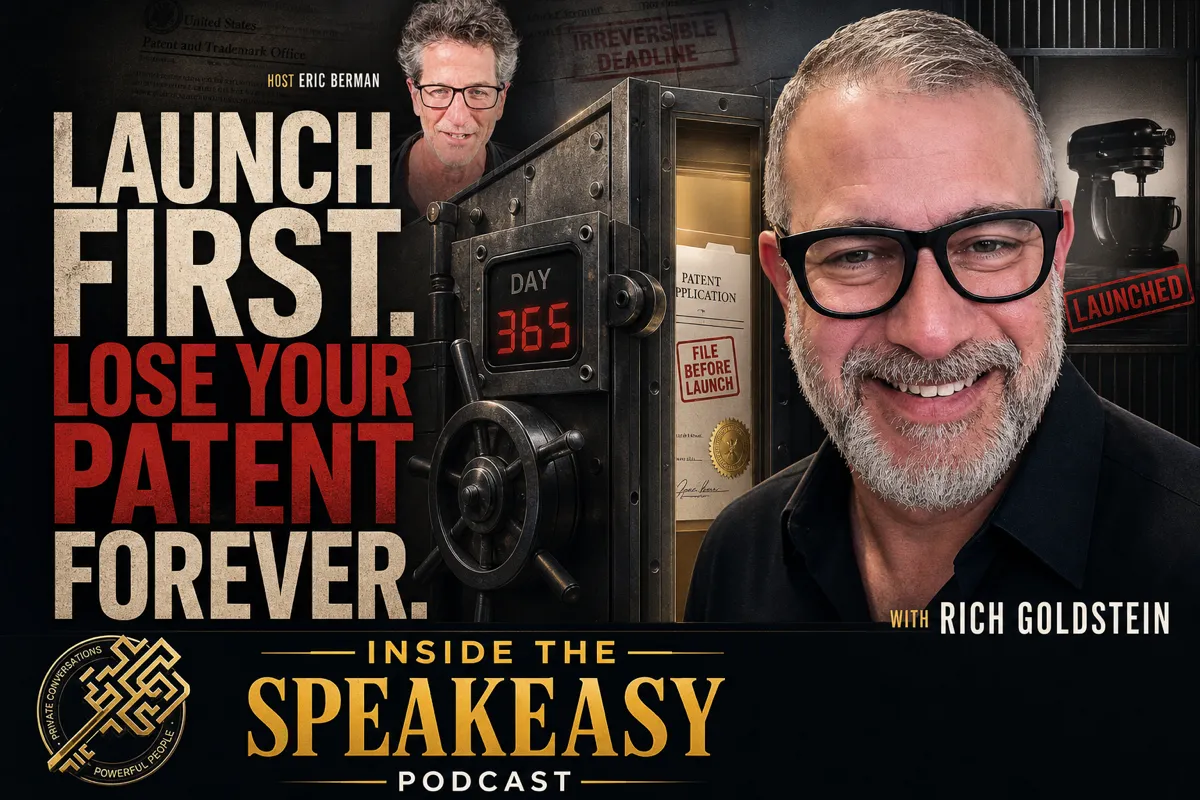
Rich Goldstein, founder of Goldstein Patent Law, is introduced by host Eric Berman as the godfather of IP and someone who has obtained more than 2,500 patents. In this conversation, Rich explains why bootstrapped entrepreneurs so often push intellectual property aside, and why that habit can be expensive. He walks through how to build an IP strategy from day one: clearing and filing trademarks early, deciding whether a product or software idea is truly patentable, and understanding what copyright does and does not protect for coaches and information businesses. Rich also shares the single mistake he sees most often, a one-year patent deadline that he says lets down would-be clients about half a dozen times a month, plus why he believes AI-generated patent work rarely succeeds. The episode closes with the story behind his legendary Las Vegas parties and why he sees IP as a driver of exit value.
In this episode, you'll discover:
- Why Rich says you should clear a business or product name before you fall in love with it, and how a $3,000 trademark filing can become a $50,000 problem if you wait
- The "technical solution to a technical problem" test Rich uses to judge whether software, including vibe-coded apps, has any real chance at a patent
- How to use a Venn diagram of what is protectable and what is marketable to decide whether a physical product is worth patenting
- Why Rich calls the one-year deadline after a public launch the number one patent mistake, and why much of the world offers no grace period at all
- How throwing parties in a private suite at the MGM in Las Vegas has, in Rich's words, given him credibility as an IP attorney
Episode Summary
Rich Goldstein opens by explaining why intellectual property so often gets ignored. For bootstrapped founders, there are endless things competing for attention and money, and many people misunderstand IP or assume that if they ignore it, it cannot hurt them. Eric Berman adds the other common attitude: dealing with it only when a letter arrives. Rich's starting point is different. He says the step people skip is IP strategy itself, a conversation with someone knowledgeable about which protections matter for that specific business.
Trademarks, Rich says, are the most universal piece and among the least expensive. Founders should clear the name they plan to use before launching, because rebranding costs far more than starting right. He explains that trademark law turns on likelihood of confusion rather than identical matches, so similar-sounding names can conflict while the same name can coexist in unrelated industries, as General Electric and General Motors once did. He also separates federal registration from common law rights, and gives an example: a filing that might cost about $3,000 now could become a $50,000 process if a competitor files first and their mark has to be canceled. Eric raises the recent Clawdbot rename, and Rich notes that trademarks are judged by how they sound.
On patents, Rich says service businesses rarely warrant them, while product businesses may qualify for a utility patent if the product functions better, or a design patent if it simply looks different. For software, he says there must be a technical solution to a technical problem, and he believes code generated entirely by AI usually will not qualify because the founder did not create that solution. For physical products, he recommends researching the closest prior patents, identifying the real difference, and asking whether that difference is what will make the product sell.
The conversation then turns to content and information businesses. Rich explains that copyright protects expression, not ideas, so a teaching framework is hard to protect through conventional IP. His recommendations are contract terms that limit how students and trainees can use the material, and trademarks on product names, slogans, and key phrases. Eric offers Michael Bernoff's Average Sucks as an example, and asks about a cease and desist Brian Tracy's One Day MBA program once received. Rich walks through descriptiveness, confusing similarity, and how crowded fields narrow protection. He also covers supplement formulations and explains that licensing deals depend on the leverage a patent provides.
Asked about the biggest mistake he sees, Rich says it is not knowing that once a product is public, whether on a website or on sale, there is one year to file a patent in the US, and in much of the world no grace period at all. He says he has to turn away people with successful products about half a dozen times a month for this reason, and traces the rule back to the constitutional purpose of the patent system. The second mistake he describes is filing a hastily written provisional application without realizing its quality determines the priority it provides.
In the final stretch, Rich describes the parties he has thrown 12 to 15 times over about six years in a suite at the MGM in Las Vegas, and how people who know him from those events now introduce him as a top IP attorney. Asked about founders who rely on AI instead of an attorney, Rich says AI fills in blanks in the expected way, while patents require something non-obvious, and that he has seen nothing good in the patent world come from AI. He closes by urging founders to treat IP as a way to build business value, saying the biggest return on IP investment comes at exit.
Big Ideas Discussed
Clear the Name Before You Fall in Love With It
Eric describes a habit many founders will recognize: searching GoDaddy for a domain, checking social handles, and getting excited about a name before anyone looks at trademarks. For a recent company he is involved with, he learned to keep a third window open for a trademark search. Rich says this is the right instinct, because handles and trademarks follow different rules. A trademark conflict is about likelihood of confusion, not exact matches, so a name that rhymes with an existing brand can be a problem, while the same name may be available in a completely different industry.
Rich's case for acting early is financial. He gives an example in which filing now might be about a $3,000 process, but if someone in the same industry files a similar mark first, it could become a $50,000 process because their mark has to be canceled before yours can be granted. Common law rights from prior use can still help, he explains, but proving them costs far more than filing at the start. His advice is to make trademark clearance part of the first conversation about a brand, not a cleanup project after a cease and desist letter arrives.
Protectable Plus Marketable: When a Patent Is Worth It
Rich says the key question for any product is what will make it a success and what competitors will want to copy once it works. He recommends researching the closest existing patents, because a new idea is judged against them, and he notes that research often turns up prior inventions closer than the founder imagined. The difference between the new product and those earlier patents is what may be protectable.
He then applies a simple test he describes as a Venn diagram. One circle is what can be protected; the other is what makes the product marketable. If those overlap, so that competitors would need to copy the protected feature to compete, the patent is worth pursuing. He applies the same logic to supplements: adding an unexpected ingredient might make a formulation patentable, but if that ingredient is not why people buy, competitors can simply leave it out. Eric connects this to acquisitions, noting that a patent on the feature that drives market share can make a company worth buying.
Information Businesses Protect Ideas Through Contracts and Brands
Coaches and course creators often complain that someone copied their funnel, webinar, or framework. Rich explains that copyright protects expression, such as the actual video file or the design of a web page, but not the ideas taught in it. He also says that while copying may raise a moral issue, it is generally not a legal one unless a defined form of IP protection applies, though copying a competitor's look and feel closely enough to confuse customers can create a trademark or unfair competition problem.
For methodologies, Rich's main tools are contracts and trademarks. If you run a teacher training for your own yoga method, for example, he says participants should agree contractually to how they can use what they learn. Phrases, slogans, and program names can be trademarked if they are used as a brand rather than as decoration and are not merely descriptive. Rich uses Michael Bernoff's Average Sucks as an example of a phrase people associate with one person, and discusses how a name like One Day MBA can be protected, subject to descriptiveness and to how many similar names already exist.
The One-Year Deadline Most Founders Never Hear About
Rich calls this by far the number one mistake. Once a product is public, whether described on a website or offered for sale, he says founders in the US have one year to file a patent application, and in much of the world there is no grace period at all. He describes people who come to him with successful products, sometimes after two and a half years on the market, ready to spend whatever it takes, only to learn it is too late. He says he has that conversation about half a dozen times a month.
Eric questions whether this clashes with the launch-and-iterate approach many startups use. Rich explains the reasoning: the patent system exists to promote progress by trading a limited period of protection for full public disclosure of an invention, so something already in the public domain cannot be pulled back out of it. He adds a second warning for those who do file: a provisional application is not reviewed when filed, but the priority it provides is only as good as the application itself. For founders, the takeaway is to look into patents before launch, not after the product takes off.
Questions We Answer in This Episode
When should a startup file a trademark?
Rich Goldstein says founders should clear and file a trademark at the very beginning, because rebranding later costs far more than starting with a protectable name. Trademarks are among the least expensive forms of IP. In his example, a filing that might cost about $3,000 now could become a $50,000 process if a competitor files a similar mark first.
Can two companies use the same name?
According to Rich Goldstein, they sometimes can, because trademark conflicts turn on likelihood of confusion. The same name may coexist in very different industries, as General Electric and General Motors once did. Names that merely sound alike can conflict in the same field, because trademarks are judged by how they sound, not just how they are spelled.
Can software or a vibe-coded app be patented?
Rich Goldstein says software can be patented only when it provides a technical solution to a technical problem, not an abstract idea. He believes apps generated entirely by AI usually will not qualify because the founder did not create the technical solution. Founders who design specific frameworks for how the software operates are more likely candidates, in his view.
What is the biggest patent mistake entrepreneurs make?
Rich Goldstein says the number one mistake is not knowing that once a product is public, on a website or on sale, there is one year to file a patent application in the US. He says much of the world offers no grace period at all. He turns away would-be clients about half a dozen times a month because they waited too long.
How can coaches and course creators protect their methods?
Rich Goldstein explains that copyright protects expression, not ideas, so a teaching framework is hard to protect through conventional IP. He recommends contract terms that limit how students or trainees can use the material. He also suggests trademarking program names, slogans, and key phrases used as a brand, such as Michael Bernoff's Average Sucks.
Is it enough to file a quick provisional patent application?
Rich Goldstein warns that it often is not. A provisional application is not reviewed when it is filed, so many people submit a quick description and assume they are protected. In his view, the priority a provisional provides is only as good as how well it was written, which matters if you ever need to rely on it.
Can AI replace a patent attorney?
Rich Goldstein says founders relying on AI alone have chances of success close to zero. He explains that patents require something non-obvious, while AI fills in blanks in the most expected way. He has seen applications pointed in the wrong direction from the start that could not be fixed later, and says he has seen nothing good in the patent world come from AI.
Full Episode Transcript
Read the Full Episode Transcript
Cold Open: Meet the Godfather of IP
Rich Goldstein: You should be clearing the name that you're going to use on your products, on your business, because it's much more expensive to rebrand. When it comes to trademarks, it's not just about whether the identical thing exists, it's about likelihood of confusion. You've got to have a technical solution to a technical problem. For software patents to get through the patent office these days, if there's any one thing I could say for the people that are listening is that.
Eric Berman: Welcome to Inside the Speakeasy Podcast, the private room where today's sharpest founders, innovators and renegade thinkers come to trade the ideas that move industries. This show is brought to you by HighLevel, the AI driven business operating system trusted by over 2 million businesses to help automate, scale and create real leverage. HighLevel isn't just a tool, it's the engine behind some of the most agile and high performing teams on the planet. If you're ready to streamline everything, amplify your reach, and actually build a business that works for you, you're in the right place. Visit www.gohighlevel.com/speakeasy-mastermind-promo to get an exclusive 30 day trial for being a listener of the Inside the Speakeasy Podcast. Enjoy the show. Welcome to Inside the Speakeasy Podcast. I'm so excited today to talk to my good friend all the way out from New Jersey, Rich Goldstein. And he is the godfather of IP. He's obtained over 2500 patents. Oh my gosh. For all your friends, clients, people out there. And every time I talk to you, I'm just like, oh shit, I got to move my IP game up a little bit. I'm not doing the right things here. I got to probably make a little bit more of a priority than I'm thinking about. And we're going to get into some crazy, amazing stuff in this episode. We're going to talk about some of the biggest mistakes that people are making when it comes to the world of IP and trademarking. In fact, many of you might be making that mistake right now and it could cost you thousands and thousands of dollars. And you can make me decisions that you cannot undo if you do the wrong thing. We're going to talk about how AI is not disrupting the world of IP. And in fact, if you think that's your answer, you're making a big mistake. And we're also going to discover a hidden secret Rich has and how he's able to actually throw six figure fun parties to get new clients in business. And he's absolutely crushing it. Let's talk about why. Let's get into it. Welcome Rich.
Why IP Gets Sidelined and Why Trademarks Come First
Rich Goldstein: Oh, thanks so much, Eric. I appreciate that intro. And yeah, okay, so the why I think a lot of it is mindset. Well, it's a combination of things. So mindset is one. Another thing is for any bootstrapped entrepreneur, there are so many things to put your attention on and so many things to spend your money on. So IP often gets sidelined because of that, because there's like really a lot of things that you need to do. And it's also because people misunderstand IP. They have misconceptions about it and so they end up pushing it aside and maybe not dealing with it. And, and sometimes thinking that, like, if I don't deal with it, then it can't hurt me. Like if I don't, if I just ignore it and pretend it doesn't exist, I'll be okay.
Eric Berman: Or I'll deal with it when it becomes a problem is probably the other way of looking at it. Like it's not a priority. When it becomes, or somebody sends me some kind of letter or something, then I'll deal with it. Or let's start from the beginning. I mean, I mean, so if we have all levels of entrepreneurs, I'm starting off my company, Boom, what do I do? And then as I kind of go through that, I'll ask sort of a few questions, roll into one. IP is a big, I'm sure it's a blanket coverage of a lot of things. So let's talk from different levels. Startup. What is my IP? What should I be doing and when?
Rich Goldstein: Yeah, so the first thing, the thing that people skip is IP strategy is to actually have those thoughts and have that conversation with someone that knows to say, well, really what should I be focusing on with IP? Because for different businesses there are different strategies and different things that you should do. So probably the most universal thing is trademarks. And if you have a brand of any kind that's public facing, then you should be filing a trademark application. You should be clearing the name that you're going to use on your products, on your business, because it's much more expensive to rebrand than it is to start out the right way and make sure you have a name that is well carved out, that you could use this name on your product or service and then file a trademark. And trademarks are like among the least expensive aspects of IP. So it's truly a no brainer to do that in the beginning.
Eric Berman: So just to cut you off, there I mean, it's funny because I did this recently with a company, Derm Click that I'm a part of. And it's just a new habit. Like, you sit there and you spend all this time like, hey, let me go play in GoDaddy, and just look up URLs to find the name. And then you're just like. And you think you have a name, you get excited. Then you're going to Social, and like, okay, does everybody have the handle? And I'm like, no, no, no. What? I learned the hard way. Same thing you're saying. Just, I have my third window up, which is the. I can't remember the trademark search. But to me, that was just as important. I was like, step one, you got to have all windows up. Who else has this name? Right?
Rich Goldstein: Yeah, yeah, absolutely. And there's a little bit of a difference there between, like, getting the handles and getting the trademark in that. So, first of all, if the exact name exists as far as the domain name, obviously you can't get that right? And, you know, but if there's like a little variation, like, you know, people get creative and they say instead of Rich Goldstein, they say the Rich Goldstein, and they use that as their Instagram handle, let's say. But when it comes to trademarks, it's not just about whether the identical thing exists. It's about likelihood of confusion. So it could even be names that rhyme with your business name that could be confusing. On the other hand, you could have the same name with two different companies having trademarks, but they're in very different industries, because, again, it's all based on likelihood of confusion. So, you know, we've got General Electric and we've got General Motors, right? They were originally in very different fields, and so they could coexist. But a lot of times you might have a name that. That you want to use, and the handles are taken up, like, maybe you're going to sell skincare products. And you notice, like, oh, that name's taken already on Socials. But it might still be possible to use that as a trademark for, you know, a different field. If someone else has it in use for, you know, clothing, you might be able to get that same name for skincare products. And so, like, there are different considerations, but, yeah, in the very beginning, it's important to sort that out. But.
Eric Berman: And I think it's important distinction to there, too. So, I mean, what I like about what you said is you might have a name that you really like, and you're like, oh, that somebody else has that name and you're like, you still could get it different industry. Now, what about somebody having you a name in the industry but they haven't trademarked it yet? What are the rules behind that? And can you say, well, I really like the name. They slept on the wheel and they didn't trademark it?
Federal Registration vs. Common Law Rights
Rich Goldstein: Yeah, there's two aspects. So first of all, there's federal registration and then there's common law rights. And. And so essentially, as far as the Patent and Trademark Office is concerned, when they're searching your application to see if that mark exists, they're looking at other registrations. So you can possibly get your mark registered even though this other person exists and that have just been using it, but they have common law rights by using it in the industry. If the extent to which they could show that people would be confused by you entering that same industry with this name, they could bring a trademark case against you. So you could technically get the trademark through the Patent and Trademark Office, but you might not be able to use that mark without conflict.
Eric Berman: Got it? Yeah.
Rich Goldstein: There are things to consider. And that's why, again, a lot of times this stuff gets sidelined. But it's really important to look at because as time goes on, things get more and more expensive. Kind of as an example of that, it's like if you were to file your trademark application, let's say now it's maybe a $3,000 process, but if someone else, if you wait and you don't file it now and you want to file it later on, but someone else has filed in your same industry with a similar trademark, now it could be a $50,000 process because you have to get their mark [unclear] canceled before you can get yours granted.
Eric Berman: So that goes back to the common right. So you're saying, back to the other thing you said. Somebody may say, well, great, what's the rush in doing then? If I've already been using it, no big deal. I can always go after them later. And you're saying you can, but it's going to cost you way more.
Rich Goldstein: Yeah, exactly. Like. So you started using it and you were developing common law rights. So let's say, you know, four years goes by and someone files their application, and then another six months go by, you file yours. Well, like, they're ahead of you at the trademark office, but you can show that while you've now been using it for four and a half years and that you've got superior rights and you could prevent them from registering theirs. But it's a much more expensive process.
Eric Berman: Now.
Rich Goldstein: Got it, got it.
Clawdbot and Why Trademarks Go by Sound
Eric Berman: Just random thought I had in my head. You know, I shouldn't assume or not assume, but the whole thing that just happened recently with Clawdbot, who had to, you know, they had a name, but it wasn't spelled. So walk through that process. Why? And I know this will probably come out six weeks or so from now from this conversation. So by then it'll be a little bit of old news. But, you know, I guess they're Moltbot now. Is it just because it was too close in theory and confusion in the market? [unclear] the pronunciation of Clawd spelled differently than Claude? Is that the idea?
Rich Goldstein: Yeah, I think the underlying principle there is that trademarks go by the sound of it. So it's like you filed a trademark application for Coca Cola spelled with a K instead of a C. It's not going to work because it's how the trademark sounds.
Eric Berman: That person did not talk to the Godfather before they went and blew up and it got viral. That was a. I mean, you probably saw that one coming a mile away.
Rich Goldstein: Yeah, well, I mean, like, again, people have misconceptions about IP and they think there's certain things they can get away with, like, oh, wait, but when they challenge us on this, we're just going to say this, or we're going to say like, no, no, no, it's with a K, it's not a C. But they're just wrong. And a lot of times when people think they have the answer, that's the most deadly thing, because they think they have the answer. So they're not looking for the answer. They think they already know.
Eric Berman: They think they know we'll deal with it later. And it goes on to the next thing. Right? We just get it and they just, you know, okay, so I know that's sort of the early on trademark. You know, we all kind of understand the concept. I think the message clearly is do not delay on that at all. Is there anything else in the trade marking side or should we now still get down and go down maybe a little bit more of the IP path and kind of. What other things should we be doing?
Building an IP Strategy: Patents, Products and Software
Rich Goldstein: Yeah, no, I'd say let's talk more about IP. And again, the reason we got into trademarks, as I was saying in the beginning, you want to have an IP strategy, you want to figure out what IP is going to apply for your business, what's going to give you the most leverage and take those steps at an early stage and then also have plans for what's going to develop over time as you Gain traction as you build your business. What others IP steps can you take? So now again, back to the beginning. Trademarks are pretty universal, should be part of any startup's IP strategy. Now patents are different because it really depends on the type of business that you have. If it's a service based business, then it's not likely to be something that warrants patents. If it's a product business, then if you have some improved products, you have a product that functions better than other things like it, then it can be what's called a utility patent. If you've got a product that is essentially the same function as others, but it has a unique look, then you could apply for a design patent to protect that unique look. So it's very much about looking at kind of what's the secret sauce your business, what's the thing that is going to set you apart? What's the thing that people are going to want to copy about your business as it gets to be successful? Because like the root of your success was X. And so then from there we want to figure out, well, what's the best way we can protect that? And that could be with patents. If it's a product based business and then just going a little further with that too. If it's software, if like you're developing a SaaS company, then software can be protected with a patent too. But it's difficult and I don't know how important it is for us to go into detail about that aspect in terms of patenting software. But I'll just say a few things because a lot of people are doing that these days. A lot of people are vibe coding. Yeah. They're saying, like I create a software app, like, you know, can I patent this? And so here's just a few guidelines. First of all, in order for software to be patentable, there needs to be a technical solution to a technical problem. You know, a lot of times people will say, well, I created an app that, it's like a dating app, except it searches by location and then finds people that have the same birthday as you or whatever. You can't patent that. That's an abstract idea. Got it. So if though you have some technical solution for maybe gaining that information and kind of arriving at the result, then it's possible to protect it. Problem is, you vibe code something. You didn't create the technical solution, the AI created the technical solution. So it's not going to be patentable.
Eric Berman: So there's nothing that you could vibe code that's patentable, more or less. Or is this pretty hard?
Rich Goldstein: Well, I mean, it depends. Sometimes people vibe code and they get really deep in. Into it and they actually set up certain frameworks about how it's going to operate. Like, in terms of that, you create a system where it takes in certain information, it stores that in a database, and then like, in other words, sometimes they get more into advising how the software is going to be created. Those are the more likely candidates for patent protection. So a lot of people are wasting a lot of money on software patents these days by applying for something that's just never going to go through the patent office. But that's the thing to understand. If there's any one thing I could say for the people in this community that are listening and that that is that you've got to have a technical solution to a technical problem for software patents to get through the patent office these days.
Eric Berman: Got it. Okay, so let's keep. I want to keep talking about that, and then I want to talk about maybe other sort of things to protect or we can protect in the IP strategy. I love sort of thinking of the overall umbrella of IP strategy. So get past the trademarking. You're sitting down, you're thinking, all right, well, what am I doing? Is my company a SaaS? Is it just content? Is it, you know, in which case, let's get in that conversation in a minute. Or is it product like you said, you know, actual physical product. So seems like the technical side, the SaaS you kind of covered a little bit. Let's maybe dig down the physical product stuff. What sort of should I be looking for? It's patentable or it's not down that path.
Physical Products: Where Protectable Meets Marketable
Rich Goldstein: Yeah. So when it comes to a physical product, if you feel like it's an improved product, like, in other words, it functions better than other things that have existed out there. It's kind of like you picture, you know, someone in the garage kind of trying to make a better soap dispenser or whatever. Like, that's typically a candidate for a utility patent. The important thing, like, the most important thing to figure out is, is what are the closest things to it? What are the closest things that were patented before to what you have in mind? Because that's what it's going to be judged against if you were to apply for a patent. So, like, you know, say you invent this new soap dispenser and it has kind of some type of mechanism with, you know, with a spring and a catch. And we'd want to do research to see if people have invented that, like the secret sauce, the thing that makes it work? Well, there are patents going back to the beginning of the patent system on just about everything you could think of. And, you know, a lot of times you think, I've never seen anything like this on the market. But when we do research, we'll find things that are closer than you imagine. Then the important inquiry is this, well, okay, what's the difference between mine and what's been created? Because that's going to give you a sense of what's protectable. So you figure out like, okay, I could protect this difference. The fact that it has this mechanism. The next question is, does that make it marketable? Like, if I was able to protect that mechanism, is that going to be the reason why my product is a runaway success? Is that going to be the thing that when competitors see how well I'm doing and they look at my patent, they say, oh, well, well, in order to cut into his market, we need to copy that feature. But you know what, we can copy that feature because of the patent. Then you've got something that you should be patenting. So it's like, got it. Thinking of a Venn diagram. Like, you think about what's protectable and you think about what's marketable. And if those two overlap, if you're able to protect the thing that's going to make your product marketable, that's a patent you should go for.
Eric Berman: And that hopefully becomes big part of the IP strategy, because now you're building that thing that hopefully somebody may say, well, shit, we just got to go buy these guys because they're chipping away at our market share and it's going to make us better with this new thing, this new device mechanism.
Rich Goldstein: Exactly, exactly.
Copyright, Copying Competitors and Unfair Competition
Rich Goldstein: And so just bigger picture on that then is like you'd mentioned content, content gets protected with copyright. So it could be the graphic design of your webpage or kind of the content of your videos. Like, that's protectable with copyright. But the thing that people misunderstand about copyright is that it protects expression, not ideas. So, you know, you teach a whole bunch of things on your video that's not protected by copyright. It's the way in which you talked about it. It's the actual video file to prevent people from just duplicating that and clipping it and using it. Like that's what's protected by copyright, not someone else doing their own video to teach the things that you talked about.
Eric Berman: What about the ideas of we're launching a new thing. I love what this competitor over here is doing, let's go model them and use as much of their stuff. We'll put our things on it. We'll tweak a couple words like where's the danger zone in there if you're trying to launch something and you just really want to model somebody else?
Rich Goldstein: Right. Well, here's the thing. So first of all, like, there may be like a moral issue about copying someone's stuff. Yep. But there is no legal issue unless there is like a defined type of IP protection on it. So, like, there is no, you know, what they call common law tort of copying. Right. You see someone's product and you copy it unless they've got protection for it. Like, there is no, like, just like kind of like moral prohibition that becomes a legal prohibition on copy.
Eric Berman: Yeah.
Rich Goldstein: When you got going to copy someone's stuff, you have to look out for a few things. Of course, you don't want to duplicate anything that's copyright protectable, which often is like things like images, like the very kind of direct content portions of it. You also don't want to infringe any patents. So if there's any patents in question, then you need to review to see if it's possible to make anything similar to it without infringing the patents.
Eric Berman: Okay.
Rich Goldstein: But then the other thing to consider, that thing that came to my mind when you mentioned, like, I see someone's stuff and I'm thinking we'll do it kind of similar, etcetera, Is there is a possibility of trademark violation. And that comes by virtue of this. Remember, trademarks are about likelihood of confusion. And it's more than just the name of the product. It could be the, well, the logo, the slogan. It can be things that people commonly associate with a particular source of a product or service. So it's like if someone heard, you know, one specific, like one particular thing that you'd copied from them, and it immediately has them think, oh, that must be your competitor, that trademark violation. Let's get ready to rumble. Michael Buffer. Yeah, like, that's more of a trademark ish. People like, he patented that. No, no, you didn't patent that. You can't patent that. But it's like somebody hears that someone saying that, like, let's get ready to rumble, you know. Yeah. They might think like, oh, that's Michael Buffer. You know that Michael Buffer was the announcement at that fight, was the announcer. And so like, you're saying you could.
Eric Berman: So you're saying somebody couldn't, let's say, have a website. Then when you land There it says let's get rid of Rumble. And it sounds like Buffer. And I use my. You're saying that would be trademark that.
Rich Goldstein: You get in trouble or you wouldn't potentially. Like, if it was something that you'd expect him to be at, like something related to a fight or a match. Yes. But the point is, like, you know, if you make your website that really reminds people of the Amazon website, you know, and your, you know, amaloo.com or something, then like, those circumstances could have people think like, oh, this is an offshoot of Amazon and so you want to avoid that. I think that's the biggest pitfall of what you're describing.
Eric Berman: Got it. So. So if you're going to be in a similar industry, don't try to. You don't want to copy exact. Look, feel all the words.
Rich Goldstein: You don't want to trick people into thinking that they're dealing with them when they're actually dealing with you. Because that's some type of trademark, unfair competition type. Yeah.
Eric Berman: And it's just interesting because I, you know, you're all sides. You hear people in our world and industries, all that. Like, I'm so frustrated about these people. They took my funnel and they took my webinar and they almost copied verbatim what I did. You know, I hear that a lot. And like, what can they do?
Rich Goldstein: Do?
Eric Berman: I mean, do they have a claim? Can they really even do much with that?
Rich Goldstein: Yeah, I mean, there's not that much, like, when it comes to content, like, you know, coaches that have their own frameworks that they teach and, like, it's not very protectable through conventional IP and like, the biggest thing that they should do is have contract terms that limit the potential use. So it's like if you are, let's say you developed a yoga methodology and you run a teacher training to teach teachers about this yoga style and all of your secrets. Well, anyone who's in that program, you want to have them agreeing contractually to what they can do with that information. That tends to be the best way to protect, like, teachings of that type, because copyright doesn't protect ideas. And then the other thing is just branding. You know, it's like, you know, you create like the webinar while you sleep method. Okay, ran that. And then other people that are also creating their how to build a webinar, programs, they can't use that phrase.
Trademarking Slogans, Phrases and Program Names
Eric Berman: Okay, so that was really helpful because I want to get into that is what can we do for people that are, especially on the information side. You just got A great idea. So it's sort of methodology you're saying you can patent of what you're doing. That's. So I just say what strategies you suggest to help us build more IP.
Rich Goldstein: Right, yeah. Methodology you cannot patent is the point. Okay. And so, yes, trademarks is one. And so if we. Circling back to trademarks, again, it's for the name of the product. It could also, though, be for the logo. It could be for. For slogans that you use. It could also be for key terminology. You know, I'm trying to think of, like, maybe if there's a Tony Robbins phrase that comes to mind. I haven't done a lot of Tony Robbins work, but like, you know, let's say he had a thing that he said always was like, Max.
Eric Berman: Okay, well, I have an example. So our good friend, he's a good buddy. He's in the Scottsdale chapter of Speakeasy. Michael Bernoff.
Rich Goldstein: Oh, he has a bunch, actually, I think I've given those shirts to my wife and she wears them all the time. There's like Average Sucks.
Eric Berman: Average sucks, right. So can you do anything with that?
Rich Goldstein: And the decision maker.
Eric Berman: That one I don't remember. But okay, I can see that.
Rich Goldstein: But yeah, average sucks. And like, so actually my wife likes that shirt. And yeah, so, like, you have a phrase like that, you can protect it.
Eric Berman: So Bernoff could be protecting that. And we'll talk to him after the show that if he's not working with the legend in IP, he should be.
Rich Goldstein: He should be. I've known him for enough years. Like, absolutely, he should be. But yeah, so if he hasn't done so already. Yes, like, he could trademark average sucks because when people see that, they think of Michael Bernoff.
Eric Berman: So he has to do so. And it's not like, I mean, this is an important conversation from just listening, I'm thinking through this and saying, okay, what's the definitive line there? Like, oh, I get to print a T shirt up and say average sucks, and I get to trademark that name. So at what point does somebody like Bernoff get the rights to win on a trademarking of that?
Rich Goldstein: Yeah, he's got a. First of all, it's got to be more than just like an ornamental thing on a T shirt, like, have a nice day. Right. It's like one of his key teachings. And maybe he's got a program named that too. But when something is trademarkable is like when it's used as a trademark. It's being used to, you know, like the common perception that it creates with consumers. Is that. Okay, that's pointing to a specific brand. So it's kind of like you put an alligator on your shirt, like that seems ornamental, that's not trademarkable. Put it on the pocket and it's like, oh, that's supposed to be a brand name. That's supposed to designate that it's a certain source of that product, a certain source of clothing. And so it's. The context is very important. But the point is that's one of the ways in which information product people can protect themselves is by using certain phrases as a trademark, like using it properly, like making sure that you don't water it down and have it just seem like a casual thing and then protecting it by filing a registered trademark application.
Eric Berman: So one more example, because I think I'm looking for applicable cases from people that we all know out there is, and you kind of alluded to it, an actual product name. And I can give you an example of somebody that actually sent us a cease and desist when I say us. And maybe you'll tell me that they had no case here in a second. But for Brian Tracy, a client that I work with that people know, we had a program for a while called the One Day MBA. And then I think somebody else said, well, we've been using this name MBA in a day or something similar. It wasn't exactly the wording. And they had a, I guess a trademark on the brand or their product name.
Rich Goldstein: Right.
Eric Berman: So in that example. So, so are you. They were able to trademark a name of a product and that. Is that something we can do?
Rich Goldstein: Yes. You know, it's possible to protect. There are some factors in figuring out there, like whether it was a problem or not. But yeah, I mean, you could trademark One Day MBA. If, I mean, for one, it's got to be. Here's the thing, it can't be descriptive. Like if you're selling red licorice, you can't trademark the term red licorice. That's descriptive.
Eric Berman: Right.
Rich Goldstein: And so like, you know, if you called it kind of liquid licorice, right.
Eric Berman: Volcano candy or volcano on a stick or something, whatever.
Rich Goldstein: It's not, it's misdescriptive. That's not what it is, a One Day MBA. It's not really an MBA. It's not really a Master's of Business Administration. And perhaps it doesn't really take one day. So then it's, you know, it's like One Day MBA for a program in business literacy. I don't know. It may be possible to trademark that subject to the descriptiveness issue. And then you can prevent people from using anything that's confusingly similar. So it's One Day MBA and you've got MBA in one day. That seems confusingly similar.
Eric Berman: Yeah.
Rich Goldstein: On the other side of it is like, well, what if there are a bunch of like, things like One Day MBA and there may be room for you to coexist.
Eric Berman: Got it.
Rich Goldstein: It's not that the MBA and one day in the same phrase is so distinctive for one company because there's a bunch of different variations of it. So then that means that protection is more narrowly construed and there may be room for Brian's program as well.
Eric Berman: Got it. And then to reverse the conversation for, again, people listening, it's. I guess that would be part of your IP strategy. Right. If you're in the information game, that is a way you can start obviously outside the trademarking and some other things. And we use Bernoff as an example. It could be that, right.
Rich Goldstein: Taking one of your programs, very tall example.
Eric Berman: But that would be a strategy then, right, Rich, that you would maybe help, like kind of if you're talking to people saying, well, yeah, why don't we take one of your products? Let's, you know, it can't be descriptive, but we can create an IP around a product that you're teaching. Right. Or a course.
Rich Goldstein: Yeah, yeah, exactly. And that's the thing is to find out the landscape and to figure out like, well, what do other people do in this field? You know, maybe you're selling carpets and it turns out that all the other carpet manufacturers are copyright protecting their patterns on their carpets or on their rugs. Then maybe that's a good thing to do. Sometimes it's really about figuring out, like, in that industry, what's the common way that people protect things. Like in the refrigerator water filter field, what happens is manufacturers patent their specific type of coupling for attaching the filter. So that's how they go after all the other companies that make duplicate water filters is because they have to use that coupling that's been patented. So it's like you talk to someone who's been there and you find out some of what works in your industry to gain IP protection.
Eric Berman: Love it. All right, the last category then I'll get off this because again, I'm just thinking of all the.
Patenting Supplements, Formulations and Licensing
Eric Berman: There's probably more physical ingredients people making physical. Yeah, stuff that includes ingredients like, like.
Rich Goldstein: Supplements or formulation of some kind. Here's the thing. A formulation is protectable by patent. It's directly one of the Categories of what's protectable. All patents though have to be different to a certain degree. Which means like it has to be more than just unique. Like no one has ever had this exact thing. It has to be unique in what's called a non obvious way. So what that means is it's a little bit, it's gotta be outside of the range of expectations to an extent. What happens with supplements and formulations is that typically when people come up with one, they're using known ingredients for their known properties and maybe they're just changing the amounts a little bit.
Eric Berman: That's what I was going to ask.
Rich Goldstein: Yeah, the patent, something unusual.
Eric Berman: I was talking over you, the Rich. So in that case, that's the one I was thinking. I was talking to you. So if they tweak the amount, you're saying that's not patentable.
Rich Goldstein: That's not going to be patentable. Yeah, you do something unexpected, you've got a weight loss composition and you add blueberry extract. Not for flavor, but because you found out that blueberry extract actually helps with weight loss. Like that could be the grounds for something being patented.
Eric Berman: Isn't that simple to say, well, I'm going to take five ingredients that I already know work for weight loss. I'm just going to add some other random ingredient that it's not going to. Maybe it helps me. It doesn't. You know, I could certainly create an argument that it might. I'm just adding a sixth ingredient to the five and I'm adding a small dose of it. Is it now patentable formula?
Rich Goldstein: Possibly. But that's kind of the direction of what could make it patentable is adding something that's just not expected, not commonly used there. Remember though, if you are able to patent that, you're just preventing people from using that random ingredient in there. And then it's like, you know, people that want to gain traction based upon your product, they see like we've got to include these six ingredients, including that.
Eric Berman: Weird, you know, Brazilian blueberry extract that they found in some.
Rich Goldstein: Then they say, okay, we'll just leave that out. It doesn't really. It's random anyway. So that's one of the things is that if you try to make something different enough to be patentable, you have to remember that then you're just getting a patent on that random thing that you added to make it patentable. And then is that really worth it?
Eric Berman: Yep, got it. Okay. And then what else? Let's talk just overall. Actually let me get on another topic and I'm not Sure. This is the area that you're covering or not. I'm licensing. Is that part of the overall IP?
Rich Goldstein: Yeah. Yeah. Well, licensing is when you give someone, you know, basically the bottom line of a licensing agreement is someone is paying you to be able to do something. So someone is manufacturing your invention and paying you a royalty. That's what a typical licensing agreement is. And the key to a licensing agreement is leverage. The reason why they're willing to pay you is, is because you've got leverage. Like they can't do it without you. And that typical reason is because you've got the rights to it, because you've got a patent, for example.
Eric Berman: Got it.
Rich Goldstein: The patent gives you the leverage to make the licensing agreement because they can't make this product without you.
Eric Berman: Got it. Okay. So, you know, that's a great coverage of everything. So thanks. I was really helpful and informative.
The Number One Mistake: The One-Year Patent Deadline
Eric Berman: What do you see as the. You know, and I guess it's all over the board for you, but maybe going back and maybe it's the trademark, I don't know. What is probably the number one mistake you think you're finding your clients, people that come to you, oh, my God, I screwed up, or I wish I had done this earlier. What is the number one mistake?
Rich Goldstein: Okay, well, by far the number one mistake is this, is that people don't know that if you put a product out in public, like you have a website that explains your product, you have the product on sale, then one year after that date, it's too late to apply for a patent. It's absolutely too late. And wow, nobody knows that. You didn't know that. I can tell from your reaction. And so this is like the most common mistake I have.
Eric Berman: People trademark. You could pick up later, but not.
Rich Goldstein: You can pick up later. Subject to maybe if someone else jumped in before you with patents. If, you know. And this is what happens all the time, people contact me and they say, oh, yeah, I've got a business. It's going well. I'm selling XYZ products, you know, where you hit 10 million in sales. And I'm thinking, like, we need to protect this product. Like, okay, well, the product that you're telling me about, how long have you been selling it? And they say, oh, you know, two and a half years and it's going well. So, like, you know, money is no object. Let's patent it. And I just have to tell them, I'm sorry, but it's too late. It was more than a year. And the answer is always the same. It's like, well, how could I have possibly known that? Yeah, well, I mean, I guess unless you were listening to the Speakeasy Mastermind Podcast, you wouldn't have known that. You wouldn't have known that. And so, like, that is the number one mistake. And literally over and over again, I would say probably a half a dozen times a month I talk to someone that I have to let down like that. Someone who could be a great client, they've got the money, their business is going well, but it's just too late and they didn't know. So number one mistake is to not look into patenting before you launch. Because here's the thing, in the US there's still technically a one year grace period, but in much of the world there is no grace period.
Eric Berman: Oh, wow.
Rich Goldstein: Applied for a patent, by the time that you publicly release it, by the time you publicly disclose it, it's just too late.
Eric Berman: That seems like a brutal law. Because I'm sitting there thinking, you know, the whole MVP strategy of just, hey, launch, iterate, et cetera, et cetera, would say get to market first before, I mean, I'm spending all this money for legal fees to patent and maybe it's not that much, but at least to apply. I guess that's a secondary question. I mean, is it not just to get the ball rolling so that you are protected?
Rich Goldstein: Yeah, it is, but. And it is brutal. I mean, you want to know why? Do you want me to give you the reasoning behind? Please.
Eric Berman: Yeah.
Rich Goldstein: So really the whole point of the patent system is to promote progress in science and the useful arts. That's right, from the Constitution, all article one, Section eight. And so the mandate was create laws for protection of IP essentially so that people will explain their inventions so that other people can build upon it. So the way patents work, it's like rather than keep your invention a secret and not tell anyone about it, and maybe go to your grave without telling anyone about it, you fully explain what it is. In return, the government gives a limited time and at the end of that, all of your explanation is useful to others because it's now in the public domain, right? Public knowledge. It's in the public domain. Anyone can make, use or sell the product that's in an expired patent. And so here's the thing, then, if you've already put it out there in public, then why should we protect you? It's already in the public domain. So it's like you can't take it out of the public domain by filing a patent. That's why most of the world doesn't even have a grace period. They're like, you put it out there, we're not giving you a patent.
Eric Berman: Wow.
Rich Goldstein: US. We give them a year grace period.
Eric Berman: But that's kind of us in this example. Wow, okay. I mean, that seems like a far. Number one.
Why the Quality of a Provisional Patent Matters
Eric Berman: Is there kind of a mid distant number two error you're seeing, or is that pretty much the big one?
Rich Goldstein: Yeah, I would say that's the big one. And then beyond that, it's. I guess the second biggest mistake they make is like, so there's this thing called a provisional patent application that most people have heard of. It's basically a stepping stone towards getting a full patent. You file the provisional, and then you have a year to follow up with the full application. And that provisional doesn't get reviewed when you file it. So you file it, you get a receipt that says it was filed. And so as a result, a lot of people file a provisional, they put together a quick description, and they fought and file it with the patent office. They say, oh, I'm provisional, patent pending. I'm good. The big mistake they make, though, is that they're not good because the quality of the priority you get from that application is only as good as it was well written. And so, like I would say, in terms of people that actually engage with the patent process, remember the people before, they would just shut out because they waited too long. In terms of those people, that's the biggest mistake they make is by just filing something and not realizing that the quality matters because they know that this is not going to be reviewed, but it will matter if you ever need to rely on it.
Eric Berman: Got it. Got it. Okay. Wow. This is really helpful. I've taken a lot of.
Rich Goldstein: I didn't know I could be that help. Yeah, no, this is great. I mean, you know what I'm talking about.
Legendary Parties at the MGM and Networking ROI
Eric Berman: I know that I'm going to turn to a fun topic as we sort of get to wind things up here. And thank you so much for your time here.
Rich Goldstein: Yeah, absolutely.
Eric Berman: You know, we think lawyers is, you know, the lawyer, the stuffy lawyer behind the desk. And if you get to know Rich, he's not that. And in fact, you're known for putting on these legendary parties, and you're such a great networker, you're out all the time. Tell us about these legendary parties. Like what? The Rich Goldstein party? What's that all about?
Rich Goldstein: No, absolutely. I do surprise people. Like, you know, it happens all the time that people like, he's actually a cool guy. Yeah, no, he's actually a cool guy and. But yes. So I surprise people on that level all the time when I'm out at events and hanging out. Like, you're not what I expected.
Eric Berman: Yeah.
Rich Goldstein: But as far as the parties go. So kind of over time, I developed this relationship with MGM to throw these huge parties at what they called the Barbra Streisand Suite. It was like a suite that they built for Barbra Streisand when she was in residency at the MGM back when it was first built. And this is not a suite that you can just rent. You can't just go on a website and get it. It's like, over time, through the relationship, they've allowed me to rent and throw parties there. And so I've thrown these epic parties there during other events. During, like, other Amazon events and things like that. And, yeah, they're just legendary because I'll have, like, eight giant. When I say giant, I mean, like, giant sushi boats from Morimoto. I mean, they're like $1,000 a piece, right? They're big boats. I have, like, somewhere between 20 and 30 bottles of, like, Clase Azul and 1942. And the tequila tasting bar upstairs in the suite. I've got three other bars in the suite. We got, like, DJ that you see him on billboards if you're gonna drive down Las Vegas Strip, like, and he performs at our events every time we have it. And yeah, I've done this for about six years now, and I've probably had. I lost count. But maybe between like 12 and 15 different times I've thrown these parties. And, yeah, so they are legendary. It's just like, such a fun and upscale experience. You go to MGM Skylofts, and it's like the walls are like, you know, are soft. Like, yeah. Go down the hallways and they're like. It's like you're in an insane asylum. Like, you could bounce off the walls. But, yeah, it's just like a really upscale and insider experience. Like, it just feels like you've been invited to, like, the coolest party in Las Vegas. Like, who gets to go to, like, a suite like this? And so it's just lots of fun.
Eric Berman: And so, I mean. I mean, the question here, the learn, let's move. We're still sharing here. I mean, is there an ROI for you? I mean, other than having fun, which is great. I mean, does it actually? Has it helped you? You know, as we know networking, building networks is important. It's. You get you friends, people know, like, and trust you, and they want to do business. Has that helped?
Rich Goldstein: Well, it's really strange how it works with that in that, like, you have people that really primarily know me as throwing the best parties that will then introduce me to someone as, like, oh, this is. Rich Goldstein is like the top IP attorney in the country. I don't know how that translated from. They know me as. From throwing great parties to knowing that I'm a great IP attorney. You know, maybe that's. I don't know where that's from, but it kind of works like that. It's crazy how it's giving me credibility for my profession, but I guess I just, you know, take that part for granted because it's just.
Eric Berman: I think let's. I mean, if we dissect that for a minute, and I think there's a story more than just the fun part of the party. I think it's just that, I mean, we talk about communities, [unclear] and everything else. And I think what you're saying is there's a million IP attorneys out there, and you meet one and you probably forget about them two months later, you know, who that person was that you met. And then there's Rich. And Rich is the guy who is an awesome. I got to know him. He's a fun guy. And, like, they, of course, want to try to. You sort of invoke the law of reciprocity by throwing. They want to turn around and figure and hook you up and probably want an invite back to your party again. And that's going to give them a good invite. So, I mean, indirectly, it works out. I mean, I'm hoping one of these guys, I get one. I mean, if you guys get to know Rich in the community, you never know, you might get that invite. So.
Rich Goldstein: Yeah, exactly. Exactly.
Why AI Is the Wrong Patent Attorney
Eric Berman: And one more question before we let you get out of here. And I totally forgot about this. And it's. The elephant in the room these days is everybody, how are you combating, you know, those that just say, I don't need to talk to Rich, I'll just get on AI and play around. What are they missing and what's the risk they're playing for them?
Rich Goldstein: I mean, I would say, like, their chances of success are close to zero. Because, you know, there's a bunch of reasons for that that, you know, first of all, the thing that's patentable is what's unexpected, Right. But when AI fills in the blanks, it does it in the expected way. I mean, AI is probabilistic. It's about, like, what have we seen the most examples of when you put A and B together is like, oh, okay, C. And then like that's how we connect the dots. So if you're going to connect the dots in the way that AI suggests, like you are not going to be non obvious, you're going to be, you know, obvious as hell and not patentable. And I see people that they've had said, well, AI did analysis and said that these things are patentable. AI is just plain wrong. Got it.
Eric Berman: Well that's good to, I mean that's good to know. I could see that people are trying to be efficient and they're doing that and they could go down the wrong path and make some big mistakes and probably like anything else, you know, I assume AI with you is a lot more dangerous because you probably know how to write the ask the right questions and push it the right way to get deeper. But if you don't know what the questions to ask, you're going to go down the wrong path and be screwed. And that's going to be your new biggest mistake everybody's making. When I ask this question to you.
Rich Goldstein: Next year, probably yeah, no, it's true. And again like I've had people contact me to try to fix it afterwards. Like they've filed a patent application and they get rejected and they're like, you know, can you respond to this rejection? It's like the problem is it was pointed in the wrong direction from the beginning so we can't unring that bell. And yeah, so that's what I really get to see. It's just I've seen nothing good in the patent world come from AI.
Eric Berman: Got it.
IP Strategy as a Driver of Exit Valuation
Eric Berman: Cool. So, so Rich, thanks for that. Any questions? I didn't ask that. You wish I did or you might want to think I should talk about this or that.
Rich Goldstein: No, not that I could think of. I mean, I think, you know, here's the thing and we talked about this a little bit before is like there's a bit of a mindset shift when it comes to doing IP correctly. And that is the shift from thinking transactionally about well okay, protect this feature, maybe stop some ripoffs to how do I create business value is like really the biggest return on IP investment comes at exit. It's like you can get 100 time return on IP investment when you get to exit. Of course not all businesses get to exit, but those that are building with the end in mind, they'll build in IP strategy and they'll execute along the way to build that $100 million business.
Eric Berman: I'm glad you brought that up because I totally forgot that I asked that obvious question. Thank you. You're right. Just the overall value of the company is just going up exponentially with proper IP strategy and proper patents and everything else we talked about. And again, without that, you're just missing out on huge valuation increases.
Rich Goldstein: Yep, yep. That's a major message that I carry. And when I speak at events like that's usually the angle is to look at how much IP can increase your valuation.
Eric Berman: I love it. I love it.
Rich Goldstein: Well, cool.
Eric Berman: Well, on that great note, thank you so much for your time today and look forward to hanging out with you again soon at the next event we see each other at.
Rich Goldstein: Absolutely. Eric. Yeah, thanks so much.
Eric Berman: And that's a wrap from the Speakeasy Podcast. If something sparked for you, don't keep it to yourself. Share it, review it, and pass it to the one person who needs to. Hear this right now. Want in on the real Mastermind? Tap the link in the show notes to apply until next time. Keep scaling, stay sharp, and don't be. The smartest one in the room.

About The Guest
Rich Goldstein
Rich Goldstein is the founder and principal patent attorney of Goldstein Patent Law, a firm with offices in New York City and Red Bank, New Jersey, that helps inventors and entrepreneurs protect their ideas through patents and trademarks. He is the author of The ABA Consumer Guide to Obtaining a Patent, published by the American Bar Association, and was introduced on the Speakeasy Podcast as having obtained more than 2,500 patents for clients. Rich advises founders on building an IP strategy from the start, from trademark clearance and design and utility patents to software patentability, and speaks at events about how IP can increase a company's valuation. Outside the office, he is known in entrepreneur circles for the parties he has hosted for about six years in a private suite at the MGM in Las Vegas, and he is a friend of host Eric Berman through the Speakeasy community.



