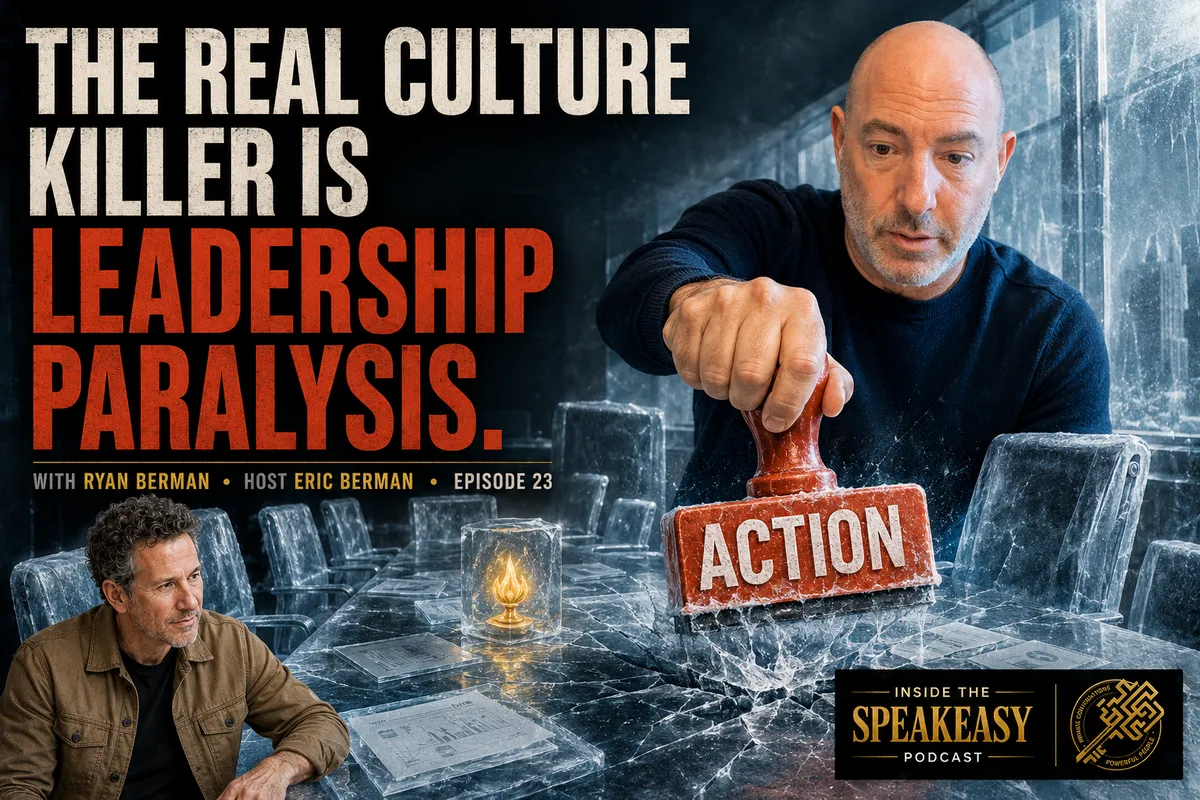
Ryan Berman, founder of Courageous and a self-described corporate fear fighter, now gets hired by companies such as Kohl's, New Belgium Brewing, and Caesars Entertainment to help leaders install courage in their teams. In this conversation with host Eric Berman (no relation), Ryan traces his path from a 700-person New York ad agency, where he secretly wrote Subway jingles, to co-founding a San Diego agency and then firing himself to follow the premise of his own book. He breaks down the three levers in his definition of courage, knowledge, faith, and action, and what happens when any one of them is missing. Ryan also explains why clear, operationalized values are the starting point for any company that wants to scale, why so much of the C-suite ignores emotion, and how pairing thinkers, feelers, and doers creates a stronger team.
In this episode, you'll discover:
- Ryan's three-lever definition of courage, knowledge, faith, and action, and what you get when one lever is missing: paralysis, recklessness, or status quo
- Why Ryan says you cannot be courageous when you are cloudy, and how clarity on values and purpose comes first
- The decision to leave the agency he helped build, with a family and a monthly nut, because the book he wrote demanded it
- Why Ryan believes about 75 percent of a typical C-suite sits on the analytical side while most decisions are made on emotion
- How thinkers, feelers, and doers aligned on shared values form the perfect team, and why "no feel, no deal" matters
Episode Summary
Ryan Berman and Eric Berman share a last name, a San Diego agency background, and roughly 15 years of friendship, but they are not related. Ryan opens by describing what his company, Courageous, actually does. He says he now gets paid to tell the truth, because so many people inside organizations know the right move and are afraid to share it. Whether the fear shows up as a "watch your back" culture, decision paralysis, or slipping relevance, his goal is to help leaders address and normalize it rather than suppress it. As he puts it, the only way to install courage in a company is to instill courage in its people.
Ryan grew up in Maryland, studied television and radio in upstate New York, and started his career at Messner Vetere Berger McNamee Schmetterer, a 700-person agency. CEO Ron Berger saw his writing portfolio and put him on the business development team, and it took four years to reach the creative department. The break came on a Subway road show, when Ryan, then in night school, wrote jingles that were presented without the client knowing they were his. After about six months of writing in secret, the client chose his Subway Jared campaign. He calls those first eight years a PhD in creative business.
At 29, Ryan planned to write screenplays and finished three scripts. A friend's invitation to San Diego, meant to be a three-month stop on the way to LA, turned into a new agency within a week after a healthcare technology lead came in. He grew that business to about 20 people, bought out his partner, merged with a social media and PR firm to launch i.d.e.a., and grew it to about 80 people over roughly a decade of six-day weeks. Looking to compete with LA and New York, he set out to write a book on courageous ideas, interviewing leaders including Method founder Eric Ryan, Steve Wilhite, Loretta Hidalgo, and John Assaraf.
The research changed his premise: courageous ideas die without courageous leaders. Realizing he could not write about courage without acting on it, Ryan told his partners the book was done and he was firing himself. That was 2017. After a two-year non-compete, he launched Return on Courage and Courageous in 2019. Early talks at Snapchat and Logitech led to an invitation from a friend at Google that grew to about 700 people on the invite and an order for 400 books, and Google then brought him to its own clients to teach how to operationalize courage.
Ryan says he spent six months finding a more useful definition of courage than the dictionary's. His answer is three levers: knowledge (think), faith (feel), and action (do). Knowledge and faith without action is paralysis, faith and action without knowledge is reckless, and knowledge and action without faith is numb, status quo work. Courageous applies this through two offerings, courageous leadership and change missions, with clients ranging from keynotes and workshops for the chief people officer's top 60 leaders at Kohl's to consulting with the CEO of New Belgium Brewing and work with Caesars Entertainment and Harrah's.
For smaller companies, Ryan's advice is to go back to values and make them tight and operationalized before adding people. At Courageous, the first value is sacrifice and the second is magic. He also encourages entrepreneurs to find partners who balance them, pairing thinkers, feelers, and doers. The conversation closes with his new book Headamentals, co-written with Dr. Suzy Burke and Rhett Power, the children's book Opposite Town he created with his kids, his upcoming book with soccer star Landon Donovan, and the value of the "collisions" that happen inside a mastermind like Speakeasy.
Big Ideas Discussed
Courage Needs Knowledge, Faith, and Action
Ryan argues the dictionary definition of courage, the ability to do something that frightens one, has little practical use at work, especially since he cites data suggesting only about 5 percent of people are wired to push through fear. After six months of research, he landed on three levers: knowledge is the think, faith is the feel, and action is the do.
The framework becomes most useful when one lever is missing. Knowledge and faith without action is paralysis, because talking about doing it is not doing it. Faith and action without knowledge is a reckless move, which Eric admits quick starts like him are guilty of. Knowledge and action without faith leaves people numb and working on status quo. Ryan even welcomes the nervous inner voice that says "this is crazy," calling it a data point that faith is present. He says he would love to see three questions on every brief: what do we think about this, how does it make us feel, and what are we going to do about it.
You Can't Be Courageous When You're Cloudy
Ryan uses a simple image to explain why clarity comes first: every business should know its North Star, but you cannot see a North Star on a cloudy night. He says clarity is a rarity, and companies need to nail their values and purpose before they can act with conviction.
For entrepreneurs who want to scale and add people, he says values must be tight and operationalized, because they shape hiring, rewards, and retention. He points to Patagonia, where every decision, including hiring, runs through its mission, and jokes that showing up to an interview in a Hummer means you have already lost. At Courageous, the first value is sacrifice and the second is magic, a reminder that decisions are emotional. Ryan acknowledges that some listeners will roll their eyes at core values, but he believes they have not yet realized how much those values matter.
Most C-Suites Underweight Emotion
Drawing on his advertising mentor's line that "you're not in advertising, you're in creative business," Ryan wishes more leaders understood what creativity can do for the bottom line. He notes that 80 percent of decisions are made on emotion, yet when he lists the roles in a typical C-suite, most of them live on the analytical side of the brain.
By his count, roughly 75 percent of the C-suite is analytical, with only the chief marketing officer and chief people officer closer to the emotional side. Ryan says he has not always succeeded in sharing this inside the mastermind, which is full of analytical minds who are excellent with data but can miss what moves people at home or makes them laugh. His shorthand is "no feel, no deal." For leaders, that means getting clear on the story coming from your lips, stepping into the audience's shoes, and thinking about the emotional outcome, whether peace of mind, relief, or confidence, that you bring to people.
Build Teams of Thinkers, Feelers, and Doers
Ryan's advice to entrepreneurs is not to try to supply all three levers alone. If you are strong on knowledge, go find your faith; if you are strong on faith, go find your knowledge or action. He says this is his favorite part of Speakeasy: the community creates enough collisions that, once you let go of fear and have the hard conversation, you find people who complement you.
He illustrates the point with a keynote he gave to top restaurant leaders in Florida. He asked for the thought leaders in the room, then said thought leadership does nothing without do leadership, and do leadership does nothing without feel leadership. The perfect team, he says, includes thinkers, feelers, and doers who are aligned on values and each bring their own expertise. Ryan also shares how a 90-minute call with Brad Costanzo helped him rework a talk on human intelligence for the American Advertising Federation in Pittsburgh, an example of the kind of collision that makes a mastermind valuable.
Questions We Answer in This Episode
How does Ryan Berman define courage?
Ryan Berman defines courage through three levers: knowledge, faith, and action, or think, feel, and do. He says that if you have all three, you are being courageous. Remove one and it becomes something else: paralysis without action, a reckless move without knowledge, or numb, status quo work without faith.
What does Courageous do for companies?
Courageous, the company Ryan Berman founded in 2019, helps leaders address and normalize fear so they can operationalize courage. Ryan describes two ways it works with clients: courageous leadership, which unlocks the potential of leaders and teams, and change missions, which unlock the potential of a business or brand. Clients discussed include Kohl's, New Belgium Brewing, and Caesars Entertainment.
Why did Ryan Berman leave the agency he co-founded?
While writing a book about courageous ideas, Ryan Berman concluded that courageous ideas die without courageous leaders. He felt he could not write the premise of a book on courage without acting on it himself. In 2017, already married with young children, he told his partners the book was done and that he was firing himself.
Why does Ryan Berman say core values matter so much?
Ryan Berman says you cannot be courageous when you are cloudy, so companies must be clear on their values and purpose first. For businesses that want to scale and add people, he says values must be tight and operationalized because they shape hiring, rewards, and retention. At Courageous, the first value is sacrifice and the second is magic.
What does "no feel, no deal" mean?
"No feel, no deal" is Ryan Berman's reminder that decisions are made emotionally. He notes that 80 percent of decisions are made on emotion, yet he estimates about 75 percent of a typical C-suite sits on the analytical side. He encourages leaders to think about the emotional outcome they bring people, such as relief, confidence, or peace of mind.
What makes the perfect team, according to Ryan Berman?
Ryan Berman says the perfect team has thinkers, feelers, and doers who are aligned on shared values and each bring their own expertise. His advice is not to try to supply every lever alone: if you are strong on knowledge, find someone strong on faith or action. He sees the collisions inside Speakeasy as a way to find those partners.
What is Ryan Berman's book Headamentals about?
Headamentals, which Ryan Berman co-wrote with Dr. Suzy Burke and Rhett Power, is about how leaders can crack negative self-talk. Ryan says the book offers four steps: the problem, the process, the practice, and the plutonium. Its core idea is that self-talk impacts team talk, so leaders who want to get ahead first need to understand their own head.
Full Episode Transcript
Read the Full Episode Transcript
Meet Ryan Berman, the Corporate Fear Fighter
Eric Berman: No fluff, no filters, just the raw strategies, personal stories, and mental models that move the needle. I'm Eric Berman. Now let's get into it. Welcome to Inside the Speakeasy Podcast. In today's episode, I am so fired up to bring a very good friend and a mentor of mine named Ryan Berman, who is the founder of Courageous. In this episode, you're going to get a sneak peek and learn a lot about some of the key things. He's actually getting hired to go speak at huge organization like Kellogg's, Procter and Gamble, Bausch + Lomb. Why is Ryan getting hired everywhere? To teach him his amazing things that he knows on courageous, how to get them to have more courage. Known as the corporate fear fighter. And he's going to show you some of the nuggets that he teaches others. My brother from another mother. That was good. Without the same last name, but no relation. My good friend, Ryan Berman. Ryan, I'm so stoked to have you. Welcome.
Ryan Berman: It's so funny because only in your world, and let's call this what it is, this is your world. I'm just happy to be a part of it. But any single time I meet anybody in Speakeasy, they're like, oh, are you related? And then you're like, no. Like, nowhere else. Nobody asked me that question. At every Speakeasy event, I was like, oh, are you Eric's brother? Are you his cousin? Are you related? You're like, you know, you would have.
Eric Berman: Been a great brother. I think we would have gone along well.
Ryan Berman: I think we still do get along well, right? The question is, I guess I'm little brother, right?
Eric Berman: Be a little. Oh, come on, you're killing me here. Yeah, I guess.
Ryan Berman: Well, you're the middle brother because you have an older bride.
Eric Berman: It'd be fun. We probably would have definitely fought a little bit, but we'd be cool now. We'd be good. Well, I'm stoked because more than anything, I've gotten to know you for shit. You and I known each other for about almost 15 plus years out when you came in San Diego from New York, and we'll talk about that crazy story. But the theme for everybody listening today, and it's so cool because we're going to take a little bit of a different spin. I think people need to know this. They're not hearing it enough now more than ever, really. It's the theme around, really, you and your brand, which is courageous. And we're going to thread that and talk a lot about courageous, what it means, and some of the massive corporations you talk to out there, I mean, just to kind of plant seed and we'll get into this in a minute. I mean, you out there on stage, you're getting hired. Some of the biggest names out there, right, It's Bausch + Lomb, Kraft, Kellogg's, Tropicana, some of the biggest football teams, because they all are afraid. They all need to level up their courage more than ever, right? They. You install courage in these companies. Is that correct?
Ryan Berman: That's. You got it, man. And it's really. I've been on a journey, you know, we all have. And I now say I get paid to tell the truth. And it wasn't that I didn't get paid to tell the truth before. It's just the amount of, like, lip biting that's going on where people know the right move and are afraid to share it. And that is the real business. As we say, we're corporate fear fighters. Like, what is the largest fear you have in your business? Right? And what fear is festering in your business? Is it a personal fear? Like, are you in a watcher back culture versus a got your back culture? Is it a fear of decision making? You've got so many choices and you don't know which door to go through. Is it like, fear of a lack of relevance or your relevance is slipping? So any place where fear might show up in the organization, what we're trying to help our leaders do is not suppress that fear, but to address it and not be so afraid of it, but, like, normalize it. And I think that's the beauty, Eric, for us, is that because we're seeing every vertical under the sun, we can say confidently, like, you're not alone. Like, it feels alone. It can be really lonely to be the leader, but you're not alone. Like, every company right now is dealing with some, you know, wild amount of fear, and it's causing paralysis in some of the companies that we love. So we try to just be their best friend. We do have a process on how to, like, actually helping them operationalize courage. Yes. The amount of times I've said the only way to install courage in a company is to instill courage in your people. And there's different ways you can go about doing that, and it makes work really fun. Although, you know, we both have little kids, and I love San Diego, but a lot of our business has me on the road. And so it makes me a little sad that I'm, I'm going to hear, daddy, you were never home. I'm going to hear that. And that hurts. That hurts a little bit.
From DMV Kid to the Mad Men of New York
Eric Berman: I'm going to dig a lot into courage. I want to go a little bit back at the beginning because you and I met on the battlefields of being. Somehow we've convinced ourselves that maybe it was fun running a digital agencies out in San Diego. I think there's been many regrets from time to time, but you know, it's all part of a journey. So you were, I mean you did some courageous things along the way and looking back in your life and some things you regret, some things you didn't, some big decisions. And then we're going to really dig into what you're seeing in the big corporations in a minute. But starting with you grew up in the, on the east coast, right? Washington. And then you went off to New York and then came to San Diego. And tell me about your journey real quick on how you got to where you are today.
Ryan Berman: Yeah, I mean I'm a DMV kid. Those who don't know what the heck that means, DC, MD, VA is called the DMV. Grew up in Maryland was an awesome place to grow up because when I was growing up there was only one real screen and on that screen were three real channels. And when you grow up that close to Washington D.C. national news, international news was your local news because everyone around you, you know, worked in D.C. or politics or were lawyers or doctors. It was an awesome place to grow up. It was being cultured and knowing what was going on was very much important in our family. But you weren't like scattered like we are now and there's 18 screens going on and you have a like a goldfish for attention span. It was a great place to start. And let's see, I went to college in upstate New York, television radio major and moved to New York City. My first mentors were all the crazy Mad Men. My first. And it was awesome. Honestly. I was at a 700 person agency called Messner Vetere Berger McNamee Schmetterer.
Eric Berman: And what's really like the show, huh? There's a lot like the show.
Ryan Berman: Oh it was, yes, it was a lot like the show. You were terrified to go into your boss's office. It actually forced you to like already it was a competitive environment but like it was a top three, maybe top four network on the planet. And you hear you are as a 22 year old kid, you realize how lucky you are to start your career there, but you want to make a name for yourself and you want to figure out a way. Like, I was like, I am going to stay, whatever. I will live here if I have to. Like, yeah, that's how committed and competitive I was. And then you collide into all these amazing writers and thinkers on how to, like, just tell us the same story. But my first four years there, Eric, I remember someone, I came out of school with a portfolio as a writer. And the CEO, Ron Berger at the time, looked at my book and was like, we need a writer on our business development team. And I'm like, yes, I'll take it. And it took me four years to get into the creative department. And I, I sort of describe it like, imagine getting into the college you want but not getting your major at first. Four years to work in. And now looking back that those four years taught me business. Ron Berger also used to say, you're not in advertising, you're in creative business. And that always stood what stuck with me too. I've always seen myself as a creative business guy. I'm not a, I'm not just a creative and I'm not a business guy. It's a Being in the creative business. Businesses was my learning ground.
Secretly Writing Subway Jingles
Ryan Berman: So. So imagine four years in, I'm working my way up on one side of the business, on the management side, and I'm at a road show in Arizona for Subway. Okay. This is like a 13 city tour to go see the franchisees and to showcase the latest campaigns and the creative directors of Subway. Here I'm in school at night to be a creative. And they're like, Ryan, client wants to see jingles. We heard you're in night school. Do you want to take a cut at it? You know, you're like, yeah, I do. And they're like, it's like a Friday. They're like, great, straight. What'd you have on Monday? And I remember, like, the first one I presented was, it was a gospel because it was about the bread. Rising. It's rising. Oh, yeah. All different types, right? This is why I don't sing, right? But they looked at me like I had 10 heads and I ended up presenting four or five. They liked all of them. They realized that I couldn't present the work because I was running the business. So like, okay, here's what we're going to do. You have to run the business. We're going to collect all of the work from all of the writers and we'll Present it that way the client doesn't need to know. And so I'm in the room as they're presenting my jingles that they can't know. I wrote and like first for the client picked were all mine and you're like, okay, this is going well. I think this is going well. So it took about six months of me writing and the client didn't know and. And they ended up picking my Subway Jared campaign where Jared finally spoke on camera and I was on set writing for another client when I got the call that I had been redirected from Toronto to LA to go shoot the campaign. And I was officially a creative and I could turn in my button downs for T shirts. And so my first eight years was like four years on one side of the business, four years on the creative side. And it was an awesome learning ground. It's like getting your PhD in creative business. It gave me a lot of confidence actually to then I'm like, well, now what? Let's start to study longer story structure.
Courage as Regret Insurance and the Move to San Diego
Ryan Berman: So you know, you mentioned the word regret earlier and the amount of times I've said courage is regret insurance. I do think that's true. My initial plan was to write screenplays and I'm 29 at the time and in my head I have this little quip that I keep telling myself I'd rather entertain 2.2 million people and have 2.2 kids. And I go to I'm now in night school for longer story structure. I ended up knocking out three movie scripts. I think the stories are good, but the dialogue needs work. My best friend and his wife had moved to San Diego after 911 and she, my buddy's wife was a strategist. She basically said, hey, why don't you come out here? I'm trying to turn a photography studio into a branding firm. Why don't you help me do that? And the deal was I was going to live rent free with them for three months, be inspired by the beach, tighten up my scripts and go to la. And I think I was here a week. In the first week we got a huge new business lead from a healthcare technology business. We end up landing the business, the two of us end up starting our own with this client. And it's four of us out of a house is how we start. And. And it was kind of one of those things where it's like, follow the opportunity. Like, oh my gosh, like, how do you say no to this?
Eric Berman: Yeah.
Ryan Berman: And so the next six, seven years of my life was growing an agency and Saying yes way more than we should have because we had to say yes because no one was investing in us.
Eric Berman: You're on the hamster wheel now. You don't grow up saying, I want to run an agency. You back into it. Exactly. Through a story, like you said. Next thing you know, you're like, you're chasing the right.
Ryan Berman: And so I hear boys, but I.
Eric Berman: Got to cover right now. Oh, shit. Yeah, we could do that.
Ryan Berman: So we. We got to about 20 folks there. I ended up buying her out again. Television, radio, major, had no business in business. I feel like now I've done the business bingo card. Then I merged.
Eric Berman: I mean, at this point, I mean, are you frustrated because you had this dream of writing scripts and you're, like, bailed on L. A thinking it was going to be a quick journey. Now you're out here, you're like, I don't have time to think about that. I'm doing well and I'm joining this new thing.
Ryan Berman: Yeah. No, I'm so, like, locked in on, like, not failing. And, like, you know, I just. My roommates are like, fear and stubbornness at this time, like, how am I going to survive? And, oh, my gosh, we're actually doing this. And this is pretty cool. And we were kids and we had, like. And we had a good product, and so we just kept going and we kept our heads down and chopping wood and figuring.
Eric Berman: But.
Ryan Berman: And I always said to myself, like, you know what? I. La, will be there. Like, if there's another time for that. Yeah, there's another, like. And I have to do this now. And then you have families that work for you, and you want to, like, take care of those families. And they believe in your mission. They believe in what you're doing. It really wasn't until. But I was still grinding, man. I. Once we merged with the social media and PR firm and launched i.d.e.a., we took that to about 80 people. To be honest, it was probably a decade of six days a week. I will not fail. Where I finally was finally able to kind of get out of the day job and really focus on, like, I hired an executive creative director. I had hired a head of design. And so the calls that I were then getting were more like, hey, biz dev calls. Can you help us with this or can you help us with that? Yeah.
Writing a Book to Win Clients, Then Firing Himself
Ryan Berman: And at that point, I'm like, well, we're big for San Diego, but who kind of cares? It's like, we're like in tennis, no man's land. Like, not la. We're not New York and could we get there. And that's where we had landed on the premise of courageous ideas are the only ones that matter. And the original plan was I was going to go write this book and it was a devious strategy. Right. Interview all these companies that we wanted to work with. This would be the business card and make them look good in three years. And you hope that some of them are clients. And two things happen. One, I mean, I did go on the journey, but the first big insight from sitting with these folks, and I'm talking like Eric Ryan, who's the founder of Method. Steve Wilhite, who's hired by Steve Jobs to run Apple. Loretta Hidalgo, a founding astronaut.
Eric Berman: Well, I got to catch up with this, though, because I want to make sure I catch a story. So you're at the agency and you're thinking you're running it and you're saying, let me write a book on courageous as a way to fight this. Will give me in the interviews to. Essentially, it was a way to get new leads for business from the high clients.
Ryan Berman: So, like, again, like, how do we compete with LA and New York on creative ideas? And as I go out and meet all these amazing leaders, John Assaraf being one of them. Shout out to John, because John gave me his mind and his time, and I learned so much from him as well. He's also in the book The Big Aha. I was like, wow. Yes. I thought I was going in thinking courageous ideas are the only ones that matter. And I kind of came out of that journey going, oh, shoot. Courageous ideas die without courageous leaders and without the courageous leader. You have good luck selling the courageous idea now, Eric, you know, because you're with me in agency world, like when you're in the Kevin Bacon game and you're six degrees away from the actual decision maker, and that's sort of that view. VP of Marketing. And this is not to knock you if you're a VP of marketing, but like that VP of marketing, those reports into svp, of marketing reports into the cmo who reports in this, I felt too far away from the actual decision maker and there was too much fear. And so when I started to look at my own life, moving to New York City, starting my own business, writing a book. How do you do that? I've never done that before. And I actually was like, wow. I never used the word courage to describe the decisions I was making because I was just doing it now, like, then I'm studying and I'm like, wow. It was courageous of me to Become an entrepreneur. It was courageous of me at 30 to move 3,000 miles away from my family to California. And it was courageous to me as a 22 year old to end up in New York City. And then I'm like, how can I write a book about courage and stay if I know in my heart you kind of have to be courageous if you're going to write the premise on the book. I remember going to my two partners and at the time it'd be like, so the good news is the book is done and the bad news is I'm firing myself. Like it's time for me to go.
Eric Berman: I mean, talk about a courageous move right there. Shit. I mean, you're walking away from income, you know, you got a monthly nut family.
Ryan Berman: And at that point I, I was married and had little kids. And again, I'm not pretending to know. I wasn't pretending to know how I was going to turn out. I just knew in my heart that it was the right move for me. So that was 2017. At that point I felt, felt really good about the process that was laid out in the book on like, oh, wow, we have like the wrong idea of courage. We confuse it with like a reckless move. I think a lot of people confuse it with a resilient move and it's not either of those things. And again, that's. This isn't like Ryan Berman has jumped onto a soapbox. Like, this was what I learned from my leadership lab. Talking to people like John Assaraf, talking to people like Steve Wilhite.
Launching Courageous and the Google Talk That Proved It
Ryan Berman: And I didn't know when I launched. So in 20, so I had a two year non compete and in 2019 launched return on Courage launch Courageous. And I wasn't sure if it was going to be like, am I just going to go keynote and talk about the book? Is it going to be in another agency? Is it going to be a consultancy? And gosh, here we are, seven, eight years. I remember the first days just testing material and like Snapchat brought me in early. That was amazing. I did a talk at Logitech. I remember I had a friend who was running travel for Google in Atlanta. I had a keynote in Florida and I'm like, hey, I'm in Florida. Does it make sense for me to come up and share the book? And he didn't ask me, he just put it on the calendar and the next thing he knows, like 700 people on the invite from Google.
Eric Berman: No way.
Ryan Berman: Because people could like zoom in and he's like, oh yeah, you're on at this time, on this day, you know, we'd also want to buy 400 books. That was the one for me that I knew was my. You're almost testing and tinkering, and I'm like, that's my 400 level class. Like, if this goes well, we've got something. And I remember the talk. I remember still being nervous, and I remember that it landed and Google then ended up taking me with them to their clients to talk about how to operationalize courage and how you actually do it where you're not going to kill your company or do something reckless. And that's when I was like, okay, we've got something here. Let's. Let's see where this takes us. And, you know, as you mentioned, now we're working with all these crazy companies.
Eric Berman: That's amazing.
Owning a Word and Pushing Past the Doubters
Eric Berman: Okay, So I want to, I want to, you know, unravel that a little bit. So first of all, I think there's something brilliant. And again, it's obvious for people. Hopefully people get there. Hopefully it's obvious people listening here. I mean, what you also did is you took a word that is a word everybody wants to feel like they are or become. You almost kind of like you turned it into an adjective and a noun and everything all at once. And then you also put your brand behind it. I mean, we talk about, about branding. I mean, you're a branding genius. You know, at the end of the day, I mean, if you could be branded as the something guy or gal, you're winning. And you clearly have done that in the world of Courageous. And that, like you just said, I'm just visualizing back that email that went across in Google. It's like, hey, there's a speaker on Courageous. I'm in. Like, everybody wants to be more of what you are teaching. So there's a brilliance in that. I know you thought, I know that wasn't just by accident.
Ryan Berman: So, yeah, but there was many people that we both, you know, there's people in. There's people in Mastermind that when I first told them this, they're like, you can't sell courage. Like, I don't see it's not easy enough. It's like, it's too hard to sell people that we deeply care about that are like, so I don't say that to vilify anybody. I say that because at the end of the day, whatever path you choose, entrepreneur, you're gonna get so many no's. You have to have the conviction to believe. You know, again, imagine like at that point, I've come a long way since when we met. Right. Like, I've come a long way as the rock skips across the pond. Right. Like the first skips are very different than this version of me. And so I'm proud of me because I had conviction to go. No, I think there's something here. I have to follow this story more. I can't totally explain why, but something below the neck is telling me to continue to go down this path. And I think anyone that's probably part of this community has said that to themselves. Felt that you're going to be met by so many nos, so many doubters, so many non believers, which is not other people's faults too. They believe in other stuff too, right? To your point, yes. Now I hear a lot like, you're like, who doesn't want to be more courageous? And like, you know, courageous as a muscle. Right. If you're going to build your courage muscle. And I definitely think there's a connection between. You cannot be courageous when you're cloudy. Like, you know, we talk about in brand. I mean, every business should know their true north. Every business should know their. Their North Star. Well, can you see a North Star on a cloudy night?
Eric Berman: Right.
Ryan Berman: No. And so you can't be courageous when you're cloudy. You gotta be clear. And so again, I think that's where we start is like clarity is a rarity. How clear are you? Have you nailed your values? Have you nailed your purpose? It's still thinking through that. And if that you've deep conviction for that, then you kind of pass go on the monopoly board to what comes next. And it's like, okay, this is who we are. This is how we want to show up, you know, even for us, we say we're a courage company.
Knowledge, Faith, and Action: A Better Definition of Courage
Eric Berman: And that's a good segue because I really want to dig in deep because, I mean, I get to cheat because I know some of the answers to these questions. But, you know, I think it's fascinating, you know, what you're teaching. And I remember, you know, there's different levers. You and I talked about different stages. You know, you look at a corporations. All right, well, we got to stage one, two, three, where you at first, let's identify that. So can you talk a little about the different stages, levers and then like some of the, you know, tips of what you get into a little bit.
Ryan Berman: So the first six months of writing my book was just, could I come up with a better definition of courage? If you look at the dictionary definition of courage, it Is the ability to do something that frightens one. Okay, so if you're still here and you're listening, let's agree. What a surprise. Entrepreneur. You're probably in the 5% of people. Maybe it's even the 1% that feels the pressure and does it anyway. But let's say you grow. Let's say you get to 20 people, let's say you get to 50 people. So the science says 95% of us are freeze or fight. 5% Of us are fighters. So if you have a company of a hundred people, the Data says that 95 are not interested in doing something that frightens them. You've got five that are like pushing the boulder up the mountain. And the other 95, it's just the way they were wired. It's not. It's just human nature, right?
Eric Berman: Good or bad, it just is.
Ryan Berman: These are just facts, right? So this is the data. So I'm like, wow, the ability to do something that frightens you. Who wants to do that? Let alone at work, Right? And so I was trying to find a definition with more utility. And so where we landed after six months of asking these questions was, well, the first lever is knowledge, the second lever is faith, and the third lever is action. And how often have you known the right move? By the way, the data folks sometimes love this, sometimes hate this, because, no, I don't think you can wait for 100% of the answer from the data or you're going to get passed by a competitor. You see or you don't see.
Eric Berman: That's right.
Ryan Berman: So how often have you known something and then you have enough knowledge where you feel it too? And that's the faith piece, right? That's the conviction piece, that's the inner belief piece. And then now you know, and now you feel. But how often do you actually do. How often do you actually leap? So it's gotta be. There's gotta be knowledge, there's gotta be faith, and there's gotta be action. And if you remove one of the levers, then it's something else. So knowledge and faith without action is paralysis.
Eric Berman: That's right. Yep. Yeah. You know, you could do it. You've got confidence. You're not doing it. You're just thinking you're doing it.
Ryan Berman: You're like, we're like talking about doing it is not doing it. That's paralysis. Faith in action without knowledge is a reckless move. So [unclear] you believe. Let's have a little bit of data before we make that call.
Eric Berman: And us quick starts. Guilty. You know, Just like, all right, let's go. I feel good about it.
Ryan Berman: Ready, fire, Aim. Right. The whole.
Eric Berman: It's here. When you're smaller, when you're a big company, too, that's dangerous stuff. Yeah.
Ryan Berman: And then knowledge and action without faith. If you're numb on the inside and you're just going through the motions, you're working on safe, working on status quo. Right. If you don't feel anything, you're like, just another day. And look, let's call it what it was, Eric. Like, there were times with your last business that you kind of felt. I know. You felt like that numbness. You felt like. You're right. It's like, that was safe, that was status quo. So if you're not, you actually want that little voice that's like, this is crazy. Oh, my gosh, what am I doing? Like, that is this imposter syndrome? You want that little voice because that's just a data point, that there is faith in it. So the way we look at courage is knowledge is the think, faith is the feel, action is the do. And if you have knowledge, faith, and action, you are being courageous. Right. And if I saw that on every brief, I would be very happy. What do we think about this? How does it make us feel? What are we going to do about it? So that's what we do with our clients. Our process is knowledge gathering, faith building, and action taking.
Eric Berman: I love it. Okay. That's brilliant.
Inside Courageous Client Work at Kohl's, New Belgium, and Caesars
Eric Berman: And then once they're. Once you find a company, there's different stages you would go through when you teach them. One is just like, you know where they're at when it's about to product one. Walk me through the three different zones, sort of you see in the company.
Ryan Berman: Yeah. So. So there's really two ways we work with the client. One's called courageous leadership. So it's unlocked the potential of the leader or the team. And then there's change missions, which is. We're actually rolling up our sleeves and unlock the potential of the business or the brand. And, you know, it's the old meet them where they are. Like, so for some of our clients, I don't think I'm bringing any NDAs here. And if I am, we'll. I'll deal with that in a minute. But, like, two weeks, we're with Kohl's. Okay, we're with Kohl's. We're going to. We are hired by the chief people officer. She's amazing. They're going through so much change right now. Like, to me, this is just. I would call it an injection of courage. It's a. It's actually. It's inspiring courage. It's like a little drip in. We're just trying to inspire the people. We're almost putting down the Pepto-Bismol, coating that courage is possible with her team. Like, that's right. It's a keynote and a workshop, and it's like, your future is safe with change. You're not alone. Here's our definition of courage. How do we want to show up? Right? Like, let's start just to talk about this stuff that we don't talk about those it's courageous conversations.
Eric Berman: Are you typically talking to the leadership team or their employees at the staff? And it seems like step one is you got to get the leadership team on board, like you said earlier.
Ryan Berman: Both.
Eric Berman: Okay.
Ryan Berman: It depends. So, like, for example, New Belgium Brewing is another company we're working with, and it's. We're sitting with the CEO looking at all the ways that they can implement courage and have the conversations or make the decisions or inject different types of ideas inside the business to optimize and maximize the team versus Kohl's. It's the chief people officers top 60 or, you know, 60 leaders on her team. Right. And we're engaging in that conversation, and they're making that investment in those people. So you've got, like, workshop versus actual consulting. Very different. Then we're working with Caesars Entertainment specifically. Harrah's in town. You know this. We're working with [unclear] again. And that's a true courageous change opportunity, where we're looking at both, hey, how are we bringing this courageous idea to life? And how are we delivering at this, at the property level? So I'm kind of back to where we started, where I have my old mentor boss saying, you're not an advertising. You're in creative business. And I think if I'm a business leader, I wish more business leaders understood what creativity could do for the bottom line. And if you look at, like, how C suites are put together, you know, CEO, cfo, coo, cio, C chief security officer, chief tech officer. I've just rattled off six that live on one side of the brain. It's emotion. 80% Of decisions are made on emotion. You've got one chief marketing officer who's trying to rebrand as a chief growth officer, which I think is interesting. Right. And then you've got a chief people officer, CHRO. So it's like 75% of your C suite is still on the analytical side. When Decisions are made with emotion and creativity. So we're trying to get ourselves, hey, as a friend and an ally with that team, to remind them that it's still story and still what is the story coming from your lips? How clear is that story coming from your lips? Hey, here's why we're making this decision. Let's ivy drip this decision out and if we're clear, right, we have the knowledge and we're getting people to believe, then we could take action on that and people will buy in and stick around and hopefully we'll continue to be relevant down the line.
Why Values Matter Most for Growing Companies
Eric Berman: Amazing. I mean it's so cool to be able to talk to you because you played a different world of duck dealing. A lot of these corporate types and you know, see what you see out there. A lot of our listeners, some there and some are a little bit more of the, you know, the entrepreneur, smaller companies, some solo, some grinding with a, you know, staff of 10, 20. What kind of, what's the biggest sort of when you think of courageous, what are the biggest things you see that we're maybe not doing that should be more courageous? Like what would be the biggest advice you have for us?
Ryan Berman: I would say, and again, I'm going off my focus group is the San Diego, right? Yeah, the San Diego. Yeah, sure, Right. So I would say that if you looked at me as a, like a business mechanic and I just looked under the hood, it doesn't matter if it's a two person company, a 10 person company, a 30 person company, a 50 person company, I still see the same problem. So go back to your knowledge, faith and action idea. Right, let's look at that. The next question is, well, which, which knowledge should you follow? How do you actually build faith? Team faith and where should we take action? And where shouldn't we take action? So I think this is the time to go back to the basics and actually look at the values of the company. How valuable are the values? I actually think you're so focused on. Again, this is, I'm not saying this is not for. If you just want to stay a two person company and you're like we have revenue to add, this is probably not the advice for you. But like if you think you're going to get, if you're looking to scale and you want to get to, you want to add people, then these better be tight and operationalized. The only way to install courage, right, is you have to know your values. The core values to me are not eye rolls are now the exceptional role. But I'm Telling you somebody right now is listening to this and they're eye rolling because they, they haven't realized how important it is from a hiring standpoint, from a rewards and retention standpoint, assuming. And again, I'm not going to sit here and say get your product straight. Of course, get your product straight. But like, what I love most about a company like Patagonia is they're trying to save our human planet. Every decision they make is through that lens. Every decision hiring is run. Is this person really here to help us save our human planet or not? Yes. They need to be talented, of course. But it's like if you show up in a hummer on day one for an interview at Patagonia, you've already lost the interview. Unless it's one of the electric ones that's different. So I think where I come at it, Eric, is words really matter. The number one value at Courageous is sacrifice. So we're helping companies keep the most important thing. The most important thing. Right. Two is magic. Because decisions are made emotionally as much as we think not. I think that's the other thing. That's the other differentiator that I don't think I've done a really good job of sharing or being successful inside of this mastermind. It's so full of many analytical minds that are excellent at looking at the data and they're missing, well, what works with you at home, what makes you laugh.
Eric Berman: Right.
Ryan Berman: What makes you, you know, moves you is usually what moves us is it's not like numbers, it's a feeling where, yeah, you know, no feel, no deal. I always say, no feel, no deal. Right. So, you know, to me, the magic piece, it's helping, I think thinking through the emotional realities of how you collide with people and how you're like bringing them peace of mind or maybe you're bringing them relief or maybe it's confidence and making sure you're really stepping into the shoes of the audience and not just getting stuck between your neck and your brain, but really between your neck and your soul. And like, what's the emotional connection which is the world I came from? Right. Like, that's, I, that's what I learned from all the storytellers.
Eric Berman: I love it.
Thinkers, Feelers, and Doers on the Perfect Team
Eric Berman: And taking away some things you just said, which is obvious as you say it, it's like KFA doesn't matter what size you are. KFA formula works. All knowledge, you know, in action didn't matter. And so I think a lot of us probably, you know, you just mentioned a lot of are probably a Little bit K and A. We're all just taking actions on stuff. Some.
Ryan Berman: Here's the other suggestion. I would say, if you're a K, go find your F. If you're an F, go find your K or your A. Right? Like, to me, you don't have. Like, it's not about you doing this alone. And I think that's my favorite part about Speakeasy, frankly, is that there's enough collisions, right? Once you get out of your own way and you let your fear go away and you actually trust the process to have the hard conversation, the scary conversation with somebody, like, you're like, oh, my gosh, I want to work with that person. Like, that person gets shit done. They are an action. They're the action team, right? Wow. That person is. Their knowledge is off the charts. I don't think there's a knowledge problem in Speakeasy. Like, there's some brilliant wizards that are so good at looking at the knowledge, but the feel side, right? One of my little fancy keynote slides, I did this in Florida earlier this week was I asked the audience, are there any thought leaders in the House? You know, you could imagine the response. I'm like, I'm like, no. Like, raise your. If you're a thought leader, I mean, you're the. These are the top leaders in the restaurant business, and you're like, any thought leaders in the House. And then I'd get this, and I'm like, no, no, that's not courage. Like, this was courage, like, razor hit. And then I said, well, thought leadership does nothing without do leadership. Where are my do leaders? Who's a do leader? And their hands went up and I said, and do leadership does nothing without feel leadership. And so, like, so there's a role, like the perfect team. There's thinkers, there's feelers, and they're doers. They're aligned on values. But then they're each good at bringing their own little expertise, and they got.
Eric Berman: To be able to let everybody do what they're good at and trust each other that we're all going to do it together. We're all of a similar role. And let's. It's. We're all equal to that degree.
Headamentals and the Opposite Town Children's Book
Eric Berman: That's great. I want to turn over to Ryan, the amazing author, because you are an amazing author. I've, you know, gone through some of your books, and not just an author, but author of all types, which makes it really fun. And we're talking. You're writing a biography for the famous Landon Donovan. You have your own two Books that you've written. Courageous. And what was the other one? Headamentals.
Ryan Berman: This is, this is this guy right here that's coming out. So. So Headamentals comes out at the end of October and it's all about how you can crack negative self talk. And I think the more leaders we've spent time with, the more ironically it's a three headed monster. Right. There's three of us who wrote it, Dr. Suzy Burke, Rhett Power, and myself. And we've all seen all sorts of size companies and leaders and it's like if you want to move ahead, if you want to get ahead, the only way to do that is to understand your head. And so Headamentals it gives you four steps on like how to actually, you know, what's the problem, what's the process? Then we get into like practice and then the plutonium and I think the idea is self talk will impact team talk. Get the self talk figured out.
Eric Berman: You gotta love Ryan's names. You haven't figured out he's brilliant at. If you ever get the chance to come to a San Diego meeting too, he comes in there and people are talking ideas and Ryan just like listens all this shit. He's like, you gotta just say this and he just gets. Distills it to all the one or two lines. So that's a brilliant name.
Ryan Berman: Love that.
Eric Berman: And then when you get that done, let us know. We're all going to support you in the community. Community. Obviously you have the courageous book which is a great book. Everybody should be reading that as well. It talks a lot more what we're talking about. My child is a big fan of yours because you just sent me this book and signed it. She loved it. It was called Opposite Town. Such a cool kids book. What was the inspiration you and your kid put that together?
Ryan Berman: Yeah. So I have a 12 year old and a 10 year old and we just. I can share this on this show because we're all entrepreneurs, right? Yeah. So the way my brain works, it's like if I fester on an idea and I still and thinking about it the next day and then the next day they're like can I get the URL? You know it's like no, I can get the URL. So I bought oppositetown.com and we just started to create the world, that universe. And it was something that was fun that my kids and I did together. And you're born old, you die young and men carry the babies. And it's not storks, but it's the vultures that are bringing the babies. And maybe the kids are on the cell phones, but the grown downs are not. And you gotta short to ride this ride, right? Like, and again, 61 to drive. And so we just had a lot of fun. And the lesson, of course is, you know, I don't want my kids to fit in. I want them to fit out. Right. I want them to be themselves. And I think for adults, it's like sometimes the opposite happens in life. Like, think about how we started this convo. Like, I don't really have regret about the LA thing. Like, I'm very happy with my life. I love living in San Diego. I'm still wildly curious about content and like working those channels. Right. But like, I'm very happy to be in the courage business. And so sometimes the opposite happens in life for us adults and we're better off for it. So those are the lessons in the book.
Eric Berman: I mean, my kid's four years old. I think she's maybe just turned four when she read the book and she was laughing non stop. So anybody again listening? As kids you got to check out that book. Your child will get a big laugh from it. And then coming up, we even talk about this, maybe doing something fun at our event.
Writing Landon Donovan's Story
Eric Berman: But you are a huge soccer fan. Are you a huge sports fan? You and I, big Padre fan.
Ryan Berman: Yeah.
Eric Berman: Well, and then you have been able to really be a mentor slash, you know, author for Landon Donovan, famous World cup and soccer player. And you're working on his. The bio right now, right? Is it done and you're launching it soon or. Tell us about that story real quick.
Ryan Berman: Yeah, to be clear, like, I've learned more from Landon. I mean, he could be my mentor. When you're 15 years old and you're kind of being rag dolled across the world on behalf of U.S. soccer, right? His school was schooling, was going to Australia to play at the Olympics or playing at the under 17, you know, world cup in New Zealand and winning. Youngest. The globe's youngest player. Like, nobody knows. They went up against Germany and they went up against Brazil and he won. Like, I think it's called the Golden Boot, right? So I've learned like what an amazing human and what a life he's had. But I think most people who haven't had the luxury of spending time in Landon, they just, they know him as Landon Donovan and Landon Donovan is very different than Landon. And so the book is, yes, of course, we cover the rise of the duct tape soccer world that they all. He's lived in. But it's also a story about mental health and, you know, a lot of stuff that Landon. People don't know about Landon. I think they just assume he's, you know, another wealthy white kid that grew up and played soccer, but grew up with no dad. He would describe himself as American poor. His dad didn't show up really until soccer contract showed up. You can imagine those conversations. It is an honor of a lifetime to help him tell his story to the world. And, you know, again, I'm like, you said, I'm a big soccer fan. So it was also a pinch me project where I got to relive all of these stories and ask questions that any fan would want to with their one of their favorite players. I told Landon, I'm like, I'm a fanboy, Landon. Are you sure you want me to, like, be the one writing this book?
Eric Berman: My conversation when I walked into Brian Tracy's office and started partnering up with him, I'm like, [unclear], Brian, I'm a huge fan of yours. I get to work with you said.
Ryan Berman: Anyway, so that comes out in end of March with and again, the World cup being in America next year, and he's finally ready to tell his story. And there's a lot in there, man, and there's something crazy in there that I know people will be surprised by. And sure, we talk about his relationship, or lack thereof with Jurgen Klinsmann, who cut him. I'll bite my lip from there.
Eric Berman: Wow. Well, maybe we'll get to share the story and bring him out to a Speakeasy event someday, and that'd be awesome.
Ryan Berman: I'm all for it. Let's shoot for, like, you know, when the book comes out. Maybe April. I'm like 90% sure. I mean, I don't have, like, if he's not, you know, covering the World cup in America, I'll be super surprised. So if we do it, it'll have to be in April, but let's figure out a way to do an event.
Eric Berman: That'd be great for everybody listening. It'd be great to have him out at our big annual event if we can pull that off.
The Power of Collisions and Final Thoughts
Eric Berman: Well, as we wrap here, is anything I didn't ask. I should have asked for relation to all the amazing things you do right now and you're teaching.
Ryan Berman: No, I. How about I just thank you for doing what you're doing and honoring your courage? It's not a plug for my word. I think, you know, you've had to make some serious pivots. You're following what you think is the right move for you, and I think we're all benefiting from it. And you're the perfect personality for it, Eric, honestly, because, like, I know you're. It's in service of all of us, and you just want it to, like, continue to grow and go, but for the right reason. So, dude, mad props. I think a lot of us feel this way about you. We will support you any way we can. And, like, it's also very cool to see other markets see the value of what this is. And I can't think of a better word. I'll use a different C word, which was collisions. I think the collisions that happen at Mastermind. And for me, it's never that I need something right in the moment, but, like, then I'll be up against something that I don't understand. Like, I did a talk in Pittsburgh for the American Advertising Federation, and I. I called it. Hi. Hi. As in human intelligence instead of, you know, artificial intelligence. Hi. And the whole idea was, like, the five ways we can stay human. Our human advantage is what makes us different. And look, I've been friends with Brad with. For years. I should give him a shout out. Brad. I want to call him Costanza. But, you know, of course, on Joe. Yeah, Costanza, Costanzo. And Brad was my first call, and I was like, Brad, I'm doing this talk, like, what do I need to know? What am I missing? And like, the next thing you know, we were on probably for 90 minutes, just shooting it up, and you're like, wow, you're just surrounded by so many smart people and, like, talking about AI and he's teaching me in the moment. My talk's like, in 36 hours, and I'm changing my deck as I'm learning stuff from Brad. I ended up, of course, giving him some love in that presentation as well, letting the world know who he was. So that is the best part, is that whatever city you go to, nobody knows everything. I'm not going to pretend to be an expert in Brad's space. I learned so much just by sitting with him and the fact that he would even be willing to get on a call with me, like, at a second's notice. And, like, he is, like, amazing. So bravo to you. Keep the collisions coming and, you know, same thing here, over. I can help.
Eric Berman: I appreciate that. And you always are there to help me. And everybody listening as well. Please. Definitely do yourself a favor. Check out some of the amazing work Ryan has done. We talk about a lot of his books, a couple of books that are coming out, a couple of books that he's had. Plus if you're looking for a killer corporate speaker, somebody to come out there at any of your events or if you have friends that are big companies that need a big dose of courage and courageous, please call Ryan. Get to know him. If you're out in San Diego, come visit or come to a Padre game with us. We'll definitely have you come join us. Ryan, thank you so much for the time today. So great to see you as always.
Ryan Berman: Thank you brother from another mother. Appreciate you man.
Eric Berman: And that's a wrap from the Speakeasy Podcast. If something sparked for you, don't keep it to yourself. Share it, review it and pass it to the one person who needs to hear this right now. Want in on the real mastermind? Tap the link in the show notes to apply until next time. Keep scaling, stay sharp and don't be the smartest one in the room.

About The Guest
Ryan Berman
Ryan Berman is the founder of Courageous, a San Diego-based change consultancy that helps leaders and companies operationalize courage, and the author of Return on Courage: A Business Playbook for Change. He began his career at the New York agency Messner Vetere Berger McNamee Schmetterer, where he worked in business development and then as a creative, including on Subway's Jared campaign. After moving to San Diego, he co-founded the creative agency i.d.e.a., which he says grew to about 80 people, before leaving in 2017 and launching Courageous in 2019. His talks and programs have reached organizations including Google, Snapchat, Logitech, Kohl's, New Belgium Brewing, and Caesars Entertainment. Ryan co-wrote Headamentals, a book on cracking negative self-talk, with Dr. Suzy Burke and Rhett Power, created the children's book Opposite Town with his kids, and is writing a book with soccer star Landon Donovan. He is part of the Speakeasy Mastermind community.



