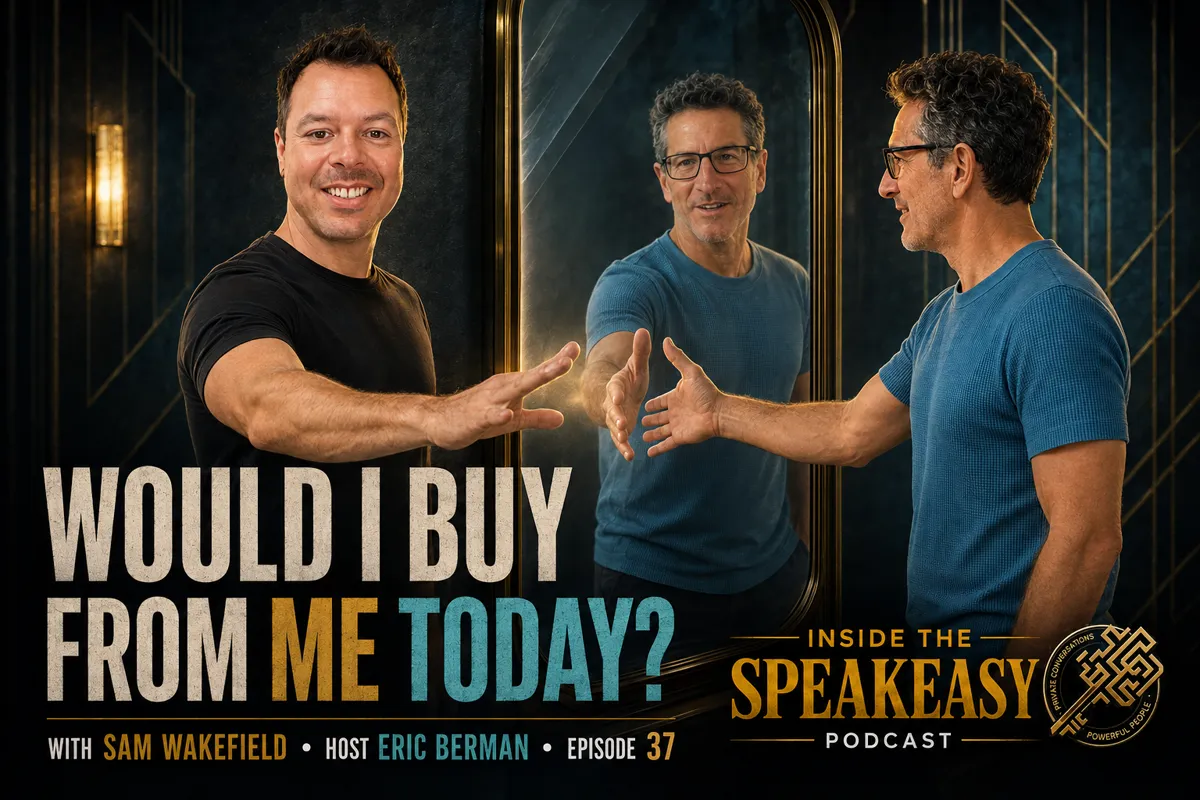
Sam Wakefield, the home services sales trainer behind the Close It Now podcast, started out as an attic rat pulling ductwork in the Texas Panhandle and nearly died after a loose live wire caught his arm. In this conversation with host Eric Berman, Sam explains how he moved into sales with nothing more than a stack of leads and a price book, helped grow one company from about $750,000 to $1.2 million, and later helped grow another HVAC company from two and a half million to over eight million in about three years. He shares why he teaches identity before scripts, the six parts of his Wheel of Success, and the mirror question every salesperson should ask before leaving home. Sam also explains how he built his coaching business without spending money on advertising, the podcast strategy that earned him a speaking slot, and the simple word swap that gets people to say yes.
In this episode, you'll discover:
- Why Sam had a full-length mirror by every door of his company with a sign asking, "Would I buy from me today?"
- The six components of Sam's Wheel of Success, and why he says sales skills are actually the least important
- How using drive time as Drive Time University over a 15-year career can add up to the equivalent of three PhDs
- The interview series Sam ran with an event's speakers that led the founder to put him on the sales panel
- Low-cost guerrilla marketing ideas, from free donut days to co-branded pizza boxes, and why to replace "interested" with "open"
Episode Summary
Sam Wakefield's path into sales began about 20 years ago, when he married his wife, who had a master's degree in library science, and moved to the small Texas Panhandle town where she worked. He took a job as an attic rat pulling ductwork in a town of about 13,000 people. A couple of years in, a loose live wire caught his arm in a 140-degree attic, and a coworker had to kick it off him. Between that scare and what the work was doing to his guitar-playing hands, Sam quit, until the owner called him back to take over sales.
His sales training, he says, was a stack of leads the last guy didn't call, a price book, and an instruction to go make money. Within about a year of Sam taking over the sales role, the company went from about $750,000 to $1.2 million. He bought in as co-owner, opened a home performance side of the business, and exited five years later when he moved to Austin. There he became sales manager and sales trainer at a young HVAC company and helped grow it from two and a half million to over eight million in about three years, before Covid. When private equity bought the company, Sam was already earning more from coaching than from selling, so he moved on. After three years in solar, he returned to HVAC, and since mid-2023 he has focused fully on helping home services companies grow.
Sam says most home services owners had what he calls an entrepreneurial seizure: they are good at fixing or installing the thing, hang out their shingle, and then hit a ceiling. What sets his training apart, he explains, is a focus on identity. Every episode of his podcast ends with the line "work to become someone worth buying from," and his own company kept a full-length mirror by every door with a sign asking whether you would buy from you today. If a salesperson keeps hearing the price objection, Sam's first question is how they shop themselves.
His philosophy is that sales is not the performance of an hour, but the overflow of a life. He teaches a six-part Wheel of Success: sales skills, which he calls the least important, a spiritual journey focused on living in alignment with your values, personal growth, relationships and communication, nutrition, and fitness. He cites Zig Ziglar's line that personal growth is like taking a shower, encourages people to treat windshield time as Drive Time University, and starts beginners with Brian Tracy's The Psychology of Selling. Eric, who mentions he is business partners with Brian Tracy, says he will pass that along. Sam notes that top performers often rate themselves lower than low performers do, and recommends a personal self-audit against a level 10 for each category.
Sam says he has never spent money on marketing or advertising. Inspired by a Gary Vaynerchuk book and a value-first approach, he started the Close It Now podcast when there were fewer than 200,000 podcasts, recording early episodes on his phone while driving between appointments. Six months in, a listener emailed to say he would pay whatever it cost to be coached, so Sam opened his coaching program, and more recently a wave of requests led him to add leadership coaching. With around 260 episodes and a rank in the top 1.5% of podcasts globally, his advice is to be consistent, ignore the gear, and never hold back the real content. When a new trades event came to Austin, he interviewed its founder and then about 60% of its speakers, and after about 12 interviews the founder put him on the sales panel.
Sam closes with practical guerrilla marketing ideas from his free guide at the Door 2 Door Institute, including partnering with a local donut shop and buying a pizza place's next load of boxes in exchange for adding your logo. He recommends swapping "interested" for "open" when pitching an idea, urges listeners to work harder on themselves than on their business, and issues a challenge to look yourself in the eyes in a mirror for a solid hour. He describes his Speakeasy Austin chapter as his monthly recharge, a place where entrepreneurs can be vulnerable and honest with people who have been through the same journey.
Big Ideas Discussed
Would I Buy From Me Today?
Sam's core teaching is that customers respond to who you are before they respond to what you say. In his own company, a full-length mirror stood by every door under a sign that asked, "Would I buy from me today?" If a salesperson could not answer with an affirmative yes, Sam says they should stay home, because if you wouldn't buy from you, homeowners won't either. As he puts it, your energy introduces you before you ever knock on the door.
He applies the same idea to objections. When a salesperson says they keep hearing that the price is too high, Sam asks whether they ask for discounts or buy premium when they shop. When someone complains about customers getting three bids, he asks whether they get three bids themselves. In his view, the objections we hear often reflect how we buy, and scripts and objection handling can only take a person so far before the internal work becomes the real needle mover.
The Wheel of Success
Sam teaches a six-part Wheel of Success: sales skills, spiritual journey, personal growth, relationships and communication, nutrition, and fitness. He calls sales skills the least important, pointing to the person everyone in a room identified as the best salesperson, who said he could be number one in a new industry within about a month. The reason, Sam says, is identity: he believes he is a closer. The spiritual component is not about a specific religion, but about whether you are doing the things you know you should be doing in alignment with your values.
For personal growth, Sam leans on Zig Ziglar's comparison to taking a shower and on the statistic that using drive time well over a 15-year career equals three PhDs. On relationships, he asks whether you expect everyone to adapt to you or recognize that if you are the common denominator, you need to change. On fitness and nutrition, he says keeping small commitments to yourself, such as working out four times a week, builds a confidence that is hard to generate any other way. Rather than prescribing one weak area, he recommends rating yourself against your own level 10 in each category.
Building a Business Without Ad Spend
Sam says his business was built intentionally on a value-first approach. He started his podcast because members of his own sales team told him more people needed to hear his training, and for the first 20 or 30 episodes he simply recorded voice memos while driving between appointments, with turn signals and rain in the background. His plan was to put out value until someone raised a hand. Six months in, a listener emailed to say he didn't care what it cost and wanted Sam to coach him.
He used the same approach to earn a speaking slot. When a new trades event was coming to Austin, Sam invited its founder onto his show, then systematically reached out to the event's speakers, interviewing about 60% of them under the title Profit Rocket Speaker Series and sharing each episode in the founder's Facebook group. After about 12 interviews, he asked to speak, and the founder put him on the sales panel. Sam's broader podcasting advice is to stay consistent, not get stuck on equipment, and give away real content instead of holding back 60 or 70 percent for a paid program.
Guerrilla Marketing and the Power of "Open"
Sam focuses on low-cost ways for local businesses to become what he calls five-mile famous. One idea is partnering with a local donut shop for a free donut day, which costs little, brings the shop more customers, and lets your team meet people face to face. Another is offering to pay for a pizza place's next load of boxes if they will add your logo next to theirs. He argues that as more buying moves to AI and one-click purchases, people are starved for interpersonal connection, and building relationships in person changes results dramatically.
When pitching ideas like these, Sam says to lead with what's in it for the other person and to drop the word "interested" from your vocabulary, because no one can be interested in something they don't know about yet. Instead, ask whether they would be open to some more information. Because nobody wants to be seen as closed-minded, he says, you are almost always going to get a yes, and your only ask is for information. Eric calls the swap of "interested" out and "open" in a great nugget.
Questions We Answer in This Episode
What does Sam Wakefield mean by "work to become someone worth buying from"?
Sam Wakefield ends every episode of his Close It Now podcast with that line. He believes customers respond to a salesperson's identity and energy before the pitch, so he asks salespeople whether they would buy from themselves today. If the answer is not an affirmative yes, he says they are not ready to go into the marketplace.
What is Sam Wakefield's Wheel of Success?
Sam Wakefield's Wheel of Success has six components: sales skills, spiritual journey, personal growth, relationships and communication, nutrition, and fitness. He says sales skills are actually the least important of the six. He recommends a self-audit that rates each area against your own picture of a level 10.
How should salespeople handle the price objection, according to Sam Wakefield?
Sam Wakefield starts by asking how the salesperson shops. If they ask for discounts instead of buying premium, or always collect three bids, he believes that energy carries into their own sales conversations. In his view, scripts and objection handling only go so far until the salesperson does the internal work.
What is Drive Time University?
Drive Time University is the idea of using time in the car to learn instead of zoning out. Sam Wakefield says that over a 15-year career in outside sales or any role with drive time, using that windshield time to learn is the equivalent of three PhDs. He starts beginners with Brian Tracy's The Psychology of Selling.
How did Sam Wakefield grow his business without paying for advertising?
Sam Wakefield says he has never spent money on marketing or advertising, and that his growth has been strictly organic through his podcast. He followed a value-first approach, and six months into the show a listener asked to be coached, which led him to open his coaching program. More recently, requests from listeners led him to add leadership coaching.
How did Sam Wakefield use his podcast to land a speaking slot?
When a new trades event came to Austin, Sam Wakefield interviewed its founder and then reached out to about 60% of the event's speakers to preview their talks on his show. He shared each episode in the founder's Facebook group. After about a dozen interviews, he asked to speak, and the founder put him on the sales panel.
Why does Sam Wakefield recommend replacing "interested" with "open"?
Sam Wakefield says no one can be interested in something they don't know anything about yet, so asking if someone is interested usually gets a no. Asking whether they would be open to some more information almost always gets a yes, because nobody wants to be perceived as closed-minded. From there, he leads with how the idea benefits them.
Full Episode Transcript
Read the Full Episode Transcript
Welcome and a Top 1.5% Sales Podcast
Eric Berman: Welcome to Inside the Speakeasy Podcast. The private room where today's sharpest founders, innovators and renegade thinkers come to trade the ideas that move industries. This show is brought to you by HighLevel, the AI driven business operating system trusted by over 2 million businesses to help automate, scale and create real leverage. High Level isn't just a tool. It's the engine behind some of the most agile and high performing teams on the planet. If you're ready to streamline everything, amplify your reach, and actually build a business that works for you, you're in the right place. Visit www.gohighlevel.com/speakeasy-mastermind-promo to get an exclusive 30 day trial for being a listener of the Inside the Speakeasy Podcast. Enjoy the show. Welcome to Inside the Speakeasy Podcast. Today's episode, we're going to learn how you can absolutely crush sales and convert with identity and authenticity without being pushy or using manipulation. I know, we all like that. Plus, we're going to get into how Sam Wakefield, our guest, was able to actually do 20 years of sales and marketing, crushing his business and without having to spend money on sales, marketing and doing all through podcasting and other guerrilla marketing tactics. And he's going to share some of his nuggets and big wins. Welcome to the show, Sam Wakefield out of Austin.
Sam Wakefield: Yes, sir. Thank you. I appreciate the honor to be here, man.
Eric Berman: Yeah, no, it's great. I love our amazing Austin chapter. So stoked to have you in today and man, we got lots to talk about and I know, in fact, we were talking in the green room and you've been in podcasting for seven years. Seven. Over seven years. And you're now at a 1.5% global in the 1.5% of overall global podcast for your Close It Now podcast. Is that right?
Sam Wakefield: That is, yeah. Absolutely true.
Eric Berman: Damn. Okay. I mean, I just want to plant that seed and maybe open that loop and we'll close in a little bit because I want to hear how you got that podcast going. Seeing as though I'm like Episode, I think this is Episode. Who knows, maybe I got to do a quick math, but probably around mid-30s, so I got a long ways to go here. So thanks for coming in and you know, I'm hoping to get to that point. So I'm excited to talk about that. But you do a ton in the sales and marketing. But let's talk about your niche and you've crushed it because your niche, for those that don't know you, is all really the home services category. And you've been doing all your success by, you know, just crushing sales for everybody in that category. And you're one of the leaders in that category. How did you. Let's just give you a little background, like how did you fall into this world? And I want to get into all the team things you've been doing.
From Attic Rat to HVAC Sales and Co-Owner
Sam Wakefield: Yeah, so that's a great question. It's actually a funny journey. You know, I started years ago as. 20 Years ago I just, I married my wife. She was a career, had a master's degree in library science. And when we got married I was like, I just work jobs, so I'll just move where you are. And got to, you know, move to the city where she was at and established. And I've initially I got into the industry because I just needed to work and barely starting my personal growth journey. So I started out as an attic rat pulling ductwork in the hot Texas panhandle. This little teeny tiny 13,000 person town. And didn't know what I didn't know at the time. And so did that for a couple years. I actually almost died in an attic one day. Came across a live electrical wire that was just loose in the attic. Caught me on the arm and the guy next to me had to kick it off of me.
Eric Berman: Oh my God. I don't know what happened. Is this wire like sit there buzzing and you're frozen or what goes on there?
Sam Wakefield: Yeah, yeah. So if, for anybody, if you've not.
Eric Berman: [unclear], by the way, bonus tip. So if you hit a live wire. Yeah. What do we do?
Sam Wakefield: Yeah, yeah. So electricity, if it's a strong enough current, it locks your muscles up and you can't move. And so because it was mid afternoon, it was about 4 o' clock in the afternoon. We'd been in 140° attic all day. So it's literally like you jumped into a swimming pool with your clothes on. And so we're soaking wet, sweating and when it hit me, it just connected right here in the arm, it connected conductivity and I just couldn't move for a second. And thankfully the guy next to me realized, thankfully he was there and realized what was going on. So, you know, kicked it off of me. And it was short enough time that no real damage was done other than mentally. And so I transitioned pretty quickly out of the installation segment of that into did some service [unclear].
Eric Berman: This is not for me. I have something better in store for me.
Sam Wakefield: Yeah, well. And at the same time, you know, I play guitar Always have. And, you know, was killing my hands. I couldn't play and all those types of things. So moved in, actually quit the company. The owner called me back a little while later and said, hey, I know that my brother who's doing sales, he's leaving, so I need somebody to do sales for me. Come back. I know you're not going to underbid the labor because you did it. And so it started out. My sales training at first was here's the stack of leads. The last guy didn't call. Here's our price book. Go make money. I didn't know anything, so I just started dialing for dollars. And so fast forward into a year later. I actually, when I stepped in as sales, the company tiny town, of course, the company went from about 750,000 to 1.2 million strictly by me taking over the sales role. And then the owner was like, hey, let's do something. So I actually bought in and became co owner. We opened the home performance side of our company. Five years later, I took an exit from that is when we moved to Austin. And then I found a new, new small company to work with. Talked to the owner, became the sales manager, sales trainer there. And we help him grow it from two and a. We were about two and a half years old. So we grew that HVAC company from two and a half million to over eight million in about three years. And this is pre Covid numbers. For anybody that knows, Covid was the biggest boom that ever happened in home services. And everything completely changed then. So those numbers a little more impressive typically.
Eric Berman: Yeah.
Sam Wakefield: And then he took an exit. And at that time I decided that I did not want to work for the large private equity organization that bought that company. And I'd also started the podcast and started coaching. So I was actually earning more from my coaching than I was from being in the field selling at the time. So I said, okay, no problem, I'll just move on. And that really is where it started my journey into coaching and training and podcasting. And since then I spent three years in solar and came back to the HVAC industry. And for mid 2023, this is 100% of what I do is help companies explode their numbers.
Eric Berman: Wow, okay, that's impressive. I love the journey and good for you, you know, school of hard knocks. Getting in there, grinding in and nothing better than just somebody. I love talking to people just like door to door, they were grinding, they figured it out, they worked those hours. And that's how we started.
Sam Wakefield: There's not a Single thing that I trained that I don't have a backstory of the is the ask me how I know moment because I made the mistake.
Inside the Home Services Industry
Eric Berman: Yep. I want to kind of create, paint a picture more macro. Then I want to get go in the weeds a little bit. The HVAC industry. So talk us through for context because I want to hear sort of the before state and after state. So who are the customers in the HVAC world that you're dealing with? What's typically the world, their world, like before they run into a Sam Wakefield and have the skills that you teach them?
Sam Wakefield: 100%. Yeah. So, hi, you know, for context, you know, there's 60,000 heating and air companies across, just in the United States alone. And so. And then of course, the podcast is listened to in over 70 countries because everyone around the world wants to either, you know, warm up or cool off when the temperatures outside get wherever they get. And so when I'm working with companies or individuals, typically what happens in that world, and this is either HVAC or any other home service and you're.
Eric Berman: Not doing just HVAC. And I wanted to make sure the HVAC and then what other types of brands would be closest align that you're talking to?
Sam Wakefield: Yeah, absolutely. So it's. So it's HVAC, it's plumbing, it's electrical, garage doors, gutters, solar roofing, irrigation. If somebody serves a home and improves a home at all that the conversation is the same, you just change the widget out.
Eric Berman: Got it. Okay, good. Thank you for that. All right, so now you're the typical situation they're in. Go back to that. Yep.
Sam Wakefield: Yeah. So normally, especially in that type of world, it's pretty easy to start a company. So what's happened is most owners had an entrepreneurial seizure at some point. They hung out, said, I want to do this for myself, hung out their shingle. And they're good at fixing the thing or installing the thing. So. But then they can only grow to a certain point. So frustration hits, sets in. They've maybe built the team and had these roller coaster of type of experiences, but they know there's so much more. So that's where I step in, help them develop their systems, develop their an actual process. Most people don't even have an actual process.
Work to Become Someone Worth Buying From
Sam Wakefield: But how I'm very, very, very different than your 90% of your trainers out there. We focus more on identity. And every single one of my podcast episodes, I end with work to become someone worth buying from. Because so in my company, we had a full Length mirror by every door with a sign over that said, would I buy from me today? And if, when I'm working with these companies, if you can't answer that question with an affirmative, hell yes, I would buy from me. Stay home. Because it's pointless to go out into the marketplace and try to work with homeowners. If you wouldn't buy from you, they're not going to either. So we read the energy of the conversation by becoming the person of character that the people, that people just naturally want to work with, which is very unique and different in a very blue collar type of a space.
Eric Berman: So it's almost like you're starting really more the personal development side and creating this image of that friend, that person that I feel that trusted authority of somebody that could feel, I mean, it would be, I assume, something that people want to buy from somebody that feels more, you know, more trusting, more, More relatable.
Sam Wakefield: Yeah, you got it. You know, and the thing I mean, you know, it's my business is sales training people. They buy what they want and I give them what they need, right? They, you know, they're here for better, you know, better outcomes, better sales numbers, you know, better close rates, better average tickets. But then I show them along the way that you're only going to be a certain level of successful by learning a script and practicing a script or learning how to handle the. Your price is too high objection. Or I'm getting three bids, objection. You're only going to see a certain level of success until you go to work on the real needle mover is the internal work. When people come to me with objections, they're like, oh man, I'm always getting this objection. So for example, if Eric, if you came to me like, man, I'm always getting the price objection. You know, and I'm like, okay, so my first question to you is, well, how do you buy when you shop for things? Do you ask for discounts or do you buy premium? If you're like, hey, I've always see the three bids. Objection. My first question is, well, when you do this type of work, how do you shop? Are you three bids, right? And so because we don't realize we're literally leading the conversation with our energy. Your energy introduces yourself before you ever knock on the door.
Eric Berman: Love it. It's important to talk. And one thing is that, that we're talking about here I am imagining is stuff that, yes, you're doing it for your industry, but we could do these tactics you're teaching. You're going to Talk about today. I mean, you're. I could already sense that is for any kind of area, right?
Sam Wakefield: Absolutely, yeah. In fact, within our Speakeasy here in Austin, I've done a couple sessions with one of our other members, Jason Hall, for his property management company. I've done a session with. With my digital marketing company that actually built my website. I volunteered and did a couple sessions with their sales team strictly for helping with that. Because the. Any type of conversation, something is sold in every conversation.
Eric Berman: Right.
Sam Wakefield: Even if it's an idea. And so when we understand the principles and the dynamics, to boil it down, just better communication skills, because most people don't communicate accurately or effectively. And so as we learn better communication skills, everything, all the results follow after that.
The Wheel of Success: Sales Skills and Spiritual Alignment
Eric Berman: Yeah. Okay, so can we dig? I want to dig deeper into that because it's fascinating. So, like you said, the identity. Okay, so look at yourself in the mirror. Let's go deeper. What do you teach in that? What do you. Give me some examples.
Sam Wakefield: Oh, so, yeah, I love this topic. Good. Talk about this way longer than most people want to listen. So it all comes back to, you know, my philosophy is sales is not the performance of an hour or 45 minutes or however long you're with that. That person. Sales is the overflow of a life. And so when we start to break down, I trained something called the Wheel of Success. And there's multiple versions of this out there, but there's six components in this wheel. And so when we start to dive into this, sales skills, of course, is one of those. But that's actually the least important. And proof of this is we all know those people. It seems like everything they touch turns to gold. And you can take that person, pick them up out of an industry and drop them in another industry they know nothing about. And then you ask them, be like, eric, how long is it going to be till you're on top of the leaderboard? I asked him, I was like, all right, everybody. Everybody in here, who would you point to in this room? First glance, that's the most badass salesperson in the room. They all pointed to this one guy, and it's like, all right, dude, if your industry went away today, it didn't exist anymore and you had to do something else. You know nothing about how long is it going to be until you're number one? He's like, I don't know, maybe a month. I said, why? It's because your identity, it's because you know who you are. Your belief in yourself is, I'm a closer. I'm a performer. And so it's getting rid of those limiting beliefs. So back to the wheel. The other components are your spiritual journey, which is not about being a specific religion. It's just being. Are you doing things in alignment with your core values that you know you should be doing to move your needle forward? The other is personal growth.
Eric Berman: I want to make sure everybody gets the message. So what would be an example of somebody doing something out of alignment with their spiritual journey, spiritual growth that you've noticed?
Sam Wakefield: Yeah, for sure. So we'll take, you know, whatever your text in your alignment. How long has it been since you picked actually read a book or studied, listened to a podcast, Studied something to further your own knowledge of where you are in your journey or another example is even an atheist has a spiritual practice. If it's mindfulness meditation, those types of things. But are you actively doing the things you know you should be doing to move that needle forward in your own life around? If it's reading the Bible, if it's reading whatever, are you doing it or are you not? Are you moving the needle or. There's no such thing as plateau. You're either moving forward or you're moving back after the next one is personal growth.
Eric Berman: Okay.
Sam Wakefield: And when I introduced this, always reference the classic Zig Ziglar quote. It says personal growth is like taking a shower. You can't do it once on Sunday and expect it to last all week. Which is the best summation of.
Eric Berman: That's it.
Sam Wakefield: Really? Even if it's five minutes of reading actual pages in a book. Are we. Drive time is a big thing for most people in my world. So are you using your drive time to just zone out and jam or are you using that to as Drive Time University? Because there's an interesting statistic. Yeah. And this goes for everybody. A 15 year career in outside sales or technician or anything that involves drive time. A 15 year career. If you use that windshield time as Drive Time University, it's the equivalent to three PhDs.
Eric Berman: Wow. I mean, being business partners with the. The famous Brian Tracy that I am just I remember him talking about that all the time. University on Wheels, you know, and listening to his programs on the car all the time. I was great. Yep.
Sam Wakefield: In fact, that's where I start. People, when they come to me, especially if they're beginners in sales, the very first thing I have them read or listen to is The Psychology of Selling.
Eric Berman: Oh, I love it. I'll let Brian know that. And it's funny because I remember when I went to working from home versus driving to work. That was like the number one thing that was, that was frustrating on one hand. You got that. But it's like I missed the drive, you know, getting in the car for 20 minutes, 30 minutes, but. All right, so you get personal development. Okay, keep going.
Relationships, Nutrition, and Fitness
Sam Wakefield: Yep. The third one is relationships. And so that relationships and communication. This is a big one that a lot of people miss because we all know, you know, your performance in whatever your profession is, is directly affected by everything else in your life. So the way I like to explain this, I like to give buckets. Are you the type of person that is, thinks that, well, this is the way I communicate. So everyone needs to learn how I communicate because maybe I rub some people the wrong way, but they just have to get over it. Or are you the type of person that says, you know what? If there's a common denominator here, that common denominator is me. For things to change, I have to change. For things to get better, I have to get better. So take Jim Rohn very much. Taking that responsibility into, okay, maybe I need to read a book on how to communicate better. Maybe I need to see a therapist on how to communicate better. But taking that responsibility is a huge part of it.
Eric Berman: There's a lot of depth in that one as I think through that. Because immediately I start thinking of people in my world who sit on the wrong side of that. That, that conversation. That's really interesting one. Thanks for sharing that one.
Sam Wakefield: Okay, the last two actually tie together nutrition and fitness. What are we doing with nutrition and fitness? You cannot be a top performer. You can't be a million dollar earner and eat off the dollar menu. Right here you are. It's not going to work. And as we rise in our socioeconomic circles and find more successful people, it just proves true over and over and over again, right? Cut out chemicals and food is important or physical activity is important. It releases all these brain chemicals that you can't tap into otherwise. And more importantly, so take fitness. You know, when you create these little micro, you have these commitments to yourself. And when we actually fulfill those micro agreements with ourself that I'm going to work out four times a week and do it, that creates this confidence that's so hard to generate in other ways. So every bit of this starts to build together into this just overall, this high vibrational state basically is what it.
Eric Berman: I was gonna say you're a very confident machine who is true to themselves. Looks the part, as you said. They look like somebody you wanna do business with because they're doing things, taking care of themselves. They know how to communicate, as you mentioned, they have the ability to look at them themselves and understand and listen properly. Confidence, like you said. And they're true. They're walking in feeling good about everything they're going in their life. So they have that. That's fantastic. So. So I imagine you're walking into a company and you're talking the sales team and if they're scoring themselves each part of that wheel, it, it ain't going to be all tens.
Sam Wakefield: No, exactly.
Why Top Performers Rate Themselves Lower
Sam Wakefield: Well, and that's the cool part of it is it's all relative to your own perspective, you know, and that's what I find is the low performers a lot of times think they know everything but have nothing. And the higher performers, they will consistently rate themselves the number one people in the room. They consistently rate themselves lower on the spectrum than the lower performers. And so, so much of it is adjusting perspective, helping [unclear]. You know, reminds me of the quote that, you know, as our island of knowledge grows, so does the shores of our ignorance. And it directly applies to this and proof of this, this is the example I always love to use in, in training situations. I introduced this and of course there's so many people like, ah, it's all woo, woo. I don't get it. It's like, let me prove it to you. How many of you have ever been in a situation? It's a dinner, it's a gala, some sort of environment where somebody walk. There's no fanfare, there's no announcement made. Somebody walks in it. Then it's like the entire room quiets down and everyone turns to look to see who just walked in. Then ask them why? Because their energy introduced themself. They are someone everyone wants to know because of who is that all of this is developed to the place that they could influence a room without even speaking a word. That's the goal. Is that so that's the foundation for working to become someone worth buying from. But it carries through to every element of our lives.
Eric Berman: Amazing. You're right. And that that person walking in that room, you'd be like, I just want to know that person. I wonder who they are. I went to their store. You'd buy from that person.
Sam Wakefield: Yeah, exactly. And then to, you know, to bring it home. Typically then everybody, we've all met those people, we're looking to buy something and we met this person and we're like, you know what? Before you even get into it, you're like, I Don't know what the price is. I don't even know all the details of this, but I'm buying from this person because I instantly sense a level of trust that you just can't fabricate. It's authenticity that's off the charts.
Eric Berman: Right, right. I love that. Okay, so there's a lot of good things on the wheel. And so where do you find, especially us listening here? And obviously let's, you know, we're talking to a lot of entrepreneurs that are operating, you know, fairly on the. I'd say, you know, they're a lot more confidence, they understand a lot of these things we're talking about. Where do you think most of these listeners of today's podcast might be if you were to do a guess the one area we're probably off the most or where would you suggest we start? As like maybe one or two? Like, okay. If nothing else, try to do this a little more.
Sam Wakefield: So you know, really it comes down to taking a self audit, going around that wheel and saying, okay, and just so the way that I typically discuss this is it's a journey. There's not a des. Success is not a destination. If it was just draw a circle on the ground, I'll buy your plane ticket, we'll just fly there and we'll stand in the circle and be successful. But it's not, it's a journey. So it doesn't matter where you are, we can always improve in these elements. So really, that self audit and just visualizing either somebody you know or somebody you know that we know of in your mind, what would be the level 10 for each of these categories and rate yourself against that. And so that's the place. So to really directly answer your question, there's not a consistent one or two areas that I normally see that are failing. It's different per person. But doing that self audit and then, I mean, I even use this for my quarterly planning and my annual planning and you know, all of the things this is a huge element in how do I want to present myself in the world.
Eric Berman: Right.
Sam Wakefield: And then when we train it, so. So it's really not a one or two, but it's more about it because it's all very personal.
Eric Berman: Right.
Sam Wakefield: And then my level 10 for fitness is like Arnold Schwarzenegger and Conan the Barbarian. I know I'm probably never going to get there because I don't have the same genetics, but if I constantly try to be closer to my own personal ideal, I'm making progress along the way. And that's all that matters.
Eric Berman: Yeah. I mean, like you said, look, if you're hitting your goals and you're hitting that workout every, you know, four or five days a week, you know, you don't have to be Schwarzenegger, but, you know, you're staying healthy and you're feeling good about yourself, and that's part of that area. Love it. Love it. Okay, so I could see, definitely this is helpful. I can see this applies to a lot of us.
Growing a Coaching Business Through Podcasting Alone
Eric Berman: So you're out there, and now let's go. Let's take a now go macro into your business. You're out there coaching, training, getting paid, you know, to go work of these big companies, all the different. How are you getting business? How are you getting your leads?
Sam Wakefield: Yeah, this is a fun question. So it's all been very intentional. You know, when I started this business, when I started Close It Now, personal growth has always been a big part of it. But I just read a Gary Vaynerchuk book and, you know, all of these different value first type of ideas, and I really resonated with that. And so my intention from the very beginning is start the podcast. I started my podcast when there was less than 200,000 podcasts in the world. Now there's like 20 million or something. Just this crazy number. And so my plan all along was put out value until somebody raises their hand. And it was six months into the show. And actually the podcast started because as I was training my own team in our company, some of the guys in the room were like, dude, this is great stuff. More people need to hear it. And they were like, start a podcast. I was like, okay, so it's funny Origin Story, my podcast, if people go back and listen to the first 20 or 30 episodes, it's literally me driving in between my own appointments, talking into the voice memo on my phone. You hear the turn signal, you hear rain. One time I remember talking about something and somebody cuts into my lane. I'm like, oh, wow. They almost ran me off the road. So anyway, what we were talking about was, that's great. And so that's how it started. It's like, just do it. And it. When you have great content, it resonates. And so everybody out there were like, hey, this guy's like, me. And so that's how it grows. So I've never spent dollars on marketing or advertisement or anything. It's strictly been organic growth through the podcast. And six months in, I got my first email from a guy that said, I don't care what it costs. I want you to Coach me. I'll throw money at you. And I was like, okay, well, clearly it's time to open my coaching program. So I did that. And then actually recently now, I had the same experience with. In one week, I had three, Two. Two or three different people reach out to me. I want you to do leadership coaching with me. So, okay, it's time to open that portion of my business. And so I've always built it very backwards in a way that give value first, and then it. It attracts the exact people that I want to work with.
Eric Berman: Right. Customers. Okay, so do you mind sharing some of the. Your podcasting tips? I mean, you said, as I mentioned earlier, you've told me in the, quote, green room that you're, you know, peaking in the podcast world in the category of what's the category that you're crushing in right now?
Sam Wakefield: And it's really fun. Yeah, that one, one and a half percent rating, that's for all podcasts global, which is really interesting. But when you chop it up into categories, it's home service. It's for sales training specifically. It's super under the radar. I'm not like the guy that's like, shouting from the rooftops on social media niches, though.
Eric Berman: Right. People are searching for the content. They see your podcast is out there.
Sam Wakefield: And, yeah, riches are in the niches. A hundred percent.
Podcast Tips: Just Start and Ignore the Noise
Eric Berman: Okay.
Sam Wakefield: As far as podcast tips, you know, I am super. Most people who are professional podcasters, they lose their minds when I tell them what my setup is. My whole philosophy has been just do it. And so my, you know, my whole setup is literally just one tiny mixer with this microphone running into my computer. Yep.
Eric Berman: Similar to my crappy setup over here.
Sam Wakefield: Yeah, that's like a big limiter to a lot of people that want to start, but they don't know. I don't have the screens and the lights and all the things. This is my background. Do I want to improve it? Yes. Have I had to? Absolutely not.
Eric Berman: Right. Still going to build that background one of these days after seven years. I don't know. And the same thing, I keep being like, you got to build a speakeasy bar back here and do something. I'm like, I know. Sure. I'll get to that. Yeah.
Sam Wakefield: I think this is actually a really cool topic because so people get lost in the minutiae. It's like I'm working with companies in there, you know? In fact, I'm a fractional sales director at a company in Dallas. And we were having this conversation the other day. Somebody came in and this Guy that wants to get mentored by this guy. And he's, all right, I'm at it. I'm at like 3 million a year now, and by next year, I want to be at like 25 million. And he's like, okay, well, what are you working on? He's like, I've got to get my jingle just right. It's like, this is not going to get you there. So we get lost in the things that. It's just noise. It's not signal, it's just noise. And so focusing on the, you know, the things that really move the needle and.
Eric Berman: Yep.
Sam Wakefield: I mean, we get lost in the busy.
Eric Berman: Sometimes I think subconsciously [unclear] delaying from doing the harder work. Right. We don't want to get it going.
Sam Wakefield: And success is on the other side of what we're avoiding.
Eric Berman: Right? Yeah, exactly. Well, cool. Okay, so you're. I mean, podcast tips. Let's keep going. So you're. You're out there, you're doing what, how many interviews a week? A month? Like, what's your strategy?
Sam Wakefield: Yeah. So, gosh, we're at probably 260 episodes at this point. I've learned a lot along the way about formatting. Formatting's huge one. Initially, you know, I just had an idea and we'll talk about it. The overtime starting mid 2023, I went, when I went super full on into this for two and a half years, I did two episodes a week. I did an interview episode and just a solo training episode. In fact, I've never repeated a topic. So I did that for two and a half years. Where I'm at right now is. And so I get at this question a lot. How often should we do an episode? What should it look like, all these things or say? It doesn't matter, as long as it's consistent. It does not have to be an interview. It doesn't have to be one thing or the other. I did both of those to get. Actually, it was my guerrilla marketing method.
The Speaker Series That Landed a Speaking Slot
Sam Wakefield: Why I started doing interviews very consistently is I wanted to get into. So the fun story with that, there was a new big event coming to Austin, a trades event that I wanted to speak at. And so the second that I heard that was happening, I got ahold of the founder of it and said, hey, I want to have you on my show. He's like, sure, of course I'll be on your show. I was like, and we can promote your event. And then after that show, what I did, and he didn't even know it at the time. And he runs a big Facebook group. I systematically went down the list of all of the speakers and reached out to them and said, hey, you're going to be speaking at this event. I'd love to have you on my show. We can give everybody a sneak peek of what you're going to be speaking on and we can help promote both you and the event. And then I did that with 60% of the speakers, put them into his Facebook group every single time. And I literally titled it Profit Rocket Speaker Series. And after I'd done about 12 of those, I reached back out to him, hey, I want to speak at your event. He's like, of course. You've been adding so much value in helping promote it. Absolutely. I'll put you on the sales panel.
Eric Berman: Genius.
Sam Wakefield: And so I was like, okay. So it just builds from there. And that's when I started the interviews. And of course, they've continued until now. Actually, recently I cut back to one episode a week strictly because bandwidth, because [unclear] grown and it's not the main mechanism at this point, but I still have a consistent weekly episode that comes out. I've done a full series on psychology of sales. And in fact. And I talk about the hard things that nobody talks about. The other thing. Other tip I would give people for podcasting is don't pull punches. There's a lot of people that do podcasts that'll give you 30% of the content or 40% of the content. And then to know the real solution or to know more, you've got to join our program. That BS meter goes a mile high from the people, from the listener side. Yeah, give it away. Give it away. I did a whole series on how to sell to the neurodivergent buyer. Nobody talks about that.
Eric Berman: Yeah.
Sam Wakefield: I was like, so we've got to talk about the hard stuff. Talk about the stuff nobody wants to talk about. And you create a very. That's how to differentiate in the marketplace.
Eric Berman: I love it. I love it.
A Free Guide and Guerrilla Marketing Ideas
Eric Berman: So. So there's two. Two final things. One is I know you have something you want to give away. Speaking of giveaways. Well, actually, we'll just hit that now. Like you said you had something cool that you think would be helpful for the listener today.
Sam Wakefield: So I just wrote a. I'm huge in the guerrilla marketing and the low cost ways to get to be five mile famous. Get in front of your communities. I work with a lot of brick and mortar, so I just wrote a guerrilla marketing guide to have consistent leads year round without spending a dime online. And so that is. That's a cool giveaway if somebody. If you want to grab a copy of it, it's got great ideas in it. And I wrote it to be a primer to help get your brain running to create millions of other ideas. Here's how to think about. And this is how I train. I want to give you the answer. I want to teach you how to think about it, to learn to be able to do this on your own. So you want to copy that. It's actually at my new company that I just started the website. It's Door 2 Door Institute. So that's D-O-O-R, the number two, D-O-O-R, institute.com and it's the first thing that pops up and grab a free copy there.
Eric Berman: All right. And editing team, if you could drop that in the show notes, that'd be awesome. Hopefully there when you're watching. Are you paying attention, editing team? Maybe not. This is your test. All right. You actually hit. You gave me a good segue. You guys just teed so nicely for. The last thing I was going to ask you is you're a genius at guerrilla tips at guerrilla marketing. You already gave us one. What else? Give us a sneak peek into the five that you give away.
Sam Wakefield: One of my favorites is doing things like things people don't normally think about. So when if you're a company that wants to get into your community more, get that level of engagement. Partner with your local donut shop. Have a free donut day. It doesn't cost you a lot. And then you show up, you be there. Hi, here's a free donut from us. The donut shop loves it because they're going to come in and buy more donuts. And you get the personal connection because in this era of moving so much more into AI and one click buying those types of things on the macro. What most people don't realize of we're so starved for interpersonal communication. The more that we can build relationship in person. It's dramatic the difference in our results and because now they know I can trust you. Another idea is the local pizza place offer to buy their next load of boxes and if they'll let you put your logo on top along with theirs. They love it. You cut their cost. And it's not that much like cardboard.
Eric Berman: Yep.
Sam Wakefield: So those types of things. Right. Are so, so crucial. But it just starts to spring ideas now that we go out in the world's like, oh, I could do this, I could do this, I could do this also.
Eric Berman: It's funny because I, I love you're saying sometimes I'll, you know, come up with these and I think people sometimes are afraid just to even ask. Well you have an idea, why not go talk to the person, get creative,.
Sam Wakefield: Figure out you miss all the shots you don't take. Right?
Eric Berman: That's right. I mean step one, put yourself in their shoes. What are they looking for? They look, they want more revenue, they want more, they want to cut costs. Okay. If you're offering a solution for them, it's a win, win. Like what do they, you know.
Sam Wakefield: Yeah.
Eric Berman: So yeah.
Sam Wakefield: And of course the you know, back to the sales training side.
Replace "Interested" With "Open"
Sam Wakefield: The tip there is anytime that we have these conversations we have to lead with how it's going to benefit them first. WIIFM what's in it for them? So here's a super quick actual. This is my favorite conversational piece. I love word substitutions. Language is so important. Most people when they have a conversation like that be like hey, I gotta dumb this down. Cause I'm so used to doing it the right way. Usually it sounds like hey, I'd love to. If you could help me promote my business, would you be interested? And nobody's interested. So the easiest word substitution we can all make is replace get rid of interested out of your vocabulary. Because no one could be interested in something they don't know anything about yet. So let's replace it with open and so and then make it a question. Hey Eric, if I could show you how to grow your business. I've got an idea. Would you like to hear it? Would you be open to some more information?
Eric Berman: Right.
Sam Wakefield: They're always going to say yes because nobody wants to be perceived as close minded. Everyone wants to be perceived as open minded. Then your only ask is for information. So hey, if I could show you how to grow your business, would you be open to some more information?
Eric Berman: Right? Yeah.
Sam Wakefield: So you're always going to get a yes and then go into the conversation. So here's my idea, here's how it will help you. And at the same time I get the ability to put my brand on it or whatever it is.
Eric Berman: Love it. That's just, that's a great nugget right there. And it's funny as you say that I'm like oh my God. Oh bulbs went off. You're right. That's such a great interested out. Open in.
Your Arch Nemesis and the One-Hour Mirror Challenge
Eric Berman: Love it. Sam, as we wrap up, is there anything I didn't ask today that you're like ooh. And hopefully you won't say that after the show. But as I'm slowly asking the question,.
Sam Wakefield: This is always the fun piece of podcasts. The main thing, I guess, really the main nugget is know work harder on yourself than you do on your business. You cannot. Your business will never grow beyond the level of your own growth. Classic John Maxwell, the law of the lid.
Eric Berman: That's right.
Sam Wakefield: And so as we start to work on that, your identity changes of who you are and what you believe is possible. And of course I know that most of the listeners and people in Speakeasy, there are a lot of them, are very much at this level already. But, you know, as far as asking me, you know, we've had great conversation here. I wouldn't say there's anything that we haven't covered other than really just that's my message, is when you truly find out who you are and step into your power. Most people, we present this mask based on how we think other, how we think that we want other people to see us. And that's hiding behind or keeping a real power locked away. And so there's a game that I always love to play with us, is you're the hero of your own journey. You are your own superhero. However, you cannot have a hero without an arch nemesis. Your arch nemesis is the very best version of yourself. So when your alarm goes off at 5 o' clock and you hit the snooze button, the best version of yourself is already at the gym and completed their first set. Yeah. When we grab our phone when we should be doing something and go down the scroll hole, the best version of ourself at 10am has already made a hundred calls.
Eric Berman: Yeah. They're staring at you, waving, winking, saying, hi, what are you doing?
Sam Wakefield: Yeah. They've already achieved the things. So the only difference though is if, when we decide to show up in our full power consistently on that daily basis and have the mirror exercise, I don't know if for everybody, if you've never done this, here's a massive challenge. My challenge to you today. Grab an hour and I challenge you to do this. Have the mirror look at your own self in the eyes for a solid hour. Whoa. If you can't do that, you're not ready to step into your power yet. The minute that you're able to do that and say, I love this guy, I love this woman, because it has to start there. And if the minute that you're able to do that and truly love the person that's looking back at you, our eyes are the mirror to the soul. And it's going to tell you a lot of stories along the way. Your brain is going to do some wild things in this exercise, but on the other side of it, you're going to find a piece of yourself that you'll realize that you've never tapped into. And it's a complete game changer.
Eric Berman: Love it. Love it. That's a great one. Well, thank you.
Why Speakeasy Is Sam's Monthly Recharge
Eric Berman: And the last question is, you've been in Speakeasy, I believe, since more or less the beginning at Austin, I think. What's the experience been like so far? What do you love about Speakeasy?
Sam Wakefield: Oh, my gosh, that's my monthly recharge. You know, we get so siloed and on an island in the day to day. And I think my favorite part of the Speakeasy, of course, the every single conversation I have there, I learned something in nuggets. And I mean, my business is more than 2x in is like every six months, my business will almost double based on some nugget I picked up from somebody at, you know, during the conversations. It might not have even been related, but it's like, oh, this is a great idea. But I think my favorite part of Speakeasy is the relationships I've built and the level of recharge that I get. Because as entrepreneurs and as high level performers, it's very difficult to find a community where we can be vulnerable and honest about things and everyone understands because we've been through the journeys at the same level. You can't have those kind of conversations to your average everyday relationships. They just don't get it. So that's been my favorite piece is to have that incredible sounding board and be like, hey, I'm struggling with this. And every time somebody in the group goes, you know what, I've been there. Let's have a conversation. And man, it's like solving that so fast. And then it's my monthly recharge.
Eric Berman: Love it.
Sam Wakefield: Like, refuel those batteries.
Eric Berman: Oh, I love it. Well, thank you for that and I'm glad you're having that experience and appreciate you. And thanks for coming Inside the Speakeasy today.
Sam Wakefield: Yeah, I appreciate it. It's been an honor to be on. I hope I brought some value to the listeners today.
Eric Berman: Absolutely did. All right, well, have a great day. And that's a wrap from the Speakeasy Podcast. If something sparked for you, don't keep it to yourself. Share it, review it, and pass it to the one person who needs to. Hear this right now. Want in on the real mastermind? Tap the link in the show notes to apply until next time. Keep scaling, stay sharp, and don't be. The smartest one in the room.

About The Guest
Sam Wakefield
Sam Wakefield is a sales trainer, speaker, and coach for the home services industry and the founder of Close It Now, which offers sales coaching, training, and speaking for HVAC and other home services companies. With roughly two decades in the trades, he started out installing ductwork in the Texas Panhandle, moved into sales, and became co-owner of that company after helping grow it from about $750,000 to $1.2 million. After moving to Austin, he served as sales manager and sales trainer for an HVAC company that grew from two and a half million to over eight million in about three years. Sam hosts the Close It Now podcast, which he has produced for more than seven years and around 260 episodes, and he is also a trainer with the Door 2 Door Institute. Since mid-2023 he has focused fully on helping home services companies grow their sales, and he is a member of the Speakeasy Mastermind Austin chapter.