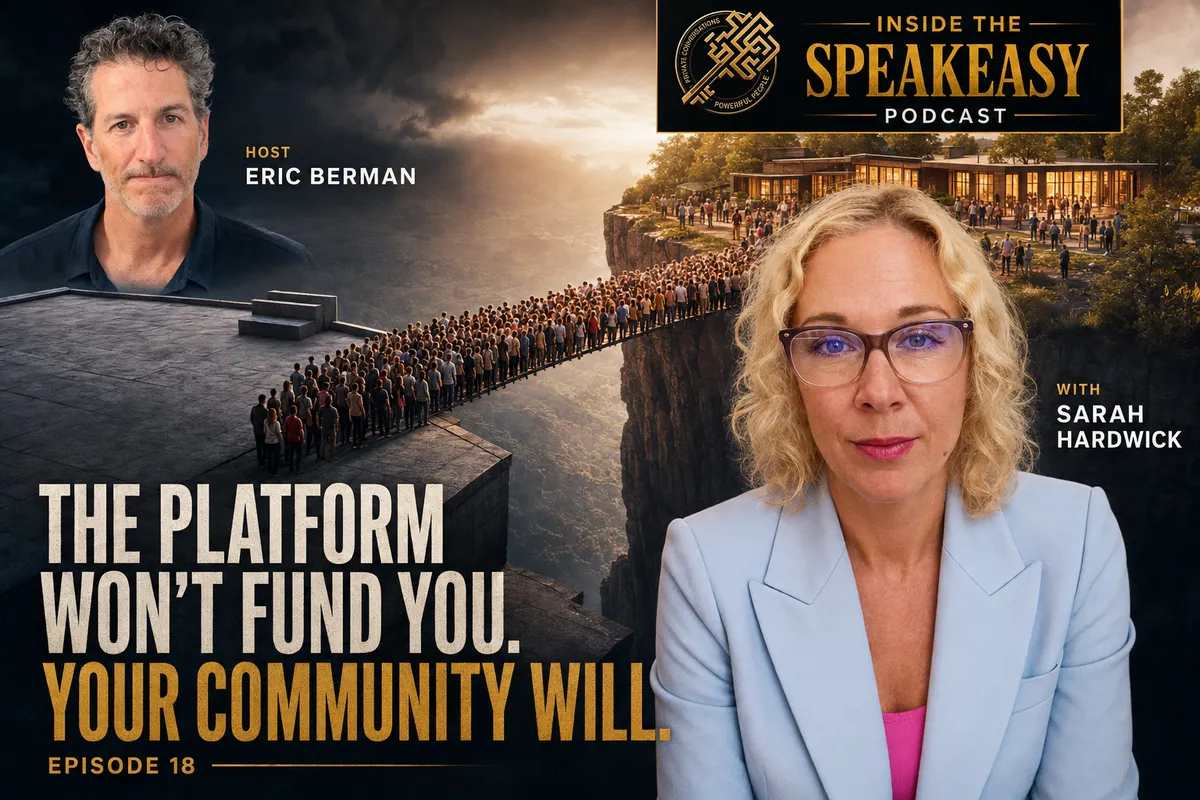
Sarah Hardwick, founder of the values-based marketing agency Zenzi and former head of marketing at solar electric car company Aptera, has helped raise $150 million through crowdfunding. In this conversation with host Eric Berman, a fellow member of her Entrepreneurs' Organization forum for more than 15 years, Sarah explains why marketing to demographics misses the point and how a values wheel built from surveying over 500,000 people changed every campaign she ran. She walks through the six value types on the wheel, shows how two friends with identical demographics can need opposite messages, and shares practical ways to uncover your customers' values from reviews and social media. Sarah then reveals how Aptera turned a $200,000 Wefunder goal into a $150 million raise, why founders are responsible for their own crowdfunding success, and how a parked domain sold for $1 million in 24 hours.
In this episode, you'll discover:
- Why marketing to demographics is a mistake, and how two women with the same age, background, and hometown can be turned off by the same message
- The six value types on Sarah's values wheel, from freedom and tradition to pleasure and security, and how opposite values change your messaging
- How to uncover your customers' values from reviews, comments, and social media without running a single survey
- How Aptera blew past a $200,000 Wefunder goal with about a $10,000 budget and an 800-person ambassador program
- Why Sarah wants to see an engaged community of roughly 1,000 to 10,000 people before a company launches an equity crowdfunding campaign
Episode Summary
Sarah Hardwick started her company, Zenzi, in 2002 when she was 25, without a business plan. The agency where she worked had shrunk from 40 people to four after 9/11, and she decided she could do it herself. She began in the bedroom of her Ocean Beach apartment, assembling press kits for public relations clients back when getting attention meant faxing press releases to editors. Over the next two decades, Zenzi evolved alongside the industry through social media, content, and even a stint as an SEO PR agency. Sarah credits the relationships she built with team members and clients for carrying her through the hard times, and she describes signing the final papers for Zenzi's sale at the top of Mary Jane Mountain in Colorado.
About 10 years into Zenzi, Sarah looked back at campaigns for brands such as Nestle, Ghirardelli Chocolate, and Chiquita Banana and asked why some performed brilliantly while others were mediocre. The difference, she realized, was deep consumer research. Large brands could spend $500,000 on a study and watch people use their products at home, and that psychological insight let her build campaigns that went beyond transactions. She found 40 years of research showing that about three quarters of decisions are based on values, but no tool connecting that psychology to marketing. So she partnered with San Francisco State University, took on psychology students as interns, surveyed over 500,000 people, and built a framework that sorts people into one of seven boxes.
Eric asks Sarah to walk through the values wheel, where opposite values sit across from each other. Achievement seekers care about status and recognition, while purpose seekers find that wasteful and want to do things for the greater good. Freedom seekers, like Sarah and Eric, are entrepreneurs with a high tolerance for risk who take spontaneous trips and try new brands, while tradition seekers buy what their parents bought and keep the same doctor and the same Sunday dinner. Pleasure seekers want new, sensory experiences, and security seekers research every washing machine review to protect their family. Sarah adds that values form early, sit beneath personality, and rarely change, though life events like having a child can shift emphasis.
To show why demographics fail, Sarah describes her college roommate Erica. They grew up in Colorado, went to the same college, are the same age, and had kids around the same time, yet they are near opposites. Erica held the same job for about 20 years, vacations at the same timeshare in Hawaii, and chose a doctor who had practiced for 40 years, while Sarah chose a young practitioner using new methods. To uncover customer values, Sarah recommends studying reviews and comments, using AI to spot trends, and asking survey questions that reach emotional benefits. Brands that try to appeal to everyone, she warns, stand for nothing, and she would rather have haters and loyal fans than ambivalence.
Sarah's values work carried directly into Aptera, the solar electric car company where she ran marketing. She expected customers to care mainly about green benefits, but research showed they were freedom seekers drawn to a car that never needs to be plugged in or fueled. With venture capital hard to find after Covid began, Aptera launched a Wefunder campaign to build its first prototype with a $200,000 goal and quickly raised $5 million on a budget of about $10,000 and no ad spend, powered by an ambassador program that grew to 800 people worldwide. A Regulation A+ campaign then raised about $75 million a year, and the team turned 30 percent of 45,000 reservations into investors.
For investor communication, Sarah recommends emailing at least weekly during active campaigns and holding investor webinars at least monthly, even featuring investors explaining why they invested. She urges honesty when progress is delayed, and Eric, an angel investor, agrees that silence makes investors assume the worst. Before an equity raise, Sarah wants to see an engaged community of roughly 1,000 to 10,000 people and founders ready to hustle, since platforms like Wefunder promote campaigns only after they gain traction. The episode closes with the story of a parked domain that drew offers from $500 to $250,000 before Sarah, channeling Austin Powers, asked for $1 million and received it within 24 hours.
Big Ideas Discussed
Market to Values, Not Demographics
Sarah's core argument is that demographic profiles lump together people who make decisions for completely different reasons. Her own example is her college roommate Erica: same home state, same college, same age, and kids at around the same time, yet one is a freedom seeker who books spontaneous weekends and the other is a tradition seeker with a timeshare and a standing Friday pizza night.
Eric admits that he, like many marketers, used to build avatar briefs around age, family status, and income until Sarah taught him to drop the word demographics from his vocabulary. Her framework, built with San Francisco State University and a survey of over 500,000 people, places customers by their underlying values instead. Sarah explains that values form early and sit beneath personality, which is why they drive choices people barely notice, such as which of 100 yogurts they grab at the supermarket. A message that delights one value type can turn off its opposite, so knowing which values your best customers hold matters more than knowing their age.
Your Reviews Already Reveal Your Customers' Values
Customers' values do not have to be expensive to uncover. Sarah's example is a window company whose reviews split into two camps: one praising windows that will last 25 years and never break, and another raving about how neighbors compliment the curb appeal. The first group is signaling security, while the second is signaling status, and each needs different messaging.
Sarah suggests passively analyzing reviews, comments, and social media, using AI to spot trends, and paying closest attention to the most passionate promoters. Surveys can go further, as long as questions move past features and benefits toward emotional benefits, higher up Maslow's hierarchy. From there, she recommends attaching a few related values to your brand so the comparison stops being apples to apples. Eric adds that brands can pair neighboring values, such as achievement and pleasure, and should not worry about turning off people who were never a fit. As Sarah puts it, where there is hate there is love, and both beat ambivalence.
Crowdfunding Runs on Community, Not Platforms
A common mistake Sarah sees is founders assuming that a platform like Wefunder will do their marketing for them. In reality, she says, the founder is responsible for the success or failure of the campaign. Platforms promote raises to their own audiences only once a company shows traction, which means bringing in the first $50,000 or $100,000, some angel investors, and plenty of follow-up calls first.
That is why Sarah wants to see a warm, engaged community of roughly 1,000 to 10,000 people before an equity raise. Trying to build a community and run a crowdfunding campaign at the same time is very hard, because investors have to love a company so much that they want to own part of it. Aptera shows what the alternative looks like: an 800-person ambassador program built from its most passionate supporters, who started Reddit communities and represented the brand at events. Sarah also stresses picking the right type of raise, pointing earlier-stage product launches toward Kickstarter or Indiegogo and saving equity campaigns for companies with more traction.
Keep Investors Close Through the Hard Parts
Once people invest, Sarah treats communication as non-negotiable. During active campaigns, which may run about four months, Aptera emailed investors at least once a week, and between campaigns she recommends investor briefings by webinar at least monthly. They do not need to be overproduced. One format she likes brings in three founders and three investors who explain why they invested and how they did their due diligence.
The harder part is sharing bad news. Sarah admits that many companies avoid transparency because progress is sometimes delayed by funding or production problems, but she has found it far better to bring investors along through the struggles. Eric, who is an angel investor in several companies, says his biggest pet peeve is putting money in and hearing nothing for months, which makes him assume things are getting worse. Both agree that investors already know problems happen; what they want to see is what the team is doing about them. Sarah adds that crowdfunding investors are uniquely loyal, because nobody is more committed to a brand's success than someone who owns part of it.
Questions We Answer in This Episode
What is values-based marketing?
Values-based marketing, as Sarah Hardwick describes it, segments customers by the core values that drive their decisions rather than by age, income, or other demographics. Sarah cites research showing that about three quarters of decisions are based on values. Her framework, built with San Francisco State University from a survey of over 500,000 people, places people in one of seven boxes so campaigns can speak directly to what motivates them.
What are the value types on Sarah Hardwick's values wheel?
In the episode, Sarah Hardwick walks through six value types arranged as opposites: freedom and tradition, achievement and purpose, and pleasure and security. Achievement seekers care about status and recognition, while purpose seekers care about the greater good. Freedom seekers love risk and spontaneity, tradition seekers prefer consistency, pleasure seekers want new experiences, and security seekers prioritize stability and protecting their family.
Why is marketing to demographics a mistake?
Sarah Hardwick says people with identical demographics can hold opposite values. She and her college roommate Erica share a home state, college, age, and the timing of their kids, yet Sarah is a freedom seeker and Erica is a tradition seeker. Marketing that appeals to one would turn off the other, so a demographic avatar can miss both.
How can a business identify its customers' values?
Sarah Hardwick recommends starting with reviews, comments, and social media, using AI to find trends in what passionate customers say. A window company's reviews might praise durability, which signals security, or curb appeal, which signals status. Surveys can go deeper if questions focus on emotional benefits rather than features, and brands can then attach those values to their messaging.
How did Aptera raise $150 million through crowdfunding?
Sarah Hardwick says Aptera's first Wefunder campaign aimed for $200,000 to build a prototype and quickly raised $5 million on a budget of about $10,000, with no ad spend. An 800-person ambassador program helped spread the word. A Regulation A+ campaign then raised about $75 million a year, and the team turned 30 percent of 45,000 reservations into investors.
How often should a company communicate with crowdfunding investors?
Sarah Hardwick recommends emailing investors at least once a week during active campaigns and holding investor webinars at least once a month between campaigns. Briefings do not need to be polished; she likes bringing in founders and investors to talk about why they invested. She also urges founders to share setbacks honestly instead of going quiet.
When is a company ready for equity crowdfunding?
Sarah Hardwick says a company should have traction and an engaged community, roughly 1,000 to 10,000 people, before launching an equity campaign. Earlier-stage product launches may fit Kickstarter or Indiegogo better. Platforms such as Wefunder promote campaigns only after they gain momentum, so founders must mobilize their own network, bring in early money, and do the follow-up calls themselves.
Full Episode Transcript
Read the Full Episode Transcript
Cold Open: The Values Hidden in Customer Reviews
Sarah Hardwick: So you look at their reviews and you're trying to uncover, I wonder what the values are. Well, you see, one set of reviews is like these are the most durable windows. They'll never break. They're going to last me for 25 years. I love how like they're going to be there forever. The other reviews might say, wow, everyone driving by says how amazing they look and how it's really improved the curb appeal. And so you can analyze and even for clues within reviews and what people are saying and use AI to uncover the trends within reviews and comments and what's on social media, media and that kind of data.
Eric Berman: Welcome to the Speakeasy Podcast where the real conversations happen behind closed doors with the boldest entrepreneurs, creators and growth minds in the game. No fluff, no filters, just the raw strategies, personal stories and mental models that move the needle. I'm Eric Berman. Now let's get into it.
Meet Sarah Hardwick, Crowdfunding Expert and EO Forum Mate
Eric Berman: In this week's episode of Inside the Speakeasy Podcast, I'm so excited to bring on one of the most special sought after consultants in the crowdfunding space who went from just a few million dollars in crowdfunding to $150 million crowdfunding campaign with one of the top solar electric car companies. Before that, she was a pioneer in what's called not demographical but values based marketing. And if you're going after demographics, you're doing it all wrong and you better find out why. And ultimately we're going to share a fun story how she went Austin Powers on all of us and got a domain for $1 million. Welcome Sarah Hardwick.
Sarah Hardwick: Thank you so much. Excited to be here.
Eric Berman: So Sarah is a forum member of mine in we're in a group called Entrepreneurs' Organization, EO, another great business group of entrepreneurs and we've been in the same forum now known each other and had many confidential conversations which we won't get into those because those are confidential. But how long have you been in forum, at like 15, 16 years?
Sarah Hardwick: Yeah, over 15 years. Yeah, it's easy.
Eric Berman: Such an honor to get to know somebody who's got literally if you get to meet Sarah, she's got one of the biggest hearts and she's such a good people person, always thinking about how to serve others. In today's episode though, we're going to talk a lot about, you'll see that through her, her talking, but we're going to talk about, she's now the number one call I make and one of the most sought after experts in the crowdfunding space. And she went out and she's raised over $150 million on crowdfunding. And we're going to get into that story, but before we get into that, we're going to talk about how, Sarah, you got there a little bit of your entrepreneurial journey. And I know a lot of the stuff you do in crowdfunding was laced through in what you were doing before that, which was with your value based marketing agency, isn't that right?
Sarah Hardwick: Yeah, that's right. Yep. The world's first values based marketing agency I started and ran for many years which was really led a lot into what I've been doing in crowdfunding. It's one of those secret ingredients for success.
Eric Berman: Oh my God. Okay, so so many good things to get into because again I fortunately this is an interview I get to do or a chat where I actually know where the story ends in many cases. And there's so much good stuff to get into that I've known. So I'm going to be able to pick out some of the stuff that I think audience is really going to enjoy. Let's go all the way back though.
Starting Zenzi After 9/11 and Adapting Through Two Decades
Eric Berman: I mean, how many years have you had been in the world of marketing?
Sarah Hardwick: Now I started my company when I was 25 and didn't have a business plan, didn't have an idea that I could, you know, hustle and started my company Zenzi back in 2002 when I was 25.
Eric Berman: And what was like the motivation to do this?
Sarah Hardwick: Like honestly it was a downturn, it was 9, 11, I was working at an agency. It went from 40 people down to where I was one of four left. And I thought to myself, you know, I think I can do this. And so I like the idea of working for myself. I love the idea of being an entrepreneur. So I started out of the bedroom of my apartment in Ocean Beach and I can remember having clients come over and assembling press kits. And at that time it was really focused on PR specifically. And so I just started building my business and started, you know, that I needed help and then I needed to move out of my Ocean Beach apartment because I needed a real office. And so it really just grew from there and it became a very wonderful part of my life and have met so many amazing people through Zenzi and really established a lot of my identity and a lot of the connections that I have that I really are so close to me and important to me now.
Eric Berman: Amazing. It's like we don't really necessarily know Are we really meant to be entrepreneurs? What's going on? We just get in the fire, be scrappy and start swimming and there you are. And you ran that thing for 20, what, 20 some odd years. I don't want to get your age. Exactly.
Sarah Hardwick: I signed the paper, the final closing papers from the very top of Mary Jane Mountain in Colorado, signed the final papers and just cried as I skied down, you know, the last run. So it was an amazing journey having Zenzi, and it was an amazing exit. So I was quite fortunate.
Eric Berman: I love it. So, lots of ups and downs. And then I really want to dig into, you know, love to maybe share a story, a couple of stories of, as we like to do here, of maybe some of your entrepreneurial journey, like some of the biggest struggles you had there. And then ultimately, let's get into values based marketing. Because you said we went from PR initially and then you made this transition. What is value based marketing? Let's get into all that stuff.
Sarah Hardwick: Yeah, okay. Well, so for the first 10 years, you know, when I started in 2002, there was no Facebook, no social media. That was all just emerging, just starting to happen. At the time, my focus was really on public relations. And at that time, the way to get attention was faxing press releases out to editors. So that was the day when, you know, we really, we were, that was the way. But so this part of the challenges, I think has just been evolving as the industry has evolved. And then there's social and then there's content. And at one point I was an SEO PR agency. And so you kind of morph your company to really adapt to the changing, you know, consumer preferences and changing consumer behavior and the different, you know, new channels that are emerging. And so I think, you know, being in marketing, it was, it's very exciting and but it also is a challenge just because over the past 10 years plus, you know, especially it's been changing so significantly and, you know, so kind of keeping up with that. I think, you know, there was a time when I was the, you know, as kind of a PR person, you're really have a seat at the table with clients and you're there working with them one on one. And then over time it's like, oh, we can get an intern to do that. And so there's just changing dynamics of how you work with clients and how you can, you know, be your best and what you offer them and how you can really move the needle for them. And so I think navigating that, you know, there's been some Good times, and there's been some challenging times, but at the end of the day, I think, you know, the relationships that I've had have carried me through, you know, 20 plus years, whether it's team that I've worked with or clients that I've had. And they keep coming back and they keep being, you know, they're part of my community. And so I'm really proud of that, that I've built. I think the tough times really show you who you are.
Eric Berman: Yeah. Yeah, no kidding. No kidding. So. So you eventually evolve. Let's dig into. And I think this is so critical. I still love this and I learned so much from you as you taught it for the years and everybody listening, they should really, you know, hone in and understand this part. Values based marketing. I think it's such a cool thing. Tell me what that means and how do you evolve into that? And you still. And that's still threaded in everything you do today.
Why the Best Campaigns Started With Values Research
Sarah Hardwick: Yeah. I think, you know, as entrepreneurs, we're always seeking for what is that differentiator and what is it that we do that's different? And so for me, about 10 years into my career at Zenzi, I looked back at all of the campaigns I had done for Nestle and Ghirardelli Chocolate and Chiquita Banana and all these brands, and some of them were amazing and just went, you know, huge and generated huge media exposure. And some of them were not so great or just were mediocre. And so I looked back and said to myself, well, what was the difference for some of these campaigns that really excelled and some that, you know, just performed on average? And when I look back, I realized a lot of these clients that I was working with, such as Nestle and Chiquita, they had the benefit of huge amounts of consumer research and consumer insights. So they'd have. They'd spend $500,000 on a study and sit with people in their living rooms and watch them consume these products. And they knew a lot about their audiences. So when we had the benefit of deep psychological information, what motivates them, you know, what gets them up, what do they really believe in, what's stressing them out? When we had this deep, rich information about these customers, the campaigns that we could create from there were incredible because we went past this idea of just transactional and we really got to the heart of what they believe in, what motivates them, and we could start to build lasting, loyal relationships. So I realized that and I thought, well, that's great. There must be a tool or Something that I could purchase to uncover people's values, because then I can create all these campaigns around it and they'll be amazing. And what I realized is that While there was 40 years of research behind the psychology of why people buy and. And proving that three quarters of all decisions are made based on values, I realized all that. But yet there was no way to connect the dots between marketing and psychology and utilize all those insights to help marketers create better content, create better user experience, create copy that converts. There was no way to unlock that. So I established a partnership with San Francisco State University. And they were really the, at the time, the only people who are really digging in and studying kind of the marketing and consumer behavior aspects of values. So I formed a relationship with the head of the department, and he gave me a bunch of his students as interns. He said, well, this is great, because I have this whole class of people, unfortunately, they don't want to be psychologists. They all want to be marketers. And I laughed. We said, can I put these guys to work in your company? And let's build this bridge between psychology and marketing. And so that is exactly what we did. So we set out, we surveyed over 500,000 people, and we created really the world's first way of uncovering and assessing data, whether it's comments and reviews or whether it's using surveys and really uncovering what people's values are and looking for markers and clues in that data. And once we have that information, we put them in one of seven boxes and we really can dig into who they are, and then we can create campaigns that are much more customized and much more relevant and really resonate with who they are as people. So we created this framework and then it just became the essence of every campaign. So we don't would never even start a campaign without doing values research and understanding what values are important to people. How do we segment them? So beyond just demographics and knowing their affluent baby boomers or their young Gen Xers, what differentiates them? Do they care about achievement and status or do they care about giving back to the planet?
Eric Berman: I think in context, because I know a lot of the visuals behind this and my bad, I should have had you bring in advance so we can show. But I know you could talk about it because you memorize this, the values wheel. And I think a good way to talk about it. You mentioned it right now. Demographics, I think we all tend to think about, hey, let's market to the demo. The demo. What's the demographics of your avatar? So common and you like, literally taught me to eliminate that from my vocabulary. And you said, really? What are the values? And so like, if we were to talk about a values wheel, which I remember you said there was. I thought it was six, but I guess there's seven different values. So let's walk us through the six values. And this is so important, everybody pay attention to this. And then I'm going to compare this to the demographics and I'll talk about an example in a second. So the six value types are. What are those again?
The Values Wheel: Achievement vs. Purpose
Sarah Hardwick: Yeah. Okay, so there's freedom. So it's interesting when you see them on the wheel, when they're opposites, they're actually polar opposites. And when they're close together, it means that they're a little bit more similar. So you've got, let's see, freedom, purpose, tradition, pleasure, security, achievement. Yes, that would be status, recognition. And so the opposite of achievement would be purpose. So if you're talking about getting someone excited around, you know, you're going to crush, you know, you're going to be so famous, you're going to be, you know, out there at that party with all the celebrities. So that might get a certain group of people really excited because they care about status and, you know, moving up and like their social position versus if there's another group who would be the opposite, purpose seekers. And they would be like, oh, who even needs that? You know, we really care about, you know, wasteful. We don't even need that. Let's care about what's in the heart and let's really focus on what matters. And you know, the idea of doing something for status and reputation, they do it for humanity. They do it for the greater good because they want to. Their motivations and how you get them excited would be dramatically different depending on those two different.
Eric Berman: We're thinking of all the people, especially a lot of us that are in the, doing a lot of social marketing out there. And you think of immediately I go to the people that are the flashy showing the Lamborghinis and all the cars and all that. In this example, they're obviously going to the achievement seekers and saying, hey, look at me. And that's. The audience are getting. All the achievement seekers are. They're loving that. The purpose seekers are just like, that is such a turn off. I don't give a crap about your Lamborghini. What are you doing to help give back to the community is what I want to see. Let's go to [unclear] because I want again, I want everybody to walk away, really learn some good stuff here. So give me an example of the freedom seeker and what's the opposite of the freedom?
Freedom Seekers vs. Tradition Seekers
Sarah Hardwick: Freedom and tradition. So freedom seekers, that's you and I, we're entrepreneurs. We live life on the edge. We're not afraid to, you know, try something risky. Our tolerance for risk is super high. So you've got freedom seekers. You know, I go, I love to take spontaneous trips. I oftentimes will buy different brands. I'll experiment with things, I'll do things differently. And then you've got the tradition seekers who like everything exactly the way that it's always been. And so they buy the same brands that their parents did. They might have a timeshare. They'll go to the same doctor. You know, I might go. I don't even have a primary care doctor, to be honest with you, because I'm a freedom seeker. I just like, you know, But a tradition seeker has, you know, the things. It's always. They find value and pleasure out of carrying on these traditions. And it's like the world is right when I have my Sunday dinner at XYZ Place. And so they, they carry on a lot of that. It's. But to a freedom seeker, we're like, how boring. You know, like, come on, tell me what to do. Yeah, or it's, you know, it's like a tradition seeker. You'd say, like, they probably have jobs that they've had for, you know, 20 years. The thought of it being an entrepreneur and going months without knowing where your next paycheck's coming from. They're like, you know, absolutely not, you know, no way. They would never be able to do that. And so when you're thinking about marketing something to someone, it's like legacy history, family, you know, versus, like, do whatever you want. Like, it's like there's different dynamics. It's like one is self focus. And it's. For me, as a freedom seeker, it's like whatever I want to do in the moment, you know, where pleasure is like that. Whatever feels good.
Eric Berman: And can we evolve? I imagine as you get, as you age and get older and you're now in retirement, I imagine you might go from freedom more to like, okay, traditional or, you know, that kind of as you.
Sarah Hardwick: For me, like, I was way more pleasure seeking until I had my son. And then I got a little bit more, you know, a little more responsible, a little more security seeking, a little more around my family. But you'll never completely change that. Your values are formed at such an early Age you. They're underneath your personality. You can't change them. Feel the dissonance around it. You know, you're like, yeah, I want to go, like, party this weekend. But it's like, oh, I want to be a good mom, too. And so you kind of, you know, you'll find, like, a little bit sometimes that feeling is called cognitive dissonance, where you kind of know there's something tugging you and those are your values. They're just at that. Like, you think of an iceberg there at the very bottom level. So you don't know why when you walk in. I use an example, a lot of, like, a wall of yogurt, and you walk into the supermarket and you look, you have 100 yogurt choices, and it's like, is it the breast cancer awareness one? The one your mom always bought? The organic one? The one that's like Kim Kardashian's yogurt? Like, what one? You pick, and you don't even think about it, but you pick one, and it's usually based in some way on your values, and you just don't even realize you're driving those decisions.
Eric Berman: Wow, that's great. I gotta think about that one. Yogurt quiz.
Pleasure Seekers vs. Security Seekers
Eric Berman: Okay, so we hit four, and then the other two that are opposite.
Sarah Hardwick: Was it pleasure and security? And pleasure is, you know, they're like adrenaline junkies. They're, you know, it's what. Literally whatever feels good to them in that very moment. It's the idea of pleasure. So there's not a lot of consequences. It's really not a lot of thought or planning. And it's kind of just, you know, [unclear] love experiences. And so you can motivate pleasure seekers by things that are sensory. You know, even biting into a chocolate bar. That's potato chip. And this, you know, it's like, that could be a pleasure seeker. You know, we did some research on a chocolate company, and we found their primary customers were pleasure seekers because they loved the unique combinations of, like, the flavors and, you know, those kind of things. So it doesn't have to be like, all adrenaline, but it's about new, unexpected. It's completely. What they don't want, is the same thing all the time. And so it's about diversity of experience and diverse, different experiences. So that's pleasure. And then you've got security, which is if you ever know someone who it's time to buy a new washing machine or whatever, and they do all of the reviews, they look at every single site online, they ask all Their friends. They do. They're so practical. They can find like the savings in this or this one at Costco or this or that. And they are so stable and secure and like, they are very predictable. It's all about being, you know, secure and having something that's predictable and having so, you know, it's kind of like tradition, but even more so even.
Eric Berman: See, financially, of course, you have the people that are just hoarding money. Saving, saving, saving. Let's not go on that vacation yet. We got to do a vacation one every five years because we got to worry about this, this.
Sarah Hardwick: Their top priority is the safety of and the protection of their family. Keeping things stable versus a pleasure seekers, like whatever feels good. Oh, you know, come along for the ride, but it's like they're not worried.
Same Demographic, Opposite Values
Eric Berman: Now I'm going to really bring this home for everybody because this still sits in my head, having learned this years ago, is when I love it when you talk through the examples of demographics versus value based. And so I want to, I'm going to ask you to give me an example of what we typically make the mistake on, which is I'm going to give you, I'm going to have you talk to me about people that are the same demographic but two different values and how we would make a mistake and what they should be doing in that example.
Sarah Hardwick: Okay, well, I'll give you a real world example. One of my college roommates, one of my best friends, her name's Erica and she and I both grew up in Colorado. We both went to the same college. We both are the same age. We both have kids, you know, around the same time. But I honestly, I laugh that we're friends and it's kind of like you and I honestly, a little bit because we're very different. But I. It's almost like we're complete opposites. And so she's had, up until recently, actually, she had the same job for like 20 years. She had the same career. She did the same thing. She worked at the same place. I, of course, entrepreneurial. I don't know where my next paycheck's coming from. I'm pivoting my business. I'm doing this and that, you know, completely opposite. She is. Her parents owns timeshares. She has a timeshare every year. She plans her same vacation to the same place in Hawaii and goes, you know, to the same place. Me, I'm like, I don't know, I was thinking about Mexico this weekend or oop, Palm Springs. You know, I constantly doing spontaneous things like that, you know, again, we're the same demographic. When it came time to have kids, as I brought this example up earlier, she picked the doctor that had been practicing for 40 years and was about to retire and was like the old school traditional guy. I picked like the Eastern medicine woman who was young, using all this new technology. Like I had never gone to her before. And like, I liked that she did all these new, wacky new methods, you know. And so we both got our kids in these like totally different ways. And so when you look at it like that, you know, and the way, you know, however, she's very predictable and I love that I can go over there and get the same advice. She has pizza night every Friday. If I ever want to hang out with her, I know that every Friday she'll be doing pizza and a movie night, you know, and in some ways she loves hearing my stories and she loves hearing my spontaneity and she kind of lives vicariously through me. But we, in traditional ways, we would be categorized exactly the same, you know, age, race, everything. But yet whatever you're going to kind of market to me in the way that would appeal to her, it would be a total turn off to me.
Eric Berman: And that ultimately is the difference, right? Because somebody, and again, I know a lot of us on this, watching this is guilty of this. Hey, let's do a brand. Let's do an avatar brief or an avatar review. Your customer is okay, well, my customer is Ms. Sarah, you know, she's X years old, you know, with a child and blah, blah, blah. And we bucket all those people together. Now let's mark that. And you're saying we're doing it all wrong. And everybody does. So many people do it wrong. And you just gave us a great example because one person can be turned off or it might be in between. You might be like half right with you, half right with her. But boy, did they miss the mark. Where they could have if they really understood their market better. And so.
How to Uncover Your Customers' Values
Eric Berman: Okay, so let's start with the how. I think you've really helped set up an understanding of. Oh my goodness, this is, this makes sense.
Sarah Hardwick: Yeah.
Eric Berman: What do I do now? Like, okay, I got these users. How do I identify what the values of my customers are?
Sarah Hardwick: Yeah, that's a great question. You know, there's easy ways to survey and a lot of these clues, it's very apparent. Like if you look at reviews, I'll give you an example of like, say there's home company and they're a window company. So you look at their reviews and you're trying to uncover, I wonder what the values are. Well, you see, one set of reviews is like, these are the most durable windows. They'll never break. They're going to last me for 25 years. I love how like, they're going to be there forever. The other reviews might say, wow, everyone driving by says how amazing they look and how it's really improved the curb appeal. And so you can analyze and even for clues within reviews and what people are saying and use AI to uncover the trends within reviews and comments and what's on social media and that kind of data, Even without doing any kind of a survey, you can passively look at that and start to identify, oh, they're really talking about this. And with the ones that are the most passionate and you know, these great net promoters, here's what they're getting excited about. And then you can kind of dig into like, okay, well, what's motivating that on a deeper level? So I think that's one good way you can definitely survey them and you can ask questions like, you know, it's all about going beyond, like, the features and benefits where you think, like, you want to go into the emotional benefits. It's like, what if you think of Maslow's hierarchy, you want to move up on that pyramid. So you want it to be out of just like a price and comparing you on price, you want it to be like, well, that brand's cool or that brand, like proven or trusted. And so you want to start to do is once you identify these values and a lot starts from who you are, you, yourself, your company. But then you want to say, well, I want to attach some of these values to my brand so that when people are looking at it, it's not just apples to apples, it's apples to a really cool super fruit. You know, where it's like, whoa, there's no comparison because this one is for me, it's cool. Or it's like trusted. It's. This is the Kim Kardashian of apples versus, like, hey, this is, you know, the opposite, whatever. So you really want to paint the picture and you know, of personifying your brand based on those values so that when people are making these buying decisions, they're feeling like you're speaking their language and that's the logical choice.
Why Brands That Stand for Everything Stand for Nothing
Sarah Hardwick: So that's kind of the next step is looking at your website copy, looking at your social posts, like, are they appealing to everyone? You know, you stand for everything. You stand for nothing. So it's it's watered down. And so I will say the biggest problem that most brands have is that they stand for nothing is that they don't have a clear either. They don't have a clear understanding of their why and that's not included in their messaging. And it's just got to the point of like here's a sale, here's this, here's a product. But they're not thinking about like what is the motivation? How is this satisfying someone's inner motivation? How is my product or service making them cool? How is it making them feel secure? How is it making them feel like they're a good human being? Like if I recycle, if I buy a 3D printed home, it makes me feel like I'm doing my part. So it isn't just about the coolness of the 3D printed home or the cost. It's about the fact that I'm good person for the planet.
Eric Berman: I mean to me, I love you said it's almost like start with obviously [unclear] mission and culture. Start with who you are, what do you want to be, what do you want your product to attract and then go all in on that. And I think you said probably could be like two or you know, a couple values right. Like that are kind of close to each other, obviously not opposite values. You're not going to go, yeah, but you maybe take two and say okay, you could be achievement and pleasure and that could be a super fun high achieving brand versus the opposite and say that's who we are. And then like I said, watch your messaging, watch your social and then that's what you marketing to and don't be upset if you turn off the person who's, who cares.
Sarah Hardwick: Yeah. And you don't want those lukewarm supporters anyways. You know, you can double down and get your hardcore loyal fans by owning who you are and really speaking to them in the way that is going to be resonant. And yeah, no, I mean you're going to turn people off and in fact I think that's sometimes a good thing. When I look at brands that have like loyal, passionate supporters and then like haters, I don't like, I don't mind that because where there's hate, there's love and it's better than ambivalence. And so values really allow you to unlock this passionate part of like what people really care about. And today like there's so much competition if you're not making people feel something like I don't think you're Going to be successful.
Eric Berman: And that's right, you're blowing up in the value stuff. You're doing so good.
How Aptera Raised $150 Million Through Crowdfunding
Eric Berman: And we're going to do a crossover here because this success we had in values led you to essentially getting, being able to sell and getting yanked over. You know, you got grabbed and tackled into this new super cool 100% solar electric car company called Aptera and you ran all marketing and are essentially one of the key stakeholders there for a long while. And a big part of it was the values based marketing. And you then led arguably one of the most successful crowdfunding campaigns out there, 150 million raised. Let's dig into that. So talk to me about, because I know the values of that car. Obviously you know, just it bleeds you and the kind of work you did and how that got out there. But ultimately tell us about the experience in there and the crowdfunding and how you pulled that off.
Sarah Hardwick: Yeah, I mean, well again yes, first it came down to really understanding and connecting with the values. And there were some surprises in there. I think when I first came I thought oh yeah, they're all like eco friendly. It's going to be all about like the fact it's EV and like it's all about the green benefits and you know, carbon neutral. And actually that was a part of it, a small part of it, but really it wasn't that at all. It was freedom seekers and they didn't want tethered down. So this is a solar EV. You don't even have to plug in to charge nor do you have to go to the gas station. So it's this idea of solar mobility, of not being tethered, of being unplugged, of going wherever you want, of not having to, you know, and also of disrupting like we don't need gas, we don't need electric, we are solar, we're totally disruptors. And so with really like leaning into that. So I think, you know, discovering that allowed us to create a campaign that really spoke to people from the very beginning. And so this was when I started was right after Covid had started and capital was hard to come across and we were trying the VC route and you know how it is, it's like they maybe pick one of a hundred and this is a solar vehicle, a new category, like they weren't picking us. And so what we realized what we had to do was start a crowdfunding campaign. I was insisting that before we launched the company we needed a prototype vehicle. So the idea of this first crowdfunding campaign. It was 200,000 was our goal on Wefunder, and it was to build our first prototype. So we launched the campaign before, you know, and this is kind of where the launching it in the right way with a prime, the group of passionate people. That's how you know when it starts to just take off. And it was, you know, it was like there was just a momentum behind us that became unstoppable. And so we blew through that 200,000 goal and quickly raised 5 million, our first 5 million through a Wefunder campaign with a list of. I think my budget for that was like, $10,000, including, like, all my time, no ad spend, zero. Just to launch this thing. But what I really did was I built an ambassador program and started building from within and started identifying the people who are the most passionate supporters and getting them on board and saying, okay, listen, guys, hey, you think we should be on Reddit? Awesome. Can you go and start up a Reddit and start moderating Reddit? Oh, you think we should be at CES or this EV show? Hey, can you go help us with that? And so I started just building people, a huge tribe of hundreds of people. It ended up to be 800 people all across the world.
Eric Berman: So much they were happy to be ambassadors. They wanted to tell the world about it, too.
Sarah Hardwick: Yeah. And so I think giving people one big lesson for that. And, you know, so we went on after that 5 million raise, we opened up a Regulation A+, what's called a Reg A campaign, and we were able to raise 75 million every year. So we basically raised 150 million, keeping this campaign rolling, campaign open for several years. And then that became all of the good work that we know as marketers on paid media and funnels, and, you know, an amazing website, which, you know, Brandetize, was able to help us with a lot to really build out the infrastructure, because once you have there's a thing, it's like you can only get so far with the excitement and the momentum and the passion, but then you got to put systems behind it. And so we were able to do is bring the right partners in to put systems behind it that made the crowdfunding predictable. So we knew with this amount of budget, with these tactics, that we would be able to bring in, you know, a couple million bucks a month. And then that became something that we just got better and better at. So building, like, the most masterful funnel and then turning customers, they call them investors now, where it's basically turning customers into investors and creating that Loop where we brought in, we have 45,000 reservations and we turned 30% of those into investors. So it's also going out and getting investors. It's bringing new people into the fold for the brand and then bringing. They may have a reservation, but before they know it, they're also going to be investors because they're going to be coming a part of our funnel and we're going to talk to them. And so we created a very synergistic cycle that built out both of those. And the cool thing about crowdfunding is that at the end of the day, these fans aren't going anywhere no matter what you do with them. They're investors. Like, is there anyone more dedicated to the success of the brand? You know, so building out this massive group of people who. It's investing in the longevity and the, you know, the passion and the engagement of your base. And so it's nice because it all stays with you. So after a crowdfunding campaign, you have more engagement and more excited people and a bigger audience almost going on.
How Often to Communicate With Investors
Eric Berman: And so how often, like, what's a tip? How often do you communicate to your, your investors to keep them thirsty and happy and excited and obviously spread the word? How often would you email them?
Sarah Hardwick: I mean, we're emailing at least once a week when we have active campaigns. Now, keep in mind, campaign might only be for a span of a couple of months, like maybe four months or so.
Eric Berman: How about non campaigns? But just like, okay, you're up and running, just to keep the investors up to speed on what's going on.
Sarah Hardwick: I am a big fan of webinars, investor briefings at a minimum of a month. And I like these. I don't think they have to be. Sometimes it can be intimidating if you expect that they have to be like, super overproduced and like. But at the end of the day, I like, bring in three of your founders and three of their investors and just have the investors talk about why they invested, how they did due diligence, you know, what they thought about it. And so it could be as easy as, you know, it doesn't have to be the founder doing a sales pitch and updating investors. It could be talking about what's happening from the investor point of view or bringing in people from your R and D department.
Eric Berman: I bring that up because I think it's such a lesson. I mean, I personally am an angel investor in a few companies, and one of the biggest pet peeves I have in others is like. Is like, you don't hear from, you know, you put money and you don't hear for months and then every month that goes by, you assume stuff's worse. And so I imagine like just the frequency of communication, good or bad, I imagine not every call was great. There's probably some bad news sometimes, but you just at least let people know what's going on. Is that right?
Sarah Hardwick: I mean, that's true. And that is the tough part. And I think that's why a lot of companies shy away from this sort of transparent communication, being that there are times when, you know it's not always good or progress is delayed and you have to go to them and say like, listen, we hope to meet this milestone, but we're still trying to get funding or we're still trying to get this into production, or we're still trying to do this. But what I found is it's so much better to bring them along through the struggles. Tell them at the end, like, ooh, you know, shit happened and now it's,.
Eric Berman: Oh, you're out of money. Has anybody running out of check? Like, I've always say the same thing too. I'm like, you want to see that? Yeah, there's problems, we all get it. But like, show us what you're doing. We know you're not sitting around on your ass doing nothing. Like, okay, so what are you doing to try to fix it? Yeah, like, maybe I could help you as an investor. Maybe I can point like, no. And it's amazing how many companies don't do that. Going back to your values based marketing, how do you feel that led to some of the successful campaigns? Was it just being able to back to the freedom seekers, know how to talk to them to get them to put money in, or is that sort of the idea?
Sarah Hardwick: Yeah, I think that, yes, certainly it's understanding what motivates them and what motivates investors is really key and just even more general than that, just going beyond making it transactional. It isn't just about you're investing for a return. Every investor into the Aptera campaign that you talked about, they believe that they're investing in the future of like a better world, something, something cooler, something more.
Eric Berman: Free, which works for this company. I mean, other companies that are doing it like might be achievement or like, I'm throwing money in because I want to get 100x multiple. I don't care what happens, just when great.
Sarah Hardwick: And then cadence of your campaign and the messaging is going to be all about like, we're making you money, how much money? Here's this guy, we made money and this guy, we made money and this guy. And you know, what are you going to do with all the money? Well, you're going to live a luxury life and you're going to paint the picture of the luxury life they're going to live and all the things they're going to do. And so it's just bringing to life. It's the greater just digging in one level, deeper, beyond. Yeah, they want to make money, but why?
Is Your Company Ready for Equity Crowdfunding?
Eric Berman: I know we have, we're a little bit running out of time. I want to get to a few more things. And one thing is that I know you're so super busy. Cause we talk and you're like on, when are we ready? What are like the couple ingredients? Because you turn away a lot of business because you're like, you know what, I don't want to take your money. It's not going to be worth your time. You're not going to be successful. And you coach them on what they need to do. What should we be looking for?
Sarah Hardwick: Yeah, I think so. There's different kinds of crowdfunding, right? Some for early stage companies. I think Kickstarter or Indiegogo is a really great option. That's not my area of expertise. That's our great buddy Will Ford, who is an amazing expert in that area. So I think it's like looking at, where are you in your product life cycle? Are you trying to get a product off the ground? Do you have a prototype? Are you just trying to fund for like bringing this one thing to life? Well, that might be more of like a Kickstarter campaign. So, you know, picking the right campaign. Now are you ready for an equity campaign? You know, do you have value? What would I be buying shares in? Like, tell me, are you profitable? And so you kind of need to be a little more advanced and have more, more of your company developed, have more traction, have raised, you know, money before to really be able to show people that it's worth whatever valuation, you know, you wanted to charge. So I think first off is just thinking about what type of a crowdfunding campaign is best for you. And depending on where you're at in the development of your company, you know, it may be rewards based, crowdfunding may be better or, you know, equity based. So I think it's kind of thinking about that first and foremost for me in this equity world, I definitely want to see a company with some community. So you have zero community. And a lot of times I'll see companies say, I want to start A crowdfunding campaign to get people excited and to build my community. That's going to be really hard. So initially you want to have your community built out and engaged and you have them warmed up and your list warmed and they know who you are and they, you know, trust you. And then we're going to get them to the point of wanting to invest in you. But it's, you know, it's a lot. They have to love you so much they want to own your company. And that isn't an easy sell. That's like a one off. Like I see an ad and I invest, you know, necessarily, it's usually a.
Eric Berman: Process that's interesting to say. So it's almost like thinking a couple steps ahead. If you ultimately feel like you want to go down that path, you're okay. I mean, I see sort of the two buckets. It's sort of the early, hey, we're still building the widget. We have this cool idea. Let's get everybody throwing some money. And if you, if you help us fund this, you're going to get our first two products. You're sort of paying for it and you'll help us pick the ones and thank you and we'll throw a free T shirt. Then you have the more, more advanced. And what you're saying, which is this is really the key, I'm learning here is that you're farther along. But do you have you invested at all in your followers, in your communication? I could see people not really paying attention to that. Hey, we're just a company out there with a brand. We have no following. We'll deal with that later. And you're saying time out. You better get ahead of this, like start investing now because that's where we're going to go to for your funding.
Sarah Hardwick: Yeah. Because a lot of times you will expect or companies will expect that. Well, we funder will do the marketing for me or whatever platform I'm on and go on there. And there's going to be so many people just waiting to invest in my company. And really you are responsible for all the success of your marketing campaign. Everything is going to be on your shoulders. You know, you're going to be the one responsible for the success or failure. And so it is going to be a big mission for you. And if you don't have an existing base or a community that's already kind of starting to get excited, it's hard to build that while also, you know, getting your crowdfunding going. So I think there's a phased approach of getting an engaged community. And maybe Your list is 5,000, maybe it's 10,000, but it's somewhere around there. 1,000, 5,000, 10,000, You know that you can go to to start to get things going.
Eric Berman: Love it. Okay, so 5 to 10k you answered that question. I think something you said there I want to clarify because I learned this in my own research. As you said, it is pretty easy for us to think that we're just going to get go to Wefunder, pay their setup dues and they're going to promote us. And what I found you to say is that now you got to raise like a significant amount of money before they put you into their email list because they have limited to think about. They have limited slots to promote a brand and they're going to do the ones that are already more successful.
Sarah Hardwick: They're a great partner. I mean I love Wefunder. I love Justin is one of my great partners at Wefunder. And when you know, when you get to that point but you kind of have to show them that you're in, you know, you got to hustle, you got to bring in the first 50 or 100,000, you got to bring in some angels, you got to get this thing going and you have to show them that you have what it takes to make it successful first. And then, you know, once they see that you're becoming rising up on their platform, then yeah, they're going to send out an email for you and they're going to push it to their fans and followers and you'll get more. But a lot of the heavy lifting in the beginning is really going to be on you to show that you can make this viable with your own network first and then every, you know, that's where it will build on that. But that first step is getting your own network mobilized and activated and getting your founders, if you're a founder like you better expect to be on the phone, you better expect to be doing follow up calls, you better expect to be hustling and if you're like expecting it's going to be hands off and it's just going to like go and fund itself, that's just.
Eric Berman: All right, I love it. You just absolutely brought in some great tips.
The Parked Domain That Sold for $1 Million
Eric Berman: Sarah, before we go on wrap I have to share and cause we only got two minutes left. I believe here with. Since I promised you I'd let you get back to the clients in a second, can you give me the 1 minute version? For those of you who don't know, Sarah, is when she was just. A lot of us are sitting on. Probably most of us watching these, listening to this podcast are sitting on some parked domains. Parked domain. And she turned a parked domain into a million dollars. Yes, a $1 million. Tell us that story in a minute.
Sarah Hardwick: It was an amazing story. I got an email from a domain broker. I had a domain that I was sitting on that I had a vision for and an idea for, but I hadn't done anything with it. I envisioned it like my. Kind of like my manifesto. And I got an email, was a Gmail address offering me 500 bucks for this domain. And I initially just ignored it and then got another one. And it was, you know, 5,000, and then it was 10,000. And I finally started paying attention when it got to about 250,000. And I thought, well, I'm going to get on with this guy. Like, this could be a down payment on a house or, I don't know, maybe I should think about this. Of course, our forum group, there were a few people who said, oh, sell it for 10. You're never going to get anything. You know, more than that. And so. But I, for some reason, and currently I was busy, and I just didn't have time to call the guy back. I don't know, I was playing hard to get unknowingly because I was just busy. And then so finally I get the CEO on the phone and he says, well, you know, I need this domain. And I know, as any good salesperson would do, I said, well, I've got big plans for that domain and I'm going to get into this, and I've got all this. And he said, well, fine. Well, I need it. Well, what is it? You know, what would you be willing to pay or to sell it for? And of course, thinking about my past Austin Powers viewing, I thought to myself, $1 million. And so I just said, I'll. How about a million bucks? How about a million dollars? And he said, you would sell this thing for $1 million? And I said, well, sure, I guess. And he said, okay, well, my chief legal officer's in here, my chief marketing officer, my whole team's in here. Deals done, sold, you know, and literally within 24 hours, they had transferred $1 million into my bank account for a parked domain. I think the secret was, though, I did have the trademark as well. And so they might have been able to pick another domain or maybe look at something different, but I happen to have the trademark for this domain as well. So having the domain and the trademark was valuable enough that I think they thought of course they were a very well known technology company that was weeks away from launching their big new thing and no one had thought to get the domain or the trademark. And so I think that was a part of the factor in their decision. But it was an incredible, incredible experience and I still to this day I'll I give myself the luxury of getting whatever domains I want that I might have to them for my future hot sauce company and all sorts of my future projects I want to have. But it's. You never know.
Eric Berman: Well Sarah, it's absolutely wonderful to be able to share chat with you as always, but ultimately being able to share some of the great things I learned from you over these years. The rest of the world and community who really need, you know, hopefully gets learned some great stuff today and appreciate you. I look forward to seeing you soon.
Sarah Hardwick: Yeah. Thank you.
Eric Berman: And that's a wrap from the Speakeasy Podcast. If something sparked for you, don't keep it to yourself. Share it, review it and pass it to the one person who needs to hear this right now. Want in on the real Mastermind? Tap the link in the show notes to apply until next time. Keep scaling, stay sharp and don't be the smartest one in the room.

About The Guest
Sarah Hardwick
Sarah Hardwick is a marketing strategist and crowdfunding expert who helps founders build investor communities and raise capital through equity crowdfunding. In 2002, at age 25, she founded Zenzi, which grew from public relations into what she calls the world's first values-based marketing agency. Partnering with San Francisco State University, her team surveyed over 500,000 people to build a framework for uncovering consumer values, and she ran campaigns for brands including Nestle, Ghirardelli Chocolate, and Chiquita Banana before selling the agency. She then became Chief Marketing Officer of Aptera Motors, the solar electric vehicle company, where she led crowdfunding campaigns that raised about $150 million and built an ambassador program spanning hundreds of supporters worldwide. Sarah has been a member of an Entrepreneurs' Organization forum with Eric Berman for more than 15 years.



