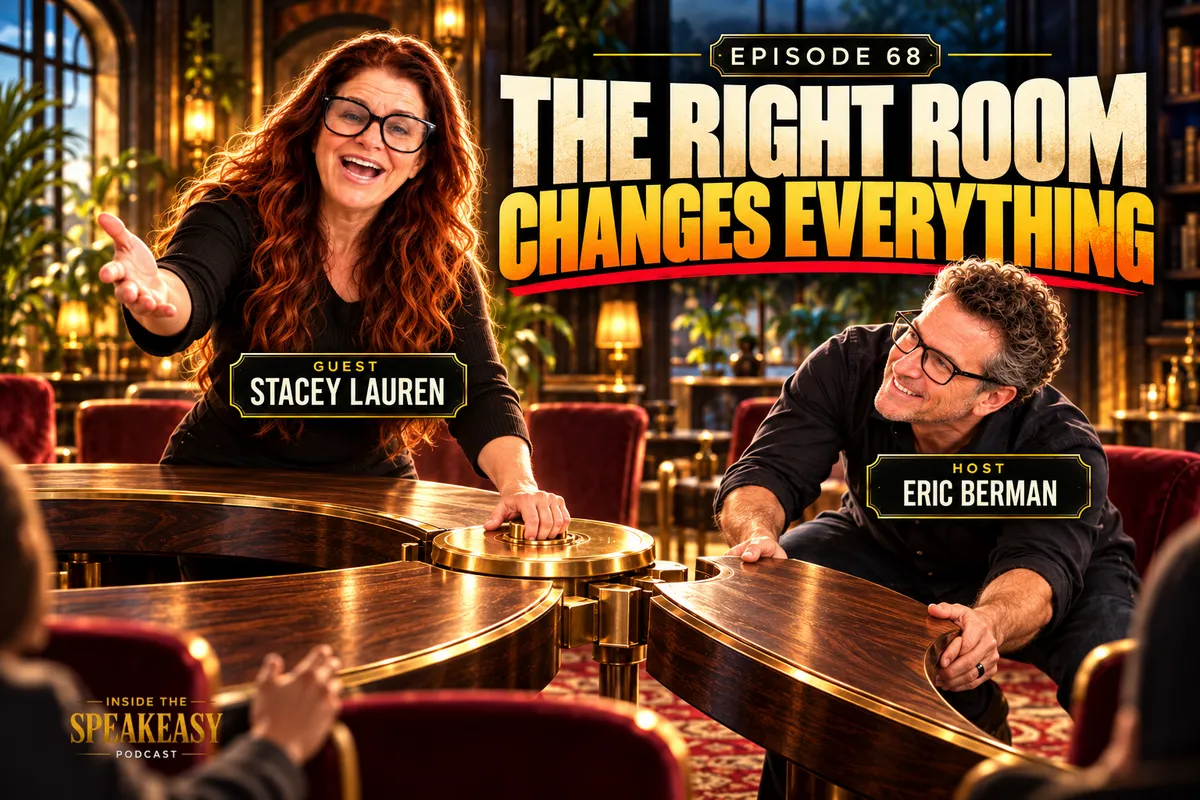
Stacey Lauren, founder of Do The Thing and a member of Speakeasy in San Diego, argues that the fastest way to build community is to gather people around a shared goal instead of small talk. Before Do The Thing, she spent 20 years as CEO of a staffing company she started with her then-husband before exiting the business. Here, Stacey walks through her I'm Game formula, the six-part acronym she says came out of a five-year experiment interviewing people about what keeps them from taking action. She explains why the "my people" piece sits at the center of it, why she runs every step inside a group, and how a simple one-hour room can build real connection without months of planning. She also describes the Billion Dollar Impact, an event model that puts nonprofits, mastermind groups, and entrepreneurs with offers in one room to raise money while people make money.
In this episode, you'll discover:
- Why Stacey Lauren builds community around shared goals rather than shared beliefs, and how that lets very different people bond the way teams do
- How the I'm Game formula works, from identifying your why to mindset, goals, accountability, my people, and educating, with each step done inside a group
- What Stacey learned as a staffing CEO when crises hit, including her rule that revenue fixes everything and turning recruiters into salespeople
- How to host a one-hour room for anywhere from two to a thousand people that builds connection without months of planning and stress
- How Billion Dollar Impact parties connect a cause, people with offers, and audiences so nonprofits raise money while attendees make money
Episode Summary
Stacey Lauren's central argument is simple: people connect most deeply when they are working toward the same goal. Speaking with host Eric Berman, she contrasts communities that stall in surface-level conversation with groups that pursue goals together, where she says the excitement builds and friendships run deeper. Her company, Do The Thing, and her newer Billion Dollar Impact events are both built on that premise, and the conversation traces how she arrived at it.
The idea first took hold while Stacey was selling books door to door for Southwestern as a Florida State student, working summers in Michigan and Iowa and even finding her housing by knocking on doors. She describes it as the first time she felt competent at anything, and the first time she experienced what she now calls "my people": being surrounded by others chasing the same goal. After more door-to-door sales work, including fitting executives for suits with Tom James, she spent a month working alongside her then-fiancé at a labor hall business and landed 20 sales, which prompted the two to start their own staffing company. Over 20 years it grew to 60 internal employees and 600 external employees and served 150 clients, though Stacey says she felt like an "unsophisticated CEO" the whole way.
Her operating lessons came from crisis. Through fires, COVID, a major lawsuit, and recession, Stacey says her default response was that revenue fixes everything, so she focused on the fastest way to bring in money rather than cutting. When job seekers or employers dried up in a two-sided market, she turned recruiters into salespeople and says the company never laid people off because of market conditions. Eric highlighted the contrast with the instinct many founders have to slash costs first. Stacey's regrets were different: she avoided speaking, declined podcasts, sent employees to present in her place, and spent months stressing over company-wide meetings. She believes that with the visibility and simpler gathering methods she uses now, the company could have grown far larger. The exit itself, she says, was not glamorous; after COVID and a divorce, she got the company back to its pre-COVID level and then told her business partner that one of them would buy the other out, which is how she exited.
Leaving the company brought an identity crisis. Following a coach's advice not to start a new business for a year, Stacey launched a podcast to collect stories for a book. That turned into what she calls a five-year experiment on why people, including herself, get stuck in self-doubt and imposter syndrome. The result is the I'm Game acronym: identify the why, mindset, goal, accountability, my people, and educate. The name Do The Thing came from her mastermind summarizing her goal of helping people with sales and dating as simply helping them "do the thing."
The distinctive move, in Stacey's telling, is doing every step in a group. Sharing your why builds connection, sharing what gets in your way creates a safe space where people realize they are not alone, and breaking a macro goal into daily micro actions keeps momentum. Educating has two sides, learning and contributing; in one podcast challenge she ran, members who taught each other tools such as Clipchamp and iMovie accelerated dramatically. Eric added that the more a community niches down, the stronger the bonds, comparing EO with Speakeasy.
Stacey closes with two ways to apply the model. For anyone not ready to run a community, she suggests hosting a single room using the same framework, for two people or a thousand, built around one goal and lots of attendee conversation. At a larger scale, the Billion Dollar Impact brings a cause, people with offers, and audiences together; Stacey auctions products and services from experts and companies, and a percentage goes to the featured beneficiary. Eric's takeaway is that a shared goal, not more funnels and ads, is what draws trusted people into the same room.
Big Ideas Discussed
Shared Goals Bond People More Deeply Than Shared Beliefs
Stacey Lauren's core claim is that the strongest communities form around a shared goal, not shared opinions or interests. She points out that when you share a goal with someone, you do not need the same beliefs or perspectives, and she uses football teams and the military as examples of very different people gathered around one objective. In her view, many communities go wrong by staying in surface-level conversation, while groups that pursue goals together get excited and build deeper friendships.
For entrepreneurs, this reframes how to design a group, event, or client community. Stacey suggests asking members directly what they want to achieve together and letting people find each other by goal. Eric Berman built on the point, arguing that the more a community niches down, the stronger the bonds, and contrasting the broad entrepreneur network of EO with the more specific personality fit he finds in Speakeasy. Stacey also cautions that people can outgrow their rooms, so it pays to keep checking whether you are in the right ones.
Run Every Step of a Goal Inside the Group
Stacey's I'm Game acronym covers identifying the why, mindset, goal, accountability, my people, and educate. What she calls her secret to community building is that each piece happens in front of others. She cites Simon Sinek on knowing your why, then adds a twist: say it inside the group, because stating your why is how connection starts. The mindset step, her favorite, asks people to share what gets in their way. She says hearing others' excuses shows people they are not alone, and she recalls a fellow CEO in her peer group admitting he also felt unsophisticated.
Goals are split into a macro goal, such as writing a book or giving a TEDx talk, and micro actions, which she delivers as daily dares in her challenges. Educating means contributing as well as learning. In a podcast challenge she ran, members who taught one another tools like Clipchamp and iMovie accelerated, she says, "like a hundred times." Her advice to community builders is to design space for members to contribute back so they stop hiding.
Revenue Fixes Everything When a Business Hits a Crisis
Across 20 years running a staffing company, Stacey Lauren faced fires, COVID, a major lawsuit, and recessions. Her consistent answer, she says, was that revenue fixes everything: find the fastest path to more money and the rest becomes solvable. Eric Berman noted how this cuts against the common reflex to start by cutting costs and labor. In a two-sided staffing marketplace, when one side dried up, Stacey moved recruiters into sales roles instead of letting them go, and she says the company never laid people off because of market conditions; people self-selected out only if they did not want the new work.
Her other hard-earned lesson was about visibility. Stacey says she avoided trainings and outside speaking, sent her best employee to speak instead, and turned down podcast invitations because she felt like an imposter. She believes a bigger megaphone would have amplified the company dramatically, and that her old six-month planning cycle for company-wide meetings was draining compared with the simpler gathering approach she uses today.
Uniting Communities of Communities Around One Cause
With the Billion Dollar Impact, Stacey Lauren is trying to stop community builders from operating in silos. The idea traces back to COVID, when associations her staffing company belonged to asked what to do, and she made a video urging them to stand together. Today her events bring together nonprofits that need money, masterminds that want to give members something valuable, and entrepreneurs with products that need visibility. She describes it as a Venn diagram of a cause, people with offers, and audiences, and says everyone has something another participant needs.
In practice, Stacey auctions products and services from world-class experts and companies, and a percentage goes to the featured beneficiary. Stacey says contributors create offers no one else can access because they are excited to support the cause, and attendees have gained new clients just from meeting people in the room. For business owners, the model shows how pooling audiences around a shared goal can raise money for a cause while creating sales, partnerships, and visibility for participants.
Questions We Answer in This Episode
What is Stacey Lauren's I'm Game formula?
I'm Game is a six-part acronym Stacey Lauren developed to help people take action on a goal. The letters stand for identify the why, mindset, goal, accountability, my people, and educate. Stacey says it came from a five-year experiment that began with her podcast, as she looked for patterns in why people stall. She describes "my people," being with others who share the same goal, as the center of the formula, and she has participants work through every step inside a group.
Why does Stacey Lauren say shared goals build stronger community than shared beliefs?
Stacey Lauren says shared goals create deeper bonds because people do not need the same beliefs or perspectives to pursue the same outcome. She compares it to football teams and the military, which unite very different people around one objective. In her view, many communities stall in surface-level talk, while groups working on goals together get energized and build deeper friendships. She recommends asking members what they want to achieve together.
How can an entrepreneur host a community-building event without overplanning it?
Stacey Lauren recommends hosting a single room built around one shared goal instead of launching a full community, using what she calls her People Party framework. Drawing on her I'm Game formula, the host gathers people around the goal, asks why they are there, shares their own struggle with the goal, and invites everyone else to share. Stacey says the format works for anywhere from two to a thousand people and for an hour, two hours, or eight hours, because attendees would rather talk to each other than listen to a host.
What is the Billion Dollar Impact and how do its events work?
The Billion Dollar Impact is Stacey Lauren's initiative to unite communities of communities, including nonprofits, CEO groups, masterminds, associations, and EO groups, around shared goals. At her parties, Stacey auctions products and services from experts and companies, and a percentage of the money goes to a featured beneficiary. Stacey describes it as a Venn diagram of a cause, people with offers, and audiences. She says participants get access to special offers, and some have gained new clients just by meeting people in the room.
What did Stacey Lauren learn about handling crises as a staffing company CEO?
Stacey Lauren says her main crisis lesson was that revenue fixes everything. Through fires, COVID, a lawsuit, and recessions at her staffing company, she focused on the fastest path to more revenue instead of defaulting to cost cuts. When one side of her two-sided staffing marketplace dried up, she shifted recruiters into sales roles. Stacey says the company never let people go because of market conditions; employees only left if they chose not to do the new work.
Why does teaching others speed up progress inside a community?
Stacey Lauren says educating has two sides, learning and contributing, and that teaching what you just learned pushes you into action. In a podcast challenge she ran, members who learned tools such as Clipchamp and iMovie began teaching others in the group, and she says that accelerated them dramatically. She advises community builders to deliberately create space for members to contribute, because it frees people from hiding in the background.
Where did the name Do The Thing come from?
The name Do The Thing came out of a mastermind Stacey Lauren was in at the time. She told the group she wanted to help people with sales and with dating, and members summed it up as helping people "do the thing." Stacey says she still has the recording of that moment. Today Do The Thing covers whatever goal someone wants to pursue, and her I'm Game acronym is the next-step framework for how to do it.
Full Episode Transcript
Read the Full Episode Transcript
Introducing Stacey Lauren and Her Community Mission
Announcer: Welcome to Inside the Speakeasy podcast, the private room where today's sharpest founders, innovators, and renegade thinkers come to trade the ideas that move industries. This show is brought to you by HighLevel, the AI-driven business operating system trusted by over 2 million businesses to help automate, scale, and create real leverage. HighLevel isn't just a tool. It's the engine behind some of the most agile and high-performing teams on the planet. If you're ready to streamline everything, amplify your reach, and actually build a business that works for you, you're in the right place. Visit www.GoHighLevel.com/Speakeasy-Mastermind-Promo to get an exclusive 30-day trial for being a listener of the Inside the Speakeasy podcast. Enjoy the show.
Stacey Lauren: Now I'm doing something called the Billion Dollar Impact, where I'm not just like running one community. I'm like uniting communities of communities together, like nonprofits, CEO groups, and mastermind groups and associations and EO groups and all the things, and we're all like, now we're all, it's like almost like a big playground. Communities are colliding with each other.
Eric Berman: Learn the secret to gathering people, and it can change everything from how you launch a business, book, or how you grow a community, achieve a goal, or rally people around a cause. So excited to bring on one of our San Diego members, who is going to wow you with some incredible nuggets, all related to one of my favorite topics: community. And she's got some really, really killer, unique ways of leveraging communities to grow the things you're trying to grow. She's been all over the place talking to some of the biggest community leaders in the world. Wherever I go, I see another group that's featuring Stacey Lauren, the founder of Do The Thing, out there. And her big vision is to unite millions of people and communities around shared goals to create a billion dollars of impact while helping people and businesses grow that way. And before she started Do The Thing, she built and scaled a staffing company to 35 million in revenue before she exited this business. And now she's doing probably what's been her true passion the whole time, and some of the nuggets she learned along the way. So excited. I know it's been a long overdue for us getting on the podcast. Welcome, Stacey.
Stacey Lauren: Thank you so much. I'm so excited to be here.
Eric Berman: Well, that was a mouthful, but there's so much exciting stuff in here. We all understand community. It's becoming such a big word right now. We all need it with AI and all that. And you've got some really, really cool models of how anybody can do some stuff they're doing and take some of the magic that you've created and leverage that to really grow their business and curate some rooms and get around some people they didn't think they had access to. But before we get into that, there is something that led to that. It didn't just happen magically. You're an entrepreneur that's learned in the school of hard knocks. You've done some incredible stuff, and I love it when people have had big exits, so congratulations on that. Can we go back? You didn't just all of a sudden say, I'm going to be a staffing company entrepreneur. I bet when you said, hey, what do you want to do in your life when you grow up, "I'm going to be an entrepreneur for a staffing company" was not your answer. So how did you get to that part? Let's go back in time a little bit.
From Door-to-Door Book Sales to Building a Staffing Company
Stacey Lauren: Yeah, great question. Well, it started, if I think back, it really started in college, where I sold books door to door, and that was like the first time I really felt, I want to say, competent in my life, because I've never been good at anything like sports or school or any of that stuff. In fact, if you ever look at some of my stand-up comedy routines, you'll see I talk about how great I am at sucking at everything. So selling books door to door is for this company called Southwestern, where you basically just go door to door, and you even have to find your housing through door to door. You don't even have like a place to live when you land in a place. And so that job really set me up for everything, you know? And it helped me learn the power of like resilience and rejection and goal setting. And then also it was my first time experiencing what I now call my people, which is being with people that have the same goal as you, and you're like doing the thing together. And so there was this like level of support and understanding and compassion. And yeah, so it really started there. So I went to Florida State, and then they purposely have you like go to other states because they don't want you to live where you are. So one summer it was Michigan, and then the next one, I was in Iowa.
Eric Berman: Yeah, they really, so you're young and they ship you all over the place.
Stacey Lauren: And we're just like, sure, I'll do whatever. I'm going to run through walls.
Eric Berman: Yeah. So you do that. How'd you all of a sudden get into recruiting?
Stacey Lauren: Yeah. So from there, I did other sales jobs where they had a sister company, and it was actually called Tom James, where you're like a tailor for clothing, and I'd go to like C-level executives and help them with their suits, but it was like door to door, like downtown San Diego. So again, I really love the door-to-door thing. And so my ex-husband actually worked for a company that was more of a labor hall type business. And then when he had decided, or what happened, oh, we were getting married at the time. And while we were waiting to get married, there was like a month that I worked with him because we had relocated, and anyway, I worked with him for the month and then got like 20 sales in that month for his other company. And he was like, what in the world is happening here? And so that was when he was like, why don't we just open up a company? Because, you know, like sales is the hardest thing for anyone to do. And so that was where, and then I like love the idea of like helping people get jobs. So when we started our business, it was like a totally different kind of business than that kind of labor hall, where we actually like pre-scheduled jobs and things like that. And so it was really built organically, like flying by the seat of our pants, where it's like, okay, I have two employees, and then I'd go out and get those employees jobs. And, you know, it just grew like crazy. We ended up with 60 internal employees, 600 external employees. I helped 150 clients fill critical...
Eric Berman: Years from start to sale?
Stacey Lauren: 20 years.
Eric Berman: Wow. Okay. So you were 20 years in this business.
Stacey Lauren: I was going to say, I was the CEO of that company. And it was like so funny, because I'm sure a lot of people can relate. You feel like you're not qualified, the bigger it gets, you know? It's like, I felt like this unsophisticated CEO, because it came from the school of hard knocks, you know, where I'm just like going and going. And so, yeah, it was wild and also incredible learning, you know, for me too.
CEO Lessons: Revenue Fixes Everything and the Cost of Hiding
Eric Berman: Well, I do want to peel some lessons, because all of us that are scaling and building businesses, and I know we want to get into the community side too, but I know you have a lot of good gems across multiple areas of business. So let's talk about that. I mean, you were the CEO, and I've been in those shoes. I can relate to that a little bit. In my first big company, we grew from like four of us to 400 employees, and you're sitting there saying, what am I doing at 25 managing all these things? And like, you know, am I good enough and all that? What do I know here? And you're sort of learning on the fly. I mean, what were some of the big lessons you had? What do you wish you knew back then that you kind of discovered later?
Stacey Lauren: Oh my gosh, I'm like, yeah, we need a couple hours for this one. But yeah, like I think so. One of the big lessons was we had so many things that happened, you know, like in the world during 20 years, right? There's the recession. There's like all the fires that would happen and devastate different areas. There was COVID. We had a big lawsuit. It was just all these different things. And it's always scary, especially when you have a lot of employees, because you worry about their future too. And the thing that I always would go to whenever I was fearful of anything that was happening, it was just: revenue fixes everything, and just figuring out what's the fastest way to be able to make money so then everything else works. You can always fix all the other stuff. So anyway, that was one of the big kind of like lessons. The other one, if I was doing what I was doing now...
Eric Berman: And let me just pause you there, because I know that sounds obvious to people, but I can again relate. I think sometimes when poo-poo hits the fan, we immediately go into, okay, we've got to start cutting costs. Like, what can we get rid of? What can we stop doing? And I like how you said no, revenue fixes everything. Stop, don't cut labor necessarily. Spend that energy generating. How can you get more money? More clients, accounts.
Stacey Lauren: Yeah, we even did it because, like, there were times, like, you know, there's no jobs. Like with staffing, there's two sides. It's a two-sided marketplace, right? So if there's no people looking for jobs, or like in the recession, you know, there's no people that need people, then we had to get our recruiters to actually like start to be salespeople, essentially. And so what was great is we never like let people go because of the market conditions. They just would self-select if they didn't want to do something that we offered. So yeah, it was a really nice thing. Yeah. And then part two of that was, man, if I would have known so many things that I know now, if I would have gone back to that company, you know, we'd be like a billion-dollar business. It's so wild. Like one thing is, well, I'll teach it a little bit later, but like I call it horse mode now, but I was very not visible, you know? Like I would be really uncomfortable speaking to anybody. I mean, I'm fine one-on-one and manager meetings and company-wide meetings, but I didn't like to do trainings. I didn't like to do outside speaking when associations would ask me. And then I would always find the best employee that could speak for me. You know, I was just very like always thinking I was an imposter, not good enough, like all the things. And so anyway, if I would have known what I know now, you know, I would have been able to really create a better megaphone for our business and be able to, you know, amplify it more. Like people asked me to go on podcasts. I said no, you know, things like that. And so that would be something. And then the other thing was I gathered people, but I had to spend a fortune in order to gather people, and time. So like we would have these company-wide meetings, and it would take me like six months. I'd be planning and stressing, and what am I going to say, and what's it going to be, and are they going to like it? And it was exhausting and draining. So by the time you're done, you're like, oh my gosh, right? And so now I have a much more fun, simple way to gather people. And I've really cracked the code on what people actually want when they're in these like spaces together. And so that's the other thing.
Selling the Business and the Identity Crisis That Followed
Eric Berman: Got it. Yeah, you probably could have saved a lot of money and energy and time. But yeah, nevertheless, so when it came time to sell, was it something that you were just burnt out, tired? How did you know it was time to sell, or did somebody come knock on your door and you're doing roll-ups? Like, what happened there?
Stacey Lauren: Yeah, great question. We were trying to sell the company for a while, and actually we had a mutual connection with Alan. He was going to buy the business. And then COVID, there was a bunch of stuff that happened, but basically COVID happened. I'd gotten divorced like two years before, and we owned it together. He was the CFO. I was the CEO. And then COVID happened. The company went in half. I got the company back up to where it was before COVID. And then I said, I'm like, either I buy you out or you buy me out. And so I ended up, yeah, getting out that way. So it was not a sexy exit.
Eric Berman: Okay. So let's segue back to what you were talking about today. So you go from that, and then your true passion. Now you're like, okay, what do I really want to do when I grow up? What do I think about? Genius [unclear]. You know, what do you love to do and you're good at? Like, you're starting to find this passion in the world of communities. And you have this neat angle, and you've been doing stuff. Let's talk a little bit about what you're up to and what we could learn from some of these things that you've gone through.
Stacey Lauren: Yeah. I mean, it started with an identity crisis because, you know, I gave my whole life to this business, and having like all these employees and all the fires and the moving parts, it's like, that was everything that I could ever think about, right? And then suddenly that business was gone, and I'm like alone with my thoughts, you know? And I'd had to deal with these employee problems all day long and everybody yelling at me and asking for this and that. Yeah, it was so wild because I hadn't had that aloneness, you know, in a really long time. And so, yeah, so I had a coach that I worked with at the time, and she told me not to start a new business for at least a year. She's like, because a lot of people do that, and then they end up in something that they don't want. And so that was when I started my podcast. And it didn't really make sense at the time, because I still was not comfortable speaking or all that stuff. But I wanted to write a book, and the person that was helping me write the book said, you know, you really need to get interviews from people, because I couldn't remember a lot of my stories. She's like, you've got to pull out their stories, and that'll help you write the book.
How the I'm Game Formula and the Do The Thing Name Were Born
Stacey Lauren: And so anyway, I started my podcast, and I was going on this basically quest of figuring out this formula to help people do the thing, because that was the biggest thing I noticed with my staffing company, is how many people, including me, had like self-doubt and imposter syndrome and blocks and baggage that like prevented them from taking action. So yeah, this ended up being a five-year experiment where I basically identified the patterns, and there's six patterns, and it's an actual acronym. It's called I'm Game. Each letter stands for a piece of the acronym.
Eric Berman: Okay, I'm writing this down. I'm what?
Stacey Lauren: I'm Game.
Eric Berman: I'm Game. Okay. So what's the acronym for? And before you answer that, you said do the thing. Okay, what do you mean by that, for those that don't know you that well?
Stacey Lauren: Yeah. So do the thing was like, it was funny. It came out in a mastermind I was in at the time, because I'd just started dating, and I was telling them I wanted to help people do sales, because I love sales, and sales to me is like one of the best things in the world to learn, because then you never have to worry about money again. You know, like, what to do. And so anyway, I had started dating, and I started meeting people, and I had different experiences than other people did with dating. I actually enjoyed it, whereas a lot of my friends hated it. And in the mastermind, I'm like telling them, and I'm like, yeah, like I want to help people with sales and dating, and I don't remember all the things. And they're like, yeah, you just want to help them do the thing. And so that was basically, I still have that recording. I have to ask them permission at some point to share it, but it was so fun, because all of a sudden, do the thing came out. They're all like, yeah, do the thing. And so that's where Do The Thing was really born.
Eric Berman: So it's really anything you want to do. Whatever you're interested in doing, it's just go do the thing. Just get it done. Just go. And then you have to help people get out of their shell. Maybe they're stalled. Maybe they just don't know which direction to go. Okay, so we have I'm Game. I'm Game. Walk me through it. What is that? Everything you hear on this show comes back to one idea: proximity. I wrote the book on it, literally. Proximity Pays, my best-selling book, available now at proximitypays.com.
Breaking Down the I'm Game Formula Step by Step
Stacey Lauren: Yeah, so the I is identify the why. And so, like, the M is mindset. The G is goal. The A is accountability. The M is my people. And my people is people that have the same goal as you. So it's different than your regular friends and family and regular support network. It's being with people that have the same goal. And then the E is educate. And there's two sides to education. One is by learning, but the other one is contributing, because when you teach someone something as soon as you've learned it, you accelerate your action. And this is really back to do the thing. This is the acronym for the next step. Once you say do the thing, okay, well, how do I do the thing?
Eric Berman: You're saying, first say, I'm game. Game to do that thing. I'm with you. And so first, okay, so we identify the why. You're basically asking people, is your why big enough to get you motivated to do the thing? Is that correct?
Stacey Lauren: Yeah. And, you know, the biggest one out of all of them that everything centers around is the M, which is my people. That's the one I did my TEDx talk on a couple years ago, which is being with people with the same goal. And then every other piece of that formula, you actually do it in a group. So that's my secret to community building, is I have people do everything in the group. So Simon Sinek talks about the I, identify the why, the power of the why. I say, yes, do that, know your why, but then tell people inside the group, because now you're starting to build connection with saying why you want to do something.
Eric Berman: Well, I assume then what you're saying, if I can talk, it's really maybe a dual thing. If I'm identifying the why and reaching out to find others, you're saying part of it is tell people, but then find who's a magnet for that, who says, wait a second, that's my why too. Now you're starting to build your M, right? You're my people. Like, okay, we have a shared why. We have a shared purpose. Is that what you're meaning by that?
Stacey Lauren: Yeah, totally. Yep.
Eric Berman: I love it. You're resonating, and together you go faster. Love that.
Stacey Lauren: Yeah. And then the M, which is mindset, this is my favorite one. This creates an immediate safe space in a community when you do it inside of a group, because I have people share their excuses, or their struggles, on what gets in their way, you know? And what I found, whether I've been helping people start podcasts or go live or do video or whatever it is they want to do, when they hear other people's excuses, they realize they're no longer alone. And this actually even goes back to my staffing company days. I was in a CEO group with like all these guys that were like, you know, five, 10 million dollar businesses. And one of the guys was like, oh yeah, I feel like a really unsophisticated CEO. And I was like, what? I had no idea, you know, because he seemed like he had it all together and the whole thing. And so that's like the M, right? Mindset of things that got in your way. And so bringing that into any goal that you have, now you're creating like a sense of vulnerability in the group. And you do this really well inside Speakeasy, you know, giving people that safe space to share and, you know, talk about what's really going on, because like, it's hard out there, right? But when you're in the group with people that want the same thing, we do have the permission, you know, to be able to say what's happening, because now we're going to be able to actually like work on it more.
Eric Berman: Yep. Love that. Okay, G, goal.
Stacey Lauren: Yeah. So there's always like a macro goal. So, you know, you want to build a business, you want to write a book, you want to do a TEDx talk. So there's some kind of macro goal. And then there's like a micro goal when I'm doing community building. So the micro goal could be, okay, I just want to record one episode this week. Or for me, I've run challenges, so I give dares, and I give people like one little action to do each day. So really the micro is, okay, what one step are you taking towards your bigger goal, kind of thing?
Eric Berman: Yeah. Let's bite-size it. Okay. And then accountability. Is it almost like you've got to find somebody to hold you accountable, or how do you teach that?
Stacey Lauren: Yeah. I mean, a lot of times, like if you think about even, like, you do a great job with this in the referral parties, you know, and the different things you do in Speakeasy, you know, it's almost like by you being there and you're seeing what other people's goals are, you're almost building in this like sense of accountability, you know? And you're going to be opening that up with other pods and different things that you're doing. But it's just being more intentional about saying, hey, who wants extra support? And then the people then find each other that way. But even just by people saying what their goals are, that's like one layer, which sometimes that's enough for people, and other people need more.
Eric Berman: Right. Right. Love it. Okay. And then my people. We talked a little bit about that. Anything more to add to that? Is it like just finding your [unclear]? Do you suggest... and that's one of your favorite ones too. So what's the magic here?
Stacey Lauren: Yeah. I mean, this is like the biggest thing that a lot of people like don't do well, you know? Because like, we talk about like our top five. What is that saying? Like, surround yourself with the five people, you know, that can help you or whatever. But it's not based on anything other than like we have similar beliefs or whatever. When you share a goal with someone, you don't actually even have to have the same beliefs or perspectives. You could be totally different. And it's so cool. Think about that with, like, football or the military or like any of these things. You're gathering people that are like totally different, diverse perspectives, you know, and things like that. And so that's what I just say, is just really be intentional, you know, about what your goals are, and then decide what rooms to be in, what groups to be in. And then as you're creating those rooms and groups, think about it as well, because we can outgrow, you know, where we are. We want to always be expanding and seeing if we're in the right place and adding more places to achieve those goals.
Eric Berman: I love that analogy. To me, it's almost like, you know, being a community builder, the more you niche within community, the stronger the bonds will be, because you have commonalities, or that much more that you're relatable to things. Like to me, you talk a lot about EO versus Speakeasy, you know? Like, EO is, okay, entrepreneurs. And I was just at my retreat with my fellow EO mates. You know, everybody's an entrepreneur. I could say they're my people, because we're all kind of entrepreneurs doing stuff at a certain level. But Speakeasy is also entrepreneurs, and it's even more my people, because it's a similar type of personality we have. There's probably even a niche down within that. So I mean, I like what you're saying about that. I think the more you can find your people, drilled down, that's where magic can definitely happen. And educate. And I like that you added the second layer to that, because I think we all know that too literally, but I like how you sort of force that in your teaching, which is not just, yeah, of course, we're all going to go out there and listen and learn and read books. But I think you probably push, I'm guessing you push a lot on the teaching side of things, right? Or making sure you're [unclear].
Stacey Lauren: Yeah, you know, it's great because I noticed this, and I ran a podcast challenge a couple of years ago. And as people were learning how to start these podcasts, they're learning all these new tools, you know, like Clipchamp or iMovie or whatever. And they're going in the group, and they're teaching people how to use these other platforms. And that got them to accelerate like a hundred times, because now they're like the gatherer of people. And so I recommend everybody do that in every community that you're in. And then if you're a community builder, to build that in, because the more you give people the space to contribute back to the group, you're freeing them from hiding in there.
Inside the Playground Community for Doing the Thing
Eric Berman: All right. So tell me more about the Playground that you're working on right now. And then I want to get into all these really fun events, the Billion Dollar Impact events that you're up to.
Stacey Lauren: Yeah. You know, it's funny. This actually got launched at my January event, by actually even a few Speakeasy people, who helped me launch it there. And they called it the Inner Circle. And I wasn't excited about the name. I don't know why, but I just wasn't ready for like an inner circle. And then all of a sudden I started looking and seeing what I was doing with people. Like, everyone's going live, they're on video, they're on podcasts or hosting events. And everyone's just like literally, like, it's doing the thing, right? We're having all this fun, and we're building relationships and friendships. And then I'm like, this is a playground. And so that's basically what it is. It's like we're launching our books together, launching our businesses. Someone has an idea, and they want to workshop it. And then I get to bring in like experts from outside. Like Jim Bunch was one of the experts that came in. He got to show us his platform. And it's just really fun to bring people in that are doing cool stuff and then also playing with the people in the group. Yeah, I love it. It's like one of the most fun things since I started, was just having this space. We're not just like, we're playing in business, you know? We're experimenting, we're launching, you know, the whole thing. It's super fun.
Eric Berman: But you're curating high-level people, so it's not an elementary playground, right? It's a big kids' playground, which is probably the magic, I imagine. I mean, maybe that's a good segue into the Billion Dollar Impact and these events that you're having right now.
Billion Dollar Impact: Uniting Communities of Communities
Stacey Lauren: Yeah. I mean, the biggest thing for anyone that's wanting to start a community is really looking at the community and asking, like, what goals would be great for the community to achieve together? Or asking them, hey, what do you guys want to do, you know, and what are some of your goals? And then I think you said it earlier, where you get to even niche down deeper, you know, based on goals, and then those people find each other easier. And I think that's where a lot of community builders go wrong. They're kind of focused more on like conversations and surface-level talk. But when you're getting into like doing goals together, it's like your endorphins are going, you're getting excited, you know? You're just building deeper friendships. And so that's one of the biggest things I suggest to people, is to do that. And so now I'm doing something called the Billion Dollar Impact, where I'm not just like running one community. I'm like uniting communities of communities together, like nonprofits, CEO groups, and mastermind groups and associations and EO groups and all the things. And we're all like, now we're all, it's like almost like a big playground, and it's colliding with each other. Yeah. And it's like, because everyone has something the other person needs. And it's funny, I did two interviews when I was with my staffing company, and one was like this really funny, like, PowerPoint video where I do not have my voice yet. So if you hear it, you'll be cracking up. But I talked about, during COVID, like all these associations we were in, BIA, ABC, I mean, BBB, whatever, all these different associations, and everyone's coming to us saying, what are we supposed to do now that the world is shutting down? I'm like, I don't know, I'm just a staffing company. But we have to find out when people are coming to us, because they think we know stuff. And so then I did this video basically uniting all these associations together. I'm like, we need to stand together. We've got to stop operating in these silos as community builders. And that's what the Billion Dollar Impact does, is I'm basically taking this whole thing of a shared goal up a notch, and I'm like, okay, let's all have a shared goal together. You're a nonprofit, you need money. You're a mastermind, you want to give value to your members and have something fun for them. You're an entrepreneur, and you have a product and service that you want to get visibility. And I've basically like brought all these people together, and I figured out what each person wants and needs. And like now we're in one room for a couple hours, and we're raising money while people are making money. It's super fun.
Eric Berman: Yeah. And there's a lot of magic in that. Again, you and I could riff and talk about communities all day, but I think there is such power in that. And I want to go back to some stuff that I'm learning from talking to you. It's going back to: whatever business you're in, you have a shared goal. How can you find others that have those shared goals? I think that's such a key point you're making today. And then can you build a community around that? Because if you can build a community around that shared goal, then we're starting to come together, and it's the power of the numbers. And then everybody wants... and now more than ever, I think, with AI, all the community builders out there are excited, because we are providing real people, and we don't know who to trust anymore. And there's this inherent trust, it seems like, when you're running a community with good integrity and people. You know, obviously something that's really important to you and I is to watch the integrity and our reputations, because the community can crumble. But assuming we're being trusted by others to bring a good group together, so they don't have to do the work and curate it. So if you're sitting listening to this and saying, well, wait a second, maybe that's a way I could do it, because you're doing the hard work. You and I were talking in the green room earlier about how it takes effort to build the right kind of people to put in the room. It means we made a lot of phone calls and checked a lot of hands, moved people in this room, tried to put people in the right spots, so that when another busy entrepreneur who doesn't have time to do that walks in there, they say, thank you for creating this space for me where I could just walk in. I know you've done all this hard work to ensure that my time is not going to be wasted. You have high-quality people. And then you're benefiting from bringing all those people together. So I think part of what you and I talked about, what you're teaching and all these things, is find your group, right? Find your community, build that together. Is that a lot of what you're going after, right?
Building Community With a Single Room Instead of a Program
Stacey Lauren: Yeah. And if you're listening and you're like, oh, I don't know if I want to start a community or like go through all of that, you can also do just a room. So that's like one of the things I love helping people do, is like, it's a People Party framework. And I actually already gave the formula earlier, and I use this I'm Game framework, where I help people in a room, in an hour, in two hours, in eight hours, however much time you want. And this is how you can create any event without overthinking, overplanning. It's like creating that space for connection in the room and helping people identify their why, helping them say what they're struggling with. And so if you're like, okay, I don't want to start a community, well, just do an event. Say you'll do an hour event. It's a great way to bring people together and build community in the room without it being just like this one-way kind of conversation. You're making it more interactive and fun and creating that space where people are talking together.
Eric Berman: Okay. I love that you said that. They're looking at you and I, and they're like, okay, that's a lot of work putting all these people together. You're saying no, no. What's a good number? What's a good low number target? Like five people, and you just get a room with five people that have similar interests?
Stacey Lauren: Yeah. And this framework, you could use it for two people. You could use it for a thousand people, basically. Yeah, you start with however many people you want, and you basically can run this system on anything. And it builds community with the shared goal. So you're like, okay, what's the goal I want to bring people together on? It could be like, okay, we're going to create conversations, so the goal is the conversations. It could be, I want to teach people how to do marketing or AI or a mastermind. And then you're attracting them through that goal. And then when they're there in the group, it could be people you know or people you don't know, whichever way you want to start. Sometimes it's easier to go to people that you don't know when you're doing something new. That's what the Playground is. I'm like giving them my audience, and they play with it until they get more confident. But basically, that's when you're creating that space of connection. You're telling them why you gathered them together around this goal. And then you're asking them why they're there. Why are you excited to be here? Right? And then from there, you're telling them what you've struggled with about the goal. And then you ask for them to share. And then you basically run it that way. It's really fun, and it's a way to bring people together easily. And that's all people care about. They want to meet people. They want to connect. You know, they don't want to hear you talking for an hour. They'd much rather talk to each other.
Eric Berman: That's why everyone comes to these rooms. Especially with a shared interest.
Stacey Lauren: Yeah, absolutely.
Eric Berman: It's actually simple when you really break it down. It's just doing a little bit of work. And I think we all try so hard to do other forms of marketing, and we sit behind our computers and try to build funnels and do this and do that and run ads. And you're like, wait a second, there's a whole other approach to start to build out what you're trying to achieve and get some collaborations with people that have shared goals. I think that's great.
How a Billion Dollar Impact Party Works
Eric Berman: Before we kind of go, you know, I think you're doing something really special with the Billion Dollar Impact. And I don't know to what extent we got a chance to really explain that, because I know your name's getting out there. A lot of people haven't been to one of your parties. They keep hearing about them, and they're really cool. So why don't you explain, if you don't mind, and if anybody's listening and you want to maybe have Stacey host one of the parties or you want to attend one, a quick overview.
Stacey Lauren: Yeah, you know, I should, I really need to get this out, because Jim Bunch helped me explain it better, and it requires me having this thing, but I'll just use it with my hands. So what the party is, is there's one end where you have, what is it, okay, wait. Oh, you have the cause. You have the cause here, okay? And then you have people with offers here, and then you have audiences here. And actually, it's a Venn diagram. They all connect. And so that's all it is. It's basically like I'm bringing in world-class experts and people that have really cool products and services. I'm auctioning them, and then a percentage of the money goes to the featured beneficiary. And it's so fun because people are like, they're willing to do more because it's for a good cause. So you get really great prices on things, but you also get access to things, like people are creating offers that no one has access to, because they're just excited to do something for the cause. And so it's a great way to meet new people. I mean, people, without even buying anything, you're meeting all these really cool people in the room. People have met, gotten new clients from it. And also when you buy the stuff, you're getting opportunities to get on like really cool podcast stages, communities, you know, like AI, software, things like that.
Eric Berman: Yeah, you're going there to learn and meet great people and have an opportunity to get an insane product. So even today, let's not kid ourselves. We're all here to like buy and sell things at the end of the day. And if you could get it at an insanely discounted price from the market price, you're happy. And then you even get to probably talk to the person who has that and build that relationship, plus all the other people in the room, in a heavily curated room. There's a lot of upsides. So to that, and obviously the charities and great causes there, we're all doing good out there. So I think it's remarkable how you're putting these pieces together and your circles, your Venn diagram of all three of those. You know, definitely hit her up. She's amazing. And thank you so much for your time today.
Stacey Lauren: Thank you.
Announcer: And that's a wrap from the Speakeasy Podcast. If something sparked for you, don't keep it to yourself. Share it, review it, and pass it to the one person who needs to hear this right now. Want in on the real mastermind? Tap the link in the show notes to apply. Until next time, keep scaling, stay sharp, and don't be the smartest one in the room.
Eric Berman: Hello, I've been noticing you've been following along to Inside the Speakeasy podcast. And if the conversations I'm having out there resonate with you, then I'd like to invite you to apply to learn more about becoming a member of Speakeasy.

About The Guest
Stacey Lauren
Stacey Lauren is the founder of Do The Thing, which helps people move past self-doubt and act on their goals through community. She created the I'm Game formula after what she describes as a five-year experiment that began when she launched a podcast to gather stories for a book, and she has given a TEDx talk on the power of being with people who share the same goal. Before Do The Thing, Stacey spent 20 years building a staffing company, serving as CEO as it grew to 60 internal employees and 600 external employees, before exiting the business. She now runs the Playground, a community where members launch books, businesses, podcasts, and events together, and leads the Billion Dollar Impact, which unites nonprofits, mastermind groups, associations, and entrepreneurs around shared goals. Stacey is part of Speakeasy's San Diego community and also performs stand-up comedy.