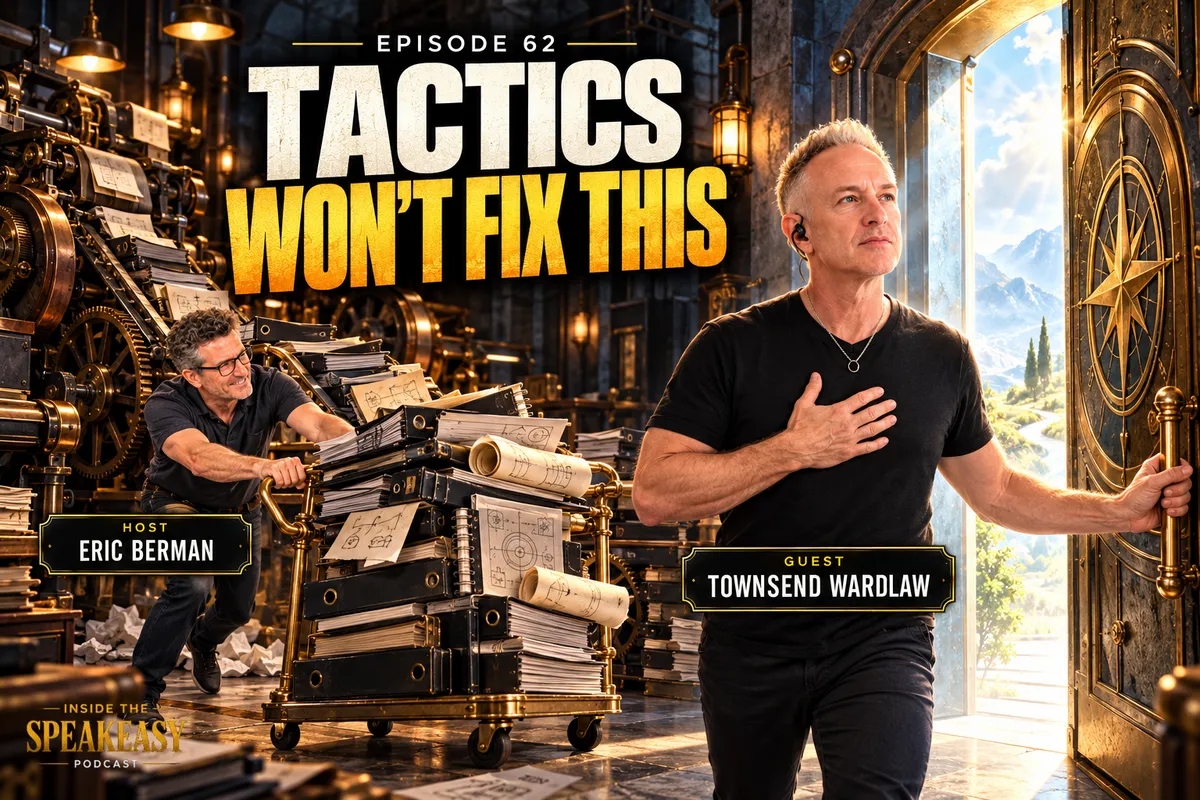
Townsend Wardlaw, a Scottsdale-based coach who has spent two decades in sales and the last ten years working with more than 300 founders, argues that consciousness, not better tactics, is the biggest lever a business owner has. His evidence starts with his own story. After climbing from bike shops to a VP role at a Fortune 500 company, he built a sales institute to 80 people and roughly three million dollars a year, then lost the company, his marriage, his money, and his health. Townsend explains how the belief that everything is up to him fueled that growth and then failed catastrophically. He describes the alternate fuels founders rarely consider, why hard work stops scaling somewhere between one and ten million, how he helped a client spot an extra million dollars in compensation by changing where he looked from, and why a big exit trades one fear for another. For entrepreneurs who feel stuck despite reading all the books, his point is uncomfortable and practical: the next stage requires a different operating system, not more effort.
In this episode, you'll discover:
- Why Townsend Wardlaw says founders stall when their identity stays fixed on it's all up to me, even after they have read every business book
- How swapping hard-work fuel for alternatives like I've done enough or help is on the way can open options a grinding founder never sees
- Why telling a client what they should do rarely works, and how Townsend walks people around their view until new strategies appear on their own
- What happens to founders after a private equity deal, when the decision-making identity that built the company suddenly collides with a board and a boss
- Why a 20 to 50 million dollar exit often leaves founders protecting money instead of feeling secure, and what Townsend calls the inside jobs money cannot buy
Episode Summary
Townsend Wardlaw's central claim is that consciousness is the most powerful lever in business. As host Eric Berman frames it in the introduction, the founders Townsend has seen break through did not find better tactics; they developed a different relationship with themselves, and enterprise value followed. Townsend argues that who a founder is, meaning how the world occurs to them, produces what they think and do, so trying to fix results without changing that identity keeps producing the same outcomes.
His own career is the case study. Townsend spent his twenties chasing professional road racing and working in bike shops, then took a cold-calling job reselling long distance in Colorado, making 150 calls a day to set two appointments. He moved to AT&T and, over seven years, rose to a VP role at a Fortune 500 company earning what he recalls as 250 to 275 thousand a year, a job he later calls a quarter-million-dollar job. He says he was living the dream and miserable. He quit in March 2002 to start a sales consulting firm, only to watch every signed client pull funding as the dot-com bubble burst. He pivoted into a bespoke sales agency, then into a sales institute after StorageTek asked him to produce 20 trained salespeople. By his account, the institute took in about 9,000 resumes a year, started about 1,000 students in cohorts, and graduated 200 to 300.
Growth exposed the limits of his approach. By 2008, Townsend says, he had 80 people, a leadership team of seven, and upwards of three million dollars a year, but everything still ran through him. He had the illusion of a company. The business went under, his marriage failed, he went bankrupt, and his health collapsed. He insists he never figured it out himself; he simply ran out of rope. Looking back, he does not frame his younger self as doing anything wrong. The belief that it is all up to him and that nobody is coming was powerful fuel, he explains, and no one builds a company from nothing without it. The problem is that it was the only fuel he had.
That idea of fuel anchors the middle of the conversation. Townsend describes alternate fuels such as I've done enough, other people can do this besides me, and help is on the way, and he stresses that these are not affirmations but programming installed early and reinforced by success. A related program says something is only worthwhile if it is hard. Hard work might get a founder to one million, twice as much to two million, and ten times as much to ten million, but eventually the more-hard button stops working. Eric connects this to his own experience: he dismissed the San Diego dinner group that became the seed of Speakeasy Mastermind because running it felt easy, until others told him that ease was a sign of his gift.
Townsend's method follows from his view that the mind projects meaning onto the world rather than receiving it objectively. Using the image of someone sitting on the south rim of the Grand Canyon, he explains that people cannot be told another view exists; they have to see it themselves. He describes a client running three regions for a PE-backed orthodontic roll-up who called with a problem, and how, through questions rather than advice, the client realized the situation could mean another million dollars in compensation. Today Townsend embeds with a handful of companies, typically founders past ten million in revenue who have been acquired or partially acquired by private equity and now face a board and sometimes a boss for the first time.
The conversation closes on wealth and fulfillment. Townsend says founders who exit with 20 to 50 million often stay miserable because the fear of not having is replaced by the fear of losing, and security, peace, love, and worth remain inside jobs. He only works with people who want what he calls a 10 out of 10 life, and he offers a practical exercise for everyone else: treat thoughts like life is hard as perfect from where you are looking, then ask how you must see yourself for that thought to make sense. His example of a client who sold for roughly 60 to 70 million by asking which choice they made, assuming the sale already happened, shows how that shift can change everyday decisions.
Big Ideas Discussed
Founders Stall When Their Identity Stays the Same
Townsend Wardlaw's core argument is that the ceiling most founders hit is not a knowledge problem. When he had 80 employees and a seven-person leadership team, he says he had read all the books, yet everything still ran through him and he complained that nobody was good enough. What he had not changed was his essential identity, his way of being. In his view, who a founder is produces how they think, what they do, and even who they hire.
That is why he describes consciousness as the ultimate tool for growing value, revenue, and exit outcomes rather than a soft add-on. He spent ten years as a consultant helping founders through exits using process, systems, and tools, and he credits that work with about a billion and a half in exit wealth. But he says many of those founders, with 30 to 50 million in the bank, were still miserable, disconnected from their families, or divorcing, and he decided he was done telling people what to do. For an owner who keeps adding people and processes while still being the bottleneck, his question is not what to do next but what belief about themselves is creating the bottleneck.
Swap the Fuel Instead of Pushing Harder
Townsend frames entrepreneurial drive as fuel. It's up to me and no one is coming are powerful fuels, and he is candid that his arrogance helped build a business from nothing. The cost, he says, is that this fuel works right up until it fails catastrophically, which for him meant losing his company, marriage, money, and health. The alternatives he names are I've done enough, there are other people who can do this besides me, and help is on the way.
He pairs this with a second program: it is only worthwhile if it is hard. Hard work, he explains, can get you to one million, twice as hard to two million, and ten times as hard to ten million, but at some point there is no more-hard button left to press. Because easy paths carry no glory or validation, founders reject them or assume something is wrong. Eric Berman shared his own version, nearly dismissing the dinner group that became Speakeasy Mastermind because it came easily. The practical takeaway is to notice when difficulty has become a requirement rather than a choice.
Change Where People Look From Instead of Telling Them What to Do
Townsend believes advice fails because everyone already has the perfect idea for the view they hold. Someone on the south rim of the Grand Canyon sees only that view, and describing the other side usually just starts an argument. So he no longer tells clients what they should do. As a consultant he spent a decade giving the right answers, and he says it worked to an extent, but on his best days now he only asks questions.
His example is a client running three regions for a private equity-backed orthodontic roll-up who called to describe a problem. While the client listed everything that could go wrong, Townsend says he saw another million dollars in cash and equity compensation. Instead of saying so, he moved the client's perspective with questions until the client said it himself. Townsend's point for leaders is that once people see themselves or their situation differently, their minds generate new strategies, tactics, and go-to-market ideas without being told.
A Big Exit Swaps One Fear for Another
Townsend says founders who walk away with 20, 30, 40, or 50 million are often miserable, and the reason is predictable. They spent their lives believing money would make things different, so the fear of not having drove them. Once they have it, that fear is replaced by the fear of losing it. His Snickers bar illustration makes the point: if you need 50 million to feel secure, the first purchase leaves you with less, and you are now playing a game of protecting instead of chasing.
He calls security, safety, peace, love, fulfillment, and worth inside jobs, and compares the idea that money cannot create them to a truth like gravity. He is clear that he enjoys building a pile of money; the problem starts when money is tied to something internal. For founders working toward an exit, including those he coaches after private equity deals, his warning is that waking up on the big day with nothing changed can make the whole narrative collapse.
Questions We Answer in This Episode
What does Townsend Wardlaw mean when he calls consciousness a business lever?
Townsend Wardlaw means that a founder's identity, or how the world occurs to them, shapes every decision, hire, and strategy they produce. He says he spent ten years as a consultant improving processes, systems, and tools for founders, but the ones who truly broke through changed their relationship with themselves first. In his view, new tactics only work within the view a founder already holds, so shifting that view is what unlocks growth and enterprise value.
Why do founders get stuck between 10 and 100 million in revenue?
Townsend Wardlaw says founders often get stuck because the identity that got them there, believing it is all up to them and that they make every decision, stops working at the next stage. He often meets founders north of 10 million who have just been acquired or partially acquired by private equity and now answer to a board or a boss. He says most founders stick around only a year or year and a half after such deals because their operating system is incompatible with the new stage.
What are the alternate fuels Townsend Wardlaw describes for entrepreneurs?
Townsend Wardlaw describes it's up to me and no one is coming as the default fuels that drive most founders. The alternatives he names are I've done enough, there are other people who can do this besides me, and help is on the way. He stresses that these are not affirmations but deeply installed programming, reinforced by every success. Founders can only use them once they recognize their default fuel is one option rather than the only way to operate.
Why does hard work stop scaling for business owners?
Townsend Wardlaw explains that founders have a lifetime of evidence that hard work gets results, so they treat it as the only option. He says working hard might get you to one million, twice as hard to two million, and ten times as hard to ten million, but eventually you cannot hit the more-hard button anymore. Because easy paths offer no glory or validation, founders often reject them or assume something must be wrong when a solution looks easy.
Why are some founders unhappy after a big exit?
Townsend Wardlaw says founders who exit with 20 to 50 million are often miserable because they believed the money would make them feel different. When it does not, the fear of not having what they want is replaced by the fear of losing it. He describes security, safety, peace, love, fulfillment, and worth as inside jobs that money cannot create, so the founder simply moves from chasing to protecting, which he calls the same game on the other side of the coin.
How does Townsend Wardlaw coach clients without giving them advice?
Townsend Wardlaw asks questions instead of telling clients what they should do. He compares a client's perspective to sitting on the south rim of the Grand Canyon; they cannot relate to another view until they see it. In one example, a regional leader at a PE-backed orthodontic roll-up called about a problem, and through questions he came to see it could mean another million dollars in cash and equity compensation. Townsend says new strategies then emerge from the client's own mind.
What question does Townsend Wardlaw suggest founders ask about their own thoughts?
Townsend Wardlaw suggests that instead of fighting negative thoughts such as life is hard, founders ask how they must see themselves for that thought to be perfect. He rejects forcing positive thinking and says the goal is to see that you are creating hard everywhere rather than reacting to it. He then asks clients to imagine everything went their way, which often surfaces options like calling a well-funded friend that were invisible from a hard-work view.
Full Episode Transcript
Read the Full Episode Transcript
Why Consciousness Is the Most Powerful Lever in Business
Announcer: Welcome to Inside the Speakeasy podcast, the private room where today's sharpest founders, innovators, and renegade thinkers come to trade the ideas that move industries. This show is brought to you by HighLevel, the AI-driven business operating system trusted by over 2 million businesses to help automate, scale, and create real leverage. HighLevel isn't just a tool, it's the engine behind some of the most agile and high-performing teams on the planet. If you're ready to streamline everything, amplify your reach, and actually build a business that works for you, you're in the right place. Visit www.GoHighLevel.com/Speakeasy-Mastermind-Promo to get an exclusive 30-day trial for being a listener of the Inside the Speakeasy podcast. Enjoy the show.
Townsend Wardlaw: If I need 50 million to feel secure, and then you give me 50 million, and I go, cool, I'm secure, and then tomorrow I buy a Snickers bar. Well, I don't have 50 million anymore, do I? Right? I got less. It might be going away. And I've never played the game called don't lose it so fast, right? It's going to be replaced by another game of chasing something versus the things we truly desire: security, safety, peace, love, fulfillment, worth.
Eric Berman: Consciousness is the most powerful lever in business. And we're going to talk more about that. I'm going to say that again. Consciousness is the most powerful lever in business, and we're going to discover why. Welcome to Inside the Speakeasy podcast. And I'm so excited today to bring in our guest, really amazing human person, business leader, guru, coach, et cetera, et cetera, mentor. I learn every time I talk to him. Townsend Wardlaw from Scottsdale. He spent the last two decades selling before he ever called himself a coach, and it taught him the one thing most coaches never learn. People don't buy expertise, and they don't buy effort. They buy an outcome they can't yet create for themselves. So well stated. Over the last 10 years, he's served more than 300 founders and walked more than three dozen of them all the way through an exit. Very impressive. And what he found is that the ones who broke through didn't get better tactics. They got a different relationship with themselves. The consciousness shift came first. Enterprise value followed. Really, really cool. I'm excited to tap into that. Welcome, Townsend.
Townsend Wardlaw: Hey, good to be here. I like the et cetera, et cetera. I think that's my best qualification.
Eric Berman: That's right. Well, I mean, there's so much to unpack here. And I know you've had an interesting career and a lot of cool stuff happening. And you've had a lot of learns along the way, like a lot of us entrepreneurs. You thought you had it all. And then all of a sudden, kind of things fell apart.
Townsend Wardlaw: And then I didn't.
Eric Berman: And then you didn't. And then you're like, oh, wait a second, maybe there's a hidden message in there that I needed to see the whole time. And I had to go through the suffering to get there.
Townsend Wardlaw: Yeah.
From Bike Racer to Fortune 500 Sales Executive
Eric Berman: And so I want to unpack that story. I mean, so walk us through the beginning a little bit. Where did your career start? Where'd you grow up?
Townsend Wardlaw: Yeah. So grew up on the East Coast, Connecticut, went to school in upstate New York. I went to Skidmore in Saratoga Springs. As I was finishing up college, all my peers were going to Boston and New York to go work in finance or insurance or something. And I was an aspiring bicycle racer. I wanted to be a professional road racer. So I packed up my car, I went to California, and I was determined not to have a real job and not to get too serious too quick. As I like to say, I didn't have my first real job until I was 27. I worked in bike shops, worked for some bike manufacturers, had just an amazing set of adventures all around the world in and around the bicycle industry. And I remember waking up one day and I was in Boulder, Colorado. I was living there. I was about 27. And I just had the thought, I probably should get a real job if I want to, you know, procreate, find a mate, things like that. I mean, literally, it never occurred to me before this. Yeah, I should probably do that.
Eric Berman: So you just woke up, and one day it just hit you. You're like, okay.
Townsend Wardlaw: I was like, yeah, one day I should get a job where I can make real money. And being thus unqualified for anything else, I decided to go get a sales job. Now, at the time, the way you got a sales job was pretty simple. You take a shitty sales job with your options at the time, where you could sell copiers, pagers, we were still selling pagers at the time, I don't remember, or long distance. Now, for those of you who are younger folks in the crowd, long distance used to be something you paid for. So I went to go work for a regional reseller of long distance.
Eric Berman: That was the battle of, what was it, like AT&T, MCI. I remember that.
Townsend Wardlaw: Sprint. Sprint was another one.
Eric Berman: Yeah.
Townsend Wardlaw: And then there were the resellers of AT&T and MCI. So we were a reseller of AT&T and MCI. So I would drive, you know, 45 minutes from Boulder to the Tech Center, make 150 cold calls a day, get told to go pound sand by most of them, and, you know, maybe set two appointments. And then I'd go out and present, and our presentation was a notebook with a pointer, which was like a retractable car antenna or something. And anyway, I did that for a few months, and I levered that into a job with AT&T, which was actually a legitimate company. I started selling into B2B, and long story short, over the course of seven years, I went from working in bike shops to a VP of a Fortune 500, making, I think it was 250, 275 a year, and, you know, had it all. I was married, had a house, two car payments, vacations, all that. But I was miserable. I was living the dream and I was miserable. So I decided to quit and start my own company.
Eric Berman: So what made you miserable? Like, what did you identify? Because as we go to the entrepreneurial shift, what was inside of you?
Townsend Wardlaw: Mediocrity, and being around a bunch of mediocre people who didn't seem to care very much about anything other than doing the same thing every day and getting home in time to watch their favorite shows and, you know, sitting in front of the television, watching sports. And I wanted to build something. Any founder watching this, any entrepreneur knows, like, there's two kinds of people in the world: people that just need to go frickin' build something, even if you don't know what it is, and those that are like, you know, I want security, stability, safety, right? I had all that, and it was like repugnant to me. I remember waking up Sunday mornings and just, like, dreading Monday. Now remember, I'm making incredible money. I had all the autonomy in the world. I had this great role where I didn't have to do anything I didn't want to do. But it was just like, I don't belong here. And it was sort of odd, because this was the dream, wasn't it?
Eric Berman: Yeah, there's a mismatch. The entrepreneurial beast hasn't come out yet. It's just like, I gotta get out of here.
Townsend Wardlaw: Yeah, yeah, yeah.
Eric Berman: What's your wife saying at the time? She's like, what's wrong? Can't you just be happy?
Townsend Wardlaw: You know, what's interesting, and this was my first marriage, and to her credit, she believed in me and trusted me. Either that, or she realized there was no other way it was going to go. I'm not sure which. I never really asked, I guess. But yeah, it was one of those things where I knew I would make it work somehow. I didn't know how, and she signed off on it, or maybe I didn't really ask. Appropriate to say, I quit one day. But I guess, you know, I can be pretty convincing if I want to be.
Quitting in 2002, Pivoting, and Building a Sales Institute
Eric Berman: So what's the sales entrepreneurial instinct? So you just quit and said you had an idea to start something?
Townsend Wardlaw: Yeah, the original idea was I wanted a sales consulting company, right? I was really good at selling. I was a great salesperson, very successful, also really talented at building systems and process and implementing technology. I was like, oh, I can take this out there and sell it to companies. And I actually had a bunch of clients lined up for when I left and had these contracts signed. So it all seemed, you know, like it was going to be smooth sailing. Unfortunately, it was somewhere around March of 2002, right, as I was quitting. So the dot-com bubble was bursting, and every single client that I had signed up and committed to work with me called me up and said, hey, we got to push, all our funding has been taken away. So that was a problem, or I should say an inflection point. It was, you know, go back and get a job or, you know, find another way. And I wasn't going to go get another job.
Eric Berman: Yeah. Caught the bug.
Townsend Wardlaw: Yeah. I pivoted. And I would love to say that everything I did was strategic. It was literally just, I'm going to find a way, figure out what works, and put my head down and do it. So the first move was, okay, if people aren't going to pay me to help them figure out how to sell and learn how to sell, maybe they'll pay me to sell for them. So I started what at the time was one of the first bespoke, high-end sales outsourcing agencies. So we would literally work with emerging software companies, work on a contract-plus-commission basis, and go and bring their stuff to market. And it turns out there was a lot of demand for that, in that you couldn't find, you know, qualified salespeople, and they were expensive, and they could get a team for about what they would spend for one and manage their risk and all that. So it actually was an incredible business model, with one exception. And that is, I couldn't find enough real salespeople who knew how to sell in the way that I did, right? There were a lot of people who were used to selling telecom and cablecom and hardware and stuff that were more like order taking. There weren't a lot of great salespeople at the time, believe it or not. So I got pissed off one day and called the University of Colorado in Boulder and started an internship and said, I'm going to make my own. So I started taking college kids and turning them into salespeople. I put them through a boot camp, put them on the phones. Like, it was just this harebrained scheme. About a year and a half into that, one of my corporate clients got wind of what we were doing, because we were doing a little bit of consulting for them. But they asked, where do I get my salespeople? Because, you know, they're really good. And I said, well, I make them. And I was actually having lunch with the VP of sales at the time, or no, president of sales. It was a company called StorageTek. They're gone, but they were a Fortune 250. And we're having lunch, and he goes, make me some. I'm like, what are you talking about? You have an HR budget that's a multiple of my revenue. And he proceeded to explain that they were really having a hard time finding qualified talent they could bring in and train. It took them a year, blah, blah, blah, all this money, and people would leave. He goes, how much would you charge me to make me a salesperson? I'm like, well, how many do you want? He goes, 20. I said, all right, give me a half a million dollars and three months. I'll make you 20. He goes, done. Wow. And then I'm like, shit, now what do I do? So we literally had to pivot the company from, you know, what we were doing with this outsourcing business, move offices. We had to recruit. I think we took in about 100 or 120 people for that first class. And we launched this sales institute to start making salespeople. And three months later, we produced our first batch of, you know, 20 certified sales associates and placed them all over the world.
Eric Berman: Wow.
Townsend Wardlaw: We're like, maybe this is the business we're supposed to be in. So long story short, that's kind of how we pivoted the business. On the outside, it looked like an outsourcer, because we would outsource demand creation, cold calling, setting appointments for B2B companies. On the back end, though, we were a school. We were an institute. And in a given year, we would take in about 9,000 resumes. We would start about 1,000 students in various cohorts, and we would graduate 200 to 300 a year and then place them. So we were making millions of [unclear] phone calls and creating these salespeople and putting them all over the world. And it was this really cool, interesting model. And we're actually doing really well with, again, one unforeseen situation. And that was, I didn't know shit about growing a company. And I made every mistake in the book. By 2009, roughly, I had, actually it was '08, I had 80 people working for me. I had a leadership team of seven. We were doing upwards of 3 million a year, but I was cooked, right? Everything was on my shoulders. Everything was up to me. I had the illusion of a company, but it was really all me spinning all the plates, and my sanity was gone. My money was gone. My health was a wreck. And that's when I say everything fell apart perfectly.
Eric Berman: So when you say money was gone, is it because you're basically spending money just to solve the problems? As more people came in, more money, more problems, right?
Townsend Wardlaw: Yeah. And of course I had to learn, right? Because everything had to go through me. So I had to learn finance and make all the mistakes there, and cash flow, and debt. Plus we had the 2008 financial stuff go on, and all the...
Identity Over Tactics: Why Founders Get Stuck
Eric Berman: So lesson number one, for those that are on a good rocket ship. I mean, there's going to be a lot of lessons here. Knowing what you know now, what are, like, two or three things you wish you had done, your wiser self back then, to have not caused such a...
Townsend Wardlaw: Well, this gets really to the heart of my work that I do today, because there's nothing else I could have done. And that is because everything I created, I created from how, what I'll say, the world occurred for me, or who I was. Who I am, who we are, produces what we think and what we do. So the human that says, I'm going to start a company, despite having a quarter-million-dollar job, safety, and security, with no real plan, has an idea of themselves in the world, about possibility, about who they are. Who I was at the time was, it's up to me, right? A founder of a company must start a company with the idea that it's up to them, it's all on them, nobody can help them, they know everything. And that's what they do, and they start to grow, and they start to make some money. Then they start hiring people and doing the things required to scale, but they haven't shifted their self, their identity, their I am. So now it's all up to me, has six people around them, or however many as the leadership team, and they complain nobody's good enough, nobody's competent, everything still runs through me. Well, is that because they're not doing the right things? No, I've read all the books. I read all that stuff. What I hadn't done is shifted my essential identity, my way of being, as I like to say. And a lot of people think that what you do will transform your way of being over time, and it can. But ultimately, I've done this now for 20-plus years working with founders. For founders to grow, it's not what they need to learn how to do, or the things they need to say or think. It's how will you shift the fundamental idea of who you even are and what your place is in the world, from it's all up to me, it's all on me, nobody else is good enough, to other ideas about how the world might be that will then produce different thinking and different actions and even different people you hire.
Eric Berman: Love it. So let's drill into that.
Townsend Wardlaw: Do it.
Eric Berman: Let's take the younger Townsend, having had to go through that to figure that out. Well, there's a bunch of questions. I want to know, like, how you finally figured it out? Like, what was the spark that hit you? And then I want to go backwards and say, okay, well, if you had been able to be your coach to yourself, like, what could you have said earlier?
Running Out of Rope and Discovering Alternate Fuels
Townsend Wardlaw: Yeah, so many great questions. First thing I'll say is I never figured it out. The universe stepped in to put a stop to what was going on and how I was doing it, simply by, I like to think of it as, you run out of rope, right? The idea, it's up to me, nobody's coming, I'm the one with the answers, is a very powerful idea that creates powerfully, right up until the point it fails catastrophically, right? It's one of the reasons that so many founders, regardless of where they get to, whether they fail or have the big payout, often have these really deep, profound, and disruptive crises of identity, you know, on the other side of it, right? Well, what is this all for? So what happened was the company went under, right? I exited, and by that, I mean closed it down and walked away. My marriage failed. I went bankrupt, and, you know, everything was gone. All the money. I mean, my health was down to nothing. So that was the moment that at some point, I guess, on some level, some part of me said, maybe that way of creating doesn't work, right? Because up until that point, it was work harder, do more, get more plates spinning, you know, find better people, because these people are idiots, find better processes.
Eric Berman: I'm unstoppable. There's always a way. I'll figure it out.
Townsend Wardlaw: Yeah, I'll figure it out, right? I must figure it out, until the universe is like, yeah, no, there's no figuring it out from who you are. And if I'm being unkind, what I would say is I was arrogant. What I would also say is there's no way you build a business from nothing without that level of arrogance. What you don't know how to do is swap out. I think of it as fuel, Eric, right? It's up to me is powerful fuel. No one's coming is fuel that drives us. Well, it also carries a cost. What we don't realize is there are other kinds of fuel. Another way that I think about my fuel, and a way of being that could describe who I was at the time, was, it's up to me. I need to do more. Everything was about doing more, right? And that works. What we don't realize is there are alternate fuels, just like, you know, you got gas and you got electric. There's a fuel called I've done enough. There's a fuel called there are other people who can do this besides me, it's not up to me. There's a fuel called help is on the way, I just have to be open to seeing it and receiving and working with it. And these aren't cute expressions. They're not affirmations. They are literally, I think, of lines of code and programming that are installed at a very young age and get reinforced as we go. My whole life has been one big story of it's up to me. I'll drive to California. It's up to me. I'll break into the corporate world. It's up to me. I'll get myself promoted, right? Like, it's up to me has no concern for it's not going to work. We'll find a way.
Eric Berman: And I think the ego starts to really muddle that up too, because it's like, you're having the successes and you've had the big wins. You're like, I've done it before. I keep doing it. I'm the superhuman person. I'll find a way.
Townsend Wardlaw: Yeah. My way of being has evidence that this is the only way it's going to work.
Eric Berman: Yeah, right. And you don't know, right? And it's the blind spots that you didn't have at the time that tell you, wait a second. Like you said, there's fuel, there's another way. You completely missed the leverage fuel, which is how to leverage the team around you, kind of thing. But yeah.
Townsend Wardlaw: Yeah, yeah.
Eric Berman: Well said. So obviously the big thing, which I think we hear you talk about, I think it truly understands, but it's another good story of how many founders I've seen that have the systems and the delegation issue. Exactly what you talk about. Like, they just build, build, build. It's going to take too long for me to explain that thing, to do this thing. I'm just going to do it myself. It'll be faster, quicker, easier, you know, get done. It'll get done correctly this time. So I'll just do it.
Hard Mode, Easy Mode, and Spotting Your Own Gift
Townsend Wardlaw: There's another one that's very persistent and pervasive, and that is, it's only worthwhile if it's hard, right? What founders know how to do is work hard.
Eric Berman: Right.
Townsend Wardlaw: And they have a lifetime of evidence that working hard gets them what they want. Now, there's nothing wrong with it. The problem is you can work hard to get to a million, twice as hard to get to 2 million, and maybe 10 times as hard to get to 10 million. At some point, you can't hit the more-hard button anymore.
Eric Berman: Right.
Townsend Wardlaw: What you don't have is a mode called, well, this is easy, right? The easy path. Because that's not how life is. And even if there is an easy path, there's no glory in that. There's no validation. So you won't take it, right?
Eric Berman: Right.
Townsend Wardlaw: You'll reject ideas because...
Eric Berman: Something might be wrong.
Townsend Wardlaw: Something might be wrong. This is too easy. It can't be that easy.
Eric Berman: So, yeah.
Townsend Wardlaw: That's right. Yeah. So, you know, I knew how to do things hard. I didn't know how to do things easy. And that's what I've spent the last 20 years working with founders on, is helping them see that there's nothing wrong with what they're doing. It's just not the only fuel they could use. Now, the first 10 years I did it as a consultant, right? And I really didn't have an awareness of what I talk about these days as consciousness, right? So when I say consciousness is the ultimate tool for growing business, creating value, revenue, exit, I mean that not as, you know, some kind of cute thing to say. I spent 10 years as a consultant working with founders, building businesses, being there through the exit, creating, you know, a billion and a half in exit revenue and wealth for founders through process, systems, tools, et cetera. So I did that. The problem was, on the other side of the rainbow, with 30, 40, 50 million in their bank account, that founder was still miserable. The founder was still dissatisfied. The founder was still disconnected from their family. The founder was still estranged, you know, from their children, or divorcing their wife and now having to cut that big pile they just made in half. And I got frustrated with that. I'm like, I'm not going to spend the rest of my life helping people make a lot of money and be miserable. There's got to be a better way. And at the time, I was starting to experience, you know, my own, we'll call it, journey with transformational coaching and coaching at the level of consciousness, and had the chance to work with some extraordinary, you know, coaches and mentors. And I remember waking up one day and saying, I'm done telling people what to do and how to do it as a way to get what they want. I want to do this. And again, I didn't really know how I was going to do it or the path, but I was committed: my life will be spent serving founders by helping them see how they occur to themselves and how the world occurs, and working with that, rather than another system or technology or tool or process that will be a pain in the ass to put in and maybe stick around for three months until they find something else to work on.
Eric Berman: Okay. A lot to unpack there. I want to go back to something you said earlier, though, and I want to double down on something you said, because it also reminded me of our good friend out in Scottsdale, Joe Polish, and his old concept of ELF: easy, lucrative, and fun. How do you stay in the lane of easy, lucrative, and fun on the things you're working on? And to me, what was so profound is, actually, it hit me in something that you and I are familiar with, in Speakeasy Mastermind, for me personally, going through that journey where I'm grinding, grinding, grinding. And this dinner group that I happened to be running in San Diego, which everybody would say, oh my God, you know, it was like the best three-hour dinner, like, that's incredible, you should do this in other cities. And to me, I looked at that and just dismissed it. Why? Because it felt easy for me to do this. It was just like, I can't have a business on this. This is just like, what's so hard about [unclear]? Until I had enough conversations with people that said, Eric, no, that's your gift. You think it's easy because you're good at wrangling the entrepreneurs, providing value for everybody in the room, all these things. And it actually was remarkable over the last, literally, two, three years of discovery for myself, at 54 now, to say, wait a second, I should be playing in this lane. This is the lane I'm going to enjoy life in as I continue my path, because it is easy. I shouldn't run away from it. So it's so relatable when you said that earlier. I've been doing it the hard way for a long time and not happy, necessarily.
Where the Belief That Life Must Be Hard Comes From
Townsend Wardlaw: Well, yeah. But let me ask this question. What's your first memory of hearing the idea you can have anything you want as long as you're willing to work hard for it? And who told you that?
Eric Berman: Yeah, you learned it as a kid, right? You just got to work hard to get it.
Townsend Wardlaw: You learned it as a kid.
Eric Berman: Yeah.
Townsend Wardlaw: Who'd you learn it from?
Eric Berman: Family, parents, you know, dad, mom, whatever, right?
Townsend Wardlaw: Well, you learned it, so you did it, and it worked.
Eric Berman: Right.
Townsend Wardlaw: So you're like, that's cool, let me do it again. And it worked.
Eric Berman: Right.
Townsend Wardlaw: And it works, and it works, and it works. So why would you not use it? Now, what nobody ever said was, hey, son, the opposite's true also, right? So at one point, we wake up in life and we trust one truth: I can have what I want as long as I work hard. And we have no basis to trust the other truth, so it seems absurd. So we no longer go through life choosing to work hard or work easy. We're not actually making a choice. Life is hard. I must work hard. That's not a choice. That's just how things are.
Eric Berman: That's what you've been taught, right? And that's part of the consciousness, you know, that we've been pushed inside. It's so funny, as you say that, I'm sitting here thinking to myself, even recently, I've had this new realization. This is like, wait a second, it's find your area of genius that you love to work in, and you will be successful, because actually you're going to be great at it. And that's probably a little bit of a twist from what you're saying, probably what you've been taught. Everything you hear on this show comes back to one idea: proximity. I wrote the book on it, literally. Proximity Pays, my bestselling book, available now at proximitypays.com.
Townsend Wardlaw: But the same principle, directionally.
Eric Berman: Yeah.
Townsend Wardlaw: Right? Like, some people were told throughout their lives, well, you're not going to be able to make money doing what you really love. So that became their truth. So when an opportunity, like, it really relates to how the mind fundamentally works, right? The mind is not a perfect receiver of information, right? It's a projector of attention, right? There's simply too much information for us to pull it all in and decide what's there. We start with an idea of the world, and we project onto it the meaning of it. So if life is hard, I have to work hard, we'll walk in a room and we'll see all the ways that I can work hard to get what I want. We won't see, we won't even receive the ways that we could do it easily. They won't even be possibilities for us. Somebody else will come along and say, well, what about that? That would be easy. And we say, well, that's not possible. And we'll produce evidence, literally produce evidence, project evidence of why it won't work, versus trying it. Our belief about the world creates the world. The world is not objectively anything. The world is not inherently anything. The world isn't hard or easy, good or bad, right or wrong, you know, wealthier, poorer, scarier, fun. The world is what we put up here and then project out onto all the stuff. Now, what's fun is when you work at the level of consciousness, you start with, well, what does somebody see, right? Like, my first question is, so how does the world look to you? And they'll tell me exactly how it looks. That's not what's wrong or right. They're not looking at it the wrong way. That's just what they see. What they've never considered is there's the exact opposite out there.
Eric Berman: Got it.
Townsend Wardlaw: They can't see it until they start to shift things up here.
The Grand Canyon View and a Hidden Million-Dollar Opportunity
Eric Berman: So part of your work, I'm starting to understand it. So part of your work is obviously a lot, I assume, a lot of questions, analysis, to get in the head of what people, the way they're viewing the world, which is the stuff that's been installed with them. And you're like, okay, here's the box that you're playing in right now. And there's this whole other field of stuff that you haven't opened yourself up to yet, the possibilities, because you're in your box. Is that a little bit of what it is?
Townsend Wardlaw: With one tweak I would put. And that is, you can't tell anybody that where they're looking from isn't the only way to look, right? They have to see for themselves, right? When somebody's sitting on the south rim of the Grand Canyon, well, what they see is the Grand Canyon. And as far as they know, that's the only view there is. You could sit there talking about the other side and how it's different, and they won't relate to that. And they'll probably just argue with you about how they like this better.
Eric Berman: Right.
Townsend Wardlaw: Not long ago, I was working with a gentleman. He worked for a private equity-funded, you know, one of these roll-ups of orthodontist offices, you know, three or four billion dollar outfit. And he ran three regions. He calls me one day. He's a client. He goes, I got a problem. So right there, he created something. There's a problem. And he spent some time starting to talk about the situation that he has. And he was explaining all the things that were wrong, were challenging, could bite him in the ass. While he's talking, what I see is something different. I see another million dollars for him in compensation, between cash and equity. Now, if I had said, you're looking at it wrong, it's actually this, from where he's looking, he can't see it.
Eric Berman: Right.
Townsend Wardlaw: What we can do is kind of metaphorically start to walk his view around whatever he's looking at and change where he's looking from. And at a certain point, as we're just sort of saying, what do you see, and what if you looked here, and I can't even get the questions across in a simple way, at one point, what comes out of his mouth is, oh, wait a minute, this could be a million dollars of additional comp for me. And I'm like, exactly. So the idea is, everybody knows what to do, and it's the perfect idea, but only from where they're looking. So whenever I'm talking to somebody about something else they should do, or a different strategy, or a different tactic, or a different go-to, I'm wasting my fucking time, because from their point of view, it's impossible. Right. What I can do is help them see what they think they're looking at differently, or from a different angle, or see themselves differently. Their mind will magically begin to produce new ideas about it, new strategies, new tactics, new go-to-markets, et cetera. And then they'll have the whole picture, right?
Eric Berman: Love it, love it.
Townsend Wardlaw: Think about the idea of life has to be hard. Well, that's not the wrong idea. That's just one perspective. From life is hard, you'll find all the hard things. Now, life is fun and easy is also not the right perspective. It's just a different one. What I like is, if you have both, you have the whole set of options, and you'll choose what works best. And sometimes it's fun to do things that are hard. Sometimes I want to do things that are hard, because it does feel more rewarding. What I don't want is a life where the only possibility is to do things that are hard. I want that to be an option.
Eric Berman: Love it. Love it. Love it. And I'm going to go back to something you said too, which I feel like a lot of mentors, consultants, people around you, it's the, I think of the you should. And I know the Entrepreneurs' Organization is really good at, you know, Gestalt. Get rid of the words you should.
Townsend Wardlaw: Yeah.
Eric Berman: As soon as they say you should, you're telling it. And what you're saying is, yeah, it's not going to work. Not only are you guiding them, but they're not going to understand what you're talking about, because they're not seeing it. You got to guide them to the path, like you said, let them see it for themselves and have their own discovery.
Townsend Wardlaw: Yeah. As a consultant, I spent 10 years telling people the right things to do and how to do them, and it worked to a certain extent. Now, in my best days, I don't tell people anything. I ask questions. I have them look at places, and they see things differently and come up with their own new ways of seeing it.
Eric Berman: You're leading the witness, if you will, in the right direction.
Townsend Wardlaw: Yeah. There you go.
Who Calls Townsend: Founders Past $10 Million and Post-PE
Eric Berman: A couple of things. So one is, you have these clients. You just gave me an example of one, you know, this guy's really successful. He calls you. How do you know, especially people listening to the show right now or watching the show, in a couple of sentences, like, what do they call Townsend for? Because it's a little bit different than I've heard from a lot of other coaches, consultants. You have a different answer. So what is the pain I'm feeling? How do I know when I'm ready for you?
Townsend Wardlaw: That's a great question. Well, first and foremost, my business model is a little different, right? Because I don't try to create clients. I don't sell my services. My clients are founders and their companies. So I have a handful of clients. It's the founder, it's their leadership team, it's the entire company, and I'm embedded in them, and they're very long-term relationships. Now, for a lot of years, I would meet people around the 2, 3 million range on the way to 10, because there's some very specific phenomena that occur at that juncture where founders start to get stuck. These days, it tends to be north of 10 million on their journey to 20, 50, and 100. But where they tend to find me is at very predictable moments in time, when what got them there is keeping them stuck, and now it looks like they can't get any further. What they don't realize is it's not something they're doing wrong. It's how they see themselves and how they create even what it means to be a founder or a CEO. So typically, I'll find somebody, you know, these days a little north of 10 million, and they've just been bought or partially acquired by PE. So now they're in a whole different game, right? The 10-plus game is entirely different.
Eric Berman: Yeah.
Townsend Wardlaw: It's all up to me and I make all the decisions, that got us here, has now been unceremoniously ripped away with all the things that PE wants to do, and a board, and sometimes they have a boss for the first time. So it's not just, can I learn new things, but can I shift my identity fast enough, and who I see myself as, to keep my job? Right? So sometimes it's the board calling me and saying, hey, we'd really like, you know, most founders post-exit stick around a year, year and a half. Why is that? Well, they're not incompetent. It's the being, the operating system that got them there, is incompatible with the next stage. And nobody says, hey, dude, we need to do some reprogramming here. So that's one way it happens. And it tends to be very predictable, at least for the founder.
Eric Berman: Right. That's interesting. So it's a really cool niche of people. You're right. Like, mentally, they're going from, they are the boss, they are the people that don't report to anybody. And then you're right, they're going to quickly be miserable within probably less than a week.
Townsend Wardlaw: Yeah, they're really unhappy.
Eric Berman: They're miserable, saying, holy shit, I got somebody to report to. I don't have this freedom and flexibility to do the hell I'm doing. And it's a total mental mind screw on that. And how do they get through that? That's wonderful. And you're like, well, look, you can lead them down the path.
Why Founders Are Still Miserable After a Big Exit
Townsend Wardlaw: Yeah. It's inflection points, right? We all go through these inflection points in our career, or growing a company, or, you know, I mean, health. Wealth is an inflection point. You know, you talk about somebody who just exited and they got 20, 30, 40, 50 million. Why are they miserable? Well, I'll tell you why they're miserable. They've spent their entire life telling themselves that when they had this money, things will be different. And that drove them, fueled them maniacally, to get the thing that they wanted.
Eric Berman: Right.
Townsend Wardlaw: And then they woke up one day and had it. Good news is they no longer are ruled by the fear of not having what they want.
Eric Berman: Right.
Townsend Wardlaw: Bad news is it's now replaced by a new fear: losing what they have that they've always wanted. And nothing has changed, right? So think of the crisis of consciousness at that point. My whole life has been a pursuit of, I'll feel different when I have this, and now I don't, and I don't feel any different. Well, maybe you move the goal line a couple of times, but eventually that entire narrative collapses, and you go, wait a minute, I'm still not happy. I guess I'll never be happy. I'll never be fulfilled. I'll never be at peace, whatever the fix is. I'll never feel secure.
Eric Berman: So many founders chase money for security. So you're saying they're not feeling secure because they're worried they're going to lose it. They had this huge exit, and now they're just still running around, doing the same things they were always doing, because they just don't want to lose it now.
Townsend Wardlaw: Well, if I need 50 million to feel secure, and then you give me 50 million, and I go, cool, I'm secure, and then tomorrow I buy a Snickers bar. Well, I don't have 50 million anymore, do I?
Eric Berman: Right.
Townsend Wardlaw: It might be going away, and I've never played the game called don't lose it so fast, right? It's going to be replaced by another game of chasing something versus the things we truly desire: security, safety, peace, love, fulfillment, worth. They're inside jobs.
Eric Berman: So using your analogies again, they've been sitting on the same side of the Grand Canyon forever, building, building, building. They know what the other side looks like. They've now got this pile of money and success. And you're like, well, wait a second, there's a whole other way of looking at life. You got to stop looking at the way you're looking at it. Or let me, you're not telling them that. You're showing them the way again. You're leading them into seeing a different viewpoint.
Townsend Wardlaw: Yeah. Well, and money's fun to make. It's my favorite game to play, is create a pile of money. The problem exists when you associate making money, having money, something outside of us, with anything inside of us. The minute we have the idea that money will create safety, security, peace, happiness, love, worth, satisfaction, we've got a problem. We have a fundamental challenge, because it's actually not how it works.
Eric Berman: Keep going. Walk down that path a little more, because...
Townsend Wardlaw: Well, it doesn't work that way because it doesn't work that way. I mean, fundamentally, it's sort of like, to me, it's a truth like gravity. Right? Money doesn't make somebody secure.
Eric Berman: Right.
Townsend Wardlaw: Right. Now, somebody without money says, well, let me find out, right? And they have a deep sense of insecurity that drives them to create money, right? Now, what happens when they have all the money? Are they secure? Has anything actually changed? What I'll tell you is, from firsthand experience, no, it has not. More importantly, the thing which gives them security, that they have, they no longer have to chase, but they now have to protect. Right? So they're just, they still are just playing that game. It's the same game, but the other side of the coin.
Eric Berman: Yeah. Yeah.
Townsend Wardlaw: Right? You actually don't, you don't get any relief. You don't get a prize. You get a new game, which is just as shitty as the old game.
Eric Berman: That's very interesting. It's eye-opening. And I'm in my mind relating to some people I know in my world that have gone into that phase now. And it's just, it's just funny, as you're saying that, just me thinking of them and their dynamic. And you're making a lot of sense on that, and it's interesting.
Townsend Wardlaw: Well, it can be difficult to, I'll say, challenging to unwind, right? Because as I'm moving towards something that I believe is going to change my essential nature, it can feel like progress, and I can tell myself the story that something's changing or I'm getting there. But when you wake up on that day and nothing is different, and anybody who's watching this who's had an exit or hit some goal that they said would change everything knows this feeling, when you wake up on that day and nothing's different, it all comes crumbling down.
Coaching Only Those Who Want a 10 Out of 10 Life
Eric Berman: So, Townsend, I'm sure you see this a lot. There's got to be a mega blind spot for a lot of these people too, where they just, they don't even know that it could be better, because this is just the life they've been living. So it goes back to, I go back to, they all probably need you in their lives, a lot of people, because there's so many blind spots they don't even realize they have. Because this ain't that bad. How unhappy can I be? I have the money and blah, blah, blah, blah, even though they're not happy, and this, this, and this.
Townsend Wardlaw: That's right.
Eric Berman: Probably now, you know, other issues might be chasing them, and other distractions, I assume, that are in their way that they have to navigate. Is it that bad? And I wonder, maybe it goes down to this question. What are the questions you ask them to get them to sort of see that they really aren't as happy as they could be?
Townsend Wardlaw: Perfect question to ask. And the answer is, that's not my job, right? One of the things I'm committed to is never talking somebody out of the life they have that works for them.
Eric Berman: Got it.
Townsend Wardlaw: Right? Like, I don't have a better life than anybody. I think I do, but not really.
Eric Berman: Yeah.
Townsend Wardlaw: Everybody's life works for them. Who I am for are those who have an uncompromising view of what they want. I want a 10 out of 10 life. And by that, I mean happiness, fulfillment, in my marriage, with my kids, with God. I want 10 out of 10 everywhere, and I'm not interested in compromising. Most people go through life, and life is about, back to consciousness, how life is, is you must compromise. You can't have it all. You can't have, you know... Okay, cool. If somebody is there, let's just say I wish them well, and sometimes I'm jealous of them, right? Because that's not my life. I'm not one who's going to say, well, this is just how it is and I'll deal with it. I'll live with it.
Eric Berman: Yeah.
Townsend Wardlaw: So who I'm for, those that align with that. And, you know, for better or worse, that's not a lot of people. Most people just say, well, you know how it is. You've been married for 20, what do you expect?
Eric Berman: Yeah.
Townsend Wardlaw: That's not my reality. That's not the world I want to live in. But if somebody else does, wonderful. I'm here to live an extraordinary life and be an example that it's possible, and a life without compromises that is amazing in all aspects is livable. So my sales strategy is simple. I live my life and seek to be the best example of what living an extraordinary life is. Sometimes people get curious and go, so is it really that good? Then we have a conversation. And if they're interested in exploring, that's the journey to go on. But for those that want to suffer and struggle and hustle, have at it. You know, nothing wrong with that. Like, I did it for a while until I couldn't do it anymore.
Eric Berman: So you run out of your own rope, as you say.
Townsend Wardlaw: Yeah, exactly.
Questioning Your Thoughts and Selling a Company the Easy Way
Eric Berman: As we kind of wind down, so some of our listeners, you know, I know there's probably some people who aren't at that level yet. They're more in the 1 to 10 range that are still working their way. What are some words of wisdom? What are some questions that we can all do some reflecting on during this conversation? Questions we can ask ourselves to maybe get us to think a little bit more, like, wait, there might be something there.
Townsend Wardlaw: I mean, absolutely. I love that question. So for me, everything works backwards from, I look at life and I have the idea I'm having thoughts about life. But for me, it's more like I'm in a movie theater, and life is the screen that's being projected from someplace else. So it looks really convincing, and it looks like the action's out there, but no matter what I do to the screen, throw shit at it, it's not going to change. There's something creating it. So I like to work backwards from, what do you think you see? How is life occurring? And just looking at our thinking. You take a piece of paper, you start writing down thoughts about life. Well, life is hard, I can't have what I want, nobody understands me. Cool, these are just thoughts. Now, if you make those thoughts wrong, or believe this positive psychology bullshit, like you should have positive thoughts, you're going to miss the point. What I say is, you take those thoughts and you ask a counterintuitive question: How must I see myself in the world such that that is the perfect thought, right? Every thought is perfect from where I'm looking. So if life is really hard and everything just seems so hard and I always have to work hard, how do I create life? How does life occur to me? How do I occur to me, such that I see that everywhere? That's the funny part. When you start looking at your thoughts, they're similar everywhere, right? Well, what I might come to in asking that question is, well, I'm probably somebody who thinks life has to be hard. Now, again, if I make that the wrong idea, well, I'm going to fight it or try to change it, or I'm going to get stuck in it. But if instead I say, what if I was somebody who life occurred to as effortless and fun? What would I see? Right? If it's up to me, well, of course I'm going to have all these ideas of what I need to do, right? So I'll be talking to a founder, and they're telling me their plan, and in hearing their plan or their thoughts, what I get a picture of is a person who's sitting there saying, it's all on me. I go over here to the other side of the canyon and say, I got a question for you. What if you didn't have to do a damn thing? What if the universe was going to hand you everything that you needed? What would you see? Now, first they go, well, that's not possible. I said, I didn't ask if it's possible. I'm saying, like, just imagine for a second you were one of those people, and I know you're not, you're one of those people where everything just went your way. What would happen? Well, somebody would come along and offer us a bunch of money. Okay, cool. Anybody in your life that might? Well, actually, now that I think about it, I could call my buddy Bob. I mean, I can't tell you the number of conversations where we have a simple thing like, there's no funding, there's no money. Well, yeah, because from where you're looking, it's impossible. As soon as you start looking from easy, somebody pops in your head you went to school with, that you could call, that has a bunch of money and will give it to you. And then you do that. So, simple example. You got to work backwards. You got to start to reverse the polarity, if you will, of life, not reacting to it, but seeing that I'm creating that. So how am I doing that? Right? How am I perfectly, beautifully, powerfully creating hard everywhere, versus hard is what's there and I'm reacting to it? And simply asking that question puts you in a different position.
Eric Berman: I love it. Well done.
Townsend Wardlaw: Can I share one more quick example?
Eric Berman: Yeah, please. Love it.
Townsend Wardlaw: One of my clients recently exited to PE, about 60, 70 million, something like that. We started the process in 2025 with a commitment to not just, we're going to sell at the valuation we did, but this is going to be the most fun that anybody's ever had selling a company for 70 million. Not, we're going to try to get there, but we started with that. And then throughout the year, as decisions would come up, and I'd get on the call with my client, he'd say, I'm trying to decide between these three courses of action. And I'd say, why are you trying to make a decision on any of these? Why are you doing any of these? And he would say something like, well, so we can sell for 70 million. I said, cool, that makes sense. Let's try this. Let's pretend we already have. Like, we know for sure we sold for 70 million. That's not even in question. How did we do it? And he'd say, oh, that was number two. I said, cool. That's probably the one you should do, then. So simply shifting from, so I can have what I want, to, because I already have gotten what I want, right, from up here will produce different thinking and different ideas. And that's a quick drive-by on a pretty deep, complex idea. So...
Eric Berman: Wow. No, that was very helpful. Wow. Okay. This is very deep. I love the conversations we had. Is there anything at all that we didn't touch on that we should cover?
Townsend Wardlaw: Yes, a universe of things, but you only have an hour, so what are you going to do?
Eric Berman: Yeah. Well, thank you so much, and I look forward to our continued conversations. Can't wait to see you again.
Townsend Wardlaw: All right, brother. Great to hang with you today.
Eric Berman: You too. Take care.
Announcer: And that's a wrap from the Speakeasy Podcast. If something sparked for you, don't keep it to yourself. Share it, review it, and pass it to the one person who needs to hear this right now. Want in on the real mastermind? Tap the link in the show notes to apply. Until next time, keep scaling, stay sharp, and don't be the smartest one in the room.
Eric Berman: Hello, I've been noticing you've been following along to Inside the Speakeasy podcast. And if the conversations I'm having out there resonate with you, then I'd like to invite you to apply to learn more about becoming a member of Speakeasy.

About The Guest
Townsend Wardlaw
Townsend Wardlaw is an entrepreneur, leadership coach, and transformation expert based in Scottsdale who embeds with a small number of founder-led companies, working with the founder, the leadership team, and the wider organization over long-term engagements. His clients today tend to be founders past ten million dollars in revenue, often after a full or partial private equity acquisition. His website lists more than 300 founders served and 36 exits, and he is the author of Stop Selling Coaching. His background includes rising from bike shops and cold-call sales to a VP role at a Fortune 500 company after joining AT&T, then founding a B2B sales agency and sales institute that trained and placed hundreds of salespeople a year. He also spent a decade as a consultant guiding founders through exits, work he says created about a billion and a half dollars in exit value, before shifting his focus to identity and consciousness.