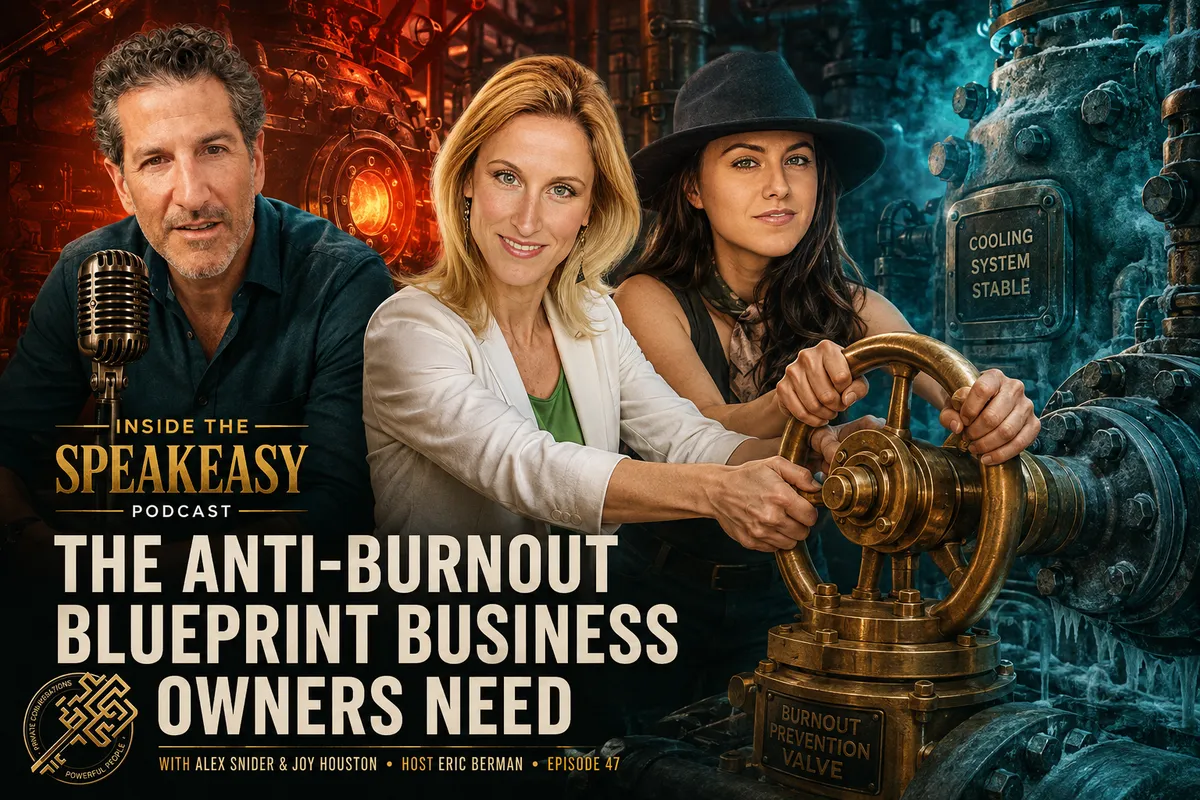
Burnout rarely starts with too much work. For Joy Houston, co-founder of Heal at Scale, it started the day a campaign that added close to a million dollars to a client's bottom line was stepped over with a quick "what's next." This compilation episode pulls two conversations from the Speakeasy vault about scaling a business without burning out the people running it. Joy explains how that moment, a hormone story from a campaign interview, and a tearful talk with her own doctor pushed her to make her marketing knowledge available to hometown health practitioners, and why she now takes the last week of every month off from delivery. Alex Snider, founder of Leaders Who Build, separates real delegation from abdication and shows how founders can turn what they know into documented processes. Together, the two clips offer a practical look at protecting energy, team capacity, and the business itself as it grows.
In this episode, you'll discover:
- Why Alex Snider says handing someone a task and setting them free is abdication, not delegation, and what she believes it costs new hires
- How documenting what you own into SOPs creates scale plus operational security and redundancy when a team member leaves
- The Thrive Week model Joy Houston rolled out a day at a time until her programs stopped delivering the entire last week of each month
- How a near-million-dollar win with no celebration led Joy Houston to bring her marketing knowledge to hometown health practitioners
Episode Summary
This special vault edition of the Speakeasy Podcast takes on a problem the announcer calls the silent killer of growth: burnout. Rather than a single interview, the episode stitches together clips from two earlier conversations with host Eric Berman. Joy Houston, co-founder of Heal at Scale, speaks to the personal side of burnout and how she designs time off into her business. Alex Snider, founder of Leaders Who Build, speaks to the operational side, explaining how founders can delegate in a way that actually transfers ownership instead of creating new fires.
Joy's story begins with a campaign she worked on for a highly regarded wellness professional, whom she chooses not to name. The campaign had just come off a win that she says added close to a million dollars to the bottom line, yet the post-campaign review she expected never really happened. Instead of taking five minutes to celebrate, extract lessons, and improve systems, the team moved straight to what was next. Joy describes it as feeling like a lack of gratitude and a lack of care about whether the team enjoyed the process, and it left her asking when anything is ever enough.
Two other experiences followed. While interviewing women for Dr. Sara Gottfried's Hormone Reset Diet campaign, Joy recognized her own symptoms in one woman's story, and on Sara's advice she found a local functional medicine doctor who helped her quickly. At a follow-up visit, that doctor broke down and told Joy she was great at her work but did not know how to get customers in the door. Joy says those moments together convinced her to democratize her marketing and health business knowledge for hometown health practitioners. With her husband Travis's support, it started as a test, and Joy says it grew into an offer of more than a million dollars. She contrasts clients who shrug off a few hundred thousand dollars in added revenue with practitioners who send flowers and cry happy tears over an extra 50 grand.
Alex's clip turns to delegation. She describes a spectrum where founders tend to live at the extremes: holding onto everything and micromanaging on one end, and abdication on the other. Handing someone a responsibility and walking away, she says, is not delegation. Her alternative is to taper off responsibility and use SOPs, where the person taking over captures the owner's process in copious notes and turns it into a document. Alex says this builds a repeatable process for the current team and future hires, supports scale, and creates operational security and redundancy so knowledge does not walk out the door when someone leaves.
The episode closes with Joy's Thrive Week, which she credits to Nick Peterson's book Bumpers and to Facebook ads expert Laurel Portie. Joy's programs deliver fulfillment in weeks one through three and pause during the last week of the month, sometimes two weeks when the month runs long. Members told her the gap lets them catch up, implement, and avoid feeling they are wasting their investment, while Joy and Travis use the time for vacations, product filming, or book writing. Across both clips, the message is that sustainable scale depends on systems that protect people, whether that means documenting knowledge before delegating or scheduling recovery before burnout arrives.
Big Ideas Discussed
Abdication Is Not Delegation, and New Hires Pay the Price
Alex Snider argues that most delegation problems come from living at one of two extremes. On one end, founders hold onto everything, micromanage, or never delegate at all. On the other end is abdication: giving someone a task or a responsibility and then setting them free with no training or structure. Alex is clear that this second pattern is not delegation, even though it can feel like letting go.
She draws on her own career to make the point. In every job she took, she says, she came in, fought fires, and had to figure things out on her own. It worked, but she calls it suboptimal and believes she would have performed better in her first three to six months if someone had actually trained her. Eric Berman adds that A players can figure it out, but having one on the team is luck. For founders, the takeaway is that true delegation means matching the work to a person's capabilities and tapering responsibility over, rather than relying on talented hires to survive an abrupt handoff.
SOPs Turn Founder Knowledge Into Operational Security
Alex Snider's practical tool for delegation is the standard operating procedure. When a founder owns a task and is handing it off or bringing in people to do it, she recommends that the incoming person take copious notes while the founder walks them through how it is done. The founder effectively dumps their brain into the new person, who then structures it into a document that both they and anyone new entering the organization can follow.
Alex notes an exception: when you bring in experts, you may want them to do the work the way it should be done, and you may not care how the sausage is made. But when the founder wants things done a specific way, repeatedly, a clear process and supporting systems are essential. She ties this directly to growth, saying processes are important for scale and for operational security and redundancy. If someone leaves, they do not take all of that knowledge with them, and the business is not left unable to run that part of its operations.
Thrive Week Builds Recovery Into the Business Calendar
Joy Houston's answer to burnout is structural rather than motivational. Her mastermind and group programs deliver fulfillment in weeks one, two, and three of each month and deliver nothing in the last week, or the last two weeks when a month has five. She credits the idea to Nick Peterson's book Bumpers and to Laurel Portie, who did not show up during the last week of the month and framed it as time for clients to go do what she had taught them.
Joy admits she was scared her community would quit, so she phased it in by first taking off the last Friday, then Thursday, then Wednesday, until the whole week was free. She says members love it because the business shares so many tactics that it can feel like a fire hose, and the gap lets them implement instead of feeling they are wasting their investment. Joy and her husband Travis plan their vacations, product filming, and book writing around those weeks, which she says is how they stay passionate about serving their people.
Questions We Answer in This Episode
What is the difference between delegation and abdication according to Alex Snider?
Alex Snider says abdication is giving someone a task or responsibility and then setting them free, while delegation involves understanding the person's capabilities and tapering responsibility over with structure. She describes founders living at two extremes, micromanaging or not delegating on one side and abdication on the other. From her own experience firefighting in new jobs, Alex believes people perform better in their first three to six months when someone actually trains them.
How do SOPs help a growing business with operational security?
Alex Snider says SOPs capture how a founder wants work done so it can be repeated by current team members and anyone new entering the organization. Her method is to have the person taking over take copious notes while the founder walks through the process, then structure those notes into a document. She says this supports scale and gives the business operational security and redundancy, because knowledge does not leave when someone leaves.
What is Joy Houston's Thrive Week and how does it work?
Thrive Week is Joy Houston's practice of pausing delivery in the last week of every month across her mastermind and group programs, or the last two weeks when a month has five weeks. Fulfillment happens in weeks one through three, and members use the gap to implement and catch up. Joy credits the idea to Nick Peterson's book Bumpers and to Facebook ads expert Laurel Portie.
How can a business owner introduce scheduled time off without losing clients?
Joy Houston introduced Thrive Week gradually because she worried her community would quit. She started by taking off the last Friday of the month, then Thursday, then Wednesday, until the entire last week was free of delivery. According to Joy, members ended up loving it, saying the gap helps them feel they are not wasting their investment because they always have time to catch up and implement.
What experience pushed Joy Houston to serve hometown health practitioners?
Joy Houston says several moments came together. A wellness campaign that added close to a million dollars to a client's bottom line was followed by little celebration or reflection. Around the same time, a functional medicine doctor who had helped Joy told her she was great at her work but did not know how to get customers in the door. Joy says this convinced her to democratize her marketing and health business knowledge for hometown practitioners.
Full Episode Transcript
Read the Full Episode Transcript
Cold Open: Processes, Scale, and Operational Security
Alex Snider: When you own something and then you're either handing it off or bringing in people to do it, you are creating a very clear process and potentially systems and other things for things to be done in the way you want them repeatedly, and not only for those people but for anyone new entering the organization. And so processes are also really important for scale and also really important for operational security and redundancy, that if somebody leaves, they don't leave with all that knowledge, and now we don't know how to do that part of the business.
Announcer: Today, on a special Speakeasy Podcast edition, we're going back to the vault to tackle the challenge every ambitious founder eventually faces, the silent killer of growth: burnout. We pulled the two most impactful discussions on scaling without losing your sanity. You'll hear from Joy Houston on the pivotal moment she realized success wasn't enough if it cost her her health, and also Alex Snider on the critical difference between true delegation and just abdication. Whether you're feeling the weight of the grind or you're preparing to scale your team, this is your blueprint for building a business that thrives while you do the same. Let's head inside the Speakeasy.
Joy Houston on Burnout After a Near-Million-Dollar Win
Eric Berman: Was there a moment that you were sort of burnt out? Like, you know, you help a lot of professionals break from the burnout they have. Like, were you burnt out and you found something? Like, how did you get to that point yourself?
Joy Houston: Yes, yes, yes. I won't mention any names, but I was working for a very highly regarded wellness professional. And as, you know, being a part of their marketing adventures, I remember that we had just come off a win that was damn near adding a million dollars to the bottom line. And at the post, you know, I feel like there needs to be, you know, after the campaign was done, you know, everybody meets: okay, what did we like doing? What do we not like doing? What can we take into the next campaign before you sort of get on the next mission? And the whole sort of assessment of what had happened in the campaign and the success that we had created was damn near stepped over. And like, what are we doing next kind of vibes, you know. And I immediately had this sense of like, oh my gosh, you know, like, it almost felt a little bit like, when is it ever enough? You know what I mean? Can we take at least five minutes and like celebrate the win and take the extractions and learn so that we're always improving our systems and the team is really enjoying the process? And there was something in that moment about the, I mean, it felt honestly like a little bit of a lack of gratitude, a little bit of caring that the team enjoyed the process of making a win at that level for the brand. And that was the time that I just kind of went home and was like, wait a second, like, all of what I'm doing, you know, is accessible for way more people than just these really big name clients with big budgets.
A Hormone Story and a Doctor Who Couldn't Get Customers
Joy Houston: And as the universe would have it, right, because we always get these interesting signs and interesting things that are happening, I was helping another one of my clients, Dr. Sara Gottfried, with the Hormone Reset Diet campaign, right? And I had been interviewing all these people who Sara had gotten amazing results for. And one of the women was talking about her hormone disruption. And she said to me, "Joy, I feel like I need to wear one of those white jackets that tie in the back because the emotions that I'm having don't feel like my own. Like, I logically know that thing that happened," let's say between her and her husband, "was like a one. I should have reacted on a scale of one out of 10, but I reacted like a 15. And I know that's not me." And as she's telling me the story, I'm thinking to myself, oh my God, that is how I feel some days. And other things she was sharing, like her eyebrows slowly disappearing on the outside, all of these things that she was saying, I was like, that's me. And so I talked to Sara and she was like, you need to get a functional medicine doctor locally. So I did. And by the way, it was not Sara who I had this problem with. Sara's amazing to work with. So I found a local doctor and she helped me with my hormones. She turned it around really quickly. And at my follow-up appointment, I could tell she just looked bad. She was like, bags under her eyes. She looked like she was gonna cry. And that's when I asked her, like, "Hey girl, like, I feel like you saved my life, my marriage, my sanity. Like, do you mind if I ask you, is everything cool?" You know, and, you know, like many of us women will do, if we're holding it all together and someone says, what's going on, then you start crying, right? So like the waterworks started happening. And she shared with me, like, "Man, I'm so good at what I do. I know that I'm so good at what I do. I'm born to do this, but I don't know how the hell to get customers in the door. I don't know how to help more people."
Democratizing Marketing for Hometown Health Practitioners
Joy Houston: And it was on that day that meeting went awry, and I just felt shitty about what was going on with one of my high-end one-on-one clients. And so it was like those two things happening at the same time made me say, I need to democratize access to the knowledge that I have for marketing and health business strategy. And I need to make it available to all of the hometown health practitioners just like her, you know, and I need to make this available to everybody. And that's when I came home to Travis and I said, "Hey, I want to change the game. Let's do something different." And he's like, "Babe, if you believe you need to do that, let's do it, and let's give it a go, and let's see if hometown health heroes everywhere are even willing to do that kind of work." And it started, honestly, Eric, as a test. Like, let's just see, let's just play and see if providing that to more practitioners would be of interest. And then it was. And you know, as soon as we got that to be over a million dollar offer, we were like, let's go, you know, let's make this available to everybody.
Eric Berman: Of course, obviously in this case, that whole seed in the back is now, the level of appreciation is at a whole different level now. Now it's just like, wow.
Joy Houston: Yeah, because you have some people, like, you could add 100, 200, 300,000 with a little marketing initiative and they're, okay, what's next? You know, as compared to you get an extra 50 grand into a hometown health practitioner's office that's been struggling, you are getting flowers and text messages. And you know what, I'm like, they're crying. They're literally crying happy tears, not because they're sad, but they're like, I never thought this would happen for me kind of vibes. And when you have a whole community of people like that, like, of course, like, I jump out of bed to serve them every morning because it makes my heart, like, I love to do that. I love it.
Alex Snider on Delegation Versus Abdication and SOPs
Announcer: Welcome to Inside the Speakeasy Podcast, the private room where today's sharpest founders, innovators, and renegade thinkers come to trade the ideas that move industries. This show is brought to you by HighLevel, the AI-driven business operating system trusted by over 2 million businesses to help automate, scale, and create real leverage. HighLevel isn't just a tool. It's the engine behind some of the most agile and high-performing teams on the planet. If you're ready to streamline everything, amplify your reach, and actually build a business that works for you, you're in the right place. Visit www.GoHighLevel.com/Speakeasy-Mastermind-Promo to get an exclusive 30-day trial for being a listener of the Inside the Speakeasy podcast. Enjoy the show.
Eric Berman: You know, what's something that, would you say, a lot of people that you work with get wrong about the delegation or trust of things?
Alex Snider: Yeah, I think there's a spectrum that people tend to live in the extremes. And the first one being just holding onto everything and micromanaging or not delegating. And the other extreme is abdication. And abdication is not delegation. Just giving someone a task and/or a responsibility or whatever and then setting them free isn't delegation, that's abdication. That's, you know, this is now your job. Bye. Every job I ever got, I came in and firefought and had to figure it out, and like, fair enough, fine. But it's suboptimal. I'm sure I would have performed better in the first three to six months if someone had actually been able to train me.
Eric Berman: And there's the A players that figure it out, but I mean, that was luck that they had you on the team. Yeah.
Alex Snider: Yeah, so understanding what delegation is, understanding, like, the way to match, you know, people's capabilities and delegation, and then how you delegate. It's just basically like tapering off, right? But if you either don't instinctually know how to break something down, or don't go and find, like, a brief or structure that you can use to create this, like, repeatable, this is how we delegate, and things like that. And we spoke about earlier SOPs. That's a great way, right? When you own something and then you're either handing it off or bringing in people to do it, you have them take copious notes while you walk them through how you do it, and you dump your brain into them, and then they structure it, and then it becomes a document that not only they follow to do it the way you want it. And if you bring experts, you may want them to do it the way it should be done, and you don't really care how the sausage is made, that's fine. But in this case, you are creating a very clear process and potentially systems and other things for things to be done in the way you want them repeatedly. And not only for those people, but for anyone new entering the organization. And so processes are also really important for scale and also really important for operational security and redundancy, that if somebody leaves, they don't leave with all that knowledge. And now we don't know how to do that part of the business.
Joy Houston's Thrive Week and Strategic Time Off
Eric Berman: So tell us about Thrive Week and why you love it, and share, share.
Joy Houston: Yeah, totally. Okay. So first of all, credit where credit is due. This comes from Nick Peterson, who wrote a book called Bumpers. You can get it on Amazon if you want to find it. It's a tiny little book, but I'll give you the nutshell about it. I found out about this process. I mentioned Laurel Portie, who is amazing in the Facebook ad space, especially if you want to learn how to run your own ads when you're getting started. So I was working with her, and she had this last week of the month where she just didn't show up. There were no calls, no nothing. And I was like, oh, this is really interesting. And she set it up as, well, this is your time to go do what I taught you to do. Like, okay, I can only teach you so much; if you don't implement, then you're not gonna get the results anyway. So it was queued up in a way that I was like, oh, that's really genius. And I was scared shitless, but I was determined to try it with our community. Like, are they gonna have a heart attack? Is everybody gonna quit? Are they all gonna leave? You know what I mean? And so we implemented it slowly. So we started, like, you know, there's so many weeks in a month, we started by taking off the last Friday, then Thursday, then Wednesday, and before you know it, the whole last week of the month we do not deliver. So we deliver fulfillment in our mastermind and any of our group programs, we deliver week one, two, and three, and then the last week, sometimes there's five weeks in a month, so sometimes it's two weeks off at the end of the month, we do not deliver. They go, they implement, and they love it. Okay? Not only do they feel like they get stuff done and get caught up, so they never waste their investment in us, because it's a fire hose of good information around here, because we're keeping people like, okay, this ad's firing on all cylinders, this process is, oh, we just did this with our EAs. We're constantly giving them all the nuggets that we find in our business, in our private client businesses. So it can be like a fire hose. So that time off, they reported back to me, "That gap gives me the time to feel like I'm not wasting my investment in being in this community, because I always have a little bit of time to catch up and implement. And if I didn't have that, I would feel bowled over by everything that you give me, and I would feel like I was wasting too much of it." So those last week or two weeks of the month, that's when Travis and I take our vacations. That's when we sometimes, like, if we need to film a new product or if I need to write another book or whatever, like, we take that time. We see it in the whole calendar year; we know exactly when it's coming. And that's how we stay really passionate about what we do. We don't want to burn ourselves out so bad that we don't love working for our people.
Announcer: You just heard from Joy Houston and Alex Snider. If you want to dive deeper into their full stories, we've linked both original episodes in the show notes. And that's a wrap from the Speakeasy Podcast. If something sparked for you, don't keep it to yourself. Share it, review it, and pass it to the one person who needs to hear this right now. Want in on the real mastermind? Tap the link in the show notes to apply. Until next time, keep scaling, stay sharp, and don't be the smartest one in the room.

About The Guest
Joy Houston and Alex Snider
Joy Houston is the co-founder of Heal at Scale, which she runs with her husband, Travis Houston, to help health and wellness practitioners scale beyond one-on-one work with marketing systems, group programs, and AI-powered processes. She previously ran a broader marketing agency, worked on campaigns including Dr. Sara Gottfried's Hormone Reset Diet campaign, has helped more than 1,700 business owners and practitioners scale their businesses, and is the author of Get Cash Pay Clients. Alex Snider is a strategic growth architect and the founder of Leaders Who Build, where she helps CEOs, founders, and executives move from managing chaos to leading with clarity through planning, delegation, and team development. She built her career in strategy consulting and M&A advisory, then partnered into one startup and co-founded another, helping one company triple in 10 months during the pandemic before its exit in April 2021. Alex is a member of the Speakeasy Mastermind Playa del Carmen chapter.
Joy Houston LinkedIn Joy Houston Instagram Heal at Scale YouTube Alex Snider Website Alex Snider LinkedIn Joy Houston's full episode Alex Snider's full episode